

EN 14134:2019
(Main)Ventilation for buildings - Performance measurement and checks for residential ventilation systems
General Information
- Abstract
This document specifies checks and measurement methods in order to verify the fitness for purpose of installed ventilation systems in dwellings. It can be applied to commissioning of new systems and performance testing of existing systems. It provides choice between simple test methods, when sufficient, and extensive measurements, when necessary.
Considering that this document has been developed for large scale application and considering the practical conditions of field measurements, no correction regarding ambient conditions (temperature and barometric pressure) is applied to functional measurements.
This document deals with items d), e), f), and g) of the following list giving the different stages of the design, installation, checking and measuring of a ventilation system:
a) design and dimensioning of residential system;
b) installation of system;
c) balancing and adjustment of system;
d) pre-checks on system;
e) functional checks on system;
f) functional measurements on system;
g) special measurements on system if required.
This document applies to ventilation systems (mechanical, hybrid, natural) comprising any of the following elements:
- air terminal devices (supply, extract, intake and exhaust);
- air transfer devices (externally mounted, internally mounted);
- controls;
- ducts;
- fans;
- filters;
- heat recovery;
- heating/cooling of supply air;
- recirculation air;
- cooker hood;
- cowls;
- dampers;
- sound reduction devices.
In case of multi-functional units, the checking and measuring only apply to the ventilation part. Therefore, this document does not apply to:
- heating systems and their control;
- refrigerating systems and their control;
- electrical power supply systems.
It does not cover the following points:
- airtightness of the building envelope; the whole dwelling and the individual room ventilation rates can be influenced by air infiltration through the building envelope (see EN ISO 9972);
- effect of the ventilation system on indoor air speed within the occupied zone (see for example EN 15726).
- Status
- Published
- Publication Date
- 26-Feb-2019
- Withdrawal Date
- 30-Aug-2019
- Technical Committee
- CEN/TC 156 - Ventilation for buildings
- Drafting Committee
- CEN/TC 156/WG 2 - Natural and mechanical powered residential ventilation
- Current Stage
- 9093 - Decision to confirm - Review Enquiry
- Start Date
- 27-Nov-2024
- Completion Date
- 30-Sep-2026



Overview
EN 14134:2019 - "Ventilation for buildings - Performance measurement and checks for residential ventilation systems" (CEN) defines practical on‑site checks and measurement methods to verify the fitness‑for‑purpose of installed residential ventilation systems. Intended for large‑scale field use, it supports commissioning of new systems and performance testing of existing systems across mechanical, hybrid and natural ventilation installations. The standard emphasizes practical, scalable procedures (simple tests where sufficient, more extensive measurements when necessary) and specifies that no correction for ambient conditions (temperature, barometric pressure) is applied to functional measurements.
Key Topics
- Scope and applicability: Covers the ventilation part of systems including air terminal devices, ducts, fans, filters, heat recovery, controls, dampers, sound reduction, cooker hoods and recirculation air. Excludes heating, refrigeration and electrical power supply systems.
- Stages addressed: Focuses on stages d–g of the lifecycle - pre‑checks, functional checks, functional measurements, and special measurements - rather than design, installation or balancing.
- Measurement procedures: Describes on‑site methods for air flow rate and direction, static pressure, running time, and specialized tests (ductwork leakage, sound pressure level, electrical power).
- Sampling and scalability: Provides sampling strategies suitable for large‑scale application and field conditions, allowing selection between simple and extensive methods.
- Practical constraints: No ambient corrections applied; requirements account for field measurement conditions and equipment uncertainty. Includes checklists and reporting templates to standardize results.
- Reporting: Specifies content for test reports including pre‑check documentation, functional checklists, measurement results and any special measurement outcomes.
Applications
- Commissioning and acceptance testing of residential ventilation systems.
- Performance verification during maintenance, retrofits, or building handover.
- Quality assurance for HVAC contractors, test‑and‑balance technicians and commissioning agents.
- Compliance checks by building inspectors, facility managers and social housing authorities.
- Product/installation verification for manufacturers and installers of multi‑functional units (ventilation portion only).
Who should use it
- HVAC engineers and designers
- Commissioning and testing professionals
- Installers and maintenance teams
- Building owners, facility managers and regulators
- Manufacturers of ventilation equipment
Related Standards
- EN ISO 9972 (building airtightness / blower door)
- EN 15726 (indoor air speed considerations)
- EN 1507, EN 12237 (ductwork strength and leakage)
- EN 12792 (terminology and symbols)
- EN ISO 16032 (sound pressure measurement from service equipment)
EN 14134:2019 is a practical, field‑oriented standard for ensuring residential ventilation systems perform as intended - useful for anyone responsible for commissioning, testing or maintaining healthy, efficient ventilation in dwellings.
Relations
- Effective Date
- 07-Oct-2015
- Effective Date
- 28-Jan-2026
- Effective Date
- 28-Jan-2026
- Effective Date
- 28-Jan-2026
- Effective Date
- 28-Jan-2026
- Effective Date
- 28-Jan-2026
- Effective Date
- 28-Jan-2026
Get Certified
Connect with accredited certification bodies for this standard

DIBt (Deutsches Institut für Bautechnik)
German Institute for Building Technology.
DIN CERTCO
DIN Group product certification.

Aboma Certification B.V.
Specialized in construction, metal, and transport sectors.
Sponsored listings
Frequently Asked Questions
EN 14134:2019 is a standard published by the European Committee for Standardization (CEN). Its full title is "Ventilation for buildings - Performance measurement and checks for residential ventilation systems". This standard covers: This document specifies checks and measurement methods in order to verify the fitness for purpose of installed ventilation systems in dwellings. It can be applied to commissioning of new systems and performance testing of existing systems. It provides choice between simple test methods, when sufficient, and extensive measurements, when necessary. Considering that this document has been developed for large scale application and considering the practical conditions of field measurements, no correction regarding ambient conditions (temperature and barometric pressure) is applied to functional measurements. This document deals with items d), e), f), and g) of the following list giving the different stages of the design, installation, checking and measuring of a ventilation system: a) design and dimensioning of residential system; b) installation of system; c) balancing and adjustment of system; d) pre-checks on system; e) functional checks on system; f) functional measurements on system; g) special measurements on system if required. This document applies to ventilation systems (mechanical, hybrid, natural) comprising any of the following elements: - air terminal devices (supply, extract, intake and exhaust); - air transfer devices (externally mounted, internally mounted); - controls; - ducts; - fans; - filters; - heat recovery; - heating/cooling of supply air; - recirculation air; - cooker hood; - cowls; - dampers; - sound reduction devices. In case of multi-functional units, the checking and measuring only apply to the ventilation part. Therefore, this document does not apply to: - heating systems and their control; - refrigerating systems and their control; - electrical power supply systems. It does not cover the following points: - airtightness of the building envelope; the whole dwelling and the individual room ventilation rates can be influenced by air infiltration through the building envelope (see EN ISO 9972); - effect of the ventilation system on indoor air speed within the occupied zone (see for example EN 15726).
This document specifies checks and measurement methods in order to verify the fitness for purpose of installed ventilation systems in dwellings. It can be applied to commissioning of new systems and performance testing of existing systems. It provides choice between simple test methods, when sufficient, and extensive measurements, when necessary. Considering that this document has been developed for large scale application and considering the practical conditions of field measurements, no correction regarding ambient conditions (temperature and barometric pressure) is applied to functional measurements. This document deals with items d), e), f), and g) of the following list giving the different stages of the design, installation, checking and measuring of a ventilation system: a) design and dimensioning of residential system; b) installation of system; c) balancing and adjustment of system; d) pre-checks on system; e) functional checks on system; f) functional measurements on system; g) special measurements on system if required. This document applies to ventilation systems (mechanical, hybrid, natural) comprising any of the following elements: - air terminal devices (supply, extract, intake and exhaust); - air transfer devices (externally mounted, internally mounted); - controls; - ducts; - fans; - filters; - heat recovery; - heating/cooling of supply air; - recirculation air; - cooker hood; - cowls; - dampers; - sound reduction devices. In case of multi-functional units, the checking and measuring only apply to the ventilation part. Therefore, this document does not apply to: - heating systems and their control; - refrigerating systems and their control; - electrical power supply systems. It does not cover the following points: - airtightness of the building envelope; the whole dwelling and the individual room ventilation rates can be influenced by air infiltration through the building envelope (see EN ISO 9972); - effect of the ventilation system on indoor air speed within the occupied zone (see for example EN 15726).
EN 14134:2019 is classified under the following ICS (International Classification for Standards) categories: 91.140.30 - Ventilation and air-conditioning systems. The ICS classification helps identify the subject area and facilitates finding related standards.
EN 14134:2019 has the following relationships with other standards: It is inter standard links to EN 14134:2004, EN 1507:2006, EN 12237:2003, EN ISO 16032:2024, EN 12792:2003, CEN/TR 14788:2006, EN 16798-17:2017. Understanding these relationships helps ensure you are using the most current and applicable version of the standard.
EN 14134:2019 is associated with the following European legislation: EU Directives/Regulations: 305/2011. When a standard is cited in the Official Journal of the European Union, products manufactured in conformity with it benefit from a presumption of conformity with the essential requirements of the corresponding EU directive or regulation.
EN 14134:2019 is available in PDF format for immediate download after purchase. The document can be added to your cart and obtained through the secure checkout process. Digital delivery ensures instant access to the complete standard document.
Standards Content (Sample)
SLOVENSKI STANDARD
01-julij-2019
Nadomešča:
SIST EN 14134:2004
Prezračevanje stavb - Preskušanje lastnosti in kontrola vgrajenih stanovanjskih
sistemov prezračevanja
Ventilation for buildings - Performance measurement and checks for residential
ventilation systems
Lüftung von Gebäuden - Leistungsprüfung und Einbaukontrollen von Lüftungsanlagen
von Wohnungen
Ventilation des bâtiments - Essais de performances et contrôles d'installation des
systèmes de ventilation résidentiels
Ta slovenski standard je istoveten z: EN 14134:2019
ICS:
91.140.30 Prezračevalni in klimatski Ventilation and air-
sistemi conditioning systems
2003-01.Slovenski inštitut za standardizacijo. Razmnoževanje celote ali delov tega standarda ni dovoljeno.
EN 14134
EUROPEAN STANDARD
NORME EUROPÉENNE
February 2019
EUROPÄISCHE NORM
ICS 91.140.30 Supersedes EN 14134:2004
English Version
Ventilation for buildings - Performance measurement and
checks for residential ventilation systems
Ventilation des bâtiments - Mesure de la performance Lüftung von Gebäuden - Leistungsprüfung und
et vérifications des systèmes de ventilation résidentiels Funktionsprüfungen von Lüftungsanlagen in
Wohnungen
This European Standard was approved by CEN on 14 December 2018.
CEN members are bound to comply with the CEN/CENELEC Internal Regulations which stipulate the conditions for giving this
European Standard the status of a national standard without any alteration. Up-to-date lists and bibliographical references
concerning such national standards may be obtained on application to the CEN-CENELEC Management Centre or to any CEN
member.
This European Standard exists in three official versions (English, French, German). A version in any other language made by
translation under the responsibility of a CEN member into its own language and notified to the CEN-CENELEC Management
Centre has the same status as the official versions.
CEN members are the national standards bodies of Austria, Belgium, Bulgaria, Croatia, Cyprus, Czech Republic, Denmark, Estonia,
Finland, Former Yugoslav Republic of Macedonia, France, Germany, Greece, Hungary, Iceland, Ireland, Italy, Latvia, Lithuania,
Luxembourg, Malta, Netherlands, Norway, Poland, Portugal, Romania, Serbia, Slovakia, Slovenia, Spain, Sweden, Switzerland,
Turkey and United Kingdom.
EUROPEAN COMMITTEE FOR STANDARDIZATION
COMITÉ EUROPÉEN DE NORMALISATION
EUROPÄISCHES KOMITEE FÜR NORMUNG
CEN-CENELEC Management Centre: Rue de la Science 23, B-1040 Brussels
© 2019 CEN All rights of exploitation in any form and by any means reserved Ref. No. EN 14134:2019 E
worldwide for CEN national Members.
Contents Page
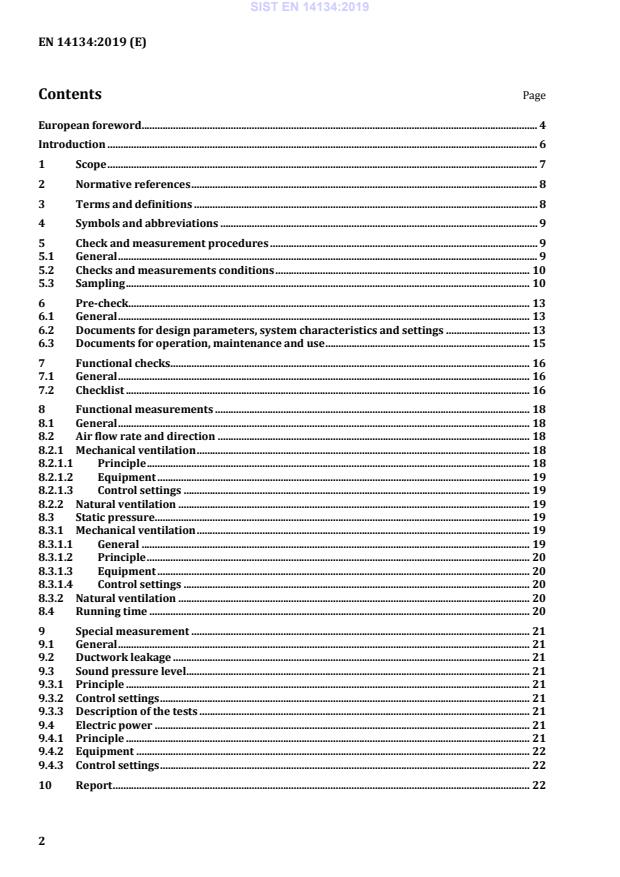
European foreword . 4
Introduction . 6
1 Scope . 7
2 Normative references . 8
3 Terms and definitions . 8
4 Symbols and abbreviations . 9
5 Check and measurement procedures . 9
5.1 General . 9
5.2 Checks and measurements conditions . 10
5.3 Sampling . 10
6 Pre-check. 13
6.1 General . 13
6.2 Documents for design parameters, system characteristics and settings . 13
6.3 Documents for operation, maintenance and use . 15
7 Functional checks . 16
7.1 General . 16
7.2 Checklist . 16
8 Functional measurements . 18
8.1 General . 18
8.2 Air flow rate and direction . 18
8.2.1 Mechanical ventilation . 18
8.2.1.1 Principle . 18
8.2.1.2 Equipment . 19
8.2.1.3 Control settings . 19
8.2.2 Natural ventilation . 19
8.3 Static pressure . 19
8.3.1 Mechanical ventilation . 19
8.3.1.1 General . 19
8.3.1.2 Principle . 20
8.3.1.3 Equipment . 20
8.3.1.4 Control settings . 20
8.3.2 Natural ventilation . 20
8.4 Running time . 20
9 Special measurement . 21
9.1 General . 21
9.2 Ductwork leakage . 21
9.3 Sound pressure level . 21
9.3.1 Principle . 21
9.3.2 Control settings . 21
9.3.3 Description of the tests . 21
9.4 Electric power . 21
9.4.1 Principle . 21
9.4.2 Equipment . 22
9.4.3 Control settings . 22
10 Report . 22
10.1 General . 22
10.2 General information . 22
10.3 Pre-check . 22
10.4 Functional checks . 22
10.5 Air flow measurement . 23
10.6 Static pressure measurement . 23
10.7 Running time measurement . 23
10.8 Ductwork leakage . 23
10.9 Sound pressure level . 24
10.10 Electric power . 24
Annex A (informative) Check lists . 25
Annex B (informative) Test pressures for air leakage measurement . 32
Bibliography . 33
European foreword
This document (EN 14134:2019) has been prepared by Technical Committee CEN/TC 156 “Ventilation
for buildings”, the secretariat of which is held by BSI.
This European Standard shall be given the status of a national standard, either by publication of an
identical text or by endorsement, at the latest by August 2019, and conflicting national standards shall be
withdrawn at the latest by August 2019.
Attention is drawn to the possibility that some of the elements of this document may be the subject of
patent rights. CEN shall not be held responsible for identifying any or all such patent rights.
This document supersedes EN 14134:2004.
In comparison to EN 14134:2004 the following changes have been made:
— modification of the title to be in accordance with terms defined in this document;
— modification of the scope to delete identification of responsible people;
— modification of the scope to define the on-site and large scale use of this document;
— modification of the definitions to complete them;
— addition of preliminary requirements for the application of this document;
— modification of methods to delete steps order;
— modification of sampling method to be applicable to all checks and measurement defined in this
document;
— modification of sampling method to explain the different levels;
— modification of pre-check and functional check methods to be more exhaustive and more detailed;
— additional pre-check for Ecodesign requirements and product labelling;
— addition of requirements for equipment uncertainties;
— removal of requirement for global measurement uncertainties;
— modification of methods for air flow measurement and for ductwork air leakage measurement to be
consistent with existing European standards;
— removal of method for control measurement to be consistent with on-site measurement conditions;
— modification of method for noise measurement;
— replacement of Annex A to give example of checklists;
— replacement of Annex B to give example of test pressures;
— removal of Annex C.
According to the CEN-CENELEC Internal Regulations, the national standards organisations of the
following countries are bound to implement this European Standard: Austria, Belgium, Bulgaria, Croatia,
Cyprus, Czech Republic, Denmark, Estonia, Finland, Former Yugoslav Republic of Macedonia, France,
Germany, Greece, Hungary, Iceland, Ireland, Italy, Latvia, Lithuania, Luxembourg, Malta, Netherlands,
Norway, Poland, Portugal, Romania, Serbia, Slovakia, Slovenia, Spain, Sweden, Switzerland, Turkey and
the United Kingdom.
Introduction
The purpose of a residential ventilation system is to supply air to and extract air from rooms in a dwelling.
The ventilation system should be designed to achieve the purpose whilst minimizing energy use and
possible discomfort (e.g. noise, draught).
The performance requirements of the ventilation system are laid down by the designer in the dwelling
specifications.
1 Scope
This document specifies checks and measurement methods in order to verify the fitness for purpose of
installed ventilation systems in dwellings. It can be applied to commissioning of new systems and
performance testing of existing systems. It provides choice between simple test methods, when sufficient,
and extensive measurements, when necessary.
Considering that this document has been developed for large scale application and considering the
practical conditions of field measurements, no correction regarding ambient conditions (temperature
and barometric pressure) is applied to functional measurements.
This document deals with items d), e), f), and g) of the following list giving the different stages of the
design, installation, checking and measuring of a ventilation system:
a) design and dimensioning of residential system;
b) installation of system;
c) balancing and adjustment of system;
d) pre-checks on system;
e) functional checks on system;
f) functional measurements on system;
g) special measurements on system if required.
This document applies to ventilation systems (mechanical, hybrid, natural) comprising any of the
following elements:
— air terminal devices (supply, extract, intake and exhaust);
— air transfer devices (externally mounted, internally mounted);
— controls;
— ducts;
— fans;
— filters;
— heat recovery;
— heating/cooling of supply air;
— recirculation air;
— cooker hood;
— cowls;
— dampers;
— sound reduction devices.
In case of multi-functional units, the checking and measuring only apply to the ventilation part. Therefore,
this document does not apply to:
— heating systems and their control;
— refrigerating systems and their control;
— electrical power supply systems.
It does not cover the following points:
— airtightness of the building envelope; the whole dwelling and the individual room ventilation rates
can be influenced by air infiltration through the building envelope (see EN ISO 9972);
— effect of the ventilation system on indoor air speed within the occupied zone (see for example
EN 15726).
2 Normative references
The following documents are referred to in the text in such a way that some or all of their content
constitutes requirements of this document. For dated references, only the edition cited applies. For
undated references, the latest edition of the referenced document (including any amendments) applies.
EN 1507, Ventilation for buildings - Sheet metal air ducts with rectangular section - Requirements for
strength and leakage
EN 12237, Ventilation for buildings - Ductwork - Strength and leakage of circular sheet metal ducts
EN 12792, Ventilation for buildings - Symbols, terminology and graphical symbols
EN ISO 16032, Acoustics - Measurement of sound pressure level from service equipment in buildings -
Engineering method (ISO 16032)
3 Terms and definitions
For the purposes of this document, the terms and definitions given in EN 12792 and the following apply.
ISO and IEC maintain terminological databases for use in standardization at the following addresses:
• IEC Electropedia: available at http://www.electropedia.org/
• ISO Online browsing platform: available at http://www.iso.org/obp
3.1
check
observation of the operation of a system or devices, against a specification without resorting to specific
measurements
[SOURCE: EN 12792:2003; definition 193]
3.2
pre-check
verification of the documentation of a system or devices intended to be used during the check process
3.3
measurement
process of experimentally obtaining one or more quantity values that can reasonably be attributed to a
quantity
[SOURCE: JCGM 200:2012; definition 2.1, modified – Notes have been removed.]
3.4
run-on timer
device which ensures that air flow through a ventilation system or an air terminal device (ATD) continues
for a specific time period after a user operated control has been turned off
Note 1 to entry: Run-on-timers are commonly used to control extract fans which are activated by the room light
switch in internal rooms.
3.5
maximum permissible measurement error
extreme value of measurement error, with respect to a known reference quantity value, permitted by
specifications or regulations for a given measurement, measuring instrument, or measuring system
[SOURCE: JCGM 200:2012; definition 4.26, modified – Notes have been removed.]
3.6
housing estate
group of homes and other buildings built together as a single development
Note 1 to entry: The exact form can vary from country to country. A housing estate is usually built by a single
contractor, with only a few styles of houses or building design, so they tend to be uniform in appearance.
4 Symbols and abbreviations
For the purpose of this document, the symbols given in EN 12792 and the following (see Table 1) apply.
Table 1 — Symbols
Symbol Designation
e sampling error (decimal value)
L A-weighted installation sound pressure level
pA
n sample size
N total numbers of apartments or houses
SL1 Sampling level
5 Check and measurement procedures
5.1 General
This document includes procedures for:
— pre-check;
— functional checks;
— functional measurements;
— special measurements.
Checks and measurements to be performed shall be defined beforehand to meet the needs.
The installation work should be completed and the system should be adjusted before starting checks and
measurements.
Safe access to the ventilation system is required for on-site checks and measurement.
5.2 Checks and measurements conditions
Checks and measurements conditions are as follows:
— the mechanical ventilation system shall be switched on;
— the system settings shall remain unchanged during measurements;
— all external and internal doors, and windows shall be closed;
— all other ventilation provisions such as externally and internally mounted air transfer devices should
be set in their intended position which shall be recorded in the report;
— as set points of control devices have an impact on the performances of the system, they shall be
recorded in the report.
— in the case of occupancy control or demand control and as the value of the relevant parameters has
an impact on the performances of the system, these parameters or any overriding of the controls
should be recorded in the report.
5.3 Sampling
Checks and measurements for ventilation systems of the same type (example of types are natural
ventilation, unidirectional ventilation or bidirectional ventilation) within apartments belonging to the
same building or within houses belonging to the same housing estate can be performed on a sample of
these apartments or houses.
NOTE The basic assumption behind the authorization for sampling is that ventilation systems that belong to
such groups (same type and same building or same housing estate) and that are considered together for the purpose
of measurement and checks (for example because of same owner or same general contractor or same installer) have
enough similarities to make sampling relevant.
The sample size depends on the selected sampling level and the total number of apartments or houses of
the considered group. Table 2 gives the sampling error for each sampling level for a level of confidence
of 95 %. Table 3 gives the sample size as a function of the total number of apartments or houses for each
sampling level. For total numbers of apartments or houses that are not in Table 3, the sample size is
calculated using Formula (1).
Table 2 — Sampling error of sampling levels for a level of confidence of 95 %
Sampling level Sampling error
%
SL1 0
SL2 5
SL3 10
SL4 20
SL5 30
SL6 40
SL7 50
2 2
N⋅⋅1,96 0,5
(1)
n=
2 2 2
Ne-1 ⋅+ 1,96 ⋅ 0,5
( )
where
n is the sample size;
N is the total number of apartments or houses;
e is the sampling error (decimal value).
NOTE Details of the formula can be found in “Theory and problems of statistics” (confidence intervals for
proportions) by M.R. Spiegel edited by Schaum's Outlines (ISBN 0-07-060281–6).
By default, the sampling level is SL1. Different sampling levels may be selected for different types of
checks or measurements. Checks or measurements at the same sampling level shall be carried out within
the same sample.
EXAMPLE 1 Sampling level SL3 is chosen for flow measurements and pressure measurements. In this case these
two types of measurement are performed on the same sample.
Smaller samples shall only include apartments or houses from larger samples.
EXAMPLE 2 Sampling level SL3 is chosen for flow measurements and sampling level SL4 is chosen for acoustic
measurements. In this case the sample for acoustic measurements is chosen within the sample for flow
measurements.
Sampling is not applicable for checks and measurements within a single house or apartment.
EXAMPLE 3 An apartment with 10 air terminal devices is part of a sample for flow measurements. In this case,
all 10 air terminal devices are measured whatever the sampling level.
Table 3 — Sample size as a function of the total number of apartments or houses for each
sampling level
Sample size
Total number of
n
houses or
apartments
SL1 SL2 SL3 SL4 SL5 SL6 SL7
1 1 1 1 1 1 1 1
2 2 2 2 2 2 2 2
3 3 3 3 3 3 2 2
4 4 4 4 4 3 3 2
5 5 5 5 4 4 3 2
6 6 6 6 5 4 3 3
7 7 7 7 6 4 4 3
8 8 8 7 6 5 4 3
9 9 9 8 7 5 4 3
10 10 10 9 7 5 4 3
11 11 11 10 8 6 4 3
12 12 12 11 8 6 4 3
13 13 13 12 9 6 4 3
14 14 14 12 9 6 4 3
15 15 14 13 9 6 5 3
16 16 15 14 10 7 5 3
17 17 16 15 10 7 5 3
18 18 17 15 11 7 5 3
19 19 18 16 11 7 5 3
20 20 19 17 11 7 5 3
21 21 20 17 11 7 5 3
22 22 21 18 12 7 5 3
23 23 22 19 12 8 5 3
24 24 23 19 12 8 5 3
25 25 24 20 13 8 5 3
30 30 28 23 14 8 5 4
Sample size
Total number of
n
houses or
apartments
SL1 SL2 SL3 SL4 SL5 SL6 SL7
40 40 36 28 15 9 5 4
50 50 44 33 16 9 5 4
60 60 52 37 17 9 6 4
70 70 59 41 18 9 6 4
80 80 66 44 19 10 6 4
90 90 73 47 19 10 6 4
100 100 80 49 20 10 6 4
200 200 132 65 22 10 6 4
300 300 169 73 22 10 6 4
400 400 196 78 23 10 6 4
500 500 217 81 23 10 6 4
600 600 234 83 23 11 6 4
700 700 248 85 23 11 6 4
800 800 260 86 23 11 6 4
900 900 269 87 23 11 6 4
1000 1000 278 88 23 11 6 4
6 Pre-check
6.1 General
The aim of the pre-check is to collate and assess all relevant documentation relating to the building and
the installed ventilation systems with particular regard to:
— design parameters, system cha
...