

prEN 13611
(Main)Safety and control devices for burners and appliances burning gaseous fuels - General requirements
- Abstract
This document specifies the general safety, design, construction, and performance requirements and testing of safety, control or regulating devices (hereafter referred to as controls) for burners and appliances burning one or more gaseous fuels or liquid fuels.
This document is applicable to controls with declared maximum inlet pressure up to and including 500 kPa and of nominal connection sizes up to and including DN 250.
- Status
- Not Published
- Publication Date
- 09-Mar-2027
- Technical Committee
- CEN/TC 58 - Safety and control devices for burners and appliances burning gaseous or liquid fuels
- Drafting Committee
- CEN/TC 58/WG 11 - Generics
- Current Stage
- 4060 - Closure of enquiry - Enquiry
- Start Date
- 03-Sep-2026
- Due Date
- 18-Feb-2026
- Completion Date
- 03-Sep-2026

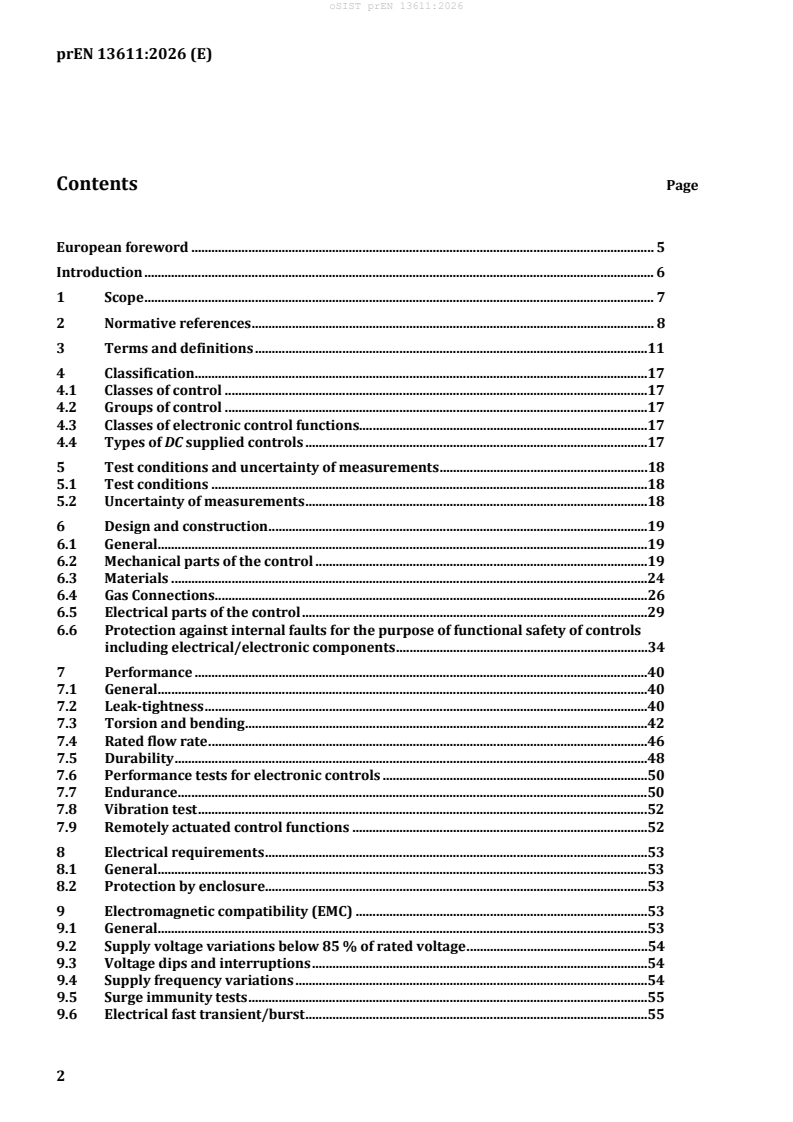
prEN 13611 is a CEN draft European Standard for safety and control devices for burners and appliances burning gaseous and/or liquid fuels. It specifies general safety, design, construction, performance and testing requirements for controls with declared maximum inlet pressure up to 500 kPa and nominal connection sizes up to diameter in nominal (DN) 250.
It is a horizontal document used with product-specific control standards, and it covers type testing only.
What does prEN 13611 specify?
prEN 13611 sets the general requirements for controls used in burners and appliances that burn one or more gaseous fuels or liquid fuels. It gives the common baseline for design, testing and marking so that product-specific standards can focus on the details of a given control type.
The scope includes:
- automatic shut-off valves
- automatic burner control systems
- flame supervision devices
- fuel/air ratio controls and supervision
- pressure regulators
- manual taps
- mechanical thermostats
- multifunctional controls
- pressure sensing devices
- valve proving systems
- automatic vent valves
The document applies to AC and DC supplied controls, including controls on stand-alone batteries, batteries in mobile applications, and DC supply networks. It also applies to reset functions used to recover from lock-out. It does not apply to mechanical controls for liquid fuels, and it does not cover environmental protection for open-air exposure.
The standard is organized into clauses 1 to 10 and these annexes:
| Annex | What it covers |
|---|---|
| A | Abbreviations and symbols |
| B | Leak-tightness tests for gas controls - volumetric method |
| C | Leak-tightness tests for gas controls - pressure loss method |
| D | Calculation of pressure loss into leakage rate |
| E | Electrical/electronic component fault modes |
| F | Requirements for controls used in DC supplied burners and appliances |
| G | Method for determining a Performance Level (PL) |
| H | Reset functions |
| I | Guidance on environmental aspects |
| J | Sealing materials of rubber-bonded cork and rubber-bonded cork with synthetic fibres for gas fittings and gas appliances |
| K | Leakage evaluations for different gaseous fuels |
| L | Essential cybersecurity requirements and a general security process model |
| ZA | Relationship with Regulation (EU) 2016/426 |
What are the key requirements of prEN 13611?
prEN 13611 is built around worst-case design and type testing. Controls have to work across the stated pressure, temperature, voltage and mounting ranges, and the standard then checks sealing, strength, electrical safety and fail-safe behavior under those conditions.
Operating conditions and classification
Clause 5 requires tests to be carried out with air at 20 °C ± 5 °C and at ambient temperature 20 °C ± 5 °C, with results corrected to standard conditions. Tests are done in the mounting position stated in the instructions, and the least favourable position is used when several positions are possible. In practice, that means a design has to survive the way it will actually be installed, not only an ideal lab setup.
Clause 4 classifies controls by bending stress and electronic function:
- Group 1 controls are for smaller connection sizes and limited bending stress
- Group 2 controls are for any situation and also meet Group 1 requirements
- Class A, B and C control functions separate non-safety functions from functions that prevent unsafe states or direct hazards
- DC supplied controls are split into Types A, B and C in Annex F
This matters because the test burden and safety expectations depend on how the control is used and how much safety responsibility it carries.
Design, construction and fault protection
Clause 6 requires controls to be designed so that the specified functions operate correctly as installed and used according to the instructions. Internal parts of mechanical controls and other controls must only be accessible with tools. Multifunctional systems must deliver the same overall safety level as separate controls, and failures in one function must not compromise safe operation of another.
The clause also covers mechanical parts, materials, gas connections and electrical parts. It includes breather holes, diaphragms, venting, screw fastenings, seals, setting devices, housing materials and corrosion resistance. For a buyer or engineer, this is the clause that shows whether the control is built for safe gas handling, not just for basic switching.
Clause 6.6 adds protection against internal faults for functional safety, including design rules for Class A, B and C functions and reset behavior. This is where the standard expects the manufacturer to think through fault reaction, lock-out and restart safety, not only normal operation.
Performance, leak-tightness and mechanical strength
Clause 7 checks that the control operates correctly across the stated inlet pressure range, ambient temperature range, mounting position and supply conditions. Leak-tightness is tested both externally and internally, with Annex B and Annex C giving example methods and Annex D giving the conversion from pressure loss to leakage rate.
Clause 7 also covers torsion and bending, rated flow rate, durability, scratch resistance, humidity resistance, lubricants in contact with gas, endurance and vibration. That means the control is not only checked for sealing, but also for connection loading, wear and repeated operation.
Electrical safety, EMC and marking
Clause 8 requires the electrical equipment to conform to selected clauses of EN IEC 60730-1:2024. It also sets enclosure protection at least IP 40 for controls with their own enclosure, or IP 54 for controls used outdoors, unless the appliance provides equivalent protection.
Clause 9 applies electromagnetic compatibility (EMC) to controls with electronic components. The control must either continue to meet the relevant requirements, react within the fault reaction time by going to safety shutdown or lock-out, or become inoperative with safety-related outputs in a safe state. The clause then tests supply voltage variations, voltage dips and interruptions, frequency variations, surge, fast transient, conducted and radiated RF disturbances, electrostatic discharge, magnetic fields, and harmonics and interharmonics.
Reset functions and performance level
Annex H treats the reset function as Class B. It requires a defined manual reset action, prevents unintended or spontaneous reset, and links remote reset to EN IEC 60730-1:2024. For an installation team, that means the reset path has to be just as controlled as the shutdown path.
Annex G gives a method to determine Performance Level (PL) for pneumatic, hydraulic, electromechanical and multifunctional controls that claim PL conformance. It also covers common cause failure (CCF), safe failure fraction (SFF), PFH and the relationship between PL and Safety Integrity Level (SIL). In practice, this annex is used when a control supplier needs a structured safety-performance claim rather than only a general design statement.
What terms does prEN 13611 define?
- control - a device that provides the functionality specified in the relevant specific control standard.
- control function - a function that provides safe operation of burners and appliances burning gaseous or liquid fuels.
- external leak-tightness - leak-tightness of a gas-carrying compartment with respect to atmosphere.
- internal leak-tightness - leak-tightness of the closure member in the closed position against another compartment or the outlet of the control.
- fault tolerating time - the time between a fault occurring and burner shutdown that the application can tolerate without creating a hazardous situation.
- lock-out - a safety-shutdown condition from which the system can be released only by reset.
- reset function - the function that releases the system from lock-out and allows a restart attempt.
- gaseous fuels - fuels including natural gas, LPG in gaseous state, biomethane, hydrogen, admixtures with natural gas and hydrogen, and other compatible synthetic or renewable gaseous fuels.
Who uses prEN 13611?
prEN 13611 is used by manufacturers of burner and appliance controls, product designers, test laboratories, certification teams and quality managers working on gas and liquid-fuel heating equipment. It is especially relevant when a product includes safety-related control functions such as shut-off, flame supervision, pressure regulation, venting or reset.
It is also used by teams responsible for compliance with CEN/TC 58 product standards, because those standards adapt prEN 13611 by adding, modifying or replacing clauses for specific control types.
What changed in prEN 13611 from the previous edition?
prEN 13611 will supersede EN 13611:2019. The foreword states these main changes compared with the previous edition:
- requirements belonging to pressure accessories were removed and will no longer be covered here
- aspects for use with hydrogen were added
- breather hole requirements were updated
- an informative cybersecurity annex was added
- normative references were updated
- terms and definitions were updated, including the addition of gaseous fuels
- the document was aligned with EN IEC 60730-1:2024
- the SIL annex was removed
- the PL annex was updated to align with EN ISO 13849-1:2023
Which standards are used with prEN 13611?
| Standard or series | What it contributes |
|---|---|
| EN IEC 60730-1:2024 | General electrical control requirements, enclosure and remote reset related provisions |
| EN ISO 13849-1:2023 | Performance Level method and the PL/SIL relationship in Annex G |
| EN 1127-1:2019 | Explosion prevention concepts for ignition source assessment |
| EN 60529:1991 | IP code for enclosure protection |
| EN 60068-2-6:2008 | Sinusoidal vibration testing |
| EN IEC 61558-2-4, -2-6, -2-16 | Safety requirements for transformers and power supply units |
| EN IEC 60384-14:2023 and EN IEC 60384-16:2019 | Capacitor types used in electronic equipment |
| EN 549:2019+A2:2024, ISO 37, ISO 815-1, ISO 1817, ISO 23529, ISO 8013 | Rubber and gasket material properties and test methods |
| EN 751-1, EN 751-2, EN 751-3; EN 10226-1, EN 10226-2; EN ISO 228-1; ISO 7-1; EN 1092 series; EN 1759 series | Threads, sealing materials and flanges for gas connections |
| EN 61643-11:2012, ISO 7637-2, ISO 7637-3 | Surge and transient disturbance related testing |
The introduction also names EN 14459 for classifying and assessing new control principles, and CEN/TR 17924 for hydrogen-specific guidance. Product-specific standards such as EN 88-1, EN 161 and EN 298 use this document as the general base and then add their own requirements.
What does the prEN 13611 document contain?
prEN 13611 contains structured requirement clauses, test conditions and annexes that support design verification and type testing. It includes tables for Group 2 connection sizes, torsion and bending moments, and the relationship between PL and SIL.
It also includes:
- Annex B and Annex C apparatus and procedures for leak-tightness testing
- Annex D formula for converting pressure loss into leakage rate
- Annex E fault mode tables for electrical and electronic components
- Annex G methods and tables for PL, CCF and PFH evaluation
- Annex H provisions and tests for reset functions
- Annex J test methods for rubber-bonded cork sealing materials
- Annex K leakage evaluation guidance for methane, propane, butane and hydrogen
- Annex L a cybersecurity process model and security requirements
- Annex ZA the link to Regulation (EU) 2016/426
Relations
- Effective Date
- 19-Feb-2025
Get Certified
Connect with accredited certification bodies for this standard

Institut za varilstvo d.o.o. (Welding Institute)
Slovenia's leading welding institute since 1952. ISO 3834, EN 1090, pressure equipment certification, NDT personnel, welder qualification. Only IIW Au
Sponsored listings
Frequently Asked Questions
prEN 13611 is a draft published by the European Committee for Standardization (CEN). Its full title is "Safety and control devices for burners and appliances burning gaseous fuels - General requirements". This standard covers: This document specifies the general safety, design, construction, and performance requirements and testing of safety, control or regulating devices (hereafter referred to as controls) for burners and appliances burning one or more gaseous fuels or liquid fuels. This document is applicable to controls with declared maximum inlet pressure up to and including 500 kPa and of nominal connection sizes up to and including DN 250.
This document specifies the general safety, design, construction, and performance requirements and testing of safety, control or regulating devices (hereafter referred to as controls) for burners and appliances burning one or more gaseous fuels or liquid fuels. This document is applicable to controls with declared maximum inlet pressure up to and including 500 kPa and of nominal connection sizes up to and including DN 250.
prEN 13611 is classified under the following ICS (International Classification for Standards) categories: 23.060.40 - Pressure regulators. The ICS classification helps identify the subject area and facilitates finding related standards.
prEN 13611 has the following relationships with other standards: It is inter standard links to EN 13611:2019. Understanding these relationships helps ensure you are using the most current and applicable version of the standard.
prEN 13611 is associated with the following European legislation: EU Directives/Regulations: 2016/426; Standardization Mandates: M/595. When a standard is cited in the Official Journal of the European Union, products manufactured in conformity with it benefit from a presumption of conformity with the essential requirements of the corresponding EU directive or regulation.
prEN 13611 is available in PDF format for immediate download after purchase. The document can be added to your cart and obtained through the secure checkout process. Digital delivery ensures instant access to the complete standard document.
Standards Content (Sample)
SLOVENSKI STANDARD
01-julij-2026
Varnostne in nadzorne naprave za gorilnike in aparate na plin in/ali tekoča goriva -
Splošne zahteve
Safety and control devices for burners and appliances burning gaseous and/or liquid
fuels - General requirements
Sicherheits- und Regeleinrichtungen für Brenner und Brennstoffgeräte für gasförmige
und/oder flüssige Brennstoffe - Allgemeine Anforderungen
Équipements auxiliaires pour brûleurs et appareils utilisant des combustibles gazeux ou
liquides - Exigences générales
Ta slovenski standard je istoveten z: prEN 13611
ICS:
23.060.40 Tlačni regulatorji Pressure regulators
27.060.20 Plinski gorilniki Gas fuel burners
2003-01.Slovenski inštitut za standardizacijo. Razmnoževanje celote ali delov tega standarda ni dovoljeno.
DRAFT
EUROPEAN STANDARD
NORME EUROPÉENNE
EUROPÄISCHE NORM
June 2026
ICS Will supersede EN 13611:2019
English Version
Safety and control devices for burners and appliances
burning gaseous and/or liquid fuels - General
requirements
Équipements auxiliaires pour brûleurs et appareils Sicherheits- und Regeleinrichtungen für Brenner und
utilisant des combustibles gazeux ou liquides - Brennstoffgeräte für gasförmige und/oder flüssige
Exigences générales Brennstoffe - Allgemeine Anforderungen
This draft European Standard is submitted to CEN members for enquiry. It has been drawn up by the Technical Committee
CEN/TC 58.
If this draft becomes a European Standard, CEN members are bound to comply with the CEN/CENELEC Internal Regulations
which stipulate the conditions for giving this European Standard the status of a national standard without any alteration.
This draft European Standard was established by CEN in three official versions (English, French, German). A version in any other
language made by translation under the responsibility of a CEN member into its own language and notified to the CEN-CENELEC
Management Centre has the same status as the official versions.
CEN members are the national standards bodies of Austria, Belgium, Bulgaria, Croatia, Cyprus, Czech Republic, Denmark, Estonia,
Finland, France, Germany, Greece, Hungary, Iceland, Ireland, Italy, Latvia, Lithuania, Luxembourg, Malta, Netherlands, Norway,
Poland, Portugal, Republic of North Macedonia, Romania, Serbia, Slovakia, Slovenia, Spain, Sweden, Switzerland, Türkiye and
United Kingdom.
Recipients of this draft are invited to submit, with their comments, notification of any relevant patent rights of which they are
aware and to provide supporting documentation.
Warning : This document is not a European Standard. It is distributed for review and comments. It is subject to change without
notice and shall not be referred to as a European Standard.
EUROPEAN COMMITTEE FOR STANDARDIZATION
COMITÉ EUROPÉEN DE NORMALISATION
EUROPÄISCHES KOMITEE FÜR NORMUNG
CEN-CENELEC Management Centre: Rue de la Science 23, B-1040 Brussels
© 2026 CEN All rights of exploitation in any form and by any means reserved Ref. No. prEN 13611:2026 E
worldwide for CEN national Members.
Contents Page
European foreword . 5
Introduction . 6
1 Scope . 7
2 Normative references . 8
3 Terms and definitions .11
4 Classification .17
4.1 Classes of control .17
4.2 Groups of control .17
4.3 Classes of electronic control functions.17
4.4 Types of DC supplied controls .17
5 Test conditions and uncertainty of measurements .18
5.1 Test conditions .18
5.2 Uncertainty of measurements .18
6 Design and construction .19
6.1 General .19
6.2 Mechanical parts of the control .19
6.3 Materials .24
6.4 Gas Connections.26
6.5 Electrical parts of the control .29
6.6 Protection against internal faults for the purpose of functional safety of controls
including electrical/electronic components .34
7 Performance .40
7.1 General .40
7.2 Leak-tightness .40
7.3 Torsion and bending .42
7.4 Rated flow rate .46
7.5 Durability .48
7.6 Performance tests for electronic controls .50
7.7 Endurance .50
7.8 Vibration test .52
7.9 Remotely actuated control functions .52
8 Electrical requirements .53
8.1 General .53
8.2 Protection by enclosure .53
9 Electromagnetic compatibility (EMC) .53
9.1 General .53
9.2 Supply voltage variations below 85 % of rated voltage .54
9.3 Voltage dips and interruptions .54
9.4 Supply frequency variations .54
9.5 Surge immunity tests .55
9.6 Electrical fast transient/burst .55
9.7 Immunity to conducted disturbances induced by radio frequency fields . 55
9.8 Immunity to radiated disturbances induced by radio frequency fields . 55
9.9 Electrostatic discharge tests . 56
9.10 Power frequency magnetic field immunity tests . 56
9.11 Harmonics and interharmonics including mains signalling at a. c. power port, low
frequency immunity tests . 56
10 Marking, instructions . 56
10.1 Marking . 56
10.2 Instructions . 56
10.3 Warning Notice . 56
Annex A (informative) Abbreviations and Symbols . 57
A.1 Abbreviations . 57
A.2 Symbols . 58
Annex B (informative) Leak-tightness tests for gas controls — volumetric method . 60
B.1 Apparatus . 60
B.2 Test method . 60
Annex C (informative) Leak-tightness tests for gas controls — pressure loss method . 62
C.1 Apparatus . 62
C.2 Test method . 62
Annex D (normative) Calculation of pressure loss into leakage rate . 63
Annex E (normative) Electrical/electronic component fault modes . 64
Annex F (normative) Requirements for controls used in DC supplied burners and
appliances burning gaseous or liquid fuels. 67
Annex G (normative) Method for the determination of a Performance Level (PL) . 70
G.1 Scope . 70
G.2 Normative references . 70
G.3 Terms and definitions . 70
G.4 Performance . 72
G.5 Relationship between Safety Integrity Level (SIL) and Performance Level (PL) . 79
G.6 Marking, instructions . 80
Annex H (normative) Reset functions . 81
H.1 General . 81
H.2 Classification . 81
H.3 Design and construction requirements . 81
H.4 Performance . 81
H.5 Performance tests of the reset function . 82
H.6 Instructions . 82
Annex I (informative) Guidance document on Environmental Aspects . 83
I.1 General . 83
I.2 Guidance on Environmental Aspects in standards .83
Annex J (normative) Sealing materials of rubber-bonded cork and rubber-bonded cork
with synthetic fibres for gas fittings and gas appliances .86
J.1 General .86
J.2 Materials .86
Annex K (informative) Leakage evaluations for different gaseous fuels .94
Annex L (informative) Essential cybersecurity requirements and a general security
process model .98
Annex ZA (informative) Relationship between this European Standard and the essential
requirements of Regulation (EU) 2016/426 aimed to be covered . 100
Bibliography. 103
European foreword
This document (prEN 13611:2026) was prepared by Technical Committee CEN/TC 58 “Safety and
control devices for burners and appliances burning gaseous or liquid fuels”, the secretariat of which is
held by BSI.
This document is currently submitted to the CEN Enquiry.
This document will supersede EN 13611:2019.
The main changes compared with EN 13611:2019 are as follows:
a) requirements that belong to pressure accessory were removed and and will no longer be covered
by EN 13611, an additional standard for these products is in preparation;
b) aspects that need to be considered when the controls are used with hydrogen added;
c) update regarding breather holes;
d) informative Cyber Security Annex added;
e) update of normative references;
f) update of terms and definitions e.g. gaseous fuels added;
g) document updated to be in-line with EN IEC 60730-1:2024;
h) SIL Annex removed from this document;
i) Performance Level Annex updated to be in-line with EN ISO 13849-1:2023.
This document has been prepared under a standardization request given to CEN by the European
Commission. The Standing Committee of the EFTA States subsequently approves these requests for its
Member States.
For the relationship with EU Legislation, see informative Annex ZA, which is an integral part of this
document.
Product specific control standards of CEN/TC 58 make use of this standard by adapting this standard
and stating “addition”, “modification” or “replacement” in their corresponding clauses.
Introduction
This document recognizes the safety level specified by CEN/TC 58 and is regarded as a horizontal
standard dealing with the safety, construction performance and testing of controls for burners and
appliances burning gaseous and/or liquid fuels. Beyond functional safety requirements, the CEN/TC 58
standards specify comprehensive requirements for safety-related control devices, such as function,
mechanical safety, electrical safety, EMC immunity, etc.
The general requirements for controls are given in this document, and methods for classification and
assessment for new controls and control functions are given in EN 14459 (see Figure 1). EN 126 (see
Figure 1) specifies multifunctional controls combining two or more controls and Application Control
Functions, one of which is a mechanical control function. The requirements for controls and application
control functions are given in the specific control standard. CEN/TR 17924 give guidance on hygrogen
specific aspects.
Figure 1 — Interrelation of control standards
This document should be used in conjunction with the specific documents for a specific type of control,
like EN 88-1, EN 88-2, EN 88-3, EN 125, EN 126, EN 161, EN 257, EN 298, EN 1106, EN 1643, EN 1854,
EN 12067-2, EN 16304, EN 16340, EN 16678 and EN 16898, or for controls for specific applications.
This document can also be applied, so far as reasonable, to controls not mentioned in a specific standard
and to controls designed on new principles, in which case additional requirements can be necessary.
EN 14459 provides methods for classification and assessment of new control principles.
1 Scope
This document specifies the general safety, design, construction, and performance requirements and
testing of safety, control or regulating devices (hereafter referred to as controls) for burners and
appliances burning one or more gaseous fuels or liquid fuels. This document is applicable to controls
with declared maximum inlet pressure up to and including 500 kPa and of nominal connection sizes up
to and including DN 250.
This document specifies general product requirements for the following controls:
— automatic shut-off valves;
— automatic burner control systems;
— flame supervision devices;
— fuel/air ratio controls/ supervision;
— pressure regulators;
— manual taps;
— mechanical thermostats;
— multifunctional controls;
— pressure sensing devices;
— valve proving systems;
— automatic vent valves.
This document applies:
— for control functions that are not covered by a specific control standard for burners and appliances
burning one or more gaseous fuels or liquid fuels.
— for AC and DC supplied controls (for controls supplied by stand-alone battery, controls supplied by
a battery which is part of a mobile application or controls supplied by a DC supply networksee
Annex F).
— to reset functions used for reset from lockout, e.g. due to ignition failure or temperature cut-out in
burners and appliances (see Annex H).
This document covers type testing only.
This document does not apply to mechanical controls for use with liquid fuels.
The protection against environmental impact in open air (i.e. capable of withstanding UV radiation,
wind, rain, snow, dirt deposits, condensation, ice and hoar frost, earthquake and external fire) is not
covered by this document.
This document establishes methodologies for the determination of a Performance Level (PL) (see
Annex G).
This document gives guidelines for environmental aspects (see Annex I) and basic cyber security
aspects (see Annex L).
2 Normative references
The following documents are referred to in the text in such a way that some or all of their content
constitutes requirements of this document. For dated references, only the edition cited applies. For
undated references, the latest edition of the referenced document (including any amendments) applies.
EN 377:1993, Lubricants for applications in appliances and associated controls using combustible gases
except those designed for use in industrial processes
EN 549:2019+A2:2024, Rubber materials for seals and diaphragms for gas appliances and gas equipment
EN 751-1:1996, Sealing materials for metallic threaded joints in contact with 1st, 2nd and 3rd family gases
and hot water - Part 1: Anaerobic jointing compounds
EN 751-2:1996, Sealing materials for metallic threaded joints in contact with 1st, 2nd and 3rd family gases
and hot water - Part 2: Non-hardening jointing compounds
EN 751-3:2022+A1:2023, Sealing materials for metallic threaded joints in contact with 1st, 2nd and 3rd
family gases and hot water - Part 3: Unsintered PTFE tapes and PTFE strings
EN 1092-1:2018, Flanges and their joints - Circular flanges for pipes, valves, fittings and accessories, PN
designated - Part 1: Steel flanges
EN 1092-2:2023, Flanges and their joints - Circular flanges for pipes, valves, fittings and accessories, PN
designated - Part 2: Cast iron flanges
EN 1092-3:2003, Flanges and their joints - Circular flanges for pipes, valves, fittings and accessories,
PN designated - Part 3: Copper alloy flanges
EN 1092-4:2002, Flanges and their joints - Circular flanges for pipes, valves, fittings and accessories, PN
designated - Part 4: Aluminium alloy flanges
EN 1127-1:2019, Explosive atmospheres - Explosion prevention and protection - Part 1: Basic concepts and
methodology
EN 1759-1:2004, Flanges and their joint - Circular flanges for pipes, valves, fittings and accessories, Class
designated - Part 1: Steel flanges, NPS 1/2 to 24
EN 1759-3:2003, Flanges and their joints - Circular flanges for pipes, valves, fittings and accessories, Class
designated - Part 3: Copper alloy flanges
EN 1759-4:2003, Flanges and their joint - Circular flanges for pipes, valves, fittings and accessories, class
designated - Part 4: Aluminium alloy flanges
EN 10255:2004+A1:2007, Non-Alloy steel tubes suitable for welding and threading - Technical delivery
conditions
As amended by EN 377:1993/A1:1996
As amended by EN 1759-3:2003/AC:2004
EN 10226-1:2004, Pipe threads where pressure tight joints are made on the threads - Part 1: Taper
external threads and parallel internal threads - Dimensions, tolerances and designation
EN 10226-2:2005, Pipe threads where pressure tight joints are made on the threads - Part 2: Taper
external threads and taper internal threads - Dimensions, tolerances and designation
EN 13906-1:2013, Cylindrical helical springs made from round wire and bar - Calculation and design -
Part 1 : Compression springs
EN 13906-2:2013, Cylindrical helical springs made from round wire and bar - Calculation and design -
Part 2: Extension springs
EN 13906-3:2014, Cylindrical helical springs made from round wire and bar - Calculation and design -
Part 3: Torsion springs
EN 60068-2-6:2008, Environmental testing - Part 2-6: Tests - Test Fc: Vibration (sinusoidal) (IEC 60068-
2-6:2007)
EN IEC 60384-14:2023, Fixed capacitors for use in electronic equipment - Part 14: Sectional specification
- Fixed capacitors for electromagnetic interference suppression and connection to the supply mains
(IEC 60384-14:2023)
EN IEC 60384-16:2019, Fixed capacitors for use in electronic equipment - Part 16: Sectional
specification: Fixed metallized polypropylene film dielectric d.c. capacitors (IEC 60384-16:2019)
EN 60529:1991, Degrees of protection provided by enclosures (IP Code) (IEC 60529:1989)
EN IEC 60730-1:2024, Automatic electrical controls - Part 1: General requirements (IEC 60730-1:2022)
EN 61000-4-29:2000, Electromagnetic compatibility (EMC) - Part 4-29: Testing and measurement
techniques - Voltage dips, short interruptions and voltage variations on d.c. input power port immunity
tests (IEC 61000-4-29:2000)
EN IEC 61558-2-4:2025, Safety of transformers, reactors, power supply units and combinations thereof -
Part 2-4: Particular requirements and tests for isolating transformers and power supply units
incorporating isolating transformers for general applications (IEC 61558-2-4:2021)
EN IEC 61558-2-6:2025, Safety of transformers, reactors, power supply units and combinations thereof -
Part 2-6: Particular requirements and tests for safety isolating transformers and power supply units
incorporating safety isolating transformers for general applications (IEC 61558-2-6:2021)
As impacted by EN IEC 60384-14:2023/AC:2024-11
As impacted by EN IEC 60384-16:2019/AC:2020-12
As impacted by EN 60529:1991/AC:1993, EN 60529:1991/A1:2000, EN 60529:1991/A2:2013, EN
60529:1991/AC:2016-12, and EN 60529:1991/A2:2013/AC:2019-02
As impacted by EN IEC 60730-1:2024/A11:2024
EN IEC 61558-2-16:2025, Safety of transformers, reactors, power supply units and combinations thereof -
Part 2-16: Particular requirements and tests for switch mode power supply units and transformers for
switch mode power supply units for general applications (IEC 61558-2-16:2021+COR 1:2023)
EN 61643-11:2012, Low-voltage surge protective devices - Part 11: Surge protective devices connected
to low-voltage power systems - Requirements and test methods
EN ISO 228-1:2003, Pipe threads where pressure-tight joints are not made on the threads - Part 1:
Dimensions, tolerances and designation (ISO 228-1:2000)
EN ISO 13849-1:2023, Safety of machinery - Safety-related parts of control systems - Part 1: General
principles for design (ISO 13849-1:2023)
ISO 7-1:1994, Pipe threads where pressure-tight joints are made on the threads - Part 1: Dimensions,
tolerances and designation
ISO 37:2024, Rubber, vulcanized or thermoplastic — Determination of tensile stress-strain properties
ISO 262:2023, ISO general purpose metric screw threads — Selected sizes for bolts, screws, studs and nuts
ISO 301:2006, Zinc alloy ingots intended for castings
ISO 815-1:2019, Rubber, vulcanized or thermoplastic — Determination of compression set — Part 1: At
ambient or elevated temperatures
ISO 1817:2024, Rubber, vulcanized or thermoplastic — Determination of the effect of liquids
ISO 7005-1:2011, Pipe flanges — Part 1: Steel flanges for industrial and general service piping systems
ISO 7005-2:1988, Metallic flanges — Part 2: Cast iron flanges
ISO 7637-2:2011, Road vehicles — Electrical disturbances from conduction and coupling — Part 2:
Electrical transient conduction along supply lines only
ISO 7637-3:2016, Road vehicles — Electrical disturbances from conduction and coupling — Part 3:
Electrical transient transmission by capacitive and inductive coupling via lines other than supply lines
ISO 8013:2019, Rubber, vulcanized — Determination of creep in compression or shear
ISO 23529:2016, Rubber — General procedures for preparing and conditioning test pieces for physical test
methods
As impacted by EN 61643-11:2012/A11:2018
As impacted by ISO 7-1:1994/AC:2007
3 Terms and definitions
For the purposes of this document, the following terms and definitions apply.
ISO and IEC maintain terminology databases for use in standardization at the following addresses:
— ISO Online browsing platform: available at https://www.iso.org/obp/
— IEC Electropedia: available at https://www.electropedia.org/
3.1
control
device which provides functionality as specified in the specific control standard
Note 1 to entry: Within this document the term “control” is equivalent to the term “fitting” of Regulation (EU)
2016/426.
3.2
control function
function providing safe operation of burners and appliances burning gaseous or liquid fuels
3.3
closure member
movable part of the control which shuts off the gas flow
3.4
breather hole
orifice which allows atmospheric pressure to be maintained within a compartment of variable volume
3.5
external leak-tightness
leak-tightness of a gas-carrying compartment with respect to atmosphere
3.6
internal leak-tightness
leak-tightness of the closure member (in the closed position) sealing a gas-carrying compartment with
respect to another compartment or to the outlet of the control
3.7
inlet pressure
pressure at the inlet of the control
3.8
outlet pressure
pressure at the outlet of the control
3.9
pressure difference
difference between the inlet and outlet pressures
3.10
maximum inlet pressure
highest inlet pressure as stated in the instructions at which the control can be operated
3.11
minimum inlet pressure
lowest inlet pressure as stated in the instructions at which the control can be operated
3.12
flow rate
volume flowing through the control in unit time
3.13
rated flow rate
air flow rate at a specified pressure difference, corrected to standard conditions
3.14
maximum ambient temperature
highest temperature of the surrounding air as stated in the instructions at which the control can be
operated
3.15
minimum ambient temperature
lowest temperature of the surrounding air as stated in the instructions at which the control can be
operated
3.16
mounting position
position as stated in the instructions for mounting the control
3.17
nominal size
DN
numerical designation of size, for reference purposes
3.18
apparatus
single piece of equipment with (a) direct function(s) intended for final use
3.19
system
combination of apparatus and/or active components constituting a single functional unit and intended
to be installed and operated to perform (a) specific task(s)
3.20
fault tolerating time
time between the occurrence of a fault and the shutdown of the burner, which is tolerated by the
application without creating a hazardous situation
Note 1 to entry: Actions other than shutdown of a burner are possible if they can show prevention of hazardous
situations.
Note 2 to entry: For illustration see Figure 2.
Key
1 fault tolerating time 4 fault occurs
2 fault detection time 5 fault flagged
3 max. fault reaction time 6 shutdown
Figure 2 — Fault tolerating time
3.21
fault reaction time
time for a control function, within the fault tolerating time, to react on a fault and initiate a shut-down
3.22
normal operation
use of the control or its associated equipment for the purpose for which it was made and in the intended
manner under the conditions as specified
3.23
safety shutdown
process which is affected immediately following the response of a protection device or the detection of
a fault in the control system and assumes a state in which the output terminals ensure a safe situation
3.24
reset
action releasing the control from lock-out
3.25
lock-out
safety-shutdown condition of the system, where a release from this condition can be accomplished by a
reset
3.25.1
non-volatile lock-out
safety-shutdown condition of the system, where a restart can only be accomplished by the manual reset
of the system and by no other means
3.25.2
volatile lock-out
safety-shut-down condition of the system, where a restart can only be accomplished by either the
manual reset of the system, or an interruption of the main power and its subsequent restoration
3.26
failure
loss of ability to perform as required
[SOURCE: IEC 60050-192:2015, 192-03-01]
3.27
degradation
undesired departure in the operational performance of any device, equipment or system from its
intended performance
Note 1 to entry: The term “degradation” can apply to temporary or permanent failure.
[SOURCE: IEC 60050-161:1990, 161-01-19]
3.28
fault
inability to perform as required, due to an internal state, excluding the inability during preventive
maintenance or other planned actions, or due to lack of external resources
Note 1 to entry: A fault of an item results from a failure
Note 2 to entry: After failure the item has a fault.
Note 3 to entry: This concept as defined does not apply to items consisting of software only.
Note 4 to entry: A fault is often the result of a failure of the item itself but can exist without prior failure.
[SOURCE: IEC 60050-192:2015, 192-04-01 modified]
3.29
harm
physical injury and/or damage to health or property
[SOURCE modified: ISO/IEC Guide 51:2014 3.1]
3.30
hazard
potential source of harm
[SOURCE: ISO/IEC Guide 51:2014 .3.2]
3.31
risk
probable rate of occurrence of a hazard causing harm and the degree of severity of the harm
3.32
functional safety
safety [of the control] related to the application that depends on the correct functioning of the [/its]
safety-related control function(s)
3.33
program
sequence of control operations
Note 1 to entry: It can consist of switching on, starting up, supervising and switching off, safety shutdown or
lock out.
3.34
setting
adjustment of a control’s operating condition
3.35
reset function
function that provides reset from lock-out allowing the system to attempt a restart
Note 1 to entry: The reset function can be performed by various electric/electronic (mobile) devices.
3.36
rated voltage
voltage as stated in the instructions at which the control can be operated
3.37
rated current
current as stated in the instructions at which the control can be operated
3.38
jointing compound
sealing material between two pipes or tubes that are to be joined
3.39
union joint
connection of pipe with union head having a male screw thread and a pipe by means of a union tail piece
and a union nut
3.40
common cause failure
failures of multiple items, which would otherwise be considered independent of one another, resulting
from a single cause
Note 1 to entry: Common cause failures should not be confused with “common mode failures”.
[SOURCE: IEC 60050-192:2015, 192-03-18 Note 1 and 2 to entry modified]
3.41
non-permanent operation
operation in the running position for less than 24 h
3.42
permanent operation
operation in the running position for more than 24 h
3.43
terms and definitions for a Method to determine performance level (PL)
see G.3
3.44
instructions
documentation provided with the control for its incorporation into an appliance or its assembly in order
to constitute an appliance, and for the control's adjustment, operation and maintenance
3.45
lower explosion limit
LEL
lowest concentration of the explosion range
[SOURCE: EN 13237:2024, 3.28.1 modified – Note 1 to entry removed]
3.46
gaseous fuels
includes natural gas (including compressed and liquefied in its gaseous state), manufactured gas or
liquefied petroleum gas (LPG in its gaseous state), biomethane, hydrogen, admixtures with natural gas
and hydrogen, synthetic and renewable gaseous fuels which are compatible for heating purposes
Note 1 to entry: As the minimum hydrogen quality see ISO 14687:2025 Grade A.
3.47
abnormal operation
operation under the effect of internal failures of the control
3.48
designed lifetime
certain lifetime as given in the instructions expressed as a number of operating cycles or years
Note 1 to entry: See afecor statement https://www.afecor.org/downloads.html
3.49
rubber-bonded cork material
vulcanised material composed of cork granulate and rubber compound
3.50
rubber-bonded cork with synthetic fibre material
vulcanised material composed of cork granulate, synthetic fibres and rubber compound
3.51
elastomer
vulcanized compound composed of raw polymer
4 Classification
4.1 Classes of control
For classification of controls, see the specific control standard.
4.2 Groups of control
Controls are grouped according to the bending stresses which they are required to withstand (see
Table 4).
Group 1 controls
— Controls with connection sizes up to and including DN 25, for use in an appliance where they are
not subjected to bending stresses imposed by installation pipe work or in an installation if used with
rigid adjacent supports.
Group 2 controls
— Controls for use in any situation, either internal or external to the appliance, typically without
support.
NOTE Controls which meet the requirements of a Group 2 control also meet the requirements of a Group 1
control.
4.3 Classes of electronic control functions
Classes of control functions are only applicable to functions consisting fully or partly out of electronics.
For the evaluation of protective measures for fault tolerance and avoidance of hazards it is necessary to
classify control functions with regard to their fault behaviour.
At the classification of control functions their integration into the complete safety concept of the
appliance shall be taken into account.
For the purpose of evaluating the design of a control function, present requirements recognize three
distinct classes:
Class A: Control functions which are not intended to be relied upon for the safety of the application.
NOTE 1 Examples are: room thermostats, temperature control.
Class B: Control functions which are intended to prevent an unsafe state of the appliance. Failure of the
control function will not lead directly to a hazardous situation.
NOTE 2 Examples are: thermal limiter, pressure limiter.
Class C: Control functions which are intended to prevent special hazards such as explosion or whose
failure could directly cause a hazard in the appliance.
NOTE 3 Examples are: burner control systems, thermal cut-outs for closed water systems (without vent
protection).
4.4 Types of DC supplied controls
DC supplied controls according to Annex F will fall into one of the three following types:
Type A: Controls supplied by stand-alone battery;
Type B: Controls supplied by a battery which is part of a mobile application (e.g. in vehicles);
Type C: Controls supplied by a DC supply network.
5 Test conditions and uncertainty of measurements
5.1 Test conditions
Except where otherwise stated, the tests shall be carried out
— with air at (20 ± 5) °C,
— at ambient temperature (20 ± 5) °C.
All measured values shall be corrected to standard conditions:
15 °C, 101,325 kPa dry.
Controls which can be converted to another gas type by exchanging components are additionally tested
with the conversion components.
Tests shall be carried out in the mounting position as stated in the instructions. Where there are several
mounting positions, tests shall be carried out in the least favourable position.
All measurements shall be made after stable conditions have been reached.
5.2 Uncertainty of measurements
Except where otherwise stated in the particular clauses, measurements shall be carried out with the
maximum uncertainties indicated below:
— Absolute pressures 500 Pa or 4 %, whichever is greater;
— Relative pressures 50 Pa or 2 % of the measured value, whichever is greater (e.g. gauge pressures
or differential pressures);
— Flow rate 3 % of the measured value;
— Leakage rate 10 cm /h (The apparatus shown schematically in Annex C or another device giving
equivalent results is used.);
— Time 0,1 % or 0,2 s, whichever is greater;
— Temperatures 1 K;
— Torque 10 %;
— Force 10 %;
— Current 1 %;
— Voltage 1 %;
— Electrical Power 2 %;
— Supply frequency 0,1 Hz.
The full range of the measuring apparatus is chosen to be suitable for maximum anticipated value.
The measurement uncertainties as listed above concern individual measurements. For measurements
requiring a combination of individual measurements (e.g. efficiency measurements), lower
uncertainties for the individual measurements can be necessary to limit the total uncertainty.
6 Design and construction
6.1 General
Controls shall be designed, so that the various functions operate correctly when installed and used as
stated in the instructions.
Mechanical controls shall be designed such that access to internal parts requires the use of tools. For
other controls access to internal parts shall only be possible by the use of tools.
If a control system consists of one apparatus and provides two or more different control functions, the
system shall provide the same overall safety level as the independent control functions provide for the
complete application.
Any interference between individual control functions shall be assessed with respect to both the
functional condition and any fault conditions.
Failures in any function shall not affect safe operation of the control function. Each individual function
shall be assessed in accordance with the requirements of this standard.
Control functions, integrated into a multifunctional system, shall be able to withstand the same long-
term performance requirements as required for independent controls.
6.2 Mechanical parts of the control
6.2.1 Appearance
Controls shall be free from sharp edges and corners which could cause damage, injury or incorrect
operation.
6.2.2 Holes
Holes for screws, pins, etc., used for the assembly of parts of the control or for mounting, shall not
penetrate gas circuits. The wall thickness between these holes and gas circuits shall be at least 1 mm.
Holes necessary for manufacture which connect gas circuits to atmosphere, but which do not affect the
operation of the control shall be permanently sealed by metallic means.
NOTE Suitable jointing compounds can additionally be used.
6.2.3 Breather holes, diaphragms and venting
6.2.3.1 General
Controls which utilize a partition diaphragm, bellows, or similar construction as the only seal against
atmospheric pressure shall have provisions to limit the leakage against atmosphere.
Particular provisions to limit the leakage against atmosphere shall be provided by either a:
— breather hole see 6.2.3.2 and Figure 3a, or
— breather and diaphragm with
...