

EN 1993-1-4:2025
(Main)Eurocode 3 - Design of steel structures - Part 1-4: Stainless steel structures
- Abstract
1.1 Scope of prEN 1993-1-4
This document provides supplementary rules for the structural design of steel structures that extend and modify the application of EN 1993-1-1, EN 1993-1-3, EN 1993-1-5 and EN 1993-1-8 to austenitic, duplex (austenitic-ferritic) and ferritic stainless steels.
NOTE 1 Austenitic-ferritic stainless steels are commonly known as duplex stainless steels. The term duplex stainless steel is used in this document.
NOTE 2 Information on the durability of stainless steels is given in Annex A.
NOTE 3 The execution of stainless steel structures is covered in EN 1090-2 and EN 1090-4.
1.2 Assumptions
Unless specifically stated, EN 1990, EN 1991 (all parts), EN 1993-1-1, EN 1993-1-3, EN 1993-1-5 and EN 1993-1-8 apply.
The design methods given in prEN 1993-1-4 are applicable if
- the execution quality is as specified in EN 1090-2 and EN 1090-4, and
- the construction materials and products used are as specified in EN 1993-1-1, EN 1993-1-3, EN 1993 1-5 and EN 1993-1-8, or in the relevant material and product specifications.
- Status
- Published
- Publication Date
- 04-Mar-2025
- Technical Committee
- CEN/TC 250 - Structural Eurocodes
- Drafting Committee
- CEN/TC 250/SC 3/WG 4 - Evolution of EN 1993-1-4 - Stainless stee
- Current Stage
- 6060 - Definitive text made available (DAV) - Publishing
- Start Date
- 05-Mar-2025
- Due Date
- 28-Nov-2021
- Completion Date
- 05-Mar-2025

Overview
EN 1993-1-4:2025 - Eurocode 3: Design of steel structures - Part 1-4: Stainless steel structures provides supplementary design rules for structural use of stainless steels. It extends and modifies the general Eurocode rules in EN 1993-1-1, EN 1993-1-3, EN 1993-1-5 and EN 1993-1-8 specifically for austenitic, duplex (austenitic‑ferritic) and ferritic stainless steels. The document also includes durability guidance (Annex A) and a continuous strength method (Annex B). Execution and fabrication requirements are referenced to EN 1090-2 and EN 1090-4.
Key topics and technical requirements
- Material scope: Rules tailored to austenitic, duplex and ferritic stainless steels; material property and fracture toughness requirements are covered.
- Durability: Annex A gives guidance on environmental selection, corrosion resistance and detailing for long-term performance.
- Structural analysis: Global and member-level analysis methods, treatment of imperfections, second‑order effects and nonlinear analysis approaches.
- Cross‑sectional behaviour: Classification of sections, effective section properties and resistance under compression, bending and shear.
- Buckling and stability: Buckling resistance rules for uniform members in compression, bending and combined loading.
- Connections and execution: Design rules for bolted and welded connections for stainless steel; execution quality must comply with EN 1090-2 / EN 1090-4.
- Serviceability, fatigue and fire: Serviceability limit states (deflections), fatigue considerations, and fire resistance provisions for stainless steel structures.
- Annex B - Continuous Strength Method: Alternative material modelling and cross‑section deformation capacity for ductile stainless steels.
Practical applications
- Design of buildings, facades, bridges, industrial structures and architectural elements where stainless steel is specified for corrosion resistance, aesthetics or hygiene.
- Projects requiring reliable guidance for using duplex stainless steels and other stainless grades in structural members, connections and plate elements.
- Use by structural engineers, detailers, fabricators, project clients, building authorities and software developers implementing Eurocode rules for stainless steel design.
Who should use this standard
- Structural engineers and designers specifying or checking stainless steel structures.
- Manufacturers and fabricators implementing material and execution requirements (in conjunction with EN 1090 series).
- Regulators, educators and software vendors who need Eurocode‑compliant design methods for stainless steel.
Related standards
- EN 1990 (Basis of design), EN 1991 (Actions), EN 1993-1-1, EN 1993-1-3, EN 1993-1-5, EN 1993-1-8, EN 1090-2, EN 1090-4.
Keywords: Eurocode 3, EN 1993-1-4, stainless steel structures, duplex stainless steel, austenitic stainless, ferritic stainless, structural design.
Relations
- Effective Date
- 12-Mar-2025
- Effective Date
- 12-Mar-2025
- Effective Date
- 19-Jan-2023
- Refers
EN 1991-3:2026 - Eurocode 1 - Actions on structures - Part 3: Actions induced by cranes and machines - Effective Date
- 25-Mar-2026
- Effective Date
- 25-Mar-2026
- Effective Date
- 25-Mar-2026
- Effective Date
- 25-Mar-2026
- Effective Date
- 25-Mar-2026
- Effective Date
- 28-Jan-2026
- Effective Date
- 28-Jan-2026
- Effective Date
- 28-Jan-2026
- Effective Date
- 28-Jan-2026
- Refers
EN 1993-1-5:2024 - Eurocode 3 - Design of steel structures - Part 1-5: Plated structural elements - Effective Date
- 28-Jan-2026
- Effective Date
- 28-Jan-2026
- Effective Date
- 28-Jan-2026
Get Certified
Connect with accredited certification bodies for this standard

DIBt (Deutsches Institut für Bautechnik)
German Institute for Building Technology.
DIN CERTCO
DIN Group product certification.

Aboma Certification B.V.
Specialized in construction, metal, and transport sectors.
Sponsored listings
Frequently Asked Questions
EN 1993-1-4:2025 is a draft published by the European Committee for Standardization (CEN). Its full title is "Eurocode 3 - Design of steel structures - Part 1-4: Stainless steel structures". This standard covers: 1.1 Scope of prEN 1993-1-4 This document provides supplementary rules for the structural design of steel structures that extend and modify the application of EN 1993-1-1, EN 1993-1-3, EN 1993-1-5 and EN 1993-1-8 to austenitic, duplex (austenitic-ferritic) and ferritic stainless steels. NOTE 1 Austenitic-ferritic stainless steels are commonly known as duplex stainless steels. The term duplex stainless steel is used in this document. NOTE 2 Information on the durability of stainless steels is given in Annex A. NOTE 3 The execution of stainless steel structures is covered in EN 1090-2 and EN 1090-4. 1.2 Assumptions Unless specifically stated, EN 1990, EN 1991 (all parts), EN 1993-1-1, EN 1993-1-3, EN 1993-1-5 and EN 1993-1-8 apply. The design methods given in prEN 1993-1-4 are applicable if - the execution quality is as specified in EN 1090-2 and EN 1090-4, and - the construction materials and products used are as specified in EN 1993-1-1, EN 1993-1-3, EN 1993 1-5 and EN 1993-1-8, or in the relevant material and product specifications.
1.1 Scope of prEN 1993-1-4 This document provides supplementary rules for the structural design of steel structures that extend and modify the application of EN 1993-1-1, EN 1993-1-3, EN 1993-1-5 and EN 1993-1-8 to austenitic, duplex (austenitic-ferritic) and ferritic stainless steels. NOTE 1 Austenitic-ferritic stainless steels are commonly known as duplex stainless steels. The term duplex stainless steel is used in this document. NOTE 2 Information on the durability of stainless steels is given in Annex A. NOTE 3 The execution of stainless steel structures is covered in EN 1090-2 and EN 1090-4. 1.2 Assumptions Unless specifically stated, EN 1990, EN 1991 (all parts), EN 1993-1-1, EN 1993-1-3, EN 1993-1-5 and EN 1993-1-8 apply. The design methods given in prEN 1993-1-4 are applicable if - the execution quality is as specified in EN 1090-2 and EN 1090-4, and - the construction materials and products used are as specified in EN 1993-1-1, EN 1993-1-3, EN 1993 1-5 and EN 1993-1-8, or in the relevant material and product specifications.
EN 1993-1-4:2025 is classified under the following ICS (International Classification for Standards) categories: 91.010.30 - Technical aspects; 91.080.13 - Steel structures. The ICS classification helps identify the subject area and facilitates finding related standards.
EN 1993-1-4:2025 has the following relationships with other standards: It is inter standard links to EN 1993-1-4:2006/A1:2015, EN 1993-1-4:2006/A2:2020, EN 1993-1-4:2006, EN 1991-3:2026, EN 1991-4:2026, EN 1991-1-8:2026, EN 1991-1-4:2026, EN 1991-1-6:2026, EN 1090-2:2018+A1:2024, EN 1991-3:2006, EN 1991-1-3:2025, EN 1991-1-6:2005, EN 1993-1-5:2024, EN 1991-1-5:2025, EN 1991-1-9:2025. Understanding these relationships helps ensure you are using the most current and applicable version of the standard.
EN 1993-1-4:2025 is associated with the following European legislation: EU Directives/Regulations: 305/2011; Standardization Mandates: M/515, M/517. When a standard is cited in the Official Journal of the European Union, products manufactured in conformity with it benefit from a presumption of conformity with the essential requirements of the corresponding EU directive or regulation.
EN 1993-1-4:2025 is available in PDF format for immediate download after purchase. The document can be added to your cart and obtained through the secure checkout process. Digital delivery ensures instant access to the complete standard document.
Standards Content (Sample)
SLOVENSKI STANDARD
oSIST prEN 1993-1-4:2023
01-maj-2023
Evrokod 3 - Projektiranje jeklenih konstrukcij - 1-4. del: Nerjavne jeklene
konstrukcije
Eurocode 3 - Design of steel structures - Part 1-4: Stainless steel structures
Eurocode 3 - Bemessung und Konstruktion von Stahlbauten - Teil 1-4: Tragwerke aus
nichtrostenden Stählen
Eurocode 3 - Calcul des structures en acier - Partie 1-4: Structures en aciers inoxydables
Ta slovenski standard je istoveten z: prEN 1993-1-4
ICS:
77.140.20 Visokokakovostna jekla Stainless steels
91.010.30 Tehnični vidiki Technical aspects
91.080.13 Jeklene konstrukcije Steel structures
oSIST prEN 1993-1-4:2023 en,fr,de
2003-01.Slovenski inštitut za standardizacijo. Razmnoževanje celote ali delov tega standarda ni dovoljeno.
oSIST prEN 1993-1-4:2023
oSIST prEN 1993-1-4:2023
DRAFT
EUROPEAN STANDARD
prEN 1993-1-4
NORME EUROPÉENNE
EUROPÄISCHE NORM
March 2023
ICS 91.010.30; 91.080.13 Will supersede EN 1993-1-4:2006
English Version
Eurocode 3 - Design of steel structures - Part 1-4: Stainless
steel structures
Eurocode 3 - Calcul des structures en acier - Partie 1-4: Eurocode 3 - Bemessung und Konstruktion von
Règles générales - Règles supplémentaires pour les Stahlbauten - Teil 1-4: Allgemeine Bemessungsregeln -
aciers inoxydables Ergänzende Regeln zur Anwendung von
nichtrostender Stählen
This draft European Standard is submitted to CEN members for enquiry. It has been drawn up by the Technical Committee
CEN/TC 250.
If this draft becomes a European Standard, CEN members are bound to comply with the CEN/CENELEC Internal Regulations
which stipulate the conditions for giving this European Standard the status of a national standard without any alteration.
This draft European Standard was established by CEN in three official versions (English, French, German). A version in any other
language made by translation under the responsibility of a CEN member into its own language and notified to the CEN-CENELEC
Management Centre has the same status as the official versions.
CEN members are the national standards bodies of Austria, Belgium, Bulgaria, Croatia, Cyprus, Czech Republic, Denmark, Estonia,
Finland, France, Germany, Greece, Hungary, Iceland, Ireland, Italy, Latvia, Lithuania, Luxembourg, Malta, Netherlands, Norway,
Poland, Portugal, Republic of North Macedonia, Romania, Serbia, Slovakia, Slovenia, Spain, Sweden, Switzerland, Türkiye and
United Kingdom.
Recipients of this draft are invited to submit, with their comments, notification of any relevant patent rights of which they are
aware and to provide supporting documentation.
Warning : This document is not a European Standard. It is distributed for review and comments. It is subject to change without
notice and shall not be referred to as a European Standard.
EUROPEAN COMMITTEE FOR STANDARDIZATION
COMITÉ EUROPÉEN DE NORMALISATION
EUROPÄISCHES KOMITEE FÜR NORMUNG
CEN-CENELEC Management Centre: Rue de la Science 23, B-1040 Brussels
© 2023 CEN All rights of exploitation in any form and by any means reserved Ref. No. prEN 1993-1-4:2023 E
worldwide for CEN national Members.
oSIST prEN 1993-1-4:2023
prEN 1993-1-4:2023 (E)
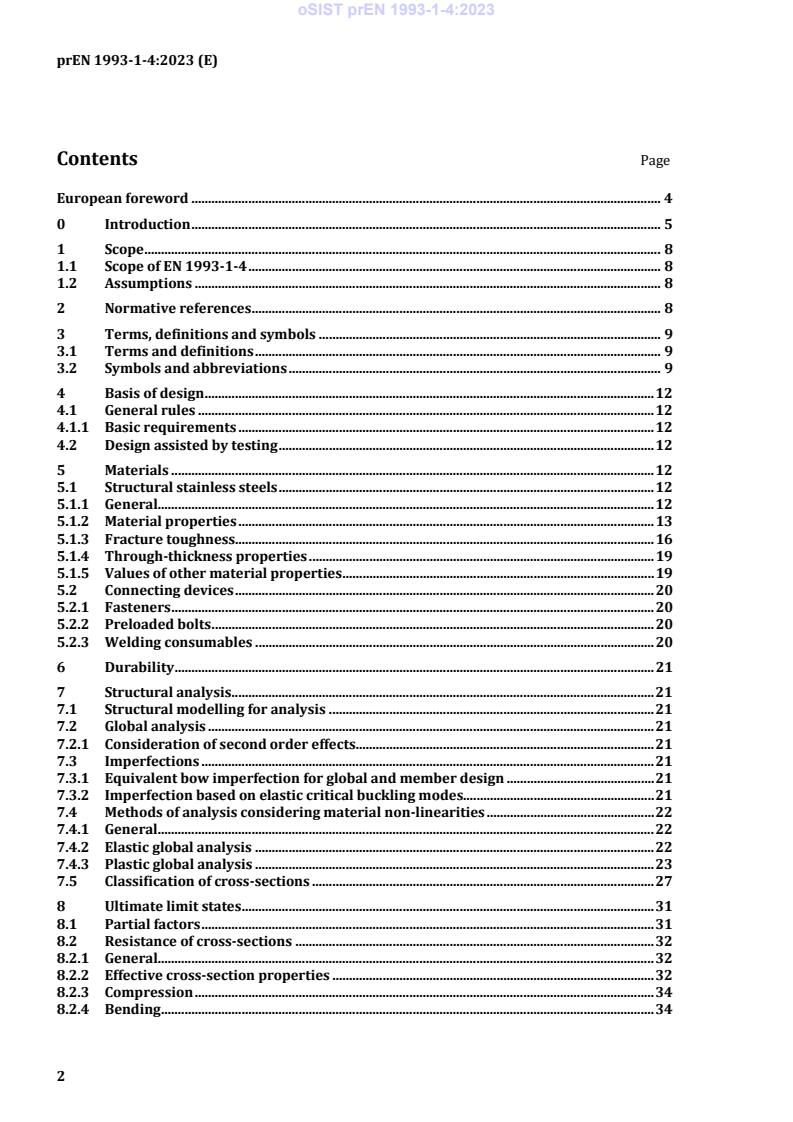
Contents Page
European foreword . 4
0 Introduction . 5
1 Scope . 8
1.1 Scope of EN 1993-1-4 . 8
1.2 Assumptions . 8
2 Normative references . 8
3 Terms, definitions and symbols . 9
3.1 Terms and definitions . 9
3.2 Symbols and abbreviations . 9
4 Basis of design . 12
4.1 General rules . 12
4.1.1 Basic requirements . 12
4.2 Design assisted by testing . 12
5 Materials . 12
5.1 Structural stainless steels . 12
5.1.1 General. 12
5.1.2 Material properties . 13
5.1.3 Fracture toughness. 16
5.1.4 Through-thickness properties . 19
5.1.5 Values of other material properties . 19
5.2 Connecting devices . 20
5.2.1 Fasteners . 20
5.2.2 Preloaded bolts . 20
5.2.3 Welding consumables . 20
6 Durability . 21
7 Structural analysis . 21
7.1 Structural modelling for analysis . 21
7.2 Global analysis . 21
7.2.1 Consideration of second order effects . 21
7.3 Imperfections . 21
7.3.1 Equivalent bow imperfection for global and member design . 21
7.3.2 Imperfection based on elastic critical buckling modes. 21
7.4 Methods of analysis considering material non-linearities . 22
7.4.1 General. 22
7.4.2 Elastic global analysis . 22
7.4.3 Plastic global analysis . 23
7.5 Classification of cross-sections . 27
8 Ultimate limit states . 31
8.1 Partial factors . 31
8.2 Resistance of cross-sections . 32
8.2.1 General. 32
8.2.2 Effective cross-section properties . 32
8.2.3 Compression . 34
8.2.4 Bending . 34
oSIST prEN 1993-1-4:2023
prEN 1993-1-4:2023 (E)
8.2.5 Shear 34
8.2.6 Resistance to transverse forces . 35
8.2.7 Transverse web stiffeners . 36
8.3 Buckling resistance of members . 36
8.3.1 General . 36
8.3.2 Uniform members in compression . 36
8.3.3 Uniform members in bending . 37
8.3.4 Uniform members in bending and axial compression . 38
9 Serviceability limit states . 41
9.1 General . 41
9.2 Determination of deflections . 41
10 Connection design . 42
10.1 General . 42
10.2 Bolted connections . 42
10.3 Design of welds . 46
11 Fatigue . 47
12 Fire resistance . 47
Annex A (normative) Selection of materials and durability . 48
A.1 Use of this Annex . 48
A.2 Scope and field of Application . 48
A.3 Corrosion protection of construction products — Requirements . 48
A.4 Selection of materials . 48
A.5 Swimming pool environments . 51
A.6 Corrosion protection of connections with other metals . 52
A.7 Galvanizing and contact with molten zinc . 52
Annex B (normative) Continuous strength method . 53
B.1 Use of this Annex . 53
B.2 Scope and field of Application . 53
B.3 General . 53
B.4 Material modelling . 53
B.5 Cross-section deformation capacity . 54
B.6 Resistance of cross-sections . 55
Bibliography . 60
oSIST prEN 1993-1-4:2023
prEN 1993-1-4:2023 (E)
European foreword
This document (prEN 1993-1-4:2023) has been prepared by Technical Committee CEN/TC 250
“Structural Eurocodes”, the secretariat of which is held by BSI. CEN/TC 250 is responsible for all
Structural Eurocodes and has been assigned responsibility for structural and geotechnical design
matters by CEN.
This document is currently submitted to the CEN Enquiry.
This document will supersede EN 1993-1-4:2006 and its amendments.
The first generation of EN Eurocodes was published between 2002 and 2007. This document forms
part of the second generation of the Eurocodes, which have been prepared under Mandate M/515
issued to CEN by the European Commission and the European Free Trade Association.
The Eurocodes have been drafted to be used in conjunction with relevant execution, material,
product and test standards, and to identify requirements for execution, materials, products and
testing that are relied upon by the Eurocodes.
The Eurocodes recognize the responsibility of each Member State and have safeguarded their right
to determine values related to regulatory safety matters at national level through the use of National
Annexes.
oSIST prEN 1993-1-4:2023
prEN 1993-1-4:2023 (E)
0 Introduction
0.1 Introduction to the Eurocodes
The Structural Eurocodes comprise the following standards generally consisting of a number of Parts:
— EN 1990 Eurocode: Basis of structural and geotechnical design
— EN 1991 Eurocode 1: Actions on structures
— EN 1992 Eurocode 2: Design of concrete structures
— EN 1993 Eurocode 3: Design of steel structures
— EN 1994 Eurocode 4: Design of composite steel and concrete structures
— EN 1995 Eurocode 5: Design of timber structures
— EN 1996 Eurocode 6: Design of masonry structures
— EN 1997 Eurocode 7: Geotechnical design
— EN 1998 Eurocode 8: Design of structures for earthquake resistance
— EN 1999 Eurocode 9: Design of aluminium structures
— New parts are under development, e.g. Eurocode for design of structural glass
The Eurocodes are intended for use by designers, clients, manufacturers, constructors, relevant
authorities (in exercising their duties in accordance with national or international regulations),
educators, software developers, and committees drafting standards for related product, testing and
execution standards.
NOTE Some aspects of design are most appropriately specified by relevant authorities or, where not specified,
can be agreed on a project-specific basis between relevant parties such as designers and clients. The Eurocodes
identify such aspects making explicit reference to relevant authorities and relevant parties.
0.2 Introduction to EN 1993 (all parts)
EN 1993 (all parts) applies to the design of buildings and civil engineering works in steel. It complies with
the principles and requirements for the safety and serviceability of structures, the basis of their design
and verification that are given in EN 1990 – Basis of structural design.
EN 1993 (all parts) is concerned only with requirements for resistance, serviceability, durability and fire
resistance of steel structures. Other requirements, e.g. concerning thermal or sound insulation, are not
covered.
EN 1993 is subdivided in various parts:
EN 1993-1, Design of Steel Structures — Part 1: General rules and rules for buildings;
EN 1993-2, Design of Steel Structures — Part 2: Steel bridges;
EN 1993-3, Design of Steel Structures — Part 3: Towers, masts and chimneys;
EN 1993-4, Design of Steel Structures — Part 4: Silos and tanks;
oSIST prEN 1993-1-4:2023
prEN 1993-1-4:2023 (E)
EN 1993-5, Design of Steel Structures — Part 5: Piling;
EN 1993-6, Design of Steel Structures — Part 6: Crane supporting structures;
EN 1993-7, Design of steel structures — Part 7: Design of sandwich panels.
EN 1993-1 in itself does not exist as a physical document, but comprises the following 14 separate parts,
the basic part being EN 1993-1-1:
EN 1993-1-1, Design of Steel Structures — Part 1-1: General rules and rules for buildings;
EN 1993-1-2, Design of Steel Structures — Part 1-2: Structural fire design;
EN 1993-1-3, Design of Steel Structures — Part 1-3: Cold-formed members and sheeting;
NOTE Cold-formed hollow sections supplied according to EN 10219 are covered in EN 1993-1-1.
EN 1993-1-4, Design of Steel Structures — Part 1-4: Stainless steel structures;
EN 1993-1-5, Design of Steel Structures — Part 1-5: Plated structural elements;
EN 1993-1-6, Design of Steel Structures — Part 1-6: Strength and stability of shell structures;
EN 1993-1-7, Design of Steel Structures — Part 1-7: Strength and stability of planar plated structures
transversely loaded;
EN 1993-1-8, Design of Steel Structures — Part 1-8: Design of joints;
EN 1993-1-9, Design of Steel Structures — Part 1-9: Fatigue;
EN 1993-1-10, Design of Steel Structures — Part 1-10: Material toughness and through-thickness
properties;
EN 1993-1-11, Design of Steel Structures — Part 1-11: Design of structures with tension components;
EN 1993-1-12, Design of Steel Structures — Part 1-12: Additional rules for steel grades up to S960;
EN 1993-1-13, Design of Steel Structures — Part 1-13: Beams with large web openings;
EN 1993-1-14, Design of Steel Structures — Part 1-14: Design assisted by finite element analysis.
All subsequent parts EN 1993-1-2 to EN 1993-1-14 treat general topics that are independent from the
structural type such as structural fire design, cold-formed members and sheeting, stainless steels, plated
structural elements, etc.
All subsequent parts numbered EN 1993-2 to EN 1993-7 treat topics relevant for a specific structural
type such as steel bridges, towers, masts and chimneys, silos and tanks, piling, crane supporting
structures, etc. EN 1993-2 to EN 1993-7 refer to the generic rules in EN 1993-1 and supplement, modify
or supersede them.
0.3 Introduction to prEN 1993-1-4
prEN 1993-1-4 gives supplementary rules for the structural design of steel structures that extend and
modify the application of EN 1993-1-1, EN 1993-1-3, EN 1993-1-5 and EN 1993-1-8 to stainless steels.
The focus is on design methods and design rules for members and skeletal structures regarding
resistance and stability.
oSIST prEN 1993-1-4:2023
prEN 1993-1-4:2023 (E)
0.4 Verbal forms used in the Eurocodes
The verb “shall" expresses a requirement strictly to be followed and from which no deviation is permitted
in order to comply with the Eurocodes.
The verb “should” expresses a highly recommended choice or course of action. Subject to national
regulation and/or any relevant contractual provisions, alternative approaches could be used/adopted
where technically justified.
The verb “may" expresses a course of action permissible within the limits of the Eurocodes.
The verb “can" expresses possibility and capability; it is used for statements of fact and clarification of
concepts.
0.5 National Annex for prEN 1993-1-4
National choice is allowed in this standard where explicitly stated within notes. National choice includes
the selection of values for Nationally Determined Parameters (NDPs).
The national standard implementing prEN 1993-1-4 can have a National Annex containing all national
choices to be used for the design of steel structures to be constructed in the relevant country.
When no national choice is given, the default choice given in this standard is to be used.
When no national choice is made and no default is given in this standard, the choice can be specified by a
relevant authority or, where not specified, agreed for a specific project by appropriate parties.
National choice is allowed in prEN 1993-1-4 through the following clauses:
5.1.1(1) 5.2.2(1) 7.2.1(1) 7.4.3.5(3)
8.1(1) A.2(8) A.3, Table A.4
The National Annex can contain, directly or by reference, non-contradictory complementary information
for ease of implementation, provided it does not alter any provisions of the Eurocodes.
oSIST prEN 1993-1-4:2023
prEN 1993-1-4:2023 (E)
1 Scope
1.1 Scope of prEN 1993-1-4
This document provides supplementary rules for the structural design of steel structures that extend and
modify the application of EN 1993-1-1, EN 1993-1-3, EN 1993-1-5 and EN 1993-1-8 to austenitic, duplex
(austenitic-ferritic) and ferritic stainless steels.
NOTE 1 Austenitic-ferritic stainless steels are commonly known as duplex stainless steels. The term duplex
stainless steel is used in this document.
NOTE 2 Information on the durability of stainless steels is given in Annex A.
NOTE 3 The execution of stainless steel structures is covered in EN 1090-2 and EN 1090-4.
1.2 Assumptions
Unless specifically stated, EN 1990, EN 1991 (all parts), EN 1993-1-1, EN 1993-1-3, EN 1993-1-5 and
EN 1993-1-8 apply.
The design methods given in prEN 1993-1-4 are applicable if
— the execution quality is as specified in EN 1090-2 and EN 1090-4, and
— the construction materials and products used are as specified in EN 1993-1-1, EN 1993-1-3,
EN 1993-1-5 and EN 1993-1-8, or in the relevant material and product specifications.
2 Normative references
The following documents are referred to in the text in such a way that some or all of their content
constitutes requirements of this document. For dated references, only the edition cited applies. For
undated references, the latest edition of the referenced document (including any amendments) applies.
NOTE See the Bibliography for a list of other documents cited that are not normative references, including
those referenced as recommendations (i.e. through ‘should’ clauses) and permissions (i.e. through ‘may’ clauses).
EN 1090-2, Execution of steel structures and aluminium structures — Part 2: Technical requirements for
steel structures
EN 1090-4, Execution of steel structures and aluminium structures — Part 4: Technical requirements for
cold-formed structural steel elements and cold-formed structures for roof, ceiling, floor and wall
applications
EN 1990, Basis of structural and geotechnical design
EN 1991 (all parts), Actions on structures
EN 1993-1-1, Design of Steel Structures — Part 1-1: General rules and rules for buildings
EN 1993-1-3, Design of Steel Structures — Part 1-3: Cold-formed members and sheeting
EN 1993-1-5, Design of Steel Structures — Part 1-5: Plated structural elements
EN 1993-1-8, Design of Steel Structures — Part 1-9: Fatigue
oSIST prEN 1993-1-4:2023
prEN 1993-1-4:2023 (E)
3 Terms, definitions and symbols
3.1 Terms and definitions
For the purposes of this document, the terms and definitions given in EN 1990, EN 1993-1-1,
EN 1993-1-3, EN 1993-1-5 and EN 1993-1-8 apply.
3.2 Symbols and abbreviations
3.2.1 General
For the purposes of this document, the symbols given in EN 1990, EN 1993-1-1, EN 1993-1-3,
EN 1993-1-5 and EN 1993-1-8 and the following apply.
3.2.2 Latin upper-case symbols
total corner cross-sectional area of the section
𝐴𝐴
c
CRF corrosion resistance factor
CSM continuous strength method
𝐶𝐶 , 𝐶𝐶 , 𝐶𝐶 material coefficients used to define the CSM material model
1 2 3
𝐸𝐸 secant modulus
s
𝐸𝐸 strain hardening modulus
sh
𝐸𝐸 secant modulus of elasticity used for serviceability limit state calculations
s,ser
𝐸𝐸 secant modulus corresponding to the stress in the tension flange
s,1
𝐸𝐸 secant modulus corresponding to the stress in the compression flange
s,2
𝐹𝐹 preloading force for bolts
p,S
𝐹𝐹 design value of the resistance of the structure calculated from 𝐹𝐹
Rd Rk
𝐹𝐹 characteristic value of the resistance of the structure, taken at the peak load factor
Rk
attained during the plastic zone analysis or the point at which the CSM strain limit is
reached, whichever is the lesser
F risk of exposure to chlorides from salt water or deicing salts
F risk of exposure to sulfur dioxide
F cleaning regime or exposure to washing by rain
𝐾𝐾 initial lateral stiffness of the structure
𝐾𝐾 secant lateral stiffness of the structure at the design load level
s
𝐾𝐾𝐾𝐾 impact energy in Joule [J] from a Charpy V notch specimen
𝐿𝐿 local buckling half-wavelength
b,cs
M distance from the sea
oSIST prEN 1993-1-4:2023
prEN 1993-1-4:2023 (E)
𝑀𝑀 design value of the CSM resistance to bending moment about one principal axis of a
csm,Rd
cross-section
𝑀𝑀 design value of the CSM bending moment resistance about major (y-y) axis
csm,y,Rd
𝑀𝑀 design value of the CSM bending moment resistance about minor (z-z) axis
csm,z,Rd
𝑀𝑀 design value of the reduced CSM bending moment resistance about major (y-y) axis
N,csm,y,Rd
making allowance for the presence of axial force
𝑀𝑀 design value of the reduced CSM bending moment resistance about minor (z-z) axis
N,csm,z,Rd
making allowance for the presence of axial force
𝑁𝑁 design value of the CSM resistance to axial force of the cross-section for uniform
csm,Rd
compression
𝑁𝑁 design value of the CSM resistance to tension axial force
csm,t,Rd
𝑅𝑅 stress at which the plastic extension is 0,2 % (i.e. 0,2 % proof strength), taken from the
p0,2
product standard
𝑆𝑆 distance from roads with deicing salts
𝑌𝑌 factor that approximates loss of stiffness due to second order effects
3.2.3 Latin lower-case symbols
𝑓𝑓 average ultimate tensile strength, accounting for work hardening due to cold-forming
ua
𝑓𝑓 nominal ultimate tensile strength of stainless steel bolts
ub
𝑓𝑓 nominal yield strength of stainless steel bolts
yb
𝑓𝑓 enhanced yield strength of a cold rolled circular hollow section
yCHS
𝑓𝑓 enhanced yield strength of the corner region
yc
𝑓𝑓 enhanced yield strength of the flat portions of cold-rolled rectangular hollow sections
yf
𝑘𝑘 coefficient for calculating the slip resistance of preloaded bolts
s
𝑛𝑛 strain hardening exponent
𝑛𝑛 number of 90° corners in the section
c
𝑛𝑛 ratio of the design compression force 𝑁𝑁 to the CSM compression resistance 𝑁𝑁
csm Ed csm,Rd
𝑛𝑛 is the exponent used in the calculation of the enhanced yield strength
p
3.2.4 Greek upper-case symbols
Ω a project specific parameter that defines the permissible level of plastic deformation
oSIST prEN 1993-1-4:2023
prEN 1993-1-4:2023 (E)
3.2.5 Greek lower-case symbols
𝛼𝛼 CSM bending parameter
𝛼𝛼 modified factor by which the design load would have to be increased to cause elastic
cr,sw,mod
instability in a global (sway) mode to account for the influence of plasticity on the sway
stiffness of frame
𝛼𝛼 CSM interaction coefficient for biaxial bending
csm
𝛽𝛽 CSM interaction coefficient for biaxial bending
csm
𝛽𝛽 correlation factor for fillet welded connections
w
𝜀𝜀 strain induced in a circular hollow section during section forming
CHS
𝜀𝜀 strain induced in the corner region during section forming
c
𝜀𝜀 limiting compressive strain from the continuous strength method
csm
𝜀𝜀 maximum design CSM strain
csm,max
𝜀𝜀 maximum attainable CSM tensile strain
csm,t
𝜀𝜀 design strain
Ed
𝜀𝜀 strain induced in the flat faces of rectangular hollow sections during section forming
f
𝜀𝜀 is the total strain corresponding to the 0,2 % proof strength
p0,2
𝜀𝜀 ultimate strain, corresponding to the ultimate tensile strength 𝑓𝑓
u u
𝜀𝜀 elastic strain at the yield strength
y
̅ limiting relative slenderness
𝜆𝜆
relative slenderness of the member determined at the critical cross-section 𝑚𝑚
𝜆𝜆̅
m
𝜆𝜆̅ cross-section slenderness for circular hollow sections
c,cs
̅cross-section slenderness for sections comprising flat plates
𝜆𝜆
p,cs
μ slip factor
𝜌𝜌 reduction factor to account for the interaction between bending and shear
csm
𝜎𝜎 elastic buckling stress of the full cross-section of the circular hollow section
cr,c
𝜎𝜎 elastic local buckling stress of the full cross-section
cr,cs
𝜎𝜎 serviceability design stress
𝑖𝑖,Ed,ser
oSIST prEN 1993-1-4:2023
prEN 1993-1-4:2023 (E)
4 Basis of design
4.1 General rules
4.1.1 Basic requirements
(1) The design of stainless steel structures shall be in accordance with the general rules given in EN 1990
and EN 1991 (all parts) and the specific design provisions for steel structures given in EN 1993-1-1,
EN 1993-1-3, EN 1993-1-5 and EN 1993-1-8.
(2) Steel structures designed according to this document shall be executed according to EN 1090-2 and
EN 1090-4 with construction materials and products used as specified in the relevant parts of EN 1993,
or in the relevant material and product specifications.
4.2 Design assisted by testing
(1) Prototypes for testing should be produced in a similar manner to the components of the final product,
such that they reflect the same levels of work hardening.
(2) Due to the anisotropy of cold worked stainless steels, test specimens should be prepared from the
plate or sheet in the same orientation (i.e. transverse or parallel to the rolling direction) as intended for
the final structure. If the final orientation is unknown or cannot be guaranteed, tests should be conducted
for both orientations and the less favourable result should be adopted.
5 Materials
5.1 Structural stainless steels
5.1.1 General
(1) For the design of austenitic, duplex and ferritic stainless steel structures according to this document,
the material should conform with one of the grades in Table A.3, and with one of the following product
standards: EN 10088, EN 10028-7, 10296-2 and 10297-2.
NOTE 1 The most common stainless steel grades from Table A.3 are listed in Table 5.1 in accordance with their
Corrosion Resistance Class and Strength Class.
NOTE 2 Other stainless steel grades and products can be defined in the National Annex.
(2) If other stainless steel grades than those mentioned in (1) are used, their mechanical properties shall
conform to the conditions given in 5.1.2.1(4), 5.1.3 and 5.1.4 when tested in accordance with the relevant
EN, ISO or EN ISO testing standards. If relevant, specialist advice should be sought regarding the
durability, fabrication, weldability, fatigue resistance and high temperature performance of these grades.
oSIST prEN 1993-1-4:2023
prEN 1993-1-4:2023 (E)
Table 5.1 — Strength and corrosion classes for common stainless steels
Strength Class
Corrosion
SC210 SC450
Resistance Class
(see Annex A)
2 2
2 2
𝑓𝑓 (N/mm ) 𝑓𝑓 (N/mm )
𝑓𝑓 (N/mm ) 𝑓𝑓 (N/mm )
y y
u u
210 500 450 650
a
I
1.4003 (F)
1.4301 (A) 1.4482 (D)
II
1.4307 (A)
1.4401 (A) 1.4162 (D)
b
1.4404 (A)
1.4362 (D)
III
1.4435 (A) 1.4062 (D)
1.4571 (A)
1.4462 (D)
IV
1.4662 (D)
1.4410 (D)
V
1.4501 (D)
NOTE 1 F = ferritic, A = austenitic and D = duplex stainless steels.
NOTE 2 The most common austenitic stainless steels are 1.4301/1.4307 and 1.4401/1.4404.
NOTE 3 The strengths apply to sheet, plate, and strip, and products fabricated from sheet,
plate and strip. The strengths also apply to cold-formed hollow sections where the strength
enhancement arising from fabrication is not taken into account.
NOTE 4 For rods, bars, hot rolled open sections and seamless tubes, 𝑓𝑓 = 180 N/mm for the
y
grades in Strength Class SC210, and EN 10088 gives values for 𝑓𝑓 for grades in Strength Class
y
SC450.
NOTE 5 Table A.3 categorises a wider selection of stainless steels into Corrosion Resistance
Classes.
2 2
a 𝑓𝑓 = 250-280 N/mm for 1.4003, depending on the product form, and 𝑓𝑓 = 450 N/mm . For
y u
rod, only 𝑓𝑓 values apply.
u
b 𝑓𝑓 = 400 N/mm
y
5.1.2 Material properties
5.1.2.1 General
(1) The nominal values of the yield strength 𝑓𝑓 and the ultimate tensile strength 𝑓𝑓 for stainless steel
y u
should be obtained:
a) either by using the Strength Classes given in Table 5.1;
b) or by adopting the values 𝑓𝑓 = 𝑅𝑅 and 𝑓𝑓 = 𝑅𝑅 (as lower bound of the given range) directly from the
y p0,2 u m
product standard.
NOTE The product standard can give higher strength values than Table 5.1, depending on the product form.
The strength of grades not listed in Table 5.1 should be taken from the product standard.
(2) Higher strength values may be derived from cold working of the sheet material, as given in 5.1.2.2 and
Table 5.2 or during fabrication of cold-formed sections, as given in 5.1.2.3.
oSIST prEN 1993-1-4:2023
prEN 1993-1-4:2023 (E)
(3) The strength enhancement from cold working should not be used for members which are to be
welded or subject to heat treatment unless the localised reduction in strength due to annealing is
determined from tests on the full-cross-section.
(4) The ductility requirements in EN 1993-1-1 shall also apply to stainless steels. Steels conforming to
one of the steel grades listed in Table 5.1 may be assumed to satisfy these requirements. The steels listed
in Table 5.2 should have declared properties that meet the ductility requirements given in EN 1993-1-1.
(5) Where cold working increases the member resistance (see 5.1.2.3), the design of joints should be
consistent with this increased member resistance, especially where capacity design is required.
5.1.2.2 Material in the cold worked condition
(1) This document covers the design of austenitic stainless steel material in the cold worked conditions
CP350 and CP500. The nominal values of the yield strength and the ultimate tensile strength are given
in Table 5.2.
(2) According to EN 10088-4, the CP classification only defines the required 0,2% proof strength, 𝑓𝑓 .
y
Therefore, the steel should have declared properties that meet the conservative tabulated values for
ultimate tensile strength, 𝑓𝑓 , unless type testing demonstrates the acceptability of higher values.
u
Table 5.2 — Nominal values of the yield strength 𝒇𝒇 and the ultimate tensile strength 𝒇𝒇 for
𝐲𝐲 𝐮𝐮
austenitic stainless steels in the cold worked condition
2 a
𝑓𝑓 (N/mm ) 𝑓𝑓 (N/mm )
y u
Cold Worked
Condition
Grade Tension Compression
1.4301, 1.4541, 1.4401,
CP350 350 315 600
1.4571
1.4301, 1.4541, 1.4401,
1.4571
CP500 350 650
1.4318 430
a
EN 10088 gives minimum specified 0,2% proof strengths in tension in the transverse direction of
2 2
350 N/mm and 500 N/mm for CP350 and CP500, respectively. The reduced values for 𝑓𝑓 given in this table
y
account for the anisotropic and asymmetric behaviour of cold worked material. No reduction is required in 𝑓𝑓 .
u
5.1.2.3 Material properties of cold-formed sections and sheeting
(1) An average yield strength 𝑓𝑓 and average ultimate tensile strength 𝑓𝑓 may be used in place of 𝑓𝑓 and
ya ua y
𝑓𝑓 to account for the strength enhancement arising during the fabrication of cold-formed structural
u
sections, except for material in the cold worked conditions CP350 and CP500 (see Table 5.2).
(2) 𝑓𝑓 is given by:
ya
𝑓𝑓 𝐴𝐴 + 𝑓𝑓 (𝐴𝐴−𝐴𝐴 )
For press braked sections or cold rolled
yc c yf c
(5.1)
𝑓𝑓 =
ya
rectangular hollow sections
𝐴𝐴
𝑓𝑓 =𝑓𝑓
For cold rolled circular hollow sections (5.2)
ya yCHS
where
A
is the gross cross-sectional area of the section
A is the total corner cross-sectional area of the section, given as:
c
oSIST prEN 1993-1-4:2023
prEN 1993-1-4:2023 (E)
𝑡𝑡
𝐴𝐴 =�𝑛𝑛 𝜋𝜋 � (2𝑟𝑟 +𝑡𝑡) For press-braked sections (5.3)
c c
𝑡𝑡
For cold rolled rectangular
𝐴𝐴 =�𝑛𝑛 𝜋𝜋 � (2𝑟𝑟 +𝑡𝑡) + 4𝑛𝑛𝑡𝑡 (5.4)
c c c
hollow sections
in which
𝑛𝑛 is the number of 90° corners in the section;
c
𝑟𝑟 is the internal bend radius, which may be taken as 2𝑡𝑡 if not known;
𝑓𝑓 is the enhanced yield strength of the corner region, obtained from:
yc
𝑛𝑛
p
𝜀𝜀
c
but 𝑓𝑓 ≤𝑓𝑓 ≤𝑓𝑓 (5.5)
𝑓𝑓 = 0,85𝑓𝑓 � + 1�
y yc u
yc y
𝜀𝜀
p0,2
𝑓𝑓 is the enhanced yield strength of the flat portions of cold rolled rectangular hollow
yf
sections, obtained according to Formula (5.6). For press-braked sections 𝑓𝑓 should be
yf
taken as 𝑓𝑓
y
𝑛𝑛
p
𝜀𝜀
f
𝑓𝑓 ≤𝑓𝑓 ≤𝑓𝑓
𝑓𝑓 = 0,85𝑓𝑓 � + 1� but (5.6)
y yf u
yf y
𝜀𝜀
p0,2
𝑓𝑓 is the yield strength of the basic material (see 5.1.2.1(1));
y
𝑓𝑓 is the enhanced yield strength of a cold rolled circular hollow section, obtained from:
yCHS
𝑛𝑛
p
𝜀𝜀
CHS
𝑓𝑓 ≤𝑓𝑓 ≤𝑓𝑓
𝑓𝑓 = 0,85𝑓𝑓 � + 1� but (5.7)
y yCHS u
yCHS y
𝜀𝜀
p0,2
in which
ln(𝑓𝑓⁄𝑓𝑓 )
y u
𝑛𝑛 = (5.8)
p
⁄𝜀𝜀
ln(𝜀𝜀 )
p0,2 u
𝑓𝑓
y
(5.9)
𝜀𝜀 = 0,002 +
𝑝𝑝0,2
𝐸𝐸
E is modulus of elasticity, see 5.1.5;
𝑓𝑓 is the ultimate tensile strength of the basic material (see 5.1.2.1(1));
u
𝜀𝜀 is the strain induced in the corner region during section forming, given by:
c
𝑡𝑡
𝜀𝜀 = (5.10)
c
2(2𝑟𝑟 +𝑡𝑡)
oSIST prEN 1993-1-4:2023
prEN 1993-1-4:2023 (E)
𝜀𝜀 is the strain induced in the flat faces of rectangular hollow sections during section forming,
f
given by Formula (5.11), where all dimensions shall be in millimetres:
𝑡𝑡 𝜋𝜋𝑡𝑡
𝜀𝜀 =� � + � � (5.11)
f
900 2(𝑏𝑏 +ℎ− 2𝑡𝑡)
𝜀𝜀 is the strain induced in a circular hollow section during section forming, given by:
CHS
𝑡𝑡
𝜀𝜀 =
(5.12)
CHS
( )
2𝑑𝑑−𝑡𝑡
𝜀𝜀 is the ultimate strain, corresponding to the ultimate tensile strength 𝑓𝑓 , which may be
u u
approximated as follows:
a) for austenitic and duplex stainless steels
𝑓𝑓
y
𝜀𝜀 = 1− but 𝜀𝜀 ≤𝜀𝜀 (5.13)
u f
𝑢𝑢
𝑓𝑓
u
b) for ferritic stainless steels
𝑓𝑓
y
𝜀𝜀 = 0,6�1− � but 𝜀𝜀 ≤𝜀𝜀 (5.14)
𝑢𝑢 u f
𝑓𝑓
u
𝜀𝜀 is the elongation after fracture as defined in the product standard
f
(3) 𝑓𝑓 is given by:
ua
a) for austenitic and duplex stainless steels
𝑓𝑓
ya
𝑓𝑓 =
ua
(5.15)
𝑓𝑓
ya
0,20 + 185
𝐸𝐸
b) for ferritic stainless steels
𝑓𝑓
ya
𝑓𝑓 =
ua
(5.16)
𝑓𝑓
ya
0,46 + 145
𝐸𝐸
5.1.3 Fracture toughness
(1) Austenitic, ferritic and duplex stainless steels exhibit different fracture toughness characteristics.
NOTE Information on embrittlement due to contact with zinc in fire is given in A.5.
(2) The austenitic stainless steels covered in this document may be assumed to have sufficient fracture
toughness to avoid brittle fracture of tension elements for service temperatures down to -50 °C.
If grades 1.4301, 1.4307, 1.4311, 1.4318 or 1.4306 are subject to extensive cold working, it should be
demonstrated that the toughness of material greater than 10 mm thick is not less than the minimum KV-
value specified in EN 10088-4 or EN 10088-5.
oSIST prEN 1993-1-4:2023
prEN 1993-1-4:2023 (E)
(3) If austenitic stainless steels are used at temperatures below -50 °C, tests should be carried out to
demonstrate the material has a KV-value of at least 40 J at the lowest service temperature after the
required fabrication steps.
(4) The ferritic stainless steels covered in this document may be assumed to have sufficient fracture
toughness to avoid brittle fracture when the thickness of tension elements, 𝑡𝑡, is ≤ 5 mm. Where 𝑡𝑡 > 5 mm,
proof of sufficient fracture toughness should be obtained by applying the fracture mechanics concepts of
EN 1993-1-10.
(5) For the duplex stainless steels covered in this document, Table 5.3 and Table 5.4 give the maximum
permissible element thickness appropriate to a steel strength, its toughness requirement in terms of KV-
value, the applied stress level 𝜎𝜎 and the reference temperature 𝑇𝑇 . Table 5.3 is for Execution Class 3
Ed Ed
and 4, and Table 5.4 for Execution Class 1 and 2.
As EN 10088 does not specify CVN requirements at low temperatures, Tables 5.3 and 5.4 specify
maximum permissible values of element thickness for four toughness requirements, TR1 to TR4. The
designer shall specify the minimum toughness requirement appropriate for the application.
𝜎𝜎 and T should be calculated according to EN 1993-1-10. The values in the tables are based on the
Ed
Ed
assumptions in EN 1993-1-10.
𝑓𝑓 (t) = 𝑓𝑓 – 0,25 (t/t ) with t = 1 mm, or 𝑓𝑓 (t) may be taken as 𝑅𝑅 from the product standard.
0 0
y y y p0,2
NOTE Tables 5.3 and 5.4 do not cover cold-formed sections and sheeting.
(6) If required, tests shall be carried out to demonstrate duplex stainless steels have a KV-value of at least
40 J at the test temperature for the selected quality in Table 5.3 or Table 5.4.
oSIST prEN 1993-1-4:2023
prEN 1993-1-4:2023 (E)
Table 5.3 — Maximum permissible values of element thickness 𝒕𝒕 in mm for duplex stainless steel
for Execution Class EXC3 and EXC4
f KV Reference Temperature T [°C]
y Ed
N/mm Toughness
at T Jmin 10 0 -10 -20 -30 -40 -50 10 0 -10 -20 -30 -40 -50 10 0 -10 -20 -30 -40 -50
Grade require-
(hot
ment
rolled
[°C] [J] σ = 0,50 f (t) σ = 0,25 f (t)
σEd = 0,75 fy(t) Ed y Ed y
plate)
70 60 45 40 30 25 20 120 100 85 70 55 45 40 185 160 140 120 105 90 75
TR1 -20 40
1.4062,
1.4162, 450
1.4482
TR2 -30 40 85 70 60 45 40 30 25 140 120 100 85 70 55 45 200 185 160 140 120 105 90
65 55 45 35 30 20 15 110 95 80 65 55 45 35 180 155 135 115 100 85 70
TR1 -20 40
1.4662 480
TR2 -30 40 80 65 55 45 35 30 20 130 110 95 80 65 55 45 200 180 155 135 115 100 85
TR3 -40 40 110 95 80 65 50 40 35 175 150 130 110 90 75 65 200 200 195 170 150 130 110
1.4362 400
TR4 -50 40 130 110 95 80 65 50 40 200 175 150 130 110 90 75 200 200 200 195 170 150 130
TR3 -40 40 100 85 70 55 45 35 30 160 135 115 95 80 70 55 200 200 185 160 140 120 100
1.4462 460
TR4 -50 40 120 100 85 70 55 45 35 185 160 135 115 95 80 70 200 200 200 185 160 140 120
TR3 -40 40 90 75 60 50 40 30 25 145 125 105 85 70 60 50 200 195 170 150 125 110 95
1.4410,
1.4501, 530
1.4507
110 90 75 60 50 40 30 170 145 125 105 85 70 60 200 200 195 170 150 125 110
TR4 -50 40
𝑓𝑓 (𝑡𝑡) 𝑓𝑓 (𝑡𝑡)
NOTE
...