

EN ISO 11137-1:2026
(Main)Sterilization of health care products - Radiation - Part 1: Requirements for the development, validation and routine control of a sterilization process for medical devices (ISO 11137-1:2025)
General Information
- Abstract
1.1 This document specifies requirements for the development, validation and routine control of a radiation sterilization process for medical devices.
NOTE Although the scope is limited to medical devices, this document can be applicable to other products and equipment.
This document covers radiation processes employing irradiators using:
a) the radionuclide 60Co or 137Cs;
b) a beam from an electron generator; or
c) a beam from an X-ray generator.
1.2 This document is not applicable to processes for inactivating viruses or the causative agents of spongiform encephalopathies, such as scrapie, bovine spongiform encephalopathy and Creutzfeldt-Jakob disease.
NOTE For information on such processes, see ISO 22442-1, ISO 22442-2, ISO 22442-3, ISO 13022 and ICH Q5A.
1.2.1 This document does not specify requirements for designating a medical device as sterile.
NOTE Regional and national requirements can designate medical devices as sterile. See, for example, EN 556-1 or ANSI/AAMI ST67.
1.2.2 This document does not specify a quality management system for the control of all stages of production of medical devices.
NOTE It is not a requirement of this document to have a complete quality management system during manufacture, but the elements of a quality management system that are the minimum necessary to control the sterilization process are normatively referenced at appropriate places in the text (see, in particular, Clause 4). Attention is drawn to the standards for quality management systems (see ISO 13485) that control all stages of production of medical devices, including the sterilization process. Regional and national regulations for the provision of medical devices can require implementation of a complete quality management system and the assessment of that system by a third party.
1.2.3 This document does not require that biological indicators be used for validation or monitoring of radiation sterilization, nor does it require that a pharmacopoeial test for sterility be carried out for product release.
1.2.4 This document does not specify requirements for occupational safety associated with the design and operation of irradiation facilities.
NOTE Regulations on safety requirements for occupational safety related to radiation can exist in some countries.
1.2.5 This document does not specify requirements for the sterilization of used or reprocessed devices.
- Status
- Published
- Publication Date
- 23-Jun-2026
- Technical Committee
- CEN/TC 204 - Sterilization of medical devices
- Drafting Committee
- CEN/TC 204 - Sterilization of medical devices
- Current Stage
- 6060 - Definitive text made available (DAV) - Publishing
- Start Date
- 24-Jun-2026
- Completion Date
- 24-Jun-2026

Overview
EN ISO 11137-1:2026 is the key European and international standard for the radiation sterilization of health care products, specifically medical devices. Developed by CEN in alignment with ISO 11137-1:2025, this standard specifies stringent requirements for the development, validation, and routine control of sterilization processes using radiation. Its guidelines apply to irradiation processes involving Cobalt-60 (Co-60), Cesium-137 (Cs-137), electron beams, and X-rays. While the main focus is on medical devices, the standard’s best practices can also be beneficial for other health care products and equipment requiring microbial decontamination.
Sterilization of medical devices is critical for patient safety, ensuring products are free from viable microorganisms. Radiation sterilization is highly effective and widely used due to its reliability and suitability for a range of product materials and configurations.
Key Topics
EN ISO 11137-1:2026 addresses several essential areas in the radiation sterilization of medical devices:
- Development of sterilization processes: Establishes requirements to define processes that achieve effective microbial inactivation while preserving product integrity.
- Validation: Details procedures to confirm that the sterilization process consistently achieves required sterility assurance, including installation, operational, and performance qualifications.
- Routine control and monitoring: Sets out systematic approaches for ongoing process monitoring, parameter control, dose measurements, and maintenance to ensure continued effectiveness and safety.
- Dosimetry and dose mapping: Emphasizes the importance of accurate absorbed dose measurements and dose distribution assessments within irradiated materials.
- Change management: Specifies controls for modifications to products, processes, or equipment that may affect sterilization outcomes.
- Process documentation: Requires clear, maintained records spanning process design, validation results, monitoring data, and corrective actions.
- Exclusions: Does not cover viral inactivation, occupational safety, designation of sterility for devices, or full quality management systems (instead referencing ISO 13485 for broader QMS requirements).
Applications
Radiation sterilization processes compliant with EN ISO 11137-1:2026 are widely used in:
- Medical device industry: Sterilization of single-use surgical instruments, syringes, implants, dressings, and various diagnostic and therapeutic devices.
- Pharmaceutical packaging: Ensuring containers and closure systems for sensitive pharmaceutical products are sterile.
- Healthcare product manufacturing: Processing of raw materials, sub-assemblies, and finished products that require high-level microbial safety.
- Contract sterilization services: Facilities providing irradiation services to a range of product manufacturers.
By adhering to this standard, organizations ensure:
- Regulatory compliance with European and global market requirements.
- Optimized patient safety and product quality through consistent, validated processes.
- Systematic management of process changes, equipment calibration, and maintenance to mitigate risks.
- Comprehensive records supporting traceability and audit readiness.
Related Standards
Conformance with EN ISO 11137-1:2026 often requires knowledge of and alignment with associated standards, including:
- ISO 11137-2: Guidance for establishing the sterilization dose during radiation processes.
- ISO 13004: Methods for substantiation of selected sterilization doses.
- ISO 11737-1 and ISO 11737-2: Methods for determining microbial populations and sterility testing.
- ISO 13485: Requirements for quality management systems in medical device manufacturing.
- ISO/ASTM 52628: Standard practices for dosimetry in radiation processing.
- EN 556-1, ANSI/AAMI ST67: Guidance regarding the designation and labelling of sterile medical devices.
- ISO 22442 series: Standards concerning virus and prion inactivation (when not under the scope of EN ISO 11137-1).
EN ISO 11137-1:2026 is an essential standard for any manufacturer, service provider, or regulatory authority involved in the sterilization of medical devices using irradiation, ensuring the effectiveness, safety, and reproducibility of the sterilization process. For the latest regulatory updates, consult the harmonized standards lists and CEN/ISO websites.
Relations
- Effective Date
- 19-Jan-2023
- Effective Date
- 19-Jan-2023
- Effective Date
- 12-Aug-2026
- Effective Date
- 12-Aug-2026
- Effective Date
- 12-Aug-2026
- Effective Date
- 12-Aug-2026
- Effective Date
- 12-Aug-2026
- Effective Date
- 01-Jul-2026
- Effective Date
- 01-Jul-2026
- Effective Date
- 01-Jul-2026
- Effective Date
- 01-Jul-2026
- Referred By
EN 12022:1999 - Blood gas exchangers - Effective Date
- 01-Jul-2026
- Effective Date
- 01-Jul-2026
- Effective Date
- 01-Jul-2026
- Effective Date
- 01-Jul-2026
Get Certified
Connect with accredited certification bodies for this standard

BSI Group
BSI (British Standards Institution) is the business standards company that helps organizations make excellence a habit.

TÜV Rheinland
TÜV Rheinland is a leading international provider of technical services.

TÜV SÜD
TÜV SÜD is a trusted partner of choice for safety, security and sustainability solutions.
Sponsored listings
Frequently Asked Questions
EN ISO 11137-1:2026 is a standard published by the European Committee for Standardization (CEN). Its full title is "Sterilization of health care products - Radiation - Part 1: Requirements for the development, validation and routine control of a sterilization process for medical devices (ISO 11137-1:2025)". This standard covers: 1.1 This document specifies requirements for the development, validation and routine control of a radiation sterilization process for medical devices. NOTE Although the scope is limited to medical devices, this document can be applicable to other products and equipment. This document covers radiation processes employing irradiators using: a) the radionuclide 60Co or 137Cs; b) a beam from an electron generator; or c) a beam from an X-ray generator. 1.2 This document is not applicable to processes for inactivating viruses or the causative agents of spongiform encephalopathies, such as scrapie, bovine spongiform encephalopathy and Creutzfeldt-Jakob disease. NOTE For information on such processes, see ISO 22442-1, ISO 22442-2, ISO 22442-3, ISO 13022 and ICH Q5A. 1.2.1 This document does not specify requirements for designating a medical device as sterile. NOTE Regional and national requirements can designate medical devices as sterile. See, for example, EN 556-1 or ANSI/AAMI ST67. 1.2.2 This document does not specify a quality management system for the control of all stages of production of medical devices. NOTE It is not a requirement of this document to have a complete quality management system during manufacture, but the elements of a quality management system that are the minimum necessary to control the sterilization process are normatively referenced at appropriate places in the text (see, in particular, Clause 4). Attention is drawn to the standards for quality management systems (see ISO 13485) that control all stages of production of medical devices, including the sterilization process. Regional and national regulations for the provision of medical devices can require implementation of a complete quality management system and the assessment of that system by a third party. 1.2.3 This document does not require that biological indicators be used for validation or monitoring of radiation sterilization, nor does it require that a pharmacopoeial test for sterility be carried out for product release. 1.2.4 This document does not specify requirements for occupational safety associated with the design and operation of irradiation facilities. NOTE Regulations on safety requirements for occupational safety related to radiation can exist in some countries. 1.2.5 This document does not specify requirements for the sterilization of used or reprocessed devices.
1.1 This document specifies requirements for the development, validation and routine control of a radiation sterilization process for medical devices. NOTE Although the scope is limited to medical devices, this document can be applicable to other products and equipment. This document covers radiation processes employing irradiators using: a) the radionuclide 60Co or 137Cs; b) a beam from an electron generator; or c) a beam from an X-ray generator. 1.2 This document is not applicable to processes for inactivating viruses or the causative agents of spongiform encephalopathies, such as scrapie, bovine spongiform encephalopathy and Creutzfeldt-Jakob disease. NOTE For information on such processes, see ISO 22442-1, ISO 22442-2, ISO 22442-3, ISO 13022 and ICH Q5A. 1.2.1 This document does not specify requirements for designating a medical device as sterile. NOTE Regional and national requirements can designate medical devices as sterile. See, for example, EN 556-1 or ANSI/AAMI ST67. 1.2.2 This document does not specify a quality management system for the control of all stages of production of medical devices. NOTE It is not a requirement of this document to have a complete quality management system during manufacture, but the elements of a quality management system that are the minimum necessary to control the sterilization process are normatively referenced at appropriate places in the text (see, in particular, Clause 4). Attention is drawn to the standards for quality management systems (see ISO 13485) that control all stages of production of medical devices, including the sterilization process. Regional and national regulations for the provision of medical devices can require implementation of a complete quality management system and the assessment of that system by a third party. 1.2.3 This document does not require that biological indicators be used for validation or monitoring of radiation sterilization, nor does it require that a pharmacopoeial test for sterility be carried out for product release. 1.2.4 This document does not specify requirements for occupational safety associated with the design and operation of irradiation facilities. NOTE Regulations on safety requirements for occupational safety related to radiation can exist in some countries. 1.2.5 This document does not specify requirements for the sterilization of used or reprocessed devices.
EN ISO 11137-1:2026 is classified under the following ICS (International Classification for Standards) categories: 11.080.01 - Sterilization and disinfection in general; 11.080.99 - Other standards related to sterilization and disinfection. The ICS classification helps identify the subject area and facilitates finding related standards.
EN ISO 11137-1:2026 has the following relationships with other standards: It is inter standard links to EN ISO 11137-1:2015, EN ISO 11137-1:2015/A2:2019, ISO 11737-1:2018, ISO 11137-2:2013, ISO 13004:2022, ISO 11737-2:2019, ISO/ASTM 52628:2020, EN 794-3:1998+A2:2009, EN 1642:2011, EN 556-2:2003, EN 13544-1:2007+A1:2009, EN 12022:1999, EN 1615:2000, EN 1639:2009, EN 12182:2012. Understanding these relationships helps ensure you are using the most current and applicable version of the standard.
EN ISO 11137-1:2026 is associated with the following European legislation: EU Directives/Regulations: 2017/745, 2017/746, 90/385/EEC, 93/42/EEC, 98/79/EC; Standardization Mandates: M/575, M/575 Amd 1, M/575 Amd 2, M/BC/CEN/89/9. When a standard is cited in the Official Journal of the European Union, products manufactured in conformity with it benefit from a presumption of conformity with the essential requirements of the corresponding EU directive or regulation.
EN ISO 11137-1:2026 is available in PDF format for immediate download after purchase. The document can be added to your cart and obtained through the secure checkout process. Digital delivery ensures instant access to the complete standard document.
Standards Content (Sample)
SLOVENSKI STANDARD
01-september-2026
Nadomešča:
SIST EN ISO 11137-1:2015
SIST EN ISO 11137-1:2015/A2:2020
Sterilizacija izdelkov za zdravstveno nego - Sevanje - 1. del: Zahteve za razvoj,
validacijo in rutinsko kontrolo sterilizacijskih postopkov za medicinske
pripomočke (ISO 11137-1:2025)
Sterilization of health care products - Radiation - Part 1: Requirements for the
development, validation and routine control of a sterilization process for medical devices
(ISO 11137-1:2025)
Sterilisation von Produkten für die Gesundheitsfürsorge - Strahlen - Teil 1:
Anforderungen an die Entwicklung, Validierung und Lenkung der Anwendung eines
Sterilisationsverfahrens für Medizinprodukte (ISO 11137-1:2025)
Stérilisation des produits de santé - Irradiation - Partie 1: Exigences relatives à la mise
au point, à la validation et au contrôle de routine d'un procédé de stérilisation pour les
dispositifs médicaux (ISO 11137-1:2025)
Ta slovenski standard je istoveten z: EN ISO 11137-1:2026
ICS:
11.080.01 Sterilizacija in dezinfekcija na Sterilization and disinfection
splošno in general
2003-01.Slovenski inštitut za standardizacijo. Razmnoževanje celote ali delov tega standarda ni dovoljeno.
EN ISO 11137-1
EUROPEAN STANDARD
NORME EUROPÉENNE
June 2026
EUROPÄISCHE NORM
ICS 11.080.01 Supersedes EN ISO 11137-1:2015
English Version
Sterilization of health care products - Radiation - Part 1:
Requirements for the development, validation and routine
control of a sterilization process for medical devices (ISO
11137-1:2025)
Stérilisation des produits de santé - Irradiation - Partie Sterilisation von Produkten für die
1: Exigences relatives à la mise au point, à la validation Gesundheitsfürsorge - Strahlen - Teil 1: Anforderungen
et au contrôle de routine d'un procédé de stérilisation an die Entwicklung, Validierung und Lenkung der
pour les dispositifs médicaux (ISO 11137-1:2025) Anwendung eines Sterilisationsverfahrens für
Medizinprodukte (ISO 11137-1:2025)
This European Standard was approved by CEN on 12 March 2025.
CEN members are bound to comply with the CEN/CENELEC Internal Regulations which stipulate the conditions for giving this
European Standard the status of a national standard without any alteration. Up-to-date lists and bibliographical references
concerning such national standards may be obtained on application to the CEN-CENELEC Management Centre or to any CEN
member.
This European Standard exists in three official versions (English, French, German). A version in any other language made by
translation under the responsibility of a CEN member into its own language and notified to the CEN-CENELEC Management
Centre has the same status as the official versions.
CEN members are the national standards bodies of Austria, Belgium, Bulgaria, Croatia, Cyprus, Czech Republic, Denmark, Estonia,
Finland, France, Germany, Greece, Hungary, Iceland, Ireland, Italy, Latvia, Lithuania, Luxembourg, Malta, Netherlands, Norway,
Poland, Portugal, Republic of North Macedonia, Romania, Serbia, Slovakia, Slovenia, Spain, Sweden, Switzerland, Türkiye and
United Kingdom.
EUROPEAN COMMITTEE FOR STANDARDIZATION
COMITÉ EUROPÉEN DE NORMALISATION
EUROPÄISCHES KOMITEE FÜR NORMUNG
CEN-CENELEC Management Centre: Rue de la Science 23, B-1040 Brussels
© 2026 CEN All rights of exploitation in any form and by any means reserved Ref. No. EN ISO 11137-1:2026 E
worldwide for CEN national Members.
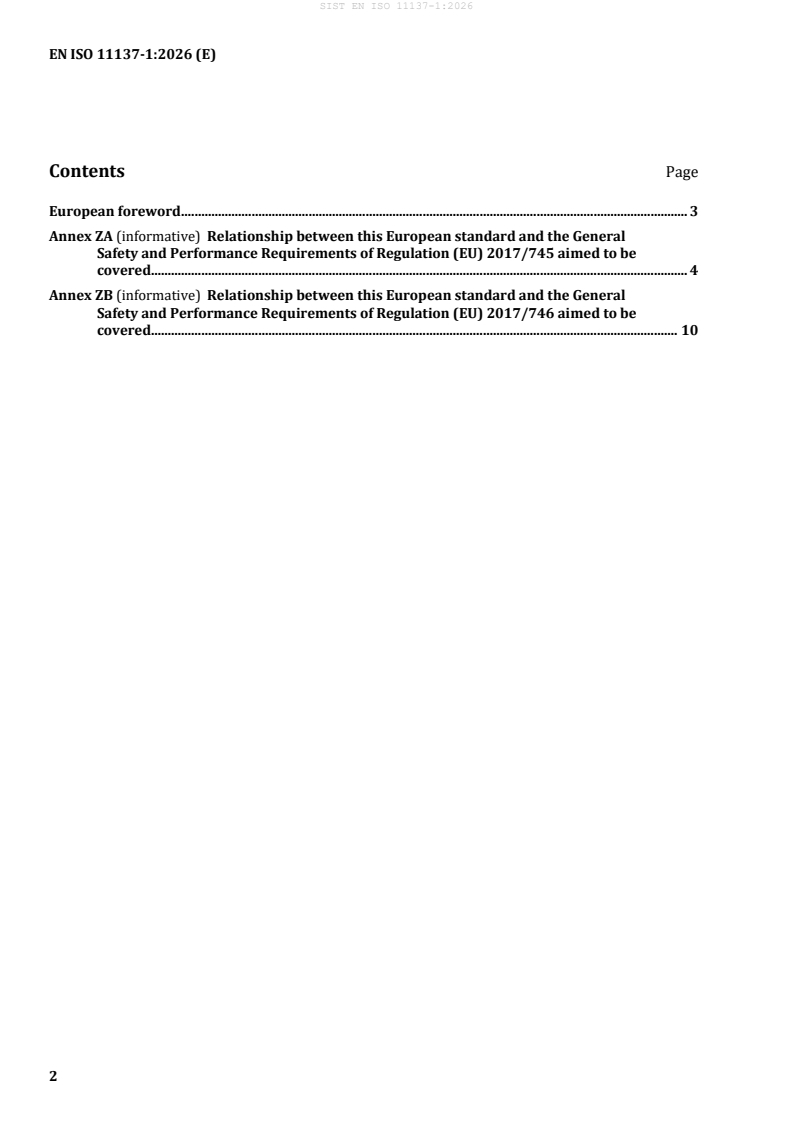
Contents Page
European foreword . 3
Annex ZA (informative) Relationship between this European standard and the General
Safety and Performance Requirements of Regulation (EU) 2017/745 aimed to be
covered. 4
Annex ZB (informative) Relationship between this European standard and the General
Safety and Performance Requirements of Regulation (EU) 2017/746 aimed to be
covered. 10
European foreword
This document (EN ISO 11137-1:2026) has been prepared by Technical Committee ISO/TC 198
"Sterilization of health care products" in collaboration with Technical Committee CEN/TC 204
“Sterilization of medical devices” the secretariat of which is held by BSI.
This European Standard shall be given the status of a national standard, either by publication of an
identical text or by endorsement, at the latest by December 2026, and conflicting national standards
shall be withdrawn at the latest by December 2026.
Attention is drawn to the possibility that some of the elements of this document may be the subject of
patent rights. CEN shall not be held responsible for identifying any or all such patent rights.
This document supersedes EN ISO 11137-1:2015.
This document has been prepared under a standardization request addressed to CEN by the European
Commission. The Standing Committee of the EFTA States subsequently approves these requests for its
Member States.
For the relationship with EU Legislation, see informative Annex ZA or ZB, which is an integral part of
this document.
Any feedback and questions on this document should be directed to the users’ national standards
body/national committee. A complete listing of these bodies can be found on the CEN website.
According to the CEN-CENELEC Internal Regulations, the national standards organizations of the
following countries are bound to implement this European Standard: Austria, Belgium, Bulgaria,
Croatia, Cyprus, Czech Republic, Denmark, Estonia, Finland, France, Germany, Greece, Hungary, Iceland,
Ireland, Italy, Latvia, Lithuania, Luxembourg, Malta, Netherlands, Norway, Poland, Portugal, Republic of
North Macedonia, Romania, Serbia, Slovakia, Slovenia, Spain, Sweden, Switzerland, Türkiye and the
United Kingdom.
Endorsement notice
The text of ISO 11137-1:2025 has been approved by CEN as EN ISO 11137-1:2026 without any
modification.
Annex ZA
(informative)
Relationship between this European standard and the General Safety and
Performance Requirements of Regulation (EU) 2017/745 aimed to be
covered
This European standard has been prepared under M/575 to provide one voluntary means of
conforming to the General Safety and Performance Requirements of Regulation (EU) 2017/745 of 5
April 2017 concerning medical devices [OJ L 117] and to system or process requirements including
those relating to quality management systems, risk management, post-market surveillance systems,
clinical investigations, clinical evaluation or post-market clinical follow-up.
Once this standard is cited in the Official Journal of the European Union under that Regulation,
compliance with the normative clauses of this standard given in Table ZA.1 and application of the
edition of the normatively referenced standards as given in Table ZA.2 confers, within the limits of the
scope of this standard, a presumption of conformity with the corresponding General Safety and
Performance Requirements of that Regulation, and associated EFTA Regulations.
Where a definition in this standard differs from a definition of the same term set out in Regulation (EU)
2017/745, the differences are indicated in Table ZA.3. For the purpose of using this standard in support
of the requirements set out in Regulation (EU) 2017/745, the definitions set out in this Regulation
prevail.
Where the European standard is an adoption of an International Standard, the scope of this standard
can differ from the scope of the European Regulation that it supports. As the scope of the applicable
regulatory requirements differ from nation to nation and region to region, the standard can only
support European regulatory requirements to the extent of the scope of the European regulation for
medical devices (EU) 2017/745).
NOTE 1 Where a reference from a clause of this standard to the risk management process is made, the risk
management process needs to be in compliance with Regulation (EU) 2017/745. This means that risks have to be
‘reduced as far as possible’, ‘reduced to the lowest possible level’, ‘reduced as far as possible and appropriate’,
‘removed or reduced as far as possible’, ‘eliminated or reduced as far as possible’, ’removed or minimized as far as
possible’, or ‘minimized’, according to the wording of the corresponding General Safety and Performance
Requirement.
NOTE 2 The manufacturer’s policy for determining acceptable risk must be in compliance with General Safety
and Performance Requirements 1, 2, 3, 4, 5, 8, 9, 10, 11, 14, 16, 17, 18, 19, 20, 21 and 22 of the Regulation.
NOTE 3 When a General Safety and Performance Requirement does not appear in Table ZA.1, it means that it is
not addressed by this European Standard.
Table ZA.1 — Correspondence between this European standard and Annex I of Regulation (EU)
2017/745 [OJ L 117] and to system or process requirements including those relating to quality
management systems, risk management, post-market surveillance systems, clinical
investigations, clinical evaluation or post-market clinical follow-up
General Safety and
Clause(s) / sub-clause(s) of
Performance Requirements of Remarks / Notes
this EN
Regulation (EU) 2017/745
11.3 5,6,8,9,10,11 This standard provides
requirements for the
development, validation and
routine control of a sterilization
process using radiation for
medical devices, including
requirements that the medical
device is safe and performs as
intended after treatment. It
could also be applied to the
development, validation and
routine control of a process for
attainment of a specific
microbial state other than
sterility.
This General Safety and
Performance Requirement is
addressed only with regard to
devices for which treatment by
irradiation is appropriate.
This relevant General Safety
and Performance Requirement
is only partly addressed in this
European Standard. Design and
packaging for maintenance of a
specific microbial state during
transportation and storage are
not covered. Aspects of
manufacture other than those
related to attainment of a
specific microbial state by
radiation are not covered.
11.4 first sentence only 5,6,8,9,10,11 This standard provides
requirements for the
development, validation and
routine control of a sterilization
process using radiation for
medical devices, including
requirements that the sterilized
medical device is safe and
performs as intended after
sterilization. This General
Safety and Performance
Requirement is addressed only
with regard to devices for
which sterilization by
irradiation is appropriate.
This relevant General Safety
and Performance Requirement
is only partly addressed in this
European Standard. Design and
packaging for maintenance of
sterility during transportation
and storage are not covered.
Aspects of manufacture other
than those related to
attainment of sterility by
radiation are not covered.
Evidence that the integrity of
the packaging is maintained to
the point of use is not covered.
11.5 5,6,8,9,10,11 This standard provides
requirements for the
development, validation and
routine control of a sterilization
process using radiation for
medical devices, including
requirements that the sterilized
medical device is safe and
performs as intended after
sterilization. This General
Safety and Performance
Requirement is addressed only
with regard to devices for
which sterilization by
irradiation is appropriate.
This relevant General Safety
and Performance Requirement
is only partly addressed in this
European Standard. Packaging
for maintenance of sterility is
not covered. Aspects of
manufacture other than those
related to attainment of
sterility by radiation are not
covered.
Table ZA.2 — Normative references from Clause 2 of this document and their corresponding
European publications
Column 1 Column 2 Column 3 Column 4
Reference in International
Title Corresponding European
Clause 2 Standard Edition
Standard Edition
ISO 11137-2:2013 ISO 11137-2:2013 Sterilization of health EN ISO 11137-2:2015
care products —
ISO 11137- EN ISO 11137-
Radiation — Part 2:
2:2013/Amd1:2022 2:2015/A1:2023
Establishing the
sterilization dose
ISO 13004 ISO 13004:2022 Sterilization of heath EN ISO 13004:2023
care products —
Radiation —
Substantiation of
selected sterilization
dose: Method VDmaxSD
ISO 11737-1 ISO 11737-1:2018 Sterilization of health EN ISO 11737-1:2018
care products —
ISO 11737- EN ISO 11737-
Microbiological
1:2018/Amd1:2021 1:2018/A1:2021
methods — Part 1:
Determination of a
population of
microorganisms on
products
ISO 11737-2 ISO 11737-2:2019 Sterilization of health EN ISO 11737-2:2020
care products —
Microbiological
methods — Part 2:
Tests of sterility
performed in the
definition, validation
and maintenance of a
sterilization process
ISO/ASTM 52628 ISO/ASTM 52628:2020 Standard Practice for N/A
Dosimetry in Radiation
Processing
The documents listed in the Column 1 of Table ZA.2, in whole or in part, are normatively referenced in
this document, i.e. are indispensable for its application. The achievement of the presumption of
conformity is subject to the application of the edition of Standards as listed in Column 4 or, if no
European Standard Edition exists, the International Standard Edition given in Column 2 of Table ZA.2.
WARNING 1: Presumption of conformity stays valid only as long as a reference to this European
standard is maintained in the list published in the Official Journal of the European Union. Users of this
standard should consult frequently the latest list published in the Official Journal of the European
Union.
WARNING 2: Other Union legislation may be applicable to the product(s) falling within the scope of this
standard.
Table ZA.3 — Definitions in this standard differs from a definition of the same term set out in
Regulation (EU) 2017/745
Term Definition in Clause 3 of this Definition in Regulation (EU)
document 2017/745
Corrective Action action to eliminate the cause of a ‘corrective action’ means action
nonconformity and to prevent taken to eliminate the cause of a
recurrence potential or actual non-conformity
or other undesirable situation;
Note 1 to entry: There can be
more than one cause for a
nonconformity.
Note 2 to entry: Corrective action
is taken to prevent recurrence
whereas preventive action is taken
to prevent occurrence.
[SOURCE: ISO 9000:2015, 3.12.2,
modified — Note 3 to entry has
been deleted.]
Medical Device instrument, apparatus, implement, ‘medical device’ means any
machine, appliance, implant, instrument, apparatus, appliance,
reagent for in vitro use, or software, implant, reagent, material
software, material or other similar or other article intended by the
or related article, intended by the manufacturer to be used, alone or in
manufacturer to be used, alone or combination, for human beings for
in combination, for human beings one or more of the following specific
for one or more of the specific medical purposes:
purpose(s) of:
- diagnosis, prevention,
- diagnosis, prevention, monitoring, prediction,
monitoring, treatment or prognosis, treatment or
alleviation of disease; alleviation of disease,
- diagnosis, monitoring, - diagnosis, monitoring,
treatment, alleviation of or treatment, alleviation of, or
compensation for an compensation for, an injury
injury; or disability,
- investigation, - investigation, replacement
replacement, modification, or modification of the
or support of the anatomy anatomy or of a
or of a physiological physiological or pathological
process; process or state,
- supporting or sustaining - providing information by
life; means of in vitro
examination of specimens
- control of conception;
derived from the human
- disinfection of medical
body, including organ, blood
devices;
and tissue donations,
- providing information by
and which does not achieve its
means of in vitro
principal intended action by
examination of specimens
pharmacological, immunological or
derived from the human
metabolic means, in or on the
body; human body, but which may be
assisted in its function by such
and does not achieve its primary
means.
intended action by
pharmacological, immunological The following products shall also be
or metabolic means, but which deemed to be medical devices:
may be assisted in its intended
- devices for the control or
function by such means
support of conception;
Note 1 to entry: Products which
- products specifically
may be considered to be medical
intended for the cleaning,
devices in some jurisdictions but
disinfection or sterilisation
not in others include:
of devices as referred to in
- items specifically Article 1(4) and of those
intended for cleaning or referred to in the first
sterilization of medical paragraph of this point.
devices;
- pouches, reel goods,
sterilization wrap, and
reusable containers for
packaging of medical
devices for sterilization;
- disinfection substances;
- aids for persons with
disabilities;
- devices incorporating
animal and/or human
tissues;
- devices for in vitro
fertilization or assisted
reproduction technologies.
[SOURCE: ISO 13485:2016, 3.11,
modified — The first two list items
in Note 1 to entry have been
added.]
Annex ZB
(informative)
Relationship between this European standard and the General Safety and
Performance Requirements of Regulation (EU) 2017/746 aimed to be
covered
This European standard has been prepared under M/575 to provide one voluntary means of
conforming to the General Safety and Performance Requirements of Regulation (EU) 2017/746 of 5
April 2017 concerning in vitro diagnostic medical devices [OJ L 117] and to system or process
requirements including those relating to quality management systems, risk management, post-market
surveillance systems, performance studies, clinical evidence or post-market performance follow-up.
Once this standard is cited in the Official Journal of the European Union under that Regulation,
compliance with the normative clauses of this standard given in Table ZB.1 and application of the
edition of the normatively referenced standards as given in Table ZA.2 confers, within the limits of the
scope of this standard, a presumption of conformity with the corresponding General Safety and
Performance Requirements of that Regulation, and associated EFTA Regulations.
Where a definition in this standard differs from a definition of the same term set out in Regulation (EU)
2017/746, the differences are indicated in Table ZB.2. For the purpose of using this standard in support
of the requirements set out in Regulation (EU) 2017/746, the definitions set out in this Regulation
prevail.
Where the European standard is an adoption of an International Standard, the scope of this standard
can differ from the scope of the European Regulation that it supports. As the scope of the applicable
regulatory requirements differ from nation to nation and region to region, the standard can only
support European regulatory requirements to the extent of the scope of the In vitro Diagnostic
Regulation (EU) 2017/746).
NOTE 1 Where a reference from a clause of this standard to the risk management process is made, the risk
management process needs to be in compliance with Regulation (EU) 2017/746. This means that risks have to be
‘reduced as far as possible’, ‘reduced to a level as low as reasonably practicable’, ‘reduced to the lowest possible
level’, ‘reduced as far as possible and appropriate’, ‘removed or reduced as far as possible’, ‘eliminated or reduced
as far as possible’, ‘prevented’ or ‘minimized’, according to the wording of the corresponding General Safety and
Performance Requirement.
NOTE 2 The manufacturer’s policy for determining acceptable risk must be in compliance with General Safety
and Performance Requirements 1, 2, 3, 4, 5, 8, 10, 11, 13, 15, 16, 17, 18 and 19 of the Regulation.
NOTE 3 When a General Safety and Performance Requirement does not appear in Table ZB.1, it means that it is
not addressed by this European Standard.
Table ZB.1 — Correspondence between this European standard and Annex I of Regulation (EU)
2017/746 [OJ L 117] and to system or process requirements including those relating to quality
management systems, risk management, post-market surveillance systems, performance
studies, clinical evidence or post-market performance follow-up.
General Safety and
Clause(s) / sub-
Performance Requirements of Remarks / Notes
clause(s) of this EN
Regulation (EU) 2017/746
11.2 5,6,8,9,10,11 This standard provides requirements
for the development, validation and
routine control of a sterilization
process using radiation for medical
devices, including requirements that
the sterilized medical device is safe
and performs as intended after
sterilization. It could also be applied
to the development, validation and
routine control of a process for
attainment of a specific microbial
state other than sterility.
This General Safety and Performance
Requirement is addressed only with
regard to devices for which treatment
by irradiation is appropriate.
This relevant General Safety and
Performance Requirement is only
partly addressed in this European
Standard. Design and packaging for
maintenance of a sterility or another
specific microbial state during
transportation and storage are not
covered. Aspects of manufacture
other than those related to
attainment of sterility or another
specific microbial state by radiation
are not covered.
11.3 5,6,8,9,10,11 This standard provides requirements
for the development, validation and
routine control of a sterilization
process using radiation for medical
devices, including requirements that
the sterilized medical device is safe
and performs as intended after
sterilization. This General Safety and
Performance Requirement is
addressed only with regard to devices
for which sterilization by irradiation
is appropriate.
This relevant General Safety and
Performance Requirement is only
partly addressed in this European
Standard. Packaging for maintenance
of sterility is not covered. Aspects of
manufacture other than those related
to attainment of sterility by radiation
are not covered.
WARNING 1: Presumption of conformity stays valid only as long as a reference to this European
standard is maintained in the list published in the Official Journal of the European Union. Users of this
standard should consult frequently the latest list published in the Official Journal of the European
Union.
WARNING 2: Other Union legislation may be applicable to the product(s) falling within the scope of this
standard.
Table ZB.2 — Definitions in this standard differs from a definition of the same term set out in
Regulation (EU) 2017/746
Term Definition in Clause 3 of this document Definition in Regulation
(EU) 2017/746
Corrective Action action to eliminate the cause of a ‘corrective action’ means
nonconformity and to prevent recurrence action taken to eliminate the
cause of a potential or actual
non-conformity or other
Note 1 to entry: There can be more than one
undesirable situation;
cause for a nonconformity.
Note 2 to entry: Corrective action is taken to
prevent recurrence whereas preventive
action is taken to prevent occurrence.
[SOURCE: ISO 9000:2015, 3.12.2, modified —
Note 3 to entry has been deleted.]
Medical Device instrument, apparatus, implement, machine, ‘medical device’ means
appliance, implant, reagent for in vitro use, ‘medical device’ as defined in
or software, material or other similar or point (1) of Article 2 of
related article, intended by the manufacturer Regulation (EU) 2017/745;
to be used, alone or in combination, for
human beings for one or more of the specific
purpose(s) of:
- diagnosis, prevention, monitoring,
treatment or alleviation of disease;
- diagnosis, monitoring, treatment,
alleviation of or compensation for an
injury;
- investigation, replacement,
modification, or support of the
anatomy or of a physiological
process;
- supporting or sustaining life;
- control of conception;
- disinfection of medical devices;
- providing information by means of
in vitro examination of specimens
derived from the human body;
and does not achieve its primary intended
action by pharmacological, immunological or
metabolic means, but which may be assisted
in its intended function by such means
Note 1 to entry: Products which may be
considered to be medical devices in some
jurisdictions but not in others include:
- items specifically intended for
cleaning or sterilization of medical
devices;
- pouches, reel goods, sterilization
wrap, and reusable containers for
packaging of medical devices for
sterilization;
- disinfection substances;
- aids for persons with disabilities;
- devices incorporating animal and/or
human tissues;
- devices for in vitro fertilization or
assisted reproduction technologies.
[SOURCE: ISO 13485:2016, 3.11, modified —
The first two list items in Note 1 to entry
have been added.]
International
Standard
ISO 11137-1
Second edition
Sterilization of health care
2025-04
products — Radiation —
Part 1:
Requirements for the
development, validation and
routine control of a sterilization
process for medical devices
Stérilisation des produits de santé — Irradiation —
Partie 1: Exigences relatives à la mise au point, à la validation
et au contrôle de routine d'un procédé de stérilisation pour les
dispositifs médicaux
Reference number
ISO 11137-1:2025(en) © ISO 2025
ISO 11137-1:2025(en)
All rights reserved.
ISO publications, in their entirety or in fragments, are owned by ISO. They are licensed, not sold, and are subject to the terms and
conditions set forth in the ISO End Customer License Agreement, the License Agreement of the relevant ISO member body, or
those of authorized third-party distributors.
Unless otherwise specified or required for its implementation, no part of this ISO publication may be reproduced, distributed,
modified, or used in any form or by any means, electronic or mechanical, including photocopying, scanning, recording, or posting
on any intranet, internet, or other digital platforms, without the prior written permission of ISO, the relevant ISO member body
or an authorized third-party distributor.
This publication shall not be disclosed to third parties, and its use is strictly limited to the license type and purpose specified in
the applicable license grant. Unauthorized reproduction, distribution, or use beyond the granted license is prohibited and may
result in legal action.
ISO copyright office
CP 401 • Ch. de Blandonnet 8
CH-1214 Vernier, Geneva
Phone: +41 22 749 01 11
Email: copyright@iso.org
Website: www.iso.org
Published in Switzerland
ii
ISO 11137-1:2025(en)
Contents Page
Foreword .iv
Introduction .viii
1 Scope . 1
2 Normative references . 2
3 Terms and definitions . 2
4 General . 9
5 Sterilizing agent characterization . 9
5.1 Sterilizing agent .9
5.2 Microbicidal effectiveness . .9
5.3 Material effects .10
5.4 Environmental considerations .10
6 Process and equipment characterization . 10
6.1 Process .10
6.2 Equipment .10
7 Product definition .11
8 Process definition .12
8.1 Establishing the maximum acceptable dose, D . 12
max,acc
8.2 Establishing the sterilization dose, D . 12
ster
8.3 Specifying the maximum acceptable dose and the sterilization dose . 12
8.4 Transference of maximum acceptable, verification or sterilization dose between
radiation sources . 13
8.4.1 Transference of maximum acceptable dose . 13
8.4.2 Transference of verification dose or sterilization dose . 13
9 Validation . .13
9.1 Installation qualification (IQ) . 13
9.2 Operational qualification (OQ) . 13
9.3 Performance qualification (PQ) .14
9.4 Review and approval of validation . 15
10 Routine monitoring and control.16
11 Product release from sterilization . 17
12 Maintaining process effectiveness . 17
12.1 Demonstration of continued effectiveness .17
12.1.1 General .17
12.1.2 Frequency of determinations of bioburden .17
12.1.3 Frequency of sterilization dose audits .18
12.2 Recalibration .19
12.3 Maintenance of equipment .19
12.4 Requalification of equipment .19
12.5 Assessment of change . 20
Annex A (informative) Guidance on this document .21
Bibliography .37
iii
ISO 11137-1:2025(en)
Foreword
ISO (the International Organization for Standardization) is a worldwide federation of national standards
bodies (ISO member bodies). The work of preparing International Standards is normally carried out through
ISO technical committees. Each member body interested in a subject for which a technical committee
has been established has the right to be represented on that committee. International organizations,
governmental and non-governmental, in liaison with ISO, also take part in the work. ISO collaborates closely
with the International Electrotechnical Commission (IEC) on all matters of electrotechnical standardization.
The procedures used to develop this document and those intended for its further maintenance are described
in the ISO/IEC Directives, Part 1. In particular, the different approval criteria needed for the different types
of ISO document should be noted. This document was drafted in accordance with the editorial rules of the
ISO/IEC Directives, Part 2 (see www.iso.org/directives).
ISO draws attention to the possibility that the implementation of this document may involve the use of (a)
patent(s). ISO takes no position concerning the evidence, validity or applicability of any claimed patent
rights in respect thereof. As of the date of publication of this document, ISO had not received notice of (a)
patent(s) which may be required to implement this document. However, implementers are cautioned that
this may not represent the latest information, which may be obtained from the patent database available at
www.iso.org/patents. ISO shall not be held responsible for identifying any or all such patent rights.
Any trade name used in this document is information given for the convenience of users and does not
constitute an endorsement.
For an explanation of the voluntary nature of standards, the meaning of ISO specific terms and expressions
related to conformity assessment, as well as information about ISO's adherence to the World Trade
Organization (WTO) principles in the Technical Barriers to Trade (TBT), see www.iso.org/iso/foreword.html.
This document was prepared by Technical Committee ISO/TC 198, Sterilization of health care products, in
collaboration with the European Committee for Standardization (CEN) Technical Committee CEN/TC 204,
Sterilization of medical devices, in accordance with the Agreement on technical cooperation between ISO and
CEN (Vienna Agreement).
This second edition cancels and replaces the first edition (ISO 11137-1:2006), which has been technically
revised.
The main changes are as follows:
— addition of ISO 13004 as a normative reference;
— addition of ISO/ASTM 52628 as a normative reference for dosimetry in radiation processing and
alignment of terminology across the document to ASTM standards terminology;
— update of Clause 4 to align with ISO/TC 198 documents;
— increase of the allowable limits above which the potential induced radioactivity shall be assessed to
11 MeV for electrons and 7,5 MeV for X-rays (see 5.1.2);
— addition of a requirement to ensure that failure of a control function does not lead to a failure in recording
process parameters such that an ineffective process appears effective (see 6.1);
— simplification of content on transference of verification dose or sterilization dose based on published
data that demonstrates that differences in operating conditions of the two radiation sources have no
effect on microbicidal effectiveness for product that does not promote microbial growth (see 8.4.2);
— clarification on the use of dose measurements and the recording of process variables for process control
(see 10.6 and 10.7);
— clarification has been provided on the allowable interval of time for quarterly dose audits, allowing for
an interval of four months provided there are four dose audits per year (see 12.1.2);
iv
ISO 11137-1:2025(en)
SD
— addition of references for all VD dose levels contained in both ISO 11137-2 and ISO 13004 (see 8.2.2
max
and 12.1.2);
— additional information has been included on bioburden determination for products with very low
bioburden (see 12.1.2.2 and A.12.1.2.2);
— addition of guidance related to new or modified normative content;
— addition of references to the Bibliography.
A list of all parts in the ISO 11137 series can be found on the ISO website.
Any feedback or questions on this document should be directed to the user’s national standards body. A
complete listing of these bodies can be found at www.iso.org/members.html.
Licensing and use terms
The ISO publications, as well as any updates and/or corrections, and any intellectual property or other rights
pertaining thereto, are owned by ISO. ISO publications are licensed, not sold. Nothing in this document shall
operate to assign or transfer any intellectual property rights from ISO to the user. The ISO publications are
protected by copyright law, database law, trademark law, unfair competition law, trade secrecy law, or any
other applicable law, as the case may be. Users acknowledge and agree to respect ISO’s intellectual property
rights in the ISO publications.
The use of ISO publications is subject to the terms and conditions of the applicable licensing agreement.
ISO publications are provided under different licensing agreement types (“License Type”) allowing a non-
exclusive, non-transferable, limited, revocable right to use/access the ISO publications for one or more of the
following purposes described below (“Purpose”), which may be internal or external in scope. The applicable
Purpose(s) must be captured in the licensing agreement.
a) License Type:
i. a single registered end-user license (watermarked in the user’s name) for the specified Purpose.
Under this license the user cannot share the ISO Publication with anyone, including on a network;
ii. a network license for the specified Purpose. The network license may be assigned to either unnamed
concurrent end-users or named concurrent end-users within the same organization.
b) Purpose:
i. Internal Purpose: internal use only within user’s organization, including but not limited to own
implementation (“Internal Purpose”).
The scope of permitted internal use is specified at the time of purchase or through subsequent
agreement with ISO, the ISO member body in the user’s country, any other ISO member body or an
authorized third-party distributor, including any applicable internal reproduction rights (such as
internal meetings, internal training programs, preparation of certification services, integration or
illustration in internal manuals, internal training materials, and internal guidance documents). Each
internal use must be explicitly specified in the purchase order, and specific fees and requirements
will apply to each permitted use.
ii. External Purpose: external use, including but not limited to:
— testing services
— inspection services
— certification services
— auditing services
— consulting services
v
ISO 11137-1:2025(en)
— training services
— software development and other digital platform or software-enabled digital services; and
any other services or activitie
...