

EN 10340:2007
(Main)Steel castings for structural uses
- Abstract
This European Standard applies to steel castings:
- for structural uses in buildings and civil engineering works. Its uses include housing and service buildings, bridges, roads, pipe network.
In cases where castings are joined by welding by the founder, this European Standard applies.
This European Standard does not apply in cases where castings are welded:
- to wrought products (plates, tubes, forgings...);
- or by non founders.
- Status
- Published
- Publication Date
- 09-Oct-2007
- Withdrawal Date
- 30-Jul-2009
- Technical Committee
- ECISS/TC 111 - Steel castings and forgings
- Drafting Committee
- ECISS/TC 111 - Steel castings and forgings
- Current Stage
- 6060 - Definitive text made available (DAV) - Publishing
- Start Date
- 10-Oct-2007
- Completion Date
- 10-Oct-2007
- Directive
- 305/2011 - Regulation (eu) No 305/2011 of the European Parliament and of the Council of 9 march 2011 laying down harmonised conditions for the marketing of construction products and repealing council directive 89/106/eecOJ Ref: C, C 259 OJ Date: 08-Aug-2014
89/106/EEC - Construction productsOJ Ref: C, C 309 OJ Date: 18-Dec-2009



Overview
EN 10340:2007 - Steel castings for structural uses is a CEN European Standard that specifies technical delivery conditions for steel castings intended for structural applications in buildings and civil engineering (for example housing and service buildings, bridges, roads and pipe networks). The standard applies when castings are welded by the founder, but excludes castings welded to wrought products (plates, tubes, forgings) or welded by non-founders. EN 10340:2007 is to be used alongside EN 1559‑1 and EN 1559‑2 and supports the Construction Products Directive (CPD) requirements (see Annex ZA).
Key topics and technical requirements
- Scope and designation
- Covers a range of cast steel grades and requires designation that includes heat‑treatment symbols where grades deliver different strength levels (see Table 2).
- Chemical composition
- Cast analysis limits are defined (see Table 1). Composition control and permitted deviations are governed in conjunction with EN 1559‑2.
- Mechanical properties
- Tensile and yield (Rp0.2) values, elongation and impact energy requirements are given by grade and heat treatment in Table 2. Mechanical property requirements apply up to specified wall thicknesses; test blocks for verification are limited to 150 mm maximum.
- Heat treatment and symbols
- Symbols such as +N (normalizing), +QT (quench + temper), +AT (solution anneal) define requirements and influence mechanical properties and post‑weld treatments.
- Welding
- Welding by the founder is permitted when performed to a qualified procedure (EN ISO 11970). Welds shall meet the same NDT criteria as the parent casting. Annex A gives preheat, interpass and post‑weld heat‑treatment guidance; normative for austenitic and austenitic‑ferritic grades, informative for others.
- Testing and inspection
- Mandatory tests include tensile, impact, ferrite, intergranular corrosion and magnetic tests (as applicable). Chemical analysis methods follow established standards; dimensional tolerances reference EN ISO 8062‑3. Non‑destructive testing, sampling, retest and conformity evaluation provisions are included.
- Conformity & safety
- Annex B addresses conformity evaluation for regulatory purposes; Annex ZA maps the standard to CPD essential requirements. Dangerous substances requirements are noted (materials must not release substances above permitted levels).
Practical applications
- Use EN 10340:2007 when specifying, manufacturing or accepting steel castings for structural elements in:
- Buildings and housing components
- Bridges and motorway/road structures
- Pipeline fittings, manholes and network infrastructure
- Civil engineering metalwork requiring controlled mechanical and welding performance
- The standard ensures castings meet required chemical, mechanical, welding and inspection criteria for safe, durable structural use.
Who should use this standard
- Foundries and casting producers (manufacture, heat treatment, welding)
- Structural engineers and designers specifying cast components
- Procurement and quality assurance teams (material acceptance, testing and documentation)
- Welding engineers and welding procedure approvers (EN ISO 11970)
- Notified bodies and authorities assessing conformity with CPD/Construction Products requirements
Related standards
- EN 1559‑1:1997 and EN 1559‑2:2000 (founding delivery conditions)
- EN ISO 11970 (welding procedure approval for steel castings)
- EN ISO 8062‑3 (dimensional tolerances for castings)
- EN 10204 (inspection documents)
Keywords: EN 10340:2007, steel castings, structural uses, CEN standard, welding conditions, mechanical properties, chemical composition, heat treatment, non‑destructive testing, construction castings, foundry quality control.
Relations
- Effective Date
- 28-Jan-2026
- Effective Date
- 28-Jan-2026
- Effective Date
- 28-Jan-2026
- Effective Date
- 28-Jan-2026
- Effective Date
- 28-Jan-2026
- Effective Date
- 28-Jan-2026
- Effective Date
- 28-Jan-2026
- Effective Date
- 28-Jan-2026
- Effective Date
- 28-Jan-2026
- Effective Date
- 28-Jan-2026
- Effective Date
- 28-Jan-2026
- Effective Date
- 28-Jan-2026
- Effective Date
- 28-Jan-2026
- Effective Date
- 28-Jan-2026
- Effective Date
- 28-Jan-2026
Get Certified
Connect with accredited certification bodies for this standard

Element Materials Technology
Materials testing and product certification.

Inštitut za kovinske materiale in tehnologije
Institute of Metals and Technology. Materials testing, metallurgical analysis, NDT.
Sponsored listings
Frequently Asked Questions
EN 10340:2007 is a standard published by the European Committee for Standardization (CEN). Its full title is "Steel castings for structural uses". This standard covers: This European Standard applies to steel castings: - for structural uses in buildings and civil engineering works. Its uses include housing and service buildings, bridges, roads, pipe network. In cases where castings are joined by welding by the founder, this European Standard applies. This European Standard does not apply in cases where castings are welded: - to wrought products (plates, tubes, forgings...); - or by non founders.
This European Standard applies to steel castings: - for structural uses in buildings and civil engineering works. Its uses include housing and service buildings, bridges, roads, pipe network. In cases where castings are joined by welding by the founder, this European Standard applies. This European Standard does not apply in cases where castings are welded: - to wrought products (plates, tubes, forgings...); - or by non founders.
EN 10340:2007 is classified under the following ICS (International Classification for Standards) categories: 77.140.80 - Iron and steel castings. The ICS classification helps identify the subject area and facilitates finding related standards.
EN 10340:2007 has the following relationships with other standards: It is inter standard links to EN ISO 11970:2025, EN 1559-2:2000, EN ISO 8062-3:2023, EN ISO 9001:2000, EN 1559-1:1997, EN 10204:2004, EN 1337-8:2007, EN 14879-1:2005, EN 13411-9:2021, EN 1090-2:2018+A1:2024, EN 13001-3-5:2025, EN 1090-2:2018, EN 15085-4:2023, EN 13001-3-5:2016+A1:2021, EN 1090-2:2008+A1:2011. Understanding these relationships helps ensure you are using the most current and applicable version of the standard.
EN 10340:2007 is associated with the following European legislation: EU Directives/Regulations: 305/2011, 89/106/EEC, 97/23/EC; Standardization Mandates: M/005, M/071, M/120, M/131. When a standard is cited in the Official Journal of the European Union, products manufactured in conformity with it benefit from a presumption of conformity with the essential requirements of the corresponding EU directive or regulation.
EN 10340:2007 is available in PDF format for immediate download after purchase. The document can be added to your cart and obtained through the secure checkout process. Digital delivery ensures instant access to the complete standard document.
Standards Content (Sample)
2003-01.Slovenski inštitut za standardizacijo. Razmnoževanje celote ali delov tega standarda ni dovoljeno.Steel castings for structural usesJekleni ulitki za uporabo v gradbeništvuAciers moulés de constructionStahlguss für das BauwesenTa slovenski standard je istoveten z:EN 10340:2007SIST EN 10340:2007en,fr,de77.140.80Železni in jekleni ulitkiIron and steel castingsICS:SLOVENSKI
STANDARDSIST EN 10340:200701-december-2007
EUROPEAN STANDARDNORME EUROPÉENNEEUROPÄISCHE NORMEN 10340October 2007ICS 77.140.80 English VersionSteel castings for structural usesAciers moulés de constructionStahlguss für das BauwesenThis European Standard was approved by CEN on 18 August 2007.CEN members are bound to comply with the CEN/CENELEC Internal Regulations which stipulate the conditions for giving this EuropeanStandard the status of a national standard without any alteration. Up-to-date lists and bibliographical references concerning such nationalstandards may be obtained on application to the CEN Management Centre or to any CEN member.This European Standard exists in three official versions (English, French, German). A version in any other language made by translationunder the responsibility of a CEN member into its own language and notified to the CEN Management Centre has the same status as theofficial versions.CEN members are the national standards bodies of Austria, Belgium, Bulgaria, Cyprus, Czech Republic, Denmark, Estonia, Finland,France, Germany, Greece, Hungary, Iceland, Ireland, Italy, Latvia, Lithuania, Luxembourg, Malta, Netherlands, Norway, Poland, Portugal,Romania, Slovakia, Slovenia, Spain, Sweden, Switzerland and United Kingdom.EUROPEAN COMMITTEE FOR STANDARDIZATIONCOMITÉ EUROPÉEN DE NORMALISATIONEUROPÄISCHES KOMITEE FÜR NORMUNGManagement Centre: rue de Stassart, 36
B-1050 Brussels© 2007 CENAll rights of exploitation in any form and by any means reservedworldwide for CEN national Members.Ref. No. EN 10340:2007: E
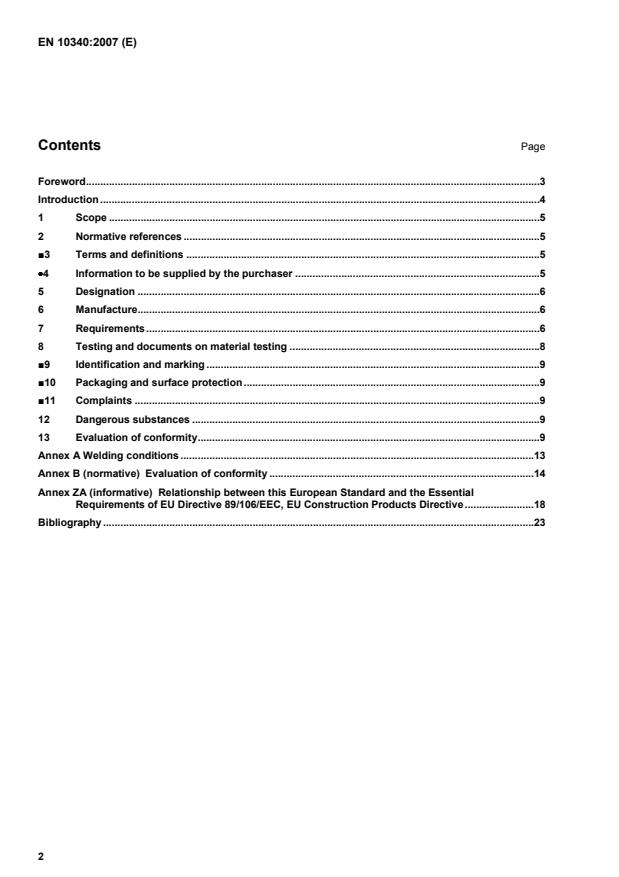
Evaluation of conformity.14 Annex ZA (informative)
Relationship between this European Standard and the Essential Requirements of EU Directive 89/106/EEC, EU Construction Products Directive.18 Bibliography.23
1) When complementary information is given in a clause or subclause of this standard (versus the same clause or subclause of EN 1559-1:1997 or EN 1559-2:2000) it is preceded by "in addition to EN 1559".
v3 Terms and definitions For the purposes of this document, the terms and definitions given in EN 1559-1:1997 and EN 1559-2:2000 apply. ••••4 Information to be supplied by the purchaser In cases of grades with different mechanical properties relating to heat treatment conditions the manufacturer shall obtain from the purchaser the heat treatment symbol in accordance with Clause 5.
6.2 Welding operations v6.2.1 General 6.2.2 Production welding 6.2.2.1 Unless otherwise specified welding is permitted, provided that all welds shall comply with the same criteria for non-destructive testing as the relevant part of the casting and shall be carried out according to a qualified welding procedure (see EN ISO 11970). 6.2.2.2 Conditions for preheat, interpass and postweld heat-treatment related to welding operations are given in Annex A. 7 Requirements v7.1 General 7.2 Material 7.2.1 Chemical composition In addition to EN 1559-2:2000: chemical composition determined by a cast analysis shall comply with the values given in Table 1; permissible deviations between the specified cast analysis and the check analysis on test blocks are indicated in Table 1 of EN 1559-2:2000.
tolerances on dimensions and shape specified in accordance with EN ISO 8062-3 and additional tolerances shall be verified by measuring equipment with sufficient accuracy. NOTE 2 Usually the accuracy of the measuring equipment is 1/10 of tolerance to be measured.
max. GS200 1.0449 - 0,18 0,60 - 1,20 0,030 0,025 - 0,30a - 0,12a - 0,40a - 0,03a - 0,30a GS240 1.0455 - 0,23 0,60 - 1,20 0,030 0,025 - 0,30a - 0,12a - 0,40a - 0,03a - 0,30a G17Mn5 1.1131 0,15 0,20 0,60 1,00 1,60 0,020 0,020 b- 0,30a - 0,12a - 0,40a - 0,03a - 0,30a G20Mn5 1.6220 0,17 0,23 0,60 1,00 1,60 0,020 0,020 b- 0,30a - 0,12a - 0,80a - 0,03a - 0,30a G24Mn6 1.1118 0,20 0,25 0,60 1,50 1,80 0,020 0,015 - 0,30a - 0,12a - 0,40a - 0,03a - 0,30a G10MnMoV6-3 1.5410 - 0,12 0,60 1,20 1,80 0,025 0,020 - 0,30 0,20 0,40 - 0,40 0,05 0,10 - 0,30 G18NiMoCr3-6 1.6759 0,17 0,22 0,60 0,80 1,20 0,020 0,015 0,40 0,90 0,40 0,70 0,60 1,00 - 0,05 - 0,30 GX4CrNi13-4 1.4317 - 0,06 1,00 - 1,00 0,035 0,015 12,00 13,50 - 0,70 3,50 5,00 - 0,08 - 0,30 GX4CrNiMo16-5-1 1.4405 - 0,06 0,80 - 1,00 0,035 0,025 15,00 17,00 0,70 1,50 4,00 6,00 - 0,08 - 0,30 GX2CrNi19-11 1.4309 - 0,030 1,50 - 2,00 0,035 0,025 18,00 20,00 - 0,50 9,00 12,00- - 0,20 max. 0,50 GX2CrNiMo19-11-2 1.4409 - 0,030 1,50 - 2,00 0,035 0,025 18,00 20,00 2,00 2,50 9,00 12,00- - 0,20 max. 0,50 GX2CrNiMoN25-6-3 1.4468
0,030 1,00 - 2,00 0,035 0,025 24,50 26,50 2,50 3,50 5,50 7,00 - - 0,12 to 0,25 0,50 a Cr + Mo + Ni + V + Cu ≤ 1 %. b For castings of ruling thickness < 28 mm, S ≤ 0,030 % (by mass) shall be permitted.
°C °C mm MPa d MPa d % J °C
min.
min. min.
GS200 1.0449 + N 900 to 980 e - t ≤ 100 200 380 to 530 25 35 RT f GS240 1.0455 + N 900 to 980 e - t ≤ 100 240 450 to 600 22 31 RT f G17Mn5 1.1131 + QT 920 to 980 e g 600 to 700 t ≤ 50 240 450 to 600 24 27 -40
70 RT f
1.6220 + N 900 to 980 e - t ≤ 30 300 480 to 620 20 27 -30
50 RT f G20Mn5
+QT 900 to 980 e g 610 to 660 t ≤ 100 300 500 to 650 22 27 - 40
60 RT f
1.1118 + QT1
520 to 570 t ≤ 50 550 700 to 800 12 27 - 20 G24Mn6
+ QT2 880 to 950 g 600 to 650 t ≤ 100 500 650 to 800 15 27 -30
+QT3
650 to 680 t ≤ 150 400 600 to 800 18 27 - 30
t ≤ 50 380 500 to 650 22 27 - 20
60 RT f
+ QT1 950 to 980 e 640 to 660 50 < t ≤ 100 350 480 to 630 22 60 RT f
100 < t ≤ 150 330 480 to 630 20 60 RT f 1.5410
150 < t ≤ 250 330 450 to 600 18 60 RT f G10MnMoV6-3
t ≤ 50 500 600 to 750 18 27 - 20
60 RT f
+QT2 950 to 980 g 640 to 660 50 < t ≤100 400 550 to 700 18 60 RT f
100 < t ≤ 150 380 500 to 650 18 60 RT f
150 < t ≤ 250 350 460 to 610 18 60 RT f
+ QT3 950 to 980 g 740 to 760
27 - 20
+ t ≤100 400 520 to 650 22
600 to 650
60 RT f
t Rp0,2 Rm A KV Temperature
°C °C mm MPa d MPa d % J °C
min.
min. min.
G18NiMoCr3-6 1.6759 + QT1 900 to 980 g 580 to 620 t ≤ 80 700 830 to 980 12 27 - 40
+QT2 900 to 980 g 590 to 630 t ≤ 150 630 780 to 930 12 27 - 40 GX4CrNi13-4 1.4317 +QT 1 000 to 1 050 590 to 620 t ≤ 300 570 760 to 960 15 50 RT f GXCrNiMo16-5-1 1.4405 +QT 1 020 to 1 070 580 to 630 t ≤ 300 540 760 to 960 15 60 RT f GX2CrNi19-11 1.4309 + ATh 1 050 to 1 150 - t ≤ 150 185 440 to 640 30 80 RT f GX2CrNiMo19-11-2 1.4409 +ATh 1 080 to 1 150 - t ≤ 150 195 440 to 640 30 80 RT f GX2CrNiMoN25-6-3 1.4468 +ATh 1 120 to 1 150 - t ≤ 150 480 650 to 850 22 50 RT f a Temperature and cooling medium (for information only). b If two impact values are given, see 7.2.2.3. c + N means: Normalizing, + QT or + QT1 or + QT2 or + QT3 means: Quenching + Tempering; + AT means: Solution Annealing. d 1 MPa = 1N/mm2. e Cooling in air (for information only). f RT means Room Temperature. g Cooling in liquid (for information only). h Solution annealing with quenching in water.
Welding conditions Annex A shall be normative for austenitic and austenitic-ferritic grades. Annex A is informative for all other grades. Table A.1 — Welding conditions Designation Name Number Preheat temperature °C a Interpass temperature °C max. Post heat treatment °C GS200 1.0449 20 to 150 350 No heat treatment necessary GS240 1.0455 20 to 150 350 No heat treatment necessary G17Mn5 1.1131 20 to 150 350 No heat treatment necessary G20Mn5 1.6220 20 to 150 350 No heat treatment necessary G24Mn6 1.1118 20 to 150 350 No heat treatment necessary G10MnMoV6-3 1.5410 20 to 150 350 b G18NiMoCr3-6 1.6759 20 to 200 350 b GX4CrNi13-4 1.4317 100 to 200 300 Same as normal tempering temperature GX4CrNiMo16-5-1 1.4405 No preheat 200 Same as normal tempering temperature Informative
Minor welds d Major welds e GX2CrNi19-11
1.4309 No heat tr. necessf No heat tr. necessf GX2CrNiMo19-11-2 1.4409 No preheat c No heat tr. necessf No heat tr. necessf GX2CrNiMoN25-6-3 1.4468 20 to 100 250f +Atg,h +ATg,h normative a The preheating temperature is related to the geometry and the thickness of the casting and climate conditions. b The post weld heat treatment temperature shall be at least 20 K but not more than 50 K below the tempering temperature, (e.g: for a tempering temperature 600 °C the post weld heat tre
...