

EN 15067:2007
(Main)Plastics and rubber machines - Film converting machines for bags and sacks - Safety requirements
- Abstract
This European Standard specifies the safety requirements applicable to the design and construction of film converting machines for making bags and sacks, for the significant and specific hazards listed in Clause 4.
This type of machine is based on the welding process.
A film converting machine for bags and sacks starts at the film unwinding unit or at the film inlet when this machine is directly fed by an upstream process and ends at the product collection or delivery unit.
The bag making line may include:
1) unwind units
2) slit-welding units
3) gussetting units
4) lane deviation units
5) perforating and welding or cutting and welding units
6) blocking units
7) pick-up and transfer units
8) stacking units
9) punching units
10) folding units
11) winding units
12) labelling or taping units
13) handle and closure units
14) draw tape insertion units
15) generators of electrostatic charge
16) electrostatic discharge equipment.
Printing units, high frequency welding machines and the design and construction of electrostatic generators are not covered by this standard.
Ultrasonic radiation hazards resulting from ultrasonic welding devices, e.g. integrated in handle and closure units, are not covered by this standard.
Film converting machines for bags and sacks generally do not create explosive atmospheres. In principle they therefore correspond with line F of Table 2 of the ATEX Guideline and consequently do not fall within the scope of Directive 94/9/EC.
This document is not applicable to machines which are manufactured before the date of its publication as EN.
- Status
- Published
- Publication Date
- 11-Dec-2007
- Withdrawal Date
- 29-Jun-2008
- Technical Committee
- CEN/TC 145 - Rubber and plastics machines - Safety
- Drafting Committee
- CEN/TC 145/WG 14 - Welding machines for plastics - Safety
- Current Stage
- 9093 - Decision to confirm - Review Enquiry
- Start Date
- 03-Sep-2025
- Completion Date
- 14-Oct-2026
- Directive
- 2006/42/EC - Directive 2006/42/EC of the European Parliament and of the Council of 17 May 2006 on machinery, and amending Directive 95/16/EC (recast)OJ Ref: C, C 214 OJ Date: 08-Sep-2009

Overview
EN 15067:2007 - published by CEN - specifies the safety requirements for the design and construction of film converting machines for bags and sacks. These machines are typically based on a welding process and the standard covers a complete bag-making line that starts at the film unwinding unit (or film inlet) and ends at the product collection or delivery unit. EN 15067:2007 is a Type C standard (per EN ISO 12100‑1) and supports relevant EU directives (see informative Annexes ZA/ZB).
Key exclusions:
- Printing units, high‑frequency welding machines and the design of electrostatic generators are not covered.
- Ultrasonic radiation hazards from ultrasonic welding devices are excluded.
- The standard does not apply to machines manufactured before its publication.
Key topics
EN 15067:2007 addresses the significant and specific hazards identified in Clause 4 and the protective measures in Clause 5. Major technical topics include:
- Machine scope and configuration - defines the bag making line components (unwind, slit‑welding, gussetting, lane deviation, perforating/cutting & welding, blocking, pick‑up/transfer, stacking, punching, folding, winding, labelling/taping, handle/closure, draw tape insertion, electrostatic generators and discharge equipment).
- Hazard categories - mechanical, electrical, slipping/tripping/falling, noise, thermal, fire, start‑up/setting operations, and specific hazards for each unit type.
- Safety requirements and protective measures - guarding, interlocks, emergency stop, control system safety, pressure‑sensitive devices and safe isolation.
- Verification and testing - procedures to verify that required safety measures are implemented (Clause 6).
- Information for use - minimum machine marking and required instruction manual content (Clause 7).
- Noise measurement - Annex A provides noise test code and declaration/verification guidance.
Applications and users
EN 15067:2007 is used by:
- Machine manufacturers and designers of film converting machines for bags and sacks to ensure compliant design and safe construction.
- Integrators and line builders who configure bag‑making lines.
- Safety engineers, CE‑marking assessors and conformity bodies verifying compliance with EU machinery directives.
- Maintenance teams and HSE managers for safe operation, guarding and procedural controls.
Practical benefits: reduces injury risk around welding and web‑handling processes, clarifies safety duties for each line unit, and standardizes verification and user information.
Related standards
EN 15067:2007 references other relevant standards for detailed requirements, for example:
- EN 60204‑1 (Electrical equipment of machines)
- EN 954‑1 / principles for safety‑related control systems
- EN 61496‑1 (Electro‑sensitive protective equipment)
- EN 1037, EN 1088, EN 953 (guards, interlocks, prevention of unexpected start‑up)
- EN ISO series for acoustics (EN ISO 11201, 11202, 3744, 3746)
Using EN 15067:2007 helps ensure film converting equipment for bags and sacks meets recognized European safety practice and supports regulatory compliance.
Relations
- Effective Date
- 25-Aug-2026
- Effective Date
- 09-Feb-2026
- Effective Date
- 09-Feb-2026
- Effective Date
- 09-Feb-2026
- Effective Date
- 28-Jan-2026
- Effective Date
- 28-Jan-2026
- Effective Date
- 28-Jan-2026
- Effective Date
- 28-Jan-2026
- Effective Date
- 28-Jan-2026
- Effective Date
- 28-Jan-2026
- Effective Date
- 28-Jan-2026
- Effective Date
- 28-Jan-2026
- Effective Date
- 28-Jan-2026
- Effective Date
- 28-Jan-2026
- Effective Date
- 28-Jan-2026
Get Certified
Connect with accredited certification bodies for this standard

DIN CERTCO
DIN Group product certification.

Smithers Quality Assessments
US management systems and product certification.
Sponsored listings
Frequently Asked Questions
EN 15067:2007 is a standard published by the European Committee for Standardization (CEN). Its full title is "Plastics and rubber machines - Film converting machines for bags and sacks - Safety requirements". This standard covers: This European Standard specifies the safety requirements applicable to the design and construction of film converting machines for making bags and sacks, for the significant and specific hazards listed in Clause 4. This type of machine is based on the welding process. A film converting machine for bags and sacks starts at the film unwinding unit or at the film inlet when this machine is directly fed by an upstream process and ends at the product collection or delivery unit. The bag making line may include: 1) unwind units 2) slit-welding units 3) gussetting units 4) lane deviation units 5) perforating and welding or cutting and welding units 6) blocking units 7) pick-up and transfer units 8) stacking units 9) punching units 10) folding units 11) winding units 12) labelling or taping units 13) handle and closure units 14) draw tape insertion units 15) generators of electrostatic charge 16) electrostatic discharge equipment. Printing units, high frequency welding machines and the design and construction of electrostatic generators are not covered by this standard. Ultrasonic radiation hazards resulting from ultrasonic welding devices, e.g. integrated in handle and closure units, are not covered by this standard. Film converting machines for bags and sacks generally do not create explosive atmospheres. In principle they therefore correspond with line F of Table 2 of the ATEX Guideline and consequently do not fall within the scope of Directive 94/9/EC. This document is not applicable to machines which are manufactured before the date of its publication as EN.
This European Standard specifies the safety requirements applicable to the design and construction of film converting machines for making bags and sacks, for the significant and specific hazards listed in Clause 4. This type of machine is based on the welding process. A film converting machine for bags and sacks starts at the film unwinding unit or at the film inlet when this machine is directly fed by an upstream process and ends at the product collection or delivery unit. The bag making line may include: 1) unwind units 2) slit-welding units 3) gussetting units 4) lane deviation units 5) perforating and welding or cutting and welding units 6) blocking units 7) pick-up and transfer units 8) stacking units 9) punching units 10) folding units 11) winding units 12) labelling or taping units 13) handle and closure units 14) draw tape insertion units 15) generators of electrostatic charge 16) electrostatic discharge equipment. Printing units, high frequency welding machines and the design and construction of electrostatic generators are not covered by this standard. Ultrasonic radiation hazards resulting from ultrasonic welding devices, e.g. integrated in handle and closure units, are not covered by this standard. Film converting machines for bags and sacks generally do not create explosive atmospheres. In principle they therefore correspond with line F of Table 2 of the ATEX Guideline and consequently do not fall within the scope of Directive 94/9/EC. This document is not applicable to machines which are manufactured before the date of its publication as EN.
EN 15067:2007 is classified under the following ICS (International Classification for Standards) categories: 83.200 - Equipment for the rubber and plastics industries. The ICS classification helps identify the subject area and facilitates finding related standards.
EN 15067:2007 has the following relationships with other standards: It is inter standard links to ISO 8598:1996, EN 60529:1991, EN 61496-1:2004, CLC/TR 50404:2003, EN ISO 14122-4:2004, EN 349:1993, EN 2286:1989, EN ISO 4871:1996, EN 1760-1:1997, EN ISO 11204:1995, EN ISO 14122-2:2001, EN ISO 3747:2000, EN 1088:1995, EN ISO 9614-2:1996, EN ISO 12100-2:2003. Understanding these relationships helps ensure you are using the most current and applicable version of the standard.
EN 15067:2007 is associated with the following European legislation: EU Directives/Regulations: 2006/42/EC, 98/37/EC; Standardization Mandates: M/079, M/396. When a standard is cited in the Official Journal of the European Union, products manufactured in conformity with it benefit from a presumption of conformity with the essential requirements of the corresponding EU directive or regulation.
EN 15067:2007 is available in PDF format for immediate download after purchase. The document can be added to your cart and obtained through the secure checkout process. Digital delivery ensures instant access to the complete standard document.
Standards Content (Sample)
2003-01.Slovenski inštitut za standardizacijo. Razmnoževanje celote ali delov tega standarda ni dovoljeno.Plastics and rubber machines - Film converting machines for bags and sacks - Safety requirements]DKWHYHMachines pour les matières plastiques et le caoutchouc - Machines de fabrication de sacs et sachets - Prescriptions de sécuritéKunststoff- und Gummimaschinen - Folienverarbeitungsmaschinen für Beutel und Säcke - SicherheitsanforderungenTa slovenski standard je istoveten z:EN 15067:2007SIST EN 15067:2008en,fr,de83.200ICS:SLOVENSKI
STANDARDSIST EN 15067:200801-april-2008
EUROPEAN STANDARDNORME EUROPÉENNEEUROPÄISCHE NORMEN 15067December 2007ICS 83.200 English VersionPlastics and rubber machines - Film converting machines forbags and sacks - Safety requirementsMachines pour les matières plastiques et le caoutchouc -Machines de fabrication de sacs et sachets - Prescriptionsde sécuritéKunststoff- und Gummimaschinen -Folienverarbeitungsmaschinen für Beutel und Säcke -SicherheitsanforderungenThis European Standard was approved by CEN on 4 November 2007.CEN members are bound to comply with the CEN/CENELEC Internal Regulations which stipulate the conditions for giving this EuropeanStandard the status of a national standard without any alteration. Up-to-date lists and bibliographical references concerning such nationalstandards may be obtained on application to the CEN Management Centre or to any CEN member.This European Standard exists in three official versions (English, French, German). A version in any other language made by translationunder the responsibility of a CEN member into its own language and notified to the CEN Management Centre has the same status as theofficial versions.CEN members are the national standards bodies of Austria, Belgium, Bulgaria, Cyprus, Czech Republic, Denmark, Estonia, Finland,France, Germany, Greece, Hungary, Iceland, Ireland, Italy, Latvia, Lithuania, Luxembourg, Malta, Netherlands, Norway, Poland, Portugal,Romania, Slovakia, Slovenia, Spain, Sweden, Switzerland and United Kingdom.EUROPEAN COMMITTEE FOR STANDARDIZATIONCOMITÉ EUROPÉEN DE NORMALISATIONEUROPÄISCHES KOMITEE FÜR NORMUNGManagement Centre: rue de Stassart, 36
B-1050 Brussels© 2007 CENAll rights of exploitation in any form and by any means reservedworldwide for CEN national Members.Ref. No. EN 15067:2007: E
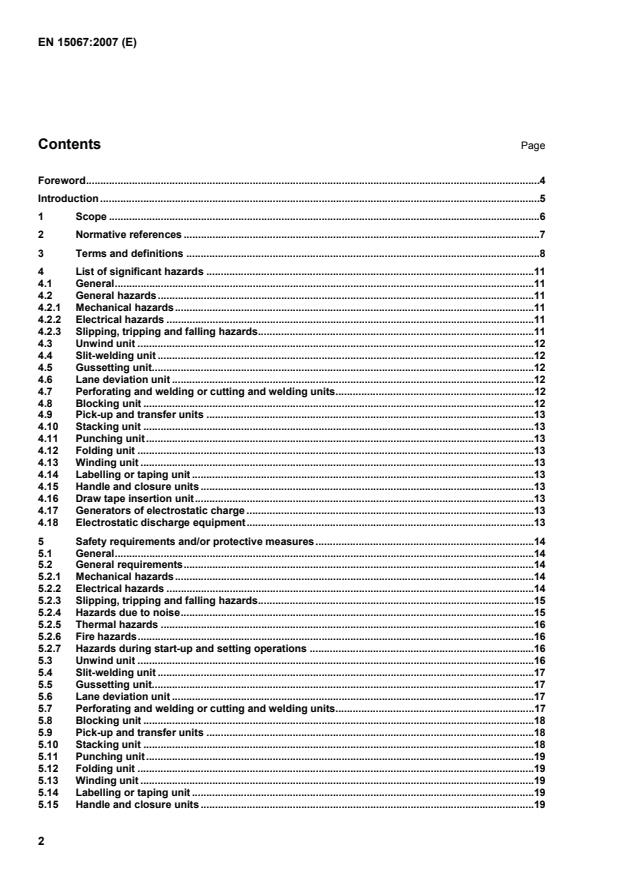
Noise test code.25 A.1 Introduction.25 A.2 Determination of the A-weighted emission sound pressure level at the workstation.25 A.3 Determination of the A-weighted sound power level.25 A.4 Mounting and operating conditions.26 A.5 Information to be recorded and reported.26 A.5.1 General.26 A.5.2 General data.26 A.5.3 Mounting and operating conditions.26 A.5.4 Standards.26 A.5.5 Noise data.26 A.6 Declaration and verification of noise emission values.27 Annex B (informative)
Relationship between the hazards and the safety requirements and/or protective measures.28 Annex ZA (informative)
Relationship between this
European
Standard and the Essential Requirements
of EU Directive 98/37/EC.30 Annex ZB (informative)
Relationship between this
European
Standard and the Essential Requirements
of EU Directive 2006/42/EC.31 Bibliography.32
The machinery concerned and the extent to which hazards, hazardous situations and events are covered are indicated in the scope of this document.
When provisions of this type C standard are different from those which are stated in type A or B standards, the provisions of this type C standard take precedence over the provisions of the other standards, for machines that have been designed and built according to the provisions of this type C standard.
The bag making line may include: 1) unwind units 2) slit-welding units 3) gussetting units
4) lane deviation units
5) perforating and welding or cutting and welding units 6) blocking units 7) pick-up and transfer units 8) stacking units 9) punching units 10) folding units 11) winding units 12) labelling or taping units 13) handle and closure units 14) draw tape insertion units 15) generators of electrostatic charge 16) electrostatic discharge equipment. Printing units, high frequency welding machines and the design and construction of electrostatic generators are not covered by this standard. Ultrasonic radiation hazards resulting from ultrasonic welding devices, e.g. integrated in handle and closure units, are not covered by this standard. Film converting machines for bags and sacks generally do not create explosive atmospheres. In principle they therefore correspond with line F of Table 2 of the ATEX Guideline and consequently do not fall within the scope of Directive 94/9/EC. This document is not applicable to machines which are manufactured before the date of its publication as EN.
3.5 perforating and welding or cutting and welding unit device that perforates and seals or cuts and seals the film transversely 3.6 blocking unit device for placing bags one upon another and which may also stick them together 3.7 pick-up and transfer unit device for picking up, transferring and conveying bags 3.8 stacking unit device for stacking bags 3.9 wicket arm device for stacking bags on pins via rotating transfer arms 3.10 punching unit device to create a shaped cut in film or bags 3.11 folding unit device for the longitudinal and/or transverse folding of the bags 3.12 winding unit device to wind-up bags in a roll 3.13 labelling or taping unit device for applying a label or a tape on or around a roll 3.14 handles and closure unit device for attaching or creating handles or placing a closing system in the bag 3.15 draw tape insertion unit device for the insertion of an additional strip of film into the top hem of the bag 3.16 non-driven roll roll for guiding film or sheet through the machine and which is driven by the film 3.17 driven roll powered roll that pulls the film by means of surface contact (friction) 3.18 nip rolls rolls that are pressed one against the other; one at least is driven. The film is drawn through the nip by the nipping effect
Figure 1 — Dancing roll 3.20 suspended roll guide roll that reciprocates between guides in a linear direction and over which the film runs (see Figure 2). The load of the suspended roll determines the film tension
Figure 2 — Suspended roll 3.21 reel lifting arms pair of arms for loading, supporting and unloading reels
4.2 General hazards 4.2.1 Mechanical hazards 4.2.1.1 Entanglement, drawing-in and crushing hazard due to belts, pulleys and mechanical transmission units that drive the machine units. 4.2.1.2 Hazards due to a possible whiplash caused by the tearing of hydraulic flexible hoses or their fittings. 4.2.1.3 Drawing-in and crushing hazards due to rolls which must be adjusted during machine operation. 4.2.2 Electrical hazards 4.2.2.1 Electrical hazard due to unintentional contact with live parts accessible from areas outside the machine through openings protected by interlocking guards. 4.2.2.2 Hazards due to a possible fault or failure of safety-related parts of control systems. 4.2.2.3 Electrical hazard due to the possible build-up of electrostatic charges in some areas of the machine or the processed material. 4.2.3 Slipping, tripping and falling hazards Hazard due to slipping, tripping or falling on or from working platforms, steps and walkways. 4.2.4 Hazards due to noise Noise can result in deafness, physiological disorders, accidents due to interference with auditory signals and speech communication. 4.2.5 Thermal hazards Thermal hazards due to unintentional contact with hot parts of the machine. 4.2.6 Fire hazards Fire hazards due to contact of the film with hot parts of the machine when production is stopped. 4.2.7 Hazards during start-up and setting operations Hazards during start-up and setting operations of the machine in areas where guards are overridden and moving machine parts are accessible. Start-up and setting operations include: reel changing, film threading, machine adjustment and fault finding and correction.
4.3.9 Ejection of reels from the unwind unit. 4.4 Slit-welding unit 4.4.1 Thermal hazard in the zone of the cutting/welding blades during a change of production. 4.4.2 Fume emission hazard in the case of particular film processing. 4.5 Gussetting unit 4.5.1 Entanglement and crushing hazards in the area of the nip rolls. 4.5.2 Entanglement hazard in the area of chains, pinions and dancing rolls. 4.6 Lane deviation unit Entanglement, crushing and drawing-in hazards in the zone of nip and dancing rolls where there is a motorised unit. 4.7 Perforating and welding or cutting and welding units 4.7.1 Entanglement and crushing hazards in the accessible zones of the continuous and/or intermittent pulling nip rolls. 4.7.2 Crushing, cutting and thermal hazards in the zone of the sealing knives and bars. 4.7.3 Fume emission hazard in the case of particular film processing. 4.8 Blocking unit 4.8.1 Perforating and cutting hazards by pins or sharp edges.
...