


EN 12608-1:2026
(Main)Unplasticized poly(vinyl chloride) (PVC-U) profiles for the fabrication of windows and doors - Classification, requirements and test methods - Part 1: Non-covered PVC-U profiles
General Information
- Abstract
This document specifies the classifications, requirements and test methods for non-covered unplasticized poly(vinyl chloride) (PVC-U) profiles intended to be used for the fabrication of windows and doors.
NOTE For editorial reasons in this document the term “window” is used for window/door.
- Status
- Published
- Publication Date
- 04-Aug-2026
- Technical Committee
- CEN/TC 249 - Plastics
- Drafting Committee
- CEN/TC 249/WG 21 - Profiles for windows and doors
- Current Stage
- 6060 - Definitive text made available (DAV) - Publishing
- Start Date
- 05-Aug-2026
- Due Date
- 11-Dec-2026
- Completion Date
- 05-Aug-2026

Overview
EN 12608-1:2026 is a European Standard developed by CEN that specifies classifications, requirements, and test methods for non-covered unplasticized poly(vinyl chloride) (PVC-U) profiles used in the fabrication of windows and doors. This standard serves as a key reference for manufacturers, installers, and quality inspectors focusing on the production and assessment of PVC-U profiles without surface coverings or coextruded exterior layers.
The document defines the essential criteria to ensure the durability, mechanical performance, and suitability of non-covered PVC-U profiles for both residential and commercial window and door applications across Europe.
Key Topics
- PVC-U Profile Classification: The standard introduces profiles classification based on climatic zones (moderate and severe), resistance to artificial weathering, impact resistance at low temperatures, and wall thickness of external walls.
- Material Requirements: Specifies the qualities and permissible materials, including the use of virgin and recovered PVC-U, with specific requirements for visible and non-visible surfaces.
- Mechanical and Physical Properties: Details requirements on profile straightness, dimensional tolerances, linear weight, heat reversion, and weldability.
- Testing Methods: Provides standardized procedures for:
- Visual inspection of appearance
- Measurement of dimensions and tolerances
- Determination of colorimetric coordinates
- Assessment of impact resistance, heat reversion, and artificial weathering
- Linear weight determination
- Traceability: Outlines identification and traceability requirements, ensuring clear marking regarding material type (e.g., rPVC, FR) and production codes for quality control.
Applications
EN 12608-1:2026 is highly relevant for:
- Manufacturers: Establishes the basis for the production and quality control of non-covered PVC-U profiles, enabling compliance with European industry expectations and regulations.
- Window and Door Fabricators: Helps ensure that assembled units are produced from profiles with verified mechanical properties and performance, optimizing their durability and aesthetic quality.
- Installers and Contractors: Provides reassurance that the profiles used will perform reliably in specific climatic zones, helping to avoid premature product failure.
- Testing Laboratories: Offers standardized test methodologies for certifying the performance of profiles, supporting accurate and comparable quality assessments.
- Specifiers and Architects: Guarantees the use of compliant PVC-U profiles in project specifications, particularly for energy-efficient and long-lasting building envelopes.
Related Standards
EN 12608-1:2026 is part of a harmonized set of standards dedicated to PVC-U profiles for windows and doors. Professionals should be aware of related documents:
- EN 12608-2: PVC-U profiles with laminated foils bonded with adhesives
- EN 12608-3: PVC-U profiles covered with paint (in preparation)
- EN 12608-4: PVC-U profiles with thermo-laminated foils
- EN 12608-5: PVC-U profiles with coextruded coloured top-layer (in preparation)
Normative references within EN 12608-1 include key standards on test methods and material definitions, such as EN 477 (impact resistance), EN 478 (appearance after heating), EN 479 (heat reversion), EN 513 (artificial weathering), and EN ISO standards for colorimetry and mechanical properties.
By adhering to EN 12608-1:2026, stakeholders across the construction and fenestration sector can ensure that non-covered PVC-U profiles for windows and doors meet harmonized European requirements for performance, safety, and durability. Regular updates to this standard help maintain industry best practices and support compliance efforts throughout Europe.
Relations
- Effective Date
- 29-May-2024
- Referred By
EN 17410:2021 - Plastics - Controlled loop recycling of PVC-U profiles from windows and doors - Effective Date
- 12-Aug-2026
- Effective Date
- 12-Aug-2026
Get Certified
Connect with accredited certification bodies for this standard

DIN CERTCO
DIN Group product certification.
DIBt (Deutsches Institut für Bautechnik)
German Institute for Building Technology.

Aboma Certification B.V.
Specialized in construction, metal, and transport sectors.
Sponsored listings
Frequently Asked Questions
EN 12608-1:2026 is a draft published by the European Committee for Standardization (CEN). Its full title is "Unplasticized poly(vinyl chloride) (PVC-U) profiles for the fabrication of windows and doors - Classification, requirements and test methods - Part 1: Non-covered PVC-U profiles". This standard covers: This document specifies the classifications, requirements and test methods for non-covered unplasticized poly(vinyl chloride) (PVC-U) profiles intended to be used for the fabrication of windows and doors. NOTE For editorial reasons in this document the term “window” is used for window/door.
This document specifies the classifications, requirements and test methods for non-covered unplasticized poly(vinyl chloride) (PVC-U) profiles intended to be used for the fabrication of windows and doors. NOTE For editorial reasons in this document the term “window” is used for window/door.
EN 12608-1:2026 is classified under the following ICS (International Classification for Standards) categories: 83.140.99 - Other rubber and plastics products; 91.060.50 - Doors and windows. The ICS classification helps identify the subject area and facilitates finding related standards.
EN 12608-1:2026 has the following relationships with other standards: It is inter standard links to EN 12608-1:2016+A1:2020, EN 17410:2021, EN 12608-4:2024. Understanding these relationships helps ensure you are using the most current and applicable version of the standard.
EN 12608-1:2026 is available in PDF format for immediate download after purchase. The document can be added to your cart and obtained through the secure checkout process. Digital delivery ensures instant access to the complete standard document.
Standards Content (Sample)
SLOVENSKI STANDARD
oSIST prEN 12608-1:2025
01-junij-2025
Profili iz trdega polivinilklorida (PVC-U) za izdelavo oken in vrat - Razvrščanje,
zahteve in preskusne metode - 1. del: Neprevlečeni PVC-U profili
Unplasticized poly(vinyl chloride) (PVC-U) profiles for the fabrication of windows and
doors - Classification, requirements and test methods - Part 1: Non-covered PVC-U
profiles
Profile aus weichmacherfreiem Polyvinylchlorid (PVC-U) zur Herstellung von Fenstern
und Türen – Klassifizierung, Anforderungen und Prüfverfahren – Teil 1: Nicht
beschichtete PVC-U-Profile
Profilés de poly(chlorure de vinyle) non plastifié (PVC-U) pour la fabrication des fenêtres
et des portes - Classification, exigences et méthodes d'essai - Partie 1 : Profilés en PVC-
U non revêtus
Ta slovenski standard je istoveten z: prEN 12608-1
ICS:
83.140.99 Drugi izdelki iz gume in Other rubber and plastics
polimernih materialov products
91.060.50 Vrata in okna Doors and windows
oSIST prEN 12608-1:2025 en,fr,de
2003-01.Slovenski inštitut za standardizacijo. Razmnoževanje celote ali delov tega standarda ni dovoljeno.
oSIST prEN 12608-1:2025
oSIST prEN 12608-1:2025
DRAFT
EUROPEAN STANDARD
prEN 12608-1
NORME EUROPÉENNE
EUROPÄISCHE NORM
March 2025
ICS 91.060.50 Will supersede EN 12608-1:2016+A1:2020
English Version
Unplasticized poly(vinyl chloride) (PVC-U) profiles for the
fabrication of windows and doors - Classification,
requirements and test methods - Part 1: Non-covered PVC-
U profiles
Profilés de poly(chlorure de vinyle) non plastifié (PVC- Profile aus weichmacherfreiem Polyvinylchlorid (PVC-
U) pour la fabrication des fenêtres et des portes - U) zur Herstellung von Fenstern und Türen -
Classification, exigences et méthodes d'essai - Partie 1 : Klassifizierung, Anforderungen und Prüfverfahren -
Profilés en PVC-U non revêtus Teil 1: Nicht beschichtete PVC-U-Profile
This draft European Standard is submitted to CEN members for enquiry. It has been drawn up by the Technical Committee
CEN/TC 249.
If this draft becomes a European Standard, CEN members are bound to comply with the CEN/CENELEC Internal Regulations
which stipulate the conditions for giving this European Standard the status of a national standard without any alteration.
This draft European Standard was established by CEN in three official versions (English, French, German). A version in any other
language made by translation under the responsibility of a CEN member into its own language and notified to the CEN-CENELEC
Management Centre has the same status as the official versions.
CEN members are the national standards bodies of Austria, Belgium, Bulgaria, Croatia, Cyprus, Czech Republic, Denmark, Estonia,
Finland, France, Germany, Greece, Hungary, Iceland, Ireland, Italy, Latvia, Lithuania, Luxembourg, Malta, Netherlands, Norway,
Poland, Portugal, Republic of North Macedonia, Romania, Serbia, Slovakia, Slovenia, Spain, Sweden, Switzerland, Türkiye and
United Kingdom.
Recipients of this draft are invited to submit, with their comments, notification of any relevant patent rights of which they are
aware and to provide supporting documentation.
Warning : This document is not a European Standard. It is distributed for review and comments. It is subject to change without
notice and shall not be referred to as a European Standard.
EUROPEAN COMMITTEE FOR STANDARDIZATION
COMITÉ EUROPÉEN DE NORMALISATION
EUROPÄISCHES KOMITEE FÜR NORMUNG
CEN-CENELEC Management Centre: Rue de la Science 23, B-1040 Brussels
© 2025 CEN All rights of exploitation in any form and by any means reserved Ref. No. prEN 12608-1:2025 E
worldwide for CEN national Members.
oSIST prEN 12608-1:2025
prEN 12608-1:2025 (E)
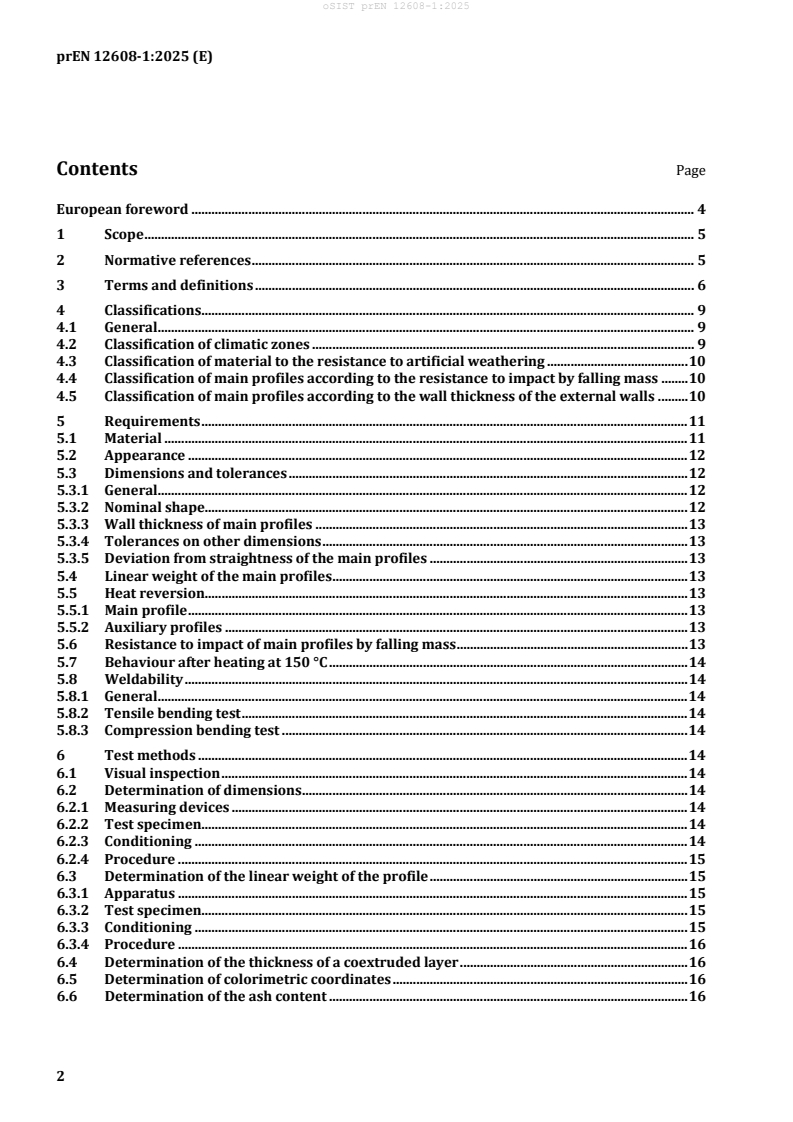
Contents Page
European foreword . 4
1 Scope . 5
2 Normative references . 5
3 Terms and definitions . 6
4 Classifications. 9
4.1 General . 9
4.2 Classification of climatic zones . 9
4.3 Classification of material to the resistance to artificial weathering . 10
4.4 Classification of main profiles according to the resistance to impact by falling mass . 10
4.5 Classification of main profiles according to the wall thickness of the external walls . 10
5 Requirements . 11
5.1 Material . 11
5.2 Appearance . 12
5.3 Dimensions and tolerances . 12
5.3.1 General . 12
5.3.2 Nominal shape. 12
5.3.3 Wall thickness of main profiles . 13
5.3.4 Tolerances on other dimensions . 13
5.3.5 Deviation from straightness of the main profiles . 13
5.4 Linear weight of the main profiles . 13
5.5 Heat reversion. 13
5.5.1 Main profile . 13
5.5.2 Auxiliary profiles . 13
5.6 Resistance to impact of main profiles by falling mass . 13
5.7 Behaviour after heating at 150 °C . 14
5.8 Weldability . 14
5.8.1 General . 14
5.8.2 Tensile bending test . 14
5.8.3 Compression bending test . 14
6 Test methods . 14
6.1 Visual inspection . 14
6.2 Determination of dimensions . 14
6.2.1 Measuring devices . 14
6.2.2 Test specimen. 14
6.2.3 Conditioning . 14
6.2.4 Procedure . 15
6.3 Determination of the linear weight of the profile . 15
6.3.1 Apparatus . 15
6.3.2 Test specimen. 15
6.3.3 Conditioning . 15
6.3.4 Procedure . 16
6.4 Determination of the thickness of a coextruded layer . 16
6.5 Determination of colorimetric coordinates . 16
6.6 Determination of the ash content . 16
oSIST prEN 12608-1:2025
prEN 12608-1:2025 (E)
7 Traceability . 16
Annex A (informative) Requirements for materials . 17
Annex B (normative) Calculation method for the determination of the radiant exposure and
exposure time to be used for artificial weathering . 21
Bibliography . 24
oSIST prEN 12608-1:2025
prEN 12608-1:2025 (E)
European foreword
This document (prEN 12608-1:2025) has been prepared by Technical Committee CEN/TC 249 “Plastics”,
the secretariat of which is held by SIS.
This document is currently submitted to the CEN Enquiry.
This document will supersede EN 12608:2016+A1:2020.
The main changes compared to the previous edition are as follows:
— the restriction of profile colour and the exclusion of fibre reinforced material in Clause 1 have
been deleted;
— material definitions in Clause 3 have been deleted and replaced by reference to EN 17508;
— requirements for materials have been summarized in new Annex A;
— the use of RUVM for non-sight visible surface has been permitted;
— the determination of the ash content has been added as an additional test method to Clause 6;
— editorial changes have been made and normative references have been updated.
EN 12608, Unplasticized poly(vinyl chloride) (PVC-U) profiles for the fabrication of windows and doors —
Classification, requirements and test methods consists of the following parts:
— Part 1: Non-covered PVC-U profiles
— Part 2: PVC-U profiles with laminated foils bonded with adhesives
— Part 3: PVC-U profiles covered with paint (in preparation)
— Part 4: PVC-U profiles with thermo-laminated foils
— Part 5: PVC-U profiles with coextruded coloured top-layer (in preparation)
oSIST prEN 12608-1:2025
prEN 12608-1:2025 (E)
1 Scope
This document specifies the classifications, requirements and test methods for non-covered unplasticized
poly(vinyl chloride) (PVC-U) profiles intended to be used for the fabrication of windows and doors.
NOTE For editorial reasons in this document the term “window” is used for window/door.
2 Normative references
The following documents are referred to in the text in such a way that some or all of their content
constitutes requirements of this document. For dated references, only the edition cited applies. For
undated references, the latest edition of the referenced document (including any amendments) applies.
EN 477, Plastics — Poly(vinyl chloride) (PVC) based profiles — Determination of the resistance to impact of
profiles by falling mass
EN 478, Plastics — Poly(vinyl chloride) (PVC) based profiles — Determination of the appearance after
exposure at 150 °C
EN 479, Plastics — Poly(vinyl chloride) (PVC) based profiles — Determination of heat reversion
EN 513, Plastics — Poly(vinyl chloride) (PVC) based profiles — Determination of the resistance to artificial
weathering
EN 514, Plastics — Poly(vinyl chloride) (PVC) based profiles — Determination of the strength of welded
corners and T-joints
EN 17508, Plastics — Unplasticized poly(vinyl chloride) (PVC-U) profiles for the fabrication of windows and
doors — Terminology of PVC based materials
EN 20105-A02, Textiles — Tests for colour fastness — Part A02: Grey scale for assessing change in colour
EN ISO 105-A01:2010, Textiles — Tests for colour fastness — Part A01: General principles of testing
(ISO 105-A01:2010)
EN ISO 178, Plastics — Determination of flexural properties
EN ISO 179-1, Plastics — Determination of Charpy impact properties — Part 1: Non-instrumented impact
test
EN ISO 306, Plastics — Thermoplastic materials - Determination of Vicat softening temperature (VST)
EN ISO 3451-5:— Plastics — Determination of ash — Part 5: Poly(vinyl chloride)
EN ISO 8256, Plastics — Determination of tensile-impact strength
EN ISO 21306-2:2019, Plastics — Unplasticized poly(vinyl chloride) (PVC-U) moulding and extrusion
materials — Part 2: Preparation of test specimens and determination of properties (ISO 21306-2:2019)
EN ISO/CIE 11664-1, Colorimetry — Part 1: CIE standard colorimetric observers
EN ISO/CIE 11664-2, Colorimetry — Part 2: CIE standard illuminants
Under preparation. Stage at the time of publication: prEN ISO 3451-5:2024.
oSIST prEN 12608-1:2025
prEN 12608-1:2025 (E)
EN ISO/CIE 11664-4, Colorimetry — Part 4: CIE 1976 L*a*b* Colour space
ISO 18314-1, Analytical colorimetry — Part 1: Practical colour measurement
3 Terms and definitions
For the purposes of this document, the terms and definitions given in EN 17508 and the following apply.
ISO and IEC maintain terminology databases for use in standardization at the following addresses:
— ISO Online browsing platform: available at https://www.iso.org/obp/
— IEC Electropedia: available at https://www.electropedia.org/
3.1
profile
product produced by extrusion
3.2
non-covered profile
profile without any surface covering and without coextruded layer(s)
EXAMPLE Profiles without laminated foils or painted surfaces.
3.3
main profile
profile, which defines the structure of the window
Note 1 to entry: See Figure 1.
3.4
auxiliary profile
profile intended to be used for the fabrication of a window which is not a main profile
Note 1 to entry: Main and auxiliary profiles can be different according to the window construction techniques in
the individual countries.
Note 2 to entry: See Figure 1.
oSIST prEN 12608-1:2025
prEN 12608-1:2025 (E)
Key
1 transom
2 sash
3 frame
4 mullion
Figure 1 —Illustration of main profiles
3.5
external wall (of a main profile)
wall of a main profile corresponding to its sight and non-sight surfaces
3.6
sight surface
surface of a profile exposed to view when the installed window is closed
Note 1 to entry: See Figure 2.
3.7
visible surface
any surface or parts of surface of a profile which can be exposed to UV radiation after installation of the
window, open or closed (sight surface and non-sight visible surface)
Note 1 to entry: See Figure 2.
oSIST prEN 12608-1:2025
prEN 12608-1:2025 (E)
Dimensions in millimetres
Key
1 + 2 sight surfaces
3 non-sight visible surface (rebate that is visible when the window is open)
4 non-visible surface
5 frame profile
6 sash/casement profile
NOTE Dimensions of grooves are given as examples only.
Figure 2 — Designation of profile surfaces by the example of frame profile and sash profile
3.8
coextruded profile
profile produced by using more than one extruder with different PVC-U materials according to EN 17508
in one production process without mixing them
3.9
nominal profile shape
shape and dimensions of a profile, as specified by the manufacturer
3.10
deviation from straightness
deviation of the longitudinal axis of a profile from the straight line
3.11
depth (of a profile)
d
dimension, measured at right angles to the glazing plane, between the front and back face surfaces of a
profile
oSIST prEN 12608-1:2025
prEN 12608-1:2025 (E)
Note 1 to entry: See “d” in Figure 3.
3.12
overall width (of a profile)
w
largest dimension, measured in the direction of the glazing plane, perpendicular to the longitudinal axis
of a profile
Note 1 to entry: See “w” in Figure 3.
Key
d depth of a profile
w overall width of a profile
Figure 3 — Cross-section of a typical profile
4 Classifications
4.1 General
The selection of appropriate classes necessary to fulfil national requirements may be given in a national
foreword of EN 12608-1.
4.2 Classification of climatic zones
For the purposes of this document, geographical Europe is divided in two climatic zones M (moderate
climate) and S (severe climate) as defined in Table 1. These climatic zones do not cover climates outside
of geographical Europe.
Table 1 — Classification of climatic zones in Europe
Class Moderate climate M Severe climate S
2 2
a
< 5 GJ/m ≥ 5 GJ/m
Annual total solar radiant exposure on horizontal
surface
and or
a
Average temperature of the warmest month per year < 22 °C ≥ 22 °C
NOTE For the purpose of this document, “moderate climate” refers in general to warm and humid weathering
conditions and “severe climate” to hot and dry weathering conditions. The relevant moderate and severe test
methods for artificial weathering can be found in EN 513.
a
Values measured according to the specifications of the World Meteorological Organization (WMO).
oSIST prEN 12608-1:2025
prEN 12608-1:2025 (E)
Profiles which are designed to be used in a severe climate (S) may also be used in a moderate climate (M).
In those countries where the two climatic zones exist, care should be taken that profiles designed for a
moderate climate (M) are not used in the severe climate (S).
4.3 Classification of material to the resistance to artificial weathering
For the resistance to artificial weathering, the material used for the surface of the profile shall be
classified according to Table 2. For calculation of the exposure time see Annex B.
Table 2 — Classification of material according to the resistance to artificial weathering
Class RUVM M S
Method 1 Method 1 Method 2
Test method according to EN 513
(climate type M) (climate type M) (climate type S)
Radiant exposure in wavelength
2 2 2
1 GJ/m 8 GJ/m 12 GJ/m
range (300 to 800) nm
approximate exposure time (for
500 h 4 000 h 6 000 h
information)
4.4 Classification of main profiles according to the resistance to impact by falling mass
For the resistance to impact by falling mass at –10 °C, the main profiles shall be classified according to
Table 3.
Table 3 — Classification of main profiles according to the resistance to impact by falling mass
Class 0 I II
Falling mass (g) NPD 1 000 1 000
Falling height (mm) NPD 1 000 1 500
NPD: No Performance Determined.
NOTE This property is assessed to ensure the extrusion process is carried out correctly.
It is recommended that class 0 is applied only when the profile geometry dictates that this test cannot be
performed.
4.5 Classification of main profiles according to the wall thickness of the external walls
For the wall thickness of the external walls, the main profiles shall be classified according to Figure 4 and
Table 4.
Figure 4 shows the areas of typical main profiles where the wall thicknesses of external walls shall satisfy
the requirements given in Table 4.
oSIST prEN 12608-1:2025
prEN 12608-1:2025 (E)
Dimensions in millimetres
NOTE The types of walls are explained in Table 4.
Figure 4 — Areas of two typical main profiles with required wall thicknesses
Table 4 — Classification of main profiles according to wall thickness
Type of wall (see Figure 4) Class A Class B Class C
sight surface ≥ 2,8 mm ≥ 2,5 mm No requirement
non-sight surface ≥ 2,5 mm ≥ 2,0 mm No requirement
seal groove ≥ 2,0 mm ≥ 2,0 mm No requirement
not to consider No requirement No requirement No requirement
NOTE The classification of main profiles according to the wall thickness is intended to represent the wide
variations in profile and window design for the various systems which are in use in Europe. It is not intended
to imply differences in profile quality or in the performance of windows provided that the relevant
performance requirements for both profiles and windows are met.
In order to be classified for either class A or B both minimum requirements for the wall thickness shall
be fulfilled.
5 Requirements
5.1 Material
All requirements for materials are given in Annex A.
Materials of type rPVC may be re-stabilized and/or enhanced with additives (e.g. modifiers, pigments,
lubricants) before use to fulfil requirements according to Annex A.
The use of permitted materials on surfaces of profiles is given in Table 5.
Table 5 — Use of materials on surfaces of profiles
Visible surface Non-visible surface
Sight surface Non-sight visible surface
Any UV resistant material Any UV resistant material (class Any material defined in Annex A
(class M or S) M or S) or reduced-UV resistant
material (class RUVM)
...