

EN 877:2021
(Main)Cast iron pipe systems and their components for the evacuation of water from works - characteristics and test methods
- Abstract
This document specifies product characteristics, test/assessment methods and how to express test/assessment results. Cast iron pipelines kits are usually composed of cast iron pipes, fittings, joints and accessories.
This document covers the range of nominal diameter from DN 40 to DN 600 inclusive.
The cast iron includes grey cast iron and ductile cast iron.
The roof gullies used for siphonic systems are outside the scope of this document.
Sewerage applications are outside the scope of this document.
It is intended to be used for the construction of gravity or vacuum discharge pressurized or unpressurised networks installed inside and/or outside works, above and/or below ground and in construction works.
- Status
- Published
- Publication Date
- 26-Oct-2021
- Technical Committee
- CEN/TC 203 - Cast iron pipes, fittings and their joints
- Drafting Committee
- CEN/TC 203/WG 3 - Soil pipelines
- Current Stage
- 6060 - Definitive text made available (DAV) - Publishing
- Start Date
- 27-Oct-2021
- Due Date
- 29-Mar-2020
- Completion Date
- 27-Oct-2021

Overview
EN 877:2021 - Cast iron pipe systems and their components for the evacuation of water from works - specifies product characteristics, test and assessment methods, and how to express results for cast iron pipeline kits. It covers DN 40 to DN 600 and applies to both grey cast iron and ductile (spheroidal) cast iron. The standard addresses kits composed of pipes, fittings, joints, gaskets, clamping elements (including grip collars) and accessories intended for gravity or vacuum discharge systems - pressurised or unpressurised, inside or outside buildings, above or below ground. Excluded are roof gullies used for siphonic systems and sewerage applications.
Key topics and technical requirements
- Scope & definitions: clear terms for kit, pipe, fitting, joint, gasket, clamping and assembled system; nominal size defined as bore (DN).
- Material types: grey cast iron and ductile (spheroidal) cast iron covered; material properties (e.g., m factors: 420 MPa for spheroidal graphite, 200 MPa for grey cast iron) are used in strength calculations.
- Mechanical properties and tests:
- Crushing strength (specified for grey cast iron components).
- Impact resistance via tensile strength and Brinell hardness testing.
- Tensile testing and Brinell hardness procedures referenced.
- Tightness (liquid and gas):
- Water-tightness methods and an internal pressure calculation are provided (example: a DN 100 grey cast iron pipe shows internal pressure strength > 35 bar).
- Sealing zones for fittings are specified (length T given per DN - e.g., DN 40 T ≈ 30 mm; DN 600 T ≈ 80 mm).
- Fire reaction & coatings: reaction-to-fire classification, calorific potential of external coatings and fire testing provisions (single burning item).
- Assessment & conformity: updated chapter on Assessment and Verification of Constancy of Performance (AVCP) for kits and components.
- Annexes: additional dimensions for buried and external kits, field-of-use guidance for soils, product property info, marking and normative calculation methods.
Applications
- Design, manufacture and testing of cast iron drainage and rainwater systems in buildings
- Use in gravity and vacuum discharge networks (internal and external installations, buried or above-ground)
- Specification and compliance verification for construction projects, renovation and building services
Who uses this standard
- Cast iron pipe and fittings manufacturers
- Product designers and system integrators (kit designers)
- Test laboratories and certification bodies
- Specifying engineers, architects, contractors and building regulators
- Procurement teams assessing product compliance for building drainage systems
Related standards
EN 877 references and aligns with multiple normative documents such as EN 598, EN 681-1, EN 13501-1 and various EN ISO test standards for coatings, mechanical testing and reaction-to-fire tests.
Keywords: EN 877:2021, cast iron pipe systems, drainage, test methods, DN 40–DN 600, grey cast iron, ductile cast iron, kit, tightness, AVCP, sealing zone.
Relations
- Effective Date
- 03-Nov-2021
- Effective Date
- 03-Nov-2021
- Effective Date
- 03-Nov-2021
- Effective Date
- 29-Jul-2026
- Effective Date
- 29-Jul-2026
- Effective Date
- 04-Feb-2026
- Effective Date
- 28-Jan-2026
- Effective Date
- 28-Jan-2026
- Effective Date
- 28-Jan-2026
- Effective Date
- 28-Jan-2026
- Effective Date
- 28-Jan-2026
- Effective Date
- 28-Jan-2026
- Effective Date
- 28-Jan-2026
- Effective Date
- 28-Jan-2026
- Refers
EN ISO 9227:2022 - Corrosion tests in artificial atmospheres - Salt spray tests (ISO 9227:2022) - Effective Date
- 28-Jan-2026
Get Certified
Connect with accredited certification bodies for this standard

Institut za varilstvo d.o.o. (Welding Institute)
Slovenia's leading welding institute since 1952. ISO 3834, EN 1090, pressure equipment certification, NDT personnel, welder qualification. Only IIW Au
Sponsored listings
Frequently Asked Questions
EN 877:2021 is a standard published by the European Committee for Standardization (CEN). Its full title is "Cast iron pipe systems and their components for the evacuation of water from works - characteristics and test methods". This standard covers: This document specifies product characteristics, test/assessment methods and how to express test/assessment results. Cast iron pipelines kits are usually composed of cast iron pipes, fittings, joints and accessories. This document covers the range of nominal diameter from DN 40 to DN 600 inclusive. The cast iron includes grey cast iron and ductile cast iron. The roof gullies used for siphonic systems are outside the scope of this document. Sewerage applications are outside the scope of this document. It is intended to be used for the construction of gravity or vacuum discharge pressurized or unpressurised networks installed inside and/or outside works, above and/or below ground and in construction works.
This document specifies product characteristics, test/assessment methods and how to express test/assessment results. Cast iron pipelines kits are usually composed of cast iron pipes, fittings, joints and accessories. This document covers the range of nominal diameter from DN 40 to DN 600 inclusive. The cast iron includes grey cast iron and ductile cast iron. The roof gullies used for siphonic systems are outside the scope of this document. Sewerage applications are outside the scope of this document. It is intended to be used for the construction of gravity or vacuum discharge pressurized or unpressurised networks installed inside and/or outside works, above and/or below ground and in construction works.
EN 877:2021 is classified under the following ICS (International Classification for Standards) categories: 23.040.01 - Pipeline components and pipelines in general. The ICS classification helps identify the subject area and facilitates finding related standards.
EN 877:2021 has the following relationships with other standards: It is inter standard links to EN 877:1999/A1:2006/AC:2008, EN 877:1999, EN 877:1999/A1:2006, ISO 185:2020, ISO 1817:2015, EN ISO 11925-2:2026, EN ISO 1514:2024, EN ISO 1716:2018, EN 598:2007+A1:2009, EN ISO 6892-1:2019, EN ISO 4628-2:2016, EN 10204:2004, EN ISO 2409:2020, EN ISO 898-1:2013, EN ISO 9227:2022. Understanding these relationships helps ensure you are using the most current and applicable version of the standard.
EN 877:2021 is associated with the following European legislation: EU Directives/Regulations: 305/2011; Standardization Mandates: M/131. When a standard is cited in the Official Journal of the European Union, products manufactured in conformity with it benefit from a presumption of conformity with the essential requirements of the corresponding EU directive or regulation.
EN 877:2021 is available in PDF format for immediate download after purchase. The document can be added to your cart and obtained through the secure checkout process. Digital delivery ensures instant access to the complete standard document.
Standards Content (Sample)
SLOVENSKI STANDARD
01-januar-2022
Nadomešča:
SIST EN 877:2001
SIST EN 877:2001/A1:2007
SIST EN 877:2001/A1:2007/AC:2008
Cevni sistemi in njihovi sestavni deli iz litega železa za odvodnjavanje iz stavb -
Karakteristike in preskusne metode
Cast iron pipe systems and their components for the evacuation of water from works -
Characteristics and test methods
Rohrsysteme aus Gusseisen und ihre Komponenten zur Entwässerung von Gebäuden -
Merkmale und Prüfverfahren
Réseaux de canalisations en fonte et leurs composants pour l'évacuation des eaux des
bâtiments - Caractéristiques et méthodes d'essai
Ta slovenski standard je istoveten z: EN 877:2021
ICS:
23.040.10 Železne in jeklene cevi Iron and steel pipes
23.040.40 Kovinski fitingi Metal fittings
91.140.80 Drenažni sistemi Drainage systems
2003-01.Slovenski inštitut za standardizacijo. Razmnoževanje celote ali delov tega standarda ni dovoljeno.
EN 877
EUROPEAN STANDARD
NORME EUROPÉENNE
October 2021
EUROPÄISCHE NORM
ICS 23.040.01 Supersedes EN 877:1999
English Version
Cast iron pipe systems and their components for the
evacuation of water from works - characteristics and test
methods
Réseaux de canalisations en fonte et leurs composants Rohrsysteme aus Gusseisen und ihre Komponenten zur
pour l'évacuation des eaux des bâtiments - Entwässerung von Gebäuden - Merkmale und
Caractéristiques et méthodes d'essai Prüfverfahren
This European Standard was approved by CEN on 16 August 2021.
CEN members are bound to comply with the CEN/CENELEC Internal Regulations which stipulate the conditions for giving this
European Standard the status of a national standard without any alteration. Up-to-date lists and bibliographical references
concerning such national standards may be obtained on application to the CEN-CENELEC Management Centre or to any CEN
member.
This European Standard exists in three official versions (English, French, German). A version in any other language made by
translation under the responsibility of a CEN member into its own language and notified to the CEN-CENELEC Management
Centre has the same status as the official versions.
CEN members are the national standards bodies of Austria, Belgium, Bulgaria, Croatia, Cyprus, Czech Republic, Denmark, Estonia,
Finland, France, Germany, Greece, Hungary, Iceland, Ireland, Italy, Latvia, Lithuania, Luxembourg, Malta, Netherlands, Norway,
Poland, Portugal, Republic of North Macedonia, Romania, Serbia, Slovakia, Slovenia, Spain, Sweden, Switzerland, Turkey and
United Kingdom.
EUROPEAN COMMITTEE FOR STANDARDIZATION
COMITÉ EUROPÉEN DE NORMALISATION
EUROPÄISCHES KOMITEE FÜR NORMUNG
CEN-CENELEC Management Centre: Rue de la Science 23, B-1040 Brussels
© 2021 CEN All rights of exploitation in any form and by any means reserved Ref. No. EN 877:2021 E
worldwide for CEN national Members.
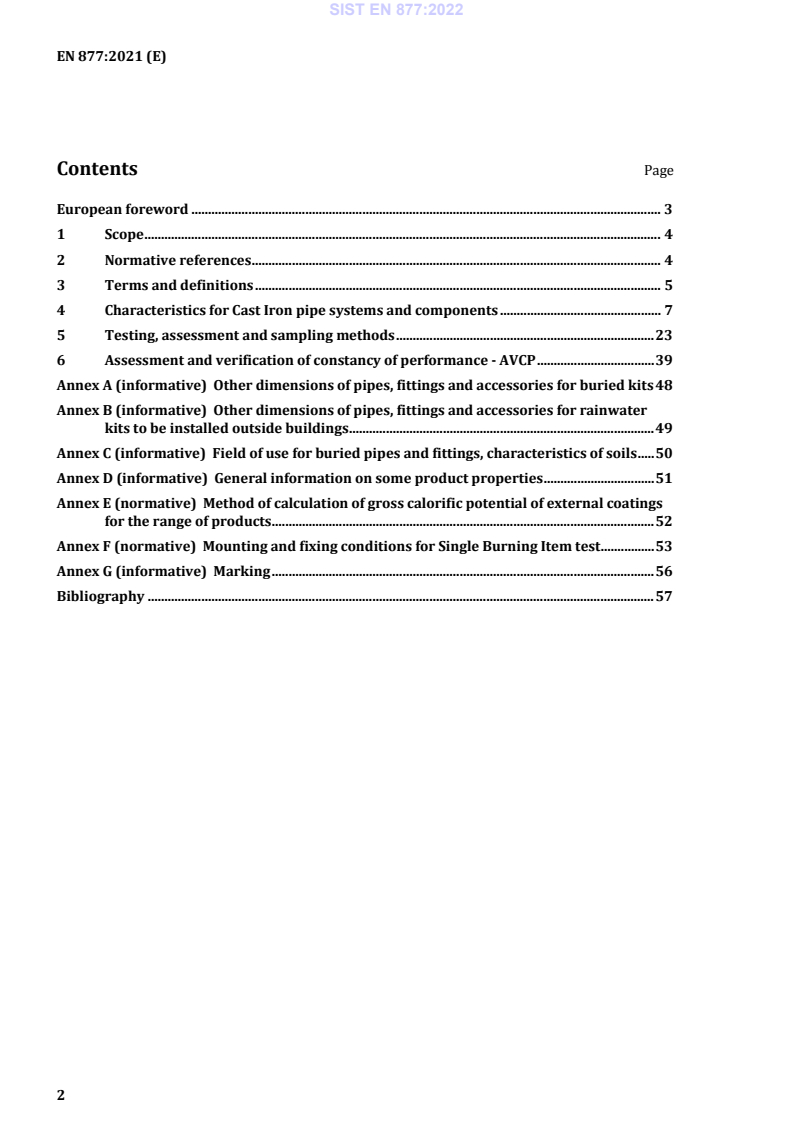
Contents Page
European foreword . 3
1 Scope . 4
2 Normative references . 4
3 Terms and definitions . 5
4 Characteristics for Cast Iron pipe systems and components . 7
5 Testing, assessment and sampling methods . 23
6 Assessment and verification of constancy of performance - AVCP . 39
Annex A (informative) Other dimensions of pipes, fittings and accessories for buried kits 48
Annex B (informative) Other dimensions of pipes, fittings and accessories for rainwater
kits to be installed outside buildings . 49
Annex C (informative) Field of use for buried pipes and fittings, characteristics of soils . 50
Annex D (informative) General information on some product properties . 51
Annex E (normative) Method of calculation of gross calorific potential of external coatings
for the range of products . 52
Annex F (normative) Mounting and fixing conditions for Single Burning Item test . 53
Annex G (informative) Marking . 56
Bibliography . 57
European foreword
This document (EN 877:2021) has been prepared by Technical Committee CEN/TC 203 “Cast iron pipes,
fittings and their joints”, the secretariat of which is held by AFNOR.
This European Standard shall be given the status of a national standard, either by publication of an
identical text or by endorsement, at the latest by April 2022, and conflicting national standards shall be
withdrawn at the latest by April 2022.
Attention is drawn to the possibility that some of the elements of this document may be the subject of
patent rights. CEN shall not be held responsible for identifying any or all such patent rights.
This document has been prepared under a Mandate given to CEN by the European Commission and the
European Free Trade Association.
This document supersedes EN 877:1999, EN 877:1999/A1:2006 and EN 877:1999/A1:2006/AC:2008.
This document includes the following significant technical changes with respect to the previous:
a) Product standard has been extended to kit and components standard.
b) Chapter 4 about characteristics has been restructured with all essential characteristics first.
c) Grip collars have been included as kit components.
d) Pressure tightness including Fittings with access as a kit component has been added.
e) Fire reaction classification has been amended with the agreement of WG 4 of TC 127.
f) Chapter 6 about Assessment and verification of constancy of performance – AVCP has been updated.
This document is one of a series of standards for cast iron products for pipelines for various applications.
Any feedback and questions on this document should be directed to the users’ national standards body.
A complete listing of these bodies can be found on the CEN website.
According to the CEN-CENELEC Internal Regulations, the national standards organisations of the
following countries are bound to implement this European Standard: Austria, Belgium, Bulgaria, Croatia,
Cyprus, Czech Republic, Denmark, Estonia, Finland, France, Germany, Greece, Hungary, Iceland, Ireland,
Italy, Latvia, Lithuania, Luxembourg, Malta, Netherlands, Norway, Poland, Portugal, Republic of North
Macedonia, Romania, Serbia, Slovakia, Slovenia, Spain, Sweden, Switzerland, Turkey and the United
Kingdom.
1 Scope
This document specifies product characteristics, test/assessment methods and how to express
test/assessment results. Cast iron pipelines kits are usually composed of cast iron pipes, fittings, joints
and accessories.
This document covers the range of nominal diameter from DN 40 to DN 600 inclusive.
The cast iron includes grey cast iron and ductile cast iron.
The roof gullies used for siphonic systems are outside the scope of this document.
Sewerage applications are outside the scope of this document.
It is intended to be used for the construction of gravity or vacuum discharge pressurized or unpressurised
networks installed inside and/or outside works, above and/or below ground and in construction works.
2 Normative references
The following documents are referred to in the text in such a way that some or all of their content
constitutes requirements of this document. For dated references, only the edition cited applies. For
undated references, the latest edition of the referenced document (including any amendments) applies.
EN 598:2007+A1:2009, Ductile iron pipes, fittings, accessories and their joints for sewerage applications -
Requirements and test methods
EN 681-1:1996, Elastomeric seals — Materials requirements for pipe joint seals used in water and drainage
applications — Part 1: Vulcanized rubber
EN 10088-1, Stainless steels — Part 1: List of stainless steels
EN 10204, Metallic products — Types of inspection documents
EN 13501-1:2018, Fire classification of construction products and building elements — Part 1:
Classification using data from reaction to fire tests
EN 13823, Reaction to fire tests for building products — Building products excluding floorings exposed to
the thermal attack by a single burning item
EN ISO 898-1, Mechanical properties of fasteners made of carbon steel and alloy steel — Part 1: Bolts,
screws and studs with specified property classes — Coarse thread and fine pitch thread (ISO 898-1)
EN ISO 898-2, Mechanical properties of fasteners made of carbon steel and alloy steel — Part 2: Nuts with
specified property classes — Coarse thread and fine pitch thread (ISO 898-2)
EN ISO 1514, Paints and varnishes — Standard panels for testing (ISO 1514)
EN ISO 1716, Reaction to fire tests for products — Determination of the gross heat of combustion (calorific
value) (ISO 1716)
EN ISO 2409, Paints and varnishes — Cross-cut test (ISO 2409)
EN ISO 2808, Paints and varnishes — Determination of film thickness (ISO 2808)
EN ISO 2812-1, Paints and varnishes — Determination of resistance to liquids — Part 1: Immersion in
liquids other than water (ISO 2812-1)
EN ISO 3506-1, Fasteners — Mechanical properties of corrosion-resistant stainless steel fasteners — Part
1: Bolts, screws and studs with specified grades and property classes (ISO 3506-1)
EN ISO 3506-2, Fasteners — Mechanical properties of corrosion-resistant stainless steel fasteners — Part
2: Nuts with specified grades and property classes (ISO 3506-2)
EN ISO 4628-2, Paints and varnishes — Evaluation of degradation of coatings — Designation of quantity
and size of defects, and of intensity of uniform changes in appearance — Part 2: Assessment of degree of
blistering (ISO 4628-2)
EN ISO 4628-3, Paints and varnishes — Evaluation of degradation of coatings — Designation of quantity
and size of defects, and of intensity of uniform changes in appearance — Part 3: Assessment of degree of
rusting (ISO 4628-3)
EN ISO 6506-1, Metallic materials — Brinell hardness test — Part 1: Test method (ISO 6506-1)
EN ISO 6892-1:2019, Metallic materials — Tensile testing — Part 1: Method of test at room temperature
(ISO 6892-1:2019)
EN ISO 9227, Corrosion tests in artificial atmospheres — Salt spray tests (ISO 9227)
EN ISO/CIE 11664-4, Colorimetry — Part 4: CIE 1976 L*a*b* colour space (ISO/CIE 11664-4)
EN ISO 11925-2, Reaction to fire tests — Ignitability of products subjected to direct impingement of
flame — Part 2: Single-flame source test (ISO 11925-2)
ISO 185:2020, Grey cast irons — Classification
ISO 1817, Rubber, vulcanized or thermoplastic — Determination of the effect of liquids
3 Terms and definitions
For the purposes of this document, the following terms and definitions apply.
ISO and IEC maintain terminological databases for use in standardization at the following addresses:
— ISO Online browsing platform: available at https://www.iso.org/obp
— IEC Electropedia: available at https://www.electropedia.org/
3.1
discharge system for buildings
system of pipes, fittings, accessories and joints used to collect and drain waste water and rainwater from
a building; it comprises discharge pipes, stack ventilation and rainwater pipes, installed within the limits
of a building or attached to the building and this includes pipes between the building and the inspection
chambers
Note 1 to entry: This applies to gravity or vacuum, inside and outside buildings, above and below ground.
3.2
drain
system of pipes, fittings, accessories and joints installed outside the limits of a building in order to connect
the discharge system of this building to a sewer or a septic tank
3.3
sewer
system of pipes designed to collect waste water and rainwater from buildings and surface water and to
convey them to the point of disposal or treatment
3.4
cast iron
alloy of iron and carbon in which graphite can be present in different forms
3.5
kit
construction product placed on the market by a single manufacturer as a set of at least two separate
components that need to be put together to be incorporated in the construction work
Note 1 to entry: The wording cast iron pipe systems is here in this document equivalent to cast iron pipe kits.
[SOURCE: CPR N° 305/2011 of 9 March 2011]
3.6
pipe
kit component casting of uniform bore, straight in axis, normally having plain ends but which can also be
socketed
3.7
fitting
kit component in cast iron which allows a deviation, a change of direction or diameter, including access
elements and traps
3.8
coupling
kit component, which is a jointing element for pipes and/or fittings subjected to internal or external
pressure
3.9
gasket
kit component providing sealing function to joints
3.10
clamping
kit component, which is a securing element for pipes and/or fittings subjected to internal pressure,
providing axial restraint to the end thrust arising from a change of direction, blank end etc., e.g. grip
collars
3.11
grip collar
kit component that ensures axial restraint up to a defined pressure by mounting it over a joint
3.12
joint
connection between the ends of pipes and/or fittings, including the coupling or clamping component,
with sealing effected by elastomeric gasket(s); as soon as it is an assembly of several kit components as
coupling, clamping or gaskets, the joint is a kit
3.13
accessory
kit component, any element used in a network, e.g. for maintenance or inspection reasons
3.14
nominal size
DN
alphanumerical designation of size for components of a pipework system, to be used for reference
purposes, which comprises the letters DN followed by a dimensionless which is indirectly related to the
physical size, in millimetres, of the bore or outside diameter of the end connections
Note 1 to entry: In this document, it is the bore.
[SOURCE: EN ISO 6708]
3.15
length
effective length of a pipe or fitting
Note 1 to entry: For double spigot pipes and fittings, the effective length is equal to the overall length. For spigot
and socket pipes and fittings, the effective length is equal to the overall length minus the spigot insertion depth as
given by the manufacturer.
3.16
range of products
design system produced by one manufacturer for which the test results for one or more characteristics
from any one product within the range are valid for all other products within this range
3.17
cast iron pipe system under vacuum
siphonic system for draining rainwater and vacuum system for waste waters
3.18
design system
collection of components from which a “kit” may be created for subsequent installation in the works
Note 1 to entry: A design system might, for example, be presented in a supplier’s catalogue, from which the
purchaser can make a choice. A design system can give rise to one or many different “kits”, but the system itself
cannot be bought.
3.19
assembled system
kit after it has been installed in the works
Note 1 to entry: An “assembled system” may be made up only of the “kit” or it may comprise the “kit” assembled
with one or more other products which could themselves be construction products.
4 Characteristics for cast iron pipe systems and components
4.1 Crushing strength (only for grey cast iron)
Cast iron components as pipes, fittings and accessories shall have the minimal crushing strength given in
Table 7. Test method is described in 5.6.
The assessment of each of those components insures the assessment of the kit.
4.2 Impact resistance for kits
The impact resistance assessment is given by the mechanical properties of pipes, fittings and accessories.
They shall have the minimal tensile strength and maximum Brinell hardness as given in Table 7 in 4.10.2.
Test method for tensile strength is given in 5.4.
Test method for Brinell hardness measurement is given in 5.5
4.3 Tightness: gas and liquid
4.3.1 General
NOTE In this document, all pressures are relative pressures, expressed in bar (100 kPa = 1 bar).
The assessment of each component as described in this 4.3 insures the assessment of the kit.
4.3.2 Lengths of fittings and sealing zone
Lengths of fittings shall be given in the manufacturers’ catalogues. When measured in accordance with
5.2.7, the lengths of fittings shall be within a tolerance of ± 5 mm.
The ends of the fittings shall have sealing zones straight in axis and free from marking and free from
defects which could impair the fitness for use.
The length T (see Figure 1) of this sealing zone shall comply with the values given in Table 1.
Figure 1 — Length of the sealing zone
4.3.3 Geometry of fittings and accessories
The geometry of fittings and accessories is not part of this document. Fittings and accessories of geometry
used in various countries are in conformity with this document as long as they comply with all other
technical requirements of this document.
Table 1 — Sealing zone of fittings
a
DN Length T of sealing zone
Lower deviation on T
mm P
mm
40 30
50 30
70 35
75 35 - 5
100 40
125 45
150 50
200 60
250 70
300 80
400 80 - 4
500 80
600 80
a
Upper deviations are not given and sealing zones with a length greater than T are permitted.
4.3.4 Water tightness
4.3.4.1 Water tightness of pipes and fittings
4.3.4.1.1 Water tightness of pipes
Water tightness of pipes can be demonstrated by the following calculation.
20××eR
m
P=
DS×
F
where
e is the minimum pipe wall thickness, in millimetres;
D is the mean pipe diameter (DE – e), in millimetres;
DE is the nominal pipe external diameter (see Table 6), in millimetres;
R is the minimum tensile strength of cast iron, in Megapascals;
m
(420 MPa for spheroidal graphite cast iron and 200 MPa for grey cast iron; see 4.10.2);
S is a safety factor of 3.
F
For a DN 100 pipe in grey cast iron, the internal pressure strength is more than 35 bars.
Expected results are given in Table 2.
4.3.4.1.2 Water tightness of fittings
4.3.4.1.2.1 Fittings without access or door
Expected results for water tightness of fittings without access or door are given in Table 2 and the
demonstration done for pipe is valid for these fittings.
4.3.4.1.2.2 Fittings with access or door
When tested in accordance with 5.8, fittings with access or door shall exhibit no visible leakage from the
access or door when subjected to the internal hydrostatic test pressure given in Table 2.
Table 2 — Water tightness of fittings with access or door - performance requirements
Internal test pressure in bar
DN ≤ DN 200 DN > DN 200
a a
0 to 5 0 to 3
a
0 to 0,5 bar water pressure for fittings which will only carry limited pressures because of their
intended use and installation e.g. sanitary application.
4.3.4.2 Water tightness of joints
4.3.4.2.1 General
When tested in accordance with 5.9.4 and 5.9.5, on test apparatus preventing any excessive axial
displacement and subjected to the test conditions and hydrostatic pressures given in Table 4, the joints
shall exhibit no visible leakage.
Table 3 specifies the hydrostatic test pressures for the following test conditions:
a) joint with pipes aligned;
b) joint with pipes deflected to an angle of at least:
3° for nominal sizes up to and including DN 200;
1°45′ for nominal sizes greater than DN 200;
c) joint subject to a shear force of at least 10 DN in newtons, with pipes aligned.
Table 3 — Water tightness of joints - performance requirements
Test condition Hydrostatic test pressure in bar
DN ≤ DN 200 DN > DN 200
internal external internal external
a b c a b c
1) aligned 0 to 5 0 to 0,5 0 to 3 0 to 0,5
a a
2) deflected 0 to 5 – 0 to 3 –
a b a b
3) subject to shear force 0 to 1 – 0 to 1 –
a
0 to 0,5 bar water pressure for joints which will only carry limited pressures because of their intended
use and installation; 0 to 0,1 bar water pressure for joints connecting to sanitary ware, e.g. WC, washbasin
and non-pressurized gravity flow.
b
Applicable to socketed joints only when they are to be buried.
c
Does not apply to nominal sizes less than DN 100 and does not apply to joints connecting to sanitary ware,
e.g. WC, washbasin.
4.3.4.2.2 Water tightness for buried systems
For joints which are used exclusively for buried kits, the internal hydrostatic test pressure specified in
Table 3 lines a) and b) may be limited to 1 bar. This may limit to 1 bar also the test pressure specified in
Table 4 for buried grip collars.
4.3.4.2.3 Water tightness for rainwater systems installed outside buildings
Joints shall be watertight at least to non-pressurized gravity flow. See note a) in Table 3.
4.3.4.3 Resistance to end thrust with grip collars
When tested in accordance with 5.10.3, on test apparatus preventing any excessive axial displacement
and subjected to the test conditions:
— joint with pipes aligned;
— internal hydrostatic pressures given in Table 4;
the grip collars shall limit the axial movement of pipes. During each stage in pressure, there shall be no
axial movement of the pipes.
Table 4 — Resistance to end thrust of grip collars - performance requirements
Test condition Internal test pressure in bar
DN ≤ DN 200 DN > DN 200
aligned 0 to 5 0 to 3
4.3.5 Air tightness
In order to ensure a seal against odours, all joints shall be tight against positive internal air pressure of
0 mbar to 10 mbar when tested in accordance with 5.9.6.
4.4 Vacuum tightness (only for under vacuum evacuation of water from works)
4.4.1 General
The assessment of each component as described in this 4.4 insures the assessment of the kit.
4.4.2 Pipes resistance to vacuum
Expected results for pipes resistance to vacuum are given in Table 5, see 4.4.4.
4.4.3 Fittings – resistance to vacuum
4.4.3.1 Fittings without access or door
Expected results for resistance to vacuum of Fittings without access or door are given in Table 5. The
demonstration done for pipe is valid for these fittings.
4.4.3.2 Fittings with access or door
When tested in accordance with 5.8, fittings with access or door shall withstand a negative pressure. An
initial negative pressure of −0,8 bar is generated and after a waiting time of 1 h, the final pressure shall
not reach the limiting values given in Table 5.
4.4.4 Joints – resistance to vacuum
In addition to the technical requirements of 4.3.4.2, 4.3.5 and 4.12 and when tested in accordance with
5.13, the joints shall withstand a negative pressure. An initial negative pressure of −0,8 bar is generated
and after a waiting time of 1 h, the final pressure shall not reach the limiting values given in Table 5.
Table 5 — Resistance to vacuum - performance requirements
Test condition Test pressure in bar
DN ≤ DN 200 DN > DN 200
aligned −0,7 −0,4
4.5 Maximum load for admissible deformation (only for below ground)
Maximum load of kits and components can be assessed by the maximum load of the pipe.
The load bearing capacity expressed by the load per unit length uniformly distributed on the top of the
pipe are evaluated by means of the formula below:
πσ.e
min
f≥
3(DE − e )
max min
where
f is the ultimate load per unit length on the top of the pipe, in newtons per millimetre;
e
is the minimum wall thickness of the pipe, in millimetres;
min
DE is the maximum external diameter, in millimetres;
max
σ is the ring crush strength in accordance with Table 7, in megapascals.
4.6 Reaction to fire (only for above ground evacuation of water from works and under
vacuum evacuation of water from works)
4.6.1 Reaction to fire of components
As written in the scope of EN 13501-1:2018, products are considered in relation to their end use
application. Components are always assembled with other components into a system, therefore the
assessment of single component is not considered as appropriate. Consequently, the assessment only
applies to kit.
4.6.2 Reaction to fire of kits
The reaction to fire indicates the degree of contribution of the material to the behaviour of the
construction product in the event of fire. When tested in accordance to the test methods given in 5.7.3.3,
relevant for the claimed class, the test results are expressed as a class according to EN 13501-1.
Whether products covered by this document are made from one or more of the materials that have been
considered, under established conditions, as belonging to the category “No contribution to fire” because
of their low level of combustibility, the reaction to fire class A applies to these products without the need
of carrying out reaction to fire tests.
The mounting and fixing conditions for the SBI test are given in Annex F.
Considering the products in their end-use conditions as an assembled system:
— internal coatings are not relevant as they are not exposed to fire (a very small volume of smoke can
be created but this will exit the building via stacks vents);
— gaskets of joints are not relevant either as in the end-use conditions they are not exposed to fire
(except for some designs a very small compressed edge) and as such represent a very low quantity
of organic material.
In order to verify these assumptions, they shall be tested according to Annex F using the mounting
adaptations given.
According to EN 13501-1, as the gross calorific potential (PCS) of the products considered as an
assembled system including pipes, fittings and couplings, due to their densities and weight quantities,
will always satisfy the requirement on PCS for the product as a whole (≤2,0 MJ/kg), the reaction to fire
classification shall be obtained as follows:
— external coatings, if containing more than 1 % by weight or volume (whichever is the more onerous)
of homogeneously distributed organic material, shall satisfy the requirements of 4.11.3 on
ignitability or gross calorific potential, depending on the intended class of reaction to fire;
and
— a range of products (including coated pipes, coated fittings, couplings and possibly grip collars) shall
be tested according to Annex F using the mounting adaptations given, and shall satisfy the
requirements of classification criteria and additional classifications listed in EN 13501-1 for the
intended class of reaction to fire. If a range of products includes grip collars, as these products are
not always installed on the discharge system depending on the intended performance:
— the test shall be done without them to evaluate the behaviour of the couplings without any
protection to the flame;
— and only if the grip collars include an organic material, the test shall be done again with the grip
collars installed on top of the couplings (see Annex F).
In order for a manufacturer of only joints to obtain a classification, the joints shall be tested once
according to Annex F using the mounting adaptations given, with pipes and fittings of a cast iron range of
products which already has a reaction to fire classification issued by a certified test laboratory. It shall be
demonstrated that the existing classification of the range of products is not made worse by the
substitution of the joints.
NOTE See D.2.
4.7 Surface condition
Pipes, fittings and accessories shall be free from defects (superficial and other defects) which could be
detrimental to their correct operation or long service life as defined in this document.
4.8 Dimensions
4.8.1 Nominal size (DN)
The nominal sizes shall be as given in column 1 of Table 6.
4.8.2 External diameter (DE)
The standard external diameters (DE) of pipes and fittings, as well as the tolerances applicable to these,
shall comply with the values given in Table 6, when measured in accordance with 5.2.1. When, by
agreement between manufacturer and purchaser, specific coatings are supplied for special applications,
other tolerances are permitted. Due regard shall be given to 4.3.4 and 4.3.5, in this case.
Table 6 — Dimensions of pipes and fittings
Dimensions in millimetres
External diameter DE Wall thickness
DN Nominal value Tolerance Nominal value Minimum value
40 48 +2 3,0 2,5
−1
50 58 +2 3,5 3,0
−1
70 78 +2 3,5 3,0
−1
75 83 +2 3,5 3,0
−1
100 110 +2 3,5 3,0
−1
125 135 +2 4,0 3,5
−2
150 160 +2 4,0 3,5
−2
200 210 +2,5 5,0 4,0
−2,5
250 274 +2,5 5,5 4,5
−2,5
300 326 +2,5 6,0 5,0
−2,5
400 429 +2 6,3 5,0
−3
500 532 +2 7,0 5,2
−3,8
600 635 +2 7,7 5,8
−4
NOTE 1 In countries where the nominal sizes DN 60, DN 65 (DE 75) and DN 80 are still mentioned in application
standards, these nominal sizes can still be used.
NOTE 2 Other dimensions are given in 4.14.2 for buried kits and in 4.15.3, 4.15.4 and 4.15.5 for rainwater kits
installed outside buildings.
4.8.3 Wall thickness
Wall thicknesses of pipes and fittings shall comply with the values given in Table 6, when measured in
accordance with 5.2.2.
Kit with minimum value of wall thickness up to −1 mm compared to Table 6 can be supplied with special
identification by agreement between the manufacturer and the purchaser, all characteristics according
to this document shall be specifically assessed. Acoustic und fire resistance performances shall also be
specifically and separately assessed.
4.8.4 Internal diameter
In order to ensure the hydraulic function, the internal diameter of pipes when measured in accordance
with 5.2.3, shall be not less than:
— 0,975 DN for nominal sizes equal to or greater than DN 70;
— 0,950 DN for nominal sizes less than DN 70.
4.8.5 Ovality
When measured in accordance with 5.2.4 the ovality of the pipes and of the sealing zones of fittings
(see 4.3.2) shall remain within the tolerances on DE shown in Table 6 for DN 40 to DN 300 and shall not
exceed 1 % for DN 400 to DN 600 (see EN 598:2007+A1:2009, 3.36).
4.8.6 Straightness of pipes
When measured in accordance with 5.2.5 the pipes shall be straight with a maximum deviation of:
— 0,15 % of their length for nominal sizes greater than DN 70;
— 0,20 % of their length for nominal sizes equal to or less than DN 70.
4.8.7 End faces
The end faces of the products shall be free from faults which could impair their fitness for use and their
planes shall be perpendicular with the axes of symmetry of the products. When measured in accordance
with 5.2.6, the maximum deviation from the right angle shall be:
— 3° for nominal sizes DN 40 to DN 200;
— 2° for nominal sizes DN 250 to DN 600.
4.8.8 Length of pipes
Pipes are usually produced with a length of 3 m. Other lengths are permitted and can be supplied with
special identification by agreement between the manufacturer and the purchaser.
When measured in accordance with 5.2.7 the length of all pipes shall be within a tolerance of ± 20 mm.
4.8.9 Angles of fittings
Fittings shall be designed to the angles specified below with a design tolerance of ± 2°:
— bends: 15°; 22°; 30°; 45°, 68°; 88°; 135°;
— single/double branches: 45°; 68°; 88°.
4.8.10 Access components and traps
The minimum dimension of the openings of access components up to DN 150 inclusive, shall be at least
equal to the whole number of the nominal size in millimetres. For access components over DN 150, the
minimum dimension of the opening shall be at least 150 mm.
The height of water seal of traps shall be at least 50 mm.
4.9 Mass
The nominal masses of finished products (pipes, fittings and accessories) shall be given in the
manufacturers’ catalogues. When the mass is measured in accordance with 5.3, the lower deviation shall
not exceed 15 % of the nominal mass.
4.10 Material characteristics of pipes, fittings and accessories
4.10.1 Cast iron
Pipes, fittings and accessories shall be manufactured from:
— grey cast iron in accordance with ISO 185; or
— spheroidal graphite cast iron in accordance with EN 598:2007+A1:2009; or
— any other type of cast iron in accordance with 4.10.2.
4.10.2 Mechanical properties
Pipes, fittings and accessories shall have the mechanical properties given in Table 7.
Table 7 — Mechanical properties of pipes, fittings and accessories
Type of casting and Minimum tensile Minimum ring crush Maximum Brinell
a b
strength strength hardness
material
MPa MPa HB
Pipes
c
— grey cast iron 200 260
— spheroidal graphite 420 230
–
cast iron
Fittings and accessories
— grey cast iron 150 – 260
— spheroidal graphite 420 – 250
cast iron
a
Other types of cast iron shall satisfy the criteria laid down for grey cast iron.
b
Tensile and ring crush strength for other products see Annex A.
c
332 MPa for nominal sizes equal to or greater than DN 250.
The modulus of elasticity E shall be given by the manufacturer.
NOTE It is normally at least 110 GPa for grey cast iron and at least 170 GPa for spheroidal graphite cast iron.
4.11 Coatings for pipes, fittings and accessories
4.11.1 General
The cast iron components shall be coated internally and externally. Before applying the coatings, the
surfaces shall be dry and free from rust or non-adhering products or foreign matter, e.g. oil, grease.
Points of contact inherent in the coating application systems are permitted.
These coatings shall not become sticky when they are heated to 100 °C. They shall maintain an acceptable
appearance up to installation and permit the application of additional external finishing coatings.
The manufacturer shall specify the minimum factory applied thicknesses of the dry internal and external
coatings on the finished products and shall demonstrate that these coatings conform to 4.11.2 or 4.11.3
respectively.
NOTE Specific requirements for coatings for buried kits and rainwater kits installed outside buildings are given
in 4.15.3 and 4.15.2 respectively.
4.11.2 Internal coatings
When tested in accordance with 5.7.2 the materials for internal coatings shall conform to the following
requirements:
— resistance to salt spray: at least 350 h in accordance with EN ISO 9227;
— resistance to waste water: at least 30 d at 23 °C ± 3°C;
— chemical resistance from pH 2 to pH 12: at least 30 d at 23 °C ± 3°C
When tested in accordance with 5.7.2, the internal coatings on finished products shall conform to the
following requirements:
— dry coating thickness: not greater than 400 μm (except for specific coatings for
special applications), and at least the minimum factory
applied thickness to be specified by the manufacturer (see
4.11.1);
— adhesion: in accordance with level 1 of EN ISO 2409;
— resistance to hot water: 24 h at 95 °C;
— resistance to temperature cycling: 1500 cycles between 15 °C and 93 °C.
4.11.3 External coatings
The external coatings on finished products which are only considered as a primary coat shall not be
readily flammable and shall be free from toxic heavy metals.
When tested in accordance with 5.7.3 the materials for external coatings shall conform to the following
requirements:
— colour: definition by trichromatic coordinates:
L = 37; a = 24; b = 16; Δ E = 4,0 in accordance with
EN ISO/CIE 11664-4 (approximately reddish-brown); other
coating colors as long as all other technical requirement in
§4.11.3 are fulfilled are permitted.
— compatibility with other paints: paints normally used on metallic structures.
For a classification of the range of products within classes E to B (see EN 13501-1:2018, Table 1), each
coating shall conform to the following requirements when tested in accordance with 5.7.3.3:
— ignitability: requirements of classification criteria and additional classifications listed in
EN 13501-1 specific to the class.
For an A2 classification of the range of products (see EN 13501-1:2018, Table 1), the gross calorific
potential of the external coatings, noted PCS shall conform to the requirements of
product range,
EN 13501-1 on external components when tested and calculated in accordance with 5.7.3.3:
— gross calorific potential of external coatings, PCS :
product range
— if external coatings are substantial components, PCS ≤ 3 MJ/kg;
product range
— if external coatings are non-substantial components, PCS ≤ 4 MJ/m2.
product range
For the A1 classification of the range of products (see EN 13501-1:2018, Table 1), the gross calorific
potential of the external coatings, noted PCS , shall conform to the requirements of
product range
EN 13501-1 on external components when tested and calculated in accordance with 5.7.3.3:
— gross calorific potential of external coatings, PCS :
product range
— if external coatings are substantial components, PCS ≤ 2 MJ/kg;
product range
— if external coatings are non-substantial components, PCS ≤ 2 MJ/m , provided that
product range
the range of products when tested according to EN 13823, using the mounting conditions of
Annex F satisfies the following criteria: FIGRA < 20 W/s, and LFS < edge of specimen, and
THR < 4,0 MJ, and s1, and d0.
600s
When tested in accordance with 5.7.3 the external coatings on finished products shall conform to the
following requirements:
— dry coating thickness: minimum factory applied thickness to be specified by the
manufacturer (see 4.11.1);
— adhesion: in accordance with level 2 of EN ISO 2409.
4.12 Joints
4.12.1 General
The joints are intrinsic components of the manufacturer’s discharge systems. They shall permit correct
connection between the ends of pipes and/or fittings and accessories in accordance with this document.
Taking into account the different applications of cast iron pipe systems and their components, various
joint designs are permitted provided that they satisfy the requirements of this document. The joints shall
incorporate one or more elastomeric gasket(s) to ensure leak tightness and prevent direct contact
between the ends of pipework components. The manufacturer shall propose a design or a device when
electrical conductivity of their joints is required.
4.12.2 Dimensions
The effective width of the sealing zone of joints shall not exceed the dimension 2 T as shown in Figure 1
and Table 1. The overall dimensions of the joints are also limited by the dimensions and angles of the
fittings. They shall be measured according 5.9.1.
The drawings of the joints provided by the manufacturer shall give the main dimensions and tolerances
of the joint and of its components.
4.12.3 Material for couplings or clamping components except grip collars (for grip collars see
4.14)
It shall usually be made from:
a) cast iron according to Table 7 (for fittings and accessories);
b) the following stainless steels in accordance with EN 10088-1 as they ensure resistance to corrosion
and a stabilization against the effects of intergranular corrosion:
— austenitic: all grades except X8CrNiS18–9 (1.4305);
— ferritic and martensitic: X3CrTi17 (1.4510), X3CrNb17 (1.4511) and X2CrTi17 (1.4520).
Cast iron couplings or clamping components shall be coated according to 4.11, at least on the surfaces not
covered by the gaskets.
When other materials are used, they shall meet the following requirements:
— the materials shall conform to the corresponding materials standards;
— the components shall be suitably coated and the assembled metallic components shall withstand a
salt spray test of at least 350 h in accordance with EN ISO 9227. For all components the acceptable
levels of blistering shall be dimension 3, class 3 in accordance with EN ISO 4628-2 and rusting Ri
shall be not greater than 2 in accordance with EN ISO 4628-3;
— for steel bolts and nuts the minimum strength class shall be 8.8 for bolts and 8 for nuts in accordance
with EN ISO 898-1 and EN ISO 898-2 respectively. If the bolts are made of stainless steel, according
to EN ISO 3506-1, they shall be made of A2 or A4 or C1 and the minimum strength class shall be 70.
If the nuts are made of stainless steel, according to EN ISO 3506-2, they shall be made of A2 or A4 or
C1 and the minimum strength class shall be 70.
4.12.4 Material for gasket
It shall:
— conform to EN 681-1;
— satisfy the type test defined in 5.9.2.1, except in the case of special joints (e.g. restrained) and/or
specific applications (e.g. resistance to certain fluids) where other elastomers may be used.
4.12.5 Suitability for use
All parts of the joints shall be free from defects likely to compromise their suitability for use. Sharp edges
should be avoided.
Couplings and clamping components shall be designed so that they satisfy the water tightness
requirements of Table 3 line a) without any permanent changes (e.g. deformation, cracks, damaged
threads) which could impair the performance of the joint.
The manufacturer’s instructions shall contain all information concerning the application and installation
of the joints and, if necessary, information on the torque for tightening the bolts.
4.12.6 Temperature resistance
When tested in accordance with 5.9.7 the joints shall conform to the following requirements:
— resistance to temperature cycling: 1500 cycles between 15 °C and 93 °C;
— resistance to hot water: 24 h at 95 °C.
These requirements shall not apply to joints for rainwater kits installed outside buildings or joints
connecting to WC and urinals.
4.13 Grip collars
4.13.1 General
Grip collars can be components of the manufacturer’s systems. They shall secure the joints of discharge
systems submitted to internal pressure by providing axial restraint to the end thrust at changes in
direction, blank ends etc.
Some joints can include components or devices which guarantee axial restraint. In such a case, they shall
fulfil both requirements on joints and on grip collars.
4.13.2 Dimensions
The overall dimensions of the grip collars are limited by the dimensions of the couplings they are
designed for, and the dimensions and the angles of the fittings. They shall be measured in accordance
with 5.10.1.
The drawings of the grip collars provided by the manufacturer shall give their main dimensions and
tolerances.
4.13.3 Materials
The grip collars shall usually be made from:
a) cast iron according to Table 7 (for fittings and accessories) and coated according to 4.11;
b) steels with corros
...