

EN 17687:2022
(Main)Public procurement - Integrity and accountability - Requirements and guidance
- Abstract
This document specifies requirements and guidance for buyer organizations, with regards to integrity and accountability in public procurement processes from the identification of needs throughout the delivering of goods, services or work contracts.
This document is applicable to use by:
a) buyer organizations;
b) contributors;
c) decision makers and their staff.
This document can have an impact on:
- individuals;
- suppliers and individuals acting in support of or on behalf of suppliers, including subcontractors; the official bodies of the member states and of the European organizations which intervene, directly or indirectly, in the public procurement process;
- organizations representing suppliers at the member state or European levels.
NOTE Further guidance for the interpretation and application of the scope and requirements of this document is provided in Annex A.
- Status
- Published
- Publication Date
- 16-Aug-2022
- Technical Committee
- CEN/TC 447 - Services - Procurement, contracts and performance assessment
- Drafting Committee
- CEN/TC 461 - Public Procurement
- Current Stage
- 6060 - Definitive text made available (DAV) - Publishing
- Start Date
- 17-Aug-2022
- Due Date
- 12-Jul-2022
- Completion Date
- 17-Aug-2022

Overview
EN 17687:2022 - Public procurement: Integrity and accountability is a European Standard published by CEN that specifies requirements and guidance for buyer organizations to ensure integrity and accountability throughout the public procurement lifecycle - from identification of needs through delivery of goods, services or works. Approved in July/August 2022, this standard is intended for use by buyer organizations, contributors, decision makers and their staff and is designed to reduce risks such as corruption, fraud and conflicts of interest while promoting transparency and value for money.
Key topics and requirements
EN 17687:2022 structures requirements and guidance across Clauses 4–10. Major technical topics include:
- Fundamental principles: integrity, accountability and transparency as the foundational concepts.
- Governance and policy: organizational policies, leadership responsibilities, ethical behaviour and social responsibility.
- Public procurement process: managing the procurement lifecycle and associated risks from needs identification to contract delivery.
- Risk management: identification, assessment and mitigation of integrity risks in procurement (detailed guidance in Annex B).
- Stakeholder management: internal interested parties, market engagement, supplier and supply‑chain management, consumers and end‑users.
- People and competence: staff competence, training, work culture, incentives, control mechanisms and codes of conduct.
- Performance evaluation and improvement: evidence‑based measurement, non‑conformity handling, corrective actions and continuous improvement.
- Terminology and definitions: standardized terms (e.g., integrity pact, value for money) with sources such as EN ISO 26000 and EN ISO 9000 referenced for definitions.
- Practical guidance: Annex A explains interpretation and application of scope and requirements.
Applications - who uses it and why
EN 17687:2022 is practical for:
- Public contracting authorities and buyer organizations seeking to strengthen procurement governance and reduce corruption/fraud risks.
- Procurement officers, compliance managers and legal teams implementing integrity controls, conflict‑of‑interest procedures and integrity pacts.
- Policy makers and auditors assessing procurement transparency, accountability and performance.
- Suppliers and supply‑chain managers who must understand buyer expectations and obligations under integrity frameworks.
Typical uses include designing procurement policies, implementing risk‑based controls, conducting market engagement with transparency, establishing codes of conduct, measuring procurement performance and embedding continuous improvement.
Related standards and context
- Draws on definitions and concepts from EN ISO 26000, EN ISO 9000 and EN ISO 14040.
- Complements EU public procurement legal frameworks and national implementing legislation.
- Annexes provide interpretative guidance and risk management examples to support implementation.
EN 17687:2022 is a practical, standards‑based tool to embed integrity, accountability and transparency into public procurement practice.
Get Certified
Connect with accredited certification bodies for this standard

BSI Group
BSI (British Standards Institution) is the business standards company that helps organizations make excellence a habit.

Bureau Veritas
Bureau Veritas is a world leader in laboratory testing, inspection and certification services.

DNV
DNV is an independent assurance and risk management provider.
Sponsored listings
Frequently Asked Questions
EN 17687:2022 is a standard published by the European Committee for Standardization (CEN). Its full title is "Public procurement - Integrity and accountability - Requirements and guidance". This standard covers: This document specifies requirements and guidance for buyer organizations, with regards to integrity and accountability in public procurement processes from the identification of needs throughout the delivering of goods, services or work contracts. This document is applicable to use by: a) buyer organizations; b) contributors; c) decision makers and their staff. This document can have an impact on: - individuals; - suppliers and individuals acting in support of or on behalf of suppliers, including subcontractors; the official bodies of the member states and of the European organizations which intervene, directly or indirectly, in the public procurement process; - organizations representing suppliers at the member state or European levels. NOTE Further guidance for the interpretation and application of the scope and requirements of this document is provided in Annex A.
This document specifies requirements and guidance for buyer organizations, with regards to integrity and accountability in public procurement processes from the identification of needs throughout the delivering of goods, services or work contracts. This document is applicable to use by: a) buyer organizations; b) contributors; c) decision makers and their staff. This document can have an impact on: - individuals; - suppliers and individuals acting in support of or on behalf of suppliers, including subcontractors; the official bodies of the member states and of the European organizations which intervene, directly or indirectly, in the public procurement process; - organizations representing suppliers at the member state or European levels. NOTE Further guidance for the interpretation and application of the scope and requirements of this document is provided in Annex A.
EN 17687:2022 is classified under the following ICS (International Classification for Standards) categories: 03.100.02 - Governance and ethics; 03.100.10 - Purchasing. Procurement. Logistics; 13.020.20 - Environmental economics. Sustainability; 91.010.20 - Contractual aspects. The ICS classification helps identify the subject area and facilitates finding related standards.
EN 17687:2022 is available in PDF format for immediate download after purchase. The document can be added to your cart and obtained through the secure checkout process. Digital delivery ensures instant access to the complete standard document.
Standards Content (Sample)
SLOVENSKI STANDARD
01-oktober-2022
Javna naročila - Integriteta in odgovornost - Zahteve in navodilo
Public procurement - Integrity and accountability - Requirements and guidance
Öffentliche Beschaffung - Integrität und Verantwortlichkeit - Anforderungen und Leitfaden
Achats publics - Intégrité et responsabilité - Exigences et recommandations
Ta slovenski standard je istoveten z: EN 17687:2022
ICS:
03.100.02 Upravljanje in etika Governance and ethics
03.100.10 Nabava. Dobava. Logistika Purchasing. Procurement.
Logistics
2003-01.Slovenski inštitut za standardizacijo. Razmnoževanje celote ali delov tega standarda ni dovoljeno.
EN 17687
EUROPEAN STANDARD
NORME EUROPÉENNE
August 2022
EUROPÄISCHE NORM
ICS 03.100.02; 03.100.10; 13.020.20; 91.010.20
English Version
Public procurement - Integrity and accountability -
Requirements and guidance
Achats publics - Intégrité et responsabilité - Exigences Öffentliche Beschaffung - Integrität und
et recommandations Verantwortlichkeit - Anforderungen und Leitfaden
This European Standard was approved by CEN on 17 July 2022.
CEN members are bound to comply with the CEN/CENELEC Internal Regulations which stipulate the conditions for giving this
European Standard the status of a national standard without any alteration. Up-to-date lists and bibliographical references
concerning such national standards may be obtained on application to the CEN-CENELEC Management Centre or to any CEN
member.
This European Standard exists in three official versions (English, French, German). A version in any other language made by
translation under the responsibility of a CEN member into its own language and notified to the CEN-CENELEC Management
Centre has the same status as the official versions.
CEN members are the national standards bodies of Austria, Belgium, Bulgaria, Croatia, Cyprus, Czech Republic, Denmark, Estonia,
Finland, France, Germany, Greece, Hungary, Iceland, Ireland, Italy, Latvia, Lithuania, Luxembourg, Malta, Netherlands, Norway,
Poland, Portugal, Republic of North Macedonia, Romania, Serbia, Slovakia, Slovenia, Spain, Sweden, Switzerland, Türkiye and
United Kingdom.
EUROPEAN COMMITTEE FOR STANDARDIZATION
COMITÉ EUROPÉEN DE NORMALISATION
EUROPÄISCHES KOMITEE FÜR NORMUNG
CEN-CENELEC Management Centre: Rue de la Science 23, B-1040 Brussels
© 2022 CEN All rights of exploitation in any form and by any means reserved Ref. No. EN 17687:2022 E
worldwide for CEN national Members.
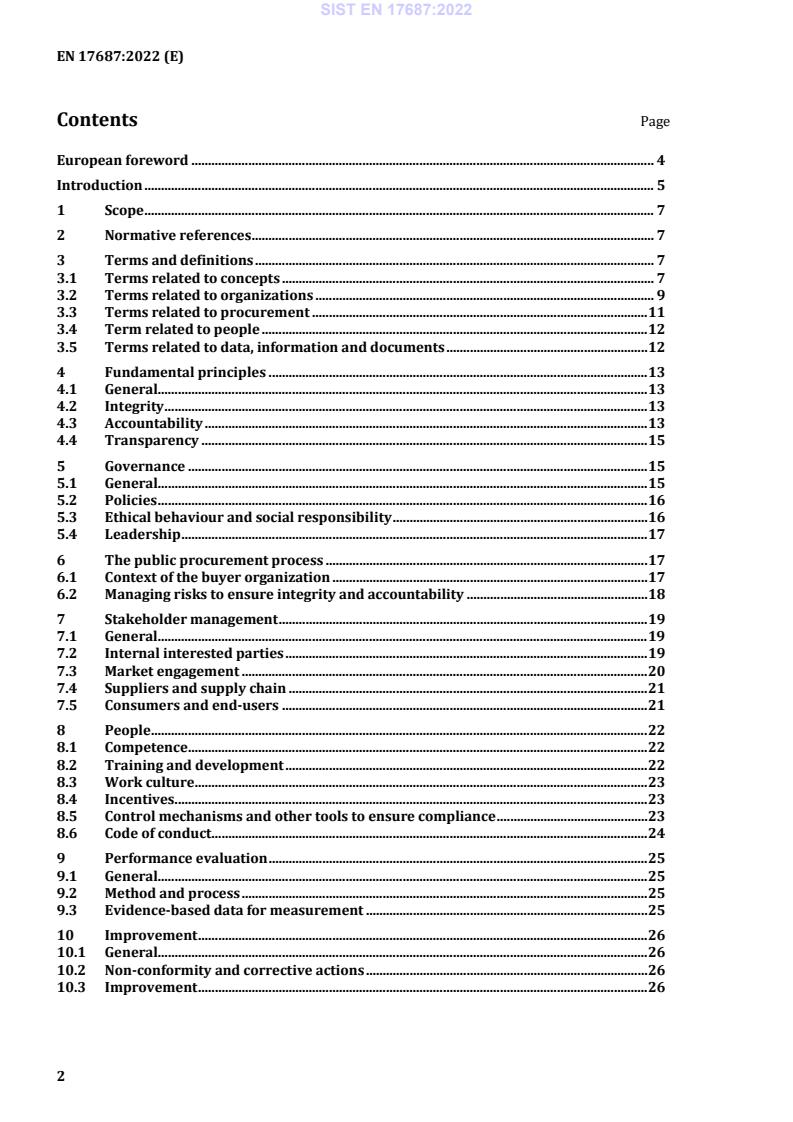
Contents Page
European foreword . 4
Introduction . 5
1 Scope . 7
2 Normative references . 7
3 Terms and definitions . 7
3.1 Terms related to concepts . 7
3.2 Terms related to organizations . 9
3.3 Terms related to procurement . 11
3.4 Term related to people . 12
3.5 Terms related to data, information and documents . 12
4 Fundamental principles . 13
4.1 General. 13
4.2 Integrity . 13
4.3 Accountability . 13
4.4 Transparency . 15
5 Governance . 15
5.1 General. 15
5.2 Policies . 16
5.3 Ethical behaviour and social responsibility . 16
5.4 Leadership . 17
6 The public procurement process . 17
6.1 Context of the buyer organization . 17
6.2 Managing risks to ensure integrity and accountability . 18
7 Stakeholder management . 19
7.1 General. 19
7.2 Internal interested parties . 19
7.3 Market engagement . 20
7.4 Suppliers and supply chain . 21
7.5 Consumers and end-users . 21
8 People . 22
8.1 Competence . 22
8.2 Training and development . 22
8.3 Work culture . 23
8.4 Incentives . 23
8.5 Control mechanisms and other tools to ensure compliance . 23
8.6 Code of conduct . 24
9 Performance evaluation . 25
9.1 General. 25
9.2 Method and process . 25
9.3 Evidence-based data for measurement . 25
10 Improvement . 26
10.1 General. 26
10.2 Non-conformity and corrective actions . 26
10.3 Improvement . 26
Annex A (informative) Guidance on the use of this document . 27
Annex B (informative) Risk management during the public procurement process . 31
Bibliography . 40
European foreword
This document (EN 17687:2022) has been prepared by Technical Committee CEN/TC 461 “Public
procurement”, the secretariat of which is held by SIS.
This European Standard shall be given the status of a national standard, either by publication of an
identical text or by endorsement, at the latest by February 2023, and conflicting national standards shall
be withdrawn at the latest by February 2023.
Attention is drawn to the possibility that some of the elements of this document may be the subject of
patent rights. CEN shall not be held responsible for identifying any or all such patent rights.
Any feedback and questions on this document should be directed to the users’ national standards body.
A complete listing of these bodies can be found on the CEN website.
According to the CEN-CENELEC Internal Regulations, the national standards organisations of the
following countries are bound to implement this European Standard: Austria, Belgium, Bulgaria, Croatia,
Cyprus, Czech Republic, Denmark, Estonia, Finland, France, Germany, Greece, Hungary, Iceland, Ireland,
Italy, Latvia, Lithuania, Luxembourg, Malta, Netherlands, Norway, Poland, Portugal, Republic of North
Macedonia, Romania, Serbia, Slovakia, Slovenia, Spain, Sweden, Switzerland, Turkey and the United
Kingdom.
Introduction
0.1 Background
This document has been developed following the acceptance by CEN to deliver the European
Commission's Pilot Project on Increased use of standards in Public Procurement - Output 3 (Integrity
and Accountability Standard). The main objective with Output 3 is to deliver a European Standard
focusing on integrity and accountability in public procurement.
The United Nations, together with international organizations such as the OECD, the European Union,
International Financing Institutions and NGOs such as Transparency International, have played leading
roles in recognizing the importance of good governance and developing technical guidance to enhance
integrity in public procurement.
Failure to commit to the fundamental principles of integrity, accountability and transparency in public
procurement can create room for corruption, undermine the effectiveness of public services and have a
negative impact on the cost-efficiency of public spending. As an indirect result, such deficiencies can
harm the public interest, undermine public trust and have a negative impact on citizens. Risks relating
to corruption and fraud are important aspects of public procurement globally. The EU regulatory
framework on public procurement and applicable national legislation provide a strong preventative
mechanism against the occurrence of potential irregularities. The EU legal system is based on the
fundamental principles of equal treatment, non-discrimination, mutual recognition, proportionality and
transparency, with clear rules on how to conduct public procurement processes to comply with these
principles.
A new generation of EU directives was adopted in 2014 that further underline the need for increased
integrity and the inclusion of specific rules for situations of conflicts of interest and more stringent
requirements on the exclusion of suppliers. However, the main challenges are normally not weak or
absent regulatory or institutional frameworks at the member state level, but rather the implementation
and practice at the level of contracting authorities and entities.
Integrity refers to the consistent alignment of, and adherence to, agreed ethical values, principles and
norms. In other terms, it is not just about being true to oneself but also about being accountable to key
stakeholders and operating in a transparent manner, such as how the procurement function is organized
and managed to secure internationally recognized frameworks for integrity and accountability. Integrity
and accountability are two components of good public governance, including sound financial
management, and are closely linked to each other.
This document aims to provide a sound framework for generally accepted principles of integrity and
accountability in public procurement.
Information marked as “NOTE” is for guidance in clarifying the associated requirement. “Notes to entry”
used in Clause 3 provide additional information that supplements the terminological data and can
contain provisions relating to the use of a term.
0.2 Structure of this document
Striving for integrity and accountability, which are objectives for any buyer organization, involves
managing various constraints in different proportions. In this document, this is reflected in the balance
between requirements and guidance.
In order to enable the buyer organization to address integrity and accountability in its public
procurement processes, this document is structured in the following way:
— Clause 1 to 3: the scope, normative references, which there are none, and terms and definitions
which apply to this document;
— Clause 4: the fundamental principles underlying this document: integrity, accountability and
transparency;
— Clause 5: governance within the buyer organization, including policies, behaviour and leadership;
— Clause 6: the public procurement process and the risks involved;
— Clause 7: stakeholder management, particularly in relation to market engagement, supply chain and
end-user levels;
— Clause 8: consideration of the human factors within the buyer organization, particularly the skills
and development of its workers, but also the mechanisms and measures taken by the buyer
organization to apply this document;
— Clause 9: evaluation of the performance of the public procurement process;
— Clause 10: continuous improvement of the public procurement process;
— Annex A: guidance for the interpretation of the requirements;
— Annex B: guidance on common risks in the public procurement process.
To simplify referencing in this document, every requirement and recommendation in Clauses 4 to 10
has been placed in a numbered subclause.
The following verbal forms are used in this document:
a) “shall” indicates a requirement;
b) “should” indicates a recommendation;
c) “may” indicates a permission;
d) “can” indicates a possibility or capability.
1 Scope
This document specifies requirements and guidance for buyer organizations, with regards to integrity
and accountability in public procurement processes from the identification of needs throughout the
delivering of goods, services or work contracts.
This document is applicable to use by:
a) buyer organizations;
b) contributors;
c) decision makers and their staff.
This document can have an impact on:
— individuals;
— suppliers and individuals acting in support of or on behalf of suppliers, including subcontractors;
the official bodies of the member states and of the European organizations which intervene, directly
or indirectly, in the public procurement process;
— organizations representing suppliers at the member state or European levels.
NOTE Further guidance for the interpretation and application of the scope and requirements of this document
is provided in Annex A.
2 Normative references
There are no normative references in this document.
3 Terms and definitions
For the purposes of this document, the following terms and definitions apply.
ISO and IEC maintain terminological databases for use in standardization at the following addresses:
— ISO Online browsing platform: available at https://www.iso.org/obp
— IEC Electropedia: available at https://www.electropedia.org/
3.1 Terms related to concepts
3.1.1
accountability
state of being answerable for decisions and activities to the buyer organization's governing bodies, legal
authorities and, more broadly, its stakeholders
[SOURCE: EN ISO 26000:2020, 2.1, modified ― The word “organization” has been replaced with “buyer
organization”.]
3.1.2
integrity
consistent alignment of, and adherence to, agreed ethical values, principles and norms
[SOURCE: OECD Recommendation on Public Integrity, 2017.]
3.1.3
integrity pact
contract between a buyer organization and suppliers bidding for public contracts that they will abstain
from corrupt practices and will conduct a transparent procurement process
Note 1 to entry: An integrity pact may be monitored by an independent third party.
3.1.4
transparency
open, comprehensive and understandable presentation of information
[SOURCE: EN ISO 14040:2006, 3.7.]
3.1.5
value for money
most advantageous combination of cost, quality and sustainability to meet customer requirements
3.1.6
international norms of behaviour
expectations of socially responsible organizational behaviour derived from customary international
law, generally accepted principles of international law, or intergovernmental agreements that are
universally or nearly universally recognized
Note 1 to entry: Intergovernmental agreements include treaties and conventions.
Note 2 to entry: Although customary international law, generally accepted principles of international law and
intergovernmental agreements are directed primarily at states, they express goals and principles to which all
organizations can aspire.
Note 3 to entry: International norms of behaviour evolve over time.
[SOURCE: EN ISO 26000:2020, 2.11.]
3.1.7
competence
ability to apply knowledge and skills to achieve intended results
[SOURCE: EN ISO 9000:2015, 3.10.4, modified ― The notes to entry have been removed.]
3.1.8
effectiveness
extent to which planned activities are realized and planned results are achieved
[SOURCE: EN ISO 9000:2015, 3.7.11, modified ― Note 1 to entry has been removed.]
3.1.9
risk
effect of uncertainty on objectives
[SOURCE: ISO 31000:2018, 3.1, modified ― The notes to entry have been removed.]
3.1.10
risk appetite
amount and type of risk that an organization is willing to pursue or retain
[SOURCE: ISO Guide 73:2009, 3.7.1.2.]
3.2 Terms related to organizations
3.2.1
organization
person or group of people that has its own functions with responsibilities, authorities and relationships
to achieve its objectives
Note 1 to entry: The concept of organization includes, but is not limited to, sole-trader, company, corporation,
firm, enterprise, authority, partnership, association, charity or institution, or part or combination thereof, whether
incorporated or not, public or private.
[SOURCE: EN ISO 9000:2015, 3.2.1, modified ― Note 2 to entry has been removed.]
3.2.2
project
temporary endeavour to achieve one or more defined objectives
[SOURCE: ISO 21500:2021, 3.15.]
3.2.3
governance
system by which the organization is directed, controlled and held accountable to achieve its core
purpose over the long term
Note 1 to entry: Governance is about the whole organization and encompasses everything that the organization
is and does.
[SOURCE: BS 13500:2013, 2.7, modified ― Notes 2 and 3 to entry have been removed.]
3.2.4
top management
person or group of people who direct and control the organization at the highest level
[SOURCE: EN ISO 9000:2015, 3.1.1, modified ― The notes to entry have been removed.]
3.2.5
business model
organization's approach to operating in its environment
[SOURCE: ISO 30400:2016, 3.4.]
3.2.6
buyer organization
organization defined as contracting authority or contracting entity by public procurement rules
Note 1 to entry: In the case of Public Administration, buyer organization can include all the administrative bodies
that take part in the whole life cycle of public procurement.
[SOURCE: Directive 2014/25/EU of the European Parliament and of Council of 26 February 2014 on
public procurement.]
3.2.7
supplier
organization that provides products, services or works
Note 1 to entry: A supplier can be an economic operator as defined by Directive 2014/24/EU of the European
Parliament and of Council of 26 February 2014 on public procurement.
Note 2 to entry: A supplier can also be any other economic operator in the supply chain, for example a
subcontractor or second tier supplier.
[SOURCE: EN ISO 9000:2015, 3.2.5, modified ― The word “works” has been added to the definition, the
example and notes to entry have been removed and a new note 1 to entry has been added.]
3.2.8
works
outcome of building or civil engineering activities taken as a whole which is sufficient in itself to fulfil an
economic or technical function
[SOURCE: Directive 2014/24/EU of the European Parliament and of Council of 26 February 2014 on
public procurement.]
3.2.9
interested party
stakeholder
person or organization that can affect, be affected by, or perceive itself to be affected by a decision or
activity
[SOURCE: EN ISO 9000:2015, 3.2.3, modified ― The example and note 1 to entry have been removed.]
3.2.10
policy
intentions and direction of an organization as formally expressed by its top management
[SOURCE: EN ISO 9001:2015, 3.2.10.]
3.2.11
ethical behaviour
behaviour that is in accordance with accepted principles of right or good conduct in the context of a
particular situation and is consistent with international norms of behaviour
[SOURCE: EN ISO 26000:2020, 2.7.]
3.2.12
social responsibility
responsibility of an organization for the impacts of its decisions and activities on society and the
environment, through transparent and ethical behaviour
[SOURCE: EN ISO 26000:2020, 2.18, modified ― The word “that” followed by a list in the definition have
been removed and the notes have been removed.]
3.2.13
key performance indicator
KPI
indicator of performance deemed by an organization to be significant and giving prominence and
attention to certain aspects
[SOURCE: EN ISO 14031:2013, 3.17.]
3.2.14
code of conduct
agreement on rules of behaviour for members of a group or organization
3.3 Terms related to procurement
3.3.1
procurement
activity of acquiring products, services or works from suppliers
Note 1 to entry: The procurement process considers the whole cycle from identification of needs through to the
end of a services contract or the end of the life of products.
[SOURCE ISO 20400:2017, 3.18, modified ― The word “works” has been added to the definition, note 1
to entry has been changed and note 2 to entry has been removed.]
3.3.2
public procurement
procurement by a buyer organization regulated by public procurement rules
Note 1 to entry: Rules can be international, national, regional or local, including from governing bodies such as
the EU.
3.3.3
supply chain
sequence of activities or parties that provides products or services to the organization, directly or
indirectly
[SOURCE: ISO/TS 26030:2019, 3.3, modified ― Note 1 to entry has been removed.]
3.3.4
contributor
person or organization directly or indirectly involved in the public procurement process in support of,
or on behalf of, a buyer organization
Note 1 to entry: A contributor can be an internal party (for example a buyer, technician, Data Protection Officer,
company lawyer or director), an external party (for example a consultant, an auditor or architect) or a semi-
external party (for example a member of a ministerial cabinet or an agent preparing the decisions of decision-
making bodies).
3.3.5
decision maker
individuals or official bodies responsible for making high level decisions for a buyer organization
Note 1 to entry: High level decisions can include approving the type of procedure for each contract, approving the
call for tender and formally awarding the contract.
3.4 Term related to people
3.4.1
worker
person who performs work, whether an employee or someone who is self-employed
[SOURCE: EN ISO 26000:2020, 2.27.]
3.5 Terms related to data, information and documents
3.5.1
documented information
information required to be controlled and maintained by an organization and the medium on which it
is contained
Note 1 to entry: Documented information can be in any format and media and from any source.
[SOURCE: EN ISO 9000:2015, 3.8.6, modified ― Notes 2 and 3 to entry have been removed.]
3.5.2
contract
binding agreement
[SOURCE: EN ISO 9000:2015, 3.4.7.]
3.5.3
evidence
data supporting the existence or verity of something
[SOURCE: EN ISO 9000:2015, 3.8.3, modified ― The word “objective” has been removed from the term.]
3.5.4
feedback
opinions, comments and expressions of interested parties on the activities, decisions and practices of
buyer organization
3.5.5
requirement
need or expectation that is stated, generally implied or obligatory
Note 1 to entry: Requirements can be generated by different interested parties or by the buyer organization itself
and can include legal, statutory and regulatory requirements.
[SOURCE: EN ISO 9000:2015, 3.6.4, modified ― Note 4 to entry has been changed, and renamed to Note
to entry 1, and the other notes to entry have been removed.]
4 Fundamental principles
4.1 General
To ensure confidence and trust in public procurement, buyer organizations involved in public
procurement processes shall demonstrate commitment to the fundamental principles of integrity,
accountability and transparency.
4.2 Integrity
4.2.1 To demonstrate integrity in public procurement processes the buyer organization shall
determine, implement and maintain processes to ensure relevant interested parties that activities are
conducted in an agreed socially beneficial way throughout the whole life cycle of public procurement.
4.2.2 The buyer organization shall ensure integrity is upheld by relevant interested parties in the
supply chain, for example by implementing a mechanism.
NOTE A widely known example of a mechanism for ensuring integrity is an integrity pact. To reinforce
accountability and to increase legitimacy, an integrity pact can include a separate contract with an independent
third-party organization which monitors that all parties comply with their commitments.
4.2.3 The buyer organization shall, as a minimum, ensure commitment to:
a) fair and equitable treatment of all relevant interested parties;
b) abstaining from corrupt practices;
c) being transparent, including any conflicts of interests;
d) evaluation of all parties and third-party monitoring, where appropriate;
e) effective governance arrangements by which the supplier monitors and ensures adherence to
commitments made in the contract.
4.3 Accountability
4.3.1 The buyer organization shall demonstrate accountability to relevant interested parties for all
decisions and activities related to its public procurement processes, including the behaviours of its
contributors and decision-makers.
4.3.2 The buyer organization shall ensure it is:
a) responsive to potential scrutiny;
b) accepting responsibility for the malpractices;
c) taking measures to remedy or prevent them, or both.
4.3.3 The buyer organization shall take a whole life cycle perspective and be accountable for the
impact of its own activities and the products and services being provided or purchased.
4.3.4 The buyer organization shall consider impacts on the:
a) supply chain;
b) society;
c) economy;
d) environment.
4.3.5 The buyer organization shall take the necessary actions on financial audit findings.
4.3.6 The buyer organization shall maintain and retain comprehensive, clear, and relevant
documented information related to:
a) organization-wide documentation:
1) its purpose and values;
2) its procurement policies;
3) how decisions are made, implemented and reviewed;
4) the definition of roles, responsibilities, accountabilities and authorities across different
functions;
5) transparency requirements for organizations in its supply chain;
6) how regulatory or agreed requirements can be met and maintained within agreed terms;
7) criteria and processes used to identify, select and engage relevant interested parties;
8) commitment to or evidence of working with all interested parties in the supply chain, to
improve value for money over the complete lifecycle.
b) overview of all contracts:
1) procurement plans;
2) contract awards and prices paid;
3) sources, amounts and application of funds;
4) complaints, including how these are handled and outcomes;
5) integrity or transparency incident investigations.
c) documentation structured on a contract-per-contract basis:
1) known and likely impacts of its decisions and activities on relevant interested parties, society,
economy and the environment;
2) anti-bribery policies and conflict of interest disclosure requirements;
3) evidence of designing and operating to sustainable contracts.
4.4 Transparency
4.4.1 The buyer organization shall be aware of applicable external constraints, such as contractual
obligations, which could limit the level of transparency.
4.4.2 Except when limited by external constraints, the buyer organization shall demonstrate
transparency regarding its mission and vision, nature and location of its activities, and the identity of
any controlling interest in its activities.
4.4.3 Except when limited by external constraints, the buyer organization shall be transparent in all
aspects of the procurement process to avoid secrecy or ambiguity regarding the decisions taken, and to
increase competition and promote an open market.
4.4.4 The buyer organization should make available the criteria against which it evaluates its current
and past performance on relevant significant issues of social responsibility by favouring the use of
benchmarks and repositories, for example standards or labels.
4.4.5 The buyer organization shall protect confidential information and personal data to ensure
relevant interested parties in the supply chain are treated equally and to avoid collusion.
4.4.6 The buyer organization shall ensure documented information is communicated to relevant
interested parties in a free format that is accessible and understandable.
5 Governance
5.1 General
5.1.1 The buyer organization shall ensure to get value for money and that public funds are spent as
intended in a way that addresses the needs to be covered, through effective governance.
5.1.2 The buyer organization shall demonstrate effective governance by:
a) identifying the risks involved in the public procurement processes;
b) establishing and maintaining a procurement process to prevent conflicts of interest;
c) directing and controlling its organization in a manner that aligns with its business model and
enables transparent reporting.
5.1.3 To further demonstrate effective governance the buyer organization should:
1) provide evidence of how it achieves and maintains its purpose and values, considering the needs
and expectations of relevant interested parties;
2) notify or make public for suppliers and all relevant interested parties of any significant change(s),
including changes in supervisory authorities, ownership and highest-level decision makers;
3) provide a clear connection between how procurement is governed, and the integrity, accountability
and transparency issues and impacts described in this document.
5.2 Policies
The buyer organization shall make available its policies, and how they are operationalized through plans
and activities, to relevant interested parties, including any policies relating to:
a) quality management;
b) occupational health and safety;
c) environmental management;
d) social responsibility;
e) risk management;
f) human rights and labour rights;
g) fair and prompt payment to suppliers throughout the supply chain;
h) anti-corruption;
i) conflict of interest;
j) preventing modern slavery;
k) equality, diversity and inclusion;
l) information management and security, including personal data protection;
m) intellectual property;
n) disclosure of sensitive information;
o) training and skills development.
NOTE The buyer organization can manage the items in the list through various methods, for example a single
or separate policies.
5.3 Ethical behaviour and social responsibility
The buyer organization shall ensure that it:
a) balances financial and operational objectives with its values and desired behaviours;
b) assesses potential procurement contracts and ensures alignment with its own purpose and values;
c) monitors behaviours of relevant external and internal interested parties and takes appropriate and
timely action to address behaviours that are not aligned to its values and desired behaviours;
d) provides appropriate mechanisms for reporting perceived or known issues, including
whistleblowing;
e) is committed to fair and prompt payment to suppliers throughout the supply chain;
f) provides evidence of awareness of the impact of its activities on the economy, environment, and
society.
5.4 Leadership
The buyer organization shall ensure that top management and other leadership positions:
a) ensures that all activities and behaviours reflect its responsibilities, purpose and values;
b) demonstrates effective and coherent leadership at the highest level and throughout its organization;
c) ensures the provision of resources and facilities necessary to fulfil its commitments;
d) ensures that people working on behalf of its organization are treated fairly and ethically;
e) ensures that different organizational objectives are aligned and do not encourage or incentivize
undesirable behaviour;
f) sets common goals and required behaviour when it comes to integrity, accountability and
transparency;
g) motivates the people to act toward achieving these common goals;
h) demonstrates commitment to these goals and behaviours in order to motivate people in the buyer
organization to act in a similar way.
NOTE Leadership commitment is sometimes referred to as “tone at the top” or “tone from the top”.
6 The public procurement process
6.1 Context of the buyer organization
6.1.1 The public procurement process is triggered by internal needs of the buyer organization. The
sourcing of external products and services is aimed at supporting the buyer organization perform its
mission in the public interest, which includes optimizing value for money. The buyer organization shall
demonstrate that it understands its societal responsibility and identity within the public procurement
process and the context it operates in, including the external and internal issues that can affect its
activities.
NOTE This demonstration can be the subject of a specific document but can also appear as parts of documents
that the buyer organization already makes available, for example code of conduct, presentation of its vision-
missions-values, policies, clauses in employment contracts with its employees and clauses in its procurement
documents.
6.1.2 The buyer organization shall establish, maintain, and provide documented evidence of its:
a) purpose;
b) need for purchasing;
c) vision;
d) values;
e) business model.
6.1.3 In order to ensure adherence to integrity and transparency standards on the operational level,
the buyer organization shall:
a) ensure that internal policies and procedures clearly set the work rules and responsibilities of each
worker (see Clause 8);
b) ensure internal policies and procedures are compliant with its obligations regarding integrity and
transparency standards, including:
1) information on procurement opportunities;
2) requirements regarding accessibility to the procurement documents;
3) timely response to suppliers’ requests;
4) adequate notifications and reporting;
5) publication of contracts when required;
6) documentation and traceability of decisions;
7) payment procedures.
c) set appropriate measures for protecting confidential and commercially sensitive information
received or generated during the whole procurement cycle and to avoid collusion.
6.1.4 The buyer organization should consider establishing additional requirements or standards on
maintaining integrity and transparency regarding the aspects, that are not expressly legal requirements
(for example opening the data on interaction with the market, the data on its public procurement in a
user-friendly form and creating a digital contract register), in order to increase external oversight and
provide possibilities for effective supervision by different entities, including, for example, the civil
society, NGO sector and international organizations.
6.2 Managing risks to ensure integrity and accountability
6.2.1 The buyer organization shall identify and assess risks relating to integrity and accountability,
taking into account the whole procurement cycle, internal and external issues and by considering risks
that are common for different stages of the procurement process.
NOTE 1 See Annex A, Figure A.1 for the stages of the procurement process.
NOTE 2 See Annex B for risks that are common for different stages of the procurement process.
6.2.2 The buyer organization shall prepare and implement risk treatment plans to prevent or mitigate
risks relating to integrity and accountability, taking into account the whole procurement cycle, by
considering risk treatment options for risks that are common for different stages of the procurement
process.
NOTE See Annex B for risk treatment options for risks that are common for different stages of the
procurement process.
6.2.3 When managing risks relating to public procurement the buyer organization shall take into
account its risk appetite.
6.2.4 The buyer organization shall document the risk treatment plans and how they are implemented.
6.2.5 When preparing and implementing risk treatment plans to prevent or mitigate risks relating
integrity and accountability, the buyer organization should take into account the extent of the need and
adapt the risk treatment plan accordingly.
7 Stakeholder management
7.1 General
7.1.1 The buyer organization shall identify:
a) relevant external and internal interested parties;
b) the expectations and requirements of those interested parties;
c) how those interested parties can affect or be affected by its public procurement processes.
7.1.2 The buyer organization shall effectively manage its relationships with relevant interested
parties, such as:
a) its workers, contributors and decision makers;
b) supervisory authority, owners and shareholders;
c) related public bodies and partners;
d) suppliers;
e) end-users;
f) other relevant interested parties.
7.1.3 To enable conformity with integrity and transparency requirements the buyer organization
shall:
a) establish and promote effective collaboration and communication with relevant interested parties;
b) recognize and reinforce desired behaviours;
c) perform regular reviews of relationships with relevant interested parties to ensure continuing
effectiveness and if the relationship is still needed.
7.2 Internal interested parties
In order to ensure integrity and transparency in relationships with internal interested parties, the buyer
organization should:
a) rank relevant internal interested parties according to their interest levels and influence on the
public procurement process (for example key stakeholders, non-critical stakeholders);
b) identify the values, needs and expectations of each internal stakeholder group;
c) set structures aimed at appropriate engagement of each internal stakeholder group (for example
involvement of key stakeholders in decision making, keeping non-critical stakeholders informed);
d) establish a process for negotiation and compromise in line with its purpose and values when the
needs of an internal stakeholder group cannot be fully satisfied.
7.3 Market engagement
7.3.1 The buyer organization shall determine what level of market engagement is needed or
appropriate, or both, in the particular procurement project, taking into account such factors as
sustainability and innovation needs, the complexity and size of the contract and timelines.
7.3.2 The buyer organization shall ensure market engagement is open and inclusive, whenever this is
appropriate.
7.3.3 The buyer organization should, when appropriate, adopt a proactive approach to market
engagement.
7.3.4 The buyer organization shall communicate in a transparent, non-discriminatory manner and
with an adequate level of publicity with relevant interested parties regularly by, for example:
a) making clear its purpose and values and how these inform its approach to procurement;
b) demonstrating public procurement plans and requirements;
c) promoting understanding of markets (including, for example, demand, supply, degree of
competition, pricing methods, market trends and technological developments);
d) demonstrating equal and fair cooperation with relevant interested parties, and avoiding preference;
e) presenting and demonstrating important underlying principles for public procurement, such as
anti-corruption, transparency, equal treatment, objectivity and fairness.
7.3.5 The buyer organization should use feedback from suppliers to improve the procurement
process.
7.3.6 The buyer organization should document and make available on request the actions taken as a
result of feedback.
7.3.7 In order to ensure integrity and transparency during the process of market engagement, the
buyer organization shall:
a) ensure effective communication with suppliers using appropriate integrity and transparency
safeguards, adequate for each specific case;
b) ensure protection of co
...