

prEN 1997-3
(Main)Eurocode 7: Geotechnical design - Part 3: Design assisted by field testing
General Information
- Abstract
Requirements for the execution, interpretation and use of results of field tests to assist in the geotechnical design of structures.
- Status
- Not Published
- Publication Date
- 04-Oct-2004
- Technical Committee
- CEN/TC 250 - Structural Eurocodes
- Drafting Committee
- CEN/TC 250 - Structural Eurocodes
- Current Stage
- 1099 - Decision on WI proposal - Accept - Evaluation of concrete proposal
- Start Date
- 06-Jun-2000
- Completion Date
- 06-Jun-2000

Overview
prEN 1997-3, part of the Eurocode 7 series, sets forth comprehensive requirements for geotechnical design assisted by field testing. Published by the European Committee for Standardization (CEN), this standard guides the execution, interpretation, and application of results from on-site geotechnical tests. Designed to support the design of geotechnical structures, it focuses on practical techniques essential for ensuring safe and effective foundation engineering through field data.
The Eurocode 7: Geotechnical Design - Part 3 complements existing frameworks by providing specific methodologies for integrating field test data into design processes. It promotes consistency and reliability in geotechnical engineering projects across Europe, aiding engineers in accurately assessing ground conditions and structural interactions.
Key Topics
Key topics covered by prEN 1997-3 include:
- Scope and assumptions for applying field test data in geotechnical design to ensure applicability and coherence within design projects.
- Definitions and symbols to standardize technical terminology and reporting conventions.
- Design of geotechnical structures such as slopes, embankments, spread foundations, piled foundations, retaining structures, anchors, reinforced fills, ground reinforcing elements, ground improvement, and groundwater control.
- Geotechnical analysis procedures underpinning ultimate and serviceability limit states.
- Material, groundwater, and soil behavior considerations, ensuring the realistic integration of environmental factors.
- Testing protocols for field tests, including how to conduct and interpret results to inform structural safety and performance.
- Reporting requirements to maintain transparency, traceability, and communication throughout the design and construction phases.
By addressing a broad spectrum of geotechnical structures and methods, the standard ensures a unified approach to site testing and design implementation that meets rigorous safety and performance expectations.
Applications
prEN 1997-3 provides practical value for a variety of geotechnical engineering applications, including:
- Design and construction of foundations: Guiding on-site testing and interpretation to optimize spread and piled foundation designs in diverse soil conditions.
- Slope stability analysis: Utilizing field tests to assess natural and engineered slopes, embankments, and cuttings.
- Retaining structures and anchors: Informing reliable designs through field data that accurately represent soil-structure interaction.
- Ground improvement techniques: Applying field test results to validate and refine ground reinforcement measures such as soil nails, rock bolts, and reinforcement meshes.
- Water control systems: Ensuring effective groundwater management by integrating field testing into the design of dewatering and impermeable barrier systems.
This standard supports civil engineers, geotechnical consultants, and construction professionals in making informed decisions based on site-specific data, thereby enhancing safety and cost-effectiveness in infrastructure projects.
Related Standards
prEN 1997-3 works within the broader Eurocode framework and other complementary standards:
- EN 1997-1: Geotechnical design - Part 1: General rules – Establishes fundamentals and overall geotechnical principles.
- EN 1997-2: Geotechnical investigation and testing - Laboratory testing of soil – Details laboratory methods to support the interpretation of field test results.
- Other Eurocodes such as EN 1992 (Concrete structures), EN 1993 (Steel structures), and EN 1991 (Actions on structures), which interrelate for comprehensive structural design.
Integration of prEN 1997-3 with these standards ensures a holistic approach to geotechnical engineering, emphasizing reliability, harmonization, and best practice in European construction projects.
Keywords: Eurocode 7, prEN 1997-3, geotechnical design, field testing, geotechnical structures, foundation design, slope stability, retaining structures, ground improvement, groundwater control, CEN standards, geotechnical analysis, construction engineering.
Relations
- Merged Into
EN 1997-2:2007 - Eurocode 7 - Geotechnical design - Part 2: Ground investigation and testing - Effective Date
- 08-Mar-2023
Get Certified
Connect with accredited certification bodies for this standard

DIBt (Deutsches Institut für Bautechnik)
German Institute for Building Technology.
DIN CERTCO
DIN Group product certification.
Zavod za gradbeništvo Slovenije (ZAG) - Inšpekcija
ZAG inspection body for construction products, structures, and materials.
Sponsored listings
Frequently Asked Questions
prEN 1997-3 is a draft published by the European Committee for Standardization (CEN). Its full title is "Eurocode 7: Geotechnical design - Part 3: Design assisted by field testing". This standard covers: Requirements for the execution, interpretation and use of results of field tests to assist in the geotechnical design of structures.
Requirements for the execution, interpretation and use of results of field tests to assist in the geotechnical design of structures.
prEN 1997-3 is classified under the following ICS (International Classification for Standards) categories: 91.010.30 - Technical aspects; 93.020 - Earthworks. Excavations. Foundation construction. Underground works. The ICS classification helps identify the subject area and facilitates finding related standards.
prEN 1997-3 has the following relationships with other standards: It is inter standard links to EN 1997-2:2007. Understanding these relationships helps ensure you are using the most current and applicable version of the standard.
prEN 1997-3 is associated with the following European legislation: EU Directives/Regulations: 305/2011, 89/106/EEC; Standardization Mandates: M/515. When a standard is cited in the Official Journal of the European Union, products manufactured in conformity with it benefit from a presumption of conformity with the essential requirements of the corresponding EU directive or regulation.
prEN 1997-3 is available in PDF format for immediate download after purchase. The document can be added to your cart and obtained through the secure checkout process. Digital delivery ensures instant access to the complete standard document.
Standards Content (Sample)
SLOVENSKI STANDARD
01-december-2022
Evrokod 7 - Geotehnično projektiranje - 3. del: Geotehnične konstrukcije
Eurocode 7 - Geotechnical design - Part 3: Geotechnical structures
Eurocode 7 - Entwurf, Berechnung und Bemessung in der Geotechnik - Teil 3:
Geotechnische Bauwerke
Eurocode 7 - Calcul géotechnique - Partie 3 : Constructions géotechniques
Ta slovenski standard je istoveten z: prEN 1997-3
ICS:
91.010.30 Tehnični vidiki Technical aspects
93.020 Zemeljska dela. Izkopavanja. Earthworks. Excavations.
Gradnja temeljev. Dela pod Foundation construction.
zemljo Underground works
2003-01.Slovenski inštitut za standardizacijo. Razmnoževanje celote ali delov tega standarda ni dovoljeno.
DRAFT
EUROPEAN STANDARD
NORME EUROPÉENNE
EUROPÄISCHE NORM
September 2022
ICS 91.010.30; 93.020 Will supersede EN 1997-1:2004
English Version
Eurocode 7 - Geotechnical design - Part 3: Geotechnical
structures
Eurocode 7 - Calcul géotechnique - Partie 3 : Eurocode 7 - Entwurf, Berechnung und Bemessung in
Constructions géotechniques der Geotechnik - Teil 3: Geotechnische Bauwerke
This draft European Standard is submitted to CEN members for enquiry. It has been drawn up by the Technical Committee
CEN/TC 250.
If this draft becomes a European Standard, CEN members are bound to comply with the CEN/CENELEC Internal Regulations
which stipulate the conditions for giving this European Standard the status of a national standard without any alteration.
This draft European Standard was established by CEN in three official versions (English, French, German). A version in any other
language made by translation under the responsibility of a CEN member into its own language and notified to the CEN-CENELEC
Management Centre has the same status as the official versions.
CEN members are the national standards bodies of Austria, Belgium, Bulgaria, Croatia, Cyprus, Czech Republic, Denmark, Estonia,
Finland, France, Germany, Greece, Hungary, Iceland, Ireland, Italy, Latvia, Lithuania, Luxembourg, Malta, Netherlands, Norway,
Poland, Portugal, Republic of North Macedonia, Romania, Serbia, Slovakia, Slovenia, Spain, Sweden, Switzerland, Türkiye and
United Kingdom.
Recipients of this draft are invited to submit, with their comments, notification of any relevant patent rights of which they are
aware and to provide supporting documentation.
Warning : This document is not a European Standard. It is distributed for review and comments. It is subject to change without
notice and shall not be referred to as a European Standard.
EUROPEAN COMMITTEE FOR STANDARDIZATION
COMITÉ EUROPÉEN DE NORMALISATION
EUROPÄISCHES KOMITEE FÜR NORMUNG
CEN-CENELEC Management Centre: Rue de la Science 23, B-1040 Brussels
© 2022 CEN All rights of exploitation in any form and by any means reserved Ref. No. prEN 1997-3:2022 E
worldwide for CEN national Members.
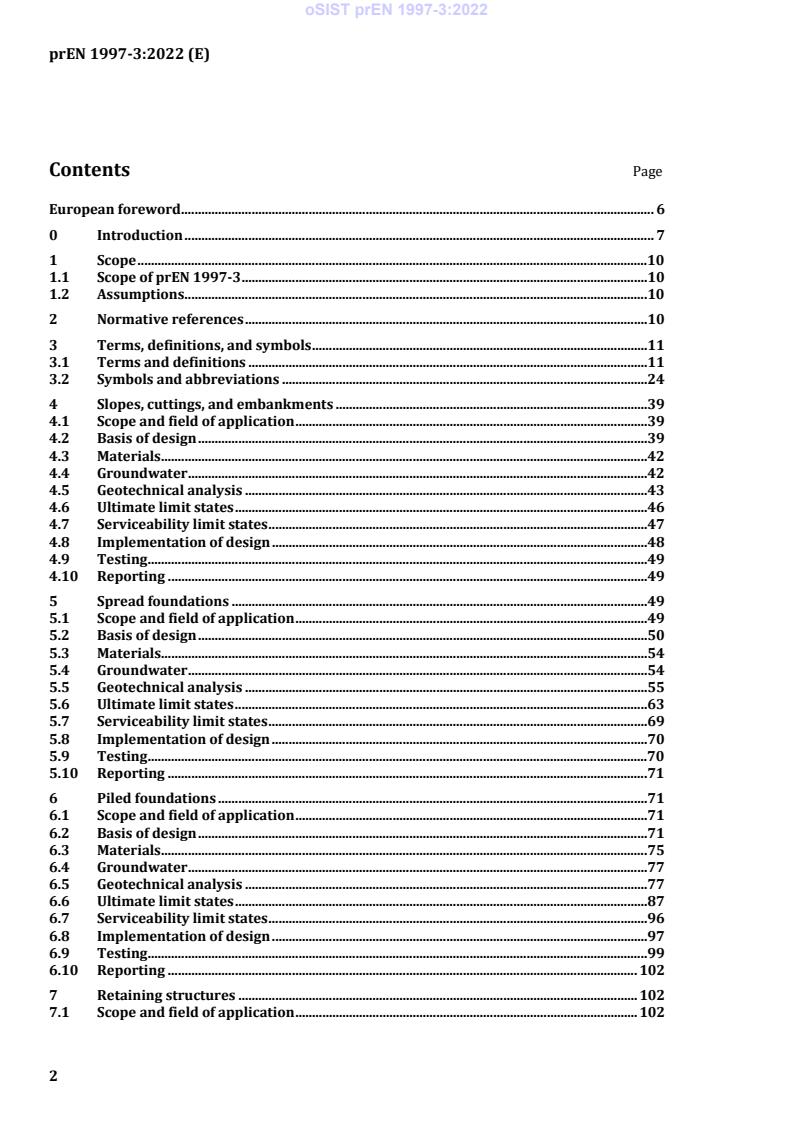
Contents Page
European foreword . 6
0 Introduction . 7
1 Scope .10
1.1 Scope of prEN 1997-3 .10
1.2 Assumptions .10
2 Normative references .10
3 Terms, definitions, and symbols .11
3.1 Terms and definitions .11
3.2 Symbols and abbreviations .24
4 Slopes, cuttings, and embankments .39
4.1 Scope and field of application .39
4.2 Basis of design .39
4.3 Materials .42
4.4 Groundwater .42
4.5 Geotechnical analysis .43
4.6 Ultimate limit states .46
4.7 Serviceability limit states .47
4.8 Implementation of design .48
4.9 Testing .49
4.10 Reporting .49
5 Spread foundations .49
5.1 Scope and field of application .49
5.2 Basis of design .50
5.3 Materials .54
5.4 Groundwater .54
5.5 Geotechnical analysis .55
5.6 Ultimate limit states .63
5.7 Serviceability limit states .69
5.8 Implementation of design .70
5.9 Testing .70
5.10 Reporting .71
6 Piled foundations .71
6.1 Scope and field of application .71
6.2 Basis of design .71
6.3 Materials .75
6.4 Groundwater .77
6.5 Geotechnical analysis .77
6.6 Ultimate limit states .87
6.7 Serviceability limit states .96
6.8 Implementation of design .97
6.9 Testing .99
6.10 Reporting . 102
7 Retaining structures . 102
7.1 Scope and field of application . 102
7.2 Basis of design . 102
7.3 Materials . 105
7.4 Groundwater . 106
7.5 Geotechnical analysis . 106
7.6 Ultimate limit states . 111
7.7 Serviceability limit states . 116
7.8 Implementation of design. 117
7.9 Testing . 118
7.10 Reporting . 119
8 Anchors . 119
8.1 Scope and field of application . 119
8.2 Basis of design . 120
8.3 Materials . 122
8.4 Groundwater . 123
8.5 Geotechnical analysis . 123
8.6 Ultimate limit states . 123
8.7 Serviceability limit states . 126
8.8 Implementation of design. 128
8.9 Testing . 129
8.10 Reporting . 131
9 Reinforced fill structures . 131
9.1 Scope and field of application . 131
9.2 Basis of design . 132
9.3 Materials . 135
9.4 Groundwater . 141
9.5 Geotechnical analysis . 141
9.6 Ultimate limit states . 148
9.7 Serviceability limit states . 152
9.8 Implementation of design. 152
9.9 Testing . 153
9.10 Reporting . 153
10 Ground reinforcing elements . 154
10.1 Scope and field of application . 154
10.2 Basis of design . 154
10.3 Materials . 156
10.4 Groundwater . 158
10.5 Rock bolts and rock anchors . 158
10.6 Soil Nails . 162
10.7 Wire mesh . 167
10.8 Sprayed concrete . 170
10.9 Facing element . 171
10.10 Reporting . 173
11 Ground improvement. 173
11.1 Scope and field of application . 173
11.2 Basis of design . 174
11.3 Materials . 179
11.4 Groundwater . 182
11.5 Geotechnical analysis . 182
11.6 Ultimate limit states . 186
11.7 Serviceability limit states . 188
11.8 Implementation of design. 188
11.9 Testing . 189
11.10 Reporting . 190
12 Groundwater control . 191
12.1 Scope and field of application . 191
12.2 Basis of design . 192
12.3 Material . 194
12.4 Groundwater . 194
12.5 Reduction of hydraulic conductivity . 194
12.6 Dewatering and infiltration. 196
12.7 Impermeable barriers . 198
12.8 Implementation of design . 199
12.9 Testing . 202
12.10 Reporting . 202
Annex A (informative) Slopes, cuttings, and embankments . 203
A.1 Use of this Informative Annex . 203
A.2 Scope and field of application . 203
A.3 Calculation models for analysing the stability of soil and fill . 203
A.4 Calculation models for analysing the stability of rock mass . 205
Annex B (informative) Spread foundations . 207
B.1 Use of this Informative Annex . 207
B.2 Scope and field of application . 207
B.3 Checklists . 207
B.4 Calculation model for bearing resistance using soil parameters . 208
B.5 Calculation model for bearing resistance on ground underlain by a weaker layer 210
B.6 Calculation model for bearing resistance from pressuremeter test results . 211
B.7 Calculation model for settlement evaluation based on adjusted elasticity method 214
B.8 Calculation model for settlement evaluation based on stress-strain method . 215
B.9 Calculation model for settlements without drainage . 215
B.10 Calculation model for settlements caused by consolidation . 215
B.11 Calculation model for time-settlement behaviour . 215
B.12 Calculation model for settlement evaluation using pressuremeter test results. 215
B.13 Calculation model for settlement evaluation using cone penetration test results . 217
B.14 Relative stiffness of a spread foundation and subgrade modulus. 218
B.15 Linear elastic spring stiffnesses of surface foundation . 219
Annex C (informative) Piled foundations . 221
C.1 Use of this Informative Annex . 221
C.2 Scope and field of application . 221
C.3 Examples of pile types . 221
C.4 Pile shaft resistance based on ground parameters. . 223
C.5 Pile base resistance based on ground parameters . 224
C.6 Axial pile resistance based on CPT profiles . 225
C.7 Axial pile resistance from PMT profiles . 229
C.8 Axial pile resistance based on empirical tables . 232
C.9 Downdrag due to vertical ground movements . 234
C.10 Pile groups subject to axial tension . 237
C.11 Calculation model for single pile settlement using load transfer functions . 238
C.12 Calculation model for single pile lateral displacement using load transfer functions
................................................................................................................................................................. 238
C.13 Buckling and second order effects . 243
C.14 Cyclic effects . 248
Annex D (informative) Retaining structures . 250
D.1 Use of this Informative Annex . 250
D.2 Scope and field of application . 250
D.3 Calculation model to determine limit values of earth pressures on vertical walls . 250
D.4 Calculation model to determine at-rest values of earth pressure . 254
D.5 Earth pressures due to compaction . 255
D.6 Earth pressures caused by cyclic thermal movement for integral bridges . 257
D.7 Basal heave . 257
D.8 Limit equilibrium models . 260
D.9 Beam-on-spring models . 260
D.10 Calculation model to determine intermediate values of earth pressure . 261
D.11 Numerical continuum models . 262
D.12 Vertical wall stability . 263
D.13 Determination of the anchor length to prevent interaction between anchors and
retaining structures . 264
Annex E (informative) Anchors . 266
E.1 Use of this Informative Annex . 266
E.2 Scope and field of application . 266
E.3 Example for anchor design models . 266
E.4 Layout of anchors . 266
Annex F (informative) Reinforced fill structures . 270
F.1 Use of this Informative Annex . 270
F.2 Scope and field of application . 270
F.3 Calculation models for reinforced fill structures . 270
F.4 Calculation models for reinforced embankment bases . 274
F.5 Calculation models for load transfer platform over rigid inclusions . 276
F.6 Calculation models for embankments over voids . 278
F.7 Veneer reinforcement . 280
F.8 Durability, reduction factor for tensile strength. 281
F.9 Typical grades of steel used for soil reinforcement elements . 282
Annex G (informative) Ground improvement . 284
G.1 Use of this Informative Annex . 284
G.2 Scope and field of application . 284
G.3 Examples of ground improvement techniques . 284
G.4 Use of stress envelope to determine acceptable limit states . 288
Bibliography . 290
European foreword
This document (prEN 1997-3:2022) has been prepared by Technical Committee CEN/TC 250 “Structural
Eurocodes”, the secretariat of which is held by BSI. CEN/TC 250 is responsible for all Structural
Eurocodes and has been assigned responsibility for structural and geotechnical design matters by CEN.
This document is currently submitted to the CEN Enquiry.
This document will partially supersede EN 1997-1:2004.
The first generation of EN Eurocodes was published between 2002 and 2007. This document forms part
of the second generation of the Eurocodes, which have been prepared under Mandate M/515 issued to
CEN by the European Commission and the European Free Trade Association.
The Eurocodes have been drafted to be used in conjunction with relevant execution, material, product
and test standards, and to identify requirements for execution, materials, products and testing that are
relied upon by the Eurocodes.
The Eurocodes recognise the responsibility of each Member State and have safeguarded their right to
determine values related to regulatory safety matters at national level through the use of National
Annexes.
0 Introduction
0.1 Introduction to the Eurocodes
The Structural Eurocodes comprise the following standards generally consisting of a number of Parts:
• EN 1990 Eurocode: Basis of structural and geotechnical design
• EN 1991 Eurocode 1: Actions on structures
• EN 1992 Eurocode 2: Design of concrete structures
• EN 1993 Eurocode 3: Design of steel structures
• EN 1994 Eurocode 4: Design of composite steel and concrete structures
• EN 1995 Eurocode 5: Design of timber structures
• EN 1996 Eurocode 6: Design of masonry structures
• EN 1997 Eurocode 7: Geotechnical design
• EN 1998 Eurocode 8: Design of structures for earthquake resistance
• EN 1999 Eurocode 9: Design of aluminium structures
• New parts are under development, e.g. Eurocode for design of structural glass.
The Eurocodes are intended for use by designers, clients, manufacturers, constructors, relevant
authorities (in exercising their duties in accordance with national or international regulations),
educators, software developers, and committees drafting standards for related product, testing and
execution standards.
NOTE Some aspects of design are most appropriately specified by relevant authorities or, where not specified,
can be agreed on a project-specific basis between relevant parties such as designers and clients. The Eurocodes
identify such aspects making explicit reference to relevant authorities and relevant parties.
0.2 Introduction to EN 1997 Eurocode 7
EN 1997 consists of a number of parts:
• EN 1997-1, Geotechnical design — Part 1: General rules
• EN 1997-2, Geotechnical design — Part 2: Ground properties
• EN 1997-3, Geotechnical design — Part 3: Geotechnical structures
EN 1997 standards establish additional principles and requirements to those given in EN 1990 for the
safety, serviceability, robustness, and durability of geotechnical structures.
Design and verification in EN 1997 (all parts) are based on the partial factor method or other reliability-
based methods, prescriptive rules, testing, or the observational method.
0.3 Introduction to prEN 1997-3
This document establishes principles and requirements for the design and verification of the following of
geotechnical structures, including temporary geotechnical structures: slopes, cuttings, embankments,
shallow foundation, piled foundation and retaining structures.
This document establishes principles and requirements for the design and verification of supporting
elements: anchors, reinforcing element in reinforced fill structures, soil nails, rock bolts and facing.
This document establishes principles and requirements for the design and verification of groundwater
control including reduction of hydraulic conductivity, dewatering and infiltration, and the use of
impermeable barriers
0.4 Verbal forms used in the Eurocodes
The verb “shall” expresses a requirement strictly to be followed and from which no deviation is permitted
in order to comply with the Eurocodes.
The verb “should” expresses a highly recommended choice or course of action. Subject to national
regulation and/or any relevant contractual provisions, alternative approaches could be used/adopted
where technically justified.
The verb “may” expresses a course of action permissible within the limits of the Eurocodes.
The verb “can” expresses possibility and capability; it is used for statements of fact and clarification of
concepts.
0.5 National Annex for prEN 1997-3
National choice is allowed in this standard where explicitly stated within notes. National choice includes
the selection of values for Nationally Determined Parameters (NDPs).
The national standard implementing prEN 1997-3:2022 can have a National Annex containing all national
choices to be used for the design of buildings and civil engineering works to be constructed in the relevant
country.
When no national choice is given, the default choice given in this standard is to be used.
When no national choice is made and no default is given in this standard, the choice can be specified by a
relevant authority or, where not specified, agreed for a specific project by appropriate parties.
National choice is allowed in prEN 1997-3:2022 through notes to the following:
Table 4.1 (NDP) Table 4.2 (NDP) Table 5.1 (NDP) Table 5.2 (NDP)
Table 5.3 (NDP) Table 6.1 (NDP) Table 6.2 (NDP) Table 6.3 (NDP)
Table 6.4 (NDP) Table 6.5 (NDP) Table 6.6 (NDP) Table 6.7 (NDP)
Formula (6.18) Table 7.1 (NDP) Table 8.1 (NDP) Table 8.2 (NDP)
Table 8.3 (NDP) Table 9.1 (NDP) Table 9.2 (NDP) Table 9.3 (NDP)
Table 10.1 (NDP) Table 10.2 (NDP) Table 10.3 (NDP) Table 10.4 (NDP)
Table 10.5 (NDP) Table 11.1 (NDP) Table 11.2 (NDP) Table 11.3 (NDP)
Table 11.4 (NDP) Table 11.5 (NDP) Table 12.1 (NDP) A.1(1) NOTE 1
G.1(1) NOTE 1
National choice is allowed in prEN 1997-3:2022 on the application of the following informative annexes.
Annex A Annex B Annex C Annex D
Annex E Annex F Annex G
The National Annex can contain, directly or by reference, non-contradictory complementary information
for ease of implementation, provided it does not alter any provisions of the Eurocodes.
1 Scope
1.1 Scope of prEN 1997-3
This document provides specific rules to be applied for design and verification of geotechnical
structures.
1.2 Assumptions
This document is intended to be used in conjunction with prEN 1990:2021, which establishes
principles and requirements for the safety, serviceability, robustness, and durability of structures,
including geotechnical structures, and other construction works.
This document is intended to be used in conjunction with prEN 1997-1:2022, which provides general
rules for design and verification of geotechnical structures.
This document is intended to be used in conjunction with prEN 1997-2:2022, which gives provisions
rules for determining ground properties from ground investigation.
This document is intended to be used in conjunction with the other Eurocodes for the design of
geotechnical structures, including temporary geotechnical structures.
2 Normative references
The following documents are referred to in the text in such a way that some or all of their content
constitutes requirements of this document. For dated references, only the edition cited applies. For
undated references, the latest edition of the referenced document (including any amendments) applies.
NOTE See the Bibliography for a list of other documents cited that are not normative references, including
those referenced as recommendations (i.e. in ‘should’ clauses), permissions (‘may’ clauses), possibilities (‘can’
clauses), and in notes.
EN 1537, Execution of special geotechnical works — Ground anchors
prEN 1990:2021, Eurocode — Basis of structural and geotechnical design
prEN 1992 (all parts), Eurocode 2 — Design of concrete structures
prEN 1993 (all parts), Eurocode 3 — Design of steel structures
prEN 1993-1-1:2022, Eurocode 3 — Design of steel structures — Part 1-1: General rules and rules for
buildings
EN 1993-5:2007, Eurocode 3 — Design of steel structures — Part 5: Piling
prEN 1994 (all parts), Eurocode 4 — Design of composite steel and concrete structures
prEN 1995 (all parts), Eurocode 5 — Design of timber structures
prEN 1996 (all parts), Eurocode 6 — Design of masonry structures
prEN 1997-1:2022, Eurocode 7 — Geotechnical design — Part 1: General rules
prEN 1997-2:2022, Eurocode 7 — Geotechnical design — Part 2: Ground properties
EN 10025 (all parts), Hot rolled products of structural steel
EN 10080, Steel for the reinforcement of concrete — Weldable reinforcing steel — General
EN 10244-2:2009, Steel wire and wire products — Non-ferrous metallic coatings on steel wire — Part 2:
Zinc or zinc alloy coatings
EN 10245-2, Steel wire and wire products — Organic coatings on steel wire — Part 2: PVC finished wire
EN 10245-3, Steel wire and wire products — Organic coatings on steel wire — Part 3: PE coated wire
EN 10245-4, Steel wire and wire products — Organic coatings on steel wire — Part 4: Polyester coated wire
EN 10245-5, Steel wire and wire products — Organic coatings on steel wire — Part 5: Polyamide coated
wire
EN 13738, Geotextiles and geotextile-related products — Determination of pullout resistance in soil
EN 14475:2006, Execution of special geotechnical works — Reinforced fill
EN 14488-4, Testing sprayed concrete — Part 4: Bond strength of cores by direct tension
EN 14488-5, Testing sprayed concrete — Part 5: Determination of energy absorption capacity of fibre
reinforced slab specimens
EN 14490, Execution of special geotechnical works — Soil nailing
EN ISO 1461, Hot dip galvanized coatings on fabricated iron and steel articles — Specifications and test
methods (ISO 1461)
EN ISO 12957-1, Geosynthetics — Determination of friction characteristics — Part 1: Direct shear test
(ISO 12957-1)
EN ISO 12957-2, Geosynthetics — Determination of friction characteristics — Part 2: Inclined plane test
(ISO 12957-2)
EN ISO 10319, Geosynthetics — Wide-width tensile test (ISO 10319)
EN ISO 22477-5, Geotechnical investigation and testing — Testing of geotechnical structures — Part 5:
Testing of grouted anchors (ISO 22477-5)
3 Terms, definitions, and symbols
3.1 Terms and definitions
For purposes of this document, the following terms and definitions apply.
3.1.1 Common terms used in prEN 1997-3
3.1.1.1
foundation
construction for transmitting forces to the supporting ground
[SOURCE: ISO 6707-1:2020]
3.1.1.2
deep foundation
foundation consisting of a pile or caisson that transfers loads below the surface stratum to a deeper
stratum or series of strata at a range of depths
3.1.1.3
caisson
hollow construction with substantial impervious walls that comprises one or more cells and is sunk into
the ground or water to form the permanent shell of a deep foundation
[SOURCE: ISO 6707-1:2020]
3.1.1.4
frost heave
swelling of soil due to formation of ice within it
[SOURCE: ISO 6707-1:2020]
3.1.1.5
ground heave
upward movement of the ground caused by either failure in the ground or by deformations due to stress
relief, creep, or swelling
3.1.1.6
secondary compression
slow deformation of soil and rock mass because of prolonged pressure and stress; synonym for ‘creep’ in
fine soils
3.1.1.7
competent rock
rock with sufficient strength and stiffness to withstand applied actions without failure or any significant
permanent movement
3.1.2 Terms relating to slopes, cuttings, and embankments
3.1.2.1
earth-structure
civil engineering structure, made of fill material or as a result of excavation
3.1.2.2
cut
void that results from excavation of the ground
3.1.2.3
cutting
earth-structure created by excavation of the ground
3.1.2.4
cut slope
slope that results from excavation
3.1.2.5
embankment
earth-structure formed by the placement of fill
3.1.2.6
embankment slope
slope that results from the placement of fill
3.1.2.7
earthworks
civil engineering process that modifies the geometry of ground surface, by creating stable and durable
earth-structures
3.1.2.8
excavation
result of removing material from the ground
3.1.2.9
levee
embankment for preventing flooding
3.1.2.10
load transfer platform
layer of coarse fill constructed with or without reinforcing element used to spread the load from an
overlying structure such as a spread foundation, raft or embankment to improved ground or piles
3.1.3 Terms relating to spread foundations
3.1.3.1
spread foundation
foundation that transmits forces to the ground mainly by compression on its base
3.1.3.2
footing
stepped construction that spreads the load at the foot of a wall or column
[SOURCE: ISO 6707-1:2020]
3.1.3.3
pad foundation
spread foundation with usually rectangular or circular footprint
3.1.3.4
strip foundation
long, narrow, usually horizontal foundation
[SOURCE: ISO 6707-1:2020]
3.1.3.5
raft foundation
spread foundation in the form of a continuous structural concrete slab that extends over the whole base
of a structure
[SOURCE: ISO 6707-1:2020]
3.1.3.6
adjusted elasticity method
method to evaluate the settlement of a spread foundation assuming the ground beneath the foundation
is homogeneous and linear elastic
3.1.4 Terms relating to piled foundations
3.1.4.1
pile
slender structural member, substantially underground, intended to transmit forces into load-bearing
strata below the surface of the ground
[SOURCE: ISO 6707-1:2020]
3.1.4.2
bored cast-in-place pile
bored pile formed by continuous or discontinuous earthwork methods where the hole is subsequently
filled with concrete
[SOURCE: ISO 6707-1:2020]
3.1.4.3
displacement pile
pile which is installed in the ground without excavation of material from the ground, except for limiting
heave, vibration, removal of obstructions, or to assist penetration
[SOURCE: ISO 6707-1:2020]
3.1.4.4
driven pile
displacement pile forced into the ground by hammering, vibration or static pressure
[SOURCE: modified from ISO 6707-1:2020]
3.1.4.5
end bearing pile
pile that transmits forces to the ground mainly by compression on its base
Note 1 to entry: The term ‘mainly’ implies at least 70 % to 80 % of the compression force applied to the pile is
transmitted to the ground via its base.
[SOURCE: ISO 6707-1:2020]
3.1.4.6
friction pile
pile transmitting forces to the ground mainly by friction between the surface of the pile and the adjacent
ground
Note
...