

EN 9215:2023
(Main)Programme Management - Definition justification and qualification - A guide to drawing up the definition justification plan and of the definition justification dossier
- Abstract
This document sets forth the general rules applying to the justification of the definition of a product (tangible or intangible) and specifies the content of the Definition Justification Plan (DJP) and the Definition Justification Dossier (DJD).
It is applicable to all products designed and developed to fulfil the requirements of a customer expressed in a (Need) Technical Specification. Industrials are advised to apply the following principles to their own needs for justification in their internal customer/supplier relations.
Clause 5 presents the concepts and the documents associated with the justification of the definition and qualification processes.
Clause 6 summarizes the role and the contractual nature of the qualification of the definition.
Clause 7 gives details of the qualification of the definition process, while Clause 8 positions this process in the programme development logic.
The document also describes the differences between the justification and the qualification of the definition and other notions, such as verification, validation or acceptance (Clause 9).
Clause 10 is a guide to the establishment and maintenance of the documents associated with the justification of the definition and qualification processes. Information related to the certification process, even if it is out of the scope of the present document, is also presented in Clause 10, because this process has certain similarities with the justification of the definition and qualification process.
This document belongs to the documents supporting the EN 9200 relating to Project Management Specification.
- Status
- Published
- Publication Date
- 11-Jul-2023
- Technical Committee
- ASD-STAN - Aerospace
- Drafting Committee
- ASD-STAN/D 1/WG 11 - System definition and realization
- Current Stage
- 6060 - Definitive text made available (DAV) - Publishing
- Start Date
- 12-Jul-2023
- Completion Date
- 12-Jul-2023

Overview
EN 9215:2023 - Programme Management: Definition justification and qualification - is a CEN European standard providing general rules and templates for demonstrating that a product definition meets a customer's requirements. The standard specifies the content and role of the Definition Justification Plan (DJP) and the Definition Justification Dossier (DJD) and explains how justification and qualification of the product definition fit into programme development. EN 9215:2023 supports the EN 9200 project management specification family and was prepared by ASD-STAN for aerospace & defence domains (ICS 49.020).
Key topics and technical requirements
- Scope and applicability
- Applies to tangible and intangible products developed to fulfil a customer's (Need) Technical Specification.
- Advises industrials on internal customer/supplier justification practices.
- Core documents
- Definition Justification Plan (DJP): plans evidence acquisition (verification, validation activities) and types of compliance demonstrating that the product definition satisfies the (N)TS.
- Definition Justification Dossier (DJD): consolidates design records, test results and arguments proving the definition fulfils requirements.
- Qualification of the definition
- Describes supplier and customer roles: supplier produces DJP/DJD; customer approves DJP, accepts DJD, conducts qualification tests and issues a qualification pronouncement.
- Emphasizes the contractual nature of qualification and how pronouncement becomes the reference for production.
- Process and lifecycle positioning
- Details steps for establishing DJP, executing justification works, performing qualification tests, and conducting qualification review.
- Positions justification/qualification within programme phasing, including partial qualification and reuse of COTS components.
- Relationship to other activities
- Distinguishes justification & qualification from verification, validation and acceptance.
- Includes guidance on document maintenance, changes, and similarities with certification (certification itself is out of scope).
Applications and users
- Primary users: programme managers, project engineers, systems engineers, quality managers, suppliers and customers involved in product development and procurement.
- Sectors: aerospace, defence and other industries developing complex products to formal customer specifications.
- Practical uses:
- Preparing contractually acceptable DJPs and DJDs.
- Structuring supplier–customer qualification activities and acceptance milestones.
- Integrating justification evidence into design reviews and production handover.
Related standards
- EN 9200 (Project Management Specification) - EN 9215:2023 is part of the supporting documents for EN 9200.
- Use alongside organization-specific quality and certification frameworks when planning qualification and certification activities.
Keywords: EN 9215:2023, Definition Justification Plan, Definition Justification Dossier, qualification of the definition, product definition justification, programme management, project management specification.
Get Certified
Connect with accredited certification bodies for this standard

BSI Group
BSI (British Standards Institution) is the business standards company that helps organizations make excellence a habit.

Bureau Veritas
Bureau Veritas is a world leader in laboratory testing, inspection and certification services.

DNV
DNV is an independent assurance and risk management provider.
Sponsored listings
Frequently Asked Questions
EN 9215:2023 is a standard published by the European Committee for Standardization (CEN). Its full title is "Programme Management - Definition justification and qualification - A guide to drawing up the definition justification plan and of the definition justification dossier". This standard covers: This document sets forth the general rules applying to the justification of the definition of a product (tangible or intangible) and specifies the content of the Definition Justification Plan (DJP) and the Definition Justification Dossier (DJD). It is applicable to all products designed and developed to fulfil the requirements of a customer expressed in a (Need) Technical Specification. Industrials are advised to apply the following principles to their own needs for justification in their internal customer/supplier relations. Clause 5 presents the concepts and the documents associated with the justification of the definition and qualification processes. Clause 6 summarizes the role and the contractual nature of the qualification of the definition. Clause 7 gives details of the qualification of the definition process, while Clause 8 positions this process in the programme development logic. The document also describes the differences between the justification and the qualification of the definition and other notions, such as verification, validation or acceptance (Clause 9). Clause 10 is a guide to the establishment and maintenance of the documents associated with the justification of the definition and qualification processes. Information related to the certification process, even if it is out of the scope of the present document, is also presented in Clause 10, because this process has certain similarities with the justification of the definition and qualification process. This document belongs to the documents supporting the EN 9200 relating to Project Management Specification.
This document sets forth the general rules applying to the justification of the definition of a product (tangible or intangible) and specifies the content of the Definition Justification Plan (DJP) and the Definition Justification Dossier (DJD). It is applicable to all products designed and developed to fulfil the requirements of a customer expressed in a (Need) Technical Specification. Industrials are advised to apply the following principles to their own needs for justification in their internal customer/supplier relations. Clause 5 presents the concepts and the documents associated with the justification of the definition and qualification processes. Clause 6 summarizes the role and the contractual nature of the qualification of the definition. Clause 7 gives details of the qualification of the definition process, while Clause 8 positions this process in the programme development logic. The document also describes the differences between the justification and the qualification of the definition and other notions, such as verification, validation or acceptance (Clause 9). Clause 10 is a guide to the establishment and maintenance of the documents associated with the justification of the definition and qualification processes. Information related to the certification process, even if it is out of the scope of the present document, is also presented in Clause 10, because this process has certain similarities with the justification of the definition and qualification process. This document belongs to the documents supporting the EN 9200 relating to Project Management Specification.
EN 9215:2023 is classified under the following ICS (International Classification for Standards) categories: 49.020 - Aircraft and space vehicles in general. The ICS classification helps identify the subject area and facilitates finding related standards.
EN 9215:2023 is available in PDF format for immediate download after purchase. The document can be added to your cart and obtained through the secure checkout process. Digital delivery ensures instant access to the complete standard document.
Standards Content (Sample)
SLOVENSKI STANDARD
01-september-2023
Upravljanje programov - Definicija upravičenosti in razvrščanja - Vodilo za
pripravo načrta za definicijo upravičenosti in dokumentacije definicije
upravičenosti
Programme Management - Definition justification and qualification - A guide to drawing
up the definition justification plan and of the definition justification dossier
Programmmanagement - Begründung und Qualifizierung der Definition - Leitfaden für
die Ausarbeitung des Definitionsbegründungsplans und des
Definitionsbegründungsdossiers
Management de programme - Justification et qualification de la définition - Guide pour
l'élaboration du plan de justification de la définition et du dossier de justification de la
définition
Ta slovenski standard je istoveten z: EN 9215:2023
ICS:
49.020 Letala in vesoljska vozila na Aircraft and space vehicles in
splošno general
2003-01.Slovenski inštitut za standardizacijo. Razmnoževanje celote ali delov tega standarda ni dovoljeno.
EN 9215
EUROPEAN STANDARD
NORME EUROPÉENNE
July 2023
EUROPÄISCHE NORM
ICS 49.020
English Version
Programme Management - Definition justification and
qualification - A guide to drawing up the definition
justification plan and of the definition justification dossier
Management de programme - Justification et Programmmanagement - Begründung und
qualification de la définition - Guide pour l'élaboration Qualifizierung der Definition - Leitfaden für die
du plan de justification de la définition et du dossier de Ausarbeitung des Definitionsbegründungsplans und
justification de la définition des Definitionsbegründungsdossiers
This European Standard was approved by CEN on 2 January 2023.
CEN members are bound to comply with the CEN/CENELEC Internal Regulations which stipulate the conditions for giving this
European Standard the status of a national standard without any alteration. Up-to-date lists and bibliographical references
concerning such national standards may be obtained on application to the CEN-CENELEC Management Centre or to any CEN
member.
This European Standard exists in three official versions (English, French, German). A version in any other language made by
translation under the responsibility of a CEN member into its own language and notified to the CEN-CENELEC Management
Centre has the same status as the official versions.
CEN members are the national standards bodies of Austria, Belgium, Bulgaria, Croatia, Cyprus, Czech Republic, Denmark, Estonia,
Finland, France, Germany, Greece, Hungary, Iceland, Ireland, Italy, Latvia, Lithuania, Luxembourg, Malta, Netherlands, Norway,
Poland, Portugal, Republic of North Macedonia, Romania, Serbia, Slovakia, Slovenia, Spain, Sweden, Switzerland, Türkiye and
United Kingdom.
EUROPEAN COMMITTEE FOR STANDARDIZATION
COMITÉ EUROPÉEN DE NORMALISATION
EUROPÄISCHES KOMITEE FÜR NORMUNG
CEN-CENELEC Management Centre: Rue de la Science 23, B-1040 Brussels
© 2023 CEN All rights of exploitation in any form and by any means reserved Ref. No. EN 9215:2023 E
worldwide for CEN national Members.
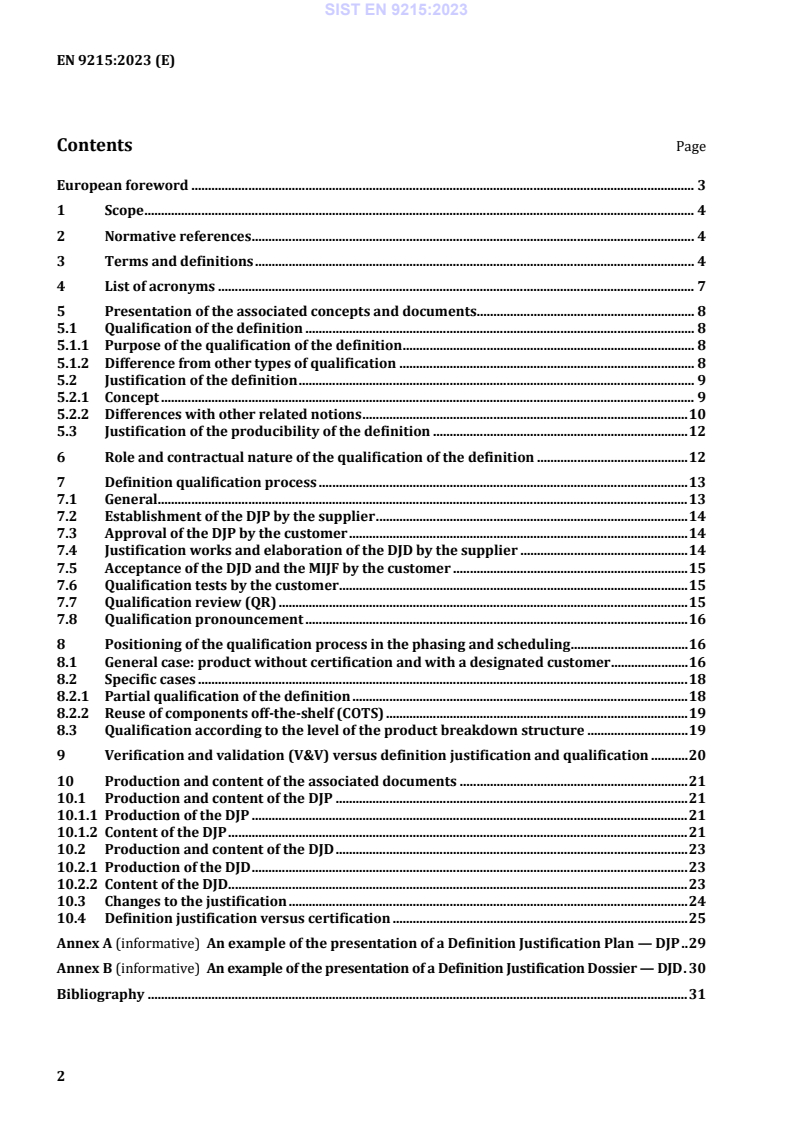
Contents Page
European foreword . 3
1 Scope . 4
2 Normative references . 4
3 Terms and definitions . 4
4 List of acronyms . 7
5 Presentation of the associated concepts and documents. 8
5.1 Qualification of the definition . 8
5.1.1 Purpose of the qualification of the definition . 8
5.1.2 Difference from other types of qualification . 8
5.2 Justification of the definition . 9
5.2.1 Concept . 9
5.2.2 Differences with other related notions . 10
5.3 Justification of the producibility of the definition . 12
6 Role and contractual nature of the qualification of the definition . 12
7 Definition qualification process . 13
7.1 General. 13
7.2 Establishment of the DJP by the supplier . 14
7.3 Approval of the DJP by the customer . 14
7.4 Justification works and elaboration of the DJD by the supplier . 14
7.5 Acceptance of the DJD and the MIJF by the customer . 15
7.6 Qualification tests by the customer . 15
7.7 Qualification review (QR) . 15
7.8 Qualification pronouncement . 16
8 Positioning of the qualification process in the phasing and scheduling . 16
8.1 General case: product without certification and with a designated customer . 16
8.2 Specific cases . 18
8.2.1 Partial qualification of the definition . 18
8.2.2 Reuse of components off-the-shelf (COTS) . 19
8.3 Qualification according to the level of the product breakdown structure . 19
9 Verification and validation (V&V) versus definition justification and qualification . 20
10 Production and content of the associated documents . 21
10.1 Production and content of the DJP . 21
10.1.1 Production of the DJP . 21
10.1.2 Content of the DJP . 21
10.2 Production and content of the DJD . 23
10.2.1 Production of the DJD . 23
10.2.2 Content of the DJD . 23
10.3 Changes to the justification . 24
10.4 Definition justification versus certification . 25
Annex A (informative) An example of the presentation of a Definition Justification Plan — DJP . 29
Annex B (informative) An example of the presentation of a Definition Justification Dossier — DJD . 30
Bibliography . 31
European foreword
This document (EN 9215:2023) has been prepared by the Aerospace and Defence Industries
Association of Europe — Standardization (ASD-STAN).
After enquiries and votes carried out in accordance with the rules of this Association, this
document has received the approval of the National Associations and the Official Services of the
member countries of ASD-STAN, prior to its presentation to CEN.
This document shall be given the status of a national standard, either by publication of an identical
text or by endorsement, at the latest by January 2024, and conflicting national standards shall be
withdrawn at the latest by January 2024.
Attention is drawn to the possibility that some of the elements of this document may be the subject
of patent rights. CEN [and/or CENELEC] shall not be held responsible for identifying any or all such
patent rights.
According to the CEN-CENELEC Internal Regulations, the national standards organizations of the
following countries are bound to implement this document: Austria, Belgium, Bulgaria, Croatia,
Cyprus, Czech Republic, Denmark, Estonia, Finland, France, Germany, Greece, Hungary, Iceland,
Ireland, Italy, Latvia, Lithuania, Luxembourg, Malta, Netherlands, Norway, Poland, Portugal,
Republic of North Macedonia, Romania, Serbia, Slovakia, Slovenia, Spain, Sweden, Switzerland,
Türkiye and the United Kingdom.
1 Scope
This document sets forth the general rules applying to the justification of the definition of a product
(tangible or intangible) and specifies the content of the definition justification plan (DJP) and the
definition justification dossier (DJD).
It is applicable to all products designed and developed to fulfil the requirements of a customer
expressed in a (need) technical specification. Industrials are advised to apply the following principles to
their own needs for justification in their internal customer/supplier relations.
Clause 5 presents the concepts and the documents associated with the justification of the definition and
qualification processes.
Clause 6 summarizes the role and the contractual nature of the qualification of the definition.
Clause 7 gives details of the qualification of the definition process, while Clause 8 positions this process
in the programme development logic.
The document also describes the differences between the justification and the qualification of the
definition and other notions, such as verification, validation or acceptance (Clause 9).
Clause 10 is a guide to the establishment and maintenance of the documents associated with the
justification of the definition and qualification processes. Information related to the certification
process, even if it is out of the scope of the present document, is also presented in Clause 10, because
this process has certain similarities with the justification of the definition and qualification process.
This document belongs to the documents supporting the EN 9200 relating to project management
specification.
2 Normative references
There are no normative references in this document.
3 Terms and definitions
For the purposes of this document, the following terms and definitions apply.
ISO and IEC maintain terminology databases for use in standardization at the following addresses:
— ISO Online browsing platform: available at https://www.iso.org/obp/
— IEC Electropedia: available at https://www.electropedia.org/
3.1
document acceptance
decision by which the customer agrees that the document complies with the contractual requirements
Note 1 to entry: in the case of document acceptance, customer’s responsibility is not committed. The document
author remains responsible for its content and is in particular in charge of fixing any non-conformity detected
after acceptance decision.
Note 2 to entry: without any response from the customer within a time limit previously specified, the document is
considered as de facto accepted.
3.2
product acceptance
contractual decision by which the customer agrees that the product is manufactured according to its
qualified definition and the agreed deviations and waivers, and it is free of defects when delivered by
the supplier
3.3
certificate
document formalizing the definition approval issued by the authority when the designer demonstrates
that the product complies with the applicable regulations
3.4
certification
acknowledgement, formalized by a certificate written internally or by an accredited third party, that the
subject of the certification conforms to specified requirements and is acceptable for operational use
Note 1 to entry: the certification may apply to a product, a service, a system, a management system or a person.
Note 2 to entry: this acknowledgement does not systematically authorize actual use.
EXAMPLE Regarding air transports, a specific second certificate issued by national authorities is necessary for
the conformance to its operational requirements.
3.5
definition justification dossier
DJD
document or file gathering all the information of design and tests demonstrating that the definition of
the product described in its definition data file fulfils all the requirements of the (need) technical
specification [(N)TS]
3.6
justification of the definition
process by which the supplier collects arguments and evidence, coming from product verification and
validation activities, in order to demonstrate that the product definition fulfils all the requirements of
the customer’s (need) technical specification [(N)TS]
Note 1 to entry: evidence acquisition activities are planned in a definition justification plan (DJP) submitted to
customer approval. However, DJP elements deemed design-critical regarding costs and time shall be included in
the contract and are de facto approved by the customer.
Note 2 to entry: collected evidence and conclusions are gathered in a definition justification dossier (DJD)
submitted to customer acceptance.
Note 3 to entry: the justification of the definition does not add specific technical activities for the supplier. It is
based on the results of the product verification and validation technical activities carried out in any case by the
supplier.
3.7
definition justification plan
DJP
document presenting how and when (types of means of compliance, types of activities, etc.) will be
justified that the definition of the product fulfils all the requirements of the (need) technical
specification [(N)TS]
3.8
qualification pronouncement
act whereby the customer certifies, on the basis of the theoretical and experimental justifications
presented by the supplier in the DJD and the manufacturing and inspection justification file (MIJF), and
on the customer’s qualification tests, that the definition of the product (contained in the definition data
file) fulfils all the requirements expressed in the (need) technical specification and that this definition is
producible
Note 1 to entry: the pronouncement can be a formal document issued by the customer or simply an explicit
mention in a qualification review report.
Note 2 to entry: the qualification pronouncement ends the development contract.
Note 3 to entry: this pronouncement is worth customer's commitment to the supplier regarding the qualified
definition. This definition becomes the reference definition on the basis of which the serial production specimens
are made.
Note 4 to entry: if the definition changes, because of the customer, after the qualification pronouncement and
after the production launching, the customer should bear the cost of the resumption of production related to the
changes.
3.9
qualification of the definition
process whose objective is to demonstrate that the product definition fulfils the requirements of the
(need) technical specification and is producible
Note 1 to entry: this process encompasses the activities of the justification of the definition (theoretical and
experimental) carried out by the supplier and activities carried out by the customer. Customer activities consist
on the one hand in the analysis of justification of the definition elements and producibility justification elements
transmitted by the supplier, and on the other hand in so-called qualification tests in a non end-user environment
Note 2 to entry: the qualification tests are conducted by the customer, on samples of the product called
qualification samples, in an environment representative of the operating environment. The scenarios used during
these tests may go beyond those defined in the supplier's definition justification plan (additional testing facilities,
extended domain, etc.). During these tests, the supplier may be present in support, for the implementation of the
product as part of a support service.
3.10
product validation
process which demonstrates through objective evidence (results of inspections, measurements,
analyses, tests, etc.) that the product as designed fulfils operational need in the intended operational
environment
Note 1 to entry: validation activities may be carried out in real or simulated operational environment.
Note 2 to entry: product validation answers the question “Has the right product been built?”
3.11
product verification
process which demonstrates through objective evidence (results of inspections, measurements,
analyses, tests, etc.) that the product as designed is compliant with specified requirements
Note 1 to entry: product verification differs from requirements verification.
Note 2 to entry: product verification answers the question “Is the product built right?”.
4 List of acronyms
AC Acceptance conditions
AS Acceptance specification
CDR Critical design review
CF Certification file
COTS Component off-the-shelf
CP Certification plan
CR Certification review
DCJF Design choice justification file
DDF Definition data file
DDFi intermediate definition data file
DGA Direction Générale de l’Armement [French Directorate General for Armaments]
DJD Definition justification dossier
DJP Definition justification plan
FPS Functional performance specification
MIJF Manufacturing and inspection justification file
(N)TS (Need) technical specification
ORR Operational readiness review
PBS Product breakdown structure
PDR Preliminary design review
PTS Product technical specification
QR Qualification review
SoW Statement of work
TOEV Technical and operational evaluations
TRR Test readiness review
V&V Verification and validation
WS Work specification
5 Presentation of the associated concepts and documents
5.1 Qualification of the definition
5.1.1 Purpose of the qualification of the definition
For the customer, the qualification of the definition:
— ensures that the definition of the product covered by the development contract fulfils the technical
requirements of the contract; and
— uses the output from the certification process to consider the fulfilment of the regulatory
requirements of the product (see 10.4) when the product is subject to certification.
For the supplier, it limits the demonstration costs and enables the customer’s agreement to be obtained
on the product definition on a clear and negotiated basis from the very start of the contract.
NOTE The supplier corresponds to the “external service provider” within the meaning of ISO 9000:2015.
The pronouncement of the qualification of the definition formally recognizes the success of the
development and constitutes the milestone representing the end of the development contract.
It constitutes an “OK to series production” on the basis of the qualified definition.
5.1.2 Difference from other types of qualification
The term “qualification” could not be used without specifying the purpose to be qualified, because
qualification covers a number of diverse notions that it is important to distinguish from one another.
Unlike the qualification of the definition, operational qualification (see Figure 4) corresponds to the use
of the product in the operational environment. Operational qualification covers the technical and
operational evaluations (TOEV) made by the end user (the supplier may provide support). The purpose
of operational qualification is to demonstrate that the product:
— is operable in an operational context and environment;
— possesses the expected operational capabilities (a capability is described by a set of operational
scenarios and processes representative of the use cases of the product); and
— achieves a level of performance required by the users (according to criteria, measurements, service
levels, etc., defined by the users).
Operational qualification is established on the basis of the operational concept document, and in
particular the description of the operational scenarios.
The pronouncement of the qualification of the definition is a prerequisite of operational qualification.
The product subject to operational qualification is a representative sample of the series definition or the
first article. Operational qualification can be pronounced by the customer and the users (decision to
adopt) after the operational readiness review (ORR).
The purpose of the qualification of the production system is to demonstrate that the production system
is capable of producing samples of the product in keeping with its definition and the objectives of the
programme at controlled risk levels. The qualification of the production system takes place in parallel
and is consistent with the qualification of the definition. The qualification of the production system
takes account of the requirements of industrialization and of the manufacturing rules.
The approach to the qualification of the production system guarantees that the factors of the industrial
process (procedures, means of manufacturing and integration, means of inspection, the environment)
are operated under controlled conditions and can guarantee the compliance and the reproducibility of
the products. The qualification of the production system is established on the basis of the
manufacturing and inspection justification file (MIJF). The supplier can pronounce the qualification of
the production system at the end of a review.
The qualification of a manufacturing process attests that the process fulfils the specified requirements
(characteristics, level of performance, reliability, etc.) on the basis of the evidence produced. It is a part
of the qualification of the production system.
Reduced qualification is a material qualification relative to a subset of requirements for resistance to
the environment, on a complete product or on a representative part of the product. When such a
qualification takes place, it is one of the steps of the qualification of the definition. Under conditions of
minimal safety, it enables intermediate milestones (e.g. first flight readiness, etc.) to be passed.
Material qualification is the complete qualification of one or more items of equipment in relation to the
requirements for resistance to the environment. It is part of the qualification of the definition (see the
RTCA DO-160, for example).
5.2 Justification of the definition
5.2.1 Concept
Justification of the definition is a part of the efforts made to control development costs.
The justification of the definition of a product consists in providing evidence and proof demonstrating
that the product definition fulfils the requirements to be met.
To this end, the supplier proposes an approach that justifies the product definition. This approach
consists in:
— reaching a common agreement on the requirements, or even the objectives, contained in the (need)
technical specification ((N)TS) and in the regulation, for which justification of the product definition
is necessary, and ensuring that they are properly and identically understood;
— identifying the risks of failing to fulfil the requirements or failing to achieve the objectives, and
estimating their gravity and probability of occurrence; and
— by common agreement, producing a common framework of reference for the elaboration of the
documents to provide, i.e.:
— the definition justification plan (DJP), which precises how and when each response to the
expressed requirements will be justified (nature of the work to be done and the
corresponding resources), in view of the identified and accepted risks;
— the definition justification dossier (DJD), which provides access to the agreed justification
information and contains a review of the justifications acquired.
For products subject to certification, the supplier makes sure that the proposed approach includes all
the factors associated with the certification process in order to optimize the justifications (studies, tests,
documentation, etc.) and to make sure they are consistent with the needs expressed by the customer
and the authorities (see 10.4).
The arguments and evidence, based on the results of the verification and validation works of the
product (see Clause 9), collected by the supplier during the development of the product and compiled in
the DJD, contribute to the pronouncement of the qualification of the definition of this product by the
customer.
The justification of the definition is based on theoretical factors, experimental factors, experience
acquired in similar developments and the supplier’s know-how. If necessary, it takes the justifications
already obtained for the constituent parts of the product concerned into consideration.
5.2.2 Differences with other related notions
5.2.2.1 Justification of the definition versus requirements justification
The justification of the definition shall not be confused with, and bears no direct relation to, the
requirements justification.
The purpose of the requirements justification of a requirements specification document [functional
performance specification (FPS), (N)TS, product technical specification (PTS), etc.] is to:
— trace and validate the requirements in relation to the requirements of a higher level, by making sure
that they are implemented correctly and completely; and
— explain the choices and compromises made for each requirement (functional analysis of the need,
negotiations with the potential suppliers, results of works resulting in the allocation of
performances, etc.).
5.2.2.2 Definition justification versus design choice justification
The justification of the definition does not explain the reasons for choosing one solution rather than
another, but it is the demonstration, based on evidence, that the requirements expressed by the
customer in the (N)TS are fulfilled by the chosen solution.
The purpose of the design choice justification (information included in the design choice justification
file – DCJF) is to provide all the information required to select alternative(s) that fulfil the requirements.
To this end, the design choice justification can be used:
— to establish the choices and hypotheses to be adopted, as well as the counter-proposals, in view of
the various possible solutions;
— to choose the best solution by, in particular, considering the criteria that are, or are not, specified in
the programme (design-to-cost, integration of value analysis, identification of improvements,
options/constraints, maturity of the technology, etc.);
— to trace the options of the definition and the decisions that led to the reference solution described in
the definition data file (DDF); and
— in the reviews (programme, requirements, architecture, etc.), to help to reach a decision by
providing the necessary justifications of the elements produced in the DDF.
The data associated with the design choice justification forms an integral part of the knowledge and
know-how of the industrial. It is essential to always protect this knowledge and never divulge it.
5.2.2.3 Definition justification versus acceptance
The general objective of a customer is to procure, from a supplier, one to n units of a product as part of a
programme, every one of which fulfils the customer’s (N)TS.
This objective is reached in two successive steps:
a) During the development phase, a definition of the product or the series is drawn up by the supplier
and formally expressed in the DDF. The justification of the definition ensures and demonstrates that
this definition fulfils the (N)TS. The qualification of the definition, pronounced by the customer on
the basis of the justifications presented by the supplier, certifies that the DDF fulfils the technical
specification. This operation is only performed once (per configuration).
b) The supplier manufactures the one to n products in the production phase. Product acceptance
checks the compliance of each product with the “qualified” DDF (of which the definition has been
pronounced as qualified) in the preceding phase. This operation is performed by the supplier for the
customer as many times as there are numbers of the product samples. This acceptance does not
engage the responsibility of the customer. It is part of the elements that could be taken into account
at the contractual reception.
These two steps complement one another and shall not be mixed up with one another: a definition is
qualified, a sample of a product is accepted.
These two concepts are positioned in Figure 1:
Figure 1 — Relations between the qualification of the design and the acceptance of the product
The acceptance conditions (AC) document specifies all the operations (measurements, inspections,
tests, etc.) to be performed on each product for acceptance purposes. This document is itself subject to
acceptance by the customer.
NOTE Depending on the industrial’s own terminology, AC document can also be called Acceptance Specifications
(AS)… It does not prevail upon receipt of the relevant contractual item(s).
5.3 Justification of the producibility of the definition
Before pronouncing the qualification of the definition, the customer expects a demonstration that the
product definition is repeatedly producible using controlled industrial means, processes and
technologies, and to the target cost.
The production system is qualified internally by the supplier. All the proof of producibility necessary for
this qualification are compiled in the MIJF. The content of this file is described in detail in
RG.Aero 000 12.
All or part of this file may be presented to the customer in order to justify producibility.
The MIJF is submitted to the customer for acceptance together with the DJD, with a view to obtain the
pronouncement of the qualification of the definition.
NOTE There are no direct links between the producibility justification of a product and the justification of the
definition of this product.
6 Role and contractual nature of the qualification of the definition
The qualification of the definition is part of a contractual relationship between the customer and the
supplier.
Three of the documents of the development contract contain qualification requirements:
— work specification (WS);
— the (N)TS;
— the DJP.
The work specification describes:
— the qualification process;
— the milestone reviews of the process;
— the expected activities for the process; and
— the resources and support required for the process.
The (N)TS defines the justification of the definition requirements, i.e.:
— the performance level to be demonstrated;
— the means and methods of demonstration imposed for some performances (similitude, calculation,
tests, simulation, etc.);
— the demonstration scope (design-critical scenarios, etc.).
NOTE In certain recent programmes commissioned by the DGA, the requirements regarding the justification of
the definition are contained in a separate document called the initial DJP, which is an integral part of the
development contract. Under the terms of the contract, the supplier complete this initial DJP with its own
proposals to justify the definition, as part of the supply of the DJP.
The DJP constitutes the response to the justification requirements contained in the two preceding
documents. It enables an agreement to be reached with the customer on the volume and the nature of
the design-critical justifications with regard to the development costs and schedule. Consequently, the
DJP contributes to the assessment and optimization of the development costs and schedule of the
product concerned.
It is advisable that the DJP be part of the development contract, but in some cases, it is one of the first
tasks to be completed under the terms of the contract.
When the DJP is finalised after the signing of the contract, the design-critical elements of the
justification (e.g., the number of flights, the number of scenarios, the scope to be covered, etc.), which
represent a significant share of the development costs and schedule, should nevertheless be discussed
by the parties during the contractual negotiations, then included in the contract in order to finalise the
commitments made.
The agreement is based on a compromise between the customer’s wish to comprehensively justify
everything and the budget he would like to allocate to the programme (the notion of “just enough”).
This compromise specifies the level of visibility negotiated between the supplier and the customer.
The final DJP, which contains this commitment between the customer and the supplier and is completed
by the detailed elements of the justification, is subject to approval by the customer and becomes the
reference DJP.
If the customer asks for changes to the volume and/or nature of the justifications to be provided during
the course of the programme, then the contract is amended.
7 Definition qualification process
7.1 General
The qualification of the definition process involves both the supplier responsible for establishing the
product definition, and the customer tasked with pronouncing the qualification of the definition.
This process starts as soon as a (N)TS [or a set of documents of technical requirements of the product
equivalent to a (N)TS] is drawn up by the customer for the supplier (see EN 9208).
The process is made up of the following steps:
— establishment of the DJP by the supplier (see 7.2);
— approval of the DJP by the customer (see 7.3);
— justification works and elaboration of the DJD by the supplier (see 7.4);
— acceptance of the DJD and the MIJF by the customer (see 7.5);
— qualification tests by the customer (see 7.6);
— qualification review (see 7.7);
— qualification pronouncement (see 7.8).
7.2 Establishment of the DJP by the supplier
The supplier draws up a preliminary DJP on the basis of the preliminary (N)TS.
When the preliminary DJP is submitted to the customer, the customer may ask the supplier to add more
justification works. Likewise, it can ask to attend certain justification works (tests, etc.).
During the process of convergence on the (N)TS between the customer and the supplier and depending
on the feedback from the customer on the preliminary DJP, this plan is gradually completed and
consolidated to become the reference DJP, which is consistent with the contract’s reference (N)TS.
NOTE For products subject to certification, see 10.4 in order to optimize the preparation of the DJP with regard
to the certification plan (CP).
7.3 Approval of the DJP by the customer
In view of the impact of the content of the DJP on the development costs and schedule, at the start of the
programme, it is important that the customer and the supplier reach an agreement on the nature and
the volume of the justification works deemed to be necessary and sufficient to demonstrate that the
definition fulfils the (N)TS. It is essential to reach this agreement during the preparation of the
development contract, especially regarding the justification elements deemed to be design-critical with
regard to the development costs and schedule.
Therefore, it is advisable to reference the DJP (or the elements judged to be design-critical, if this plan is
still not complete at this stage) in the input data of the contract.
If only the design-critical elements are referenced in the contract and the complete DJP will be supplied
at a later date under the terms of the contract, the latter is formally approved by the customer and
becomes the reference DJP for the justification works done by the supplier during the development.
7.4 Justification works and elaboration of the DJD by the supplier
The justification activities consist in implementing the DJP.
The first stage of the justification activities consists in planning the different justification documents.
Any specific resources are provided (test benches, simulators, laboratories, etc.). In certain cases, the
customer may provide its own resources (e.g., encryption devices).
As the supplier performs the justification operations stipulated in the DJP, the results are collected and
analysed, and the documents of evidence (study reports, simulation results, test reports, etc.) are
compiled. In particular, the results highlight the requirements for which the product has been verified
and that have been fulfilled, along with any issues.
Fine-tuning tests may be necessary to finalise the DDF in readiness for the final validation tests. When
the simulations and tests are performed jointly, predictive test simulations are recommended, followed
by simulation/test correlations.
The tests performed by the supplier may also include a phase performed as an integrated team with the
customer in the customer’s environment, inasmuch as such tests are included in the DJP (see Figure 4).
It is important that justifications by analogy of reused components take into consideration the impact of
the new conditions of use and of the interfaces when the component is integrated into the product.
Each of the justifications produced is verified internally by the supplier.
The DJD drawn up by the supplier identifies the various documents of evidence to which it refers and
summarizes all the results and any non-compliance from the requirements of the (N)TS.
The status and the proof of compliance of each justification shall be managed using dedicated tools in
order to check that the DJD is complete and complies with the DJP.
NOTE For products subject to certification, see 10.4 to identify the common and specific resources relative to
the elements of the DJD.
The supplier submits the DJD to the customer for acceptance.
7.5 Acceptance of the DJD and the MIJF by the customer
The customer analyses the DJD in order to verify that the justifications are valid and complete relative
to the DJP. The customer can express reservations requiring clarification or further justifications to be
acquired from the supplier. Once the justifications are judged to be valid and complete, the customer
formally accepts the DJD.
Likewise, the customer verifies the validity and the relevance of the MIJF produced by the
industrialization operations (see 5.1.2), and formally accepts the latter in keeping with the DJD.
The acceptance of these documents may be pronounced in the qualification review (see 7.7).
NOTE For products subject to certification, see 10.4.
7.6 Qualification tests by the customer
In addition to the tests performed by the supplier in accordance with the reference DJP, the customer
may also perform tests (see Figure 4) on the basis of predefined scenarios, in the customer’s
environment and on qualification sample of the product, to consolidate its own opinion and its own
expertise of the product definition, and to make sure that the definition fulfils the need expressed in the
(N)TS. These tests may be a prerequisite for the acceptance of the supplier’s DJD (see 7.5).
When so required by the contract, the supplier may provide support for the implementation of the
product during these tests.
7.7 Qualification review (QR)
The qualification review is attended by the customer and the supplier.
The qualification review consists in examining the validity and completeness of the proof
demonstrating that the definition contained in the product’s DDF fulfils the requirements of the
specified need and that this product can be manufactured. The qualification review is held with a view
to pronouncing the qualification of the definition. It is held after the supplier’s verification tests and the
customer’s qualification tests.
The expected proofs are contained in the DJD and MIJF provided by the supplier, and in the results of
the qualification tests performed by the customer.
The DDF shall be updated with the latest input produced by the development operations (tests
performed, in particular). For any results of the supplier’s verification tests that could not be taken into
consideration, a review of the gaps and remaining works is presented at the product qualification
review, and the corresponding documents are updated.
The qualification review, like any other review, may result in reservations being expressed. When
reservations are identified, a plan for the lifting of the reservations is proposed by the supplier and
approved by the customer.
Subsequent to this review, the customer may also make recommendations on:
— restrictions of the scope of the qualification pronouncement;
— restrictions of use; and
— recommendations for use.
Qualification reviews may be held for different levels (system, subsystem, equipment, etc.), depending
on the complexity of the product. In this case, the conclusions of the component qualification reviews
are escalated to the product level qualification review.
NOTE See RG.Aero 000 67 for more details.
7.8 Qualification pronouncement
The pronouncement of the qualification of the definition is a milestone that represents the end of the
product development phase and gives the go-ahead for the start of the series production phase.
After the qualification review and any internal customer reviews, t
...