

EN 1870-9:2012
(Main)Safety of woodworking machines - Circular sawing machines - Part 9: Double blade circular sawing machines for cross-cutting with integrated feed and with manual loading and/or unloading
- Abstract
This European Standard deals with all significant hazards, hazardous situations and events as listed in Clause 4 which are relevant to double blade circular sawing machines for cross-cutting with integrated feed of the saw units and with manual loading and/or unloading, hereinafter referred to as 'machines'. These are machines designed to cut solid wood, chipboard, fibreboard and plywood, and also these materials when covered with plastic edging and/or plastic/light alloy laminate, when they are used as intended and under the conditions foreseen by the manufacturer including reasonably foreseeable misuse.
This European Standard does not apply to:
- machines for cross cutting logs;
- double blade up-cutting cross-cut sawing machines.
This European Standard is primarily directed at machines which are manufactured after its date of publication as an EN.
- Status
- Published
- Publication Date
- 04-Sep-2012
- Withdrawal Date
- 30-Mar-2013
- Technical Committee
- CEN/TC 142 - Woodworking machines - Safety
- Current Stage
- 9092 - Decision on results of review/2YR ENQ - revise - Review Enquiry
- Start Date
- 08-Apr-2024
- Completion Date
- 07-Oct-2026
- Directive
- 2006/42/EC - Directive 2006/42/EC of the European Parliament and of the Council of 17 May 2006 on machinery, and amending Directive 95/16/EC (recast)OJ Ref: C, C 350 OJ Date: 15-Nov-2012



Overview
EN 1870-9:2012 is a CEN (European) safety standard for double blade circular sawing machines for cross-cutting with integrated feed and manual loading and/or unloading. It defines safety requirements, hazard mitigation and information the manufacturer must supply for machines designed to cut solid wood, chipboard, fibreboard and plywood (including these materials when covered with plastic edging or laminates), when used as intended or under reasonably foreseeable misuse. It is harmonised to support conformity with the EU Machinery Directive (2006/42/EC) and applies to machines manufactured after its publication. Excluded are machines for cross-cutting logs and double blade up‑cutting cross‑cut sawing machines.
Key topics and requirements
EN 1870-9 structures safety measures around identified hazards (Clause 4) and detailed requirements (Clause 5). Major technical topics include:
- Controls and control systems (5.2): safety, reliability, control positions, starting, normal stopping, emergency stop and response to power failure. The 2012 edition incorporated considerations of performance levels (PL).
- Protection against mechanical hazards (5.3): stability, risk of break-up, tool and tool‑holder design, braking systems and tests, anti‑ejection devices, workpiece supports/guides, clamping and prevention of access to moving parts.
- Non-mechanical hazards (5.4): fire, noise, chip and dust emissions, electrical safety, ergonomics, lighting, pneumatic/hydraulic hazards, laser precautions, isolation and maintenance safety.
- Information for use (Clause 6): warnings, marking of the machine, and mandatory instruction handbook content.
- Normative annexes: dimensional tolerances of saw spindles (A), braking tests and run‑down criteria (B), impact test method for guards (C), and Annex ZA mapping to EU Directive essential requirements.
Applications and practical value
This standard is practical for:
- Manufacturers and authorised representatives designing and building compliant double‑blade cross‑cut saws for the EU market.
- Designers and machine builders specifying guards, braking, controls and ergonomics to meet harmonised safety requirements.
- Importers, test laboratories and conformity assessors evaluating CE compliance and verifying braking, guarding and control safety.
- Safety managers and maintenance teams using the document to develop safe operating procedures, maintenance schedules and operator training tied to manufacturer information.
Using EN 1870-9 helps reduce mechanical and non‑mechanical risks (e.g., ejection, noise, dust), clarifies required markings and documentation, and supports CE marking and regulatory compliance.
Related standards
Relevant complementary standards referenced in EN 1870-9 include:
- EN ISO 12100 (general machine risk assessment and design)
- EN 847-1 (tooling safety for woodworking)
- EN 574, EN 614-1 and ergonomics/display/control standards
Keywords: EN 1870-9, double blade circular sawing machines, cross‑cutting, woodworking machine safety, CEN, Machinery Directive, guards, braking, noise, dust, ergonomics.
Relations
- Effective Date
- 17-Jul-2010
- Effective Date
- 25-Aug-2026
- Effective Date
- 25-Aug-2026
- Effective Date
- 09-Feb-2026
- Refers
EN 60825-1:2007 - Safety of laser products - Part 1: Equipment classification and requirements - Effective Date
- 09-Feb-2026
- Effective Date
- 09-Feb-2026
- Effective Date
- 09-Feb-2026
- Effective Date
- 09-Feb-2026
- Effective Date
- 28-Jan-2026
- Effective Date
- 28-Jan-2026
- Effective Date
- 28-Jan-2026
- Effective Date
- 28-Jan-2026
- Effective Date
- 28-Jan-2026
- Effective Date
- 28-Jan-2026
- Effective Date
- 28-Jan-2026
Get Certified
Connect with accredited certification bodies for this standard

Gozdarski inštitut Slovenije
Slovenian Forestry Institute. Forest management certification support, timber testing.
Sponsored listings
Frequently Asked Questions
EN 1870-9:2012 is a standard published by the European Committee for Standardization (CEN). Its full title is "Safety of woodworking machines - Circular sawing machines - Part 9: Double blade circular sawing machines for cross-cutting with integrated feed and with manual loading and/or unloading". This standard covers: This European Standard deals with all significant hazards, hazardous situations and events as listed in Clause 4 which are relevant to double blade circular sawing machines for cross-cutting with integrated feed of the saw units and with manual loading and/or unloading, hereinafter referred to as 'machines'. These are machines designed to cut solid wood, chipboard, fibreboard and plywood, and also these materials when covered with plastic edging and/or plastic/light alloy laminate, when they are used as intended and under the conditions foreseen by the manufacturer including reasonably foreseeable misuse. This European Standard does not apply to: - machines for cross cutting logs; - double blade up-cutting cross-cut sawing machines. This European Standard is primarily directed at machines which are manufactured after its date of publication as an EN.
This European Standard deals with all significant hazards, hazardous situations and events as listed in Clause 4 which are relevant to double blade circular sawing machines for cross-cutting with integrated feed of the saw units and with manual loading and/or unloading, hereinafter referred to as 'machines'. These are machines designed to cut solid wood, chipboard, fibreboard and plywood, and also these materials when covered with plastic edging and/or plastic/light alloy laminate, when they are used as intended and under the conditions foreseen by the manufacturer including reasonably foreseeable misuse. This European Standard does not apply to: - machines for cross cutting logs; - double blade up-cutting cross-cut sawing machines. This European Standard is primarily directed at machines which are manufactured after its date of publication as an EN.
EN 1870-9:2012 is classified under the following ICS (International Classification for Standards) categories: 79.120.10 - Woodworking machines. The ICS classification helps identify the subject area and facilitates finding related standards.
EN 1870-9:2012 has the following relationships with other standards: It is inter standard links to EN 1870-9:2000+A1:2009, ISO 7960:1995, ISO 8598:1996, EN 60529:1991, EN 60825-1:2007, CLC/TS 61496-2:2006, EN 61800-5-2:2007, EN 61310-1:2008, EN ISO 11202:2010, EN ISO 5511:1996, EN 574:1996+A1:2008, EN 1760-2:2001+A1:2009, EN 1088:1995+A2:2008, EN 2286:1989, EN 614-1:2006+A1:2009. Understanding these relationships helps ensure you are using the most current and applicable version of the standard.
EN 1870-9:2012 is associated with the following European legislation: EU Directives/Regulations: 2006/42/EC; Standardization Mandates: M/396. When a standard is cited in the Official Journal of the European Union, products manufactured in conformity with it benefit from a presumption of conformity with the essential requirements of the corresponding EU directive or regulation.
EN 1870-9:2012 is available in PDF format for immediate download after purchase. The document can be added to your cart and obtained through the secure checkout process. Digital delivery ensures instant access to the complete standard document.
Standards Content (Sample)
2003-01.Slovenski inštitut za standardizacijo. Razmnoževanje celote ali delov tega standarda ni dovoljeno.Sicherheit von Holzbearbeitungsmaschinen - Kreissägemaschinen - Teil 9: Doppelgehrungskreissägemaschinen mit mechanischem Vorschub und Handbeschickung und/oder HandentnahmeSécurité des machines pour le travail du bois - Machines à scies circulaires - Partie 9: Machines à scier à deux lames de scie circulaires pour tronçonnage, à avance mécanisée et à chargement et/ou déchargement manuelsSafety of woodworking machines - Circular sawing machines - Part 9: Double blade circular sawing machines for cross-cutting with integrated feed and with manual loading and/or unloading79.120.10Lesnoobdelovalni strojiWoodworking machines25.080.60Strojne žageSawing machinesICS:Ta slovenski standard je istoveten z:EN 1870-9:2012SIST EN 1870-9:2012en,fr,de01-december-2012SIST EN 1870-9:2012SLOVENSKI
STANDARDSIST EN 1870-9:2000+A1:20091DGRPHãþD
EUROPEAN STANDARD NORME EUROPÉENNE EUROPÄISCHE NORM
EN 1870-9
September 2012 ICS 79.120.10 Supersedes EN 1870-9:2000+A1:2009English Version
Safety of woodworking machines - Circular sawing machines - Part 9: Double blade circular sawing machines for cross-cutting with integrated feed and with manual loading and/or unloading
Sécurité des machines pour le travail du bois - Machines à scies circulaires - Partie 9: Machines à scier à deux lames de scie circulaires pour tronçonnage, à avance mécanisée et à chargement et/ou déchargement manuels
Sicherheit von Holzbearbeitungsmaschinen - Kreissägemaschinen - Teil 9: Doppelgehrungskreissägemaschinen mit mechanischem Vorschub und Handbeschickung und/oder HandentnahmeThis European Standard was approved by CEN on 13 July 2012.
CEN members are bound to comply with the CEN/CENELEC Internal Regulations which stipulate the conditions for giving this European Standard the status of a national standard without any alteration. Up-to-date lists and bibliographical references concerning such national standards may be obtained on application to the CEN-CENELEC Management Centre or to any CEN member.
This European Standard exists in three official versions (English, French, German). A version in any other language made by translation under the responsibility of a CEN member into its own language and notified to the CEN-CENELEC Management Centre has the same status as the official versions.
CEN members are the national standards bodies of Austria, Belgium, Bulgaria, Croatia, Cyprus, Czech Republic, Denmark, Estonia, Finland, Former Yugoslav Republic of Macedonia, France, Germany, Greece, Hungary, Iceland, Ireland, Italy, Latvia, Lithuania, Luxembourg, Malta, Netherlands, Norway, Poland, Portugal, Romania, Slovakia, Slovenia, Spain, Sweden, Switzerland, Turkey and United Kingdom.
EUROPEAN COMMITTEE FOR STANDARDIZATION
COMITÉ EUROPÉEN DE NORMALISATION EUROPÄISCHES KOMITEE FÜR NORMUNG
Management Centre:
Avenue Marnix 17,
B-1000 Brussels © 2012 CEN All rights of exploitation in any form and by any means reserved worldwide for CEN national Members. Ref. No. EN 1870-9:2012: ESIST EN 1870-9:2012
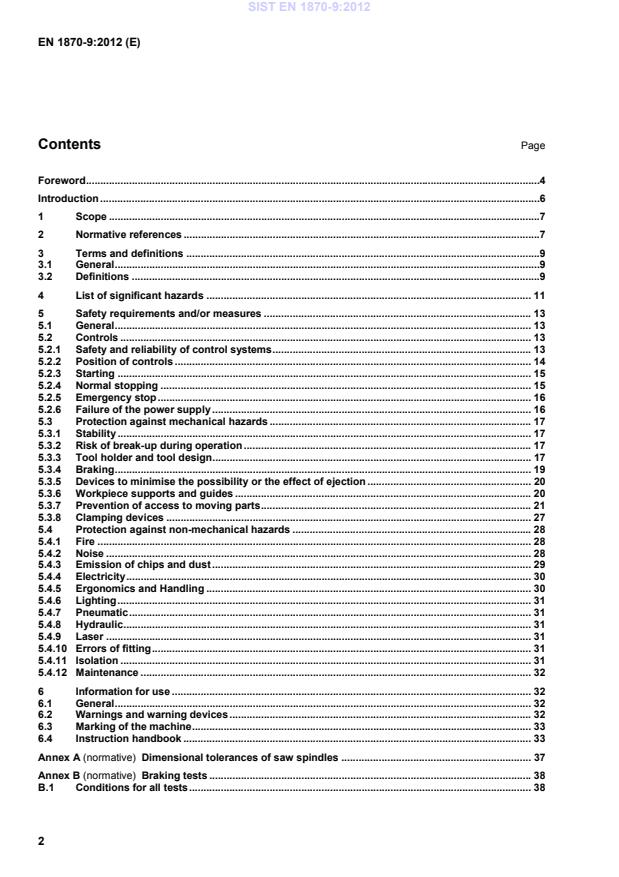
Dimensional tolerances of saw spindles . 37Annex B (normative)
Braking tests . 38B.1 Conditions for all tests . 38SIST EN 1870-9:2012
Impact test method for guards . 39C.1 General . 39C.2 Test method . 39C.2.1 Preliminary remarks . 39C.2.2 Testing equipment . 39C.2.3 Projectile for guards . 39C.2.4 Sampling. 39C.2.5 Test procedure . 39C.3 Results . 40C.4 Assessment . 40C.5 Test report . 40C.6 Test equipment for impact test . 40Annex ZA (informative)
Relationship between this European Standard and the Essential Requirements of EU Directive 2006/42/EC . 42Bibliography . 43 SIST EN 1870-9:2012
Part 19: Circular saw benches (with and without sliding table) and building site saws
The European Standards produced by CEN/TC 142 are particular to woodworking machines and complement the relevant A and B Standards on the subject of general safety (see introduction of EN ISO 12100:2010 for a description of A, B and C standards). According to the CEN/CENELEC Internal Regulations, the national standards organisations of the following countries are bound to implement this European Standard: Austria, Belgium, Bulgaria, Croatia, Cyprus, Czech Republic, Denmark, Estonia, Finland, Former Yugoslav Republic of Macedonia, France, Germany, Greece, Hungary, Iceland, Ireland, Italy, Latvia, Lithuania, Luxembourg, Malta, Netherlands, Norway, Poland, Portugal, Romania, Slovakia, Slovenia, Spain, Sweden, Switzerland, Turkey and the United Kingdom.
EN 60825-1:2007, Safety of laser products — Part 1: Equipment classification and requirements (IEC 60825-1:2007) EN 61310-1:2008, Safety of machinery — Indication, marking and actuation — Part 1: Requirements for visual, acoustic and tactile signals (IEC 61310-1:2007) CLC/TS 61496-2:2006, Safety of machinery — Electro-sensitive protective equipment — Part 2: Particular requirements for equipment using active opto-electronic protective devices (AOPDs) (IEC 61496-2:2006) EN 61800-5-2:2007, Adjustable speed electrical power drive systems — Part 5-2: Safety requirements — Functional (IEC 61800-5-2:2007) EN ISO 3743-1:2010, Acoustics — Determination of sound power levels and sound energy levels of noise sources using sound pressure — Engineering methods for small, movable sources in reverberant fields — Part 1: Comparison method for a hard-walled test room (ISO 3743-1:2010) EN ISO 3743-2:2009, Acoustics — Determination of sound power levels of noise sources using sound pressure — Engineering methods for small, movable sources in reverberant fields — Part 2: Methods for special reverberation test rooms (ISO 3743-2:1994) EN ISO 3744:2010, Acoustics — Determination of sound power levels and sound energy levels of noise sources using sound pressure — Engineering methods for an essentially free field over a reflecting plane (ISO 3744:2010) EN ISO 3745:2009, Acoustics — Determination of sound power levels of noise sources using sound pressure — Precision methods for anechoic and hemi-anechoic rooms (ISO 3745:2003)2)
EN ISO 3746:2010, Acoustics — Determination of sound power levels and sound energy levels of noise sources using sound pressure — Survey method using an enveloping measurement surface over a reflecting plane (ISO 3746:2010) EN ISO 4413:2010, Hydraulic fluid power — General rules and safety requirements for systems and their components (ISO 4413:2010) EN ISO 4414:2010, Pneumatic fluid power — General rules and safety requirements for systems and their components (ISO 4414:2010) EN ISO 4871:2009, Acoustics — Declaration and verification of noise emission values of machinery and equipment (ISO 4871:1996)
1) EN 60529:1991 is impacted by EN 60529:1991/A1:2000. 2) EN ISO 3745:2009 has been replaced by EN ISO 3745:2012.
No Hazards, hazardous situations and hazardous events EN ISO 12100:2010 Relevant sub-clause of this document 1 Mechanical hazards related to: - machine parts or workpieces:
a) shape 6.2.2.1, 6.2.2.2, 6.3 5.3.3, 5.3.7, 5.3.8
b) relative location 5.2.2, 5.2.3, 5.3.6, 5.3.7, 5.3.8
d) mass and velocity (kinetic energy of elements in controlled or uncontrolled motion) 5.3.7
e) mechanical strength 5.3.2, 5.3.3, 5.3.6
- accumulation of energy inside the machinery: g) liquids and gases under pressure 6.2.10, 6.3.5.4 5.4.7, 5.4.8 1.1 Crushing hazard
5.3.7, 5.3.8 1.2 Shearing hazard 5.3.7, 5.3.8 1.3 Cutting or severing hazard 5.3.2, 5.3.3, 5.3.7, 1.4 Entanglement hazard 5.3.7 1.5 Drawing-in or trapping hazard 5.3.7 1.9 High pressure fluid injection or ejection hazard 6.2.10 5.4.7, 5.4.8 2 Electrical hazards due to: 2.1 Contact of persons with live parts (direct contact) 6.2.9, 6.3.5.4 5.4.4, 5.4.11, 5.4.12 2.2 Contact of persons with parts which have become live under faulty conditions (indirect contact) 6.2.9 5.4.4, 5.4.11, 5.4.12 4 Hazards generated by noise, resulting in: 4.1 Hearing loss (deafness), other physiological disorders (loss of balance, loss of awareness) 6.2.2.2, 6.3 5.4.2 4.2 Interference with speech communication, acoustic signals. 5.4.2 6 Hazards generated by radiation 6.5 Lasers 6.3.4.5 5.4.9 SIST EN 1870-9:2012
No
Hazards, hazardous situations and hazardous events EN ISO 12100:2010
Relevant sub-clause of this document 7 Hazards generated by materials and substances (and their constituent elements) processed or used by the machinery 7.1 Hazards from contact with or inhalation of harmful fluids and dusts 6.2.3, 6.2.4
5.4.3 7.2 Fire hazard 6.2.4 5.4.1, 5.4.3 8 Hazards generated by neglecting ergonomic principles in machinery design related to: 8.1 Unhealthy postures or excessive effort 6.2.7, 6.2.8, 6.2.11.12, 6.3.5.5, 6.3.5.6 5.2.2 8.2 Hand-arm or foot-leg anatomy 6.2.8.3 5.2.2 8.4 Local lighting 6.2.8.6 6.4 8.6 Human error, human behaviour 6.2.8, 6.2.11.8, 6.2.11.10, 6.3.5.2, 6.4 6.4 8.7 Design, location or identification of manual controls 6.2.8.7, 6.2.11.8 5.2.2 8.8 Design or location of visual display units 6.2.8.8, 6.4.2 5.2.2 9 Combination of hazards 6.3.2.1 5.2.6 10 Unexpected start up, unexpected overrun/overspeed (or any similar malfunction) from: 10.1 Failure/disorder of the control system 6.2.11, 6.3.5.4
5.2.1 10.2 Restoration of energy supply after an interruption 6.2.11.4
5.2.7, 5.2.8, 5.4.7, 5.4.8 10.3 External influences on electrical equipment 6.2.11.11 5.2.1, 5.4.4 10.6 Errors made by the operator (due to mismatch of machinery with human characteristics and abilities, see 8.6)
6.2.8, 6.2.11.8, 6.2.11.10, 6.3.5.2, 6.4 5.2.1, 5.4.5, 6.4 11 Impossibility of stopping the machine in the best possible conditions 6.2.11.1, 6.2.11.3, 6.3.5.2
5.2.2, 5.2.4, 5.2.5 13 Failure of the power supply 6.2.11.1, 6.2.11.4 5.2.7 14 Failure of the control system 6.2.11, 6.3.5.4
5.2.1 15 Errors of fitting 6.2.7, 6.4.5 5.3.3 16 Break-up during operation 6.2.3 5.3.2 17 Falling or ejected objects or fluids 6.2.3, 6.2.10
5.3.2, 5.3.3, 5.3.5, 5.3.6, 5.3.8 18 Loss of stability/overturning of machinery 6.3.2.6
5.3.1 SIST EN 1870-9:2012
and the related control system shall be at least PL=c in accordance with the requirements of EN ISO 13849-1:2008; b) if a time delay is used it shall be of fail safe technique e.g. of capacity type conforming to the requirements of at least PL=c in accordance with the requirements of EN ISO 13849-1:2008. Verification: By checking the relevant drawings and/or circuit diagrams, inspection of the machine, measurement and relevant functional testing of the machine. NOTE For the components characteristics, a confirmation from the components' manufacturers can be useful. 5.2.2 Position of controls
Hand-operated control devices for start and stop of the motor for the saw spindles, emergency stop, integrated feed, reset controls and hold-to run shall be located in an area between 600 mm and 1700 mm above the floor level. NOTE For electric control devices, see also EN 60204-1:2006, 10.1.1. Where the machine is fitted with a two-hand control device, it shall be: a) situated at the front of the machine; b) below the workpiece support; c) at a minimum height above floor level of 750 mm; d) such that where the maximum distance between the saw units is ≥ 2,5 m it is capable of being located centrally between the saw units ± 300 mm for each adjusted position and not less than 300 mm from the closest position of a saw blade. Where the control for the clamps is separate from the two hand control it shall be within 400 mm measured horizontally to the two hand control. According to the size of machine, one or more emergency stops (see 5.2.5) shall be positioned: 1) within 1,0 m of the loading position; 2) within 1,0 m of the unloading position; 3) at the main control panel; 4) within 500 mm of the two hand control (where provided); 5) within 3,0 m of the saw unit. Verification: By checking the relevant drawings, inspection, measurement and relevant functional testing on the machine. SIST EN 1870-9:2012
NOTE For the purpose of this document "all the relevant safeguards in place and functional" is achieved by the interlocking arrangements described in 5.3.7 and 5.3.8 and "operation" means rotation and/or powered adjustment of any saw spindle and/or powered movement of any workpiece holding and feeding device and/or any machine element in which a saw blade is mounted.
b) Start or restart shall only be possible by actuation of the start control device provided for that purpose. c) The closure of movable interlocked guards shall not lead to an automatic restart of hazardous movements. d) The exceptions described in EN 60204-1:2006, 9.2.5.2 are not relevant. e) For semi-automatic machines, the cutting stroke shall only be capable of being started with a manually operated control device after saw blade rotation and clamping have been initiated. f) For all machines, the cutting stroke shall only be capable of being started after saw blade rotation and clamping have been initiated and when: 1) all interlocked guards are in the closed position; 2) no person is standing on pressure sensitive mats (where provided); 3) no person is within the beams of an active opto-electronic protective device (where provided). g) All start and/or reset controls shall be located outside protected areas and not reachable when standing inside a protected area. h) The safety related part of the control systems (also see 5.2.1) for starting and the interlocking arrangements shall be at least PL=c in accordance with the requirements of EN ISO 13849-1:2008. Verification: By checking the relevant drawings and/or circuit diagrams, inspection and relevant functional testing of the machine. 5.2.4 Normal stopping Machines shall be fitted with a stop control system which, when actuated, shall disconnect power from all the machine actuators unless STO according to EN 61800-5-2:2007 is used, and actuate the brake (if provided). For normal stopping of PDS(SR) (power drive system, safety related) see EN 61800-5-2:2007, 4.2.2.2 "safe torque off (STO)" and 4.2.2.3 "safe stop 1 (SS1)". When initiated, the stopping sequence shall be: a) initiate the return stroke of the saw unit(s); b) cut power to saw spindle drive motors and initiate the brakes (if provided); c) when braking sequence is complete, cut power to the brakes (if electrical brake is provided); d) remove power to the workpiece clamping device. SIST EN 1870-9:2012
b) Where the machine is fitted with pneumatic and/or hydraulic actuators, the restoration of the energy supply shall not result in a restart of any machine actuator.
c) The control system to prevent automatic restart shall be designed to achieve at least PL=c in accordance with the requirements of EN ISO 13849-1:2008. Verification: By checking the relevant drawings and/or circuit diagrams, inspection and relevant functional testing on the machine. SIST EN 1870-9:2012
...