


EN 18220:2026
(Main)Digital product passport - Data carriers
General Information
- Abstract
This document specifies requirements for data carriers used in a digital product passport system. This covers: symbology characteristics, format, error correction codes, encoding methods, printing and production quality, and durability.
This document also specifies requirements on graphical or other indicators for easy recognition of DPP data carriers and the indication on the data carrier placement, machine readability, quality checking, links between physical product and digital representation.
The following aspects are out of scope: architecture and use cases, secure elements and any other cryptographic security features.
- Status
- Published
- Publication Date
- 26-May-2026
- Technical Committee
- JTC 24 - Digital Product Passport (DPP)
- Drafting Committee
- WG 2 - Unique identifiers and data carriers
- Current Stage
- 6060 - Definitive text made available (DAV) - Publishing
- Start Date
- 27-May-2026
- Due Date
- 22-May-2026
- Completion Date
- 27-May-2026
- Directive
- Not Harmonized2024/1781 - Regulation (EU) 2024/1781 of the European Parliament and of the Council of 13 June 2024 establishing a framework for the setting of ecodesign requirements for sustainable products, amending Directive (EU) 2020/1828 and Regulation (EU) 2023/1542 and repealing Directive 2009/125/ECText with EEA relevanceOJ Ref: OJ L,2026/1736 OJ Date: 15-Jul-2026

Overview
EN 18220:2026 is a European standard developed by CEN that specifies the requirements for data carriers used within Digital Product Passport (DPP) systems. As a key tool arising from the Ecodesign for Sustainable Product Regulation (ESPR) under the European Green Deal, digital product passports enable the traceability and accessibility of essential product information throughout a product’s lifecycle. This standard is crucial for ensuring that the data carriers-such as barcodes, QR codes, RFID, and NFC tags-associated with DPPs are standardized in terms of symbology, encoding, production quality, and durability. Importantly, these carriers must guarantee reliable machine-readability and provide clear indications for easy recognition and use by all stakeholders.
Key Topics
- Symbology and Format Requirements: Outlines standardized characteristics required for 1D/2D barcodes (including Data Matrix and QR), RFID, and NFC carriers to ensure consistent readability and interoperability.
- Error Correction Codes (ECC): Specifies the use of error correction codes for 2D symbols, facilitating robust data retrieval even if the carrier is partially damaged or dirty.
- Encoding Methods: Defines how unique product identifiers should be encoded, referencing standardized character sets and ensuring compatibility with systems using URIs.
- Quality and Durability: Establishes criteria for print and production quality, ensuring the data carrier’s longevity, readability, and functionality throughout the product’s intended lifetime.
- Data Carrier Placement and Recognition: Requires clear graphical or visual indicators to help users easily find and recognize the DPP data carrier on products, packaging, or documentation, and defines standard placement practices.
- Machine Readability and Quality Checking: Sets out requirements so data carriers can be read by common scanning devices, including mobile phones and industrial scanners, supporting efficient and universal data access.
Applications
EN 18220:2026 can be applied across a broad range of industry sectors as part of the transition to a circular economy. Typical applications include:
- Consumer Goods: Product identification and traceability for end-users, supporting access to information such as user manuals, recycling guidelines, and repair instructions.
- Manufacturing and Supply Chain: Enables manufacturers, distributors, and resellers to verify product data, support recalls, track batches, and manage inventory efficiently.
- Retail: Facilitates seamless point-of-sale scanning, returns handling, and authenticity checks.
- Recycling and Waste Management: Provides recyclers with accurate product history and material information, supporting improved resource management.
- Regulatory Compliance: Assists economic operators in satisfying EU ESPR requirements for sustainability, durability, and transparency, as well as customs and market surveillance processes.
By establishing standardized requirements for DPP data carriers, EN 18220:2026 helps ensure interoperability between value chain participants, supports efficient data-driven product lifecycle management, and enhances the accessibility of critical sustainability data to both professionals and consumers.
Related Standards
For effective implementation and integration of data carriers in digital product passport systems, EN 18220:2026 references and aligns with several key international standards, including:
- ISO/IEC 15961 Series: Data protocol for RFID for item management (parts 1-3)
- ISO/IEC 18046 Series: RFID device performance test methods (parts 1-3)
- ISO/IEC 19762: Vocabulary for automatic identification and data capture (AIDC) techniques
- ISO/IEC 29158: Direct Part Mark (DPM) Quality Guideline
- GS1 Standards: For encoding and digital link URI syntaxes relevant to product identification
By following EN 18220:2026 and related reference standards, organizations can ensure that their digital product passport implementations are robust, interoperable, and future-proof-contributing to a more transparent, efficient, and sustainable product ecosystem.
Relations
- Effective Date
- 17-Jun-2026
- Effective Date
- 17-Jun-2026
- Effective Date
- 17-Jun-2026
- Effective Date
- 17-Jun-2026
- Effective Date
- 17-Jun-2026
- Effective Date
- 17-Jun-2026
- Effective Date
- 17-Jun-2026
- Effective Date
- 17-Jun-2026
- Effective Date
- 17-Jun-2026
- Effective Date
- 17-Jun-2026
- Effective Date
- 17-Jun-2026
- Effective Date
- 17-Jun-2026
- Effective Date
- 17-Jun-2026
- Effective Date
- 17-Jun-2026
- Effective Date
- 17-Jun-2026
Get Certified
Connect with accredited certification bodies for this standard

BSI Group
BSI (British Standards Institution) is the business standards company that helps organizations make excellence a habit.

NYCE
Mexican standards and certification body.
Sponsored listings
Frequently Asked Questions
EN 18220:2026 is a standard published by the European Committee for Standardization (CEN). Its full title is "Digital product passport - Data carriers". This standard covers: This document specifies requirements for data carriers used in a digital product passport system. This covers: symbology characteristics, format, error correction codes, encoding methods, printing and production quality, and durability. This document also specifies requirements on graphical or other indicators for easy recognition of DPP data carriers and the indication on the data carrier placement, machine readability, quality checking, links between physical product and digital representation. The following aspects are out of scope: architecture and use cases, secure elements and any other cryptographic security features.
This document specifies requirements for data carriers used in a digital product passport system. This covers: symbology characteristics, format, error correction codes, encoding methods, printing and production quality, and durability. This document also specifies requirements on graphical or other indicators for easy recognition of DPP data carriers and the indication on the data carrier placement, machine readability, quality checking, links between physical product and digital representation. The following aspects are out of scope: architecture and use cases, secure elements and any other cryptographic security features.
EN 18220:2026 is classified under the following ICS (International Classification for Standards) categories: 35.240.63 - IT applications in trade. The ICS classification helps identify the subject area and facilitates finding related standards.
EN 18220:2026 has the following relationships with other standards: It is inter standard links to ISO/IEC 18046-2:2020, ISO/IEC 18046-3:2020, ISO/IEC 14443-4:2018, ISO/IEC 15961-2:2019, ISO/IEC 15693-1:2018, ISO/IEC 21481:2021, ISO/IEC 18046-1:2011, ISO/IEC 19762:2025, ISO/IEC 14443-2:2020, ISO/IEC 18000-3:2010, ISO/IEC 18047-63:2023, ISO/IEC 29158:2025, ISO/IEC 15693-3:2019, ISO/IEC 18004:2024, ISO/IEC 15962:2022. Understanding these relationships helps ensure you are using the most current and applicable version of the standard.
EN 18220:2026 is associated with the following European legislation: EU Directives/Regulations: 2024/1781, (EU) 2024/1781; Standardization Mandates: M/604, M/604 Amd 1. When a standard is cited in the Official Journal of the European Union, products manufactured in conformity with it benefit from a presumption of conformity with the essential requirements of the corresponding EU directive or regulation.
EN 18220:2026 is available in PDF format for immediate download after purchase. The document can be added to your cart and obtained through the secure checkout process. Digital delivery ensures instant access to the complete standard document.
Standards Content (Sample)
SLOVENSKI STANDARD
01-julij-2026
Digitalni potni list izdelka - Nosilci podatkov
Digital product passport - Data carriers
Digitaler Produktpass - Datenträger
Passeport numérique des produits - Supports de données
Ta slovenski standard je istoveten z: EN 18220:2026
ICS:
13.020.20 Okoljska ekonomija. Environmental economics.
Trajnostnost Sustainability
35.240.63 Uporabniške rešitve IT v IT applications in trade
trgovini
2003-01.Slovenski inštitut za standardizacijo. Razmnoževanje celote ali delov tega standarda ni dovoljeno.
EUROPEAN STANDARD EN 18220
NORME EUROPÉENNE
EUROPÄISCHE NORM
May 2026
ICS 35.240.63
English version
Digital product passport - Data carriers
Passeport numérique des produits - Supports de Digitaler Produktpass - Datenträger
données
This European Standard was approved by CEN on 3 May 2026.
This European Standard was corrected and reissued by the CEN-CENELEC Management Centre on 2 June 2026.
CEN and CENELEC members are bound to comply with the CEN/CENELEC Internal Regulations which stipulate the conditions for
giving this European Standard the status of a national standard without any alteration. Up-to-date lists and bibliographical
references concerning such national standards may be obtained on application to the CEN-CENELEC Management Centre or to
any CEN and CENELEC member.
This European Standard exists in three official versions (English, French, German). A version in any other language made by
translation under the responsibility of a CEN and CENELEC member into its own language and notified to the CEN-CENELEC
Management Centre has the same status as the official versions.
CEN and CENELEC members are the national standards bodies and national electrotechnical committees of Austria, Belgium,
Bulgaria, Croatia, Cyprus, Czech Republic, Denmark, Estonia, Finland, France, Germany, Greece, Hungary, Iceland, Ireland, Italy,
Latvia, Lithuania, Luxembourg, Malta, Netherlands, Norway, Poland, Portugal, Republic of North Macedonia, Romania, Serbia,
Slovakia, Slovenia, Spain, Sweden, Switzerland, Türkiye and United Kingdom.
CEN-CENELEC Management Centre:
Rue de la Science 23, B-1040 Brussels
© 2026 CEN/CENELEC All rights of exploitation in any form and by any means Ref. No. EN 18220:2026 E
reserved worldwide for CEN national Members and for
CENELEC Members.
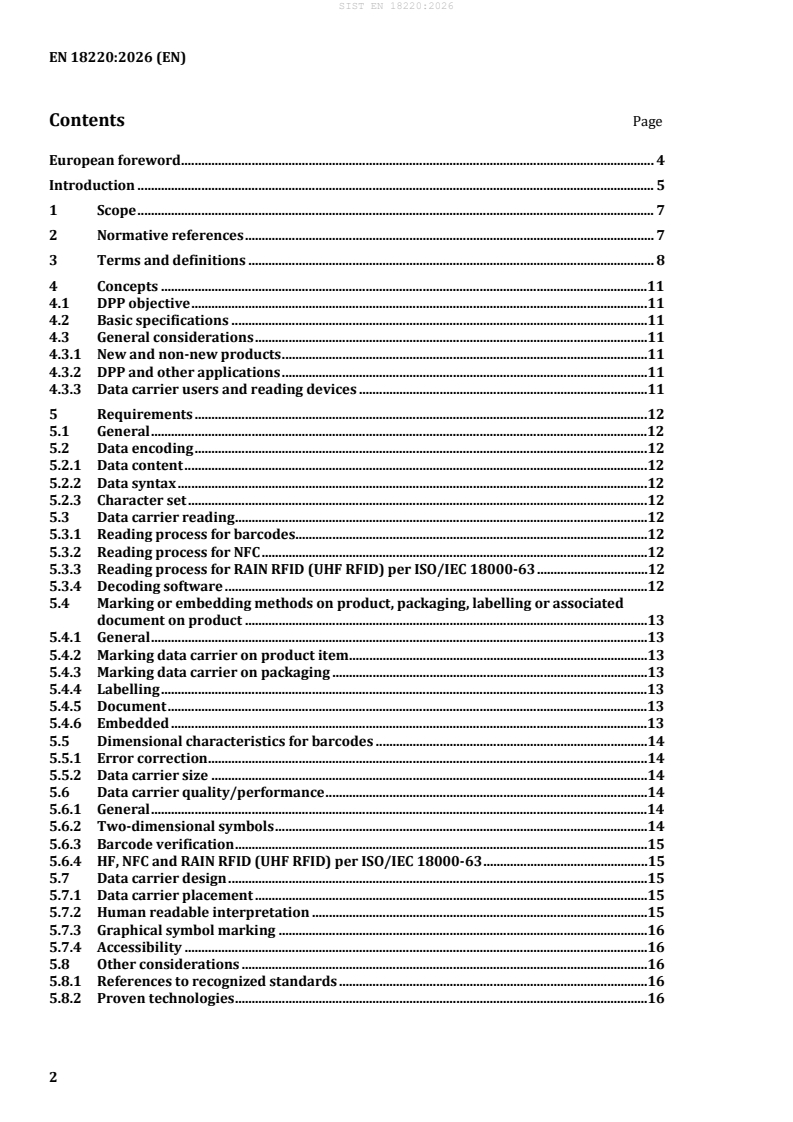
Contents Page
European foreword . 4
Introduction . 5
1 Scope . 7
2 Normative references . 7
3 Terms and definitions . 8
4 Concepts .11
4.1 DPP objective .11
4.2 Basic specifications .11
4.3 General considerations .11
4.3.1 New and non-new products .11
4.3.2 DPP and other applications .11
4.3.3 Data carrier users and reading devices .11
5 Requirements .12
5.1 General .12
5.2 Data encoding .12
5.2.1 Data content .12
5.2.2 Data syntax .12
5.2.3 Character set .12
5.3 Data carrier reading .12
5.3.1 Reading process for barcodes.12
5.3.2 Reading process for NFC .12
5.3.3 Reading process for RAIN RFID (UHF RFID) per ISO/IEC 18000-63 .12
5.3.4 Decoding software .12
5.4 Marking or embedding methods on product, packaging, labelling or associated
document on product .13
5.4.1 General .13
5.4.2 Marking data carrier on product item .13
5.4.3 Marking data carrier on packaging .13
5.4.4 Labelling .13
5.4.5 Document .13
5.4.6 Embedded .13
5.5 Dimensional characteristics for barcodes .14
5.5.1 Error correction .14
5.5.2 Data carrier size .14
5.6 Data carrier quality/performance .14
5.6.1 General .14
5.6.2 Two-dimensional symbols .14
5.6.3 Barcode verification .15
5.6.4 HF, NFC and RAIN RFID (UHF RFID) per ISO/IEC 18000-63 .15
5.7 Data carrier design .15
5.7.1 Data carrier placement .15
5.7.2 Human readable interpretation .15
5.7.3 Graphical symbol marking .16
5.7.4 Accessibility .16
5.8 Other considerations .16
5.8.1 References to recognized standards .16
5.8.2 Proven technologies .16
6 Data carrier technologies . 16
6.1 General . 16
6.2 Two-dimensional barcodes. 16
6.2.1 General . 16
6.2.2 Data Matrix . 17
6.2.3 QR Code . 17
6.2.4 Two-dimensional barcodes characteristics . 17
6.3 Radio frequency data carriers . 18
6.3.1 General . 18
6.3.2 HF RFID . 18
6.3.3 NFC . 19
6.3.4 RAIN RFID (UHF RFID) per ISO/IEC 18000-63 . 19
6.3.5 Radio Frequency Privacy . 20
6.3.6 Radio frequency data carriers characteristics . 20
Annex A (informative) Examples of Data Syntax . 22
Annex B (informative) Data carriers and ID schemes for products . 26
Annex C (informative) DPP data carrier recognition . 34
Annex ZA (informative) Relationship between this European Standard and the essential
requirements of 2024/1781 aimed to be covered . 36
Bibliography . 37
European foreword
This document (EN 18220:2026) has been prepared by Technical Committee CEN/CLC/JTC 24 “Digital
product passport – Framework and systems”, the secretariat of which is held by DIN.
This European Standard shall be given the status of a national standard, either by publication of an
identical text or by endorsement, at the latest by November 2026, and conflicting national standards shall
be withdrawn at the latest by November 2026.
Attention is drawn to the possibility that some of the elements of this document may be the subject of
patent rights. CEN shall not be held responsible for identifying any or all such patent rights.
This document has been prepared under a standardization request addressed to CEN by the European
Commission. The Standing Committee of the EFTA States subsequently approves these requests for its
Member States.
For relationship with EU Legislation, see informative Annex ZA, which is an integral part of this document.
Any feedback and questions on this document should be directed to the users’ national standards body.
A complete listing of these bodies can be found on the CEN website.
According to the CEN-CENELEC Internal Regulations, the national standards organisations of the
following countries are bound to implement this European Standard: Austria, Belgium, Bulgaria, Croatia,
Cyprus, Czech Republic, Denmark, Estonia, Finland, France, Germany, Greece, Hungary, Iceland, Ireland,
Italy, Latvia, Lithuania, Luxembourg, Malta, Netherlands, Norway, Poland, Portugal, Republic of North
Macedonia, Romania, Serbia, Slovakia, Slovenia, Spain, Sweden, Switzerland, Türkiye and the United
Kingdom.
Introduction
0.1 Background
In 2019 the European Commission set out the European Green Deal as the EU’s strategic framework for
sustainable growth. A central legislative instrument in that framework is the Ecodesign for Sustainable
Products Regulation (ESPR), which aims to support the Union’s transition to a circular, resource-efficient
economy and long-term climate neutrality.
The ESPR promotes production and consumption patterns that reduce environmental impact and
improve product performance across the lifecycle. To support these objectives, the ESPR sets out
ecodesign requirements that improve product durability, reliability, repairability, upgradability,
reusability and recyclability and that seek to reduce waste, minimize harmful substances and improve
resource and energy efficiency.
Digital product passports (DPPs) are identified in the ESPR as a key enabling mechanism to make product
information traceable and accessible across value chains - supporting economic operators,
manufacturers, distributors, repairers, recyclers and consumers to make informed decisions. The
implementation of digital product passports will be carried out progressively. Sector-specific legislation
will determine the precise DPP content and requirements for individual product groups.
This staged approach enables regulatory requirements to be refined according to sectoral characteristics
while maintaining coherence with the EU’s environmental policy objectives and stakeholder
considerations. Where applicable, DPP requirements will be consistent with other EU legislation, such as
the Construction Products Regulation and the Batteries Regulation.
To support the implementation of DPPs, 8 standards have been developed:
— EN 18219 – Digital product passport – Unique identifiers
— EN 18220 – Digital product passport – Data carriers (this document)
— EN 18222 [1] – Digital Product Passport – Application Programming Interfaces (APIs) for the product
passport lifecycle management and searchability
— EN 18216 [2] – Digital Product Passport – Data exchange protocols
— EN 18221 [3] – Digital product passport – data storage, archiving, and data persistence
— EN 18223 [4] – Digital Product Passport – System interoperability
— EN 18239 [5] – Digital Product Passport – access rights management, information system security,
and business confidentiality
— EN 18246 [6] – Digital Product Passport – Data authentication, reliability and integrity
0.2 Overview
This document addresses suitable data carriers and shows how they meet the requirements. ESPR [7]
defines ‘data carrier’ as a linear barcode symbol, a two-dimensional symbol or other automatic
identification data capture medium that can be read by a device. It further stipulates that delegated acts
could specify one or more data carriers to be used. This document specifies common rules for how to
construct automatic identification and data capture (AIDC) media to be used as data carrier to provide a
link to a DPP. These rules are based on the requirements derived from the ESPR and from the subsequent
Under preparation. Stage at the time of publication: prEN 18239:2025.
Under preparation. Stage at the time of publication: prEN 18246:2025.
standardization request issued by the European Commission. The requirements relate to the encoding
capability, the dimensional characteristics, quality, persistence and durability as applicable. This
document includes data carriers and shows how they meet the requirements.
1 Scope
This document specifies requirements for data carriers used in a digital product passport system. This
covers: symbology characteristics, format, error correction codes, encoding methods, printing and
production quality, and durability.
This document also specifies requirements on graphical or other indicators for easy recognition of DPP
data carriers and the indication on the data carrier placement, machine readability, quality checking, links
between physical product and digital representation.
The following aspects are out of scope: architecture and use cases, secure elements and any other
cryptographic security features.
2 Normative references
The following documents are referred to in the text in such a way that some or all of their content
constitutes requirements of this document. For dated references, only the edition cited applies. For
undated references, the latest edition of the referenced document (including any amendments) applies.
ISO/IEC 14443-1:2018, Cards and security devices for personal identification — Contactless proximity
objects — Part 1: Physical characteristics
ISO/IEC 14443-2:2020, Cards and security devices for personal identification — Contactless proximity
objects — Part 2: Radio frequency power and signal interface
ISO/IEC 14443-3:2018, Cards and security devices for personal identification — Contactless proximity
objects — Part 3: Initialization and anticollision
ISO/IEC 14443-4:2018, Cards and security devices for personal identification — Contactless proximity
objects — Part 4: Transmission protocol
ISO/IEC 15415:2024, Automatic identification and data capture techniques — Bar code symbol print
quality test specification — Two-dimensional symbols
ISO/IEC 15426-2:2023, Information technology — Automatic identification and data capture techniques
— Bar code verifier conformance specification — Part 2: Two-dimensional symbols
ISO/IEC 15693-1:2018, Cards and security devices for personal identification — Contactless vicinity objects
— Part 1: Physical characteristics
ISO/IEC 15693-2:2019, Cards and security devices for personal identification — Contactless vicinity objects
— Part 2: Air interface and initialization
ISO/IEC 15693-3:2019, Cards and security devices for personal identification — Contactless vicinity objects
— Part 3: Anticollision and transmission protocol
ISO/IEC 15961-2:2019, Information technology — Data protocol for radio frequency identification (RFID)
for item management — Part 2: Registration of RFID data constructs
ISO/IEC 15962:2022, Information technology — Radio frequency identification (RFID) for item
management — Data protocol: data encoding rules and logical memory functions
ISO/IEC 16022:2024, Information technology — Automatic identification and data capture techniques —
Data Matrix bar code symbology specification
ISO/IEC 18000-3:2010, Information technology — Radio frequency identification for item management —
Part 3: Parameters for air interface communications at 13,56 MHz
ISO/IEC 18000-63:2021, Information technology — Radio frequency identification for item management
— Part 63: Parameters for air interface communications at 860 MHz to 960 MHz Type C
ISO/IEC 18004:2024, Information technology — Automatic identification and data capture techniques —
QR code bar code symbology specification
ISO/IEC 18046-1:2011, Information technology — Radio frequency identification device performance test
methods — Part 1: Test methods for system performance
ISO/IEC 18046-2:2020, Information technology — Radio frequency identification device performance test
methods — Part 2: Test methods for interrogator performance
ISO/IEC 18046-3:2020, Information technology — Radio frequency identification device performance test
methods — Part 3: Test methods for tag performance
ISO/IEC 18047-63:2023, Information technology — Radio frequency identification device conformance test
methods — Part 63: Test methods for air interface communications at 860 MHz to 960 MHz
ISO/IEC 18092:2023, Telecommunications and information exchange between systems — Near Field
Communication Interface and Protocol 1 (NFCIP-1)
ISO/IEC 19762:2025, Information technology — Automatic identification and data capture (AIDC)
techniques — Vocabulary
ISO/IEC 21481:2021, Information technology — Telecommunications and information exchange between
systems — Near field communication interface and protocol 2 (NFCIP-2)
ISO/IEC 29158, Automatic identification and data capture techniques — Bar code symbol quality test
specification — Direct part mark (DPM)
EN 18219:2026, Digital product passport — Unique identifiers
EPC Tag Data Standard V2. 3, https://ref.gs1.org/standards/tds/
3 Terms and definitions
For the purposes of this document, the terms and definitions given in ISO/IEC 19762:2025 and the
following apply.
— ISO Online browsing platform: available at http://www.iso.org/obp
— IEC Electropedia: available at http://www.electropedia.org/
3.1
additional software
additional application, program, or tool that a user will install or access separately from the default setup
of most smartphones or similar devices to interact with the digital product passport
EXAMPLE Proprietary applications, plugins or extensions, dedicated apps, specialized middleware, or
customized software readers.
Note 1 to entry: Standard functionalities, such as web browsers, camera-based QR readers, and universal
communication protocols (e.g. DNS, HTTP, HTTPS), are not considered as additional software.
3.2
barcode
printed data carrier indicating either a reference to a linear or a 2D matrix
Note 1 to entry: It excludes RFID data carriers.
3.3
batch
subset of a model (3.10) that is grouped by an economic operator based on common characteristics
3.4
consumer
individual member of the general public purchasing or using goods, property or services for private
purposes
[SOURCE: EN ISO 14025:2010, 3.16]
3.5
data carrier
device or medium used to store data as a relay mechanism in an automatic identification and data capture
system
3.6
digital product passport
DPP
digital record of product characteristics throughout its life cycle that is accessible via electronic means
through a data carrier
Note 1 to entry: Example characteristics include environmental sustainability, environmental impact, and
recyclability
3.7
economic operator
manufacturer, authorized representative, importer, distributor, dealer or fulfilment service provider that
places the product onto the market
3.8
item
single unit of a model (3.10)
3.9
life cycle
consecutive and interlinked stages of a product system, from raw material acquisition or generation from
natural resources to final disposal
[SOURCE: EN ISO 14040:2006, 3.1]
3.10
model
version of a product of which all units share the same technical characteristics and the same model
identifier
3.11
NFC
near field communication
subset of HF passive radio-frequency identification with low range
3.12
persistence
process to keep a unique identifier associated with an identified object throughout its life cycle
3.13
PIA
RFID Privacy Impact Assessment Process
3.14
product
any physical good that is placed on the market or put into service
3.15
radio-frequency identification
RFID
identification technology that uses electromagnetic fields to automatically identify and track tags
attached to objects
3.16
RAIN RFID (UHF RFID) per ISO/IEC 18000-63
passive UHF radio-frequency identification (3.15)
3.17
two-dimensional symbol
code representing data in machine-readable form by a collection of polygonal or circular cells in a regular
pattern which are read optically by scanning
3.18
unique identifier
string of characters that is required to be unique among all identifiers used for all objects for a specific
purpose
Note 1 to entry: A unique identifier refers to unique product identifier, unique economic operator identifier and
unique facility identifier.
[SOURCE: ISO 29404:2015, 3.26, modified — “identifier” replaced by “string of characters”, Note 1 to
entry removed and a new Note 1 to entry added]
3.19
X dimension
specified width of the narrow in a bar code symbol or the specified width of a single element in a two-
dimensional symbol
[SOURCE: ISO/IEC 19762:2025, 3.2.1.10]
4 Concepts
4.1 DPP objective
The general objective of the DPP is to ensure that all value chain stakeholders have access to essential,
traceable, and reliable product information. This is done through a link to the web or to a lookup
mechanism associated with the product. The identifier is represented in a data carrier that can be read
automatically. In cases where the lookup mechanism through an identifier is temporarily not available,
and there is sufficient space (barcode) or memory (RFID tag), additional information may be made
available in the data carrier.
4.2 Basic specifications
This document specifies the basic rules applicable to data carriers for the identification of model, batch,
and item level products. Additional legislation determines precisely the level of identification (model,
batch, item) and the data carriers that apply to a given product group.
4.3 General considerations
4.3.1 New and non-new products
The DPP will apply to different product groups available on the market. The circular economy will
facilitate products to be sold, used, re-sold and re-used multiple times. In some cases, the identifier and
associated data carrier will remain unchanged through the lifecycle of the product. In other cases, if a new
digital product passport is needed, then a new identifier and the associated data carrier will be required.
A data carrier should remain usable after several used-reused-repair cycles having an impact on the
durability of the support of the data carrier associated to the product.
4.3.2 DPP and other applications
Unique identification and associated data carrier technologies are widely used in some sectors for trade
and logistic applications, consumer communication via the web and support for other regulatory
requirements. Depending on the requirements set for a given product group, it may be that the existing
data carriers related to the product meet the DPP requirements, at least partially. The data carrier
specification for DPP should thus take into consideration the state of identification and data carriers'
usage in the product group and this usage includes production specifications established by existing
industry standards (e.g. barcode module size, print quality and location, RFID tag frequency or memory
constraints). This is to say that DPP implementation will not necessarily imply the use of a new data
carrier.
4.3.3 Data carrier users and reading devices
It is expected that the DPP concept will be used by many parties, where consumers are a key target.
Consumers will have the ability to discover relevant information about a product, which can influence
the purchasing decision. After purchase, the DPP will enable finding useful information such as user
manuals, safety instructions or guidelines for recycling.
The DPP will also be used by manufacturers, distributors, resellers, recyclers, etc., for example to verify
the availability and accuracy of information related to products, and to enable the reuse, repair, and
recycling of products. In addition, governmental agencies, such as customs, will use the DPP to access
relevant information about products.
The devices used to read the data carrier and access DPP information are smart devices and other AIDC
devices (e.g: industrial barcode scanners and RFID readers in the supply chain).
5 Requirements
5.1 General
This clause describes the requirements that data carriers should meet, as stipulated in the ESPR
regulation. A product item shall have at least one data carrier physically present either on the product
itself, on the packaging or on documentation in accordance with this document.
5.2 Data encoding
5.2.1 Data content
A data carrier shall encode a unique product identifier that allows to access the DPP. The data carrier
shall comply with the rules of the unique ID to enable a smooth interoperability between systems,
including the syntax when used.
5.2.2 Data syntax
Data syntaxes of unique identifier are defined in EN 18219:2026.
For examples of data syntax, see Annex A.
5.2.3 Character set
The data carrier shall support character sets as required by the identifier schemes defined in
EN 18219:2026. Other data may be encoded using characters specified in ISO/IEC 8859-1 [10] or
ISO/IEC 646 [11].
5.3 Data carrier reading
5.3.1 Reading process for barcodes
Where individual products are scanned in hand, typical scan distances would be 10 cm to 30 cm. Where
automated, distances will vary based on many factors which may impact the size specification for the
barcode and typically affect either large products (i.e. home appliance, furniture, machine) or product
groupings like master cartons or pallets. In such cases, the reading distance will generally be up to 30 cm.
The reading distance of the DPP data carrier will typically range between 2 and 30 cm. In general, for
barcodes, this distance can vary depending on several factors, such as barcode quality, lighting
conditions, barcode size.
5.3.2 Reading process for NFC
NFC technologies operate in a one-to-one communication mode between a reader and a tag. The DPP data
carrier reading process is thus like the process used when the DPP data carrier is a bar code.
5.3.3 Reading process for RAIN RFID (UHF RFID) per ISO/IEC 18000-63
RAIN RFID (UHF RFID) per ISO/IEC 18000-63 is designed to read multiple tags simultaneously over
several meters. Different techniques can be used to read only a specific tag, such as filtering by
communications protocol, adjusting the power output of the reader and the placement of the antenna,
filtering by software or letting the user choose (in a list).
5.3.4 Decoding software
For end consumer usage, the unique product identifier shall be useable to access DPP public information
without the need to register, download DPP-specific software, or add user credentials. For smart devices,
this implies that the decoding software should be natively available in the operating system.
5.4 Marking or embedding methods on product, packaging, labelling or associated
document on product
5.4.1 General
To support the persistence of the data carrier, it is important to consider the marking method(s) and
whether the data carrier is placed on the product, embedded in the product, on the packaging, and/or
documentation accompanying the product. It is possible that the mark on the packaging, on the product
or embedded in the product, or on the documentation is lost, damaged or removed, this would result in
the loss of the data carrier linking the physical product to its identifier. The allowed methods are 5.4.2,
5.4.3, 5.4.4, 5.4.5 and 5.4.6.
5.4.2 Marking data carrier on product item
This method refers to the process of permanently marking or engraving information directly onto a part
or product. There are several techniques that could be used to permanently identify a product throughout
its lifetime.
5.4.3 Marking data carrier on packaging
The representation of the identifier with a data carrier is often part of the packaging of the product. This
approach is used commonly for consumer goods.
It is important to consider a marking method that supports persistence of the identifier in the data carrier
for the lifecycle of the product.
NOTE As it is possible the original packaging could become damaged or lost, this would result in the loss of the
data carrier linking the physical product to its identifier.
5.4.4 Labelling
Another method is to attach a label with the data carrier on the product or on the product packaging.
The economic operator should assess the process of printing, affixing, or integrating the data carrier onto
the packaging or physical item, considering factors that may affect its durability and persistency.
5.4.5 Document
The DPP product identifier may be included in a document accompanying the product. The document
may be physical or digital.
If the documentation is the only source of the DPP product identifier the data carrier shall be included in
the documentation accompanying the product.
— Examples of physical documentation: User manual, warranty documents, customer printed receipt,
and conformity documents.
— Examples of digital documentation: E-commerce web page, Digital customer receipt, online customer
account, and e-mail.
5.4.6 Embedded
A data carrier used for digital product passport can be embedded into the product itself. Examples: textile
products, tyres.
5.5 Dimensional characteristics for barcodes
5.5.1 Error correction
Error correction code (ECC) is a crucial feature that helps 2D symbols, such as QR Codes and Data Matrix
codes, remain readable even if they are partially damaged, obscured, or dirty. ECC involves adding extra
data to the barcode, a higher error correction level will in theory make the code more robust, but it will
also make the code larger. The error correction level will not necessarily make a barcode easier to read,
if the barcode print quality is poor.
5.5.2 Data carrier size
Several factors influence the size of the data carrier such as:
— the type of symbology;
— the X dimension that applies for the application;
— The selected error correction rate for data carrier technologies that support error correction;
— the amount of data encoded;
— the encoding methods of characters and character sets;
— the size of the product to which the DPP data carrier applies;
— the print method and the media.
Different industries and applications may have specific standards or recommendations for the X-
dimension to ensure compatibility with their scanning and printing equipment. The X-dimension shall be
chosen carefully to ensure that the barcode can be scanned accurately by the intended scanning
environments (e.g. Point-of-Sale, consumer mobile devices). The combination of the above factors will
determine the size of the data carrier. Opting for a smaller X-dimension to reduce the overall size based
on the required encoded data may lead to a higher-density barcode, which can be challenging for lower-
resolution scanners to read. The X-dimension also impacts printing. Printers need to have the appropriate
resolution to produce clear and distinct bars or modules at the chosen X-dimension.
5.6 Data carrier quality/performance
5.6.1 General
The DPP data carrier shall reach a minimum level of quality to ensure performance in the targeted
environment(s). This subclause specifies the standards that define implementation of different data
carrier technology.
5.6.2 Two-dimensional symbols
Where minimum print quality for 2D symbols is assessed, the methodology shall conform to
ISO/IEC 15415:2024. This standard defines the methodology for grading the quality of printed 2D
barcodes. The grade includes a grade level, measuring aperture and the wavelength of light used for the
measurement.
The minimum print quality grade is typically 1,5/80 %/660, where:
Minimum print quality grades are established based upon the scanner operating environment (e.g. retail
point-of-sale, transport and logistics, smart device) but these specifications, established within industry
application standards follow a convention of
— 1,5 is the overall symbol quality grade;
— 80 % is the measuring aperture related to the measured X dimension;
— illumination 660 is the peak response wavelength in nanometres.
ISO/IEC 29158, Direct Part Mark (DPM) Quality Guideline shall be used to assess the symbol quality of
direct marked parts, where the mark is applied directly to the surface of the item and the reading device
is a two-dimensional imager.
There are many industry standards that specify, per application scanning/reading environment, data
carrier specifications such as minimum and maximum size, minimum print quality, and/or symbol
placement.
5.6.3 Barcode verification
In the case the quality/performance is to be assessed, the quality/performance of 2D barcode symbols
shall use ISO/IEC 15426-2:2023.
5.6.4 HF, NFC and RAIN RFID (UHF RFID) per ISO/IEC 18000-63
In case the quality/performance is to be assessed, the quality/performance of RFID (UHF or NFC) shall
use the following standards:
— ISO/IEC 18046-1:2011: Information technology — Radio frequency identification device
performance test methods — Part 1: Test methods for system performance;
— ISO/IEC 18046-2:2020: Information technology — Radio frequency identification device
performance test methods — Part 2: Test methods for interrogator performance;
— ISO/IEC 18046-3:2020: Information technology — Radio frequency identification device
performance test methods — Part 3: Test methods for tag performance;
— or NFC Forum tag performance: Test Cases for Tag Performance (Version 1.1).
There may be additional standard requirements adapted to specific product types such as ISO 20909 [12],
ISO 20910 [13], ISO 20911 [14], ISO 20912 [15] and ISO/PAS 25091 [16] for tyres.
Data carriers should be write protected after encoding the unique identifier as specified in
EN 18219:2026.
5.7 Data carrier design
5.7.1 Data carrier placement
To facilitate the choice of more sustainable products, the presence of DPP data carriers should be clear to
the consumer. This could be achieved when the data carrier is visible (e.g. visible 2D, RFID, NFC). This
could also be achieved with a mark indicating presence of RFID or NFC when they are not visible to the
consumer. They should be recognizable to consumers without having to read the brand name and model
number in text on the label. For placement of visible data carriers, industry standards should be followed
to ensure scanning efficiency and fulfilment of existing industry requirements for safety.
5.7.2 Human readable interpretation
Human readable interpretation (HRI) is the information encoded in the DPP data carrier presented close
to it in a clearly legible font, such as OCR-B specified in ISO 1073-2 [17]. Different industries may have
specific recommendations for HRI. Additional legislations can specify rules applicable to different
product groups.
5.7.3 Graphical symbol marking
A 2D data carrier that links to a DPP may have a graphical marking to distinguish it from other data
carriers.
When an optional graphical marking is used by the economic operator, it should comply with ISO 7000
[18], IEC 60417 [19] symbol 6452 or 6452-1.
5.7.4 Accessibility
DPP data carriers shall not limit accessibility of users with a range of abilities by taking into account
guidelines and standards such as Packaging - Accessible design - information and marking ISO 19809 [20]
and accessibility requirements for ICT products and services EN 301549 [21] v3.2.1 for web and mobile
(digital). Accessibility shall cover both digital and physical interactions with products, packaging and
documentation to ensure all consumers can easily obtain DPP information.
NOTE Consumer mobile and assisted device solutions are improving accessibility by enabling users to locate
products (e.g. graphical patterns adjacent to 2D barcodes) and communicate essential product features and DPP
information through language localization and structured menus.
5.8 Other considerations
5.8.1 References to recognized standards
Data carrier and quality standards used for digital product passport (DPP) applications shall be
recognized by ISO and IEC. Where necessary, other specifications may be considered in the following
order of preference: existing European standards, national standards, and specifications developed by
industry fora. The use of additional software to enhance accessibility may also be considered.
5.8.2 Proven technologies
The data carriers selected for DPP applications should have proven implementations on the market, both
to produce the data carrier and for the capture and processing of the encoded data with the goal of
minimizing disruption.
6 Data carrier technologies
6.1 General
This clause introduces 2D barcodes and radio-frequency technologies. It provides an overview of their
technical characteristics and shows how they meet the requirements specified in Clause 5. New data
carriers emerging in the future could be included in a new version of this document and be subject to the
same assessment against the identification schemes requirements.
All data carriers described in Clause 6 shall be used to represent at least one of the globally unique
product identifiers defined in EN 18219:2026.
The list of requirements is expressed in the document with the normative references.
6.2 Two-dimensional barcodes
6.2.1 General
Two-dimensional (2D) barcodes store data in both the horizontal and vertical dimensions through a
pattern of dots, squares, hexagons or rectangles. 2D barcodes can in theory encode up to 7 000 characters.
6.2.2 Data Matrix
Data Matrix shall conform to ISO/IEC 16022:2024. It is a compact 2D barcode that uses black and white
cells arranged in a square or rectangular pattern. It can store text, numeric, or binary data and is highly
efficient for encoding small amounts of information. Its robust error correction makes it ideal for marking
small items like medical devices and electronics and cosmetics and also in retail since its
...