

EN 13215:2016+A1:2020
(Main + Amendment)Condensing units for refrigeration - Rating conditions, tolerances and presentation of manufacturer's performance data
- Abstract
This European Standard specifies the rating conditions, tolerances and presentation of manufacturer's performance data for condensing units for refrigeration with compressors of the positive-displacement type. These include single stage compressors and single and two stage compressors having an integrated means of fluid sub cooling. This is required so that a comparison of different condensing units can be made. The data relate to the refrigerating capacity and power absorbed and include requirements for part-load performance where applicable.
- Status
- Published
- Publication Date
- 11-Aug-2020
- Withdrawal Date
- 27-Feb-2021
- Technical Committee
- CEN/TC 113 - Heat pumps and air conditioning units
- Current Stage
- 9092 - Decision on results of review/2YR ENQ - revise - Review Enquiry
- Start Date
- 19-Mar-2024
- Completion Date
- 21-Oct-2026
- Directive
- 2015/1095 - Commission Regulation (EU) 2015/1095 of 5 May 2015 implementing Directive 2009/125/EC of the European Parliament and of the Council with regard to ecodesign requirements for professional refrigerated storage cabinets, blast cabinets, condensing units and process chillersOJ Ref: 2024/1329, OJ L, OJ L, 2024/1329 OJ Date: 06-Jun-2024



Overview
EN 13215:2016+A1:2020, published by the European Committee for Standardization (CEN), establishes the requirements for rating conditions, tolerances, and presentation of manufacturer’s performance data for condensing units for refrigeration that use positive-displacement compressors. This includes single-stage compressors and single/two-stage compressors equipped with integrated fluid subcooling. The main objective of this European Standard is to enable transparent, consistent comparison of performance data between different refrigeration condensing units.
This standard is integral for ensuring that manufacturers provide reliable and uniform data on refrigerating capacity, absorbed power, and part-load performance when applicable. It also aligns reporting methods with eco-design requirements and regulatory obligations within the European Union.
Key Topics
Scope and Applicability:
EN 13215 addresses condensing units for refrigeration systems using positive-displacement compressors. It covers both air-cooled and water-cooled types, including those for household, commercial, and industrial refrigeration applications.Rating Conditions:
The standard defines clear rating conditions such as:- Evaporating temperature levels (low, medium, high)
- Standard ambient or water conditions for unit operation
- Defined reference points for both air-cooled and water-cooled condensing units
Tolerance Requirements:
Specifies tolerances in relation to the manufacturer’s stated performance data (refrigerating capacity, COP, and absorbed power) to account for manufacturing variances.Part-Load Performance:
Details requirements for presenting part-load performance data and calculation of the seasonal energy performance ratio (SEPR), supporting energy efficiency comparisons over variable operating conditions.Data Presentation:
Performance data must be provided in tabular or graphical form, enhancing clarity and ease of comparison. Manufacturers must also state correction factors for different superheat levels and compressor speeds.Conformance with EU Ecodesign:
Supports compliance with Commission Regulation (EU) No 2015/1095 by linking performance metrics like COP and SEPR to eco-design criteria.
Applications
Product Development & Selection:
Refrigeration equipment manufacturers, system designers, and end users benefit from standardization when selecting or specifying condensing units for commercial and industrial refrigeration, ensuring efficiency and compatibility.Performance Benchmarking:
Uniform testing and data presentation allow for reliable benchmarking and comparison across different brands and models of condensing units, whether for supermarkets, cold storage, process cooling, or refrigerated cabinets.Regulatory Compliance:
EN 13215 aids manufacturers in demonstrating compliance with EU regulations concerning energy efficiency and environmental impact, particularly Directive 2009/125/EC on eco-design.Market Transparency:
The clear, standardized reporting requirements ensure that purchasers and specifiers can make informed, objective decisions based on comparable performance data.
Related Standards
- EN 378-1:2016 – Refrigerating systems and heat pumps - Safety and environmental requirements
- EN 13771-2:2017 – Compressors and condensing units for refrigeration - Performance testing and test methods
- ISO 817 – Refrigerants - Designation and safety classification
- EN 12900 – Refrigerant compressors - Rating conditions, tolerances, and presentation of manufacturer's performance data
By adhering to EN 13215:2016+A1:2020, stakeholders across the refrigeration industry enhance reliability, efficiency, and energy performance, while ensuring regulatory compliance and supporting sustainability goals throughout Europe.
Relations
- Effective Date
- 19-Jan-2023
- Effective Date
- 18-Jan-2023
- Effective Date
- 09-Feb-2026
- Effective Date
- 28-Jan-2026
- Effective Date
- 28-Jan-2026
Get Certified
Connect with accredited certification bodies for this standard

DNV
DNV is an independent assurance and risk management provider.

Lloyd's Register
Lloyd's Register is a global professional services organisation specialising in engineering and technology.
DNV Energy Systems
Energy and renewable energy certification.
Sponsored listings
Frequently Asked Questions
EN 13215:2016+A1:2020 is a standard published by the European Committee for Standardization (CEN). Its full title is "Condensing units for refrigeration - Rating conditions, tolerances and presentation of manufacturer's performance data". This standard covers: This European Standard specifies the rating conditions, tolerances and presentation of manufacturer's performance data for condensing units for refrigeration with compressors of the positive-displacement type. These include single stage compressors and single and two stage compressors having an integrated means of fluid sub cooling. This is required so that a comparison of different condensing units can be made. The data relate to the refrigerating capacity and power absorbed and include requirements for part-load performance where applicable.
This European Standard specifies the rating conditions, tolerances and presentation of manufacturer's performance data for condensing units for refrigeration with compressors of the positive-displacement type. These include single stage compressors and single and two stage compressors having an integrated means of fluid sub cooling. This is required so that a comparison of different condensing units can be made. The data relate to the refrigerating capacity and power absorbed and include requirements for part-load performance where applicable.
EN 13215:2016+A1:2020 is classified under the following ICS (International Classification for Standards) categories: 27.200 - Refrigerating technology. The ICS classification helps identify the subject area and facilitates finding related standards.
EN 13215:2016+A1:2020 has the following relationships with other standards: It is inter standard links to EN 13215:2016/FprA1, EN 13215:2016, ISO 817:2014, EN 13771-2:2017, EN 378-1:2016. Understanding these relationships helps ensure you are using the most current and applicable version of the standard.
EN 13215:2016+A1:2020 is associated with the following European legislation: EU Directives/Regulations: 2015/1095; Standardization Mandates: M/495. When a standard is cited in the Official Journal of the European Union, products manufactured in conformity with it benefit from a presumption of conformity with the essential requirements of the corresponding EU directive or regulation.
EN 13215:2016+A1:2020 is available in PDF format for immediate download after purchase. The document can be added to your cart and obtained through the secure checkout process. Digital delivery ensures instant access to the complete standard document.
Standards Content (Sample)
SLOVENSKI STANDARD
01-oktober-2020
Nadomešča:
SIST EN 13215:2017
Kondenzacijske enote za hladilne naprave - Ocenjevalni pogoji za razvrščanje,
odstopanja in predstavitev podatkov o lastnostih, ki jih navede proizvajalec
(vključuje dopolnilo A1)
Condensing units for refrigeration - Rating conditions, tolerances and presentation of
manufacturer's performance data
Verflüssigungssätze für die Kälteanwendung - Nennbedingungen, Toleranzen und
Darstellung von Leistungsdaten des Herstellers
Unités de condensation pour la réfrigération - Détermination des caractéristiques,
tolérances et présentation des performances du fabricant
Ta slovenski standard je istoveten z: EN 13215:2016+A1:2020
ICS:
27.200 Hladilna tehnologija Refrigerating technology
2003-01.Slovenski inštitut za standardizacijo. Razmnoževanje celote ali delov tega standarda ni dovoljeno.
EN 13215:2016+A1
EUROPEAN STANDARD
NORME EUROPÉENNE
August 2020
EUROPÄISCHE NORM
ICS 27.200 Supersedes EN 13215:2016
English Version
Condensing units for refrigeration - Rating conditions,
tolerances and presentation of manufacturer's
performance data
Unités de condensation pour la réfrigération - Verflüssigungssätze für die Kälteanwendung -
Détermination des caractéristiques, tolérances et Nennbedingungen, Toleranzen und Darstellung von
présentation des performances du fabricant Leistungsdaten des Herstellers
This European Standard was approved by CEN on 24 September 2016 and includes Amendment 1 approved by CEN on 5 July
2020.
CEN members are bound to comply with the CEN/CENELEC Internal Regulations which stipulate the conditions for giving this
European Standard the status of a national standard without any alteration. Up-to-date lists and bibliographical references
concerning such national standards may be obtained on application to the CEN-CENELEC Management Centre or to any CEN
member.
This European Standard exists in three official versions (English, French, German). A version in any other language made by
translation under the responsibility of a CEN member into its own language and notified to the CEN-CENELEC Management
Centre has the same status as the official versions.
CEN members are the national standards bodies of Austria, Belgium, Bulgaria, Croatia, Cyprus, Czech Republic, Denmark, Estonia,
Finland, France, Germany, Greece, Hungary, Iceland, Ireland, Italy, Latvia, Lithuania, Luxembourg, Malta, Netherlands, Norway,
Poland, Portugal, Republic of North Macedonia, Romania, Serbia, Slovakia, Slovenia, Spain, Sweden, Switzerland, Turkey and
United Kingdom.
EUROPEAN COMMITTEE FOR STANDARDIZATION
COMITÉ EUROPÉEN DE NORMALISATION
EUROPÄISCHES KOMITEE FÜR NORMUNG
CEN-CENELEC Management Centre: Rue de la Science 23, B-1040 Brussels
© 2020 CEN All rights of exploitation in any form and by any means reserved Ref. No. EN 13215:2016+A1:2020 E
worldwide for CEN national Members.
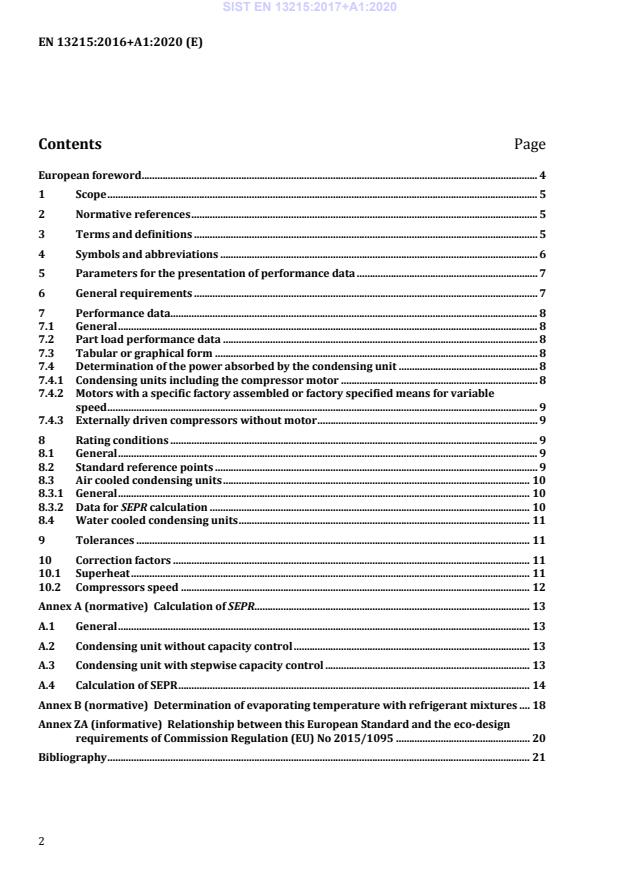
Contents Page
European foreword . 4
1 Scope . 5
2 Normative references . 5
3 Terms and definitions . 5
4 Symbols and abbreviations . 6
5 Parameters for the presentation of performance data . 7
6 General requirements . 7
7 Performance data . 8
7.1 General . 8
7.2 Part load performance data . 8
7.3 Tabular or graphical form . 8
7.4 Determination of the power absorbed by the condensing unit . 8
7.4.1 Condensing units including the compressor motor . 8
7.4.2 Motors with a specific factory assembled or factory specified means for variable
speed . 9
7.4.3 Externally driven compressors without motor . 9
8 Rating conditions . 9
8.1 General . 9
8.2 Standard reference points . 9
8.3 Air cooled condensing units . 10
8.3.1 General . 10
8.3.2 Data for SEPR calculation . 10
8.4 Water cooled condensing units . 11
9 Tolerances . 11
10 Correction factors . 11
10.1 Superheat . 11
10.2 Compressors speed . 12
Annex A (normative) Calculation of SEPR. 13
A.1 General . 13
A.2 Condensing unit without capacity control . 13
A.3 Condensing unit with stepwise capacity control . 13
A.4 Calculation of SEPR . 14
Annex B (normative) Determination of evaporating temperature with refrigerant mixtures . 18
Annex ZA (informative) Relationship between this European Standard and the eco-design
requirements of Commission Regulation (EU) No 2015/1095 . 20
Bibliography . 21
Tables
Table 1 — Symbols and abbreviations .6
Table 2 — Indices .7
Table 3 — Parameters for the presentation of performance data .7
Table 4 — Standard reference points .9
Table 5 — Actual performance in relation to published data . 11
Table A.1 — Required input for SEPR calculation . 14
Table A.2 — Ambient temperatures and duration for SEPR determination . 15
Table ZA.1 — Correspondence between this European Standard and Commission Regulation (EU)
No 2015/1095 of 5 May 2015 implementing Directive 2009/125/EC of the European
Parliament and of the Council with regard to ecodesign requirements for professional
refrigerated storage cabinets, blast cabinets, condensing units and process chillers and
Commission’s standardization request M/495 (Ecodesign) . 20
European foreword
This document (EN 13215:2016+A1:2020) has been prepared by Technical Committee CEN/TC 113
“Heat pumps and air conditioning units”, the secretariat of which is held by AENOR.
This European Standard shall be given the status of a national standard, either by publication of an
identical text or by endorsement, at the latest by February 2021, and conflicting national standards
shall be withdrawn at the latest by February 2021.
Attention is drawn to the possibility that some of the elements of this document may be the subject of
patent rights. CEN shall not be held responsible for identifying any or all such patent rights.
This document includes Amendment 1 approved by CEN on 5 July 2020.
This document supersedes !EN 13215:2016".
The start and finish of text introduced or altered by amendment is indicated in the text by tags !".
This document has been prepared under a mandate given to CEN by the European Commission and the
European Free Trade Association, and supports essential requirements of EU Directive(s).
For relationship with EU Directive(s), see informative Annex ZA which is an integral part of this
document.
The main changes with respect to the previous edition are listed below:
a) part load conditions according to M/495 “Standardisation mandate to CEN, CENELEC and ETSI
under Directive 2009/125/EC relating to harmonised standards in the field of Ecodesign” are taken
into account;
b) inclusion of the calculation of seasonal energy performance ratio (SEPR).
According to the CEN-CENELEC Internal Regulations, the national standards organisations of the
following countries are bound to implement this European Standard: Austria, Belgium, Bulgaria,
Croatia, Cyprus, Czech Republic, Denmark, Estonia, Finland, France, Germany, Greece, Hungary, Iceland,
Ireland, Italy, Latvia, Lithuania, Luxembourg, Malta, Netherlands, Norway, Poland, Portugal, Republic of
North Macedonia, Romania, Serbia, Slovakia, Slovenia, Spain, Sweden, Switzerland, Turkey and the
United Kingdom.
1 Scope
This European Standard specifies the rating conditions, tolerances and presentation of manufacturer's
performance data for condensing units for refrigeration with compressors of the positive-displacement
type. These include single stage compressors and single and two stage compressors having an
integrated means of fluid sub cooling. This is required so that a comparison of different condensing
units can be made. The data relate to the refrigerating capacity and power absorbed and include
requirements for part-load performance where applicable.
2 Normative references
The following documents, in whole or in part, are normatively referenced in this document and are
indispensable for its application. For dated references, only the edition cited applies. For undated
references, the latest edition of the referenced document (including any amendments) applies.
!EN 378-1:2016, Refrigerating systems and heat pumps - Safety and environmental requirements - Part
1: Basic requirements, definitions, classification and selection criteria
EN 13771-2:2017, Compressors and condensing units for refrigeration - Performance testing and test
methods - Part 2: Condensing units"
ISO 817, Refrigerants — Designation and safety classification
3 Terms and definitions
For the purposes of this document, the terms and definitions given in !EN 378-1:2016" and the
following apply.
3.1
condensing unit
combination of one or more compressors, condensers/gas coolers and, where applicable, liquid
receivers and the regularly furnished accessories
!3.2
evaporating temperature
t
o
temperature between the evaporating dew point and the evaporator inlet temperature of the
refrigerant at the pressure of the condensing unit inlet, as calculated according to Annex B
Note 1 to entry: For refrigerants without glide the evaporating temperature is equal to the dew point
temperature at the condensing unit inlet pressure."
!3.3"
refrigerating capacity
Q
product of the mass flow of refrigerant through the condensing unit and the difference between the
specific enthalpy of the refrigerant at the condensing unit inlet, the refrigerant being superheated above
the suction dew point temperature to the appropriate value (see Table 3), and the specific enthalpy of
the liquid refrigerant at the condensing unit outlet
!3.4"
!subcooling"
difference between the bubble point temperature of the refrigerant corresponding to the pressure at
the condensing unit outlet and the temperature of the liquid refrigerant at the condensing unit outlet
!3.5"
superheat
difference between the dew point temperature of the refrigerant corresponding to the pressure at the
condensing unit inlet and the temperature of the refrigerant vapour at the condensing unit inlet
!3.6"
power absorbed
P
power demand to drive the condensing unit
!3.7"
coefficient of performance
COP
refrigerating capacity to the power absorbed
!3.8"
seasonal energy performance ratio
SEPR
reference annual refrigeration demand divided by the annual electrical energy demand
!3.9
glide
difference between dew point temperature and bubble point temperature at a given pressure
[SOURCE: EN 14511-1:2018, 3.46]
3.10
condensing temperature
arithmetic mean temperature between the condensing dew point and bubble point at the compressor
discharge pressure"
4 Symbols and abbreviations
Table 1 — Symbols and abbreviations
Symbol Designation Unit
LT Low evaporating temperature -
MT Medium evaporating temperature -
HT High evaporating temperature -
COP Coefficient of performance -
CR Capacity ratio -
d Duration h
E Annual electrical energy demand kWh
P Power W
q Refrigeration demand ratio -
Q Refrigerating capacity W
SEPR Seasonal energy performance ratio -
t Temperature °C
Table 2 — Indices
Index Designation
LT Low evaporating temperature
MT Medium evaporating temperature
amb ambient
cor corrected
dm demand
low low
A, B, C and D Rating conditions
j bin-number
R rated
5 Parameters for the presentation of performance data
The parameters as shown in Table 3 shall be used for the presentation of the performance data.
Table 3 — Parameters for the presentation of performance data
Parameters refrigerant Suction temperature (°C) or Condensing unit
superheat (K) at the application
condensing unit inlet
Household and similar
Halocarbons and
32 °C
refrigerators/freezers
hydrocarbons including
refrigerant blends
20 °C or 10 K Other applications
R717 Any application using
5 K
ammonia
32 °C Household and similar
R744
10 K Other application using CO2
6 General requirements
The performance data of a condensing unit for refrigeration shall be presented in either tabular or
graphical form as shown in 7.3. Data outside the allowable working range of the condensing unit shall
not be included.
The performance of the condensing unit at the standard reference points in Table 4 shall also be
reported.
To calculate the performance at other suction temperatures/superheat and at other compressor speeds,
correction factors shall be given as shown in Clause 10.
Refrigerants shall be designated in accordance with ISO 817. The source from which the
thermodynamic properties are taken shall be stated.
EN 13215:2016+A
...