

EN 15784:2021
(Main)Animal feeding stuffs: Methods of sampling and analysis - Detection and enumeration of Bacillus spp. used as feed additive
General Information
- Abstract
This document specifies general rules for the enumeration of bacilli in feeding stuffs (additives, premixtures and compound feeds including mineral feeds) [4] that contain bacilli as a single microorganism component or in a mixture with other microorganisms. There are different categories of feed samples:
a) Additives containing about 1010 colony forming units (CFU)/g;
b) Premixtures containing about 1011 CFU/kg;
c) Compound feeds, meal or pellets containing about 109 CFU/kg.
- Status
- Published
- Publication Date
- 23-Nov-2021
- Withdrawal Date
- 30-May-2022
- Technical Committee
- CEN/TC 327 - Animal feeding stuffs - Methods of sampling and analysis
- Drafting Committee
- CEN/TC 327/WG 3 - Feed additives and drugs
- Current Stage
- 6060 - Definitive text made available (DAV) - Publishing
- Start Date
- 24-Nov-2021
- Due Date
- 05-Jul-2020
- Completion Date
- 24-Nov-2021

Overview
EN 15784:2021 (CEN) - "Animal feeding stuffs: Methods of sampling and analysis - Detection and enumeration of Bacillus spp. used as feed additive" defines a validated laboratory method for detecting and counting Bacillus spp. spores in animal feed matrices (additives, premixtures and compound feeds, including mineral feeds). The method was approved in November 2021 and supersedes EN 15784:2009. It is intended to support official control, product labelling checks and quality assurance where bacilli are added as feed additives.
Key topics and requirements
- Scope and sample categories: covers additives (~10^10 CFU/g), premixtures (~10^11 CFU/kg) and compound feeds (~10^9 CFU/kg).
- Target organism: designed for Bacillus spp. used as feed additives (spore-forming strains); vegetative cells are not considered. Not intended to detect ubiquitous or pathogenic Bacillus in feeds.
- Principle: prepare representative test sample → prepare initial suspension in 0.2% NaOH diluent (reduces vegetative flora, preserves spores) → decimal dilutions → plating on tryptone soy agar (TSA) → incubate 37 °C ±1 °C for 16–24 h → count characteristic colonies → confirm isolates if necessary.
- Media & reagents: composition and preparation of TSA and 0.2% sodium hydroxide + Tween 80 are specified. Sterilization and temperature-holding procedures are described.
- Apparatus & procedures: allows homogenization devices (rotary or paddle homogenizers, vibrational mixers) up to specified speeds (aligned with EN ISO 7218 guidance), options for spread plating or spiral platers, and use of laminar flow and phase-contrast microscopy for confirmation.
- Counting range & precision: validated colony count acceptance range adjusted to ≈10–100 colonies per plate; interlaboratory validation data (VDLUFA ring trials) and precision/reproducibility information are included.
- Reporting: instructions for expression of results (CFU per g or kg) and required test report items.
Applications
- Official control and regulatory compliance testing of feed additives and finished feed for correct labelling and declared Bacillus content.
- Quality control and release testing in feed manufacturing and premix production.
- Validation and routine monitoring in contract laboratories performing microbiological analysis of feed products.
- Reference method for comparative studies and method transfer/validation of in-house procedures.
Who should use this standard
- Microbiology laboratories in the feed sector, official control laboratories, feed manufacturers, quality assurance teams, regulatory authorities and consultants involved in feed additive compliance or microbiological testing.
Related standards
- EN ISO 6498 - Guidelines for sample preparation (referenced for sampling guidance).
- EN ISO 7218 - General requirements for microbiological examination (homogenization and laboratory practice).
- VDLUFA methods and ring-trial reports referenced for validation data and method alignment.
Relations
- Replaces
EN 15784:2009 - Animal feeding stuffs - Isolation and enumeration of presumptive Bacillus spp. - Effective Date
- 08-Jun-2022
- Effective Date
- 28-Jan-2026
Get Certified
Connect with accredited certification bodies for this standard

Control Union Certifications
Global certification for agriculture and sustainability.

ECOCERT
Organic and sustainability certification.

FSC International
Forest Stewardship Council certification.
Sponsored listings
Frequently Asked Questions
EN 15784:2021 is a standard published by the European Committee for Standardization (CEN). Its full title is "Animal feeding stuffs: Methods of sampling and analysis - Detection and enumeration of Bacillus spp. used as feed additive". This standard covers: This document specifies general rules for the enumeration of bacilli in feeding stuffs (additives, premixtures and compound feeds including mineral feeds) [4] that contain bacilli as a single microorganism component or in a mixture with other microorganisms. There are different categories of feed samples: a) Additives containing about 1010 colony forming units (CFU)/g; b) Premixtures containing about 1011 CFU/kg; c) Compound feeds, meal or pellets containing about 109 CFU/kg.
This document specifies general rules for the enumeration of bacilli in feeding stuffs (additives, premixtures and compound feeds including mineral feeds) [4] that contain bacilli as a single microorganism component or in a mixture with other microorganisms. There are different categories of feed samples: a) Additives containing about 1010 colony forming units (CFU)/g; b) Premixtures containing about 1011 CFU/kg; c) Compound feeds, meal or pellets containing about 109 CFU/kg.
EN 15784:2021 is classified under the following ICS (International Classification for Standards) categories: 65.120 - Animal feeding stuffs. The ICS classification helps identify the subject area and facilitates finding related standards.
EN 15784:2021 has the following relationships with other standards: It is inter standard links to EN 15784:2009, EN ISO 6498:2012. Understanding these relationships helps ensure you are using the most current and applicable version of the standard.
EN 15784:2021 is associated with the following European legislation: EU Directives/Regulations: 882/2004. When a standard is cited in the Official Journal of the European Union, products manufactured in conformity with it benefit from a presumption of conformity with the essential requirements of the corresponding EU directive or regulation.
EN 15784:2021 is available in PDF format for immediate download after purchase. The document can be added to your cart and obtained through the secure checkout process. Digital delivery ensures instant access to the complete standard document.
Standards Content (Sample)
SLOVENSKI STANDARD
01-februar-2022
Nadomešča:
SIST EN 15784:2009
Krma: Metode vzorčenja in analize - Določanje in štetje prisotnih Bacillus spp.
uporabljen kot krmni dodatek
Animal feeding stuffs: Methods of sampling and analysis - Detection and enumeration of
Bacillus spp. used as feed additive
Futtermittel: Probenahme- und Untersuchungsverfahren - Nachweis und Zählung von
Bacillus spp. als Futtermittelzusatzstoff
Aliments des animaux: Méthodes d’échantillonnage et d’analyse - Détection et
dénombrement des souches de Bacillus spp. utilisées comme additifs pour l’alimentation
animale
Ta slovenski standard je istoveten z: EN 15784:2021
ICS:
65.120 Krmila Animal feeding stuffs
2003-01.Slovenski inštitut za standardizacijo. Razmnoževanje celote ali delov tega standarda ni dovoljeno.
EN 15784
EUROPEAN STANDARD
NORME EUROPÉENNE
November 2021
EUROPÄISCHE NORM
ICS 65.120 Supersedes EN 15784:2009
English Version
Animal feeding stuffs: Methods of sampling and analysis -
Detection and enumeration of Bacillus spp. used as feed
additive
Aliments des animaux: Méthodes d'échantillonnage et Futtermittel: Probenahme- und
d'analyse - Détection et dénombrement des souches de Untersuchungsverfahren - Nachweis und Zählung von
Bacillus spp. utilisées comme additifs pour Bacillus spp. als Futtermittelzusatzstoff
l'alimentation animale
This European Standard was approved by CEN on 2 August 2021.
CEN members are bound to comply with the CEN/CENELEC Internal Regulations which stipulate the conditions for giving this
European Standard the status of a national standard without any alteration. Up-to-date lists and bibliographical references
concerning such national standards may be obtained on application to the CEN-CENELEC Management Centre or to any CEN
member.
This European Standard exists in three official versions (English, French, German). A version in any other language made by
translation under the responsibility of a CEN member into its own language and notified to the CEN-CENELEC Management
Centre has the same status as the official versions.
CEN members are the national standards bodies of Austria, Belgium, Bulgaria, Croatia, Cyprus, Czech Republic, Denmark, Estonia,
Finland, France, Germany, Greece, Hungary, Iceland, Ireland, Italy, Latvia, Lithuania, Luxembourg, Malta, Netherlands, Norway,
Poland, Portugal, Republic of North Macedonia, Romania, Serbia, Slovakia, Slovenia, Spain, Sweden, Switzerland, Turkey and
United Kingdom.
EUROPEAN COMMITTEE FOR STANDARDIZATION
COMITÉ EUROPÉEN DE NORMALISATION
EUROPÄISCHES KOMITEE FÜR NORMUNG
CEN-CENELEC Management Centre: Rue de la Science 23, B-1040 Brussels
© 2021 CEN All rights of exploitation in any form and by any means reserved Ref. No. EN 15784:2021 E
worldwide for CEN national Members.
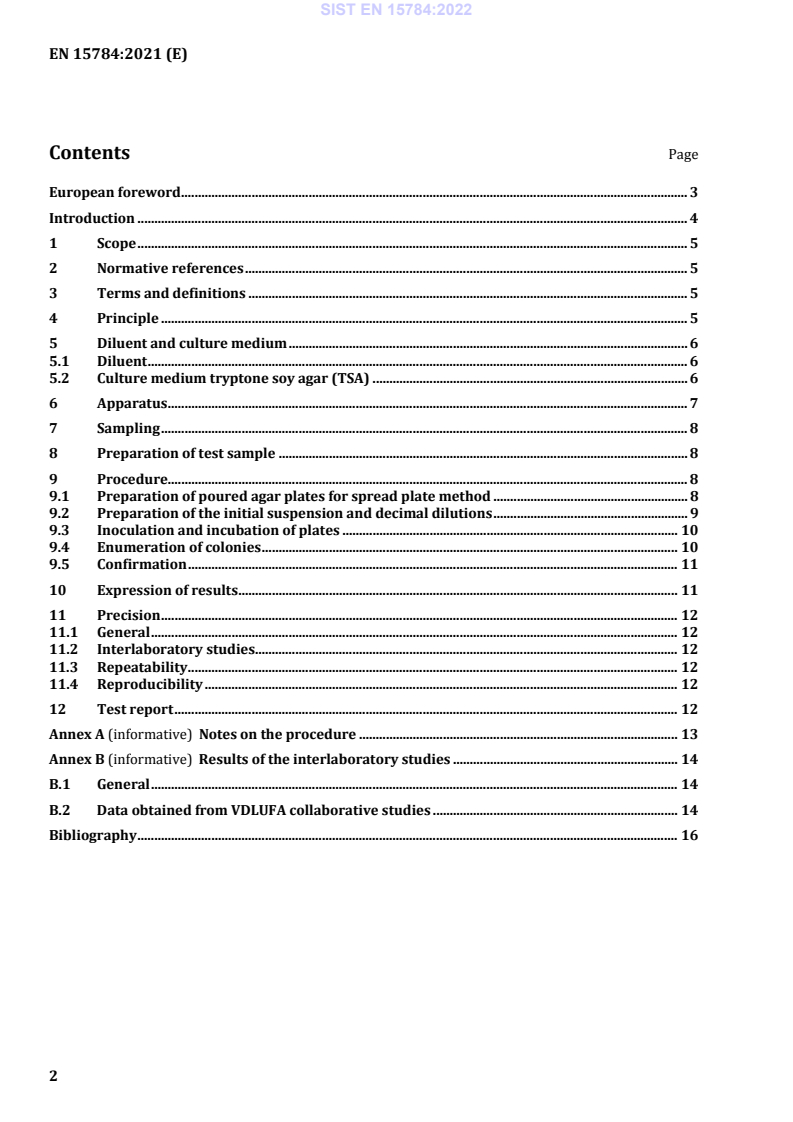
Contents Page
European foreword . 3
Introduction . 4
1 Scope . 5
2 Normative references . 5
3 Terms and definitions . 5
4 Principle . 5
5 Diluent and culture medium . 6
5.1 Diluent . 6
5.2 Culture medium tryptone soy agar (TSA) . 6
6 Apparatus . 7
7 Sampling . 8
8 Preparation of test sample . 8
9 Procedure. 8
9.1 Preparation of poured agar plates for spread plate method . 8
9.2 Preparation of the initial suspension and decimal dilutions . 9
9.3 Inoculation and incubation of plates . 10
9.4 Enumeration of colonies . 10
9.5 Confirmation . 11
10 Expression of results . 11
11 Precision . 12
11.1 General . 12
11.2 Interlaboratory studies . 12
11.3 Repeatability . 12
11.4 Reproducibility . 12
12 Test report . 12
Annex A (informative) Notes on the procedure . 13
Annex B (informative) Results of the interlaboratory studies . 14
B.1 General . 14
B.2 Data obtained from VDLUFA collaborative studies . 14
Bibliography . 16
European foreword
This document (EN 15784:2021) has been prepared by Technical Committee CEN/TC 327 “Animal
feeding stuffs - Methods of sampling and analysis”, the secretariat of which is held by NEN.
This European Standard shall be given the status of a national standard, either by publication of an
identical text or by endorsement, at the latest by May 2022, and conflicting national standards shall be
withdrawn at the latest by May 2022.
Attention is drawn to the possibility that some of the elements of this document may be the subject of
patent rights. CEN shall not be held responsible for identifying any or all such patent rights.
This document supersedes EN 15784:2009.
The main changes compared to the previous edition are as follows:
— Amendment of the title;
— Extension of the scope of application to all Bacilli used as feed additive and to mineral feeds;
— Updating of normative cross references;
— Addition of 0,2 % NaOH as diluent for initial suspension and serial dilutions;
— Removal of the necessity of a heating step;
— Unification of the treatment of all matrices;
-1
— Replacement of the required laboratory mixer with a rotation speed of 18 000 min to
-1
22 000 min by homogenization devices, for example according to EN ISO 7218, with a maximal
-1
requested rotation speed of 10 000 min ;
— Addition of the option to use a spiral plater for plating;
— Addition of validation data derived from VDLUFA ring trials of different feeding stuff matrices
including mineral feed;
— Adjustment of the range of accepted colony numbers for counting from '≥ 30 to ≤ 300' to '≥ 10
to ≤ 100' colonies per plate.
Any feedback and questions on this document should be directed to the users’ national standards body.
A complete listing of these bodies can be found on the CEN website.
According to the CEN-CENELEC Internal Regulations, the national standards organisations of the
following countries are bound to implement this European Standard: Austria, Belgium, Bulgaria, Croatia,
Cyprus, Czech Republic, Denmark, Estonia, Finland, France, Germany, Greece, Hungary, Iceland, Ireland,
Italy, Latvia, Lithuania, Luxembourg, Malta, Netherlands, Norway, Poland, Portugal, Republic of North
Macedonia, Romania, Serbia, Slovakia, Slovenia, Spain, Sweden, Switzerland, Turkey and the United
Kingdom.
Introduction
This methodology has been developed to enumerate bacilli spores used as feed additives capable of
germinating, to enable the European Commission to control proper labelling of animal feeding products.
It was compiled first during the EU project SMT4-CT98-2235 “Methods for the official control of
probiotics used as feed additives” [1]. During the revision of the method it was adjusted to VDLUFA
method 28.2.2 “Enumeration of Bacillus licheniformis and Bacillus subtilis” and completed with validation
data from interlaboratory studies with commercial feed products [2]. The method is validated in this
project for two strains of Bacillus subtilis (DSM 5750 and DSM 15544) and one strain of Bacillus
licheniformis (DSM 5749). It can be assumed that the method is suitable also for other Bacillus strains
used as feed additives. However, the applicability of the method to the determination of Bacillus spp. in
specific feed additive preparations may need to be demonstrated based on a case by case decision.
Vegetative cells are not taken into account in this method, as all approved Bacillus species products at
present are spores.
Spores of Bacillus species survive a treatment with 0,2 % sodium hydroxide solution and the Bacillus
species characteristic colony morphology of the individually authorized strains is examined using the
proposed method [3].
This method is not selective for bacilli used as feed additives but can be applied to enumerate Bacillus
spp. in feeding stuffs assuming that the added bacilli are present in far higher numbers than any other
bacilli.
This method is not applicable for the detection of any ubiquitous or pathogenic Bacillus spp. in food and
animal feeding stuffs.
1 Scope
This document specifies general rules for the enumeration of bacilli in feeding stuffs (additives,
premixtures and compound feeds including mineral feeds) [4] that contain bacilli as a single
microorganism component or in a mixture with other microorganisms. There are different categories of
feed samples:
a) Additives containing about 10 colony forming units (CFU)/g;
b) Premixtures containing about 10 CFU/kg;
c) Compound feeds, meal or pellets containing about 10 CFU/kg.
2 Normative references
The following documents are referred to in the text in such a way that some or all of their content
constitutes requirements of this document. For dated references, only the edition cited applies. For
undated references, the latest edition of the referenced document (including any amendments) applies.
EN ISO 6498, Animal feeding stuffs - Guidelines for sample preparation (ISO 6498)
3 Terms and definitions
For the purposes of this document, the following terms and definitions apply.
ISO and IEC maintain terminological databases for use in standardization at the following addresses:
— ISO Online browsing platform: available at https://www.iso.org/obp
— IEC Electropedia: available at https://www.electropedia.org/
3.1
Bacillus strains
genus of Gram-positive, rod-shaped bacteria
Note 1 to entry: This description is based on their characteristics as used for this document.
Note 2 to entry: Bacillus species can be either obligate aerobes or facultative anaerobes. Cultured Bacillus species
are catalase-positive if cultivated in the presence of oxygen.
Note 3 to entry: Bacilli can form oval endospores.
Note 4 to entry: Bacilli form colonies on the surface of tryptone soy agar (TSA) after incubation at a temperature of
37 °C under aerobic conditions for 16 h to 24 h fitting the description given in 9.5.
4 Principle
a) Preparation of sterile and dry poured plates;
b) Drawing a representative test sample under aseptic conditions;
c) Preparation of the initial suspension with a tempered 0,2 % sodium hydroxide diluent to obtain a
homogeneous distribution of bacterial cells from the test portion and to reduce the vegetative
bacterial flora in the suspension;
d) Preparation of further decimal dilutions of the initial suspension in order to reduce the number of
microorganisms per unit volume to allow, after incubation, the counting of colonies;
e) Inoculation of the prepared poured plates with an aliquot of the optimum dilutions and dispersion
of the inoculum by using a sterile spreader;
f) Incubation of inverted plates for 16 h to 24 h at 37 °C ± 1 °C under aerobic conditions;
g) Counting of typical colonies, considering the specific properties of bacilli;
h) Confirmation of exemplary isolates by microscopy or biochemical properties if necessary;
i) Calculation of the colony forming units of Bacillus spp. per gram or kilogram of feed sample.
5 Diluent and culture medium
5.1 Diluent
This diluent, a sodium hydroxide solution, is used for the preparation of the initial suspension and for the
preparation of further decimal dilutions. The composition of the diluent is given in Table 1.
Table 1 — Components of a 0,2 % sodium hydroxide solution
Sodium hydroxide NaOH 2,0 g
® 1
C H O 1 ml
Polyoxyethylene (20) sorbitan monooleate (Tween 80)
64 124 26
Water, distilled or deionized H O 1 000 ml
Dissolve the components (see Table 1) in water. Fill the solution into appropriate containers (e.g. bottles,
flasks, or test tubes) and sterilize at 121 °C ± 3 °C for 15 min. To avoid loss during autoclaving, screw cap
bottles are recommended.
For immediate use, hold at 40 °C ± 1 °C in a water bath or incubator.
5.2 Culture medium tryptone soy agar (TSA)
5.2.1 Composition
The composition of the culture medium tryptone soy agar is given in Table 2. The resulting pH value at
25 °C is 7,3 ± 0,2.
1 ®
Tween 80 is an example of a suitable product available commercially. This information is given for the
convenience of users of this document and does not constitute an endorsement by CEN of this product.
The TSA medium is commercially ready made available from various suppliers.
Table 2 — Composition of the tryptone soy agar (TSA)
Tryptone 15,0 g
Sodium chloride 5,0 g
Soja peptone 5,0 g
a
Agar agar
12 g to 15 g
Water, distilled or deionized 1 000 ml
a
Depending on the gel strength of the agar.
5.2.2 Preparation
Dissolve all components (Table 2) in water under heating and fill into appropriate containers (e.g. bottles
or flasks with non-toxic metal screw-caps). If necessary, adjust to a final pH of 7,3 ± 0,2 at 25 °C after
sterilization. Sterilize at 121 °C ± 3 °C for 15 min.
6 Apparatus
Usual microbiological laboratory equipment and, in particular, the following:
6.1 Equipment for dry sterilization (oven) and wet sterilization (autoclave), for example
according to EN ISO 7218 [5].
6.2 Incubator, capable of maintaining a temperature of 37 °C ± 1 °C. Optionally also capable of
maintaining a temperature of 40 °C ± 1 °C and/or between 44 °C and 47 °C.
6.3 Water bath, capable of maintaining a temperature of 40 °C ± 1 °C and between 44 °C and 47 °C.
6.4 Blending equipment.
The following apparatus may be used according to EN ISO 7218 [5]:
-1 -1
— a rotary homogenizer (blender) with a notional variable speed of 3 000 min to 10 000 min , as
well as aseptic glass or metals bowls equipped with covers; or
— a peristaltic homogenizer with sterile bags (paddle homogenizer), possibly with the option to adjust
blending speed and time; or
— a vibrational mixer with sterile bags; or
— any other homogenizing system with equivalent efficiency (e.g. a hand blender with aseptic beaker).
6.5 Mechanical stirrer.
A mechanical stirrer (e.g. Vortex Mixer) facilitates the homogenous mixing of decimal dilutions, as
described in e.g. EN ISO 7218 [5].
6.6 Balances, of the required range and accuracy, for example according to EN ISO 7218 [5], for the
different products to be weighed.
6.7 Flasks or screw-cap bottles, of appropriate capacities.
6.8 Test tubes, of appropriate capacities.
6.9 Pipettes or pipettor and sterile tips, to dispense 0,1 ml to 1 ml.
6.10 Sterile pipettes, to dispense 5 ml, for full outlet with wide (approx. 3 mm) tips (e.g. serological
pipette).
NOTE As alternative, 5 ml graduated pipettes without tips can be used.
6.11 Spreading spatula, sterile L- or triangular-shaped spreaders from glass or metal or sterile
disposable plastic spreaders.
NOTE As alternatives, a spiral plater with a sanitized dispensing system or disposable one–way micro syringes
can be used.
6.12 Sterile Petri dishes, with triple vents (plates), 90 mm in diameter.
6.13 Laminar flow cabinet.
6.14 Microscope, capable of phase-contrast microscopy at a magnification of 600× to 1 000×.
6.15 pH meter, having an accuracy of calibration of ± 0,1 pH unit at 20 °C to 25 °C.
7 Sampling
Carry out the sampling procedure in a
...