


EN 388:2016+A1:2018
(Main)Protective gloves against mechanical risks
Protective gloves against mechanical risks
This European Standard specifies requirements, test methods, marking and information to be supplied for protective gloves against the mechanical risks of abrasion, blade cut, tear, puncture and, if applicable, impact.
This standard is intended to be used in conjunction with EN 420.
The test methods developed in this standard may also be applicable to arm protectors.
Schutzhandschuhe gegen mechanische Risiken
Diese Europäische Norm legt Anforderungen, Prüfverfahren, Kennzeichnung und Herstellerinformationen für Schutzhandschuhe gegen die mechanischen Risiken Abrieb, Schnitt, Weiterreißen, Durchstich und, falls zutreffend, Stoß fest.
Diese Norm ist für die Anwendung in Verbindung mit EN 420 vorgesehen.
Die in dieser Norm angegebenen Prüfverfahren dürfen auch auf Armprotektoren angewendet werden.
Gants de protection contre les risques mécaniques
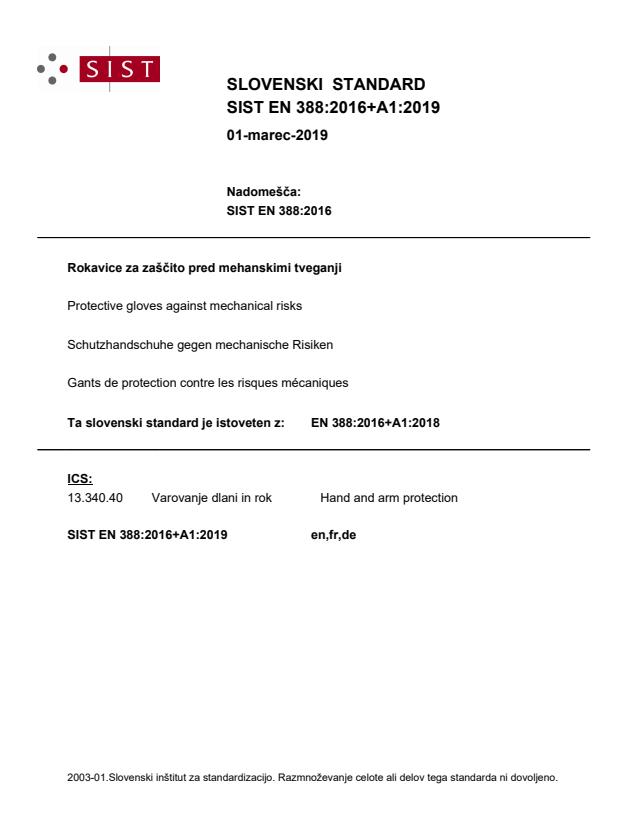
Rokavice za zaščito pred mehanskimi tveganji
Ta evropski standard določa zahteve, preskusne metode, označevanje in informacije, ki jih je treba zagotoviti za rokavice za zaščito pred mehanskimi tveganji zaradi abrazije, rezanja z nožem, trganja, preluknjanja in, če je primerno, udarca.
Ta standard je treba uporabljati v povezavi s standardom EN 420.
Preskusne metode, razvite v tem standardu, se lahko uporabljajo tudi za ščitnike za roke.
General Information
- Status
- Published
- Publication Date
- 11-Dec-2018
- Withdrawal Date
- 29-Jun-2019
- Technical Committee
- CEN/TC 162 - Protective clothing including hand and arm protection and lifejackets
- Drafting Committee
- CEN/TC 162/WG 8 - Protective gloves
- Current Stage
- 9092 - Decision on results of review/2YR ENQ - revise - Review Enquiry
- Start Date
- 17-Jan-2024
- Completion Date
- 11-Feb-2026
Relations
- Effective Date
- 18-Jan-2023
- Effective Date
- 17-Oct-2018
- Effective Date
- 28-Jan-2026
- Referred By
EN 511:2006 - Protective gloves against cold - Effective Date
- 28-Jan-2026
- Effective Date
- 28-Jan-2026
- Effective Date
- 28-Jan-2026
- Effective Date
- 28-Jan-2026
- Effective Date
- 28-Jan-2026
- Effective Date
- 28-Jan-2026
- Effective Date
- 28-Jan-2026
- Effective Date
- 28-Jan-2026
- Effective Date
- 28-Jan-2026
- Effective Date
- 28-Jan-2026
- Effective Date
- 28-Jan-2026
- Effective Date
- 28-Jan-2026
Overview - EN 388:2016+A1:2018 (Protective gloves against mechanical risks)
EN 388:2016+A1:2018 is the CEN European Standard that specifies requirements, test methods, marking and user information for protective gloves designed to protect against mechanical risks - notably abrasion, blade cut, tear, puncture and, where applicable, impact. It is intended to be used together with EN 420 (general glove requirements) and its test methods can also apply to arm protectors. The standard supports conformity with EU Regulation (EU) 2016/425 for personal protective equipment.
Key topics and technical requirements
- Scope and applicability
- Defines protective gloves against mechanical hazards and arm protectors; specimens for testing are typically taken from the palm or claimed area of protection.
- Performance classification
- Gloves must achieve at least level 1 or above in one or more mechanical properties (abrasion, blade cut, tear, puncture) or level A under EN ISO 13997 (TDM cut test) to be considered protective against mechanical risks.
- Test methods included
- Abrasion resistance (Martindale-style method referenced via EN ISO 12947-1)
- Blade cut resistance (blade cut test and a separate cut-resistance method EN ISO 13997)
- Tear resistance
- Puncture resistance
- Optional impact protection testing
- Marking and information
- Specifies pictograms, marking formats and user information that manufacturers must supply.
- Sampling, conditioning and measurement
- Details on specimen selection, conditioning, sampling and measurement uncertainty (see normative annexes).
Practical applications - who uses EN 388
- PPE manufacturers - design, test and certify gloves to meet market and regulatory requirements.
- Test laboratories and conformity assessors - perform standardized mechanical tests and classification.
- Procurement and safety managers - select appropriate gloves for tasks involving cutting, abrasion, tearing or puncture risk.
- Regulators and notified bodies - verify compliance with EU PPE Regulation (2016/425).
- Product designers and R&D teams - choose materials and constructions that meet targeted performance levels.
Note: Gloves passing puncture tests may still not be suitable for hypodermic needles or very fine pointed hazards - consult specific test ratings and intended use.
Related standards
- EN 420 - General requirements and test methods for protective gloves (used in conjunction with EN 388)
- EN ISO 13997 - Cut resistance (TDM method) referenced for higher-level cut classification
- Other referenced ISO/CEN methods for abrasion, tensile and dimensioning tests are cited within the standard.
Keywords: EN 388:2016+A1:2018, protective gloves, mechanical risks, abrasion, blade cut, tear, puncture, impact, EN 420, PPE compliance, CEN standard.


Get Certified
Connect with accredited certification bodies for this standard

NSF International
Global independent organization facilitating standards development and certification.

CIS Institut d.o.o.
Personal Protective Equipment (PPE) certification body. Notified Body NB-2890 for EU Regulation 2016/425 PPE.

Kiwa BDA Testing
Building and construction product certification.
Sponsored listings
Frequently Asked Questions
EN 388:2016+A1:2018 is a standard published by the European Committee for Standardization (CEN). Its full title is "Protective gloves against mechanical risks". This standard covers: This European Standard specifies requirements, test methods, marking and information to be supplied for protective gloves against the mechanical risks of abrasion, blade cut, tear, puncture and, if applicable, impact. This standard is intended to be used in conjunction with EN 420. The test methods developed in this standard may also be applicable to arm protectors.
This European Standard specifies requirements, test methods, marking and information to be supplied for protective gloves against the mechanical risks of abrasion, blade cut, tear, puncture and, if applicable, impact. This standard is intended to be used in conjunction with EN 420. The test methods developed in this standard may also be applicable to arm protectors.
EN 388:2016+A1:2018 is classified under the following ICS (International Classification for Standards) categories: 13.340.40 - Hand and arm protection. The ICS classification helps identify the subject area and facilitates finding related standards.
EN 388:2016+A1:2018 has the following relationships with other standards: It is inter standard links to EN 388:2016/prA1:2018, EN 388:2016, EN 17092-1:2020, EN 511:2006, EN 343:2003+A1:2007, EN 374-1:2003, EN 943-1:2015+A1:2019, EN 17067:2018, EN ISO 10819:2013, EN 943-1:2015, EN 13567:2002+A1:2007, EN 13594:2015, EN 13113:2002+A1:2010, EN ISO 5912:2011, EN 659:2003+A1:2008. Understanding these relationships helps ensure you are using the most current and applicable version of the standard.
EN 388:2016+A1:2018 is associated with the following European legislation: EU Directives/Regulations: 2016/425. When a standard is cited in the Official Journal of the European Union, products manufactured in conformity with it benefit from a presumption of conformity with the essential requirements of the corresponding EU directive or regulation.
EN 388:2016+A1:2018 is available in PDF format for immediate download after purchase. The document can be added to your cart and obtained through the secure checkout process. Digital delivery ensures instant access to the complete standard document.
Standards Content (Sample)
2003-01.Slovenski inštitut za standardizacijo. Razmnoževanje celote ali delov tega standarda ni dovoljeno.Schutzhandschuhe gegen mechanische RisikenGants de protection contre les risques mécaniquesProtective gloves against mechanical risks13.340.40Varovanje dlani in rokHand and arm protectionICS:Ta slovenski standard je istoveten z:EN 388:2016+A1:2018SIST EN 388:2016+A1:2019en,fr,de01-marec-2019SIST EN 388:2016+A1:2019SLOVENSKI
STANDARDSIST EN 388:20161DGRPHãþD
EUROPEAN STANDARD NORME EUROPÉENNE EUROPÄISCHE NORM
EN 388:2016+A1
December
t r s z ICS
s uä u v rä v r Supersedes EN
u z zã t r s xEnglish Version
Protective gloves against mechanical risks Gants de protection contre les risques mécaniques
Schutzhandschuhe gegen mechanische Risiken This European Standard was approved by CEN on
t { July
t r s x and includes Amendment
s approved by CEN on
t v October
t r s zä
egulations which stipulate the conditions for giving this European Standard the status of a national standard without any alterationä Upætoædate lists and bibliographical references concerning such national standards may be obtained on application to the CENæCENELEC Management Centre or to any CEN memberä
translation under the responsibility of a CEN member into its own language and notified to the CENæCENELEC Management Centre has the same status as the official versionsä
CEN members are the national standards bodies of Austriaá Belgiumá Bulgariaá Croatiaá Cyprusá Czech Republicá Denmarká Estoniaá Finlandá Former Yugoslav Republic of Macedoniaá Franceá Germanyá Greeceá Hungaryá Icelandá Irelandá Italyá Latviaá Lithuaniaá Luxembourgá Maltaá Netherlandsá Norwayá Polandá Portugalá Romaniaá Serbiaá Slovakiaá Sloveniaá Spainá Swedená Switzerlandá Turkey and United Kingdomä
EUROPEAN COMMITTEE FOR STANDARDIZATION COMITÉ EUROPÉEN DE NORMALISATION EUROPÄISCHES KOMITEE FÜR NORMUNG
CEN-CENELEC Management Centre:
Rue de la Science 23,
B-1040 Brussels
t r s z CEN All rights of exploitation in any form and by any means reserved worldwide for CEN national Membersä Refä Noä EN
u z zã t r s x ªA sã t r s z ESIST EN 388:2016+A1:2019
Abradant . 24 A.1 Definition of the abradant . 24 A.2 Acceptation criteria of the abradant . 24 Annex B (normative)
Test results - Uncertainty of measurement . 25 Annex C (normative)
Validation test for the adhesive used in EN 388, 6.1.2.2 . 26 C.1 Objective . 26 C.2 Apparatus and materials . 26 C.3 Preparation of test specimens . 27 C.4 Test procedure . 28 C.5 Examples of acceptable adhesive tape . 30 Annex ZA (informative)
!Relationship between this European Standard and the essential requirements of REGULATION (EU) 2016/425 of the European Parliament and of the Council of 9 March 2016 on personal protective equipment aimed to be covered" . 31
Level A Level B Level C Level D Level E Level F 6.3 TDM: cut resistance (N) 2 5 10 15 22 30 NOTE 2 There is no correlation between the levels of performance obtained with the 6.2 and 6.3 test methods. NOTE 3 Uncertainty of measurement, see Annex B. If relevant, additional areas of the protective glove shall be tested (e.g. for specific protection or for areas which provide lower protection) and the results shall be reported in the user instructions. 4.2 Additional Protection 4.2.1 General Additional protection can be claimed when the gloves conform to the requirements defined in the following clause(s). SIST EN 388:2016+A1:2019
1)
Klingspor PL31B, Grit 180 is the trade name of a product supplied by KLINGSPOR Schleifsysteme GmbH & Co. KG, Hüttenstraße 36, D-35708 Haiger. This information is given for the convenience of users of this European Standard and does not constitute an endorsement by CEN of the product named. Equivalent products may be used if they can be shown to lead to the same results. SIST EN 388:2016+A1:2019
Figure 1 — Alternative clamping ring for thick material Some materials might need a longer contact time to ensure maximum adhesion between the test specimen and the adhesive tape. Surface treatment (e.g. removal of fluff) may be used in order to improve adhesion between the test specimen and the adhesive tape, provided this treatment will not affect the performance of the material during the test. If a different contact time (> 5 min) and/or if a surface treatment is used, this should be reported. While ensuring that the ring containing the specimen and metal insert is held firmly in the mounting plate, start to screw the top of the specimen holder on to the ring, taking care that the screw threads are not crossed. Having started the screwing down operation, use both hands to maintain a continuous downwards pressure on the assembly against the mounting plate. This procedure will normally ensure that the specimen is securely retained in the holder in a wrinkle-free condition and that it is ready for testing. NOTE It is important to use a sufficiently effective double-sided adhesive tape which prevents the movement of the test specimen during the duration of the test (appropriate double-side adhesive tapes can for example be found in the building and construction industry). This information is given for the convenience of users in Annex C. 6.1.5.1.2 Mounting abradant Secure carefully the abradant (6.1.2.1) by means of double-sided adhesive tape covering the whole surface of the mounting plate. Ensure the abradant is flat by placing the weight supplied with the testing machine for this purpose on its surface, and if a retaining frame is used, then position and tighten it up SIST EN 388:2016+A1:2019
...
Questions, Comments and Discussion
Ask us and Technical Secretary will try to provide an answer. You can facilitate discussion about the standard in here.
Loading comments...