


FprEN 14363-1
(Main)Railway applications — Testing and simulation for the assessment of running characteristics of rail vehicles operated on the heavy rail network — Part 1: General
General Information
- Abstract
This document is applicable to all rail vehicles including OTMs and Road-rail machines, which are operated on the heavy rail network with nominal track gauge 1 435 mm and nominal static vertical wheelset forces up to 350 kN.
This document may also be applicable (partly or in full) to:
— rail systems with different track layout, e.g. urban rail systems and/or;
— rail systems with other than 1 435 mm nominal track gauge and/or;
— non-public rail networks and vehicles, e.g. mine rail systems.
NOTE For rail systems other than 1 435 mm track gauge or urban rail systems, the related post processing, limit values and test conditions could be different. They are specified nationally or individually taking into account track design and operating conditions.
This document contains the common parts of the series of documents as well as the relationship to other standards, general requirements and handling of deviations from requirements. These specifications are necessary for the application of the other parts of this series of documents.
- Status
- Not Published
- Publication Date
- 04-Nov-2026
- Technical Committee
- CEN/TC 256 - Railway applications
- Drafting Committee
- CEN/TC 256/WG 10 - Vehicle/Track Interaction
- Current Stage
- 4599 - Dispatch of FV draft to CMC - Finalization for Vote
- Start Date
- 03-Jun-2026
- Due Date
- 13-Jun-2025
- Completion Date
- 03-Jun-2026

Overview
FprEN 14363-1 is a key draft European standard created by CEN for railway applications, specifically focused on the testing and simulation for the assessment of running characteristics of rail vehicles operated on the heavy rail network. Part 1 of this series provides the general principles, definitions, and framework necessary for consistent and reliable evaluation of rail vehicles, including On-Track Machines (OTMs) and road-rail vehicles, on railways with the standard track gauge of 1,435 mm and nominal static vertical wheelset forces up to 350 kN.
The document serves as the foundational part of a multi-part standard series, aiming to harmonize assessment methods across Europe, improve safety, and ensure economic operation. It lays out the key relationships to other standards, describes how to handle exceptions and deviations during assessments, and specifies the general requirements for consistent vehicle evaluation.
Key Topics
- Applicability:
- Standard covers all rail vehicles on heavy rail networks with standard track gauge (1,435 mm), and it may also apply (fully or partially) to urban rail systems, alternative gauges, and non-public rail systems.
- Assessment Methodology:
- Defines a two-stage assessment approach: initial investigation of vehicle’s basic running characteristics at low speed, followed by a more comprehensive analysis of running behaviour.
- Accepts various assessment methods, including physical testing, simulations, calculations, or comparison to a reference vehicle.
- General Test Requirements:
- Specifies test conditions, assessment criteria, and handling of deviations.
- Addresses measuring uncertainty, test extent, and procedures for situations involving vehicle faults or failures.
- Vehicle Selection and Status:
- Establishes requirements for choosing test vehicles that represent series production and for determining their status and configuration.
- Describes documentation practices for test conditions, vehicle status, loading conditions, and test outcomes.
- Terminology & Parameters:
- Provides standard definitions for key concepts (e.g., running characteristics, running behaviour, wheel lift, admissible speed/cant deficiency).
- Specifies a symbolic system for assessed quantities and operational parameters to ensure data consistency and traceability.
Applications
- Safety Assessment:
- Ensures new or modified rolling stock meets European rail safety requirements before entering service.
- Supports validation of running behaviour and safety against derailment, both for new designs and when significant vehicle modifications occur.
- Standardized Testing Procedures:
- Guides manufacturers, operators, and assessors in conducting comparable tests and simulations across Europe.
- Facilitates the use of simulation as an alternative to physical testing, supporting efficiency and innovation.
- Fleet Upgrades & Network Integration:
- Assists with assessing the suitability of existing vehicles for operation under changing infrastructure conditions, speeds, or loads.
- Supports cross-acceptance of vehicles previously approved under national or earlier European standards.
- Special Vehicles:
- Applicable to a range of special vehicles (e.g., OTMs, inspection vehicles, emergency vehicles, road-rail machines) and their unique operational scenarios.
Related Standards
- EN 13803:2017 - Provides requirements for track layout and is referenced for test condition assumptions.
- prEN 14363 Series
- Part 2: Safety against derailment on twisted track
- Part 3: Stationary tests
- Part 4: On-track testing
- Part 5: Simulations/calculations
- Technical Report (prCEN/TR 14363-6): Background information
- EN 17343:2023 - General terms and definitions for railway applications
- EN 15663 - Mass and loading definitions for railway vehicles
- EN 15654-2 - Procedures for measuring static wheel forces
FprEN 14363-1 provides the essential rules and requirements for railway rolling stock assessments, forming the basis for safe and efficient integration of vehicles onto the European heavy rail network. By standardizing terminology, test requirements, and documentation processes, it supports interoperability, reliability, and consistent high safety levels for rail operations across Europe.
Relations
- Effective Date
- 28-Jan-2026
- Effective Date
- 19-Jan-2023
- Effective Date
- 20-Oct-2021
Get Certified
Connect with accredited certification bodies for this standard

Bureau Veritas Railway Certification
Railway and transportation certification.

Deutsch Quality Systems (India) Pvt. Ltd. (DQS India)
Subsidiary of DQS Holding GmbH, founding member of IQNet. CDSCO Notified Body.

Excellence Ireland Quality Association (EIQA)
Irish quality certification organization.
Sponsored listings
Frequently Asked Questions
FprEN 14363-1 is a draft published by the European Committee for Standardization (CEN). Its full title is "Railway applications — Testing and simulation for the assessment of running characteristics of rail vehicles operated on the heavy rail network — Part 1: General". This standard covers: This document is applicable to all rail vehicles including OTMs and Road-rail machines, which are operated on the heavy rail network with nominal track gauge 1 435 mm and nominal static vertical wheelset forces up to 350 kN. This document may also be applicable (partly or in full) to: — rail systems with different track layout, e.g. urban rail systems and/or; — rail systems with other than 1 435 mm nominal track gauge and/or; — non-public rail networks and vehicles, e.g. mine rail systems. NOTE For rail systems other than 1 435 mm track gauge or urban rail systems, the related post processing, limit values and test conditions could be different. They are specified nationally or individually taking into account track design and operating conditions. This document contains the common parts of the series of documents as well as the relationship to other standards, general requirements and handling of deviations from requirements. These specifications are necessary for the application of the other parts of this series of documents.
This document is applicable to all rail vehicles including OTMs and Road-rail machines, which are operated on the heavy rail network with nominal track gauge 1 435 mm and nominal static vertical wheelset forces up to 350 kN. This document may also be applicable (partly or in full) to: — rail systems with different track layout, e.g. urban rail systems and/or; — rail systems with other than 1 435 mm nominal track gauge and/or; — non-public rail networks and vehicles, e.g. mine rail systems. NOTE For rail systems other than 1 435 mm track gauge or urban rail systems, the related post processing, limit values and test conditions could be different. They are specified nationally or individually taking into account track design and operating conditions. This document contains the common parts of the series of documents as well as the relationship to other standards, general requirements and handling of deviations from requirements. These specifications are necessary for the application of the other parts of this series of documents.
FprEN 14363-1 is classified under the following ICS (International Classification for Standards) categories: 45.060.01 - Railway rolling stock in general. The ICS classification helps identify the subject area and facilitates finding related standards.
FprEN 14363-1 has the following relationships with other standards: It is inter standard links to EN 16602-70-80:2021, EN 14363:2016+A2:2022, EN 14363:2016+A1:2018. Understanding these relationships helps ensure you are using the most current and applicable version of the standard.
FprEN 14363-1 is associated with the following European legislation: EU Directives/Regulations: 2016/679, 2016/797/EU; Standardization Mandates: M/483, M/591. When a standard is cited in the Official Journal of the European Union, products manufactured in conformity with it benefit from a presumption of conformity with the essential requirements of the corresponding EU directive or regulation.
FprEN 14363-1 is available in PDF format for immediate download after purchase. The document can be added to your cart and obtained through the secure checkout process. Digital delivery ensures instant access to the complete standard document.
Standards Content (Sample)
SLOVENSKI STANDARD
01-september-2025
Železniške naprave - Preskušanje in simulacija za oceno voznih lastnosti
železniških vozil, ki obratujejo na omrežju težkih železniških prog - 1. del: Splošno
Railway applications - Testing and simulation for the assessment of running
characteristics of railway vehicles operated on the heavy rail network - Part 1: General
Bahnanwendungen - Prüfungen und Simulationen für die Bewertung der fahrtechnischen
Eigenschaften von Schienenfahrzeugen, die auf dem Vollbahnnetz betrieben werden -
Teil 1: Allgemeines
Applications ferroviaires - Essais en vue de l'évaluation du comportement dynamique
des véhicules ferroviaires circulant sur un réseau du système ferroviaire lourd - Partie 1:
Généralités
Ta slovenski standard je istoveten z: prEN 14363-1
ICS:
45.060.01 Železniška vozila na splošno Railway rolling stock in
general
2003-01.Slovenski inštitut za standardizacijo. Razmnoževanje celote ali delov tega standarda ni dovoljeno.
DRAFT
EUROPEAN STANDARD
prEN 14363-1
NORME EUROPÉENNE
EUROPÄISCHE NORM
June 2025
ICS Will supersede EN 14363:2016+A2:2022
English Version
Railway applications - Testing and simulation for the
assessment of running characteristics of rail vehicles
operated on the heavy rail network - Part 1: General
Applications ferroviaires - Essais en vue de l'évaluation Bahnanwendungen - Versuche und Simulationen für
du comportement dynamique des véhicules die Bewertung der fahrtechnischen Eigenschaften von
ferroviaires circulant sur un réseau du système Schienenfahrzeugen, die auf dem Vollbahnnetz
ferroviaire lourd - Partie 1: General betrieben werden - Teil 1: Allgemeines
This draft European Standard is submitted to CEN members for enquiry. It has been drawn up by the Technical Committee
CEN/TC 256.
If this draft becomes a European Standard, CEN members are bound to comply with the CEN/CENELEC Internal Regulations
which stipulate the conditions for giving this European Standard the status of a national standard without any alteration.
This draft European Standard was established by CEN in three official versions (English, French, German). A version in any other
language made by translation under the responsibility of a CEN member into its own language and notified to the CEN-CENELEC
Management Centre has the same status as the official versions.
CEN members are the national standards bodies of Austria, Belgium, Bulgaria, Croatia, Cyprus, Czech Republic, Denmark, Estonia,
Finland, France, Germany, Greece, Hungary, Iceland, Ireland, Italy, Latvia, Lithuania, Luxembourg, Malta, Netherlands, Norway,
Poland, Portugal, Republic of North Macedonia, Romania, Serbia, Slovakia, Slovenia, Spain, Sweden, Switzerland, Türkiye and
United Kingdom.
Recipients of this draft are invited to submit, with their comments, notification of any relevant patent rights of which they are
aware and to provide supporting documentation.
Warning : This document is not a European Standard. It is distributed for review and comments. It is subject to change without
notice and shall not be referred to as a European Standard.
EUROPEAN COMMITTEE FOR STANDARDIZATION
COMITÉ EUROPÉEN DE NORMALISATION
EUROPÄISCHES KOMITEE FÜR NORMUNG
CEN-CENELEC Management Centre: Rue de la Science 23, B-1040 Brussels
© 2025 CEN All rights of exploitation in any form and by any means reserved Ref. No. prEN 14363-1:2025 E
worldwide for CEN national Members.
prEN 14363-1:2025 (E)
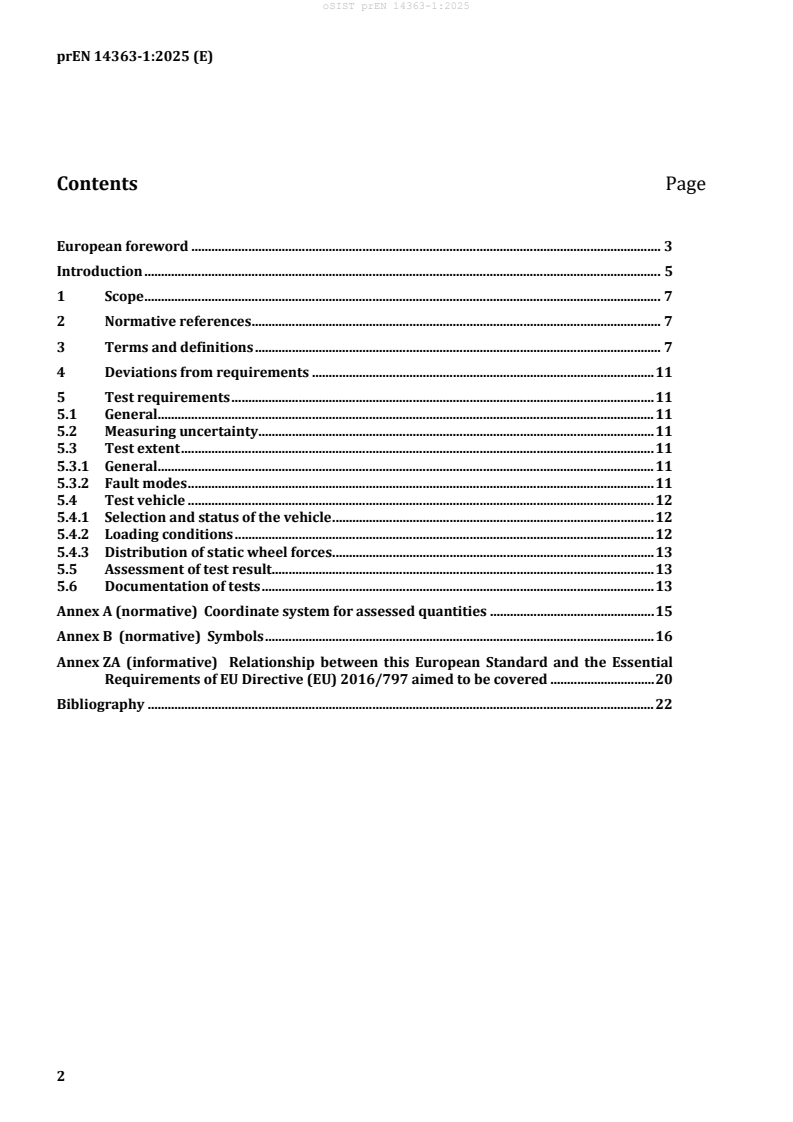
Contents Page
European foreword . 3
Introduction . 5
1 Scope . 7
2 Normative references . 7
3 Terms and definitions . 7
4 Deviations from requirements . 11
5 Test requirements . 11
5.1 General. 11
5.2 Measuring uncertainty . 11
5.3 Test extent . 11
5.3.1 General. 11
5.3.2 Fault modes . 11
5.4 Test vehicle . 12
5.4.1 Selection and status of the vehicle . 12
5.4.2 Loading conditions . 12
5.4.3 Distribution of static wheel forces . 13
5.5 Assessment of test result . 13
5.6 Documentation of tests . 13
Annex A (normative) Coordinate system for assessed quantities . 15
Annex B (normative) Symbols . 16
Annex ZA (informative) Relationship between this European Standard and the Essential
Requirements of EU Directive (EU) 2016/797 aimed to be covered . 20
Bibliography . 22
prEN 14363-1:2025 (E)
European foreword
This document (prEN 14363-1:2025) has been prepared by Technical Committee CEN/TC 256 “Railway
applications”, the secretariat of which is held by DIN.
This document is currently submitted to the CEN Enquiry.
This document together with prEN 14363-2:2025, prEN 14363-3:2025, prEN 14363-4:2025 and
prEN 14363 5:2025, will supersede EN 14363:2016+A2:2022.
The EN 14363 series “Railway applications — Testing and Simulation for the assessment of running
characteristics of rail vehicles operated on the heavy rail network” consists of the following parts:
— prEN 14363-1:2025, General gives general information for the assessment of the running
characteristics of railway vehicles;
— prEN 14363-2:2025, Safety against derailment on twisted track gives the testing rules and
explanations on how to assess railway vehicles for safety against derailment on twisted tracks;
— prEN 14363-3:2025, Stationary tests that are not obligatory on European level gives the testing rules
and explanations on how to assess and evaluate railway vehicles by tests not obligatory on a European
level;
— prEN 14363-4:2025, On-track testing gives the testing rules and explanation on how to assess railway
vehicles from a Running Behaviour point of view;
— prEN 14363-5:2025, Simulations/calculations gives the rules and explanations on how to validate
vehicle models, how to simulate or calculate using the same models, with the purpose of partly or fully
replacing testing with simulations and/or calculations;
— prCEN/TR 14363-6:2025, Technical Report providing background information to the EN 14363 series
of standards (under development).
The EN 14363 series includes the following significant technical changes with respect to
EN 14363:2016+A2:2022:
— the standard was fully restructured, from one standard to a series of standards consisting of five
parts;
— the term “acceptance” has been changed to “assessment” in title as well as in the entire series of
document’s main text and annexes;
— limit values and procedures for wagons and locomotives, nominal static vertical wheelset forces up
to 350 kN have been introduced;
— reference values have been introduced for track loading parameters B , B and Y ;
max qst max
— for validation of vehicle models per validation method 2, weighted standard deviations have been
introduced so that it is not necessary to have the same number of sections in each test zone;
— Table U.1 has been modified concerning the test extent of the simplified method for some parameter
and divided into prEN 14363-4:2025, Table J.1 and Table J.2;
prEN 14363-1:2025 (E)
— evaluation procedures and assessment criteria for Low Frequency Body Motion (LFBM) have been
developed, including definition of a separate test zone;
— calculation of roll moment compensation related to test method 2 for safety against derailment on
twisted tracks was modified;
— in test zone 1, tests only need to be executed up to a test speed of V ;
adm
— the reference to test under Longitudinal Compressive Forces (LCF) has been removed;
— the previous informative Annex I (now prEN 14363-4:2025, Annex B), when and how to position
instrumented wheelsets has been developed;
— dispensation rules for stationary tests for exempt from tests have been developed;
— vehicles with maximum admissible speed V ≤ 60 km/h and a P < = 250 kN was previously
adm F0
exempt from dynamic testing. An addition has been made in prEN 14363-4:2025, 4.1 that certain
functional tests for such vehicles are necessary;
— the definition of the safety factor (λ) has been modified to, in certain cases, be applicable only to sub-
systems of the vehicle, prEN 14363-5:2025, Annex J.2;
— prEN 14363-4:2025, Annex J (previously Annex U) has been changed from informative to normative;
— it was clarified that for validating a model for track forces even if not measured is allowed under
certain circumstances in prEN 14363-5:2025, 8.3.3.3.3.1 and 8.3.3.3.3.2.
This document has been prepared under a standardization request addressed to CEN by the European
Commission. The Standing Committee of the EFTA States subsequently approves these requests for its
Member States.
For the relationship with EU Legislation, see informative Annex ZA, which is an integral part of this
document.
prEN 14363-1:2025 (E)
Introduction
It is not necessary to require further assessment of vehicles which have been already assessed under the
conditions of previous standards in this field. Test results achieved under the conditions of the previous
standards remain valid and can be used for the extension of field of application of a vehicle or vehicle
design according to this series of documents.
Prior to the first issue of this standard, national and international procedures were applied for vehicle
approval, for example in Germany, the UK and by UIC. The underlying principles that were applied in
these earlier standards or leaflets are also incorporated in this series of documents. The fundamentals
have not been changed but the formulation of the requirements has been made consistent. Therefore, it
is considered that also vehicles that were previously approved utilizing these earlier requirements have
an equal status compared to vehicles that are approved according to this series of documents. This applies
to the infrastructure and operating conditions that were considered in the earlier approval. This includes
also a use as reference vehicle for extension of field of application.
Acceptable running characteristics of a railway vehicle (hereafter called vehicle) are essential for a safe
and economic operation of a heavy rail system (hereafter called system). They are related to:
— the vehicle;
— the operating conditions;
— the characteristics of the infrastructure (track layout, track quality and track design) and;
— the contact conditions of the wheel/rail interface.
The objective of this series of documents is hence to provide common European rules for the assessment
of vehicles in order to facilitate safe and economic operation. Therefore, it was necessary to quantify the
vehicle's performance under known representative conditions of operation and infrastructure to make
the assessment results as reproducible as possible.
The vehicle performance is assessed in two stages. Usually in the first stage the basic characteristics and
low speed behaviour are investigated before first runs on the line under controlled operating conditions.
In the second stage the running behaviour is assessed. The assessment of a vehicle can be performed
either by physical testing, numerical simulation, calculation or comparison with a known solution
(dispensation). Details about the requirements relating to the choice of the appropriate assessment
method are given in this series of documents.
A vehicle accepted according to the requirements of this series of documents is able to be operated on all
standard gauge tracks complying with EN 13803:2017, in regard to the requirements of this series of
documents.
NOTE For guidance, see EN 13803:2017, Clause N.2.
The establishment of this series of documents was based on existing rules, practices and procedures. The
following principles were applied:
— the system requires comprehensive technical rules in order to ensure an acceptable interaction of
vehicle and track;
— the performance of new vehicles has to be evaluated and assessed before putting them into service;
— it is of particular importance that the existing level of safety and reliability is not compromised even
when changes in design or operating conditions are demanded, e.g. by the introduction of higher
speeds, higher vertical wheel forces, modification of the suspension, etc.;
prEN 14363-1:2025 (E)
— it is possible to demonstrate compliance with the requirements of this series of documents by
comparison of relevant parameters or by simulation if changes are made to the design or to the
operating conditions;
— it is possible to demonstrate the compliance in spite of missing target test conditions by other means
than those provided in this series of documents;
— experience over many years has demonstrated that vehicles complying with this series of documents
can be operated safely on infrastructure with conditions more severe than the target test conditions,
if the current general operating rules are applied. As an example, it is generally current practice to
restrict cant deficiency in curves below a certain radius. It may be necessary to adapt these operating
rules, if a deterioration of the infrastructure conditions is observed. These operating rules are defined
on a national basis;
— there are margins included in the specified limit values and the statistical evaluation. They cannot be
quantified, but they explain why vehicles can also be operated at full speed and cant deficiency in
many cases outside of the target test conditions;
— as the combination of all the target test conditions described is not always achievable, the compliance
against the missing target test conditions can be demonstrated by other means.
prEN 14363-1:2025 (E)
1 Scope
This document applies to all railway vehicles, which are operated on the heavy rail network with
standard track gauge 1 435°mm and nominal static vertical wheelset forces up to 350 kN.
This document may also be applicable (partly or in full) to:
— rail systems with different track layout, e.g. urban rail systems and/or;
— rail systems with other than 1 435 mm nominal track gauge and/or;
— non-public rail networks and vehicles, e.g. mine rail systems.
NOTE For rail systems other than 1 435 mm track gauge or urban rail systems, the related post analysis, limit
values and test conditions could be different. They are specified nationally taking into account track design and
operating conditions.
This document contains the common parts of the series of documents as the relationship to other
standards, handling of deviations from requirements and general test requirements. These specifications
are necessary for the application of the other parts of this series of documents.
2 Normative references
The following documents are referred to in the text in such a way that some or all of their content
constitutes requirements of this document. For dated references, only the edition cited applies. For
undated references, the latest edition of the referenced document (including any amendments) applies.
EN 17343:2023, Railway applications - General terms and definitions
prEN 14363-4:2025 , Railway applications — Testing and Simulation for the assessment of running
characteristics of rail vehicles operated on the heavy rail network — Part 4: On-track testing
3 Terms and definitions
For the purposes of this document, the terms and definitions given in EN 17343:2023 and the following
apply.
ISO and IEC maintain terminology databases for use in standardization at the following addresses:
— ISO Online browsing platform: available at https://www.iso.org/obp/
— IEC Electropedia: available at https://www.electropedia.org/
3.1
target test conditions
conditions specified in this standard for the performance of on-track tests
3.2
bogie yaw resistance
torque around the vertical axis between bogie and vehicle body required to rotate a bogie while
supporting a vehicle body
At draft stage.
prEN 14363-1:2025 (E)
3.3
unsprung mass
mass of a wheelset including all components that are attached to it and which are not suspended by the
primary suspension or the wheelset guidance, e. g. brake discs, gear wheels, bearings, axle boxes plus half
of the primary suspension mass, half the mass of suspension links and if applicable the unsuspended part
of the traction equipment
Note 1 to entry: Sometimes it will be necessary to regard different wheelsets of a running gear separately.
Note 2 to entry: Sometimes it will be necessary to include or exclude parts which are separately suspended with
regard to the problem in question, e.g. magnetic brakes.
3.4
primary suspended mass
mass between primary and secondary suspension of a running gear with two vertical suspension stages,
i. e. the bogie frame together with all components attached to it, e. g. braking equipment, antennas, pipes
and cables plus half of the primary and secondary suspension mass, half the mass of suspension links and
traction rods and if applicable the primary suspended part of the traction equipment
Note 1 to entry: Sometimes it will be necessary to include or exclude parts which are separately suspended with
regard to the problem in question, e.g. magnetic brakes.
3.5
secondary suspended mass
mass supported by the secondary suspension of a running gear, i. e. the mass of the relevant part of a
vehicle body with all components attached to it, e. g. upper bolster or adapter beam plus half of the
secondary suspension mass, half the mass of suspension links and traction rods and if applicable the
secondary suspended part of the traction equipment
3.6
bogie mass
mass of the bogie which rotates against the vehicle body around the vertical axis during the entrance into
curves
Note 1 to entry: In most cases this mass is similar to the sum of the unsprung masses and the primary suspended
mass of a running gear with two or more wheelsets.
3.7
yaw moment of inertia of whole running gear
moment of inertia of the mass of the running gear which rotates against the vehicle body around the
vertical axis during the entrance into curves
3.8
displacement characteristics
combination of lateral and roll displacements of a vehicle when subjected to cant excess or deficiency
3.9
running behaviour
behaviour of a vehicle or running gear with regard to the interaction between vehicle and track covering
the specific terms running safety, track loading and ride characteristics
prEN 14363-1:2025 (E)
3.10
running characteristics
characteristics of a vehicle or running gear with regard to running behaviour, safety against derailment
in twisted track and under longitudinal compressive forces in S-shaped curves, torsional coefficient of a
vehicle body, displacement characteristics, loading of the diverging branch of a switch and running safety
in curved crossings
3.11
equivalent conicity
tan γe
tangent of the cone angle of a wheelset with coned wheels whose lateral movement has the same
kinematic wavelength as the given wheelset
[SOURCE: EN 15302:2021, definition 3.1]
3.12
radial steering index
q
E
ratio between curve radius RE negotiable without longitudinal creepage and the actual curve radius R of
the track section and it describes the radial steering capability of a free wheelset in a track section
[SOURCE: EN 15302:2021, definition 3.3]
3.13
rolling radii coefficient
ρ
E
relationship describing the capability of a wheel-rail contact geometry to provide the rolling radii
difference needed for a wheelset to negotiate an actual curve without longitudinal creepage and flange
contact
[SOURCE: EN 15302:2021, definition 3.4]
Note 1 to entry: This parameter is related to the radial steering index.
Note 2 to entry: Alternative presentation of the radial steering index.
3.14
operation envelope
combination of speed and cant deficiency for which the vehicle is intended to be operated
Note 1 to entry: See prEN 14363-4:2025, informative Annex A.
3.15
conventional technology vehicle
vehicles which are operated under normal operating conditions and correspond completely or in those
construction parts which are relevant to the running behaviour to the proven state of the art
------------------
...