

EN 12268:2014
(Main)Food processing machinery - Band saw machines - Safety and hygiene requirements
- Abstract
1.1 General
This European Standard specifies requirements for the design and manufacturing of band saw machines as described in 1.2 (see Figures 1 to 5).
The machines covered by this European Standard are used to cut:
- bones;
- fresh or deep frozen meat with or without bones ;
- fresh or deep frozen fish, natural or in fillets ;
- deep frozen block food products;
- fresh or deep frozen vegetables;
- other products such as pork fat or similar products.
The band saw machines covered by this European Standard do not include band saw machines for processing wood and similar materials which are covered by the EN 1807 series.
Band saw machines for domestic use are not included in this European Standard.
This document is not applicable to band saw machines which were manufactured before its date of publication as EN.
This European Standard deals with all significant hazards, hazardous situations and events relevant to band saw machines, when they are used as intended and under conditions of misuse which are reasonably foreseeable by the manufacturer (see Clause 4).
This European Standard deals with the hazards which can arise during all the lifetime of the machine, including the phases of transport, assembly, commissioning, operation, cleaning, use, maintenance, decommissioning, dismantling, disabling and scrapping of the machine.
This European Standard covers the following types of machines:
- band saw machines designed as table-top machines with and without base;
- band saw machines designed as floor-type machines with and without castors.
1.2 Description of various machine types
1.2.1 General
Band saw machines consist of a machine casing, a fixed feed table or a sliding feed table, a roller conveyor or conveyor belt, a product pusher, a height-adjustable protective rail, a top and a bottom wheel, a saw blade, an upper and lower blade guide, a blade tensioning device, a drive and electrical components, depending on machine type. This standard does not deal with machinery with automatic loading/unloading systems (e.g. automatic conveyors).
On floor-type band saw machines, the product to be cut is placed by hand onto the fixed feed table or sliding feed table and pushed against the cutting zone of the saw blade by means of the product pusher or the rear table wall on the sliding feed table or by means of the roller conveyor or conveyor belt and sawed.
1.2.2 Type A
Band saw machine with a fixed feed table and a non-detachable, movable product pusher:
Maximum cutting height SH ≤ 250 mm.
(...)
1.2.3 Type B
Band saw machine with a fixed feed table, a protective rail and a maximum cutting height < 420 mm.
1.2.4 Type C
Band saw machine with a sliding feed table, a protective rail and a maximum cutting height ≤ 420 mm.
(...)
1.2.5 Type D
Band saw machine with non-automatic feed and removal unit (e.g. roller conveyor, conveyor belt); maximum cutting height SH ≤ 550 mm.
(...)
- Status
- Published
- Publication Date
- 04-Nov-2014
- Withdrawal Date
- 30-May-2015
- Technical Committee
- CEN/TC 153 - Food processing machinery - Safety and hygiene specifications
- Drafting Committee
- CEN/TC 153/WG 2 - Meat processing machinery
- Current Stage
- 9060 - Closure of 2 Year Review Enquiry - Review Enquiry
- Start Date
- 03-Jun-2020
- Completion Date
- 03-Jun-2020
- Directive
- 2006/42/EC - Directive 2006/42/EC of the European Parliament and of the Council of 17 May 2006 on machinery, and amending Directive 95/16/EC (recast)OJ Ref: C, C 14 OJ Date: 15-Jan-2016

Overview
EN 12268:2014 - "Food processing machinery - Band saw machines - Safety and hygiene requirements" is a CEN (European) standard that specifies design, manufacturing and safety/hygiene requirements for commercial band saw machines used in the food industry. It covers table-top and floor-type band saw machines used to cut bones, fresh or deep-frozen meat and fish, frozen block products, vegetables and similar food products. The standard excludes machines for wood processing, domestic band saws and machines manufactured before its publication. EN 12268:2014 addresses hazards across the machine life‑cycle, including transport, assembly, operation, cleaning, maintenance and scrapping.
Key Topics
- Scope and machine types: Defines Types A–D (e.g., Type A: fixed feed table with non‑detachable pusher, SH ≤ 250 mm; Type B: fixed table/protective rail, SH < 420 mm; Type C: sliding feed table, SH ≤ 420 mm; Type D: non‑automatic feed/removal units, SH ≤ 550 mm).
- Hazard zones and mechanical safety: Requirements by danger zones (saw blade outside cutting zone, cutting zone protection, wheel areas, sliding feed table, drive system).
- Electrical safety: ON/OFF switching, stopping functions, protection against water ingress, electromagnetic considerations.
- Hygiene and cleanability: Design principles and materials to ensure food‑area cleanability, splash and non‑food area requirements, surface finish and cleaning procedures.
- Ergonomics and noise: Ergonomic design principles and noise reduction measures; Annex A provides a noise test code.
- Verification and documentation: Test and verification procedures, marking and instruction handbook requirements (including operator training).
- Annexes: Noise test code, cleanability design guidance, examples of work‑aid tools, and informative relationship to EU Machinery Directive 2006/42/EC (Annex ZA).
Applications and Who Uses It
EN 12268:2014 is used by:
- Manufacturers and machine designers to design compliant band saw machines for the food sector.
- Safety engineers and compliance officers for conformity assessment against EU Directive 2006/42/EC.
- Food processors and plant managers selecting equipment that meets hygiene and safety expectations.
- Maintenance teams and trainers to develop safe work procedures and operator instructions.
- Notified bodies and auditors verifying conformity and performing risk assessments.
Practical benefits include reduced contamination risk, improved operator safety, clearer maintenance and cleaning practices, and documented conformity for market access in Europe.
Related Standards
- EN ISO 12100 (machine risk assessment and safety principles)
- EN 614‑1 and EN 1005 series (ergonomics and human factors)
- Relevant EN electrical and EMC standards and national adaptations of EN 12268:2014 (implemented by CEN members)
Keywords: EN 12268:2014, band saw machines, food processing machinery, safety and hygiene requirements, CEN standard, cleanability, hazard zones, noise emission, machine design.
Relations
- Effective Date
- 08-Jun-2022
- Effective Date
- 25-Aug-2026
- Effective Date
- 18-Mar-2026
- Effective Date
- 09-Feb-2026
- Effective Date
- 28-Jan-2026
- Effective Date
- 28-Jan-2026
- Effective Date
- 28-Jan-2026
- Effective Date
- 28-Jan-2026
- Effective Date
- 28-Jan-2026
- Effective Date
- 28-Jan-2026
- Effective Date
- 28-Jan-2026
- Effective Date
- 28-Jan-2026
- Effective Date
- 28-Jan-2026
- Effective Date
- 28-Jan-2026
- Effective Date
- 28-Jan-2026
Get Certified
Connect with accredited certification bodies for this standard

BSI Group
BSI (British Standards Institution) is the business standards company that helps organizations make excellence a habit.

Bureau Veritas
Bureau Veritas is a world leader in laboratory testing, inspection and certification services.

DNV
DNV is an independent assurance and risk management provider.
Sponsored listings
Frequently Asked Questions
EN 12268:2014 is a standard published by the European Committee for Standardization (CEN). Its full title is "Food processing machinery - Band saw machines - Safety and hygiene requirements". This standard covers: 1.1 General This European Standard specifies requirements for the design and manufacturing of band saw machines as described in 1.2 (see Figures 1 to 5). The machines covered by this European Standard are used to cut: - bones; - fresh or deep frozen meat with or without bones ; - fresh or deep frozen fish, natural or in fillets ; - deep frozen block food products; - fresh or deep frozen vegetables; - other products such as pork fat or similar products. The band saw machines covered by this European Standard do not include band saw machines for processing wood and similar materials which are covered by the EN 1807 series. Band saw machines for domestic use are not included in this European Standard. This document is not applicable to band saw machines which were manufactured before its date of publication as EN. This European Standard deals with all significant hazards, hazardous situations and events relevant to band saw machines, when they are used as intended and under conditions of misuse which are reasonably foreseeable by the manufacturer (see Clause 4). This European Standard deals with the hazards which can arise during all the lifetime of the machine, including the phases of transport, assembly, commissioning, operation, cleaning, use, maintenance, decommissioning, dismantling, disabling and scrapping of the machine. This European Standard covers the following types of machines: - band saw machines designed as table-top machines with and without base; - band saw machines designed as floor-type machines with and without castors. 1.2 Description of various machine types 1.2.1 General Band saw machines consist of a machine casing, a fixed feed table or a sliding feed table, a roller conveyor or conveyor belt, a product pusher, a height-adjustable protective rail, a top and a bottom wheel, a saw blade, an upper and lower blade guide, a blade tensioning device, a drive and electrical components, depending on machine type. This standard does not deal with machinery with automatic loading/unloading systems (e.g. automatic conveyors). On floor-type band saw machines, the product to be cut is placed by hand onto the fixed feed table or sliding feed table and pushed against the cutting zone of the saw blade by means of the product pusher or the rear table wall on the sliding feed table or by means of the roller conveyor or conveyor belt and sawed. 1.2.2 Type A Band saw machine with a fixed feed table and a non-detachable, movable product pusher: Maximum cutting height SH ≤ 250 mm. (...) 1.2.3 Type B Band saw machine with a fixed feed table, a protective rail and a maximum cutting height < 420 mm. 1.2.4 Type C Band saw machine with a sliding feed table, a protective rail and a maximum cutting height ≤ 420 mm. (...) 1.2.5 Type D Band saw machine with non-automatic feed and removal unit (e.g. roller conveyor, conveyor belt); maximum cutting height SH ≤ 550 mm. (...)
1.1 General This European Standard specifies requirements for the design and manufacturing of band saw machines as described in 1.2 (see Figures 1 to 5). The machines covered by this European Standard are used to cut: - bones; - fresh or deep frozen meat with or without bones ; - fresh or deep frozen fish, natural or in fillets ; - deep frozen block food products; - fresh or deep frozen vegetables; - other products such as pork fat or similar products. The band saw machines covered by this European Standard do not include band saw machines for processing wood and similar materials which are covered by the EN 1807 series. Band saw machines for domestic use are not included in this European Standard. This document is not applicable to band saw machines which were manufactured before its date of publication as EN. This European Standard deals with all significant hazards, hazardous situations and events relevant to band saw machines, when they are used as intended and under conditions of misuse which are reasonably foreseeable by the manufacturer (see Clause 4). This European Standard deals with the hazards which can arise during all the lifetime of the machine, including the phases of transport, assembly, commissioning, operation, cleaning, use, maintenance, decommissioning, dismantling, disabling and scrapping of the machine. This European Standard covers the following types of machines: - band saw machines designed as table-top machines with and without base; - band saw machines designed as floor-type machines with and without castors. 1.2 Description of various machine types 1.2.1 General Band saw machines consist of a machine casing, a fixed feed table or a sliding feed table, a roller conveyor or conveyor belt, a product pusher, a height-adjustable protective rail, a top and a bottom wheel, a saw blade, an upper and lower blade guide, a blade tensioning device, a drive and electrical components, depending on machine type. This standard does not deal with machinery with automatic loading/unloading systems (e.g. automatic conveyors). On floor-type band saw machines, the product to be cut is placed by hand onto the fixed feed table or sliding feed table and pushed against the cutting zone of the saw blade by means of the product pusher or the rear table wall on the sliding feed table or by means of the roller conveyor or conveyor belt and sawed. 1.2.2 Type A Band saw machine with a fixed feed table and a non-detachable, movable product pusher: Maximum cutting height SH ≤ 250 mm. (...) 1.2.3 Type B Band saw machine with a fixed feed table, a protective rail and a maximum cutting height < 420 mm. 1.2.4 Type C Band saw machine with a sliding feed table, a protective rail and a maximum cutting height ≤ 420 mm. (...) 1.2.5 Type D Band saw machine with non-automatic feed and removal unit (e.g. roller conveyor, conveyor belt); maximum cutting height SH ≤ 550 mm. (...)
EN 12268:2014 is classified under the following ICS (International Classification for Standards) categories: 67.260 - Plants and equipment for the food industry. The ICS classification helps identify the subject area and facilitates finding related standards.
EN 12268:2014 has the following relationships with other standards: It is inter standard links to EN 12268:2003+A1:2010, ISO 8598:1996, EN ISO 3744:2026, EN 60529:1991, EN 2286:1989, EN ISO 13849-1:2008, EN 1005-3:2002+A1:2008, EN ISO 11688-1:2009, EN ISO 4871:2009, EN 1005-1:2001+A1:2008, EN ISO 14119:2013, EN ISO 12100:2010, EN ISO 11204:2010, EN 1005-2:2003+A1:2008, EN 614-1:2006+A1:2009. Understanding these relationships helps ensure you are using the most current and applicable version of the standard.
EN 12268:2014 is associated with the following European legislation: EU Directives/Regulations: 2006/42/EC; Standardization Mandates: M/396. When a standard is cited in the Official Journal of the European Union, products manufactured in conformity with it benefit from a presumption of conformity with the essential requirements of the corresponding EU directive or regulation.
EN 12268:2014 is available in PDF format for immediate download after purchase. The document can be added to your cart and obtained through the secure checkout process. Digital delivery ensures instant access to the complete standard document.
Standards Content (Sample)
2003-01.Slovenski inštitut za standardizacijo. Razmnoževanje celote ali delov tega standarda ni dovoljeno.]DKWHYHNahrungsmittelmaschinen - Bandsägemaschinen - Sicherheits- und HygieneanforderungenMachines pour les produits alimentaires - Scies à ruban - Prescriptions relatives à la sécurité et à l'hygiéneFood processing machinery - Band saw machines - Safety and hygiene requirements67.260Tovarne in oprema za živilsko industrijoPlants and equipment for the food industry25.080.60Strojne žageSawing machinesICS:Ta slovenski standard je istoveten z:EN 12268:2014SIST EN 12268:2015en,fr,de01-januar-2015SIST EN 12268:2015SLOVENSKI
STANDARDSIST EN 12268:2003+A1:20101DGRPHãþD
EUROPEAN STANDARD NORME EUROPÉENNE EUROPÄISCHE NORM
EN 12268
November 2014 ICS 67.260 Supersedes EN 12268:2003+A1:2010English Version
Food processing machinery - Band saw machines - Safety and hygiene requirements
Machines pour les produits alimentaires - Scies à ruban - Prescriptions relatives à la sécurité et à l'hygiéne
Nahrungsmittelmaschinen - Bandsägemaschinen - Sicherheits- und Hygieneanforderungen This European Standard was approved by CEN on 13 September 2014.
CEN members are bound to comply with the CEN/CENELEC Internal Regulations which stipulate the conditions for giving this European Standard the status of a national standard without any alteration. Up-to-date lists and bibliographical references concerning such national standards may be obtained on application to the CEN-CENELEC Management Centre or to any CEN member.
This European Standard exists in three official versions (English, French, German). A version in any other language made by translation under the responsibility of a CEN member into its own language and notified to the CEN-CENELEC Management Centre has the same status as the official versions.
CEN members are the national standards bodies of Austria, Belgium, Bulgaria, Croatia, Cyprus, Czech Republic, Denmark, Estonia, Finland, Former Yugoslav Republic of Macedonia, France, Germany, Greece, Hungary, Iceland, Ireland, Italy, Latvia, Lithuania, Luxembourg, Malta, Netherlands, Norway, Poland, Portugal, Romania, Slovakia, Slovenia, Spain, Sweden, Switzerland, Turkey and United Kingdom.
EUROPEAN COMMITTEE FOR STANDARDIZATION
COMITÉ EUROPÉEN DE NORMALISATION EUROPÄISCHES KOMITEE FÜR NORMUNG
CEN-CENELEC Management Centre:
Avenue Marnix 17,
B-1000 Brussels © 2014 CEN All rights of exploitation in any form and by any means reserved worldwide for CEN national Members. Ref. No. EN 12268:2014 ESIST EN 12268:2015
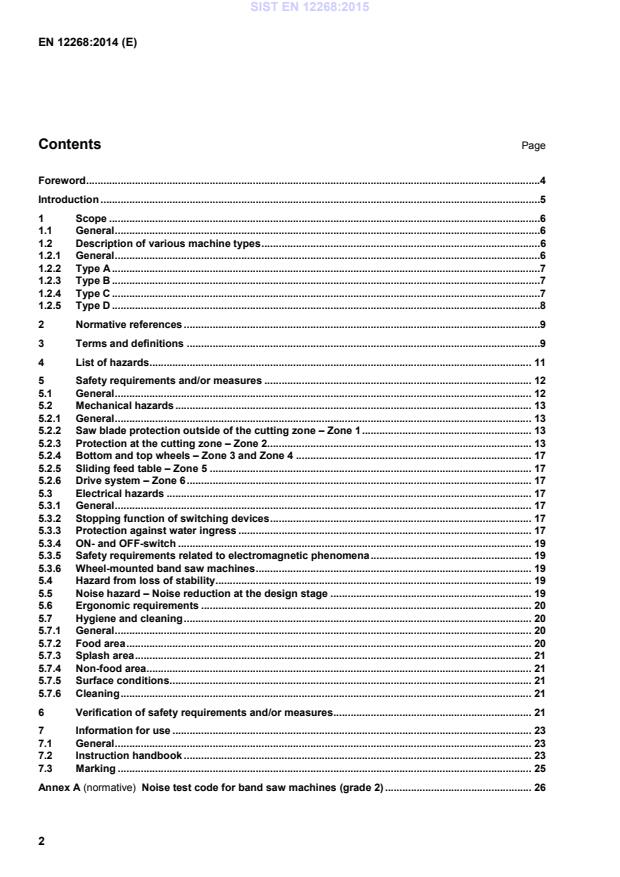
Noise test code for band saw machines (grade 2) . 26 SIST EN 12268:2015
Design principles to ensure cleanability of band saw machines . 28 B.1 Definitions . 28 B.2 Materials of construction . 29 B.3 Design . 29 Annex C (informative)
Examples of work aid tools having a protective function . 34 C.1 General . 34 C.2 Example of a pusher to saw small parts (chicken legs, wings…) . 34 C.3 Example of a device for cutting pork knuckles, shoulders and chest bones… . 35 C.4 Example of a device for cutting of feet, long products… . 36 C.5 Example of a device for cutting frozen plates . 37 C.6 Example of a pusher that is not an integral part of the machine and that slides in the table groove . 38 C.7 Example of a device for slicing parts . 39 Annex ZA (informative)
Relationship between this European Standard and the Essential Requirements of EU Directive 2006/42/EC . 40 Bibliography . 41
Key Key 1 ON-/OFF-switch 1 ON-/OFF-switch 2 product pusher 2 product pusher 3 portioning plate 3 portioning plate 4 table 4 base Figure 1 — Band saw machine type A with product pusher – Location: table top Figure 2 — Band saw machine type A with product pusher – Location: base
1.2.3 Type B Band saw machine with a fixed feed table, a protective rail and a maximum cutting height < 420 mm. 1.2.4 Type C Band saw machine with a sliding feed table, a protective rail and a maximum cutting height ≤ 420 mm. SIST EN 12268:2015
Key Key 1 ON-/OFF-switch 1 ON-/OFF-switch 2 door 2 door 3 protective rail 3 protective rail 4 fixed feed table 4 finger protection bar 5 machine rack 5 sliding feed table
6 machine rack Figure 3 — Band saw machine type B with fixed feed table and protective rail Figure 4 — Band saw machine type C with sliding feed table and protective rail 1.2.5 Type D Band saw machine with non-automatic feed and removal unit (e.g. roller conveyor, conveyor belt); maximum cutting height SH ≤ 550 mm.
Key 1 roller conveyor or transport conveyor Figure 5 — Band saw machine type D with feed and removal unit SIST EN 12268:2015
cutting height thickness of product that can be processed by the machines 3.11 table rear wall device on the sliding feed table to hold the product and to push it towards the cutting zone 3.12 top wheel pulley wheel for reversing the saw blade above the table 3.13 cutting line system for automatic product processing 3.14 fixed feed table table surface for manual product supply 3.15 sliding feed table movable table surface with table rear wall for product supply SIST EN 12268:2015
Key 1 zone 1 2 zone 2 3 zone 3 4 zone 4 5 zone 5 6 zone 6 7 zone 7 Figure 6 — Band saw machine – Danger zones 5 Safety requirements and/or measures 5.1 General Band-saw machines shall comply with the safety requirements and/or protective measures of this clause. In addition, they shall be designed according to the principles of EN ISO 12100 for hazards relevant but not significant, which are not dealt with by this document. Where the means of reducing the risk is by the physical arrangement or positioning of the installed band-saw machine, the manufacturer shall include in the Information for use a reference to the reduction means to be provided, and to any limiting value of the requirement, and, if appropriate, to the means of verification. The safety related parts of the control system shall present at least a performance level “c” in accordance with EN ISO 13849-1:2008. For specific intended use and/or applications some examples for work aid tools with a protective function are given in Annex C. SIST EN 12268:2015
Key 1 saw blade A1 distance between the product pusher in its protective position and the non-detachable feed table Figure 7 — Schematic design of a product pusher 5.2.3.2 Type B Access to that portion of the cutting zone of the saw blade which is not used for cutting shall be prevented. This can be achieved e.g. by the following measures: A non-detachable blade guide and a height adjustable protective rail shall be provided (see Figures 3, 4 and 8). A maximum distance of 6 mm shall be installed, either between product pusher and table or between blade guide and table. It shall be self-blocking or capable of being blocked in position. When unblocking the height adjustable protective rail, an abrupt lowering to < 25 mm shall be avoided. The vertical force needed to move the guard shall not exceed 20 N ± 2 N. SIST EN 12268:2015
Key 1 saw blade Figure 8 — Schematic design of a protective rail 5.2.3.3 Type C The sliding feed table shall be provided with a system that ensures the safe handling of the product so that access to the saw blade is prevented by a table rear wall with a finger protection bar. The height of the table rear wall shall be > 60 mm, and the finger protection bar shall be > 100 mm high and > 50 mm wide. Tapering towards the top to 25 mm is admissible. The finger protection bar shall overlap the saw blade in the position of maximum forward travel of the sliding feed table by > 10 mm (see Figure 9 and Figure 10). The blade shall be protected on 2 faces and in any case, it shall be possible to adjust the protective rail to a distance ≤ 6 mm from the table. SIST EN 12268:2015
Key Key 1 saw blade 1 saw blade 2 table rear wall 2 table rear wall 3 finger protection bar (in maximum forward position) 3 finger protection bar (in maximum forward position) Figure 9 — Band saw machine type C with protective rail and sliding feed table
Figure 10 — Schematic design of a finger protection bar When the sliding feed table is locked or tilted down, it shall be possible to establish a continuous table surface or this shall be present. In the case of a locked sliding feed table, it shall be possible to tilt down the table rear wall with the finger protection bar. If the finger protection bar is tilted down, the sliding feed table shall be prevented from being moved. A horizontal adjustable portioning plate of a height ≥ 60 mm shall be provided. The portioning plate may be tiltable and detachable. A last slice device of a height ≥ 150 mm shall be provided. The last slice device may be provided with spikes on the side facing the saw blade. The last slice device may be removable. A removable product pusher may be provided. 5.2.3.4 Type D For requirements relating to the protective rail, see 5.2.3.2. A product pusher and a portioning plate are not required. SIST EN 12268:2015
...