

EN 16228-1:2014/FprA1
(Amendment)Drilling and foundation equipment - Safety - Part 1: Common requirements
- Abstract
This European Standard specifies the common safety requirements for drilling and foundation equipment.
Part 1 of this European Standard deals with the significant hazards common to drilling and foundation equipment (see Annex A), when they are used as intended and under the conditions of misuse which are reasonably foreseeable by the manufacturer associated with the whole life time of the machine (transport, assembly, dismantling, equipment in service and out of service, maintenance, moving on site, storage, disabling and scrapping).
NOTE 1 The requirements specified in this part of the standard are common to two or more families of drilling and foundation equipment.
This document gives safety requirements for all types of drilling and foundation equipment and is intended to be used in conjunction with one of parts 2 to 7. These machine specific parts do not repeat the requirements from part 1 but supplement or modify the requirements for the type of drilling and foundation equipment in question.
For multipurpose machinery, the parts of the standard that cover the specific functions and applications are used, e.g. a drilling machine also used as a piling machine will use the relevant requirements of EN 16228 parts 1, 2, and 4.
The following machines are excluded from the scope of this standard:
- tunnelling machines, unshielded tunnel boring machines and rodless shaft boring machines for rock according to prEN 16191;
- raise boring machines;
- drill rigs used in oil and gas industry.
NOTE 2 Specific requirements for offshore applications are not covered by this European Standard.
Where a drilling or foundation equipment of fixed configuration that is not intended to be separated is assembled using a carrier based on earth-moving equipment, agricultural equipment, or a crane, then the completed assembly will conform to the requirements specified in this drilling and foundation equipment standard.
Drilling and foundation equipment within the scope of EN 16228 parts 1 to 6 may include interchangeable auxiliary equipment within the scope of EN 16228 part 7, either as an integral part of its construction or as interchangeably fitted equipment.
If drilling and foundation equipment is intended to be used in a potentially explosive atmosphere, additional requirements will need to be met which are not covered by this standard.
Modification to Clause 1:
In the fifth paragraph, last sentence delete the final punctuation of the third item and add the following text: ";
- specialized mining machinery and equipment for opencast mining (e.g. rock drill rigs, blast hole drills, jumbos) (under the scope of CEN/TC 196);
- all underground mining machinery and equipment for the extraction of solid mineral substances (e. g. rock drill rigs, raise boring machines, shaft boring machines, mining auger boring machines) as well as machinery and equipment for underground mine development (under the scope of CEN/TC 196);
- core drilling machines on stand (covered by EN 12348);
- hand-held machines (in particular machines covered by ISO 11148-5).".
In the sixth paragraph, first sentence, replace "will conform to the requirements specified in this drilling and foundation equipment" with "is covered by this".
Last paragraph, replace with the following text:
"If drilling and foundation equipment is intended to be used in a potentially explosive atmosphere, or in case of lightning risk, additional requirements will need to be met which are not covered by this document.
This document is not applicable to drilling and foundation equipment manufactured before the date of its publication.".
- Status
- Not Published
- Publication Date
- 24-Apr-2022
- Withdrawal Date
- 24-Jul-2022
- Technical Committee
- CEN/TC 151 - Construction equipment and building material machines - Safety
- Drafting Committee
- CEN/TC 151/WG 3 - Drilling equipment - Safety
- Current Stage
- 5060 - Closure of Vote - Formal Approval
- Start Date
- 21-Oct-2021
- Completion Date
- 21-Oct-2021

Overview
EN 16228-1:2014/FprA1 is a European standard developed by CEN that establishes common safety requirements for drilling and foundation equipment. This standard addresses significant hazards that may arise during the entire life cycle of these machines, including transport, assembly, operation, maintenance, dismantling, and scrapping. It ensures manufacturers foresee possible misuse and integrate necessary safety measures accordingly, promoting safer working environments in construction and geotechnical operations.
This document represents Part 1 of the EN 16228 series and specifies general safety principles applicable across various families of drilling and foundation equipment. It is intended to be used in conjunction with Parts 2 to 7, which focus on specific types and functions of drilling machinery. Notably, this standard excludes certain specialized equipment such as tunneling machines, raise boring machines, and rigs for oil and gas industries. Offshore applications and use in explosive atmospheres require additional safety considerations not covered here.
Key Topics
- Scope and Application: Covers common safety hazards associated with drilling and foundation equipment used as intended, including predictable misuse during their life cycle.
- Hazard Identification: Extensive list of mechanical, electrical, thermal, noise, and vibration hazards relevant to drilling equipment.
- Safety Requirements: Specifications for structural integrity, electrical safety, hydraulic systems, ergonomics, control systems, and protective devices.
- Operator and Assistant Safety: Definitions and requirements concerning operators and assistant operators, noting exposure to moving parts and safety protocols.
- Tool and Equipment Handling: Guidelines for mechanized and manual tool handling systems to minimize risks during operation.
- Electromagnetic Compatibility (EMC): Compliance with EMC standards to ensure operational stability around electrical interference.
- Sensitive Protective Devices: Use of advanced safety systems such as TAG based systems (e.g., RFID or industrial radar) to detect personnel proximity and reduce accidents.
- Verification and Testing: Methods for confirming compliance with safety requirements throughout the equipment lifecycle.
- Environmental Considerations: Addressing noise reduction, dust control, and exhaust gas handling in equipment design.
Applications
EN 16228-1:2014/FprA1 is critical for manufacturers, safety engineers, and regulatory bodies involved in:
- Construction Equipment Safety: Ensuring safe design and use of drilling rigs and foundation machines on construction sites.
- Equipment Lifecycle Management: Encouraging safe transport, assembly, operation, maintenance, and decommissioning practices.
- Interdisciplinary Machinery Use: Applicable for multi-purpose machinery combining drilling with piling or other foundation-related operations.
- Safety System Integration: Specification of ergonomics and control interface design for operators and assistants, improving human-machine interaction.
- Site Risk Management: Mitigating hazards related to mechanical, electrical, thermal, noise, and vibration by following standardized requirements.
- Compliance and Certification: Supporting manufacturers in meeting EU directives and harmonized norms for safety compliance across European markets.
This standard also supports the inclusion of interchangeable auxiliary equipment covered in Part 7, facilitating modular and flexible foundation machinery design.
Related Standards
To fully implement safety practices for drilling and foundation equipment, EN 16228-1 is used in conjunction with:
- EN 16228 Parts 2 to 7: Specific requirements for different types of drilling equipment and tasks.
- EN ISO 14120:2015: Safety of machinery - guards and protective devices.
- EN 614-1:2006+A1:2009: Ergonomic design principles.
- EN 894-3:2000+A1:2008: Ergonomic requirements for control actuators.
- EN IEC 61000 series: Electromagnetic compatibility standards for industrial machinery.
- EN 12348: Standards covering core drilling machines on stands.
- ISO 11148-5: Hand-held power tools safety.
- prEN 16191: Tunnelling and rodless shaft boring machines (excluded from EN 16228 scope).
- Other EU directives related to machinery safety and environmental compliance.
These related standards and guidelines enhance the comprehensive safety framework required for drilling and foundation equipment, ensuring robust protection of personnel and machinery in line with modern industrial safety demands.
Keywords: EN 16228-1, drilling equipment safety, foundation machinery standards, construction equipment safety, mechanical hazards, electrical hazards, ergonomic design, TAG based safety system, drilling rig safety, CEN standards, machinery safety compliance, hydraulic system safety, electromagnetic compatibility, equipment risk management.
Relations
- Merged Into
EN 16228-1:2014+A1:2021 - Drilling and foundation equipment - Safety - Part 1: Common requirements - Effective Date
- 18-Jan-2023
- Effective Date
- 09-Nov-2016
Get Certified
Connect with accredited certification bodies for this standard

Zavod za gradbeništvo Slovenije (ZAG) - Inšpekcija
ZAG inspection body for construction products, structures, and materials.
Sponsored listings
Frequently Asked Questions
EN 16228-1:2014/FprA1 is a draft published by the European Committee for Standardization (CEN). Its full title is "Drilling and foundation equipment - Safety - Part 1: Common requirements". This standard covers: This European Standard specifies the common safety requirements for drilling and foundation equipment. Part 1 of this European Standard deals with the significant hazards common to drilling and foundation equipment (see Annex A), when they are used as intended and under the conditions of misuse which are reasonably foreseeable by the manufacturer associated with the whole life time of the machine (transport, assembly, dismantling, equipment in service and out of service, maintenance, moving on site, storage, disabling and scrapping). NOTE 1 The requirements specified in this part of the standard are common to two or more families of drilling and foundation equipment. This document gives safety requirements for all types of drilling and foundation equipment and is intended to be used in conjunction with one of parts 2 to 7. These machine specific parts do not repeat the requirements from part 1 but supplement or modify the requirements for the type of drilling and foundation equipment in question. For multipurpose machinery, the parts of the standard that cover the specific functions and applications are used, e.g. a drilling machine also used as a piling machine will use the relevant requirements of EN 16228 parts 1, 2, and 4. The following machines are excluded from the scope of this standard: - tunnelling machines, unshielded tunnel boring machines and rodless shaft boring machines for rock according to prEN 16191; - raise boring machines; - drill rigs used in oil and gas industry. NOTE 2 Specific requirements for offshore applications are not covered by this European Standard. Where a drilling or foundation equipment of fixed configuration that is not intended to be separated is assembled using a carrier based on earth-moving equipment, agricultural equipment, or a crane, then the completed assembly will conform to the requirements specified in this drilling and foundation equipment standard. Drilling and foundation equipment within the scope of EN 16228 parts 1 to 6 may include interchangeable auxiliary equipment within the scope of EN 16228 part 7, either as an integral part of its construction or as interchangeably fitted equipment. If drilling and foundation equipment is intended to be used in a potentially explosive atmosphere, additional requirements will need to be met which are not covered by this standard. Modification to Clause 1: In the fifth paragraph, last sentence delete the final punctuation of the third item and add the following text: "; - specialized mining machinery and equipment for opencast mining (e.g. rock drill rigs, blast hole drills, jumbos) (under the scope of CEN/TC 196); - all underground mining machinery and equipment for the extraction of solid mineral substances (e. g. rock drill rigs, raise boring machines, shaft boring machines, mining auger boring machines) as well as machinery and equipment for underground mine development (under the scope of CEN/TC 196); - core drilling machines on stand (covered by EN 12348); - hand-held machines (in particular machines covered by ISO 11148-5).". In the sixth paragraph, first sentence, replace "will conform to the requirements specified in this drilling and foundation equipment" with "is covered by this". Last paragraph, replace with the following text: "If drilling and foundation equipment is intended to be used in a potentially explosive atmosphere, or in case of lightning risk, additional requirements will need to be met which are not covered by this document. This document is not applicable to drilling and foundation equipment manufactured before the date of its publication.".
This European Standard specifies the common safety requirements for drilling and foundation equipment. Part 1 of this European Standard deals with the significant hazards common to drilling and foundation equipment (see Annex A), when they are used as intended and under the conditions of misuse which are reasonably foreseeable by the manufacturer associated with the whole life time of the machine (transport, assembly, dismantling, equipment in service and out of service, maintenance, moving on site, storage, disabling and scrapping). NOTE 1 The requirements specified in this part of the standard are common to two or more families of drilling and foundation equipment. This document gives safety requirements for all types of drilling and foundation equipment and is intended to be used in conjunction with one of parts 2 to 7. These machine specific parts do not repeat the requirements from part 1 but supplement or modify the requirements for the type of drilling and foundation equipment in question. For multipurpose machinery, the parts of the standard that cover the specific functions and applications are used, e.g. a drilling machine also used as a piling machine will use the relevant requirements of EN 16228 parts 1, 2, and 4. The following machines are excluded from the scope of this standard: - tunnelling machines, unshielded tunnel boring machines and rodless shaft boring machines for rock according to prEN 16191; - raise boring machines; - drill rigs used in oil and gas industry. NOTE 2 Specific requirements for offshore applications are not covered by this European Standard. Where a drilling or foundation equipment of fixed configuration that is not intended to be separated is assembled using a carrier based on earth-moving equipment, agricultural equipment, or a crane, then the completed assembly will conform to the requirements specified in this drilling and foundation equipment standard. Drilling and foundation equipment within the scope of EN 16228 parts 1 to 6 may include interchangeable auxiliary equipment within the scope of EN 16228 part 7, either as an integral part of its construction or as interchangeably fitted equipment. If drilling and foundation equipment is intended to be used in a potentially explosive atmosphere, additional requirements will need to be met which are not covered by this standard. Modification to Clause 1: In the fifth paragraph, last sentence delete the final punctuation of the third item and add the following text: "; - specialized mining machinery and equipment for opencast mining (e.g. rock drill rigs, blast hole drills, jumbos) (under the scope of CEN/TC 196); - all underground mining machinery and equipment for the extraction of solid mineral substances (e. g. rock drill rigs, raise boring machines, shaft boring machines, mining auger boring machines) as well as machinery and equipment for underground mine development (under the scope of CEN/TC 196); - core drilling machines on stand (covered by EN 12348); - hand-held machines (in particular machines covered by ISO 11148-5).". In the sixth paragraph, first sentence, replace "will conform to the requirements specified in this drilling and foundation equipment" with "is covered by this". Last paragraph, replace with the following text: "If drilling and foundation equipment is intended to be used in a potentially explosive atmosphere, or in case of lightning risk, additional requirements will need to be met which are not covered by this document. This document is not applicable to drilling and foundation equipment manufactured before the date of its publication.".
EN 16228-1:2014/FprA1 is classified under the following ICS (International Classification for Standards) categories: 93.020 - Earthworks. Excavations. Foundation construction. Underground works. The ICS classification helps identify the subject area and facilitates finding related standards.
EN 16228-1:2014/FprA1 has the following relationships with other standards: It is inter standard links to EN 16228-1:2014+A1:2021, EN 16228-1:2014. Understanding these relationships helps ensure you are using the most current and applicable version of the standard.
EN 16228-1:2014/FprA1 is associated with the following European legislation: EU Directives/Regulations: 2006/42/EC; Standardization Mandates: M/396. When a standard is cited in the Official Journal of the European Union, products manufactured in conformity with it benefit from a presumption of conformity with the essential requirements of the corresponding EU directive or regulation.
EN 16228-1:2014/FprA1 is available in PDF format for immediate download after purchase. The document can be added to your cart and obtained through the secure checkout process. Digital delivery ensures instant access to the complete standard document.
Standards Content (Sample)
SLOVENSKI STANDARD
SIST EN 16228-1:2014/oprA1:2019
01-julij-2019
Oprema za vrtanje in temeljenje - Varnost - 1. del: Splošne zahteve - Dopolnilo A1
Drilling and foundation equipment - Safety - Part 1: Common requirements
Geräte für Bohr- und Gründungsarbeiten - Sicherheit - Teil 1: Gemeinsame
Anforderungen
Machines de forage et de fondation - Sécurité - Partie 1 : Prescriptions générales
Ta slovenski standard je istoveten z: EN 16228-1:2014/prA1
ICS:
53.100 Stroji za zemeljska dela Earth-moving machinery
93.020 Zemeljska dela. Izkopavanja. Earthworks. Excavations.
Gradnja temeljev. Dela pod Foundation construction.
zemljo Underground works
SIST EN 16228-1:2014/oprA1:2019 en,fr,de
2003-01.Slovenski inštitut za standardizacijo. Razmnoževanje celote ali delov tega standarda ni dovoljeno.
SIST EN 16228-1:2014/oprA1:2019
SIST EN 16228-1:2014/oprA1:2019
DRAFT
EUROPEAN STANDARD
EN 16228-1:2014
NORME EUROPÉENNE
EUROPÄISCHE NORM
prA1
May 2019
ICS 93.020
English Version
Drilling and foundation equipment - Safety - Part 1:
Common requirements
Machines de forage et de fondation - Sécurité - Partie 1 Geräte für Bohr- und Gründungsarbeiten - Sicherheit -
: Prescriptions générales Teil 1: Gemeinsame Anforderungen
This draft amendment is submitted to CEN members for enquiry. It has been drawn up by the Technical Committee CEN/TC 151.
This draft amendment A1, if approved, will modify the European Standard EN 16228-1:2014. If this draft becomes an
amendment, CEN members are bound to comply with the CEN/CENELEC Internal Regulations which stipulate the conditions for
inclusion of this amendment into the relevant national standard without any alteration.
This draft amendment was established by CEN in three official versions (English, French, German). A version in any other
language made by translation under the responsibility of a CEN member into its own language and notified to the CEN-CENELEC
Management Centre has the same status as the official versions.
CEN members are the national standards bodies of Austria, Belgium, Bulgaria, Croatia, Cyprus, Czech Republic, Denmark, Estonia,
Finland, Former Yugoslav Republic of Macedonia, France, Germany, Greece, Hungary, Iceland, Ireland, Italy, Latvia, Lithuania,
Luxembourg, Malta, Netherlands, Norway, Poland, Portugal, Romania, Serbia, Slovakia, Slovenia, Spain, Sweden, Switzerland,
Turkey and United Kingdom.
Recipients of this draft are invited to submit, with their comments, notification of any relevant patent rights of which they are
aware and to provide supporting documentation.
Warning : This document is not a European Standard. It is distributed for review and comments. It is subject to change without
notice and shall not be referred to as a European Standard.
EUROPEAN COMMITTEE FOR STANDARDIZATION
COMITÉ EUROPÉEN DE NORMALISATION
EUROPÄISCHES KOMITEE FÜR NORMUNG
CEN-CENELEC Management Centre: Rue de la Science 23, B-1040 Brussels
© 2019 CEN All rights of exploitation in any form and by any means reserved Ref. No. EN 16228-1:2014/prA1:2019 E
worldwide for CEN national Members.
SIST EN 16228-1:2014/oprA1:2019
EN 16228-1:2014/prA1:2019 (E)
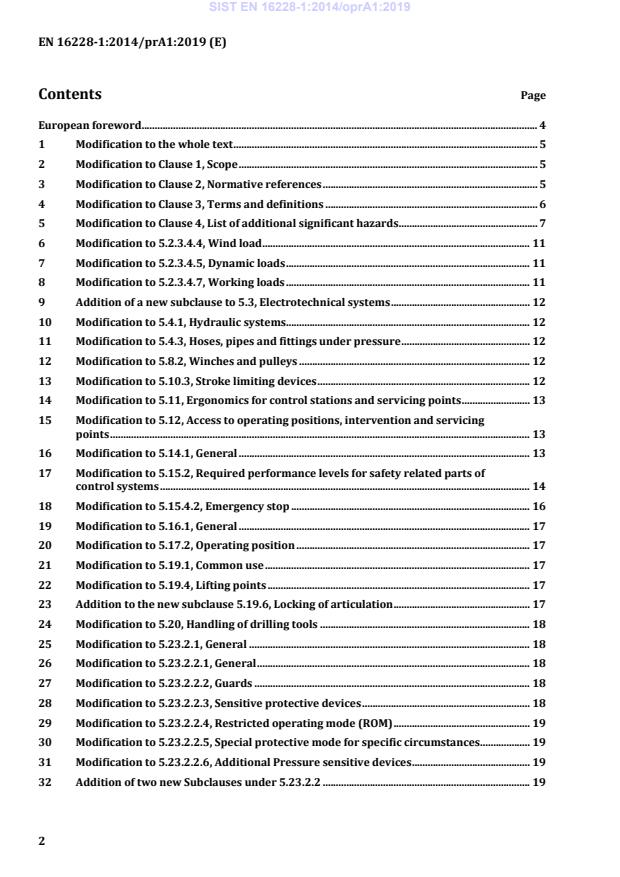
Contents Page
European foreword . 4
1 Modification to the whole text . 5
2 Modification to Clause 1, Scope . 5
3 Modification to Clause 2, Normative references . 5
4 Modification to Clause 3, Terms and definitions . 6
5 Modification to Clause 4, List of additional significant hazards . 7
6 Modification to 5.2.3.4.4, Wind load . 11
7 Modification to 5.2.3.4.5, Dynamic loads . 11
8 Modification to 5.2.3.4.7, Working loads . 11
9 Addition of a new subclause to 5.3, Electrotechnical systems . 12
10 Modification to 5.4.1, Hydraulic systems. 12
11 Modification to 5.4.3, Hoses, pipes and fittings under pressure . 12
12 Modification to 5.8.2, Winches and pulleys . 12
13 Modification to 5.10.3, Stroke limiting devices . 12
14 Modification to 5.11, Ergonomics for control stations and servicing points . 13
15 Modification to 5.12, Access to operating positions, intervention and servicing
points . 13
16 Modification to 5.14.1, General . 13
17 Modification to 5.15.2, Required performance levels for safety related parts of
control systems . 14
18 Modification to 5.15.4.2, Emergency stop . 16
19 Modification to 5.16.1, General . 17
20 Modification to 5.17.2, Operating position . 17
21 Modification to 5.19.1, Common use . 17
22 Modification to 5.19.4, Lifting points . 17
23 Addition to the new subclause 5.19.6, Locking of articulation . 17
24 Modification to 5.20, Handling of drilling tools . 18
25 Modification to 5.23.2.1, General . 18
26 Modification to 5.23.2.2.1, General . 18
27 Modification to 5.23.2.2.2, Guards . 18
28 Modification to 5.23.2.2.3, Sensitive protective devices . 18
29 Modification to 5.23.2.2.4, Restricted operating mode (ROM) . 19
30 Modification to 5.23.2.2.5, Special protective mode for specific circumstances . 19
31 Modification to 5.23.2.2.6, Additional Pressure sensitive devices . 19
32 Addition of two new Subclauses under 5.23.2.2 . 19
SIST EN 16228-1:2014/oprA1:2019
EN 16228-1:2014/prA1:2019 (E)
33 Modification to 5.23.3, Transmission parts . 20
34 Modification to 5.23.6, Tools handling system . 20
35 Modification to 5.27.2.1, Noise reduction at the design stage . 22
36 Modification to 5.28.1, Engine exhausts . 22
37 Modification to 5.28.2, Dust . 22
38 Modification to 5.30, Warning devices . 22
39 Modification of Clause 6, Verification of the safety requirements and/or protective
measures . 22
40 Modification to 6.2.1, General . 29
41 Modification to 7.3.2.1, General information . 29
42 Modification to 7.3.2.2.1, General . 29
43 Modification to 7.3.2.3, Technical information . 29
44 Modification to 7.3.2.4, Operating instructions . 30
45 Modification to 7.3.2.5, Transportation and assembly instructions . 30
46 Modification to 7.3.3, Maintenance instructions . 30
47 Modification to A.2, Illustrations . 30
48 Addition of a new Annex H (normative) Requirements to sensitive protective
devices, consisting of TAG based system, at drill and foundation equipment
according prEN 16228-1:2017, 5.23.2.2.8 . 36
Annex A (normative) Requirements for TAG based system . 37
A.1 General . 37
A.2 Additional requirements with tag based system . 37
A.3 Positioning of the TAG based system . 38
A.4 Instruction for use . 38
A.5 Warnings and pictograms . 38
49 Modification to the Bibliography . 41
SIST EN 16228-1:2014/oprA1:2019
EN 16228-1:2014/prA1:2019 (E)
European foreword
This document (EN 16228-1:2014/prA1:2019) has been prepared by Technical Committee CEN/TC 151
“Construction equipment and building material machines - Safety”, the secretariat of which is held by
DIN.
This document is currently submitted to the CEN Enquiry.
This document has been prepared under a standardization request given to CEN by the European
Commission and the European Free Trade Association, and supports essential requirements of
EU Directive(s).
For relationship with EU Directive(s), see informative Annex ZA, which is an integral part of EN 16228‑
1:2014.
SIST EN 16228-1:2014/oprA1:2019
EN 16228-1:2014/prA1:2019 (E)
1 Modification to the whole text
In the entire document, for all instances found, replace “EN 16228-1:2014” with
“EN 16228-1:2014+prA1:2019”.
2 Modification to Clause 1, Scope
In the fifth paragraph, last sentence delete the final punctuation of the third item and add the following text:
“;
— core drilling machines on sIn tand covered by EN 12348;
— hand-held machine (in particular machines covered by ISO 11148-5”
In the sixth paragraph, first sentence, replace “will conform to the requirements specified in this drilling
and foundation equipment” with “is covered by this”.
3 Modification to Clause 2, Normative references
Replace “EN 953” with “EN ISO 14120:2015”.
Add the following references:
“EN 614-1:2006+A1:2009, Ergonomic design principles — Part 1: Terminology and general principles
EN 894-3:2000+A1:2008, Ergonomic requirements for the design of displays and control actuators – Part 3:
Control actuators”
EN IEC 61000 6-2, Electromagnetic compatibility (EMC) - Part 6-2: Generic standards - Immunity standard
for industrial environments
EN IEC 61000 6-4, Electromagnetic compatibility (EMC) - Part 6-2: Generic standards - Immunity standard
for industrial environments
prEN ISO 13766-1, Construction machinery - Electromagnetic compatibility of machines with internal
electrical power supply — Part 1: General EMC requirements under typical EMC environmental conditions
prEN ISO 13766-2, Construction machinery - Electromagnetic compatibility of machines with internal
electrical power supply — Part 1: General EMC requirements under typical EMC environmental conditions
SIST EN 16228-1:2014/oprA1:2019
EN 16228-1:2014/prA1:2019 (E)
4 Modification to Clause 3, Terms and definitions
In definition 3.17 (assistant), delete “operation”; replace “assists with the” by “is intended to make
operation during the use of some”.
Add the following NOTE to definition 3.17:
“Note 1 to Entry The assistant operator could be exposed to moving parts involved in the drilling process without
having the control on the said mobile elements.”
After definition 3.19 (operator), add the following NOTE:
“Note 2 to entry: The operator can also be the maintenance technician of the rig.”
After the last definition 3.38, add the following new definitions:
“
3.39
geometric protection zone
volume within which, in case of a rolling-over or tilting-over of the rig, the cabin is located to be safe from
major deformations
3.40
supplementary trip device
sensitive protective equipment intended to detect the touch of a person or body part of a person
(mechanically or electro sensitive activated trip) and which can also act as impeding device
Note 1 to entry: This device is aimed at reducing severity of the accident, in addition to the other protective
devices intended to reduce the occurrences of accidents.
[SOURCE: ISO 13856-3:2013(en), 3.1 modified]
3.41
TAG based system
system, e.g. RFID or industrial radar, capable of detecting any person (e.g. operator and assistant)
carrying a TAG, i.e. a localisation device
3.42
integral mechanised tool handling system
mechanised handling system installed on the machine allowing transfer of rods and/or tools to the drill
axis and vice versa
Note 1 to entry: The mechanised tool handling system can be a carousel, a magazine, a robot arm, etc.
3.43
integral lifting device for drilling tools
manually operated lifting device installed on the machine, allowing transfer of rods and/or tools to the
drill axis and vice versa
Note 1 to entry: A pivoting rotary head with a chuck or a travelling block either with an elevator, lifting cap,
pulling out flange, lifting sling or similar is considered a lifting device.
3.44
external mechanised tool handling system
mechanised handling system for rods and/or tools that is not part of the drilling rig, allowing the transfer
of the rods and/or tools to the drill axis and vice versa
SIST EN 16228-1:2014/oprA1:2019
EN 16228-1:2014/prA1:2019 (E)
Note 1 to entry: An external mechanised tool handling system is interchangeable equipment fitted on a carrier
e.g. an excavator.
Note 2 to entry: An external mechanised tool handling system can be operated by the assistant and it has its own
operator’s panel.
3.45
communication connection port for external mechanised tool handling systems
connection port located on the drilling rig that interfaces with the communication device between an
external mechanised tool handling system and the drilling rig
3.46
communication device
device designed to be plugged into the communication connection port to provide the communication
between an external mechanised tool handling system and the drilling rig
Note 1 to entry: The communication device can be e.g. a wireless or a cable connection.
Note 2 to entry: The manufacturer of this device cannot be the manufacturer of the drilling rig.”
5 Modification to Clause 4, List of additional significant hazards
Replace Table 1 by the following:
Table 1 — List of significant hazards and associated requirements
No. Hazard Relevant clause(s) in this
document
1 Mechanical hazards
1.1 Generated by machine parts or work pieces, e.g. by:
1.1.1 Shape 5.11, 5.12, 5.14, 5.22
1.1.2 Mass and stability 5.2.1, 5.2.3, 5.10.1, 5.10.2,
Annex F
1.1.3 Mass and velocity 5.2.1, 5.2.3.4
1.1.4 Inadequacy of mechanical strength 5.2.2
1.2 Accumulation of energy inside the machinery, e.g. by:
1.2.1 Fluids under pressure 5.4.1, 5.4.2, 5.4.3, 7.3.2
1.2.2 Live parts under voltage 5.3, 5.21, 7.3.2
1.3 Elementary forms of mechanical hazards
1.3.1 Crushing 5.7, 5.8, 5.9, 5.12, 5.23, 7.2.2,
7.2.3
1.3.2 Shearing 5.7, 5.8, 5.9, 5.12, 5.23, 7.2.2,
7.2.3
1.3.3 Cutting or severing 5.8, 5.9, 5.12, 5.23, 7.2.2, 7.2.3
1.3.4 Entanglement hazard 5.9, 5.23
1.3.5 Drawing-in or trapping hazard 5.23
moving transmission parts 5.23.3
1.3.6 Stabbing or puncture hazard 5.20
1.3.7 High pressure fluid injection or ejection hazard 5.4.1, 5.4.3
SIST EN 16228-1:2014/oprA1:2019
EN 16228-1:2014/prA1:2019 (E)
No. Hazard Relevant clause(s) in this
document
2 Electrical hazards due to:
2.1 Contact of persons with live parts (direct contact) 5.3.1
2.2 Contact of persons with parts which have become live 5.3.1
under faulty conditions (indirect contact)
2.3 Approach to live parts under high voltage 5.3.1
2.4 Thermal radiation or other phenomena such as the 5.3.2
projection of molten particles and chemical effects from
short-circuits, overloads, etc.
3 Thermal hazards, resulting in:
3.1 Burns and scalds, by possible contact of persons with 5.22
objects or materials with an extreme temperature, by
flames, by radiation, etc.
3.2 Hot or cold working environment 5.14.1
4 Hazards generated by noise, resulting in:
4.1 Hearing losses and physiological disorders 5.14.1, 5.27, Annex B
4.2 Accidents due to interference with speech communication 5.27, Annex B
and warning signals
5 Hazards generated by vibration
5.1 5.14.1, 5.27.3, Annex C
Whole-body vibration, particularly when combined with
poor postures
6 Processed materials and substances, used materials, fuels
6.1 Hazards from contact with harmful fluids, gases, mists, 5.3.2, 5.14, 5.28
fumes and dusts
6.2 Fire or explosion hazard 5.26, 5.28, 5.3.2
7 Neglected ergonomic principles in machine design e.g.
hazards from:
7.1 Unhealthy postures or excessive efforts 5.11, 5.14.1
7.2 Inadequate consideration of hand-arm or foot-leg anatomy 5.14
7.3 Neglected use of personal protection equipment 5.11, 5.13, 5.14
7.4 Inadequate local lighting 5.25
7.5 Mental overload or underload, stress 5.11, 5.14.1
7.6 Human errors, human behaviour 5.11, 5.14.1
7.7 Inadequate design, location or identification of manual 5.11, 5.14.1
controls
7.8 Inadequate design or location of visual display units 5.11, 5.14.1
8 Combination of hazards 5.18, 5.23.2.2, 5.23.5, 5.23.6,
5.29, 7.2.2
9 Unexpected start-up, unexpected overrun/overspeed (or
any similar malfunction) from:
9.1 Failure/disorder of control system 5.15, 5.17, 5.18
SIST EN 16228-1:2014/oprA1:2019
EN 16228-1:2014/prA1:2019 (E)
No. Hazard Relevant clause(s) in this
document
9.2 Restoration of energy supply after an interruption 5.5, 5.15
9.3 External influences on electrical equipment 5.3.1
9.4 Other external influences (gravity, wind, etc.) 5.2
9.5 Errors in the software 5.15
9.6 Errors made by the operator (due to mismatch of 5.14.1
machinery with human characteristics and abilities)
9.7 Electromagnetic disturbances 5.3.3
10 Impossibility of stopping the device in the best possible 5.5, 5.6, 5.15
conditions
10.1 Control that can accidentally initiate dangerous 5.15.4, 5.16, 5.17, 5.18
movements
11 Failure of the power supply 5.5, 5.6
12 Failure of the control circuit 5.15
13 Errors of fitting 5.9, 7.3
14 Break-up during operation 5.2, 7.3
15 Falling or ejected object or fluid 5.4.3, 5.14.1, 5.24
16 Loss of stability/overturning of machinery 5.2.3
17 Slip, trip and falling of persons (related to machinery) 5.12
18 Electromagnetic radiation 5.3.3
Additional hazards, hazardous situations and hazardous events due to mobility
18 Relating to the travelling function
18.1 Uncontrolled movement of machine when starting the 5.6
engine
18.2 Movement without an operator at the driving position 5.15, 5.16.1
18.3 Insufficient ability of machinery to be slowed down, 5.6, 5.7
stopped and immobilised
Linked to the work position (including driving station) on
the machine
19.1 Fall of persons during access to (or at/from) the work 5.12
position
19.2 Exhaust gases/lack of oxygen at the work position 5.14.1, 5.28
19.3 Fire (flammability of the cab, lack of extinguishing means) 5.26
19.4 Mechanical hazards at the work position contact with the 5.14.1, 5.23
wheels/crawlers; fall of objects, penetration by object.
5.24
19.5 Insufficient visibility from the working position 5.14.2
19.6 Inadequate lighting 5.25
19.7 Inadequate seating 5.14.1
19.8 Noise at the driving position 5.14.1, 5.27.2, Annex B
SIST EN 16228-1:2014/oprA1:2019
EN 16228-1:2014/prA1:2019 (E)
No. Hazard Relevant clause(s) in this
document
19.9 Vibration at the driving position 5.14.1, 5.27.3, Annex C
19.10 Insufficient means of evacuation/emergency exit 5.14.1
20 Due to the control system
20.1 Inadequate location of controls/control devices 5.16
20.2 Inadequate design of the actuation mode and/or action 5.15, 5.16
mode of controls
21 From handling the machine (lack of stability) 5.2, 5.19, 7.3
22 Due to the power source and to the transmission of power
22.1 Hazards from the engine and the batteries 5.3.2, 5.15, 5.23.3
22.2 Hazards from coupling and towing 5.19
23 From/to third persons
23.1 Unauthorized start 5.13.3, 5.15.3
23.2 Drift of a part, away from its stopping position 5.4.1, 5.5, 5.6, 5.7, 5.8
23.3 Lack or inadequacy of visual or acoustic warning means 5.30
24 Insufficient instructions for the driver/operator 7.3.2
Additional hazards, hazardous situations and hazardous events due to lifting
25 Mechanical hazards and events
25.1 From load falls, collision, machine tipping caused by:
25.1.1 Lack of stability 5.2.3, 5.8.2, 5.10, 7.3.2
25.1.2 Uncontrolled loading; overloading; overturning moment 5.6, 5.8.2, 5.9, 5.10, 7.3.2
exceeded
25.1.3 Uncontrolled amplitude of movements 5.5, 5.6, 5.8.2, 5.10, 7.3.2
25.1.4 Unexpected/unintended movement of loads 5.5, 5.6, 5.8.2, 7.3.2
25.1.5 Inadequate holding devices/accessories 5.8.2, 5.9, 7.3.2, 7.3.3
25.1.6 Collision of more than one machine 5.7
25.2 From access of persons to load support 7.3.2
25.3 From insufficient mechanical strength of parts 5.2, 5.9
25.4 From inadequate design of pulleys, drums 5.8.2, 5.8.3
25.5 From inadequate selection/integration into the machine of 5.8.3, 5.8.4, 5.8.5, Annex E
chains, ropes, lifting accessories
25.6 From lowering of the load by friction brake 5.8.2
25.7 From abnormal conditions of 6.1, 6.2, 7.3.3
assembly/testing/use/maintenance
25.8 Load-person interference (impact by load) 7.3.2
26 Electrical hazards 5.3, 5.5
27 Hazards generated by neglecting ergonomic principles
27.1 Insufficient visibility from the driving position 5.14.2
Additional hazards, hazardous situations and hazardous events due to lifting of persons
SIST EN 16228-1:2014/oprA1:2019
EN 16228-1:2014/prA1:2019 (E)
No. Hazard Relevant clause(s) in this
document
28 Mechanical hazards and hazardous events due to:
28.1 Inadequate working coefficients 5.13.2, 5.13.3
28.2 Failing of load control 5.8.2, 5.13.2
28.3 Failing of controls at working platform for lifting 5.13.2
personnel (function, priority)
28.4 Overspeed of working platform for lifting personnel 5.13.2
29 Falling of person from the working platform for lifting 5.13.2
personnel
30 From derailment of the working platform for lifting 5.13.2
personnel
6 Modification to 5.2.3.4.4, Wind load
Delete first indent and its related sub-indent.
After the enumeration, before the last paragraph, add the following indent:
“
— for all other operating conditions:
— P 0,25 kPa× 250 N/ m ”;
( )
In the last paragraph, first sentence, after the text “The direction of the wind load”, add “, if any, “.
7 Modification to 5.2.3.4.5, Dynamic loads
In the fourth paragraph, first and second sentence, replace “equal to the weight of the released mass. It is
applicable to equipment” with “that shall be calculated considering the application and the structure of
the equipment”.
After "chisel, hammer grab, rope grab, etc.", add "or on the basis of a default value of 30 % of the released
mass”.
8 Modification to 5.2.3.4.7, Working loads
In the first paragraph, third indent, after the text “pushing or feed load that may cause a backward
overturning.”, add the following new sentence:
“The maximum permissible values shall be given in the operator's manual, see Clause 7.”
=
SIST EN 16228-1:2014/oprA1:2019
EN 16228-1:2014/prA1:2019 (E)
9 Addition of a new subclause to 5.3, Electrotechnical systems
After subclause 5.3.2, add the following new subclause:
“5.3.3 Electromagnetic compatibility (EMC)
Machines connected to an external electrical power source shall comply with ENIEC 61000-6-2 and
EN 61000-6-4 with regard to electromagnetic compatibility (EMC).
Machines powered by internal combustion engines shall comply with prEN ISO 13766-1 and
prEN ISO 13766-2.
NOTE Tests are carried out either on the complete machines or on the safety-relevant ESA as specified in
prEN ISO 13766 series.”
10 Modification to 5.4.1, Hydraulic systems
In the second paragraph, delete the last sentence “These devices… load side” and the NOTE.
After the second paragraph the following text:
“Load holding cylinders shall be fitted with a safety device to prevent unintended movement caused by
failure of an external pipe or hose (excluding those pipes indicated in c)). The device shall only be released
by an external force or by an internal force caused by thermal expansion inside the cylinder. The setting
of the internal relief-valve shall be at a pressure which does not allow movements causing unsafe
conditions. They shall be either:
a) integral with the cylinder; or
b) directly and rigidly flange-mounted; or
c) placed close to the cylinder and connected to it by means of rigid pipes, having welded or flanged
connections and being calculated in the same way as the cylinder.
Alternatively, bleeding may also be obtained by moving the piston between full stroke movements.”
Fourth paragraph starting with “Hydraulic hoses and pipes shall be separated”
Add the following text before final punctuation: “, in accordance with EN 60204-1:2006, 13.5.1 and 13.5.7”.
11 Modification to 5.4.3, Hoses, pipes and fittings under pressure
In the third paragraph, after the term “Hoses”, delete the comma (,) and add the liaison word “and” then
delete “and nozzles”.
12 Modification to 5.8.2, Winches and pulleys
In the eighth paragraph, first sentence, delete “by influencing the winch control”.
13 Modification to 5.10.3, Stroke limiting devices
Add the following NOTE after the first paragraph:
“
NOTE Stroke limiting devices do not prevent tipping or overloading of the machine.”
SIST EN 16228-1:2014/oprA1:2019
EN 16228-1:2014/prA1:2019 (E)
14 Modification to 5.11, Ergonomics for control stations and servicing points
Delete “for control stations and servicing points” to read: "5.11 Ergonomics”.
Insert the following before the first paragraph,:
“5.11.1 General
The machine shall be designed according to the principles of EN 614-1:2006+A1:2009.
5.11.2 For control stations and servicing points”
In the first paragraph, second sentence after “may wear”, add “personal protective equipment, e.g.” and
after “heavy gloves” delete the comma (,) and replace with “and”; then delete “and other personal
protection equipment”.
15 Modification to 5.12, Access to operating positions, intervention and servicing
points
In the fifth paragraph, second sentence, replace “EN 795:2012”with “EN 795:2016”.
16 Modification to 5.14.1, General
In the first paragraph, first sentence, delete “driving,”.
In the second paragraph, first sentence, delete “driving,”.
In the second paragraph, first sentence replace “an alternative driver's position or a tip-over protective
structure (TOPS) in accordance with EN 474-5:2006+A3:2013, 5.3.2.2.3, shall be provided. Alternatively,
remote control shall be provided.” with the following text:
“one of the following measures shall be taken:
— installing a tip-over protective structure (TOPS) on machines having a mass less than or equal to 50 t
complying with the following;
— Evaluation of the performance of the TOPS, ISO 12117-2 shall be used in respect of lateral loading
only and with the following lateral load energy:
1,25
— Lateral load energy Us
JM 6 500 × / 10 000
( ) ( )
— TOPS shall be labelled in accordance with ISO 12117-2:2008, Clause 9, except that the standard
referred to shall be EN 16228-1:2014+prA1:2019;
— providing an alternative driver's position (e.g. by a remote control);
— providing evidence of the geometric protection zone as defined in 3.39.
NOTE There is no standard existing for testing TOPS for machines over 50 t.
In the third paragraph, first sentence delete “driving,”, then replace “a roll-over protective structure (ROPS)
in accordance with ISO 12117-2:2008 shall be provided. Alternatively, remote control shall be provided.”
with the following text:
“one of the following measures shall be taken:
— installing a roll-over protective structure (ROPS) in accordance with ISO 12117-2:2008 or
EN ISO 3471;
— providing an alternative driver's position (e.g. by a remote control);
=
SIST EN 16228-1:2014/oprA1:2019
EN 16228-1:2014/prA1:2019 (E)
— providing evidence of the geometric protection zone as defined in 3.39.
When a ROPS or TOPS is provided, a seat belt shall be provided and shall be designed according to
ISO 6683.”
After NOTE 1, add the following text:
“The geometric protection zone shall be verified by drawing, which shows that the cabin is distant from
even ground in the cases of rolling-over or tilting-over. The distance between ground and cabin shall be
verified by a straight line, which connects the relevant tipping line with the firm outmost part of the
equipment in the cases of tilting-over or rolling-over as shown in Figure 1.
Safety belt complying with ISO 6683:2005 shall be provided in the cabin.
Figure 1 — Geometric protection”
17 Modification to 5.15.2, Required performance levels for safety related parts of
control systems
Replace the entire subclause by the following:
“The design of the safety-related parts of control system shall meet the requirements of EN ISO 13849-1.
EN ISO 13849-1 is relevant for cases where a risk assessment according to EN ISO 12100 has initiated a
risk reduction measure that relies on a safety-related control system. In those cases, the safety-related
control system has to perform a safety function. The application of EN ISO 13849-1 is restricted to those
cases only.
NOTE 1 The combined safety-related parts of a control system start at the point where the safety-related input
signals are initiated (including, for example, the actuating cam and the roller of the position switch) and end at the
output of the power control elements (including, e.g. the main contacts of a contactor).
NOTE 2 The control system is defined in EN ISO 12100:2010, Annex A to end at the output of the power control
elements. By this definition, e.g. load holding valves are considered to belong to the operating part of the system
and not to the safety related part of the control system.
The performance level (PL) for safety functions shall meet the minimum required performance level
(PLr) as detailed in Table 3 below. For purely mechanical solutions that fulfil the required functions of
Table 3, no specific performance level is required; for example a locking pin.
The manufacturer's risk assessment may require different and/or additional safety functions than those
listed in Table 3.
SIST EN 16228-1:2014/oprA1:2019
EN 16228-1:2014/prA1:2019 (E)
Table 3 — Required performance level
Required
Safety function
Relevant clause(s) in
Performance Level
No.
this standard
PL
r
Travelling/tramming
Prevention of uncontrolled movement 5.5, 5.6, 5.7.1 c
Slewing
20 Prevention of uncontrolled movement 5.5, 5.6, 5.7.2 c
Lifting
5.5, 5.6, 5.8.2,
5 Prevention of uncontrolled movement c
5.23.6.2
6 Limiters 5.8.2 c
Winching
(Pulling/anchoring the machine)
21 Prevention of uncontrolled movement 5.5, 5.6, 5.8.2 b
8 Limiters 5.8.2 b
Working platforms for lifting personnel
22 Prevention of uncontrolled movement 5.5, 5.6, 5.13.2 c
10 Limiters 5.13.2 c
Machine stability jacks and ground
anchor systems
12 Prevention of uncontrolled movement 5.5, 5.6 c
Guards and protective devices
Stop rotation/feed on activation of
5.5, 5.23.2.2.2,
13 interlocked guards or sensitive protective c
5.23.2.2.3
devices
Restricted Operating Mode
14 Limit rotation and feed speed 5.5, 5.23.2.2.4 c
Stop rotation/feed on deactivation of hold to
5.5, 5.23.2.2.4 b
run
SIST EN 16228-1:2014/oprA1:2019
EN 16228-1:2014/prA1:2019 (E)
Required
Safety function
Relevant clause(s) in
Performance Level
No.
this standard
PL
r
Special protective mode for specific
circumstances
Stop rotation/feed on deactivation of hold to
5.5, 5.23.2.2.5 c
run
Stop rotation/feed on activation TAG bases 5.5, 5.23.2.2.5,
c
system 5.23.2.2.8
Stop rotation/feed on activation of rod
5.5, 5.23.2.2.5 b
add/remove recognition sensor
Supplementary trip device
Stop rotation/feed on activation of
15 5.5, 5.23.2.2.6 c
supplementary trip devices
Clamping and breaking of tools
16 Prevention of uncontrolled movement 5.5, 5.23.5 b
Mechanised tool handling system
17 Prevention of uncontrolled movement 5.5, 5.23.6.2 c
Stop rotation/feed on deactivation of the
5.5, 5.23.6.5 b
external tool handling system
Mast/boom/leader positioning system
19 Prevention of uncontrolled movement 5.5, 5.9 c
Limiters 5.10.3 c
Emergency stop
25 Stop all dangerous movements 5.5, 5.14.4.2, 5.17.3 c
“
18 Modification to 5.15.4.2, Emergency stop
Add the following text to the end of the fourth paragraph
“In the case of a drilling and foundation machine pneumatically powered, one or several emergency stop
devices shall be provided close to the operator position to cut off the air supply of the dangerous
movements.
If this function is performed by pneumatic valve(s), the operating handle shall be red coloured and easily
accessible from the control station.”
SIST EN 16228-1:2014/oprA1:2019
EN 16228-1:2014/prA1:2019 (E)
19 Modification to 5.16.1, General
In the second paragraph, first sentence, add “one of” before "the official”, delete “language of”, delete “s”
from the word “States”, add “first” before” put into service.”
In the fourth paragraph, delete third indent and adapt punctuation.
After the fourth paragraph, add the following NOTE:
“
NOTE Guidance on the selection, design and location of control actuators are given in EN 894‑
3:2000+A1:2008.”
20 Modification to 5.17.2, Operating position
In the second paragraph, first sentence, delete texts “, without an operator's position on it,” and “ for a
remote control box” and "an" after "at least", and after “At least”, add the following text:
“:
— a storage place for the remote control box to avoid unintentional operation of the controls;
— an accessory or supporting device (e.g. support arm attached to machine, external tripod) to hold the
“
After “remote control box”, add the following text: “that remains for use at the discretion of the operator,
if its mass is greater than 5 kg,”.
21 Modification to 5.19.1, Common use
Delete the Note and add the following text:
“Lifting and tie down points shall be in accordance with ISO 15818 and shall be clearly identified on the
machine.”
22 Modification to 5.19.4, Lifting points
Delete the second paragraph and add the following:
“Lifting points that are not intended for the lifting of the whole machine shall be marked in a different
way that those intended for the lifting of the subassemblies (e.g. different colours).
NOTE The lifting accessories needed to lift heavy attachments, components and machines are not considered
as part of the machine.”
23 Addition to the new subclause 5.19.6, Locking of articulation
Add the following new subclause:
“5.19.6 Locking of articulation
On articulated carriers there shall be a mechanical locking device for locking the articulation joint during
lifting and transport. The articulation frame lock shall comply with ISO 10570.”
SIST EN 16228-1:2014/oprA1:2019
EN 16228-1:2014/prA1:2019 (E)
24 Modification to 5.20, Handling of drilling tools
Replace the first paragraph with the following NOTE:
“
NOTE “Specific requirements for handling of drilling tools are given in parts 2 to 7 of this standard
(EN 16228).”
25 Modification to 5.23.2.1, General
In the first paragraph, first indent, replace “fixed guard” with “guards (see 5.23.2.2.2)”.
Second indent, delete:
Third indent, after “sensitive protective devices”, add “(see 5.23.2.2.3),”
After NOTE 2, add the following NOTE:
“
NOTE 3 Parts of the machine offering a physical barrier (e.g. Integral mechanised tool handling system) can be
considered as a guard or part of a guard.”
After the last paragraph, add the following text:
“Information regarding residual hazards at the area between clamps of the machine and ground shall be
given in the instructions for use (see 7).”
26 Modification to 5.23.2.2.1, General
After the first paragraph, add the following NOTE:
“
NOTE Guards and protective devices are intended to prevent the operator and assistant from inadvertently
coming in contact with moving parts.”
27 Modification to 5.23.2.2.2, Guards
In the first and second paragraphs, replace “EN 953:1997+A1:2009”with “EN ISO 14120:2015”.
In the third paragraph, first sentence, after “When” replace “the” with “an”.
In the fifth paragraph, first sentence, replace “Table 4 of EN ISO 13857:2008, ” with “EN ISO 13857:2008,
Table 4”
At the end of the subclause, add the following text:
“Where guards are power operated, they shall not be capable of causing injury. They shall be:
— designed in accordance with the requirements of 5.2.5.4 of EN ISO 14120:2015; or
— controlled with hold to run controls and full visibility of the movements from control panel.”
28 Modification to 5.23.2.2.3, Sensitive protective devices
Add the following text before the current first paragraph:
“For eletro-sensitive protective equipment, EN 61496-1 shall be complied with.”
SIST EN 16228-1:2014/oprA1:2019
EN 16228-1:2014/prA1:2019 (E)
29 Modification to 5.23.2.2.4, Restricted operating mode (ROM)
In the eighth paragraph, first sentence, add, after the sentence “When hold to run controls for rotation are
released the rotating parts shall stop in less than half a revolution.” the following text:
“The stopping performance shall be checked in accordance with the test code specified in Annex G.
During restricted operating mode, supplementary trip devices (5.23.2.2.6) shall be active to minimize
hazards.”
30 Modification to 5.23.2.2.5, Special protective mode for specific circumstances
In the third paragraph, first sentence add “mechanically attached” before “control station” and delete “or
using a remote control”.
In the fifth paragraph, first indent, after “hold-to-run”, add ” with the exception of machines equipped for
this mode with a tag based system (5.23.2.2.8)”;.
In the fourth indent, replace ” additional pressure sensitive devices “with ” a supplementary trip device “
Replace the seventh and eighth paragraphs with the following text:
“When rods are manually added or removed, the rotation and feed functions together with any associated
moving parts identified with residual risks shall stop by activation of a sensor (e.g. on clamps) or tag
based system (as defined in 5.23.2.2.8). Restarting shall only be possible in restricted operating mode
(see 5.23.2.2.4).”
31 Modification to 5.23.2.2.6, Additional Pressure sensitive devices
Change title to “Supplementary trip device”.
Replace the first paragraph with “Supplementary trip devices (e.g. trip wire) as defined in 3.40 shall be
fitted in addition to the guard or to the protective devices as specified in 5.23.2.2.2 and 5.23.2.2.3. They
shall comply with EN ISO 13856-2:2013 and EN ISO 13856-3:2013 for the pressure sensitive protective
equipment PSPE or with EN ISO 61496-1 for the electro sensitive protective equipment ESPE, as relevant,
together with the following requirements:".
In the first indent, add “or by detection” after "“be activated by contact”.
In the second indent, delete “and from any foreseeable actuation direction”.
In the first sub-indent of the fourth indent, after “shall stop as quickly as possible”, add “as specified in the
specific parts 2 to 7 of this standard”.
In the seventh indent, add “for the PSPE” before current text.
32 Addition of two new Subclauses under 5.23.2.2
Add the two following new subclauses:
“
SIST EN 16228-1:2014/oprA1:2019
EN 16228-1:2014/prA1:2019 (E)
5.23.2.2.7 Requirements for machines equipped with mechanised tool handling systems or machines
without rod handling during drilling process
Drilling machines with integral mechanised tool handling systems or machines that do not require rod
handling during the drilling process are not required to be equipped with protective means as specified
in 5.23.2.2.2 and 5.23.2.2.3, if the following requirements are met:
— the drilling rig is designed in such a way that the presence of operator(s) and assistant(s) is not
required in the danger zone of the moving parts involved in the drilling process (i.e. no action of
manual adding or removing tools is intended during the drilling process); and
— supplementary trip devices as specified in 5.23.2.2.6 shall be provided and active; and
— the machine shall be designed in order that the mechanised tool handli
...