

EN 13389:2005+A1:2009
(Main)Food processing machinery - Mixers with horizontal shafts - Safety and hygiene requirements
- Abstract
This European Standard specifies requirements for the design, installation, operation and maintenance of batch production fixed or tilting horizontal bowl type mixers with one or two rotating shafts with or without movable blades. These mixers are used to mix, knead and homogenise food for animal or human consumption in powder, paste or liquid form. The mixers can be floor mounted or transportable (with or without castors). They are intended to be used when stationary.
These machines are used in feed mills and factories which produce, work on or process foodstuff, for example biscuits, bread, chocolate, cereal products.
This European Standard does not deal with the use of the machine in potentially explosive atmospheres.
This European Standard deals with the significant hazards, hazardous situations and events relevant to mixers with horizontal shafts, when used as intended and under the conditions foreseen by the manufacturer.
This European Standard also specifies food hygiene requirements.
The feeding equipment, the dosing equipment, and the requirements of equipment for the supply of inert gases, and for heating and cooling, are excluded from the scope of this European Standard.
The hazards due to the unloading equipment (container, discharge belt, etc.) are not dealt with in this European Standard.
When drafting this European Standard, it has been assumed that the machines are not intended to be cleaned with a water jet.
This European Standard is not applicable to mixers with horizontal shafts which are manufactured before the date of publication of this European Standard by CEN.
- Status
- Published
- Publication Date
- 22-Dec-2009
- Withdrawal Date
- 29-Jun-2010
- Technical Committee
- CEN/TC 153 - Food processing machinery - Safety and hygiene specifications
- Drafting Committee
- CEN/TC 153/WG 1 - Bakery equipment
- Current Stage
- 9060 - Closure of 2 Year Review Enquiry - Review Enquiry
- Start Date
- 02-Dec-2017
- Completion Date
- 02-Dec-2017
- Directive
- 2006/42/EC - Directive 2006/42/EC of the European Parliament and of the Council of 17 May 2006 on machinery, and amending Directive 95/16/EC (recast)OJ Ref: C, C 136 OJ Date: 26-May-2010
Buy Documents


Overview
EN 13389:2005+A1:2009 is a CEN type‑C standard that defines safety and hygiene requirements for batch-production horizontal bowl mixers used in the food and feed industry. It covers fixed or tilting bowl mixers with one or two horizontal rotating shafts (with or without movable blades) used to mix, knead and homogenise powdered, paste or liquid foodstuffs for human or animal consumption. The standard applies to floor‑mounted or transportable machines intended to be used stationary and addresses design, installation, operation, maintenance, verification and information for use.
Key topics and technical requirements
- Scope limits: excludes feeding/dosing equipment, inert‑gas supply systems, specific heating/cooling supply requirements and hazards from unloading equipment; assumes machines are not cleaned by water jet; not applicable to mixers manufactured before publication.
- Hazard identification: detailed list of significant hazards - mechanical trapping/shearing (six danger zones), electrical shock, thermal burns from jacketed bowls, noise, dust/mist inhalation, fire/explosion risk for dusty materials, hygienic and ergonomic hazards.
- Protective measures: requirements for guards and interlocking devices, emergency stop design, verification of safety-related control parts, machine stability, safe access for maintenance, and ergonomic considerations.
- Hygiene & cleanability: principles for hygienic design and maintainability (Annex on design to ensure cleanability), including surface finishes and access for cleaning (with the caveat on no water‑jet cleaning).
- Verification & testing: includes noise test code (normative annex) and requirements for verification of implemented safety and hygiene measures.
- Compliance linkage: informative annexes relate EN 13389 to EU Machinery Directives for CE marking and regulatory conformity.
Practical applications
- Designing horizontal bowl mixers that meet European safety and hygiene expectations for bakeries, chocolate, cereal and feed production.
- Developing machine guards, interlocks and control systems to mitigate trapping, crushing and electrical hazards.
- Specifying hygienic materials, surface finishes and access for cleaning to reduce contamination risk.
- Performing machine risk assessments, verification testing (including noise measurement) and preparing information for users and maintenance personnel.
- Supporting conformity assessment and documentation required for CE marking under applicable EU directives.
Who uses this standard
- Machine manufacturers and OEMs of food processing mixers
- Product safety and compliance engineers
- Food plant engineers, maintenance teams and hygienists
- Certification bodies and notified bodies performing conformity assessments
- Procurement and QA managers specifying safe, hygienic equipment
Related standards (select)
- EN 1672-2 (food machinery - hygiene requirements)
- EN ISO 12100 (machine safety - risk assessment/design principles)
- EN 1088 / EN ISO 13849-1 (interlocks and safety‑related control systems)
- EN ISO 3744 / EN ISO 4871 (noise measurement and declaration)
Keywords: EN 13389, mixers with horizontal shafts, food processing machinery, safety and hygiene requirements, horizontal bowl mixers, tilting bowl mixers, machine design, cleanability, risk assessment.
Relations
- Effective Date
- 10-Oct-2009
- Effective Date
- 25-Aug-2026
- Effective Date
- 09-Feb-2026
- Effective Date
- 28-Jan-2026
- Effective Date
- 28-Jan-2026
- Refers
EN ISO 13850:2008 - Safety of machinery - Emergency stop - Principles for design (ISO 13850:2006) - Effective Date
- 28-Jan-2026
- Effective Date
- 28-Jan-2026
- Effective Date
- 28-Jan-2026
- Effective Date
- 28-Jan-2026
- Effective Date
- 28-Jan-2026
- Effective Date
- 28-Jan-2026
- Effective Date
- 28-Jan-2026
- Effective Date
- 28-Jan-2026
- Effective Date
- 28-Jan-2026
- Effective Date
- 28-Jan-2026
Buy Documents
Get Certified
Connect with accredited certification bodies for this standard

BSI Group
BSI (British Standards Institution) is the business standards company that helps organizations make excellence a habit.

Bureau Veritas
Bureau Veritas is a world leader in laboratory testing, inspection and certification services.

DNV
DNV is an independent assurance and risk management provider.
Sponsored listings
Frequently Asked Questions
EN 13389:2005+A1:2009 is a standard published by the European Committee for Standardization (CEN). Its full title is "Food processing machinery - Mixers with horizontal shafts - Safety and hygiene requirements". This standard covers: This European Standard specifies requirements for the design, installation, operation and maintenance of batch production fixed or tilting horizontal bowl type mixers with one or two rotating shafts with or without movable blades. These mixers are used to mix, knead and homogenise food for animal or human consumption in powder, paste or liquid form. The mixers can be floor mounted or transportable (with or without castors). They are intended to be used when stationary. These machines are used in feed mills and factories which produce, work on or process foodstuff, for example biscuits, bread, chocolate, cereal products. This European Standard does not deal with the use of the machine in potentially explosive atmospheres. This European Standard deals with the significant hazards, hazardous situations and events relevant to mixers with horizontal shafts, when used as intended and under the conditions foreseen by the manufacturer. This European Standard also specifies food hygiene requirements. The feeding equipment, the dosing equipment, and the requirements of equipment for the supply of inert gases, and for heating and cooling, are excluded from the scope of this European Standard. The hazards due to the unloading equipment (container, discharge belt, etc.) are not dealt with in this European Standard. When drafting this European Standard, it has been assumed that the machines are not intended to be cleaned with a water jet. This European Standard is not applicable to mixers with horizontal shafts which are manufactured before the date of publication of this European Standard by CEN.
This European Standard specifies requirements for the design, installation, operation and maintenance of batch production fixed or tilting horizontal bowl type mixers with one or two rotating shafts with or without movable blades. These mixers are used to mix, knead and homogenise food for animal or human consumption in powder, paste or liquid form. The mixers can be floor mounted or transportable (with or without castors). They are intended to be used when stationary. These machines are used in feed mills and factories which produce, work on or process foodstuff, for example biscuits, bread, chocolate, cereal products. This European Standard does not deal with the use of the machine in potentially explosive atmospheres. This European Standard deals with the significant hazards, hazardous situations and events relevant to mixers with horizontal shafts, when used as intended and under the conditions foreseen by the manufacturer. This European Standard also specifies food hygiene requirements. The feeding equipment, the dosing equipment, and the requirements of equipment for the supply of inert gases, and for heating and cooling, are excluded from the scope of this European Standard. The hazards due to the unloading equipment (container, discharge belt, etc.) are not dealt with in this European Standard. When drafting this European Standard, it has been assumed that the machines are not intended to be cleaned with a water jet. This European Standard is not applicable to mixers with horizontal shafts which are manufactured before the date of publication of this European Standard by CEN.
EN 13389:2005+A1:2009 is classified under the following ICS (International Classification for Standards) categories: 67.260 - Plants and equipment for the food industry. The ICS classification helps identify the subject area and facilitates finding related standards.
EN 13389:2005+A1:2009 has the following relationships with other standards: It is inter standard links to EN 13389:2005, ISO 8598:1996, EN 60529:1991, EN 1672-2:2005, EN 1127-1:2019, EN ISO 13850:2008, EN ISO 21920-2:2022, EN ISO 13732-1:2008, EN ISO 13732-3:2008, EN 1088:1995, EN ISO 12100-2:2003, EN ISO 12001:2009, EN ISO 11688-1:2009, EN ISO 4871:2009, EN ISO 11201:2010. Understanding these relationships helps ensure you are using the most current and applicable version of the standard.
EN 13389:2005+A1:2009 is associated with the following European legislation: EU Directives/Regulations: 2006/42/EC, 98/37/EC; Standardization Mandates: M/079, M/396. When a standard is cited in the Official Journal of the European Union, products manufactured in conformity with it benefit from a presumption of conformity with the essential requirements of the corresponding EU directive or regulation.
EN 13389:2005+A1:2009 is available in PDF format for immediate download after purchase. The document can be added to your cart and obtained through the secure checkout process. Digital delivery ensures instant access to the complete standard document.
Standards Content (Sample)
2003-01.Slovenski inštitut za standardizacijo. Razmnoževanje celote ali delov tega standarda ni dovoljeno.Stroji za predelavo hrane - Mešalniki z vodoravno gredjo - Varnostne in higienske zahteveNahrungsmittelmaschinen - Mischmaschinen mit waagerechten Wellen - Sicherheits- und HygieneanforderungenMachines pour les produits alimentaires - Pétrins horizontaux - Prescriptions relatives à la sécurité et à l'hygièneFood processing machinery - Mixers with horizontal shafts - Safety and hygiene requirements67.260Tovarne in oprema za živilsko industrijoPlants and equipment for the food industryICS:Ta slovenski standard je istoveten z:EN 13389:2005+A1:2009SIST EN 13389:2006+A1:2010en01-marec-2010SIST EN 13389:2006+A1:2010SLOVENSKI
STANDARD
EUROPEAN STANDARD NORME EUROPÉENNE EUROPÄISCHE NORM
EN 13389:2005+A1
December 2009 ICS 67.260 Supersedes EN 13389:2005English Version
Food processing machinery - Mixers with horizontal shafts - Safety and hygiene requirements
Machines pour les produits alimentaires - Pétrins horizontaux - Prescriptions relatives à la sécurité et à l'hygiène
Nahrungsmittelmaschinen - Mischmaschinen mit waagerechten Wellen - Sicherheits- und Hygieneanforderungen This European Standard was approved by CEN on 1 August 2005 and includes Amendment 1 approved by CEN on 1 November 2009.
CEN members are bound to comply with the CEN/CENELEC Internal Regulations which stipulate the conditions for giving this European Standard the status of a national standard without any alteration. Up-to-date lists and bibliographical references concerning such national standards may be obtained on application to the CEN Management Centre or to any CEN member.
This European Standard exists in three official versions (English, French, German). A version in any other language made by translation under the responsibility of a CEN member into its own language and notified to the CEN Management Centre has the same status as the official versions.
CEN members are the national standards bodies of Austria, Belgium, Bulgaria, Cyprus, Czech Republic, Denmark, Estonia, Finland, France, Germany, Greece, Hungary, Iceland, Ireland, Italy, Latvia, Lithuania, Luxembourg, Malta, Netherlands, Norway, Poland, Portugal, Romania, Slovakia, Slovenia, Spain, Sweden, Switzerland and United Kingdom.
EUROPEAN COMMITTEE FOR STANDARDIZATION
COMITÉ EUROPÉEN DE NORMALISATION EUROPÄISCHES KOMITEE FÜR NORMUNG
Management Centre:
Avenue Marnix 17,
B-1000 Brussels © 2009 CEN All rights of exploitation in any form and by any means reserved worldwide for CEN national Members. Ref. No. EN 13389:2005+A1:2009: ESIST EN 13389:2006+A1:2010
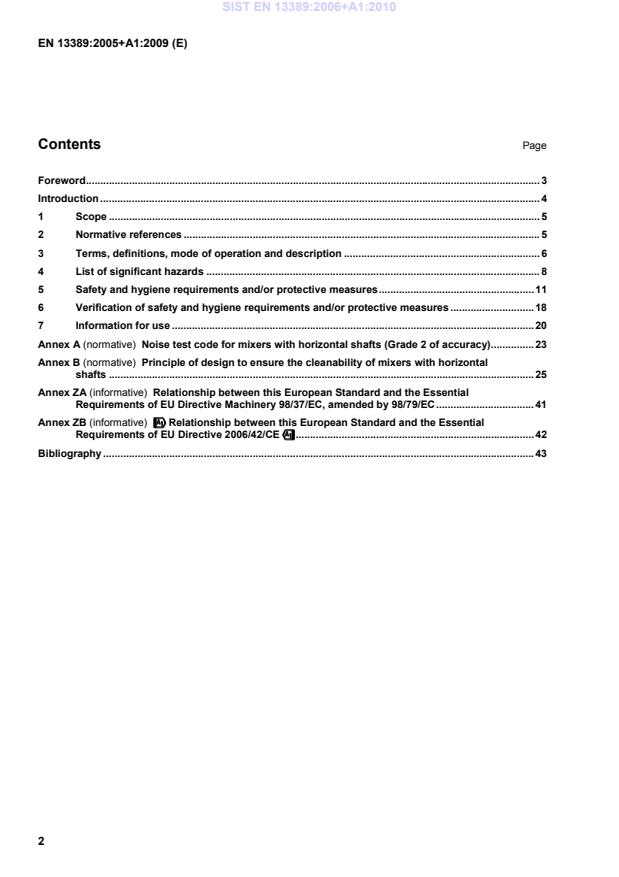
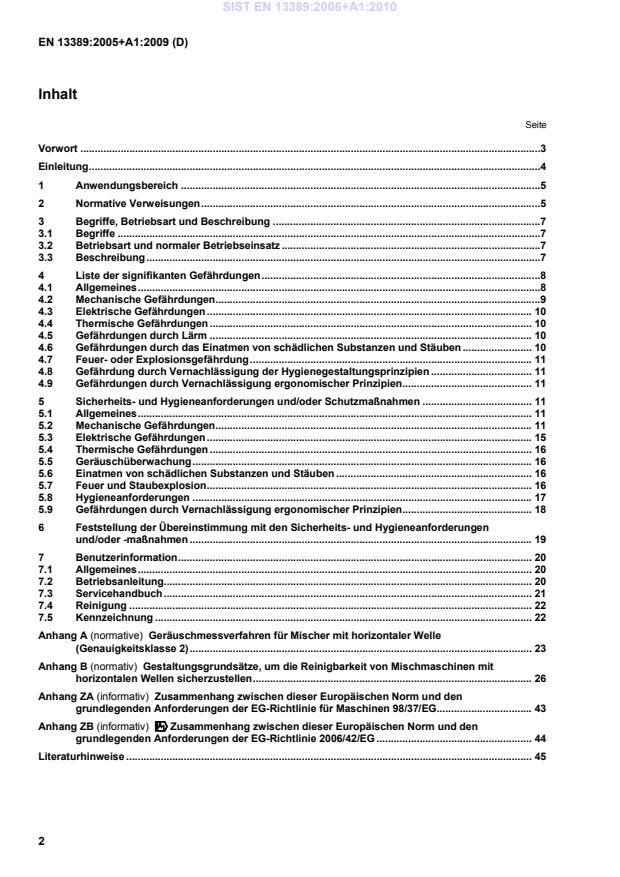
Noise test code for mixers with horizontal shafts (Grade 2 of accuracy) . 23Annex B (normative)
Principle of design to ensure the cleanability of mixers with horizontal shafts . 25Annex ZA (informative)
Relationship between this European Standard and the Essential Requirements of EU Directive Machinery 98/37/EC, amended by 98/79/EC . 41Annex ZB (informative)
!!!!Relationship between this European Standard and the Essential Requirements of EU Directive 2006/42/CE"""" . 42Bibliography . 43 SIST EN 13389:2006+A1:2010
This European Standard does not deal with the use of the machine in potentially explosive atmospheres. !This European Standard deals with the significant hazards, hazardous situations and events relevant to mixers with horizontal shafts, when they are used as intended and under conditions of misuse which are reasonably foreseeable by the manufacturer (see Clause 4)." This European Standard also specifies food hygiene requirements. The feeding equipment, the dosing equipment, and the requirements of equipment for the supply of inert gases, and for heating and cooling, are excluded from the scope of this European Standard. The hazards due to the unloading equipment (container, discharge belt, etc.) are not dealt with in this European Standard. When drafting this European Standard, it has been assumed that the machines are not intended to be cleaned with a water jet. This European Standard is not applicable to mixers with horizontal shafts which are manufactured before the date of publication of this European Standard by CEN. 2 Normative references The following referenced documents are indispensable for the application of this European Standard. For dated references, only the edition cited applies. For undated references, the latest edition of the referenced document (including any amendments) applies. EN 294:1992, Safety of machinery — Safety distance to prevent danger zones being reached by the upper limbs. !deleted text" EN 574:1996, Safety of machinery — Two-hand control devices — Functional aspects — Principles for design. EN 953, Safety of machinery — Guards — General requirements for the design and construction of fixed and movable guards. !deleted text" EN 999, Safety of machinery — The positioning of protective equipment in respect of approach speeds of parts of the human body. EN 1088:1995, Safety of machinery — Interlocking devices associated with guards — Principles for design and selection. EN 1127-1, Explosive atmospheres — Explosion prevention and protection — Part 1: Basic concepts and methodology. SIST EN 13389:2006+A1:2010
Figure 1a — "Z blade and tilting bowl" machine
Figure 1b — "Fixed bowl" machine Figure 1 — Mixers with horizontal shafts 4 List of significant hazards 4.1 General This clause contains all the significant hazards, hazardous situations and events, as far as they are dealt with in this European Standard, identified by risk assessment as significant for this type of machinery and which require action to eliminate or reduce the risk. SIST EN 13389:2006+A1:2010
4.2 Mechanical hazards The significant mechanical hazards are: a) trapping points between the blades and the bowl; b) trapping points between the bowl and machine frame during tilting of the bowl on tilting bowl machines; c) trapping points between the mixer bowl and cover; d) drive mechanisms; e) loss of stability. The example shown in Figure 2 illustrates 6 danger zones associated with these hazards: Zone 1: Access to the rotating tools through the feed opening: hazards of trapping and shearing, between blades and bowl, to the whole or any part of the
body; Zone 2: Access to the rotating tools through the discharge:
hazards of trapping and
shearing, between blades and bowl, to the whole or any part of the body; Zone 3: Access to trapping point between the bowl and machine frame on machines with tilting bowls:
hazard of trapping and shearing, between the bowl and machine frame during the tilting operation; to upper parts of the body; Zone 4: Access to trapping points between the mixer bowl and cover:
hazard of trapping and shearing, between the bowl and cover, to upper parts of the body; Zone 5: Access to the drive mechanism for the rotating shafts or the tilting bowl:
hazard of shearing and trapping to any part of the body; Zone 6: Loss of stability of machine - access to areas adjacent to the machine:
hazard of trapping and crushing of whole or part of body if machine overturns. SIST EN 13389:2006+A1:2010
Key 1 Zone 1 2 Zone 2 3 Zone 3 4 Zone 4 5 Zone 5 6 Zone 6 Figure 2 — Danger zones 4.3 Electrical hazards Hazard of electric shock from direct or indirect contact with live components. Hazard of external influences on electrical equipment (e. g. cleaning with water). 4.4 Thermal hazards Where the mixing bowl has a double wall for heating or cooling during mixing, there is a hazard of burning when touching hot or cold surfaces of the jacket. 4.5 Hazards generated by noise Mixers with horizontal shafts can generate an airborne noise being able to involve a deterioration of hearing or accidents due to the interferences with the oral communication and the perception of the acoustical signals. 4.6 Hazards resulting from the inhalation of harmful mists and dusts Loading the products exposes operators to dust including flour and ingredients which may be harmful to their health, causing rhinitis (running noses), watering eyes and possibly occupational asthma (see also 4.7 below). 4.7 Fire or explosion hazard When loading, mixing or discharging finely divided, dusty materials, a hazard of dust explosion exists when dust/air mixtures are present between the lower and upper explosive limits. SIST EN 13389:2006+A1:2010
EN ISO 13732-1 and EN ISO 13849-1, the manufacturer shall carry out a risk assessment to establish the requirements of the type B-standard. This specific risk assessment shall be part of the general risk assessment of the machine." 5.2 Mechanical hazards 5.2.1 General !Unless otherwise specified, interlocking guards shall be at least interlocking without guard locking as defined in EN 1088:1995, 4.2.1 and they shall comply with EN 1088:1995, Clauses 5 and 6. The safety related parts of the control systems shall meet at least a performance level c defined in accordance with EN ISO 13849-1:2008. The guards shall comply with EN 953. When fixed guards, or parts of the machine acting as such, are not permanently fixed e. g. by welding, their fixing systems shall remain attached to the guards or to the machinery when the guards are removed." 5.2.2 Machines with fixed bowl 5.2.2.1 Zone 1 – Access to the rotating mixing element through the in-feed opening Access to the area where the mixing element moves shall be prevented by a solid, movable, interlocking guard with guard control locking (see clause 4.2.2 of EN 1088:1995). Openings and/or feed chutes in the lid or bowl shall be in accordance with 4.5 in EN 294:1992. For small openings Table 4 of EN 294:1992 shall be used. 5.2.2.2 Zone 2 – Access to the rotating mixing element during discharge Access to the area where the mixing element moves shall be prevented in one of the following ways. SIST EN 13389:2006+A1:2010
A rigid chute or hopper fixed to the machine discharge for collecting product complying with the safety distances in EN 294:1992 Table 4. 5.2.2.2.2 Use of a “hold to run control” or “two hand control” A “hold to run control device” in accordance with 3.26.3 in EN ISO 12100-1:2003 or a two hand control device in accordance with type IIIA in EN 574:1996 may be used to prevent access during discharge. Where these types of safeguard are employed, the following features are necessary: a) control shall be sited in a fixed position and at a safe distance from the mixer discharge so that it is not possible to operate the device and reach into the mixing element through the discharge. When the control is released the mixing element shall stop within 2 seconds when the machine is empty; b) operator shall have a clear view of all sides of the mixer so that if another person were to approach the danger zone they could be easily detected; c) rotary movement of the shafts during discharge shall only be carried out at minimum speed necessary to discharge the product. 5.2.2.2.3 Fixed and/or interlocked distance guarding Access to the mixing element through the discharge shall be prevented, for example, by the use of fixed or interlocked distance guarding. The guards shall prevent access from all sides of the machine. The guard dimensions shall comply with the safety distances in Table 2 of EN 294:1992. The guards shall be constructed in accordance with the requirements of EN 953. The guards shall be designed so that there is a clear view into the area behind the guards e.g. they may be constructed from mesh. Openings in the guards shall be in accordance with Table 4 of EN 294:1992. It shall not be possible to run the mixing element when any guards are open and opening any guard shall cause the mixing element to come to a halt within 2 seconds when the machine is empty. If this is not possible the guards shall be interlocked and fitted with a guard locking that is released only when the mixing element has stopped. 5.2.2.3 Zone 3 – Trapping point between the bowl and machine frame This hazard is not relevant for machines with fixed bowls. 5.2.2.4 Zone 4 – Access to trapping points between the mixer bowl and cover The design of the manually operated covers shall ensure that the force exerted by the cover onto the bowl is less than 150N e.g. by counterbalancing. In case of powered cover movement one of the following solutions shall be adopted: use of a “hold to run control” or “two hand control” in accordance with the principles described in 5.2.2.2.2; or use of fixed and/or interlocked distance guarding in accordance with the principles described in 5.2.2.2.3. 5.2.2.5 Zone 5 – Access to drive mechanisms
All moving transmission parts shall be safeguarded by fixed or interlocked guards (see 5.3.2.2 and 5.3.2.3 in EN ISO 12100-2:2003) (in accordance with EN 953). SIST EN 13389:2006+A1:2010
5.2.2.6.1 Machines shall be designed to be stable and shall comply with 5.2.2.6.2 or 5.2.2.6.3 as applicable. For machines designed to be fixed to the floor, the instruction handbook shall indicate the values of forces at the fixing points and the dimensions of the anchor points provided. 5.2.2.6.2 Free standing machines without castors shall not fall or tip over when tilted 10° from the horizontal plane in the most unfavourable direction and containing the most unfavourable load. 5.2.2.6.3 Free standing machines with castors shall have at least two castors (or sets of castors) fitted with a locking device to prevent rolling and turning, and shall comply with the provisions of 5.2.2.6.2. 5.2.3 Machines with tilting bowl 5.2.3.1 Zone 1 – Access to the rotating mixing element through the infeed opening See 5.2.2.1 above. 5.2.3.2 Zone 2 – Access to the rotating mixing element during discharge 5.2.3.2.1 General For tilting machines it may be necessary to run the mixing element during discharge. Access to the area where the mixing element moves shall be prevented in one of the following ways: 5.2.3.2.2 Use of a “hold to run control” or “ two hand control” See 5.2.2.2.2 above. 5.2.3.2.3 Use of fixed and interlocked distance guarding See 5.2.2.2.3 above. 5.2.3.3 Zone 3 – Trapping points between the bowl and machine frame Access to the trapping points between bowl and the machine frame during tilting shall be prevented in one of the following ways. 5.2.3.3.1 Use of a “hold to run control” or “two hand control” A “hold to run control device” in accordance with 3.26.3 in EN ISO 12100-1:2003 or a “two hand control device” in accordance with type III A in EN 574:1996 and positioned in accordance with EN 999 may be used to prevent access during tilting of the bowl. Where these types of safeguard are employed, the following features are necessary: a) control shall be sited in a fixed position and at a safe distance from any trapping points so that it is not possible at the same time to operate the device and reach the trapping points. When the control is released the tilting movement shall stop within 2 seconds. b) operator shall have a clear view of all sides of the mixer so that if another person were to approach the danger zone they could be easily detected. A “hold to run control” shall not be used if it cannot be situated at a safe distance from the mixer. In this case, a “two hand control device” in accordance with type III A in EN 574:1996 and positioned in accordance with EN 999 shall be used and conform to the conditions a) and b) above. SIST EN 13389:2006+A1:2010
See 5.2.2.6 above. 5.2.4 Other precautions relevant to mechanical hazards 5.2.4.1 Additional tools, e.g. side cutters, shall be safeguarded in the same way as for the mixing element. 5.2.4.2 For the rescue or release of persons trapped within the guarded area measures according to 5.5.3 of EN ISO 12100-2:2003 shall be provided. 5.3 Electrical hazards 5.3.1 General The electrical equipment shall comply with EN 60204-1, with the following precision. 5.3.2 Safety requirements relating to electromagnetic phenomena The machines shall have sufficient immunity to electromagnetic disturbances to enable them to operate safely as intended and not fail to danger when exposed to the levels and types of disturbances intended by the manufacturer. The manufacturer of the machines shall design, install and wire the equipment and sub-assemblies taking into account the recommendations of the suppliers of these sub-assemblies. 5.3.3 Protection against electric shock !!!!deleted text"""" The electrical equipment shall comply with !Clause 6 of EN 60204-1:2006". For movable machines the instruction handbook shall contain recommended practice, such as, disconnecting the machine from the electrical supply before moving it, and the need to avoid damaging the supply cable during movement. 5.3.4 Power circuits !!!!deleted text"""" Devices for detection and interruption of over-current shall be applied to each live conductor in compliance with !7.2.3 of EN 60204-1:2006". In case of single phase machines, no such device is required for earthed neutral conductor. SIST EN 13389:2006+A1:2010
Start devices shall be designed to reduce the risk of inadvertent operation by conforming to !10.6 of
EN 60204-1:2006". 5.3.8 Unexpected start-up !!!!deleted text"""" The hazards from mechanical parts unexpectedly restarting by restoration of energy supply after an interruption shall be provided by conforming to !7.5 of EN 60204-1:2006". ! 5.3.9 Motor enclosures
Where a motor has a degree of protection lower than IP23 (see EN 60529:1991) it shall be mounted inside an enclosure (see 14.2 of EN 60204-1:2006) that guarantees a minimum degree of protection of IP23 (see EN 60529:1991). The whole machine frame shall have a degree of protection IP24 (see EN 60529)." 5.3.10 Electrical requirements of controls Control actuating devices, signals and display elements shall have a degree of protection IP 54 (see EN 60529). 5.4 Thermal hazards Where bowls are heated, the temperatures of touchable surfaces in the working area shall conform to
!EN ISO 13732-1". The contact period for surfaces intended to be touched during operation of the mixer shall be assumed to be not less than 3 s. Where bowls are cooled, the requirements for the touchable surfaces of EN ISO 13732-3 apply. 5.5 Noise control Mixers with horizontal shafts shall be designed and constructed so that the risk due to the airborne noise emission is reduced to the lowest levels, by applying in particular measures at source to control the noise (EN ISO 11688-1). The success of the applied noise reduction measures is assessed on the basis of the actual noise emission values (see Annex A) in relation to other machines of the same family. SIST EN 13389:2006+A1:2010
...
2003-01.Slovenski inštitut za standardizacijo. Razmnoževanje celote ali delov tega standarda ni dovoljeno.Stroji za predelavo hrane - Mešalniki z vodoravno gredjo - Varnostne in higienske zahteveNahrungsmittelmaschinen - Mischmaschinen mit waagerechten Wellen - Sicherheits- und HygieneanforderungenMachines pour les produits alimentaires - Pétrins horizontaux - Prescriptions relatives à la sécurité et à l'hygièneFood processing machinery - Mixers with horizontal shafts - Safety and hygiene requirements67.260Tovarne in oprema za živilsko industrijoPlants and equipment for the food industryICS:Ta slovenski standard je istoveten z:EN 13389:2005+A1:2009SIST EN 13389:2006+A1:2010en,fr,de01-marec-2010SIST EN 13389:2006+A1:2010SLOVENSKI
STANDARD
EUROPÄISCHE NORM EUROPEAN STANDARD NORME EUROPÉENNE
EN 13389:2005+A1
Dezember 2009 ICS 67.260 Ersatz für EN 13389:2005Deutsche Fassung
Nahrungsmittelmaschinen - Mischmaschinen mit waagerechten Wellen - Sicherheits- und Hygieneanforderungen
Food processing machinery - Mixers with horizontal shafts -Safety and hygiene requirements
Machines pour les produits alimentaires - Pétrins horizontaux - Prescriptions relatives à la sécurité et à l'hygiène Diese Europäische Norm wurde vom CEN am 1. August 2005 angenommen und schließt Änderung 1 ein, die am 1. November 2009 vom CEN angenommen wurde.
Die CEN-Mitglieder sind gehalten, die CEN/CENELEC-Geschäftsordnung zu erfüllen, in der die Bedingungen festgelegt sind, unter denen dieser Europäischen Norm ohne jede Änderung der Status einer nationalen Norm zu geben ist. Auf dem letzen Stand befindliche Listen dieser nationalen Normen mit ihren bibliographischen Angaben sind beim Management-Zentrum des CEN oder bei jedem CEN-Mitglied auf Anfrage erhältlich.
Diese Europäische Norm besteht in drei offiziellen Fassungen (Deutsch, Englisch, Französisch). Eine Fassung in einer anderen Sprache, die von einem CEN-Mitglied in eigener Verantwortung durch Übersetzung in seine Landessprache gemacht und dem Zentralsekretariat mitgeteilt worden ist, hat den gleichen Status wie die offiziellen Fassungen.
CEN-Mitglieder sind die nationalen Normungsinstitute von Belgien, Bulgarien, Dänemark, Deutschland, Estland, Finnland, Frankreich, Griechenland, Irland, Island, Italien, Lettland, Litauen, Luxemburg, Malta, den Niederlanden, Norwegen, Österreich, Polen, Portugal, Rumänien, Schweden, der Schweiz, der Slowakei, Slowenien, Spanien, der Tschechischen Republik, Ungarn, dem Vereinigten Königreich und Zypern.
EUROPÄISCHES KOMITEE FÜR NORMUNG EUROPEAN COMMITTEE FOR STANDARDIZATION
COMITÉ EUROPÉEN DE NORMALISATION
Management-Zentrum:
Avenue Marnix 17,
B-1000 Brüssel © 2009 CEN Alle Rechte der Verwertung, gleich in welcher Form und in welchem Verfahren, sind weltweit den nationalen Mitgliedern von CEN vorbehalten.Ref. Nr. EN 13389:2005+A1:2009 DSIST EN 13389:2006+A1:2010
Geräuschmessverfahren für Mischer mit horizontaler Welle (Genauigkeitsklasse 2).23 Anhang B (normativ)
Gestaltungsgrundsätze, um die Reinigbarkeit von Mischmaschinen mit horizontalen Wellen sicherzustellen.26 Anhang ZA (informativ)
Zusammenhang zwischen dieser Europäischen Norm und den grundlegenden Anforderungen der EG-Richtlinie für Maschinen 98/37/EG.43 Anhang ZB (informativ)
!Zusammenhang zwischen dieser Europäischen Norm und den grundlegenden Anforderungen der EG-Richtlinie 2006/42/EG.44 Literaturhinweise.45
Diese Europäische Norm behandelt nicht den Einsatz dieser Maschinen in explosionsfähiger Atmosphäre. !Diese Europäische Norm behandelt signifikante Gefährdungen, Gefährdungssituationen und Gefährdungsereignisse, die auf Mischmaschinen mit waagrechten Wellen zutreffen, wenn sie bestimmungsgemäß und unter Bedingungen von durch den Hersteller vernünftigerweise vorhersehbaren Fehlanwendungen verwendet werden (siehe Abschnitt 4)." In dieser Europäischen Norm werden ebenfalls Anforderungen an die Lebensmittelhygiene beschrieben. Einrichtungen für Beladung und Dosierung sowie Anforderungen an Einrichtungen für die Zufuhr von Schutzgasen, für die Beheizung und für die Kühlung sind vom Anwendungsbereich dieser Europäischen Norm ausgeschlossen. Die Gefährdungen in Verbindung mit der Entladeausrüstung
(Container, Förderband zum Entladen usw.) werden in dieser Norm nicht berücksichtigt. Bei der Erstellung dieser Europäischen Norm wurde festgestellt, dass diese Maschinen nicht mit einem Hochdruckwasserstrahl zu reinigen sind. Diese Europäische Norm ist nicht auf Mischmaschinen mit horizontalen Wellen anwendbar, die vor dem Datum der Veröffentlichung dieser Europäischen Norm durch CEN gebaut wurden. 2 Normative Verweisungen Die folgenden zitierten Dokumente sind für die Anwendung dieses Dokuments erforderlich. Bei datierten Verweisungen gilt nur die in Bezug genommene Ausgabe. Bei undatierten Verweisungen gilt die letzte Ausgabe des in Bezug genommenen Dokuments (einschließlich aller Änderungen).
EN 294:1992, Sicherheit von Maschinen — Sicherheitsabstände gegen das Erreichen von Gefahrstellen mit den oberen Gliedmaßen !gestrichener Text" EN 574:1996, Sicherheit von Maschinen — Zweihandschaltungen — Funktionelle Aspekte — Gestaltungsleit-sätze EN 953, Sicherheit von Maschinen — Trennende Schutzeinrichtungen — Allgemeine Anforderungen an die Gestaltung und Bau von feststehenden und beweglichen trennenden Schutzeinrichtungen !gestrichener Text" EN 999, Sicherheit von Maschinen — Anordnung von Schutzeinrichtungen im Hinblick auf Annäherungs-geschwindigkeiten von Körperteilen SIST EN 13389:2006+A1:2010
Wenn der Mischbottich in seiner Beladeposition ist, wird die Maschine mit abgewogenen oder dosierten, trockenen oder feuchten Zutaten befüllt. Dieser Arbeitsvorgang wird entweder vom Operator der Maschine oder automatisch gesteuert. Die Maschine kann über einen Zeitraum Zutaten während eines Arbeitsganges mischen und/oder aufschmel-zen oder mit Hilfe einer auf energiebasierenden Maßnahme. Ist der Mischzyklus beendet, wird das Produkt in einen fahrbaren Behälter, in einen feststehenden Trichter oder auf ein Ausgabeband entleert, z. B. durch Kippen des Mischbottichs.
Die Maschine darf manuell oder vollautomatisch betrieben werden. Der Bottich darf beheizt oder gekühlt werden.
3.3 Beschreibung Typische Mischmaschinen mit horizontalen Wellen sind in Bild 1a und 1b dargestellt und umfasst folgende Hauptelemente:
a) starrer Maschinenrahmen; b) Mischbottich; c) rotierende Mischwellen; d) Hauptantriebsmotor und Getriebe; SIST EN 13389:2006+A1:2010
Legende 1 Zone 1 2 Zone 2 3 Zone 3 4 Zone 4 5 Zone 5 6 Zone 6 Bild 2 — Gefahrenzonen
4.3 Elektrische Gefährdungen Gefährdung durch elektrischen Schlag bei direkter oder indirekter Berührung von stromführenden Teilen. Gefährdung durch äußere Einflüsse auf die elektrische Ausrüstung (z. B. Reinigen mit Wasser). 4.4 Thermische Gefährdungen
Ist der Mischbottich zur Beheizung oder Kühlung während des Mischvorganges doppelwandig, besteht eine Gefährdung durch Berühren heißer oder kalter Oberflächen der Ummantelung. 4.5 Gefährdungen durch Lärm Mischmaschinen mit horizontalen Wellen können Schall erzeugen, die zu Hörschäden oder zu Unfällen auf Grund von Störungen der Sprachkommunikation oder der Wahrnehmung akustischer Signale führen können. 4.6 Gefährdungen durch das Einatmen von schädlichen Substanzen und Stäuben Durch das Beschicken der Maschine mit den Produkten sind die Operatoren Staubeinwirkungen, einschließ-lich Mehl und Zutaten, ausgesetzt, die gesundheitsschädlich für sie sein können, da sie Rhinitis (laufende Nasen), tränende Augen und eventuell Berufsasthma verursachen können (siehe auch 4.7 unten). SIST EN 13389:2006+A1:2010
5.2 Mechanische Gefährdungen 5.2.1 Allgemeines !Falls nicht anders festgelegt, müssen verriegelte Schutzeinrichtungen mindestens als verriegelte Schutzeinrichtung
ohne Zuhaltung, wie in EN 1088:1995, 4.2.1 festgelegt, ausgeführt sein, und müssen den Anforderungen nach EN 1088:1995, Abschnitt 5 und 6 entsprechen. Die sicherheitsbezogenen Teile von Steuerungen müssen mindestens dem Performance Level c, festgelegt in Übereinstimmung mit EN ISO 13849-1:2008, entsprechen. Die Schutzeinrichtungen müssen EN 953 entsprechen. Wenn feststehende Schutzeinrichtungen, oder wenn Teile der Maschine diese Aufgabe übernehmen, nicht dauerhaft befestigt sind, z. B. durch Schweißen, müssen deren Befestigungsmittel an der Schutzeinrichtung oder der Maschine verbleiben, wenn die Schutzeinrichtung entfernt wird." SIST EN 13389:2006+A1:2010
Es darf nicht möglich sein, die Mischvorrichtung zu betreiben während eine trennende Schutzeinrichtung offen ist. Das Öffnen einer trennenden Schutzeinrichtung muss die Mischvorrichtung innerhalb von 2 s zum SIST EN 13389:2006+A1:2010
Im Fall, dass die Hubbewegung des Deckels kraftbetrieben ist, müssen die folgenden Lösungen integriert werden:
⎯ Einsatz einer „Steuereinrichtung mit selbsttätiger Rückstellung“ oder einer „Zweihandschaltung“ nach den Grundsätzen in 5.2.2.2.2 oder ⎯ Verwendung von feststehenden trennenden und/oder verriegelten Abstandsschutzeinrichtungen nach den in 5.2.2.2.3 beschriebenen Grundsätzen. 5.2.2.5 Zone 5 – Zugang zu Antriebsmechanismen Alle sich bewegenden kraftübertragenden Teile müssen durch feststehende oder verriegelte trennende Schutzeinrichtungen gesichert sein (siehe EN ISO 12100-2:2003, 5.3.2.2 und 5.3.2.3) (in Übereinstimmung mit EN 953). 5.2.2.6 Zone 6 – Verlust der Standfestigkeit 5.2.2.6.1 Die Maschinen müssen standfest gestaltet sein und je nach Anwendbarkeit 5.2.2.6.2 oder 5.2.2.6.3 entsprechen. Bei Maschinen, die für die Befestigung am Boden konstruiert sind, muss die Betriebsanleitung angeben, welche Werte für die Kräfte an den Befestigungspunkten und welche Abmessungen für die Verankerungs-punkte vorgesehen sind. 5.2.2.6.2 Freistehende Maschinen ohne Laufrollen dürfen nicht umfallen oder umkippen, wenn sie um 10° aus der Horizontalen in die ungünstigste Richtung mit der ungünstigsten Ladung geneigt werden. 5.2.2.6.3 Freistehende Maschinen mit Laufrollen müssen mindestens 2 Laufrollen (oder Laufrollensätze) mit einer Bremse ausgestattet sein, um ein Wegrollen und Drehen zu verhindern, und müssen den Vorgaben von 5.2.2.6.2 entsprechen. 5.2.3 Maschinen mit Kippbottich 5.2.3.1 Zone 1 – Zugriff zur rotierenden Mischvorrichtung durch die Zuführöffnung Siehe 5.2.2.1 oben. 5.2.3.2 Zone 2 – Zugang zur rotierenden Mischvorrichtung während des Entleerens 5.2.3.2.1 Allgemeines Bei Maschinen mit Kippbottich kann es nötig sein, die Mischvorrichtung während des Entleerens zu betreiben. Der Zugang zu dem Bereich, in dem sich die Mischvorrichtung bewegt, muss durch eine der folgenden Arten verhindert werden. SIST EN 13389:2006+A1:2010
oder einer „Zweihandschaltung“ Eine Steuereinrichtung mit selbsttätiger Rückstellung in Übereinstimmung mit EN ISO 12100-1:2003, 3.26.3, oder eine Zweihandschaltung in Übereinstimmung mit Schutzklasse III A in EN 574:1996 und einer Positio-nierung nach EN 999 kann benutzt werden, um den Zugang während des Kippvorganges des Bottichs zu verhindern. Werden diese Arten von Sicherheitseinrichtungen angewandt, sind die folgenden Anforderungen wichtig. a) Die Steuereinrichtung muss ortsfest und in sicherem Abstand von jeglichen Quetschstellen platziert sein, sodass es nicht möglich ist, gleichzeitig das Gerät zu bedienen und die Quetschstelle zu erreichen. Wird die Steuereinrichtung losgelassen, muss die Kippbewegung des Bottichs innerhalb von 2 s zum Stillstand kommen. b) Der Operator muss freie Sicht auf alle Seiten der Mischmaschine haben, sodass eine andere Person, die sich der Gefahrenzone nähert, leicht wahrgenommen werden kann. Eine Steuereinrichtung mit selbsttätiger Rückstellung darf nicht benutzt werden, wenn sie nicht in sicherem Abstand von der Mischmaschine platziert werden kann. In diesem Fall muss eine Zweihandsteuerung in Übereinstimmung mit Schutzklasse III A in EN 574:1996 und einer Positionierung nach EN 999 nach den obigen Bedingungen a) und b) benutzt werden. 5.2.3.3.2 Feststehende und verriegelte Abstandsschutzeinrichtung Die Anforderungen von 5.2.2.2.3 müssen für jede mögliche Position des Kippbottichs angewendet werden. Es darf nicht möglich sein, den Bottich zu kippen, wenn irgendeine trennende Schutzeinrichtung geöffnet ist. Das Öffnen einer jeglichen trennenden Schutzeinrichtung muss die Kippbewegung innerhalb von 2 s zum Stillstand bringen. 5.2.3.4 Zone 4 – Zugang zu Quetschstelle zwischen dem Mischbottich und der Abdeckung Siehe Anforderungen an Quetschstellen zwischen Bottich und Rahmen in 5.2.2.4 oben. 5.2.3.5 Zone 5 – Zugang zum Antriebsmechanismus Siehe 5.2.2.5 oben. 5.2.3.6 Zone 6 – Verlust der Standfestigkeit Siehe 5.2.2.6 oben. SIST EN 13389:2006+A1:2010
5.2.4.2 Zur Rettung oder Befreiung von eingequetschten Personen innerhalb des Schutzbereiches müs-sen Maßnahmen in Übereinstimmung mit EN ISO 12100-2:2003, 5.5.3, vorgesehen werden. 5.3 Elektrische Gefährdungen 5.3.1 Allgemeines Die elektrische Ausrüstung muss EN 60204-1 mit folgender Präzisierung entsprechen. 5.3.2 Sicherheitsanforderungen in Verbindung mit elektromagnetischen Phänomenen Die Maschinen müssen, damit ein sicherer Betrieb möglich ist, gegenüber elektromagnetischen Störungen ausreichend immun sein und keine Gefahr verursachen, wenn die Maschinen den vom Hersteller vorher-gesehenen elektromagnetischen Feldern nach Stärke und Art ausgesetzt werden. Der Maschinenhersteller muss die Maschinen und Baugruppen so bauen, installieren und verkabeln, dass die Empfehlungen der Zulieferer dieser Komponenten berücksichtigt werden. 5.3.3 Schutz gegen elektrischen Schlag !gestrichener Text" Die elektrische Ausrüstung muss mit !EN 60204-1:2006, Abschnitt 6," übereinstimmen
Bei ortsveränderlichen Maschinen muss die Betriebsanleitung z. B. eine Empfehlung enthalten, dass die Maschine von der Stromversorgung zu trennen ist, bevor sie bewegt wird und dass es zu keinen Beschä-digungen des Anschlusskabels während der Bewegung kommen darf. 5.3.4 Stromkreise !gestrichener Text" Einrichtungen zur Erkennung und Unterbrechung von Überspannung müssen bei jedem stromführenden Leiter nach !EN 60204-1:2006, 7.2.3," eingesetzt werden. Im Falle einer einphasigen Maschine, ist diese Einrichtung nicht für den geerdeten Nullleiter erforderlich. ! 5.3.5 Schutz vor Erdschlüssen in Steuerkreisen Für Maschinen, die von einem Einphasenleiter und einem geerdeten Neutralleiter gespeist werden, ist eine zweipolige Unterbrechung im Steuerkreis nicht erforderlich. Bei einer einpoligen Unterbrechung muss diese im Phasenleiter sein (siehe EN 60204-1:2006, 9.4.3.1). 5.3.6 NOT-HALT Eine NOT-HALT-Einrichtung (siehe EN 60204-1:2006, 10.7) der Kategorie 0 oder 1, in Übereinstimmung mit EN ISO 13850:2008, 4.1.4, muss mindestens an der Vorder- und Rückseite des Maschinengehäuses befestigt sein."
5.3.7 Startfunktion !gestrichener Text" Damit das Risiko einer unbeabsichtigten Bedienung reduziert wird, müssen Starteinrichtungen in Überein-stimmung mit !EN 60204-1:2006, 10.6," gestaltet sein. SIST EN 13389:2006+A1:2010
Wenn es nicht möglich ist, Emissionen von schädlichen Substanzen und Stäuben zu verhindern (siehe !EN 626-1"), muss die Maschine Vorkehrungen zum Anbringen einer Absaugeinrichtung aufweisen. Der Hersteller muss Einzelheiten über Absaugleistung und Anschlussmaßnahmen in der Betriebsanleitung angeben.
5.7 Feuer und Staubexplosion Wenn der Arbeitsgang oder das zu verarbeitende Material signifikante Feuer- und/oder Explosionsgefahr in sich bergen, muss die Maschine die Anforderungen von EN 1127-1 und/oder EN 13478 erfüllen. Im Allgemeinen müssen die folgenden Maßnahmen bedacht werden:
Es müssen Maßnahmen ergriffen werden, um das Entstehen wirksamer Zündquellen zu vermeiden, wie z. B. begrenzen der Temperaturen, Auswahl von Materialien im Hinblick auf die bei Kontakt mechanisch erzeugten SIST EN 13389:2006+A1:2010
⎯ während der Beschickungs- und Entleerungsvorgänge wird die Mischmaschine mit reduzierten Misch-geschwindigkeiten (v < 1 m/s−1) betrieben, und es werden keine Zerhacker oder Zerkleinerer verwendet; ⎯ zwischen den sich hin- und herbewegenden sowie rotierenden Teilen muss ein ausreichender Abstand vorhanden sein, damit eine Berührung unter allen zu erwartenden Betriebsbedingungen nicht möglich ist; ⎯ verunreinigende Fremdkörper, die zu wirksamen Zündquellen werden könnten wurden entfernt;
⎯ es werden keine Produkte verwendet, die dazu neigen, sich unter den erwarteten Betriebsbedingungen spontan zu entzünden, z. B. durch thermische und mechanische Beanspruchungen;
⎯ gefährliche Produktablagerungen werden durch konstruktive Maßnahmen oder durch geeignete Reini-gungsmaßnahmen vermieden.
5.8 Hygieneanforderungen 5.8.1 Allgemeines Mischmaschinen mit horizontalen Wellen müssen nach den Anforderungen von EN 1672-2 gestaltet und gebaut werden, wobei Anhang B dieser Europäischen Norm zusätzliche Informationen gibt.
Die Betriebsanleitung muss Empfehlungen bezüglich der Reinigungsverfahren, geeigneter und (falls zu-treffend) ungeeigneter Reinigungsmittel sowie Angaben zu Schutzmaßnahmen für den Operator, wie z. B. persönliche Schutzausrüstung, beinhalten. Die drei in EN 1672-2 erwähnten Zonen werden in Bild 4 gezeigt und sind im Allgemeinen mindestens die folgenden; die genaue Grenze zwischen den Bereichen hängt von der genauen Gestaltung der Maschine ab. 5.8.2 Lebensmittelbereich Der Lebensmittelbereich ist der folgende: ⎯ die Innenseite des Bottichs und des Deckels; ⎯ die Innenflächen von trennenden Schutzeinrichtungen, die am Bottich montiert sind; ⎯ die Misch- und Knetwellen und die eingebauten Komponenten; ⎯ die Innenseite von Beschickungs- und Entleerungsöffnungen oder der Anschlussrohre.
1) Siehe ISSA (International Social Security Association) Sektion Maschinensicherheit, Arbeitsgruppe 2 Staubexplosion. SIST EN 13389:2006+A1:2010
Legende
Lebensmittelbereich
Spritzbereich
Nicht-Lebensmittelbereich
Bild 3 — Hygienebereiche bei Mischmaschinen mit horizontalen Wellen 5.9 Gefährdungen durch Vernachlässigung ergonomischer Prinzipien Ergonomische Faktoren müssen berücksichtigt werden (siehe EN 614-1). Ungünstige Körperhaltungen während der Wartung und Reinigung sowie beim Füllen und Entleeren des Bottichs müssen vermieden werden. Dies kann durch eine gute ergonomische Gestaltung und durch Verwendung von automatischen Beschickungs- und Entleerungseinrichtungen geschehen. Das Heben schwerer Lasten muss dadurch vermieden werden, dass die Maschine mit Anbauten für Hebeeinrichtungen ausgerüstet wird. Das Höchstgewicht für das manuelle Heben in der besten Hebeposition beträgt 25 kg. Schieben und Ziehen mit übermäßigem Kraftaufwand muss vermieden werden, z. B. durch Verwendung von Laufrädern mit geringer Reibung und ergonomisch gut gestalteten Handgriffen. SIST EN 13389:2006+A1:2010
Dieser Abschnitt enthält Methoden zur Überprüfung der Sicherheitsanforderungen aus dieser Europäischen Norm. Solange die Annahmekriterien und die Umstände während der Überprüfung selbsterklärend sind, können diese ebenfalls in Tabelle 1 gefunden werden. Eine Überprüfung der Forderungen kann durch Besichtigen, Berechnen oder Tests erreicht werden. Die Überprüfung muss bei voll beladener Maschine erfolgen, aber es kann erforderlich sein, für spezielle Testzwecke eine Teilzerlegung durchzuführen. Eine solche Teilzerlegung darf das Ergebnis der Überprüfung nicht beeinträchtigen. Die Prüfmethoden sind in der Tabelle 1 aufgeführt. Tabelle 1 Relevanter Abschnitt Prüfmethode 5.2.2.1 Überprüfung der Funktion der verriegelten Schutzeinrichtung mit Zuhaltung und dem Schaltplan. Ausmessen der Maße. 5.2.2.2 Ausmessen der Maße. Überprüfung der Funktion der verriegelten Schutzeinrichtung und dem Schaltplan. Funktionstest der Steuereinrichtung mit selbsttätiger Rückstellung. 5.2.2.3 Nicht relevant 5.2.2.4 Messen der Kräfte. 5.2.2.5 Durch Besichtigung. 5.2.2.6 Für bewegbare Maschinen durch Kippen um 10°, Sichtprüfung. Bei Stationärgeräten durch Prüfung der Betriebsanleitung. 5.2.3.1 Überprüfung der Funktion der verriegelten Schutzeinrichtung mit Zuhaltun
...