


FprEN 54-26
(Main)Fire detection and fire alarm systems - Part 26: Carbon monoxide detectors - Point detectors
General Information
- Abstract
This document specifies product characteristics, test methods and performance criteria for point detectors using carbon monoxide sensing (CO fire detectors) for use in fire detection and fire alarm systems for buildings and civil engineering works.
- Status
- Not Published
- Publication Date
- 09-Dec-2026
- Technical Committee
- CEN/TC 72 - Fire detection and fire alarm systems
- Drafting Committee
- CEN/TC 72/WG 20 - CO detectors
- Current Stage
- 5020 - Submission to Vote - Formal Approval
- Start Date
- 20-Aug-2026
- Due Date
- 02-Jul-2026
- Completion Date
- 20-Aug-2026


Overview
FprEN 54-26 is a draft European Standard developed by CEN that focuses on the requirements for carbon monoxide (CO) point detectors used in fire detection and fire alarm systems. The key objective of this standard is to specify product characteristics, test methods, and performance criteria necessary to ensure that CO fire detectors installed in buildings and civil engineering works are reliable, sensitive, and suitable for early fire detection.
As part of the EN 54 series-addressing fire detection and fire alarm systems-this document establishes criteria for point-type detectors that sense carbon monoxide, making them especially relevant for environments where early detection of smouldering, carbon-based fires is critical. This standard supersedes EN 54-26:2015 and introduces updated testing procedures, requirements, and assessments to enhance performance and reliability.
Key Topics
- Product Characteristics: Specifies how CO point detectors should be designed, including operational behavior, mounting requirements, and the integration of visual alarm indicators.
- Test Methods: Details comprehensive test procedures, including general atmospheric conditions, CO response value measurements, and environmental robustness (such as shock, vibration, and humidity tests).
- Performance Criteria: Sets stringent sensitivity, repeatability, and reproducibility requirements to ensure consistent alarm response and minimize false alarms.
- Cross-sensitivity and Environmental Considerations: Requires detectors to be tested for cross-sensitivity to substances typically present in service environments, safeguarding against unwanted activations.
- Software Reliability: For detectors utilizing software control, FprEN 54-26 mandates modular software structure and robust data handling to ensure fault-free operation.
- Long-Term Stability and Fire Sensitivity: Includes measures to verify stable performance throughout the lifecycle of the detector and responsiveness to a range of smouldering fire types.
- Visual Alarm Indication: Ensures at least one distinguishable, resettable red visual alarm indicator is present.
Applications
Point-type carbon monoxide detectors compliant with FprEN 54-26 are intended for integration within fire detection and alarm systems in a wide range of building categories, such as:
- Commercial and Industrial Premises: Early CO detection is essential where smouldering fires may occur, especially in environments exposed to dust, steam, or cooking vapours that can lead to unwanted alarms with smoke detectors.
- Public Buildings and Institutions: Enhances safety and evacuation effectiveness by providing rapid detection of CO produced by incomplete combustion.
- Residential Complexes: Suitable for multifamily dwellings where fire risk assessment identifies smouldering carbonaceous fires as a primary hazard.
- Special Environments: Particularly effective in locations where traditional smoke detectors could be compromised by common environmental contaminants.
It is important to note that CO fire detectors are not replacements for smoke detectors; they complement existing fire safety systems under specific risk assessments.
Related Standards
FprEN 54-26 is part of the broader EN 54 family, which comprehensively addresses fire detection and alarm system components. Related and referenced standards include:
- EN 54-1: Introduction to fire detection and fire alarm systems
- EN 54-7: Smoke detectors - Point detectors using scattered light, transmitted light or ionization
- EN 54-13: Compatibility and connectability assessment of system components
- EN 60130-4: Electromagnetic compatibility requirements for alarm system components
- EN 60068 series: Environmental testing methods (temperature, vibration, humidity, etc.)
- EN 54-30 and EN 54-31: Standards focusing on multi-sensor fire detectors (combining CO, smoke, and heat sensing)
Adoption of FprEN 54-26 alongside these related standards ensures a harmonized approach to fire protection, supporting both safety and regulatory compliance across the European Union.
Keywords: FprEN 54-26, carbon monoxide detector standard, CO fire detectors, fire alarm systems, point detectors, EN 54 series, fire safety standards, building alarm systems, CEN standard, environmental fire detector testing, performance criteria, fire protection compliance
Relations
- Effective Date
- 17-Jul-2024
Get Certified
Connect with accredited certification bodies for this standard

CIS Institut d.o.o.
Personal Protective Equipment (PPE) certification body. Notified Body NB-2890 for EU Regulation 2016/425 PPE.

Kiwa BDA Testing
Building and construction product certification.
Kmetijski inštitut Slovenije
Agricultural Institute of Slovenia. Soil testing, plant health, agricultural product analysis.
Sponsored listings
Frequently Asked Questions
FprEN 54-26 is a draft published by the European Committee for Standardization (CEN). Its full title is "Fire detection and fire alarm systems - Part 26: Carbon monoxide detectors - Point detectors". This standard covers: This document specifies product characteristics, test methods and performance criteria for point detectors using carbon monoxide sensing (CO fire detectors) for use in fire detection and fire alarm systems for buildings and civil engineering works.
This document specifies product characteristics, test methods and performance criteria for point detectors using carbon monoxide sensing (CO fire detectors) for use in fire detection and fire alarm systems for buildings and civil engineering works.
FprEN 54-26 is classified under the following ICS (International Classification for Standards) categories: 13.220.20 - Fire protection. The ICS classification helps identify the subject area and facilitates finding related standards.
FprEN 54-26 has the following relationships with other standards: It is inter standard links to EN 54-26:2015. Understanding these relationships helps ensure you are using the most current and applicable version of the standard.
FprEN 54-26 is available in PDF format for immediate download after purchase. The document can be added to your cart and obtained through the secure checkout process. Digital delivery ensures instant access to the complete standard document.
Standards Content (Sample)
SLOVENSKI STANDARD
oSIST prEN 54-26:2025
01-februar-2025
Sistemi za odkrivanje in javljanje požara ter alarmiranje - 26. del: Javljalniki
ogljikovega monoksida - Točkovni javljalniki
Fire detection and fire alarm systems - Part 26: Carbon monoxide detectors - Point
detectors
Brandmeldeanlagen - Teil 26: Kohlenmonoxidmelder - Punktförmige Melder
Systèmes de détection et d’alarme incendie - Partie 26 : Détecteurs de monoxyde de
carbone - Détecteurs ponctuels
Ta slovenski standard je istoveten z: prEN 54-26
ICS:
13.220.20 Požarna zaščita Fire protection
13.320 Alarmni in opozorilni sistemi Alarm and warning systems
oSIST prEN 54-26:2025 en,fr,de
2003-01.Slovenski inštitut za standardizacijo. Razmnoževanje celote ali delov tega standarda ni dovoljeno.
oSIST prEN 54-26:2025
oSIST prEN 54-26:2025
DRAFT
EUROPEAN STANDARD
prEN 54-26
NORME EUROPÉENNE
EUROPÄISCHE NORM
December 2024
ICS 13.220.20 Will supersede EN 54-26:2015
English Version
Fire detection and fire alarm systems - Part 26: Carbon
monoxide detectors - Point detectors
Systèmes de détection et d'alarme incendie - Partie 26 : Brandmeldeanlagen - Teil 26: Kohlenmonoxidmelder -
Détecteurs de monoxyde de carbone - Détecteurs Punktförmige Melder
ponctuels
This draft European Standard is submitted to CEN members for enquiry. It has been drawn up by the Technical Committee
CEN/TC 72.
If this draft becomes a European Standard, CEN members are bound to comply with the CEN/CENELEC Internal Regulations
which stipulate the conditions for giving this European Standard the status of a national standard without any alteration.
This draft European Standard was established by CEN in three official versions (English, French, German). A version in any other
language made by translation under the responsibility of a CEN member into its own language and notified to the CEN-CENELEC
Management Centre has the same status as the official versions.
CEN members are the national standards bodies of Austria, Belgium, Bulgaria, Croatia, Cyprus, Czech Republic, Denmark, Estonia,
Finland, France, Germany, Greece, Hungary, Iceland, Ireland, Italy, Latvia, Lithuania, Luxembourg, Malta, Netherlands, Norway,
Poland, Portugal, Republic of North Macedonia, Romania, Serbia, Slovakia, Slovenia, Spain, Sweden, Switzerland, Türkiye and
United Kingdom.
Recipients of this draft are invited to submit, with their comments, notification of any relevant patent rights of which they are
aware and to provide supporting documentation.
Warning : This document is not a European Standard. It is distributed for review and comments. It is subject to change without
notice and shall not be referred to as a European Standard.
EUROPEAN COMMITTEE FOR STANDARDIZATION
COMITÉ EUROPÉEN DE NORMALISATION
EUROPÄISCHES KOMITEE FÜR NORMUNG
CEN-CENELEC Management Centre: Rue de la Science 23, B-1040 Brussels
© 2024 CEN All rights of exploitation in any form and by any means reserved Ref. No. prEN 54-26:2024 E
worldwide for CEN national Members.
oSIST prEN 54-26:2025
prEN 54-26:2024 (E)
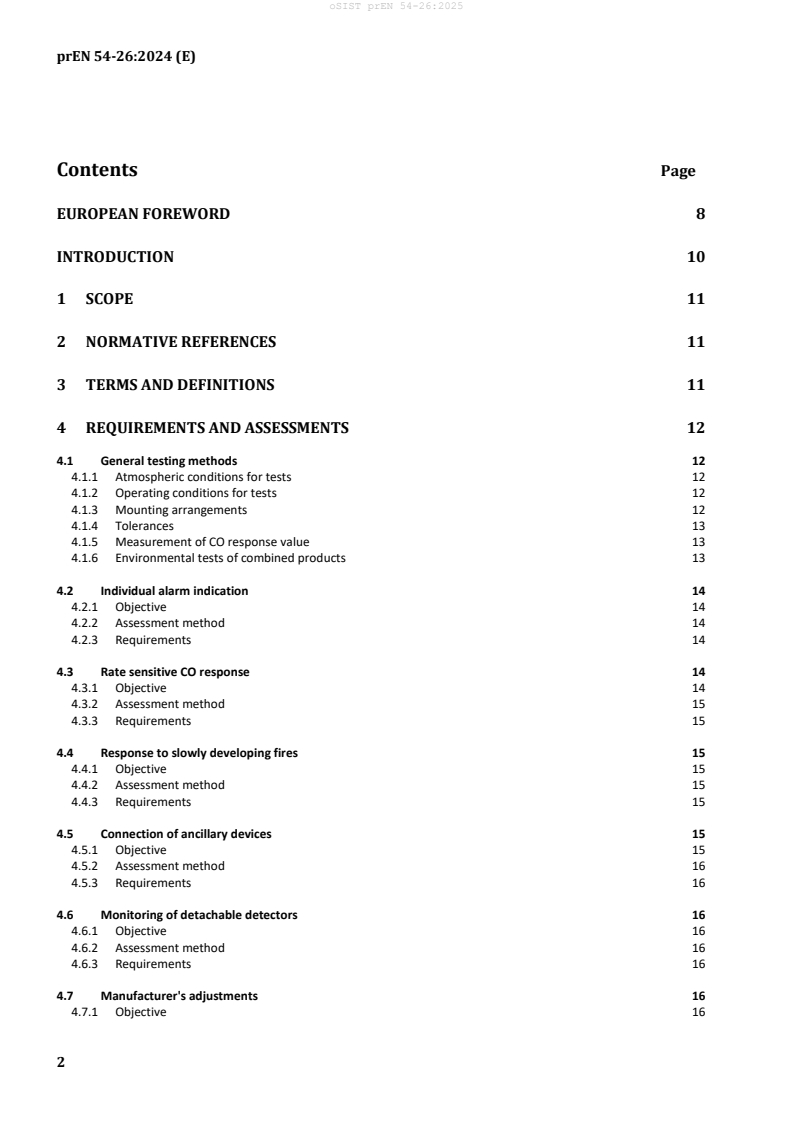
Contents Page
EUROPEAN FOREWORD 8
INTRODUCTION 10
1 SCOPE 11
2 NORMATIVE REFERENCES 11
3 TERMS AND DEFINITIONS 11
4 REQUIREMENTS AND ASSESSMENTS 12
4.1 General testing methods 12
4.1.1 Atmospheric conditions for tests 12
4.1.2 Operating conditions for tests 12
4.1.3 Mounting arrangements 12
4.1.4 Tolerances 13
4.1.5 Measurement of CO response value 13
4.1.6 Environmental tests of combined products 13
4.2 Individual alarm indication 14
4.2.1 Objective 14
4.2.2 Assessment method 14
4.2.3 Requirements 14
4.3 Rate sensitive CO response 14
4.3.1 Objective 14
4.3.2 Assessment method 15
4.3.3 Requirements 15
4.4 Response to slowly developing fires 15
4.4.1 Objective 15
4.4.2 Assessment method 15
4.4.3 Requirements 15
4.5 Connection of ancillary devices 15
4.5.1 Objective 15
4.5.2 Assessment method 16
4.5.3 Requirements 16
4.6 Monitoring of detachable detectors 16
4.6.1 Objective 16
4.6.2 Assessment method 16
4.6.3 Requirements 16
4.7 Manufacturer's adjustments 16
4.7.1 Objective 16
oSIST prEN 54-26:2025
prEN 54-26:2024 (E)
4.7.2 Assessment method 16
4.7.3 Requirements 16
4.8 On-site adjustment of response behaviour 16
4.8.1 Objective 16
4.8.2 Assessment method 16
4.8.3 Requirements 17
4.9 Software controlled detectors 17
4.9.1 Objective 17
4.9.2 Assessment method 17
4.9.3 Requirements 18
4.10 Repeatability 18
4.10.1 Objective 18
4.10.2 Assessment method 18
4.10.3 Requirements 18
4.11 Variation in supply parameters 18
4.11.1 Objective 18
4.11.2 Assessment method 19
4.11.3 Requirements 19
4.12 Reproducibility 19
4.12.1 Objective 19
4.12.2 Assessment method 19
4.12.3 Requirements 19
4.13 Fire sensitivity 19
4.13.1 Objective 19
4.13.2 Assessment method 19
4.13.3 Requirements 21
4.14 Long term stability (operational) 21
4.14.1 Objective 21
4.14.2 Assessment method 22
4.14.3 Requirements 22
4.15 Dry heat (operational) 22
4.15.1 Objective 22
4.15.2 Assessment method 22
4.15.3 Requirements 22
4.16 Dry heat (endurance) 23
4.16.1 Objective 23
4.16.2 Assessment method 23
4.16.3 Requirements 23
4.17 Cold (operational) 23
4.17.1 Objective 23
4.17.2 Assessment method 23
4.17.3 Requirements 24
4.18 Damp heat, cyclic (operational) 24
4.18.1 Objective 24
4.18.2 Assessment method 24
oSIST prEN 54-26:2025
prEN 54-26:2024 (E)
4.18.3 Requirements 25
4.19 Damp heat steady-state (operational) 25
4.19.1 Objective 25
4.19.2 Assessment method 25
4.19.3 Requirements 26
4.20 Damp heat steady-state (endurance) 26
4.20.1 Objective 26
4.20.2 Assessment method 26
4.20.3 Requirements 26
4.21 Low humidity, steady-state (operational) 26
4.21.1 Objective 26
4.21.2 Assessment method 27
4.21.3 Requirements 27
4.22 Shock (operational) 27
4.22.1 Objective 27
4.22.2 Assessment method 27
4.22.3 Requirements 28
4.23 Impact (operational) 28
4.23.1 Objective 28
4.23.2 Assessment method 28
4.23.3 Requirements 29
4.24 Vibration, sinusoidal (operational) 29
4.24.1 Objective 29
4.24.2 Assessment method 29
4.24.3 Requirements 30
4.25 Vibration, sinusoidal (endurance) 30
4.25.1 Objective 30
4.25.2 Assessment method 30
4.25.3 Requirements 30
4.26 Exposure to high level of carbon monoxide (operational) 31
4.26.1 Objective 31
4.26.2 Assessment method 31
4.26.3 Requirements 31
4.27 Exposure to chemical agents at environmental concentrations (operational) 31
4.27.1 Objective 31
4.27.2 Assessment method 31
4.27.3 Requirements 32
4.28 Sulphur dioxide (SO ) corrosion (endurance) 32
4.28.1 Objective 32
4.28.2 Assessment method 32
4.28.3 Requirements 33
4.29 Immunity against electromagnetic interferences (operational) 33
4.29.1 Objective 33
4.29.2 Assessment method 33
4.29.3 Requirements 34
oSIST prEN 54-26:2025
prEN 54-26:2024 (E)
5 MARKING, LABELLING AND SUPPLIED DATA 34
ANNEX A (NORMATIVE) GAS TEST CHAMBER FOR RESPONSE VALUE AND CROSS-
SENSITIVITY 35
A.1 GENERAL 35
A.2 GAS TEST CHAMBER SPECIFICATION 35
ANNEX B (NORMATIVE) CO AND SMOKE MEASURING INSTRUMENTS 37
B.1 GENERAL 37
B.2 CO MEASURING INSTRUMENTS 37
B.3 OBSCURATION METER 37
B.4 MEASURING IONIZATION CHAMBER (MIC) 37
ANNEX C (NORMATIVE) FIRE TEST ROOM 38
C.1 GENERAL 38
C.2 FIRE TEST ROOM SPECIFICATION 38
ANNEX D (NORMATIVE) SMOULDERING (PYROLYSIS) WOOD FIRE (TF2) 40
D.1 GENERAL 40
D.2 FUEL 40
D.3 HOTPLATE 40
D.4 ARRANGEMENT 40
D.5 HEATING RATE 40
D.6 END OF TEST CONDITION 40
D.7 TEST VALIDITY CRITERIA 40
ANNEX E (NORMATIVE) GLOWING SMOULDERING COTTON FIRE (TF3) 45
oSIST prEN 54-26:2025
prEN 54-26:2024 (E)
E.1 GENERAL 45
E.2 FUEL 45
E.3 ARRANGEMENT 45
E.4 IGNITION 46
E.5 END OF TEST CONDITION 46
E.6 TEST VALIDITY CRITERIA 46
ANNEX F (INFORMATIVE) INFORMATION CONCERNING THE CONSTRUCTION OF THE GAS
TEST CHAMBER 50
F.1 GENERAL 50
F.2 CONSTRUCTION OF THE GAS TEST CHAMBER 50
F.3 RECIRCULATING CO CHAMBER 50
F.4 DIFFUSION CO CHAMBER 52
F.5 VERIFICATION TIME CONSTANT AND OF MOUNTING POSITION FOR CO
MEASURING INSTRUMENT 53
ANNEX G (INFORMATIVE) ESTABLISHING EXPOSURE LEVELS OF CHEMICAL AGENTS 57
G.1 GENERAL 57
G.2 ESTABLISHING CONCENTRATION OF CHEMICAL AGENTS FOR TEST GASES 1 TO 9 57
G.3 VERIFICATION OF TEST CHAMBER LEAKAGE 57
G.4 ESTABLISHING CONCENTRATION OF OZONE 57
ANNEX H (INFORMATIVE) APPARATUS FOR IMPACT TEST 59
H.1 GENERAL 59
H.2 APPARATUS CONSTRUCTION 59
oSIST prEN 54-26:2025
prEN 54-26:2024 (E)
ANNEX I (INFORMATIVE) INFORMATION CONCERNING TEST PROCEDURES AND
ASSESSMENT FOR THE RESPONSE TO SLOWLY DEVELOPING FIRES 61
ANNEX J (INFORMATIVE) TEST SCHEDULE 65
J.1 GENERAL 65
J.2 PROVISION FOR TESTS 65
J.3 TEST SCHEDULE 65
ANNEX K (INFORMATIVE) SIGNIFICANCE OF EDITION CHANGES 67
K.1 GENERAL 67
K.2 EDITION CHANGES 67
oSIST prEN 54-26:2025
prEN 54-26:2024 (E)
European foreword
This document (prEN 54-26:2024) has been prepared by Technical Committee CEN/TC 72“Fire detection
and fire alarm systems”, the secretariat of which is held by BSI.
This document is currently submitted to the CEN Enquiry.
This document will supersede EN 54-26:2015.
EN 54, Fire detection and fire alarm systems, consists of the following parts:
— Part 1: Introduction;
— Part 2: Control and indicating equipment;
— Part 3: Fire alarm devices — Sounders;
— Part 4: Power supply equipment;
— Part 5: Heat detectors — Point heat detectors;
— Part 7: Smoke detectors — Point smoke detectors that operate using scattered light, transmitted light
or ionization [the present document];
— Part 10: Flame detectors — Point detectors;
— Part 11: Manual call points;
— Part 12: Smoke detectors — Line detectors using an optical light beam;
— Part 13: Compatibility and connectability assessment of system components;
— Part 14: Guidelines for planning, design, installation, commissioning, use and maintenance [CEN
Technical Specification];
— Part 16: Voice alarm control and indicating equipment;
— Part 17: Short circuit isolators;
— Part 18: Input/output devices;
— Part 20: Aspirating smoke detectors;
— Part 21: Alarm transmission and fault warning routing equipment;
— Part 22: Resettable line-type heat detectors [currently at acceptance stage];
— Part 23: Fire alarm devices — Visual alarms devices;
— Part 24: Components of voice alarm systems — Loudspeakers;
— Part 25: Components using radio links;
— Part 26: Carbon monoxide detectors — Point smoke detectors;
oSIST prEN 54-26:2025
prEN 54-26:2024 (E)
— Part 27: Duct smoke detectors;
— Part 28: Non-resettable line type heat detectors;
— Part 29: Multi-sensor fire detectors — Point smoke detectors using a combination of smoke and heat
sensors;
— Part 30: Multi-sensor fire detectors — Point smoke detectors using a combination of carbon
monoxide and heat sensors;
— Part 31: Multi-sensor fire detectors — Point smoke detectors using a combination of smoke, carbon
monoxide and optionally heat sensors;
— Part 32: Planning, design, installation, commissioning, use and maintenance of voice alarm systems.
NOTE This list includes standards that are in preparation and other standards can be added. For current status
of published standards refer to www. cencenelec.eu.
In comparison with the previous edition EN 54-26:2015, the following technical modifications have been
made:
— removal of directional dependence test and requirements for mounting orientation for fire tests and
CO response value measurement have been modified;
— removal of Air Movement test;
— in the Shock (operational) test the peak acceleration has been reduced as agreed by CEN/TC 72;
— in the Exposure to high level of carbon monoxide (operational) test the conditioning is at 500 µl/l to
align with other EN 54 CO standards;
— modifcication of Annex A, Gas test chamber and Annex F, Construction of the gas test chamber. This
allows the use of a diffusion test chamber in addition to the previously specified recirculating test
chamber.
oSIST prEN 54-26:2025
prEN 54-26:2024 (E)
Introduction
Carbon monoxide (CO) is a product of the incomplete combustion of carbon-based materials. CO fire
detectors can react promptly to smouldering fires involving carbonaceous materials because CO does not
depend solely on convection, but also moves by diffusion. CO fire detectors might be better suited to
applications where other fire detection techniques are prone to false alarms, i.e. due to dust, steam and
cooking vapours.
The purpose of this document is to ensure that carbon monoxide (CO) fire detectors have adequate
sensitivity and reliability for use in fire detection and fire alarm systems for residential commercial and
industrial premises. In many fire situations CO is not produced in detectable quantities where pyrolysis
of material rather than self-sustained combustion occurs (e.g. overheating cables) or in the early stages
of rapidly burning flaming fires (e.g. liquid fuel fires). It is important that carbon monoxide fire detectors
are only used where a risk assessment indicates that they are appropriate for detecting the types of fires
that may occur. CO fire detectors should not be considered as a direct replacement for smoke detectors.
CO fire detectors detect carbon monoxide gas rather than the smoke particulates detected by optical and
ionization smoke detectors.
A number of different methods for sensing CO are suitable. However, most sensors will also be influenced
by other gases and phenomena. Tests have therefore been included in the test schedule to assess cross-
sensitivity to substances normally present in the service environment that may affect the performance of
the detector.
As CO detectors are specifically well suited for the detection of incipient fires rather than flaming fires
this document only includes tests to verify performance in smouldering fires. For this purpose, test fires
TF2 and TF3 from EN 54-7 have been included in the test schedule. An additional validity criterion has
been added to each of these tests to make them suitable for evaluating CO fire detectors.
CO detectors are intended to be installed indoors, and only indoor environmental test severities are
specified in the test schedule.
The environmental tests specified in this standard cover normal general conditions. Other directives or
regulations applicable to the CO fire detector or installation guidelines may require other environmental
test methods or conditions (including test apparatus, procedure, and conditioning).
oSIST prEN 54-26:2025
prEN 54-26:2024 (E)
1 Scope
This document specifies product characteristics, test methods and performance criteria for point
detectors using carbon monoxide sensing (CO fire detectors) for use in fire detection and fire alarm
systems for buildings and civil engineering works.
2 Normative references
The following documents are referred to in the text in such a way that some or all of their content
constitutes requirements of this document. For dated references, only the edition cited applies. For
undated references, the latest edition of the referenced document (including any amendments) applies.
EN 54-1:2021, Fire detection and fire alarm systems — Part 1: Introduction
EN 54-7:2018, Fire detection and fire alarm systems — Part 7: Smoke detectors — Point smoke detectors
that operate using scattered light, transmitted light or ionization
EN 50130-4:2011+A1:2014, Alarm systems — Part 4: Electromagnetic compatibility — Product family
standard: Immunity requirements for components of fire, intruder, hold up, CCTV, access control and social
alarm systems
EN 60068-1:2014, Environmental testing — Part 1: General and guidance (IEC 60068-1:2013)
EN 60068-2-1:2007, Environmental testing — Part 2-1: Tests — Test A: Cold (IEC 60068-2-1:2007)
EN 60068-2-2:2007, Environmental testing — Part 2-2: Tests — Test B: Dry heat (IEC 60068-2-2:2007)
EN 60068-2-6:2008, Environmental testing — Part 2-6: Tests — Test Fc: Vibration (sinusoidal)
(IEC 60068-2-6:2007)
EN 60068-2-27:2009, Environmental testing — Part 2-27: Tests — Test Ea and guidance: Shock
(IEC 60068-2-27:2008)
EN 60068-2-30:2005, Environmental testing — Part 2-30: Tests — Test Db: Damp heat, cyclic (12 h + 12h
cycle) (IEC 60068-2-30:2005)
EN 60068-2-42:2003, Environmental testing — Part 2-42: Tests — Test Kc: Sulphur dioxide test for
contacts and connections (IEC 60068-2-42:2003)
EN 60068-2-78:2013, Environmental testing — Part 2-78: Tests — Test Cab: Damp heat, steady state
(IEC 60068-2-78:2012)
ISO 209:2007, Aluminium and aluminium alloys — Chemical composition
3 Terms and definitions
For the purposes of this document, the terms and definitions given in EN 54-1:2021 and the following
apply.
ISO and IEC maintain terminology databases for use in standardization at the following addresses:
— ISO Online browsing platform: available at https://www.iso.org/obp/ui/#home
— IEC Electropedia: available at https://www.electropedia.org/
oSIST prEN 54-26:2025
prEN 54-26:2024 (E)
3.1
CO response value
CO concentration in the proximity of the specimen at the moment that it generates an alarm signal, when
tested as described in 4.1.5
Note 1 to entry: The response value may depend on signal processing in the detector and in the control and
indicating equipment.
3.2
rate -sensitive
behaviour of a detector that depends on the rate of change of CO concentration
4 Requirements and assessments
4.1 General testing methods
4.1.1 Atmospheric conditions for tests
Unless otherwise stated in a test procedure, the testing shall be carried out after the test specimen has
been allowed to stabilize in the standard atmospheric conditions for testing as described in
EN 60068-1:2014 as follows:
— temperature: (15 to 35) °C;
— relative humidity: (25 to 75) %;
— air pressure: (86 to 106) kPa.
If variations in these parameters have a significant effect on a measurement, then such variations should
be kept to a minimum during a series of measurements carried out as part of one test on one specimen.
The ambient concentration of CO shall not exceed 3 µl/l.
4.1.2 Operating conditions for tests
If a test method requires a specimen to be operational, then the specimen shall be connected to suitable
supply and monitoring equipment with characteristics as required by the manufacturer's data. Unless
otherwise specified in the test method, the supply parameters applied to the specimen shall be set within
the manufacturer's specified range(s) and shall remain substantially constant throughout the tests. The
value chosen for each parameter shall normally be the nominal value, or the mean of the specified range.
If a test procedure requires a specimen to be monitored to detect any alarm or fault signals, then
connections shall be made to any necessary ancillary devices (e.g. through wiring to an end-of-line device
for conventional detectors) to allow a fault signal to be recognized.
The details of the supply and monitoring equipment and the alarm criteria used should be given in the
test report.
4.1.3 Mounting arrangements
The specimen shall be mounted by its normal means of attachment and in its normal orientation in
accordance with the manufacturer's instructions. If these instructions describe more than one method of
mounting, or more than one acceptable orientation, then the method considered to be most unfavourable
shall be chosen for each test.
oSIST prEN 54-26:2025
prEN 54-26:2024 (E)
4.1.4 Tolerances
Unless otherwise stated, the tolerances for the environmental test parameters shall be as given in the
basic reference standards for the test (e.g. the relevant part of EN 60068).
If a requirement or test procedure does not specify a tolerance or deviation limits, then deviation limits
of ± 5 % shall be applied.
4.1.5 Measurement of CO response value
The specimen, for which the CO response value shall be measured, shall be installed in the gas test
chamber, described in Annex A, in its normal operating position, by its normal means of attachment. The
orientation of the specimen, relative to the direction of airflow or gas diffusion, shall be selected
arbitrarily and recorded.
Before commencing each measurement, the gas test chamber shall be purged with clean air to ensure
that the concentration of CO in the chamber is less than 1,5 µl/l.
Unless otherwise specified in the test procedure, the air temperature in the gas test chamber shall be
(23 ± 5) °C and shall not vary by more than 5 K for all the measurements.
The specimen shall be connected to its supply and monitoring equipment as described in 4.1.2 and shall
be allowed to stabilize for a period of at least 15 min, unless otherwise specified by the manufacturer.
CO shall be introduced into the gas test chamber such that the rate of increase of CO concentration is
between 1 μl/l per min and 6 μl/l per min, unless otherwise specified in the test procedure. For detectors
with a rate sensitive behaviour, the manufacturer may specify a rate of increase within this range to
ensure that the measured CO response value is representative of the static CO response value of the
detector.
The same target rate of increase of CO concentration should be used for all measurements on a particular
detector type. Above 20 µl/l during the ramp the measured CO concentration shall not vary by more
than ± 2 µl/l from the target value.
The CO concentration at the moment that the specimen gives an alarm shall be recorded as S (μl/l). This
shall be taken as the CO response value.
NOTE The typical range of response values is between 25 µl/l and 60 µl/l.
4.1.6 Environmental tests of combined products
Where the CO fire detector has an additional function which in the scope of another standard in the EN 54
series (e.g. a detector and sounder or a manual call point and transmission path/short-circuit isolator),
the following points shall be considered for each environmental test when applied to the CO fire detector:
a) if the specific environmental test exists in both standards and the environmental conditions
(including test apparatus, procedure, and conditioning, when applicable) are the same, then the
conditioning shall be done only once. Tests before and after the conditioning shall be conducted
according to both standards as well as monitoring of all relevant signals of both standards during the
conditioning phase.
When special equipment to monitor and operate the specimen during/after conditioning is needed,
the equipment of both standards can be used together or in combination when it is assured that it
has no impact to the environmental conditions or the test and monitoring results. If this is not
possible or in cases of doubt, the environmental tests shall be done twice, each test based on applying
the standards separately and independently;
b) if the specific environmental test exists in both the standards but the environmental conditions
(including test apparatus, procedure, and conditioning, when applicable) are not the same, then the
oSIST prEN 54-26:2025
prEN 54-26:2024 (E)
environmental tests shall be done twice, each test based on applying the standards separately and
independently.
Measurements and monitoring signals as well as requirements shall be independent for each
environmental test. If it is expected that the environmental conditions will harm the product in any
way, a separate sample shall be used for each test;
c) if the specific environmental test exists only in one standard, then the environmental test shall be
done only once. Measurements and monitoring of signals, as well as any other requirement, shall be
applied only according to the standard that specifies the environmental test.
NOTE 1 Environmental tests are tests where the product is exposed to specific environmental conditions.
Measurements before, during or after the conditioning are performed to assess the ability of the product to function
correctly during or after the conditioning.
NOTE 2 The logic of the above specified procedure can also be applied in cases where the product is in the scope
of three or more standards by comparing pairs of standards in turn.
NOTE 3 Case c) implies that it is acceptable for an additional function to be susceptible to (or adversely affected)
by the conditioning. However, careful attention is needed to the criteria for each environmental test as expressed
in the standard being applied to ensure that the appropriate criteria is used.
4.2 Individual alarm indication
4.2.1 Objective
The CO fire detector is assessed to demonstrate the provision of an integral visual alarm indicator, by
which the detector that released an alarm can be identified, until the alarm indicator is externally reset.
For detachable detectors, the indicator may be integral with the base or the detector head.
4.2.2 Assessment method
One specimen shall be mounted in an ambient light intensity up to 500 lx at a distance of 6 m from the
observer. The mounting surface shall be perpendicular to the line of view.
When the detector is in alarm condition, it shall be indicated by a visual alarm indicator. The visibility of
the indicator shall be confirmed, and the colour of the indicator shall be recorded. The alarm indication
shall then be reset by an external signal.
Where other conditions of the detector can be visually indicated, it shall be confirmed and recorded that
they are clearly distinguishable from the alarm indication, except when the detector is switched into a
service mode.
4.2.3 Requirements
There shall be at least one distinguishable red alarm indicator, and the alarm indicator shall be resettable
by an external signal.
4.3 Rate sensitive CO response
4.3.1 Objective
The CO response value of the detector may depend on the rate of change of CO concentration in the
vicinity of the detector. Such behaviour may be incorporated in the detector design to improve the
discrimination between ambient CO levels and those generated by a fire.
oSIST prEN 54-26:2025
prEN 54-26:2024 (E)
The CO fire detector is assessed to demonstrate that if such rate sensitive behaviour is included then it
shall not lead to a significant reduction in the detector’s sensitivity to fires, nor to a significant increase
in the probability of false alarm.
4.3.2 Assessment method
The behaviour of the CO fire detector to rate sensitive CO response shall be assessed by analysis of the
circuit/software, and/or by physical tests and simulations.
NOTE This approach is used as it is not practical to make tests with all possible rates of increase in CO
concentration.
4.3.3 Requirements
The CO fire detector shall not signal an alarm condition when subjected to a step change in CO
concentration of 10 µl/l, superimposed on a background level between 0 µl/l and 1,5 µl/l.
4.4 Response to slowly developing fires
4.4.1 Objective
The CO fire detector is assessed to demonstrate that if automatic offset compensation” is provided, for
example to compensate for ageing of the CO sensor or the build-up of contaminants, then it shall not lead
to a significant change in the detector's sensitivity to slowly developing fires.
4.4.2 Assessment method
An analysis of the circuit/software and/or physical or software simulations of the CO fire detector's
response to slow increases in CO concentration shall be conducted to assess the provision for “drift
compensation”.
NOTE 1 This approach is used as it is not practical to make tests with all possible rates of increase in CO
concentration.
NOTE 2 Further information about the assessment is given in Annex I.
4.4.3 Requirements
If drift compensation is provided:
a) for any rate of increase in CO concentration R, which is greater than S/4 per hour (where S is the
detector's initial uncompensated CO response value), the time for the detector to give an alarm or
reach the compensated CO response value shall not exceed 1,6 × S/R by more than 100 s;
b) The range of compensation shall be limited such that, throughout this range, the compensation does
not cause the CO response value of the detector to change from its initial value by a factor greater
than 1,6.
4.5 Connection of ancillary devices
4.5.1 Objective
The CO fire detector is assessed to demonstrate that where the detector provides for connections to
ancillary devices (e.g. remote indicators, control relays), open- or short-circuit failures of these
connections shall not prevent the correct operation of the detector.
oSIST prEN 54-26:2025
prEN 54-26:2024 (E)
4.5.2 Assessment method
One specimen shall be mounted as described in 4.1.3, shall be connected to supply and monitoring
equipment as described in 4.1.2 and a simple functional test, i.e. providing a stimulus sufficient to
generate an alarm condition shall be conducted while each connection to ancillary devices has open- or
short-circuit failure.
4.5.3 Requirements
Where the detector provides for connections to ancillary devices the detector operates correctly with
open or short circuit failures on any connection to ancillary devices.
4.6 Monitoring of detachable detectors
4.6.1 Objective
The CO fire detector is assessed to demonstrate the provision of means for a remote monitoring system
(e.g. the control and indicating equipment) to detect the removal of the head from the base of the detector.
4.6.2 Assessment method
For detachable detectors, one specimen shall be mounted as described in 4.1.3, shall be connected to
supply and monitoring equipment as described in 4.1.2 and a visual inspection shall be conducted while
removing the head from the base.
4.6.3 Requirements
If the CO fire detector is detachable the removal of the detector head from the base is indicated as fault
signal at a remote monitoring system.
4.7 Manufacturer's adjustments
4.7.1 Objective
The CO fire detector is assessed to demonstrate that it shall not be possible to change the manufacturer's
settings except by special means.
4.7.2 Assessment method
A visual inspection of one specimen and its supporting data shall be conducted to assess the possibilities
of changing the manufacturer’s settings.
4.7.3 Requirements
It shall not be possible to change the manufacturer's settings except by special means (e.g. the use of a
special code or tool or by breaking or removing a seal).
4.8 On-site adjustment of response behaviour
4.8.1 Objective
The CO fire detector is assessed to demonstrate that if on site adjustment of response behaviour is
provided it should not enable non-compliance with this standard unless this is clearly marked.
4.8.2 Assessment method
A visual inspection of one specimen and its supporting data shall be conducted in conjunction with the
appropriate operation of the detector in order to assess the possibilities of on-site adjustment of the
detector response behaviour.
oSIST prEN 54-26:2025
prEN 54-26:2024 (E)
4.8.3 Requirements
If there is provision for on-site adjustment of the response behaviour of the detector, then the response
behaviour can only be adjusted by the use of a code or special tool or by removing the detector from its
base or mounting.
NOTE On-site adjustment of the detector response behaviour can either be carried out at the detector or via
the control and indicating equipment. A control and indicating equipment is considered a special tool.
4.9 Software controlled detectors
4.9.1 Objective
CO fire detectors which rely on software control are assessed to ensure the reliability of the software.
4.9.2 Assessment method
4.9.2.1 General
For CO fire detectors which rely on software control the manufacturer software documentation shall be
visually assessed as in 4.9.2.2 and 4.9.2.3.
4.9.2.2 Design overview
The software documentation shall be in sufficient detail for the design to be inspected and shall include
at least the following:
a) a functional description of the main program flow (e.g. as a flow diagram or structogram) including:
1) a brief description of the modules and the functions that they perform;
2) the way in which the modules interact;
3) the overall hierarchy of the program;
4) the way in which the software interacts with the hardware of the detector;
5) the way in which the modules are called, including any interrupt processing;
b) a description of which areas of memory are used for the various purposes (e.g. the program, site
specific data and running data);
c) a designation, by which the software and its version can be uniquely identified.
4.9.2.3 Design detail
If the design overview of 4.9.2.2 is not sufficient for the assessment additional documentation shall
comprise at least the following:
a) an overview of the whole system configuration, including all software and hardware components;
b) a description of each module of the program, containing at least:
1) the name of the module;
2) a description of the tasks performed;
oSIST prEN 54-26:2025
prEN 54-26:2024 (E)
3) a description of the interfaces, including the type of data transfer, the valid data range and the
checking for valid data;
c) full source code listings, as hard copy or in machine-readable form (e.g. ASCII-code), including all
global and local variables, constants and labels used, and sufficient comment for the program flow to
be recognized;
d) details of any software tools used in the design and implementation phase (e.g. CASE-tools,
compilers).
4.9.3 Requirements
The software shall have the following characteristics:
a) the software has a modular structure;
b) the design of the interfaces for manually and automatically generated data does not permit invalid
data to cause error in the program operation;
c) the software is designed to avoid the occurrence of deadlock of the program flow;
d) the program and pre-set data are held in non-volatile memory;
e) writing to areas of memory containing the program and pre-set data are only be possible by the use
of some special tool or code and shall not be possible during normal operation of the detector;
f) site-specific data are held in memory which will retain data for at least two weeks without external
power to the detector, unless provision is made for the automatic renewal of such data, following
loss of power, within 1 h of power being restored.
4.10 Repeatability
4.10.1 Objective
The CO fire detector is assessed to demonstrate that it has stable behaviour with respect to its sensitivity,
even after a number of alarm conditions.
4.10.2 Assessment method
The CO response value of one specimen shall be measured as described in 4.1.5 six times.
4.10.3 Requirements
The maximum response value shall be designated S , the minimum value shall be designated S .
max min
The ratio of the CO response values S : S shall not be greater than 1,6.
max min
The lower CO response value S shall not be less than 25 μl/l.
min
4.11 Variation in supply parameters
4.11.1 Objective
The CO fire detector is assessed to show that, within the specified range(s) of the supply parameters (e.g.
voltage), the sensitivity is not unduly dependent on these parameters.
oSIST prEN 54-26:2025
prEN 54-26:2024 (E)
4.11.2 Assessment method
The response value of the specimen shall be measured as described in 4.1.5, at the upper and lower limits
of the supply parameter (e.g. voltage) range(s) specified by the manufacturer. For the test the
manufacturer may provide suitable supply equipment to allow the supply parameters to be changed as
required.
The maximum response value shall be designated S and the minimum value shall be designated S .
max min
NOTE For conventional CO fire detectors, the supply parameter is the dc voltage applied to the detector. For
other types of detectors (e.g. addressable) signal levels and timing need to be considered to evaluate a
corresponding voltage applied to the detector.
4.11.3 Requirements
The ratio of the CO response values S : S shall not be greater than 1,6.
max min
The lower CO response value S shall not be less than 25 μl/l.
min
4.12 Reproducibility
4.12.1 Objective
The CO fire detector is assessed to demonstrate that the sensitivity of the detector does not vary unduly
from specimen to specimen.
4.12.2 Assessment method
The CO response value of all test specimens (minimum 20) shall be measured as described in 4.1.5.
The specimens shall be representative of the manufacturer's production limits with regard to their
construction and calibration. The upper and lower limits of the response values of all the specimens shall
also represent the upper and lower limit of the production.
4.12.3 Requirements
The mean of these CO response values shall be calculated and shall be designated S .
mean
The maximum response value shall be designated S and the minimum value shall be designated S .
max min
The ratio of the CO response values S : S shall not be greater than 1,33 and the ratio of the CO
max mean
response values S : S shall not be greater than 1,5.
mean min
The lower CO response value S shall not be less than 25 μl/l.
min
4.13 Fire sensitivity
4.13.1 Objective
The CO fire detector is assessed to demonstrate that it has adequate sensitivity to a broad spectrum of
fire types for the application in fire detection systems.
4.13.2 Assessment method
4.13.2.1 General
Four specimens are mounted in a standard fire test room and are exposed to a series of test fires designed
to produce smoke and CO.
oSIST prEN 54-26:2025
prEN 54-26:2024 (E)
The specimens shall be representative of least sensitive specimen of the manufacturer's production limits
(i.e. those with the latest response time when subjected to the test fires). In case of doubt the
manufacturer shall select representative specimen.
NOTE The specimen can be taken from the four least sensitive specimens of the reproducibility test.
4.13.2.2 Fire test room
The fire sensitivity tests shall be conducted in a rectangular room with a flat horizontal ceiling, and the
following dimensions:
— length: 9 m to 11 m;
— width: 6 m to 8 m;
— height: 3,8 m to 4,2 m.
The fire test room shall be equipped with the following measuring instruments arranged as indicated in
Annex C:
— temperature probe;
— measuring ionization chamber (MIC);
— obscuration meter;
— CO monitor.
4.13.2.3 Test fires
The specimens shall be subjected to two test fires, TF2 and TF3. The type, quantity and arrangement of
the fuel and the method of ignition are described in Annex D and Annex E, along with the end of test
condition and the required profile curve limits.
In order to be a valid test fire, the development of the fire shall be such that the profile curves of m against
y, m against time, and S against time fall within the specified limits, up to the time when all of the
specimens have generated an alarm signal or the end of test condition is reached, whichever is the earlier.
If these conditions are not met, then the test is invalid and shall be repeated. It is permissible, and may
be necessary, to adjust the quantity, condition (e.g. moisture content) and arrangement of the fuel to
obtain valid test fires.
4.13.2.4 Mounting of the specimens
The specimens shall be mounted on the fire test room ceiling in the designated area (see Annex C). The
specimens shall be mounted in accordance with the manufacturer's instructions, such that specimens are
in different orientations with respect to the fire, in 90° steps. If there is some asymmetry in the CO sensor
position within the detector, then the first orientation should be with the CO sensor placed away from
the fire. If there is no asymmetry in the CO sensor position within the detector, then an LED or other
distinguishing feature should be used as the initial orientation and the feature used shall be recorded.
Each specimen shall be connected to its supply and monitoring equipment, as described in 4.1.2, and shall
be allowed to stabilize in its quiescent condition before the start of each test fire.
For detectors which dynamically modify their sensitivity in response to varying ambient conditions and
require special reset procedures or stabilization times, or both, the manufacturer’s guidance shall be
sought to ensure that the state of the detectors at the start of each test is representative of their normal
quiescent state.
oSIST prEN 54-26:2025
prEN 54-26:2024 (E)
4.13.2.5 Initial conditions
Before each test fire the room shall be ventilated with clean air until it is free from smoke and CO, and so
that the conditions listed below can be obtained.
The ventilation system shall then be switched off and all doors, windows and other openings shall be
closed. The air in the room shall then be allowed to stabilize, and the following conditions shall be
obtained before the test is started:
— air temperature T: (23 ± 5) °C;
— air movement: negligible;
— smoke density (ionization): y ≤ 0,05;
— smoke density (optical): m ≤ 0,02 dB/m;
— CO concentration: S ≤ 3 µl/l.
The stability of the air, and temperature gradients, affect the flow of smoke and CO within the room. This
is particularly important for test fires TF2 and TF3 which produce low thermal lift for the smoke and CO.
It is therefore recommended that the difference between the temperature near the floor and the ceiling
is lower than 2 K, and that local heat sources that can cause convection currents (e.g. lights and heaters)
should be avoided. If it is necessary for people to be in the room at the beginning of a test fire, they should
leave as soon as possible, taking care to produce the minimum disturbance to the air.
4.13.2.6 Recording of the fire parameters and response values
During each test fire the following fire parameters shall be recorded continuously or at least once per
second:
— ΔT: air temperature in K;
— y: smoke density (ionization, dimensionless);
— m: smoke density (optical) in dB/m;
— S: CO concentration in μl/l.
The measuring instruments used to record the values of y, m and S during the test fires are further
specified in Annex B.
The alarm signal given by the supply and monitoring equipment shall be taken as the indication that a
specimen has responded to the test fire.
The time of response of each specimen shall be recorded along with the fire parameters y, m, S, and ΔT at
the moment of response.
4.13.3 Requirements
All four specimens shall generate an alarm signal, in each test fire, before the specified end of test
condition is reached.
4.14 Long term stability (operational)
4.14.1 Objective
The CO fire detector is assessed to confirm that its response value is stable over long periods of time.
oSIST prEN 54-26:2025
prEN 54-26:2024 (E)
4.14.2 Assessment method
Before the conditioning, CO response value of one specimen shall be measured as described in 4.1.5. The
measured value shall be designated S .
before
For the conditioning, the specimen shall be mounted as described in 4.1.3 and shall be connected to its
supply and monitoring equipment as described in 4.1.2.
The following conditioning shall be applied:
— laboratory atmospheric conditions (see 4.1.1);
— duration: 84 days.
During the conditioning, the specimen shall be monitored for alarm or fault signals.
After the conditioning period, the CO response value shall be measured as described in 4.1.5. The
measured value shall be designated S .
after
4.14.3 Requirements
The status of the monitored alarm or fault signals during the conditioning shall not change.
The greater of S and S
...