


FprEN IEC 63399:2024
(Main)Household and similar electrical rice cookers - Methods for measuring the performance
Household and similar electrical rice cookers - Methods for measuring the performance
IEC 63399:2024 applies to household and similar electrical rice cookers. This document defines the main performance characteristics that are of interest to the user and specifies methods for measuring these characteristics. This document does not specify the requirements for performance. This document does not apply to the pressure type rice cooker or the micro-pressure rice cooker. This document does not apply to rice cookers with the rated volume of rice cooker larger than 8 L. The pressure type rice cooker refers to a rice cooker that cooks at a pressure more than 40 kPa. The micro-pressure rice cooker refers to a rice cooker that cooks at a pressure larger than 10 kPa but not more than 40 kPa. This document does not deal with safety requirements (covered in IEC 60335-2-15).
Elektrische Reiskocher für den Hausgebrauch und ähnliche Zwecke – Verfahren zur Messung der Gebrauchseigenschaften
Cuiseurs à riz électrodomestiques et analogues - Méthodes de mesure de l'aptitude à la fonction
L'IEC 63399:2024 s'applique aux cuiseurs à riz électrodomestiques et analogues. Le présent document définit les caractéristiques d'aptitude à la fonction principales qui sont pertinentes pour l'utilisateur et spécifie les méthodes de mesure de ces caractéristiques. Le présent document ne spécifie pas les exigences pour l'aptitude à la fonction de ces appareils. Le présent document ne s'applique pas aux cuiseurs à riz à pression ni aux cuiseurs à riz à micropression. Le présent document ne s'applique pas aux cuiseurs à riz dont le volume assigné du cuiseur à riz est supérieur à 8 L. Un cuiseur à riz à pression est un cuiseur à riz qui cuit à une pression supérieure à 40 kPa. Un cuiseur à riz à micropression est un cuiseur à riz qui cuit à une pression supérieure à 10 kPa, mais inférieure ou égale à 40 kPa. Le présent document ne traite pas des exigences de sécurité (couvertes par l'IEC 60335-2-15).
Gospodinjski in podobni električni kuhalniki za riž - Metode za merjenje učinkovitost delovanja
General Information
- Status
- Not Published
- Publication Date
- 15-Dec-2024
- Technical Committee
- CLC/TC 59X - Consumer information related to household electrical appliances
- Drafting Committee
- IEC/SC 59L - IEC_SC_59L
- Current Stage
- 5098 - Decision to drop project - Standstill maintained / released - Formal Approval
- Start Date
- 14-Oct-2024
- Completion Date
- 20-Feb-2026
Overview
FprEN IEC 63399:2024 establishes standardized methods for measuring the performance of household and similar electrical rice cookers. Developed by the International Electrotechnical Commission (IEC) and CENELEC (CLC), this standard targets key performance characteristics that are important to end-users and testing organizations. It is specifically applicable to rice cookers with a rated volume of up to 8 liters and excludes pressure and micro-pressure rice cookers. Importantly, the document does not specify minimum performance requirements or address safety concerns, which are covered under other standards such as IEC 60335-2-15.
By providing consistent, repeatable measurement methods, FprEN IEC 63399:2024 supports manufacturers, testing laboratories, and regulators in evaluating product performance and facilitating market comparison. This helps drive product improvement, transparency, and informed purchasing decisions.
Key Topics
FprEN IEC 63399:2024 focuses on objective performance testing for rice cookers. The following measurement methods and areas are covered:
- Physical measurements: Determining the actual inner pot volume and verifying deviation from the manufacturer’s declared volume.
- Durability: Assessing coating abrasion and corrosion resistance of the inner pot to ensure longevity.
- Cooking performance: Evaluating uniformity of rice cooking, moisture deviation, and levels of burnt rice through standardized cooking and assessment procedures.
- Temperature retention: Measuring temperature maintenance during the keep-warm state to assess how well the cooker preserves rice quality post-cooking.
- Energy efficiency: Calculating energy use during the cooking process for comparable efficiency ratings.
- Power consumption: Measuring standby power, reservation state power (when start delay is set), and consumption during the keep-warm state.
- Performance in low voltage conditions: Assessing functionality under less-than-optimal electrical supply situations.
- Endurance of operation: Verifying long-term functional reliability over repeated use cycles.
The standard includes annexes for evaluating cooked rice texture and appearance, as well as criteria for burnt conditions.
Applications
FprEN IEC 63399:2024 is intended for use by:
- Manufacturers: To validate claims and optimize product design by applying harmonized test protocols for performance features such as overall cooking result, inner pot quality, and energy efficiency.
- Test laboratories: As a reference document to ensure reliable, reproducible, and comparable results across various rice cooker brands and models.
- Regulatory bodies/market surveillance: For verifying compliance with voluntary or mandatory efficiency and performance labeling programs.
- Consumers and retailers: To enable comparison of key characteristics such as cooking uniformity, energy consumption, and quality consistency based on standardized test data.
- Procurement specialists: As a tool to specify or assess product performance using internationally recognized measurement methods.
Implementing the standard promotes fair competition, user satisfaction, and transparency in the small appliance market segment.
Related Standards
For a comprehensive evaluation and compliance regime, users should consider the following related standards:
- IEC 60335-2-15: Safety requirements for household electric heating appliances, including rice cookers.
- IEC 62301: Methods for measuring standby power in household electrical appliances, referenced for standby and reservation power consumption assessment in IEC 63399.
- ISO/IEC Directives, Part 2: Reference for documentation drafting and harmonization.
- Other relevant small appliance standards under IEC SC 59L, covering performance and testing of related kitchen appliances.
By adopting FprEN IEC 63399:2024 and the complementary standards, stakeholders ensure thorough, comparable, and reliable performance assessments for household electrical rice cookers. This fosters trust and advances quality across the global appliance industry.

Frequently Asked Questions
FprEN IEC 63399:2024 is a draft published by CLC. Its full title is "Household and similar electrical rice cookers - Methods for measuring the performance". This standard covers: IEC 63399:2024 applies to household and similar electrical rice cookers. This document defines the main performance characteristics that are of interest to the user and specifies methods for measuring these characteristics. This document does not specify the requirements for performance. This document does not apply to the pressure type rice cooker or the micro-pressure rice cooker. This document does not apply to rice cookers with the rated volume of rice cooker larger than 8 L. The pressure type rice cooker refers to a rice cooker that cooks at a pressure more than 40 kPa. The micro-pressure rice cooker refers to a rice cooker that cooks at a pressure larger than 10 kPa but not more than 40 kPa. This document does not deal with safety requirements (covered in IEC 60335-2-15).
IEC 63399:2024 applies to household and similar electrical rice cookers. This document defines the main performance characteristics that are of interest to the user and specifies methods for measuring these characteristics. This document does not specify the requirements for performance. This document does not apply to the pressure type rice cooker or the micro-pressure rice cooker. This document does not apply to rice cookers with the rated volume of rice cooker larger than 8 L. The pressure type rice cooker refers to a rice cooker that cooks at a pressure more than 40 kPa. The micro-pressure rice cooker refers to a rice cooker that cooks at a pressure larger than 10 kPa but not more than 40 kPa. This document does not deal with safety requirements (covered in IEC 60335-2-15).
FprEN IEC 63399:2024 is classified under the following ICS (International Classification for Standards) categories: 97.040.50 - Small kitchen appliances. The ICS classification helps identify the subject area and facilitates finding related standards.
FprEN IEC 63399:2024 is available in PDF format for immediate download after purchase. The document can be added to your cart and obtained through the secure checkout process. Digital delivery ensures instant access to the complete standard document.
Standards Content (Sample)
SLOVENSKI STANDARD
oSIST prEN IEC 63399:2023
01-december-2023
Gospodinjski in podobni električni kuhalniki za riž - Metode za merjenje
zmogljivosti
Household and similar electrical rice cookers - Methods for measuring the performance
Ta slovenski standard je istoveten z: prEN IEC 63399:2023
ICS:
97.040.50 Majhni gospodinjski aparati Small kitchen appliances
oSIST prEN IEC 63399:2023 en
2003-01.Slovenski inštitut za standardizacijo. Razmnoževanje celote ali delov tega standarda ni dovoljeno.
oSIST prEN IEC 63399:2023
oSIST prEN IEC 63399:2023
59L/244/CDV
COMMITTEE DRAFT FOR VOTE (CDV)
PROJECT NUMBER:
IEC 63399 ED1
DATE OF CIRCULATION: CLOSING DATE FOR VOTING:
2023-10-20 2024-01-12
SUPERSEDES DOCUMENTS:
59L/232/CD, 59L/243/CC
IEC SC 59L : SMALL HOUSEHOLD APPLIANCES
SECRETARIAT: SECRETARY:
Italy Mr Davide Pietrosemoli
OF INTEREST TO THE FOLLOWING COMMITTEES: PROPOSED HORIZONTAL STANDARD:
Other TC/SCs are requested to indicate their interest, if any, in
this CDV to the secretary.
FUNCTIONS CONCERNED:
EMC ENVIRONMENT QUALITY ASSURANCE SAFETY
SUBMITTED FOR CENELEC PARALLEL VOTING NOT SUBMITTED FOR CENELEC PARALLEL VOTING
Attention IEC-CENELEC parallel voting
The attention of IEC National Committees, members of
CENELEC, is drawn to the fact that this Committee Draft for Vote
(CDV) is submitted for parallel voting.
The CENELEC members are invited to vote through the
CENELEC online voting system.
This document is still under study and subject to change. It should not be used for reference purposes.
Recipients of this document are invited to submit, with their comments, notification of any relevant patent rights of which they are
aware and to provide supporting documentation.
Recipients of this document are invited to submit, with their comments, notification of any relevant “In So me Countries” clauses to
be included should this proposal proceed. Recipients are reminded that the CDV stage is the final stage for submitting ISC cl auses.
(SEE AC/22/2007 OR NEW GUIDANCE DOC).
TITLE:
Household and similar electrical rice cookers - Methods for measuring the performance
PROPOSED STABILITY DATE: 2027
NOTE FROM TC/SC OFFICERS:
electronic file, to make a copy and to print out the content for the sole purpose of preparing National Committee positions. You
may not copy or "mirror" the file or printed version of the document, or any part of it, for any other purpose without permis sion in
writing from IEC.
oSIST prEN IEC 63399:2023
IEC CDV 63399 © IEC 2023 - 2 - 59L/244/CDV
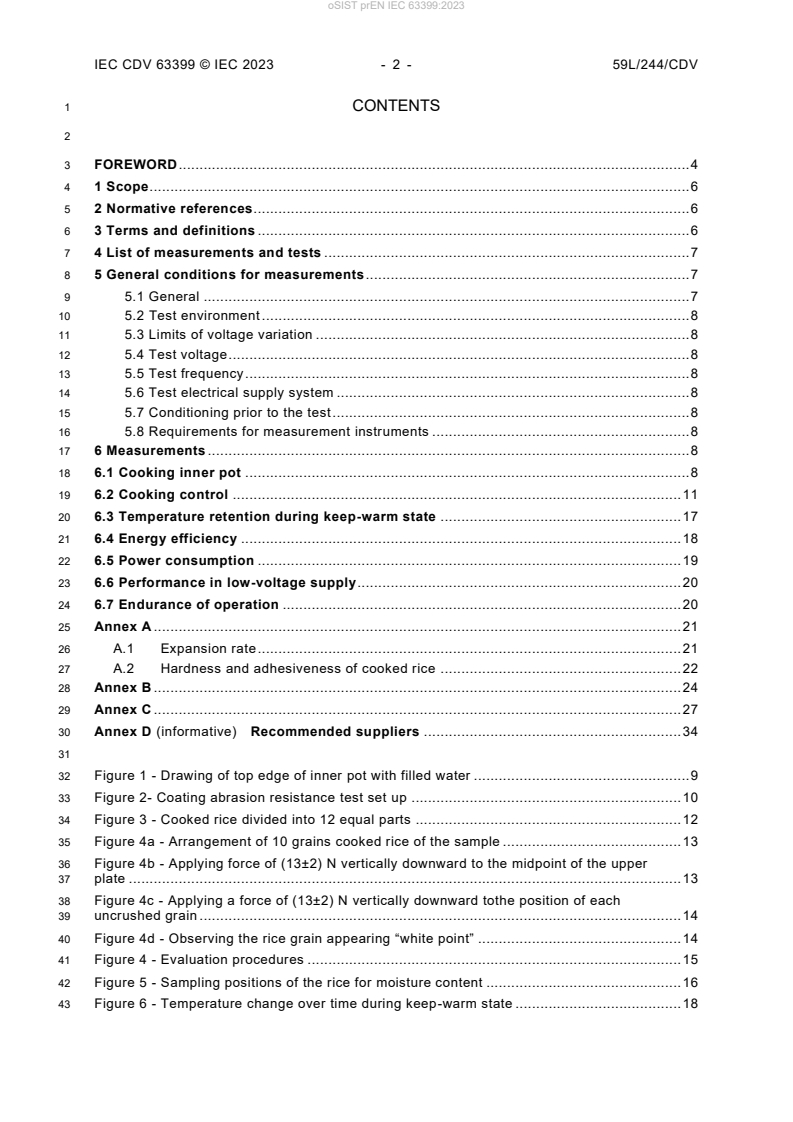
1 CONTENTS
3 FOREWORD . 4
4 1 Scope . 6
5 2 Normative references. 6
6 3 Terms and definitions . 6
7 4 List of measurements and tests . 7
8 5 General conditions for measurements . 7
9 5.1 General . 7
10 5.2 Test environment . 8
11 5.3 Limits of voltage variation . 8
12 5.4 Test voltage . 8
13 5.5 Test frequency . 8
14 5.6 Test electrical supply system . 8
15 5.7 Conditioning prior to the test . 8
16 5.8 Requirements for measurement instruments . 8
17 6 Measurements . 8
18 6.1 Cooking inner pot . 8
19 6.2 Cooking control . 11
20 6.3 Temperature retention during keep-warm state . 17
21 6.4 Energy efficiency . 18
22 6.5 Power consumption . 19
23 6.6 Performance in low-voltage supply . 20
24 6.7 Endurance of operation . 20
25 Annex A . 21
26 A.1 Expansion rate . 21
27 A.2 Hardness and adhesiveness of cooked rice . 22
28 Annex B . 24
29 Annex C . 27
30 Annex D (informative) Recommended suppliers . 34
32 Figure 1 - Drawing of top edge of inner pot with filled water . 9
33 Figure 2- Coating abrasion resistance test set up . 10
34 Figure 3 - Cooked rice divided into 12 equal parts . 12
35 Figure 4a - Arrangement of 10 grains cooked rice of the sample . 13
36 Figure 4b - Applying force of (13±2) N vertically downward to the midpoint of the upper
37 plate . 13
38 Figure 4c - Applying a force of (13±2) N vertically downward tothe position of each
39 uncrushed grain . 14
40 Figure 4d - Observing the rice grain appearing “white point” . 14
41 Figure 4 - Evaluation procedures . 15
42 Figure 5 - Sampling positions of the rice for moisture content . 16
43 Figure 6 - Temperature change over time during keep-warm state . 18
oSIST prEN IEC 63399:2023
IEC CDV 63399 © IEC 2023 - 3 - 59L/244/CDV
44 Figure 7 Location of virtual cylinder in inner pot and dimension of cylinder . 19
45 Figure A.1 - Texture characteristics curve from measurement of texture analyzer . 23
46 Figure B.1 - Reference pictures of “white points” . 26
47 Figure C.1 - Example of Level 1 of burnt condition . 27
48 Figure C.2 - Example of Level 2 of burnt condition . 28
49 Figure C.3 - Example of Level 3 of burnt condition . 28
50 Figure C.4 - Example of Level 4 of burnt condition . 29
51 Figure C.5 - Example of Level 5 of burnt condition . 29
52 Figure C.6 - Example of Level 6 of burnt condition . 30
53 Figure C.7 - Example of Level 7 of burnt condition . 30
54 Figure C.8 - Example of Level 8 of burnt condition . 31
55 Figure C.9 - Example of Level 9 of burnt condition . 31
56 Figure C.10 - Example of Level 10 of burnt condition . 32
57 Figure C.11 - Example of Level 11 of burnt condition . 32
58 Figure C.12- Example of Level 12 of burnt condition . 33
59 Figure C.13- Example of Level 13 of burnt condition . 33
61 Table A.1 Texture analyzer measuring parameter . 22
oSIST prEN IEC 63399:2023
IEC CDV 63399 © IEC 2023 - 4 - 59L/244/CDV
64 INTERNATIONAL ELECTROTECHNICAL COMMISSION
65 ____________
67 HOUSEHOLD AND SIMILAR ELECTRICAL RICE COOKERS–
68 METHODS FOR MEASURING THE PERFORMANCE
70 FOREWORD
72 1) The International Electrotechnical Commission (IEC) is a worldwide organization for
73 standardization comprising all national electrotechnical committees (IEC National
74 Committees). The object of IEC is to promote international co-operation on all questions
75 concerning standardization in the electrical and electronic fields. To this end and in addition
76 to other activities, IEC publishes International Standards, Technical Specifications,
77 Technical Reports, Publicly Available Specifications (PAS) and Guides (hereafter referred to
78 as “IEC Publication(s)”). Their preparation is entrusted to technical committees; any IEC
79 National Committee interested in the subject dealt with may participate in this preparatory
80 work. International, governmental and non-governmental organizations liaising with the IEC
81 also participate in this preparation. IEC collaborates closely with the International
82 Organization for Standardization (ISO) in accordance with conditions determined by
83 agreement between the two organizations.
84 2) The formal decisions or agreements of IEC on technical matters express, as nearly as
85 possible, an international consensus of opinion on the relevant subjects since each technical
86 committee has representation from all interested IEC National Committees.
87 3) IEC Publications have the form of recommendations for international use and are accepted
88 by IEC National Committees in that sense. While all reasonable efforts are made to ensure
89 that the technical content of IEC Publications is accurate, IEC cannot be held responsible
90 for the way in which they are used or for any misinterpretation by any end user.
91 4) In order to promote international uniformity, IEC National Committees undertake to apply
92 IEC Publications transparently to the maximum extent possible in their national and regional
93 publications. Any divergence between any IEC Publication and the corresponding national
94 or regional publication shall be clearly indicated in the latter.
95 5) IEC itself does not provide any attestation of conformity. Independent certification bodies
96 provide conformity assessment services and, in some areas, access to IEC marks of
97 conformity. IEC is not responsible for any services carried out by independent certification
98 bodies.
99 6) All users should ensure that they have the latest edition of this publication.
100 7) No liability shall attach to IEC or its directors, employees, servants or agents including
101 individual experts and members of its technical committees and IEC National Committees
102 for any personal injury, property damage or other damage of any nature whatsoever, whether
103 direct or indirect, or for costs (including legal fees) and expenses arising out of the
104 publication, use of, or reliance upon, this IEC Publication or any other IEC Publications.
105 8) Attention is drawn to the normative references cited in this publication. Use of the referenced
106 publications is indispensable for the correct application of this publication.
107 9) Attention is drawn to the possibility that some of the elements of this IEC Publication may
108 be the subject of patent rights. IEC shall not be held responsible for identifying any or all
109 such patent rights.
110 International Standard has been prepared by subcommittee 59L: Small household appliances,
111 of IEC technical committee Performance of household and similar electrical appliances:
112 The text of this standard is based on the following documents:
oSIST prEN IEC 63399:2023
IEC CDV 63399 © IEC 2023 - 5 - 59L/244/CDV
FDIS Report on voting
59L/XXX/FDIS 59L/XXX/RVD
114 Full information on the voting for the approval of this standard can be found in the report on
115 voting indicated in the above table.
116 This publication has been drafted in accordance with the ISO/IEC Directives, Part 2.
117 The committee has decided that the contents of this publication will remain unchanged until the
118 stability date indicated on the IEC website under "http://webstore.iec.ch" in the data related to
119 the specific publication. At this date, the publication will be
120 • reconfirmed,
121 • withdrawn,
122 • replaced by a revised edition, or
123 • amended.
125 The National Committees are requested to note that for this publication the stability date is
126 2027.
127 THIS TEXT IS INCLUDED FOR THE INFORMATION OF THE NATIONAL COMMITTEES AND WILL BE DELETED
128 AT THE PUBLICATION STAGE.
oSIST prEN IEC 63399:2023
IEC CDV 63399 © IEC 2023 - 6 - 59L/244/CDV
133 HOUSEHOLD AND SIMILAR ELECTRICAL RICE COOKERS–
134 METHODS FOR MEASURING THE PERFORMANCE
137 1 Scope
138 This International Standard applies to household and similar electrical rice cookers.
139 This standard defines the main performance characteristics that are of interest to the user and
140 specifies methods for measuring these characteristics.
141 This standard does not specify the requirements for performance.
142 This standard does not apply to the pressure type rice cooker or the micro-pressure rice
143 cooker.
144 NOTE 1 The pressure type rice cooker refers to a rice cooker that cooks at a pressure more than 40 kPa.
145 NOTE 2 The micro-pressure rice cooker refers to a rice cooker that cooks at a pressure larger than 10 kPa but
146 not more than 40 kPa.
147 NOTE 3 This standard does not deal with safety requirements (IEC 60335-2-15).
148 NOTE 4 Some of the tests which are specified in this standard are not considered to be reproducible since the
149 results may vary between laboratories. They are therefore intended for comparative testing purposes only.
150 2 Normative references
151 The following referenced documents are indispensable for the application of this document. For
152 dated references, only the edition cited applies. For undated references, the latest edition of
153 the referenced document (including any amendments) applies.
154 IEC 62301 Household electrical appliances – Measurement of standby power
155 3 Terms and definitions
156 For the purpose of this document, the following definitions apply.
157 3.1
158 rice cooker
159 appliance for cooking rice that is placed in a detachable inner pot, the inner pot being placed
160 within the appliance when cooking
161 3.2
162 Rated volume of rice cooker
163 total volume of the inner pot of a rice cooker declared by the manufacturer
164 3.3
165 stand-by mode
166 any product modes where the energy using product is connected to a mains power source
167 and offers one or more of the following user oriented or protective functions which usually
168 persist
169 - to facilitate the activation of other modes (including activation or deactivation of active
170 mode) by remote switch (including remote control), internal sensor, timer;
171 - continuous function: information or status displays including clocks;
oSIST prEN IEC 63399:2023
IEC CDV 63399 © IEC 2023 - 7 - 59L/244/CDV
172 - continuous function: sensor-based functions
173 NOTE: Optional definition: a power on state in which the rice cooker is ready for interaction with the user, before
174 confirming to heat up or cook.
175 3.4
176 reservation state
177 a power on state in which the rice cooker counts the timing and starts to work once a period
178 of time set by the user in advance elapses
179 3.5
180 keep-warm state
181 a power on state in which the rice cooker keeps a low electric heating power to maintain the
182 warm temperature of the cooked rice
183 3.6
184 expansion rate
185 the ratio of the volume increase of the cooked rice to the volume of the raw rice
186 NOTE: The raw rice becomes bigger sized after cooked.
187 4 List of measurements and tests
188 - Volume of inner pot of rice cooker (6.1.1)
189 - Endurance of the inner pot coatings– abrasion resistance (6.1.2)
190 - Endurance of the inner pot coatings– corrosion resistance (6.1.3)
191 - Cooking uniformity (6.2.1)
192 - Moisture deviation (6.2.2)
193 - Burnt levels of the cooked rice (6.2.3)
194 - Temperature retention during keep-warm state (6.3)
195 - Energy efficiency (6.4)
196 - Power consumption in stand-by mode(6.5.1)
197 - Power consumption in reservation state(6.5.2)
198 - Power consumption during keep-warm state(6.5.3)
199 - Performance in low-voltage supply (6.6)
200 - Endurance of operation (6.7)
201 Evaluation of physical characteristics of the cooked rice is provided in an informative Annex A.
202 5 General conditions for measurements
203 Unless otherwise specified, the tests are carried out under the conditions of 5.1 to 5.8.
204 5.1 General
205 If the instructions for use of the rice cooker recommend the setting, then that setting shall be
206 used.
--``````-`-`,,`,,`,`,,`---
oSIST prEN IEC 63399:2023
IEC CDV 63399 © IEC 2023 - 8 - 59L/244/CDV
207 If the instructions for use of the rice cooker do not recommend the setting, the default
208 function setting shall be used.
209 Unless otherwise specified, the water used in the test is the drinking water with the ambient
210 temperature.
211 NOTE The drinking water refers to the water which is used for cooking in the area of the lab .
212 5.2 Test environment
213 The tests are carried out in a draught-free location at an ambient temperature of 20 °C ± 5 °C.
214 Ambient temperature is maintained at 23 °C ± 2 °C for temperature-sensitive cooking and
215 warming performance.
216 The relative humidity is maintained at 45%~75%.
217 The air pressure for the test shall be 98kPa~102kPa.
218 5.3 Limits of voltage variation
219 During the tests, the variation in the voltage shall not exceed ±1 % of the test voltage.
220 5.4 Test voltage
221 Unless otherwise specified, the tests are carried out at a specific voltage within a voltage range
222 (e.g. 100V to 240V) or at the rated voltage or voltages (e.g. 120V, or 120V and 240V).
223 5.5 Test frequency
224 The appliances are tested at the rated frequency or within a rated frequency range( e.g. rated
225 as 50 Hz and 60 Hz, or 50 Hz to 60 Hz).
226 5.6 Test electrical supply system
227 Total harmonic distortion of the test electrical supply system shall be less than 5%.
228 5.7 Conditioning prior to the test
229 The rice cooker including the inner pot, the outer pot and the water for the test, shall remain
230 6 h under the ambient temperature.
231 The control setting of the rice cooker shall be set to the function of rice-cooking.
232 5.8 Requirements for measurement instruments
233 The accuracy of voltmeter and wattmeter shall not be larger than ±0.5 %.
234 The resolution of the instrument used to measure temperature shall be 0.1°C.
235 With full scale, the relative error of weighing apparatus shall not exceed ±0.1 % and their
236 resolution shall be less than 1 g.
237 The accuracy of time shall be ± 5 s.
238 The wire diameter of thermocouple shall not be larger than 0.3 mm.
239 6 Measurements
240 6.1 Cooking inner pot
241 6.1.1 Volume of inner pot of rice cooker
242 a) The mass of the inner pot is weighed and recorded as m1;
243 b) The inner pot is positioned horizontally, and filled with the water until the level of water
244 reaches the top edge of the inner pot. See Figure 1. The total weight of the inner pot and
245 water is measured and recorded as m. If the top surface of water is affected by the surface
246 tension, the water is leveled with a surfactant;
oSIST prEN IEC 63399:2023
IEC CDV 63399 © IEC 2023 - 9 - 59L/244/CDV
247 NOTE: Any commercially available rinsing agent may be used as the surfactant.
248 c) The actual volume of the inner pot is calculated by the formula (1) as below. The
249 deviation from the rated volume of rice cooker is calculated by the formula (2).
m−m
250 V = (1)
c
251 Where
252 V - the actual volume of the inner pot, in L;
c
253 m- the total mass of the inner pot and water filled in it, in kg;
254 m1- the mass of the inner pot, in kg;
255 ρ- the density of water, taken as 1 kg/L.
V
c
257 = 100% (2)
V
e
258 Where
259 δ - the volume deviation of the inner pot, round off two decimal place;
260 Vc - the actual volume of the inner pot, in L;
261 V - the rated volume of rice cooker, in L.
e
265 Figure 1 - Drawing of top edge of inner pot with filled water
266 6.1.2 Endurance of the inner pot coatings -Abrasion resistance
267 The test set up is shown in Figure 2.
268 A clean inner pot of a rice cooker is fixed on the test equipment as shown in Figure 2.The
269 size of the jig to which the scouring pad is attached is 60 mm ± 3 mm in length and 20 mm ± 3
270 mm in width. The scouring pad (Type: 3M7447B) with dimensions of 70 mm ± 5 mm length
271 and 30mm ± 5mm width is placed on the middle of bottom surface of the inner pot. A
oSIST prEN IEC 63399:2023
IEC CDV 63399 © IEC 2023 - 10 - 59L/244/CDV
272 downward force of 15 N is applied on the scouring pad. The pad is moved in a reciprocating
273 manner with the speed of 30 cycles/min. The movement of the pad is started from the middle
274 of the inner pot. One cycle includes 4 strokes, including the movements from the middle to the
275 left end, from the left end back to the middle, from the middle to the right end and from the
276 right end back to the middle. The distance of one stroke is 50 mm.
277 NOTE: For the inner pot with small volume(less than 3 liters), the stroke distance could be accordingly adjusted.
278 The coating surface of the inner pot is inspected at the interval of 250 cycles by means of a
279 10-multiple magnifying glass. At the same interval, the scouring pad is replaced with a new
280 one. The test is terminated when a trace of the exposed substrate with a width of more than
281 1mm is detected on the coating surface of the inner pot.
282 Record the total number of cycles before termination of the test.
284 Keys:
285 1 – Driving device;
286 2 – Fixture;
287 3 – Scouring pad;
288 4–Inner pot of rice cooker;
289 5 – Fixture;
290 6 – Weight for applying 15N downwards force.
291 Figure 2- Coating abrasion resistance test set up
292 6.1.3 Endurance of the inner pot coatings - Corrosion resistance
293 The inner pot is filled with 5% saline water (obtained by mixing pure water and sodium
294 chloride) to the maximum level as marked or specified in the instructions for use of the rice
295 cooker. The inner pot is placed in the outer pot of the rice cooker, and covered with its lid.
296 Switch on the cooking function to heat the water to boil and keep cooking function for 8 h. The
297 inner pot is refilled with water every two hours to keep the water level at the starting level.
oSIST prEN IEC 63399:2023
IEC CDV 63399 © IEC 2023 - 11 - 59L/244/CDV
298 Then the rice cooker is transferred from cooking function to keep-warm state and kept in
299 warming preservation condition for 8 h.
300 8h heating + 8h warming preservation are considered as one test cycle. 8h heating may
301 include several cooking cycles. When one cooking cycle is ended, another cooking cycle is
302 manually restarted, this process is repeated until the total 8 h heating period is reached.
303 The test is carried out for 4 test cycles and the coating is inspected after each test cycle. A
304 10-multiple magnifying glass is used for inspection.
305 Inspection result is recorded. If a trace of corrosion is detected, the size of corrosion is
306 measured and recorded.
307 6.2 Cooking control
308 6.2.1 Cooking uniformity
309 6.2.1.1 Preparing the test sample of cooked rice
310 a) The rice used for the test is obtained from the normal consumer market, which was
311 produced not more than 12 months;
312 b) According to the instructions for use supplied by the manufacturer, the inner pot is filled
313 with the medium amount of rice and the corresponding water and the cooking function is
314 switched on;
315 c) The whole cooked rice is taken out after 15 min of the end of the cooking cycle, and put on
316 a table, keeping the shape of cooked rice cylinder as in the inner pot;
317 d) The whole cooked rice is divided into 12equal parts as shown in Figure 3.
oSIST prEN IEC 63399:2023
IEC CDV 63399 © IEC 2023 - 12 - 59L/244/CDV
321 Figure 3 - Cooked rice divided into 12 equal parts
322 6.2.1.2 Evaluation
323 a) Take 10 grains of cooked rice with a tweezer with evenly from each of the 12 cooked rice
324 samples as above;
325 b) Arrange 10 cooked rice grains evenly between two pieces of transparent glass plates or PC
326 plastic plates that provide a good contrast to the cooked rice. The plates have dimensions of
327 150 mm 150 mm 4mm;
328 c) Apply (13±2) N vertically downward to the midpoint of the upper plate for 2 s to crush the
329 rice grains as much as possible, see Figure 4b. If there are rice grains which are not crushed
330 fully, apply a force of (13±2) N vertically downward to the position of each uncrushed grain
331 until it is crushe
...
Questions, Comments and Discussion
Ask us and Technical Secretary will try to provide an answer. You can facilitate discussion about the standard in here.
Loading comments...