

prEN IEC 62862-1-5:2023
(Main)Solar thermal electric plants - Part 1-5: Performance test code for solar thermal electric plants
General Information
- Abstract
IEC 62862-1-5:2024 provide procedures and guidelines to carry out acceptance tests for solar thermal power plants, of any concentration technology, with the uncertainty level given in ISO/IEC Guide 98-3. This document establishes the measurements, instrumentation and techniques required for determining the following performance parameters for a given period: - available solar radiation energy, - plant electricity consumptions, - net electricity generation, - non-solar energy, - net plant efficiency. This document specifies the characteristics of a calculation tool that serves as a reference for expected electricity production during the test period and under real-time solar irradiance and other meteorological data. This document is applicable to solar thermal power plants of any size using any concentration technology, where the sun is the main source of energy, and all elements and systems are operative. Such power plants can optionally have non-solar energy sources, such as natural gas or other renewable energies, and a thermal storage system. This document is applicable to acceptance testing in such power plants, as well as in any other scenario in which their performance must be known.
- Status
- Not Published
- Publication Date
- 01-Dec-2024
- Technical Committee
- CLC/SR 117 - Solar thermal electric plants
- Drafting Committee
- IEC/TC 117 - Solar thermal electric plants
- Current Stage
- 4098 - Decision to drop project - Standstill maintained / released - Enquiry
- Start Date
- 22-Sep-2023
- Completion Date
- 25-Aug-2026

Overview
prEN IEC 62862-1-5:2023 - "Solar thermal electric plants - Part 1-5: Performance test code for solar thermal electric plants" is a performance test code published by CLC (based on IEC TC 117). The standard provides procedures, measurement protocols and uncertainty guidance (referencing ISO/IEC Guide 98-3) to carry out acceptance testing and performance verification of solar thermal power plants of any concentration technology (e.g., parabolic-trough, solar tower, linear Fresnel). It defines how to determine key performance parameters for defined test periods and specifies the required instrumentation, data processing and a reference calculation tool for expected electricity production under real-time irradiance and meteorological inputs.
Key topics and technical requirements
- Scope and applicability: Applicable to solar thermal power plants of any size and concentration technology where the sun is the main energy source; plants may include thermal storage and optional non-solar energy (e.g., natural gas).
- Performance parameters to be measured:
- Available solar radiation energy
- Plant electricity consumptions (auxiliaries)
- Net electricity generation (delivered minus received)
- Non-solar energy contributions
- Net plant efficiency
- Instrumentation & measurements (clause highlights): Direct normal irradiance, heat transfer fluid (HTF) flow rate, temperatures, wind speed, relative humidity, atmospheric pressure, power meters for net generation and auxiliary consumption.
- Test types and durations: Short quasi-stationary checks, short-duration tests (≥24 h), long-duration tests (≥365 days), dispatchability and durability/integrity testing - with guidelines tailored to purpose and test boundary definition.
- Reference simulation model: Specifies characteristics of a calculation tool that serves as the reference for expected electricity production using real-time solar irradiance and meteorological data.
- Uncertainty and reporting: Uncertainty evaluation consistent with ISO/IEC Guide 98-3 (GUM); normative annex provides equations and procedures for uncertainty of net plant efficiency and examples. Standard prescribes structure and content of an acceptance test report.
Practical applications
- Commissioning and provisional/final acceptance testing of solar thermal power plants.
- Validation of performance guarantees and contractually agreed output.
- Diagnostic and verification for plant operation optimization, grid dispatchability tests and investor due diligence.
- Input for warranty claims, certification and regulatory compliance where verified production and efficiency metrics are required.
Who should use this standard
- Plant owners and operators
- EPC and O&M contractors
- Independent testing and certification bodies
- Investors, insurers and lenders assessing performance risk
- Grid operators and regulatory authorities
Related standards
- ISO/IEC Guide 98-3 (uncertainty / GUM) - referenced for uncertainty assessment.
- IEC 62862 series (other parts addressing design, components and system aspects) - consult the IEC catalogue for related parts.
Keywords: prEN IEC 62862-1-5:2023, solar thermal electric plants, performance test code, acceptance testing, net plant efficiency, measurement uncertainty, solar thermal power plants, direct normal irradiance.
Get Certified
Connect with accredited certification bodies for this standard

DNV
DNV is an independent assurance and risk management provider.

Lloyd's Register
Lloyd's Register is a global professional services organisation specialising in engineering and technology.
DNV Energy Systems
Energy and renewable energy certification.
Sponsored listings
Frequently Asked Questions
prEN IEC 62862-1-5:2023 is a draft published by CLC. Its full title is "Solar thermal electric plants - Part 1-5: Performance test code for solar thermal electric plants". This standard covers: IEC 62862-1-5:2024 provide procedures and guidelines to carry out acceptance tests for solar thermal power plants, of any concentration technology, with the uncertainty level given in ISO/IEC Guide 98-3. This document establishes the measurements, instrumentation and techniques required for determining the following performance parameters for a given period: - available solar radiation energy, - plant electricity consumptions, - net electricity generation, - non-solar energy, - net plant efficiency. This document specifies the characteristics of a calculation tool that serves as a reference for expected electricity production during the test period and under real-time solar irradiance and other meteorological data. This document is applicable to solar thermal power plants of any size using any concentration technology, where the sun is the main source of energy, and all elements and systems are operative. Such power plants can optionally have non-solar energy sources, such as natural gas or other renewable energies, and a thermal storage system. This document is applicable to acceptance testing in such power plants, as well as in any other scenario in which their performance must be known.
IEC 62862-1-5:2024 provide procedures and guidelines to carry out acceptance tests for solar thermal power plants, of any concentration technology, with the uncertainty level given in ISO/IEC Guide 98-3. This document establishes the measurements, instrumentation and techniques required for determining the following performance parameters for a given period: - available solar radiation energy, - plant electricity consumptions, - net electricity generation, - non-solar energy, - net plant efficiency. This document specifies the characteristics of a calculation tool that serves as a reference for expected electricity production during the test period and under real-time solar irradiance and other meteorological data. This document is applicable to solar thermal power plants of any size using any concentration technology, where the sun is the main source of energy, and all elements and systems are operative. Such power plants can optionally have non-solar energy sources, such as natural gas or other renewable energies, and a thermal storage system. This document is applicable to acceptance testing in such power plants, as well as in any other scenario in which their performance must be known.
prEN IEC 62862-1-5:2023 is classified under the following ICS (International Classification for Standards) categories: 27.160 - Solar energy engineering. The ICS classification helps identify the subject area and facilitates finding related standards.
prEN IEC 62862-1-5:2023 is available in PDF format for immediate download after purchase. The document can be added to your cart and obtained through the secure checkout process. Digital delivery ensures instant access to the complete standard document.
Standards Content (Sample)
SLOVENSKI STANDARD
01-julij-2023
Sončne termoelektrarne - 1-5. del: Preskus postopkov merjenja učinkovitosti za
sončne termoelektrarne
Solar thermal electric plants - Part 1-5: Performance code test for solar thermal electric
plants
Centrales électriques solaires thermiques - Partie 1-5 : Essai du code de performance
pour les centrales électriques thermosolaires
Ta slovenski standard je istoveten z: prEN IEC 62862-1-5:2023
ICS:
27.160 Sončna energija Solar energy engineering
2003-01.Slovenski inštitut za standardizacijo. Razmnoževanje celote ali delov tega standarda ni dovoljeno.
117/177/CDV
COMMITTEE DRAFT FOR VOTE (CDV)
PROJECT NUMBER:
IEC 62862-1-5 ED1
DATE OF CIRCULATION: CLOSING DATE FOR VOTING:
2023-05-12 2023-08-04
SUPERSEDES DOCUMENTS:
117/170/CD, 117/176/CC
IEC TC 117 : SOLAR THERMAL ELECTRIC PLANTS
SECRETARIAT: SECRETARY:
Spain Ms Lourdes González Martínez
OF INTEREST TO THE FOLLOWING COMMITTEES: PROPOSED HORIZONTAL STANDARD:
Other TC/SCs are requested to indicate their interest, if any, in this
CDV to the secretary.
FUNCTIONS CONCERNED:
EMC ENVIRONMENT QUALITY ASSURANCE SAFETY
SUBMITTED FOR CENELEC PARALLEL VOTING NOT SUBMITTED FOR CENELEC PARALLEL VOTING
Attention IEC-CENELEC parallel voting
The attention of IEC National Committees, members of CENELEC,
is drawn to the fact that this Committee Draft for Vote (CDV) is
submitted for parallel voting.
The CENELEC members are invited to vote through the CENELEC
online voting system.
This document is still under study and subject to change. It should not be used for reference purposes.
Recipients of this document are invited to submit, with their comments, notification of any relevant patent rights of which they are aware
and to provide supporting documentation.
Recipients of this document are invited to submit, with their comments, notification of any relevant “In Some Countries” clauses to be
included should this proposal proceed. Recipients are reminded that the CDV stage is the final stage for submitting ISC clauses. (see
AC/22/2007 or New Guidance.doc).
TITLE:
Solar thermal electric plants – Part 1-5: Performance code test for solar thermal electric plants
PROPOSED STABILITY DATE: 2028
NOTE FROM TC/SC OFFICERS:
electronic file, to make a copy and to print out the content for the sole purpose of preparing National Committee positions.
You may not copy or "mirror" the file or printed version of the document, or any part of it, for any other purpose without
permission in writing from IEC.
– 2 – IEC CDV 62862-1-5 © IEC 2023
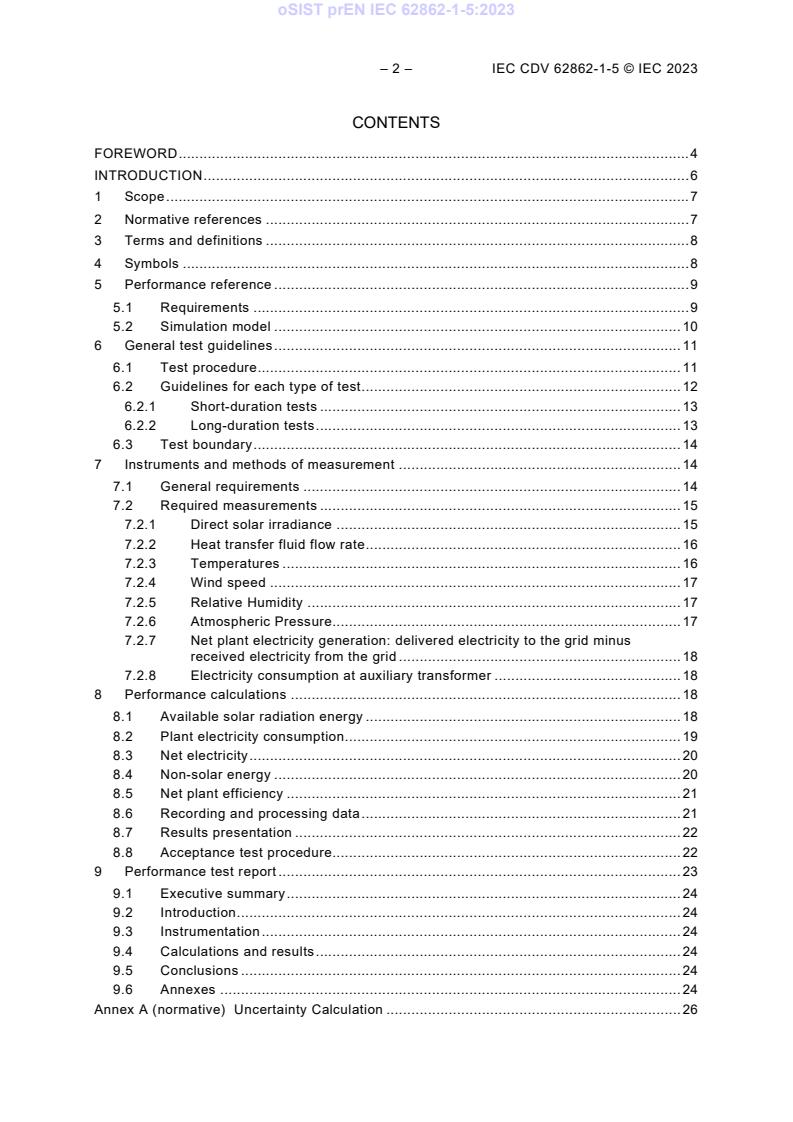
CONTENTS
FOREWORD . 4
INTRODUCTION . 6
1 Scope . 7
2 Normative references . 7
3 Terms and definitions . 8
4 Symbols . 8
5 Performance reference . 9
5.1 Requirements . 9
5.2 Simulation model . 10
6 General test guidelines . 11
6.1 Test procedure. 11
6.2 Guidelines for each type of test . 12
6.2.1 Short-duration tests . 13
6.2.2 Long-duration tests . 13
6.3 Test boundary . 14
7 Instruments and methods of measurement . 14
7.1 General requirements . 14
7.2 Required measurements . 15
7.2.1 Direct solar irradiance . 15
7.2.2 Heat transfer fluid flow rate . 16
7.2.3 Temperatures . 16
7.2.4 Wind speed . 17
7.2.5 Relative Humidity . 17
7.2.6 Atmospheric Pressure. 17
7.2.7 Net plant electricity generation: delivered electricity to the grid minus
received electricity from the grid . 18
7.2.8 Electricity consumption at auxiliary transformer . 18
8 Performance calculations . 18
8.1 Available solar radiation energy . 18
8.2 Plant electricity consumption. 19
8.3 Net electricity . 20
8.4 Non-solar energy . 20
8.5 Net plant efficiency . 21
8.6 Recording and processing data . 21
8.7 Results presentation . 22
8.8 Acceptance test procedure. 22
9 Performance test report . 23
9.1 Executive summary . 24
9.2 Introduction . 24
9.3 Instrumentation . 24
9.4 Calculations and results . 24
9.5 Conclusions . 24
9.6 Annexes . 24
Annex A (normative) Uncertainty Calculation . 26
IEC CDV 62862-1-5 © IEC 2023 – 3 –
A.1 Purpose and assumptions . 26
A.2 Equations for calculating net plant efficiency . 26
A.3 Considerations for calculating uncertainties . 27
A.4 Basic equations for calculating uncertainties . 28
A.5 Calculating uncertainties . 28
A.5.1 Introduction . 28
A.5.2 Type B uncertainty of the direct solar irradiance . 29
A.5.3 Type B uncertainty of the electrical power . 30
A.5.4 Type B uncertainty of the mass flow rate of heat transfer fluid in the
auxiliary heater . 30
A.5.5 Type B uncertainty of the enthalpy difference of heat transfer fluid in the
auxiliary heater . 31
A.6 Alternative method for calculating the uncertainty of net plant efficiency . 32
A.7 Calculation of type B standard uncertainty when redundant instruments are
used . 32
A.7.1 Type B standard uncertainty of temperatures measured with two
redundant sensors . 33
A.7.2 Type B standard uncertainty of direct solar irradiance. 33
Annex B (informative) Example of uncertainty of net efficiency calculated following the
procedure in clause A.5 . 34
Annex C (informative) Example of uncertainty of net efficiency calculated following the
alternative procedure described in clause A.6 . 40
Figure 1 – Energy flows in a Solar Thermal Power Plant . 6
Figure 2 – Required simulation model inputs and outputs . 11
Figure 3 – Generic test boundary and energy flows. 14
Figure 4 – Typical electrical connections in a power plant . 18
Figure 5 – Examples of acceptance criteria. Comparison of the measured value (M)
against the reference value (RV) with uncertainty bands . 23
Table 1 – Symbols and units . 8
Table 2 – Example of a test main results table . 22
Table 3 – Levels of confidence and associated coverage factors (Normal distribution) . 22
– 4 – IEC CDV 62862-1-5 © IEC 2023
INTERNATIONAL ELECTROTECHNICAL COMMISSION
____________
SOLAR THERMAL ELECTRIC PLANTS –
Part 1-5: Performance test code for solar thermal electric plants
FOREWORD
1) The International Electrotechnical Commission (IEC) is a worldwide organization for standardization comprising
all national electrotechnical committees (IEC National Committees). The object of IEC is to promote international
co-operation on all questions concerning standardization in the electrical and electronic fields. To this end and
in addition to other activities, IEC publishes International Standards, Technical Specifications, Technical Reports,
Publicly Available Specifications (PAS) and Guides (hereafter referred to as “IEC Publication(s)”). Their
preparation is entrusted to technical committees; any IEC National Committee interested in the subject dealt with
may participate in this preparatory work. International, governmental and non-governmental organizations liaising
with the IEC also participate in this preparation. IEC collaborates closely with the International Organization for
Standardization (ISO) in accordance with conditions determined by agreement between the two organizations.
2) The formal decisions or agreements of IEC on technical matters express, as nearly as possible, an international
consensus of opinion on the relevant subjects since each technical committee has representation from all
interested IEC National Committees.
3) IEC Publications have the form of recommendations for international use and are accepted by IEC National
Committees in that sense. While all reasonable efforts are made to ensure that the technical content of IEC
Publications is accurate, IEC cannot be held responsible for the way in which they are used or for any
misinterpretation by any end user.
4) In order to promote international uniformity, IEC National Committees undertake to apply IEC Publications
transparently to the maximum extent possible in their national and regional publications. Any divergence between
any IEC Publication and the corresponding national or regional publication shall be clearly indicated in the latter.
5) IEC itself does not provide any attestation of conformity. Independent certification bodies provide conformity
assessment services and, in some areas, access to IEC marks of conformity. IEC is not responsible for any
services carried out by independent certification bodies.
6) All users should ensure that they have the latest edition of this publication.
7) No liability shall attach to IEC or its directors, employees, servants or agents including individual experts and
members of its technical committees and IEC National Committees for any personal injury, property damage or
other damage of any nature whatsoever, whether direct or indirect, or for costs (including legal fees) and
expenses arising out of the publication, use of, or reliance upon, this IEC Publication or any other IEC
Publications.
8) Attention is drawn to the Normative references cited in this publication. Use of the referenced publications is
indispensable for the correct application of this publication.
9) Attention is drawn to the possibility that some of the elements of this IEC Publication may be the subject of patent
rights. IEC shall not be held responsible for identifying any or all such patent rights.
IEC 62862-1-5 has been prepared by IEC technical committee TC 117: Solar Thermal Electric
Plants. It is an International Standard.
The text of this International Standard is based on the following documents:
Draft Report on voting
XX/XX/FDIS XX/XX/RVD
Full information on the voting for its approval can be found in the report on voting indicated in
the above table.
The language used for the development of this International Standard is English.
This document was drafted in accordance with ISO/IEC Directives, Part 2, and developed in
accordance with ISO/IEC Directives, Part 1 and ISO/IEC Directives, IEC Supplement, available
IEC CDV 62862-1-5 © IEC 2023 – 5 –
at https://www.iec.ch/members_experts/refdocs. The main document types developed by IEC
are described in greater detail at https://www.iec.ch/standardsdev/publications.
The committee has decided that the contents of this document will remain unchanged until the
stability date indicated on the IEC website under webstore.iec.ch in the data related to the
specific document. At this date, the document will be
• reconfirmed,
• withdrawn,
• replaced by a revised edition, or
• amended.
– 6 – IEC CDV 62862-1-5 © IEC 2023
1 INTRODUCTION
2 Solar thermal power plants are electricity generation plants that use solar radiation to heat a
3 fluid to a high temperature. This fluid usually transfers its heat to water to produce superheated
4 steam, which is expanded in a turbine-generator machine to transform thermal energy first into
5 mechanical energy and finally into electricity. These plants use solar collectors to concentrate
6 the solar radiation, and they are classified depending on the concentration technology, including
7 but not limited to Parabolic-Trough Collector (PTC), Central Receiver Collector (CRC) also
8 called Solar Tower, and Linear Fresnel Collector (LFC).
9 Solar thermal power plants are made of a solar field interconnected to a power block, but
10 sometimes they also include a non-solar energy source and a thermal storage system which
11 enable electricity generation under conditions of reduced or no solar radiation (see Figure 1).
12 Depending on the concentration technology, the solar field may consist of a set of parabolic-
13 trough collector rows, linear Fresnel collector rows, or a set of heliostats with a central receiver
14 located in a tower. All these systems track the sun and collect the energy that it projects in the
15 form of direct radiation.
16 The Plant Performance must be demonstrated, or verified, as part of the commissioning and
17 acceptance process, for all the configurations agreed by the parties involved.
19 Figure 1 – Energy flows in a Solar Thermal Power Plant
20 The complexity and duration of performance acceptance tests depend on what these tests are
21 for. There are several different types of tests:
22 • Short quasi-stationary tests: Their purpose is to verify the characteristics and features
23 of the power plant systems (solar field, thermal storage system, power block, and
24 auxiliary non-solar energy systems)
25 • Short-duration testing (at least 24 hours): The purpose is to verify the performance of
26 the power plant over a short period of time (usually associated with Provisional Plant
27 Acceptance Testing)
28 • Long-duration tests (at least 365 days): The purpose is to verify or validate annual
29 plant production and auxiliary consumptions (electricity and non-solar energy source)
30 (These tests are usually associated with Final Plant Acceptance).
31 • Dispatchability tests: The purpose is to verify the ability of the solar thermal power
32 plant to respond to grid operator signals regardless of meteorological conditions.
33 • Durability and integrity testing: The purpose is to verify integrity and validate
34 equipment durability
35 This standard focuses on acceptance testing of the complete power plant and defines the
36 measurement procedures for short-duration and long-duration efficiency testing.
IEC CDV 62862-1-5 © IEC 2023 – 7 –
38 SOLAR THERMAL ELECTRIC PLANTS –
39 Part 1-5: Performance test code for solar thermal electric plants
42 1 Scope
43 The purpose of this standard is to provide procedures and guidelines to carry out acceptance
44 tests for solar thermal power plants, of any concentration technology, with the uncertainty level
45 given in the ISO/IEC Guide 98-3.
46 This standard establishes the measurements, instrumentation and techniques required for
47 determining the following performance parameters for a given period:
48 • Available solar radiation energy
49 • Plant electricity consumptions
50 • Net electricity generation
51 • Non-solar energy
52 • Net plant efficiency
53 Other parameters that characterize the solar thermal power plant system features are not dealt
54 with in this standard but are the subject of other complementary standards.
55 Due to the variability of the sun as the energy source for a solar power plant, it is necessary to
56 compare any measured production data (performance) of the system to a jointly agreed
57 calculation tool serving as a reference for expected production in the specific period and under
58 the real-time solar irradiance and other meteorological data.
59 This standard is applicable to solar thermal power plants of any size using any concentration
60 technology, where the sun is the main source of energy, and all elements and systems are
61 operative. Such power plants may optionally have non-solar energy sources, such as natural
62 gas or other renewable energies, and a thermal storage system.
63 It is applicable to acceptance testing in such power plants, as well as in any other scenario in
64 which their performance must be known. Acceptance tests serve for the purpose of verification
65 of a contractual performance measure, and for establishing claims in case of non-fulfillment of
66 performance. In this document the owner, builder, financier, and any other entity interested in
67 knowing these features are called “parties involved.”
68 2 Normative references
69 The following documents are referred to in the text in such a way that some or all of their content
70 constitutes requirements of this document. For dated references, only the edition cited applies.
71 For undated references, the latest edition of the referenced document (including any
72 amendments) applies.
73 IEC 60044-7:1999, Instrument transformers – Part 7: Electronic voltage transformers
74 IEC 60044-8:2002, Instrument transformers – Part 8: Electronic current transformers
75 IEC TS 62862-1-1:2018, Solar Thermal Electric Plants – Terminology
– 8 – IEC CDV 62862-1-5 © IEC 2023
76 IEC 62862-3-2:2018, Solar Thermal Electric Plants – Part 3-2: Systems and components.
77 General requirements and test methods for large-size parabolic-trough collectors
78 IEC 62862-5-2:2022, Solar thermal electric plants - Part 5-2: Systems and components -
79 General requirements and test methods for large-size linear Fresnel collectors
80 ISO 9060:1990, Solar energy. Specification and classification of instruments for measuring
81 hemispherical solar and direct solar radiation
82 ISO 9488:1999, Solar energy – Vocabulary
83 ISO 9806:2017, Solar energy - Solar thermal collectors – Test methods
84 ISO/IEC Guide 98-3:2008, Uncertainty of measurement – Part 3: Guide to the expression of
85 uncertainty in measurement (GUM:1995)
86 UNE 206010:2015, Tests for the verification of the performance of solar thermal power plants
87 with parabolic trough collector technology
88 3 Terms and definitions
89 For the purposes of this standard, the terms and definitions included in IEC TS 62862-1-1 apply.
90 4 Symbols
91 The symbols and units used in this document are displayed in Table 1.
92 Table 1 – Symbols and units
Symbol Description Units
A Net collection area m
net
C Specific heat capacity J/(kg·K)
p
E Direct normal solar irradiance W/m
b
E Net electricity generated and delivered to the kWh
el,net
grid
E Thermal energy supplied by fossil fuels and/or kWh
ns
other non-solar energies
h Specific enthalpy J/kg
m Mass flow rate kg/s
Number of single elements in operation in the -
Ncol
solar field: parabolic-trough collectors,
Fresnel reflectors or heliostats
P Power kW
p Atmospheric pressure bar
atm
RH Relative humidity %
t Time h
T Temperature ºC
U Type B uncertainty
B
IEC CDV 62862-1-5 © IEC 2023 – 9 –
Symbol Description Units
Wind speed m/s
v
/s
Volumetric flow m
V
Greek Symbols
difference or variation -
∆
net plant efficiency %
η
plant,net
ρ
Density kg/m
τ
Test time s
Subscripts
accum cumulative value
atm atmospheric
aux at auxiliar transformer high voltage side
avail available in the aperture area of the plant
solar field
con consumption
el electricity
gross at generator terminals
HTF heat transfer fluid
i, j time interval, index
in, out inlet, outlet
net net value
ns non solar
plant related to the power plant
solar solar radiation
startup at startup transformer high voltage side
tr transformer
trloss transformer losses
util useful
0, end initial and final time
93 5 Performance reference
94 5.1 Requirements
95 According to this standard, the verification of performance for a solar thermal power plant
96 requires:
97 a) The use of a power plant simulation model, hereinafter simulation model, to generate
98 reference values from the input and boundary conditions existing during a test.
99 b) To define the verification procedure. That is, the way measurements are to be compared
100 with the reference considering uncertainties.
– 10 – IEC CDV 62862-1-5 © IEC 2023
101 Clause 5.2 defines the simulation model, while the verification procedure is defined in clause
102 8.8.
103 5.2 Simulation model
104 This standard stablishes that the simulation model of the tested solar power plant and its
105 systems is an essential element in the acceptance process. The simulation model to be used
106 shall be agreed by the parties involved, and its validation must be documented. It is
107 recommended that the simulation model meet at least with the requirements listed in this
108 section.
109 Due to the importance of inertial and transient phenomena during performance tests, the
110 simulation model must be dynamic, or at least consider solar field inertia phenomena, to be
111 able to calculate the reference performance indicators, like electrical power or plant efficiency,
112 for the test boundary conditions.
113 For short-duration and long-duration efficiency tests, the simulation model will include
114 commonly the following inputs and outputs (see Figure 2):
115 • Input specifications:
116 – Power plant location (geographic latitude and longitude)
117 – Test start and end dates and times
118 – Date and time, direct solar irradiance, and other meteorological conditions during testing
119 (temperature, wind speed, atmospheric pressure, relative humidity, and, if needed by
120 the simulation model, wind direction), recorded in time intervals no longer than 10
121 minutes and averaged as specified in clause 8.6
122 – Plant operating modes during testing
123 – Solar field and power plant availability during testing
124 – Reflectance of mirrors in the solar field over time
125 – Starting conditions of the thermal storage system
126 – Starting conditions of the power plant when testing begins (type of startup)
127 – Non-solar energy consumption during testing
128 • Output specifications:
129 – Available solar radiation energy
130 – Net electricity production (at test boundaries)
131 – Auxiliary electricity consumption
132 – Consumption of electricity imported from the grid
IEC CDV 62862-1-5 © IEC 2023 – 11 –
135 Figure 2 – Required simulation model inputs and outputs
136 The simulation model used in the acceptance process must be previously validated and agreed
137 upon by the parties. It is recommended that the simulation model validation include the
138 following:
139 • Verification that the simulation model reproduces nominal performance values at reference
140 conditions (i.e., design point conditions).
141 • Consistency in predicting performance values at conditions other than those of reference;
142 showing that when input parameters are varied, output trends are congruent with these
143 variations.
144 6 General test guidelines
145 This section provides the general instructions to carry out performance tests for solar thermal
146 power plants, with the steps required to plan, prepare, and perform them.
147 6.1 Test procedure
148 The Test procedure is a detailed document on the test plan, which must be prepared and
149 approved beforehand by the parties involved. This basic document must include all the details
150 for preparing and conducting a test, as well as how to make calculations and report the results.
151 It is recommended that it includes at least the following:
152 1) Purpose of the test, indicating foreseen duration.
153 2) Features to be verified, along with their guaranteed values and uncertainty margins, if
154 applicable.
155 3) Test boundaries, identifying the input and output flows and measurement points.
156 4) Basic test plan.
157 5) Description of the activities to be performed during test preparation, such as calibration and
158 verification of measurement equipment, training of personnel who take part in the test,
159 inspection and cleaning of equipment, and carrying out a pretest if so agreed. The
160 instrumentation that is to be used during the tests must meet the specifications defined in
161 clause 7. All measuring equipment, both permanent and temporary instruments, necessary
162 for the test, must be checked, inspected, and tuned before starting the test.
– 12 – IEC CDV 62862-1-5 © IEC 2023
163 6) Description of activities to be carried out during the test, such as checking the conditions
164 necessary to start, interrupt, suspend or end the test, operating conditions, adjustments
165 permitted before and during the test, and details about data recording. The test conditions
166 must not at any time surpass the maximum limits of the equipment involved, as set by their
167 suppliers, nor those of the normal plant operating procedures.
168 7) Description of plant operating conditions, including both major and auxiliary equipment that
169 affect test results.
170 8) Procedure for determining the solar field cleanliness factor.
171 9) List of plant instruments and measuring equipment, including tag, description, calibration,
172 location, number, type, uncertainty (accuracy) and main technical data.
173 10) Calibration certificates of listed instruments.
174 11) Prior uncertainty analysis, establishing the uncertainties estimated by non-statistical
175 procedures.
176 12) Methodology for determining the meteorological variables, such as direct normal radiation,
177 wind speed, atmospheric pressure, ambient temperature and relative humidity.
178 13) Sampling methods for the heat transfer fluid, the storage medium and/or the non-solar
179 energy sources, if any. Indicating preparation, sampling frequency, parameters to be
180 determined, and analysis methods.
181 14) Identification of the laboratory that will analyze the heat transfer fluid and storage medium
182 and/or non-solar energy source, if any.
183 15) Thermo-physical property tables for heat transfer fluid and storage medium and/or non-solar
184 energy source, if any.
185 16) Format in which data and results will be recorded and supplied.
186 17) Data averaging and validation procedures for redundant measurements.
187 18) Data verification and rejection criteria. Procedure to solve Data Acquisition System (DAS)
188 failures, generating gaps in the records, with criteria to complete or discard such periods.
189 19) Data distribution procedure. The measured data shall be stored in electronic data files that
190 shall be available to the parties involved. Processed values and calculations derived from
191 these data shall be done in different files from the original files. Final reports on results shall
192 include the original data files.
193 20) Specific reference and description of the simulation model used to obtain acceptance
194 criteria. It shall include acceptable deviation limits between measured and calculated values
195 using the simulation model, considering uncertainties.
196 21) Procedure for determining the effect of degradation of plant components, if applicable.
197 22) Procedure for verifying plant performance.
198 If the parties involved consider it advisable, any of the above may be excluded.
199 6.2 Guidelines for each type of test
200 Within the scope of this standard, guidelines for two types of performance tests are given: short-
201 duration (at least 24 hours), and long-duration (at least 365 days). The specific duration, agreed
202 by the parties, shall be indicated in the Test Procedure.
203 For short-duration tests, it is recommended to keep the thermal storage inactive. But in cases
204 where the use of the thermal storage system, if any, was necessary, a procedure shall be
205 considered to check the complete charge/discharge of the system during the test period; for
206 example, recording initial and final temperatures and levels.
207 For long-duration tests, the influence on the calculated efficiency of the difference between
208 initial and final thermal storage conditions is negligible.
IEC CDV 62862-1-5 © IEC 2023 – 13 –
209 6.2.1 Short-duration tests
210 The purpose of short-duration tests is to verify plant performance for at least 24-hours. The
211 operating parameters required for acceptance of the complete solar thermal power plant during
212 these tests are available solar radiation energy, net electricity generation, electricity
213 consumption, non-solar energy consumption and net efficiency.
214 It is recommended that a short pretest be done, for example during a couple of hours before
215 beginning the short-duration test, to check that the plant meets the conditions to start the test
216 and that the measurement equipment and DAS are working properly. The pretest is also used
217 to analyze whether system adjustments are necessary before starting the plant performance
218 acceptance test. Specifications for the pretest shall be stipulated in the Test Procedure.
219 Short-duration tests must last at least 24 hours to enable evaluation of the plant, taking into
220 account all subsystems and operating modes in which plant performance is to be verified. If the
221 solar thermal power plant has a thermal storage system, the test to verify overall plant efficiency
222 must be long enough to include the complete charge/discharge process from beginning to end
223 of testing.
224 For short-duration performance tests, the parties involved must agree on the conditions under
225 which the tests are to be performed and define them in the Test Procedure. It is suggested that
226 the test be repeated at least three times to reduce uncertainties.
227 All instruments used must be checked before the test. After the test, instruments suspected of
228 abnormalities should be rechecked. The result of these checks must be collected in a report
229 that also includes the calibration certificates. These reports must be distributed among the
230 parties.
231 It is recommended that the heat transfer fluid temperature be homogenized in the solar thermal
232 power plant before beginning the test.
233 The short-duration tests must be done on clear days and with a maximum direct solar irradiance
234 of no less than 700 W/m for at least four hours. A clear day is understood to be one on which
235 possible solar radiation transients do not surpass 5% of sunlight hours. A solar radiation
236 transient means a time interval of no longer than 30 minutes, in which the solar radiation is
237 significantly lowered due to clouds, recording a clarity index below 0.5 for the period in
238 consideration. The clarity index is defined as the quotient of global horizontal irradiance and
239 the product of extraterrestrial solar irradiance by the cosine of the solar zenith angle (according
240 to ISO 9488). In those cases, in which weather conditions at the site make it very difficult to
241 achieve these conditions, the parties involved may agree on other criteria which must be defined
242 in the Test Procedure.
243 It is recommended to carry out the test when it is not necessary to use antifreeze systems for
244 the heat transfer fluid or the storage fluid.
245 Required simulation model inputs and outputs are defined in clause 5.2.
246 6.2.2 Long-duration tests
247 Long-duration tests, lasting at least 365 days, evaluates plant performance under normal
248 operation subjected to seasonally varying technical, weather and electricity supply conditions.
249 This test will show a faithful image of real plant performance. Although the usual period of that
250 test is a full one year, the Test Procedure shall specify if it is continuous or if it can be
251 temporarily suspended. Abnormal operating conditions or unusual maintenance activities must
252 be identified, evaluated, and documented.
253 The operating parameters required for acceptance or verification of the solar thermal power
254 plant performance during these tests are available solar radiation energy, net electricity
255 generation, electricity consumption, non-solar energy consumption, and net efficiency.
– 14 – IEC CDV 62862-1-5 © IEC 2023
256 All instruments used must be checked before starting the test and regularly during the test,
257 especially those suspected of abnormal behavior. The result of these checks must be collected
258 in a report that also includes the calibration certificates. These reports must be distributed
259 among the parties.
260 The thermal storage system must be considered an intermediate heat transfer subsystem, and
261 therefore it is not necessary to measure specific variables of this subsystem during the tests.
262 Required simulation model inputs and outputs are defined in clause 5.2.
263 6.3 Test boundary
264 The test boundary is defined as the limits enclosing the solar power plant where the inlet and
265 outlet energy flows must be measured to calculate the plant performance. It is not necessary to
266 determine the energy flows inside the boundary unless they serve to verify the operating
267 conditions or to evaluate subsystem performance.
268 The test boundary is specific to each plant and must be defined in the Test Procedure. Figure
269 3 shows a generic diagram of the test boundary for a solar thermal power plant, with fossil fuel
270 as the non-solar energy source and a thermal storage system. Clause 7 provides more detailed
271 information on what measurements to take and how.
273 Figure 3 – Generic test boundary and energy flows
274 Energy received by solar thermal power plants comes mainly from the sun (primary energy
275 source), but also from fossil fuel or other renewable energies (non-solar energy). Net electricity
276 generation is the plant output variable. Thermal storage systems are inside the test boundary,
277 so they are not considered inlet/outlet energy sources. Both the verification of solar field
278 efficiency and thermal storage system characteristics are out of the scope of this standard.
279 7 Instruments and methods of measurement
280 This section describes the instruments and test procedures necessary to obtain the required
281 accuracy level for the solar power plant performance evaluation, including the type of
282 measurements to be made, how to make them, and the instrument specification.
283 7.1 General requirements
284 The plant must have an automatic data acquisition system (DAS) to record and store
285 simultaneous measurements.
IEC CDV 62862-1-5 © IEC 2023 – 15 –
286 Process instrumentation, portable instruments, and alternative sensors may be used in the test,
287 if they comply with the specifications agreed by the parties.
288 All instruments used in the test must have a calibration certificate not older than one year when
289 starting the test. During long-duration tests, instrumentation must be checked regularly,
290 recalibrating those suspected of malfunctioning.
291 Contribution of individual instruments uncertainties to the result uncertainty is calculated
292 following Annex A.
293 When multiple sensors are used to measure or average a single magnitude, all must meet the
294 requirements. Averaging must be defined in the test procedure, and uncertainty calculated
295 following Annex A.
296 7.2 Required measurements
297 7.2.1 Direct solar irradiance
298 The symbol used is E in units of W/m .
b
299 Among the different existing devices to measure direct solar irradiance, pyrheliometers are
300 recommended due to their accuracy and reliability. The typical measurement range of
301 pyrheliometers is 0 to 1 500 W/m with an accuracy of ± 1 %, with a maximum type B uncertainty
302 on the order of ± 20 W/m .
303 Pyrheliometers must meet the following specifications:
304 – Angle of vision of the pyrheliometer: 6º maximum.
305 – Thermoelectric transducer
306 – The measurement spectrum of the transducer must include the range from 280 to 4 000 nm
307 Any error associated with the tracking system may not be over ± 0,5º. The use of a solar tracking
308 sensor connected to the tracker is recommended. The use of Secondary Standard quality
309 pyrheliometers is recommended as specified in the Table 1 of the ISO 9060 standard.
310 To obtain a representative value of the average direct solar irradiance, the minimum number of
311 pyrheliometers, distributed over the solar field, must be 3 every 2 km of area.
312 Pyrheliometers must be installed far away from smoke or steam sources (cooling tower,
313 auxiliary heater, etc.) to avoid unwished influence on measurements.
314 During tests, sensors shall be cleaned daily, and their correct pointing verified. Sensor cleaning
315 and pointing checks shall not affect radiation measurement for more than one minute.
316 Otherwise, they must be done when there is no direct solar radiation or after replacing the
317 affected sensor.
318 In any case, sensors shall be cleaned and pointing checked whenever any difference, between
319 daily cumulative measurements of existing sensors under clear-sky conditions, exceeds 3%. If
320 the difference persists after cleaning and checking, the affected instruments shall be
321 recalibrated or substituted. The anomalous values shall be discarded.
322 The following expression is a check that every pair of pyrheliometers must comply before the
323 test to avoid inconsistencies
– 16 – IEC CDV 62862-1-5 © IEC 2023
EE−
bi bj
324 Z < 2
ij
UE + UE
( ) ( )
B bi B bj
E
325 E and are the values delivered by a pair of pyrheliometers. UE and UE are their
( )
bi bj B bi ( )
B bj
326 B expanded uncertainties. This verification of pyrheliometers must be done in a clear day with
327 very low atmospheric attenuation (i.e., visibility range of 20 km or more) to assure that possible
328 discrepancies are not due to uneven distribution of aerosols at the site of the solar field where
329 the pyrheliometers are installed.
330 If the various pyrheliometers used are the same model, are all installed the same way, and have
331 been calibrated using the same reference element, Standard Type B uncertainty of the final
332 measurement (found as the arithmetic mean of the data provided by all the pyrheliometers) may
333 be assumed to be the same as for a single pyrheliometer.
334 7.2.2 Heat transfer fluid flow rate
335 The symbol used is m in units of kg/s.
HTF
336 Heat transfer fluid flow rate through the auxiliary heater is measured to calculate the non-solar
337 energy consumption. Flow rate may be measured using different types of devices: differential
338 pressure, vortex, ultrasonic, turbine or Coriolis flow meters. The parties involved must agree on
339 the type of flow meter to be installed, provided that the type B uncertainty is less than 1,5% for
340 the temperature working range.
341 Although the flowm
...