

EN 50306-2:2020
(Main)Railway applications - Railway rolling stock cables having special fire performance - Thin wall - Part 2: Single core cables
General Information
- Abstract
This document specifies requirements for, and constructions and dimensions of, single core cables, rated voltage U0 / U = 300 /300 V, of the following type: Unscreened (0,5 mm2 to 2,5 mm2 single core) These cables are rated for occasional thermal stresses causing ageing equivalent to continuous operational life at a temperature of 105 °C. For standard cables, this is determined by the acceptance test defined in EN 50305, using accelerated long-term (5 000 h) thermal ageing indicating a 125 °C/20 000 h temperature index. If the customer were to require lifetime predictions, this would be demonstrated based on the temperature index of the product as supplied by the manufacturer. The maximum temperature for short circuit conditions is 160 °C based on duration of 5 s. Under fire conditions the cables exhibit special performance characteristics in respect of maximum permissible flame propagation (flame spread) and maximum permissible emission of smoke and toxic gases. These requirements are specified to permit the cables to satisfy Hazard Level 3 of EN 45545 1 and EN 45545 2. EN 50306-2:2020 is expected to be used in conjunction with EN 50306-1:2020, General requirements.
- Status
- Published
- Publication Date
- 19-Mar-2020
- Withdrawal Date
- 29-Dec-2022
- Technical Committee
- CLC/TC 20 - Electric cables
- Drafting Committee
- CLC/TC 20 - Electric cables
- Current Stage
- 9093 - Decision to confirm - Review Enquiry
- Start Date
- 23-Oct-2024
- Completion Date
- 25-Aug-2026



Overview
EN 50306-2:2020 - "Railway applications - Railway rolling stock cables having special fire performance - Thin wall - Part 2: Single core cables" (CLC) specifies construction, dimensions and performance requirements for thin-wall single-core cables used in railway rolling stock. It covers unscreened single cores with conductor cross-sections from 0.5 mm² to 2.5 mm², rated U0/U = 300/300 V, designed for enhanced fire performance (smoke, toxicity and flame spread) and for operation under defined thermal and short‑circuit stresses.
Key topics and technical requirements
- Scope & construction
- Unscreeened single-core cables, conductor wires are tin-coated annealed copper; insulation applied by extrusion.
- Standard core colour: white (durable, identifiable).
- Conductor sizes: 0.5 → 2.5 mm² with specified strandings and overall diameter limits.
- Voltage and thermal ratings
- Rated voltage: U0/U = 300/300 V.
- Rated for occasional thermal stresses equivalent to continuous life at 105 °C; acceptance thermal ageing via accelerated test 5 000 h → indicative 125 °C / 20 000 h temperature index.
- Maximum short‑circuit conductor temperature: 160 °C for a duration of 5 s.
- Fire performance
- Cables are required to meet limits on flame propagation, smoke emission and toxic gas release suitable to achieve Hazard Level 3 (HL3) per EN 45545‑1 and EN 45545‑2.
- Testing & acceptance
- Uses test methods from EN 50305:2020 and referenced standards (EN 60332, EN 61034, EN 62230, EN 60811).
- Example electrical tests: voltage test (AC 2 kV / DC 4.8 kV for 5 min on 20 m sample), insulation resistance at 20 °C and 90 °C, dielectric strength (≥ 4 kV AC immersion).
- Mechanical and aging tests include hot set, long‑term thermal ageing, abrasion, low‑temperature bending, oil/fuel resistance, etc.
Applications and who uses this standard
- Intended for railway rolling stock designers, cable manufacturers, component specifiers, rolling stock OEMs, maintenance engineers, and procurement teams needing cables that comply with high fire‑safety requirements.
- Typical uses: onboard wiring for passenger trains, trams and metros where thin-wall, halogen‑free single cores are required to limit smoke/toxicity and flame spread under fire scenarios while meeting space and weight constraints.
Related standards
- EN 50306‑1:2020 - General requirements (use in conjunction)
- EN 50305:2020 - Test methods for special fire‑performance cables
- EN 45545‑1 / EN 45545‑2 - Fire protection on railway vehicles (Hazard Level HL3)
- EN 50355 - Guide to use; EN 50343 - Installation rules
- EN 60332, EN 61034, EN 62230, EN 60811 - referenced test standards
Keywords: EN 50306-2:2020, railway rolling stock cables, single core cables, thin wall, special fire performance, HL3, thermal ageing, halogen-free, U0/U 300/300 V.
Relations
- Effective Date
- 07-Jun-2022
- Refers
EN 45545-1:2013 - Railway applications - Fire protection on railway vehicles - Part 1: General - Effective Date
- 09-Feb-2026
- Effective Date
- 09-Feb-2026
- Effective Date
- 03-Feb-2026
- Effective Date
- 03-Feb-2026
- Effective Date
- 03-Feb-2026
- Effective Date
- 03-Feb-2026
- Effective Date
- 03-Feb-2026
- Effective Date
- 03-Feb-2026
- Effective Date
- 03-Feb-2026
- Effective Date
- 03-Feb-2026
- Effective Date
- 03-Feb-2026
- Effective Date
- 03-Feb-2026
- Effective Date
- 03-Feb-2026
- Effective Date
- 03-Feb-2026
Get Certified
Connect with accredited certification bodies for this standard

IMQ S.p.A. (Certification)
Italian electrical product certification.

IRIS Certification (UNIFE)
International Railway Industry Standard certification.

SLG Prüf- und Zertifizierungs GmbH
German testing and certification body.
Sponsored listings
Frequently Asked Questions
EN 50306-2:2020 is a standard published by CLC. Its full title is "Railway applications - Railway rolling stock cables having special fire performance - Thin wall - Part 2: Single core cables". This standard covers: This document specifies requirements for, and constructions and dimensions of, single core cables, rated voltage U0 / U = 300 /300 V, of the following type: Unscreened (0,5 mm2 to 2,5 mm2 single core) These cables are rated for occasional thermal stresses causing ageing equivalent to continuous operational life at a temperature of 105 °C. For standard cables, this is determined by the acceptance test defined in EN 50305, using accelerated long-term (5 000 h) thermal ageing indicating a 125 °C/20 000 h temperature index. If the customer were to require lifetime predictions, this would be demonstrated based on the temperature index of the product as supplied by the manufacturer. The maximum temperature for short circuit conditions is 160 °C based on duration of 5 s. Under fire conditions the cables exhibit special performance characteristics in respect of maximum permissible flame propagation (flame spread) and maximum permissible emission of smoke and toxic gases. These requirements are specified to permit the cables to satisfy Hazard Level 3 of EN 45545 1 and EN 45545 2. EN 50306-2:2020 is expected to be used in conjunction with EN 50306-1:2020, General requirements.
This document specifies requirements for, and constructions and dimensions of, single core cables, rated voltage U0 / U = 300 /300 V, of the following type: Unscreened (0,5 mm2 to 2,5 mm2 single core) These cables are rated for occasional thermal stresses causing ageing equivalent to continuous operational life at a temperature of 105 °C. For standard cables, this is determined by the acceptance test defined in EN 50305, using accelerated long-term (5 000 h) thermal ageing indicating a 125 °C/20 000 h temperature index. If the customer were to require lifetime predictions, this would be demonstrated based on the temperature index of the product as supplied by the manufacturer. The maximum temperature for short circuit conditions is 160 °C based on duration of 5 s. Under fire conditions the cables exhibit special performance characteristics in respect of maximum permissible flame propagation (flame spread) and maximum permissible emission of smoke and toxic gases. These requirements are specified to permit the cables to satisfy Hazard Level 3 of EN 45545 1 and EN 45545 2. EN 50306-2:2020 is expected to be used in conjunction with EN 50306-1:2020, General requirements.
EN 50306-2:2020 is classified under the following ICS (International Classification for Standards) categories: 13.220.40 - Ignitability and burning behaviour of materials and products; 29.060.20 - Cables; 45.060.01 - Railway rolling stock in general. The ICS classification helps identify the subject area and facilitates finding related standards.
EN 50306-2:2020 has the following relationships with other standards: It is inter standard links to EN 50306-2:2002, EN 45545-1:2013, EN ISO 6892-1:2019, EN 60811-1-2:1995, EN 50305:2020, EN 60811-1-1:1995/A1:2001, EN 61034-2:2005, EN 60332-1-2:2004, EN 60811-1-3:1995, EN 60811-1-4:1995, EN 62230:2007, EN 60811-1-3:1995/A1:2001, EN 60811-1-1:1995, EN 50334:2001, EN 60811-1-4:1995/A2:2001. Understanding these relationships helps ensure you are using the most current and applicable version of the standard.
EN 50306-2:2020 is available in PDF format for immediate download after purchase. The document can be added to your cart and obtained through the secure checkout process. Digital delivery ensures instant access to the complete standard document.
Standards Content (Sample)
SLOVENSKI STANDARD
01-junij-2020
Nadomešča:
SIST EN 50306-2:2003
Železniške naprave - Kabli v železniških vozilih s posebno požarno odpornostjo -
Tanka stena - 2. del: Enožilni kabli
Railway applications - Railway rolling stock cables having special fire performance - Thin
wall - Part 2: Single core cables
Bahnanwendungen - Kabel und Leitungen für Schienenfahrzeuge mit verbessertem
Verhalten im Brandfall - Reduzierte Isolierwanddicken - Teil 2: Einadrige Kabel und
Leitungen
Applications ferroviaires - Câbles pour matériel roulant ferroviaire ayant des
performances particulières de comportement au feu - Isolation mince - Partie 2: Câbles
monoconducteurs
Ta slovenski standard je istoveten z: EN 50306-2:2020
ICS:
13.220.40 Sposobnost vžiga in Ignitability and burning
obnašanje materialov in behaviour of materials and
proizvodov pri gorenju products
29.060.20 Kabli Cables
45.060.01 Železniška vozila na splošno Railway rolling stock in
general
2003-01.Slovenski inštitut za standardizacijo. Razmnoževanje celote ali delov tega standarda ni dovoljeno.
EUROPEAN STANDARD EN 50306-2
NORME EUROPÉENNE
EUROPÄISCHE NORM
March 2020
ICS 13.220.40; 29.060.20; 45.060.01 Supersedes EN 50306-2:2002 and all of its amendments
and corrigenda (if any)
English Version
Railway applications - Railway rolling stock cables having
special fire performance - Thin wall - Part 2: Single core cables
Applications ferroviaires - Câbles pour matériel roulant Bahnanwendungen - Kabel und Leitungen für
ferroviaire ayant des performances particulières de Schienenfahrzeuge mit verbessertem Verhalten im
comportement au feu - Isolation mince - Partie 2: Câbles Brandfall - Reduzierte Isolierwanddicken - Teil 2: Einadrige
monoconducteurs Kabel und Leitungen
This European Standard was approved by CENELEC on 2019-12-30. CENELEC members are bound to comply with the CEN/CENELEC
Internal Regulations which stipulate the conditions for giving this European Standard the status of a national standard without any alteration.
Up-to-date lists and bibliographical references concerning such national standards may be obtained on application to the CEN-CENELEC
Management Centre or to any CENELEC member.
This European Standard exists in three official versions (English, French, German). A version in any other language made by translation
under the responsibility of a CENELEC member into its own language and notified to the CEN-CENELEC Management Centre has the
same status as the official versions.
CENELEC members are the national electrotechnical committees of Austria, Belgium, Bulgaria, Croatia, Cyprus, the Czech Republic,
Denmark, Estonia, Finland, France, Germany, Greece, Hungary, Iceland, Ireland, Italy, Latvia, Lithuania, Luxembourg, Malta, the
Netherlands, Norway, Poland, Portugal, Republic of North Macedonia, Romania, Serbia, Slovakia, Slovenia, Spain, Sweden, Switzerland,
Turkey and the United Kingdom.
European Committee for Electrotechnical Standardization
Comité Européen de Normalisation Electrotechnique
Europäisches Komitee für Elektrotechnische Normung
CEN-CENELEC Management Centre: Rue de la Science 23, B-1040 Brussels
© 2020 CENELEC All rights of exploitation in any form and by any means reserved worldwide for CENELEC Members.
Ref. No. EN 50306-2:2020 E
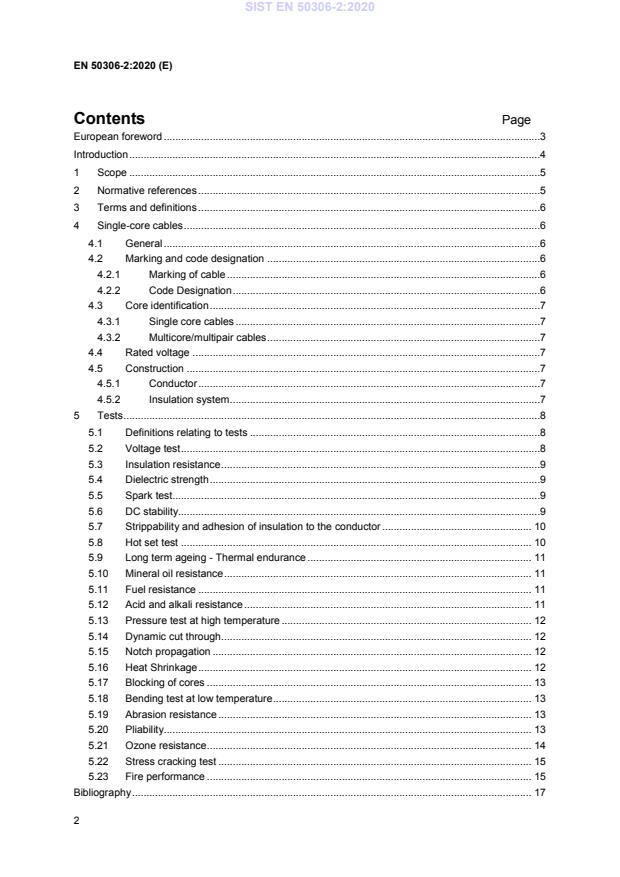
Contents Page
European foreword .3
Introduction .4
1 Scope .5
2 Normative references .5
3 Terms and definitions .6
4 Single-core cables .6
4.1 General .6
4.2 Marking and code designation .6
4.2.1 Marking of cable .6
4.2.2 Code Designation .6
4.3 Core identification .7
4.3.1 Single core cables .7
4.3.2 Multicore/multipair cables .7
4.4 Rated voltage .7
4.5 Construction .7
4.5.1 Conductor .7
4.5.2 Insulation system .7
5 Tests .8
5.1 Definitions relating to tests .8
5.2 Voltage test .8
5.3 Insulation resistance .9
5.4 Dielectric strength .9
5.5 Spark test.9
5.6 DC stability.9
5.7 Strippability and adhesion of insulation to the conductor . 10
5.8 Hot set test . 10
5.9 Long term ageing - Thermal endurance . 11
5.10 Mineral oil resistance . 11
5.11 Fuel resistance . 11
5.12 Acid and alkali resistance . 11
5.13 Pressure test at high temperature . 12
5.14 Dynamic cut through . 12
5.15 Notch propagation . 12
5.16 Heat Shrinkage . 12
5.17 Blocking of cores . 13
5.18 Bending test at low temperature . 13
5.19 Abrasion resistance . 13
5.20 Pliability. 13
5.21 Ozone resistance . 14
5.22 Stress cracking test . 15
5.23 Fire performance . 15
Bibliography . 17
European foreword
This document (EN 50306-2:2020) has been prepared by CLC/TC 20, “Electric cables”.
The following dates are fixed:
• latest date by which this document has (dop) 2020-12-30
to be implemented at national level by
publication of an identical national
standard or by endorsement
• latest date by which the national (dow) 2022-12-30
standards conflicting with this document
have to be withdrawn
This document supersedes EN 50306-2:2002 and all of its amendments and corrigenda (if any).
This edition includes the following significant technical changes with respect to the previous edition:
— The documents have been updated to reflect the changes in the test standard EN 50305;
— The range of the conductor cross sections has been extended;
— The reference to cited standards (e.g. 60811 series) has been updated.
Attention is drawn to the possibility that some of the elements of this document may be the subject of
patent rights. CENELEC shall not be held responsible for identifying any or all such patent rights.
Introduction
The EN 50306 series covers a range of sheathed and unsheathed cables with thin wall thickness
insulation, based on halogen-free materials, for use in railway rolling stock. It is divided into four parts:
Part 1: General requirements;
Part 2: Single core cables;
Part 3: Single core and multicore cables screened and thin wall sheathed;
Part 4: Multicore and multipair screened or not screened sheathed cables.
Special test methods referred to in the EN 50306 series are given in EN 50305. A guide to use is
given in EN 50355 and rules for installation are given in EN 50343.
The cables in EN 50306-2:2020 are also required in other parts of this series of standards to build up
cables with additional screening and sheathing and also in multicore and multipair combinations.
EN 50306-1:2020, General requirements, contains a more extensive introduction to the EN 50306
series and should be read in conjunction with this document.
1 Scope
This document specifies requirements for, and constructions and dimensions of, single core cables,
rated voltage U / U = 300 /300 V, of the following type:
2 2
Unscreened (0,5 mm to 2,5 mm single core)
These cables are rated for occasional thermal stresses causing ageing equivalent to continuous
operational life at a temperature of 105 °C. For standard cables, this is determined by the acceptance
test defined in EN 50305, using accelerated long-term (5 000 h) thermal ageing indicating a
125 °C/20 000 h temperature index. If the customer were to require lifetime predictions, this would be
demonstrated based on the temperature index of the product as supplied by the manufacturer. The
maximum temperature for short circuit conditions is 160 °C based on duration of 5 s.
Under fire conditions the cables exhibit special performance characteristics in respect of maximum
permissible flame propagation (flame spread) and maximum permissible emission of smoke and toxic
gases. These requirements are specified to permit the cables to satisfy Hazard Level 3 of EN 45545-1
and EN 45545-2.
2 Normative references
The following documents are referred to in the text in such a way that some or all of their content
constitutes requirements of this document. For dated references, only the edition cited applies. For
undated references, the latest edition of the referenced document (including any amendments)
applies.
EN 10002-1, Metallic materials - Tensile testing - Part 1: Method of test at ambient temperature
EN 45545-1, Railway applications - Fire protection on railway vehicles - Part 1: General
EN 50305:2020, Railway applications - Railway rolling stock cables having special fire performance -
Test methods
EN 50306-1:2020, Railway applications - Railway rolling stock cables having special fire performance -
Thin wall - Part 1: General requirements
EN 50334, Marking by inscription for the identification of cores of electric cables
EN 60332-1-2, Tests on electric and optical fibre cables under fire conditions - Part 1-2: Test for
vertical flame propagation for a single insulated wire or cable - Procedure for 1 kW pre-mixed flame
EN 60811 (all parts), Electric and optical fibre cables - Test methods for non-metallic materials
EN 61034-2, Measurement of smoke density of cables burning under defined conditions - Part 2: Test
procedure and requirements
EN 62230, Electric cables - Spark-test method
3 Terms and definitions
No terms and definitions are listed in this document.
ISO and IEC maintain terminological databases for use in standardization at the following addresses:
— ISO Online browsing platform: available at https://www.iso.org/obp
— IEC Electropedia: available at http://www.electropedia.org/
4 Single-core cables
4.1 General
The cables shall conform to the applicable general requirements given in EN 50306-1:2020 and to the
specific requirements of this Part 2.
Conformity with the requirements shall be checked by inspection and by the tests given in Table 4.
4.2 Marking and code designation
4.2.1 Marking of cable
Cables shall be marked with the following:
— Manufacturer's name;
— EN reference;
— Voltage rating (U );
— Conductor size;
— A code designation according for use of the cable (see 4.2.2).
For example:
XYZ EN 50306-2 300 V 1x1,5 M
The marking shall conform to the requirements of EN 50306-1:2020, Clause 5.
4.2.2 Code Designation
The following letters shall be used as a code to identify the suitability of a particular cable with the
Hazard Level 3 of EN 45545-1, and to indicate performance levels relating to low temperature and to
oil and fuel resistance:
Hazard Level EN 45545-1 HL3
— low temperature / oil resistance C
— extra low temperature / oil resistance F
— low temperature / extra oil and fuel resistance J
— extra low temperature / extra oil and fuel resistance M
EN 50306-2:202
...