

EN IEC 62115:2020/A11:2020
(Amendment)Electric toys - Safety
General Information
- Abstract
2021: CLC legacy converted by DCLab NISOSTS
- Status
- Published
- Publication Date
- 20-Feb-2020
- Withdrawal Date
- 01-Dec-2021
- Technical Committee
- CLC/TC 61 - Safety of household and similar electrical appliances
- Drafting Committee
- CLC/TC 61 - Safety of household and similar electrical appliances
- Current Stage
- 6060 - Document made available - Publishing
- Start Date
- 21-Feb-2020
- Due Date
- 03-Oct-2020
- Completion Date
- 21-Feb-2020
- Directive
- 2009/48/EC - DIRECTIVE 2009/48/EC OF THE EUROPEAN PARLIAMENT AND OF THE COUNCIL of 18 June 2009 on the Safety of ToysOJ Ref: L, L 190 OJ Date: 31-May-2021


Overview
EN IEC 62115:2020/A11:2020 - Electric toys - Safety is a CENELEC amendment to the international IEC 62115 series. It specifies safety requirements for electric toys that have at least one function dependent on electricity and are designed or clearly intended for play by children under 14 years. The amendment updates scope, test conditions, marking and instruction requirements, and specific construction and component provisions. It supports essential safety requirements of EU Directive 2009/48/EC.
Key topics and technical requirements
The standard focuses on electrical-safety aspects only and contains normative requirements and test methods including (excerpted from the amendment):
- Scope & definitions - what qualifies as an electric toy (examples: constructional sets, electric toy computers, dollhouse lamps); clear exclusions (e.g., combustion-engine toys, playground equipment, certain collector items).
- General requirements and test conditions - mandatory test environments, general conditions for routine and abnormal tests.
- Marking, instructions and packaging - identification, warnings (including temperature warnings), symbols and instructions; packaging considered part of the toy when it has play value.
- Heating and abnormal operation - heating limits, abnormal-condition testing and compliance criteria.
- Construction and components - mechanical and electrical construction, battery provisions (including small batteries), charging arrangements, protection of cords and wiring.
- Resistance to heat, fire and radiation - material flammability tests (e.g., needle-flame), resistance to heat, and optical radiation safeguards (Annex E).
- EMF considerations - measurement methods for toys generating electromagnetic fields (Annex I).
- Special cases - requirements for experimental sets (Annex A), safety of remote controls for electric ride-on toys (Annex J), speed limitation considerations for ride-on toys.
Practical applications
- Use EN IEC 62115:2020/A11:2020 when designing, testing or certifying toys with electrical functions to ensure product safety and regulatory compliance in Europe.
- Apply the standard for product risk assessment, lab testing protocols, labeling and instructions, and conformity documentation required for CE marking.
- Integrate its requirements into product design cycles to avoid recall risks from electrical hazards (heat, fire, radiation, EMF, battery failures).
Who should use this standard
- Toy manufacturers and designers
- Compliance engineers and product safety managers
- Test laboratories and conformity assessment bodies
- Importers, retailers and regulatory authorities operating under EU toy safety rules
Related standards
- EN 71 series (toy mechanical/chemical hazards)
- EN 61558-2-7 / EN 61558-2-16 (transformers for toys)
- EN 60335-2-29 (battery chargers)
- Directive 2009/48/EC (Toy Safety Directive) - Annex ZZ maps coverage
Keywords: EN IEC 62115:2020/A11:2020, electric toys safety, toy safety standard, CENELEC, batteries, ride-on toys, optical radiation, electromagnetic fields, toy marking and instructions.
Relations
- Effective Date
- 09-Feb-2026
- Effective Date
- 13-Mar-2018
Get Certified
Connect with accredited certification bodies for this standard

CIS Institut d.o.o.
Personal Protective Equipment (PPE) certification body. Notified Body NB-2890 for EU Regulation 2016/425 PPE.

Kiwa BDA Testing
Building and construction product certification.
Kmetijski inštitut Slovenije
Agricultural Institute of Slovenia. Soil testing, plant health, agricultural product analysis.
Sponsored listings
Frequently Asked Questions
EN IEC 62115:2020/A11:2020 is a amendment published by CLC. Its full title is "Electric toys - Safety". This standard covers: 2021: CLC legacy converted by DCLab NISOSTS
2021: CLC legacy converted by DCLab NISOSTS
EN IEC 62115:2020/A11:2020 is classified under the following ICS (International Classification for Standards) categories: 13.120 - Domestic safety; 97.200.50 - Toys. The ICS classification helps identify the subject area and facilitates finding related standards.
EN IEC 62115:2020/A11:2020 has the following relationships with other standards: It is inter standard links to EN 12790-1:2023, EN IEC 62115:2020. Understanding these relationships helps ensure you are using the most current and applicable version of the standard.
EN IEC 62115:2020/A11:2020 is associated with the following European legislation: EU Directives/Regulations: 2009/48/EC; Standardization Mandates: M/445. When a standard is cited in the Official Journal of the European Union, products manufactured in conformity with it benefit from a presumption of conformity with the essential requirements of the corresponding EU directive or regulation.
EN IEC 62115:2020/A11:2020 is available in PDF format for immediate download after purchase. The document can be added to your cart and obtained through the secure checkout process. Digital delivery ensures instant access to the complete standard document.
Standards Content (Sample)
SLOVENSKI STANDARD
01-april-2020
Električne igrače - Varnost - Dopolnilo A11
Electric toys - Safety
Elektrishe Spielzeuge - Sicherheit
Jouets électriques - Sécurité
Ta slovenski standard je istoveten z: EN IEC 62115:2020/A11:2020
ICS:
13.120 Varnost na domu Domestic safety
97.200.50 Igrače Toys
2003-01.Slovenski inštitut za standardizacijo. Razmnoževanje celote ali delov tega standarda ni dovoljeno.
EUROPEAN STANDARD EN IEC 62115:2020/A11
NORME EUROPÉENNE
EUROPÄISCHE NORM
February 2020
ICS 13.120; 97.200.50
English Version
Electric toys - Safety
Jouets électriques - Sécurité Elektrishe Spielzeuge - Sicherheit
This amendment A11 modifies the European Standard EN IEC 62115:2020; it was approved by CENELEC on 2019-12-02. CENELEC
members are bound to comply with the CEN/CENELEC Internal Regulations which stipulate the conditions for giving this amendment the
status of a national standard without any alteration.
Up-to-date lists and bibliographical references concerning such national standards may be obtained on application to the CEN-CENELEC
Management Centre or to any CENELEC member.
This amendment exists in three official versions (English, French, German). A version in any other language made by translation under the
responsibility of a CENELEC member into its own language and notified to the CEN-CENELEC Management Centre has the same status as
the official versions.
CENELEC members are the national electrotechnical committees of Austria, Belgium, Bulgaria, Croatia, Cyprus, the Czech Republic,
Denmark, Estonia, Finland, France, Germany, Greece, Hungary, Iceland, Ireland, Italy, Latvia, Lithuania, Luxembourg, Malta, the
Netherlands, Norway, Poland, Portugal, Republic of North Macedonia, Romania, Serbia, Slovakia, Slovenia, Spain, Sweden, Switzerland,
Turkey and the United Kingdom.
European Committee for Electrotechnical Standardization
Comité Européen de Normalisation Electrotechnique
Europäisches Komitee für Elektrotechnische Normung
CEN-CENELEC Management Centre: Rue de la Science 23, B-1040 Brussels
© 2020 CENELEC All rights of exploitation in any form and by any means reserved worldwide for CENELEC Members.
Ref. No. EN IEC 62115:2020/A11:2020 E
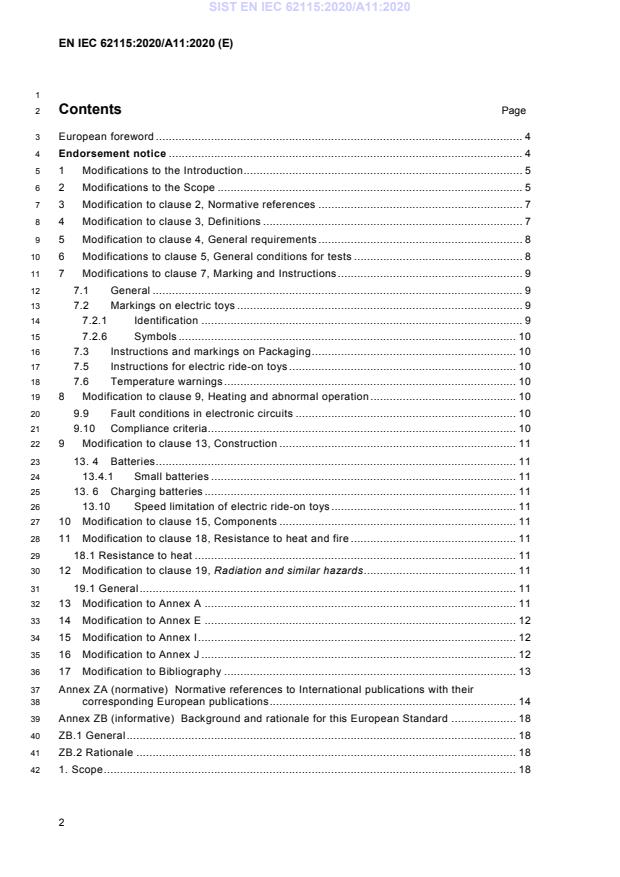
2 Contents Page
3 European foreword . 4
4 Endorsement notice . 4
5 1 Modifications to the Introduction . 5
6 2 Modifications to the Scope . 5
7 3 Modification to clause 2, Normative references . 7
8 4 Modification to clause 3, Definitions . 7
9 5 Modification to clause 4, General requirements . 8
10 6 Modifications to clause 5, General conditions for tests . 8
11 7 Modifications to clause 7, Marking and Instructions . 9
12 7.1 General . 9
13 7.2 Markings on electric toys . 9
14 7.2.1 Identification . 9
15 7.2.6 Symbols . 10
16 7.3 Instructions and markings on Packaging . 10
17 7.5 Instructions for electric ride-on toys . 10
18 7.6 Temperature warnings . 10
19 8 Modification to clause 9, Heating and abnormal operation . 10
20 9.9 Fault conditions in electronic circuits . 10
21 9.10 Compliance criteria . 10
22 9 Modification to clause 13, Construction . 11
23 13. 4 Batteries . 11
24 13.4.1 Small batteries . 11
25 13. 6 Charging batteries . 11
26 13.10 Speed limitation of electric ride-on toys . 11
27 10 Modification to clause 15, Components . 11
28 11 Modification to clause 18, Resistance to heat and fire . 11
29 18.1 Resistance to heat . 11
30 12 Modification to clause 19, Radiation and similar hazards . 11
31 19.1 General . 11
32 13 Modification to Annex A . 11
33 14 Modification to Annex E . 12
34 15 Modification to Annex I . 12
35 16 Modification to Annex J . 12
36 17 Modification to Bibliography . 13
37 Annex ZA (normative) Normative references to International publications with their
38 corresponding European publications . 14
39 Annex ZB (informative) Background and rationale for this European Standard . 18
40 ZB.1 General . 18
41 ZB.2 Rationale . 18
42 1. Scope . 18
43 5. General conditions for tests . 18
44 6. Criteria for reduced testing . 19
45 7. Marking and Instructions . 19
46 8. Power input . 20
47 9. Heating and abnormal operation . 20
48 10 Electric Strength . 22
49 11 Electric toys used in water, electric toys used with liquid and electric toys cleaned with
50 liquid . 22
51 12 Mechanical strength . 22
52 13 Construction . 22
53 14 Protection of cords and wires . 25
54 15 Components . 25
55 16 Screws and connections . 25
56 17 Clearance and creepage distances . 26
57 18 Resistance to heat and fire . 26
58 19 Radiation, toxicity and similar hazards . 26
59 Annex A Experimental sets (normative) . 26
60 Annex B Needle flame test (normative) . 27
61 Annex C Automatic controls and switches (normative) . 27
62 Annex D Electric toys with protective electronic circuits (normative) . 27
63 Annex E Safety of Electric Toys incorporating Optical Radiation Sources (normative) . 27
64 Annex I Electric toys generating electromagnetic fields (normative) . 28
65 Annex J Safety of remote-controls for electric ride-on toys . 28
66 Annex J Clause 7 Marking and Instructions . 28
67 Annex J Clause 9 Heating and Abnormal Operation . 29
68 Annex J Clause 13 Construction . 29
69 Annex ZZ (informative) Relationship between this European Standard and the essential
70 requirements of Directive 2009/48/EC aimed to be covered. 30
71 Table ZZ.1 — Correspondence between this European Standard and Directive 2009/48/EC . 30
73 European foreword
74 This European Standard (EN IEC 62115:2020/A11:2020) has been prepared by CLC/TC 61, "Safety of
75 household and similar electrical appliances".
76 The following dates are fixed:
• latest date by which this document has to be (dop) 2020-09-02
implemented at national level by publication of an
identical national standard or by endorsement
• latest date by which the national standards (dow) 2021-12-02
conflicting with this document have to be
withdrawn
77 This document supersedes EN 62115:2005.
78 This document has been prepared under a mandate given to CENELEC by the European Commission and
79 the European Free Trade Association and supports essential safety requirements of EC Directive 2009/48/EC.
80 For the relationship with EU Directive(s) see informative Annex ZZ, which is an integral part of this document.
81 NOTE The following print types are used:
82 — requirements: in roman type;
83 — test specifications: in italic type;
84 — notes: in small roman type.
85 Words in bold in the text are defined in Clause 3. When a definition concerns an adjective, the adjective and
86 the associated noun are also in bold.
87 There are no special national conditions causing a deviation from this European Standard.
88 There are no national deviations from this European Standard.
89 Annexes ZA, ZB and ZZ have been added by CLC/TC 61.
90 Endorsement notice
91 The text of the International Standard IEC 62115:2017/COR1:2019 was approved by CENELEC as a
92 European Standard with agreed common modifications.
93 1 Modifications to the Introduction
94 If the IEC Foreword or parts of it is used in the EN Foreword, the following applies: Replace the 8th paragraph
95 by the following:
96 Other safety aspects of electric toys are described in the EN 71 series of standards.
th
97 Delete the 10 paragraph.
98 Delete “IEC” or replace it where appropriate by “CLC”.
99 2 Modifications to the Scope
100 Replace the scope by the following:
101 This European Standard specifies safety requirements for electric toys that have at least one function
102 dependant on electricity, electric toys being any product designed or clearly intended, whether or not
103 exclusively, for use in play by children of less than 14 years of age.
104 NOTE 1 Examples of electric toys also within the scope of this standard are
105 — constructional sets;
106 — experimental sets;
107 — functional electric toys (an electric toy which performs and is used in the same way as a product, appliance
108 or installation intended for use by adults, and which may be a scale model of such product, appliance or installation);
109 — electric toy computers;
110 — A doll's house having an interior lamp
111 Additional requirements for experimental sets are given in Annex A.
112 Additional requirements for electric toys incorporating optical radiation sources are given in Annex E.
113 Measurement methods for electric toys generating Electromagnetic fields (EMF) are given in Annex I.
114 Additional requirements for the safety of remote-controls for electric ride-on toys are given in Annex J.
115 If the packaging is intended to have play value, then it is considered to be part of the electric toy.
116 This European Standard only covers the safety aspects of electric toys that relate to an electrical function.
117 NOTE 2 The EN 71 series of standards address other aspects of the safety of toys. Other horizontal product standards
118 may also apply to toys.
119 This standard covers the safety of electric toys taking power from any source, such as batteries, transformers,
120 solar cells and inductive connections.
121 NOTE 3 Transformers for toys (EN 61558-2-7:2007 for linear types or EN 61558-2-7:2007 and EN 61558-2-16:2013
122 for switch mode types), battery chargers (EN 60335-2-29:2010) and battery chargers for use by children (EN 60335-2-
123 29:2010,Annex AA) are not considered to be part of an electric toy even if supplied with an electric toy.
124 NOTE 4 This standard is not intended to assess the safety of batteries however it does address the safety of the electric
125 toy with the batteries inserted.
126 This European Standard does not apply to the following toys:
127 — playground equipment intended for public use;
128 — automatic playing machines, whether coin operated or not, intended for public use;
129 — toy vehicles equipped with combustion engines;
130 — toy steam engines; and
131 — slings and catapults;
132 Furthermore, it does not cover the following items, which, for the purposes of this European Standard, are not
133 considered toys:
134 — decorative objects for festivities and celebrations;
135 — products for collectors, provided that the product or its packaging bears a visible and legible indication
136 that it is intended for collectors of 14 years of age and above; examples of this category are:
137 — detailed and faithful scale models ;
138 — kits for the assembly of detailed scale models;
139 — folk dolls and decorative dolls and other similar articles;
140 — historical replicas of toys;
141 — reproductions of real fire arms;
142 — sports equipment, including roller skates, inline skates, and skateboards intended for children with a body
143 mass of more than 20 kg;
144 — bicycles with a maximum saddle height of more than 435 mm, measured as the vertical distance from the
145 ground to the top of the seat surface, with the seat in a horizontal position and with the seat pillar set to
146 the minimum insertion mark;
147 — scooters and other means of transport designed for sport or which are intended to be used for travel on
148 public roads or public pathways;
149 — electrically driven vehicles which are intended to be used for travel on public roads, public pathways, or
150 the pavement thereof;
151 — aquatic equipment intended to be used in deep water, and swimming learning devices for children, such
152 as swim seats and swimming aids;
153 — puzzles with more than 500 pieces;
154 — guns and pistols using compressed gas, with the exception of water guns and water pistols andbows for
155 archery over 120 cm long;
156 — fireworks, including percussion caps which are not specifically designed for toys;
157 — products and games using sharp-pointed missiles, such as sets of darts with metallic points;
158 — functional educational products, such as electric ovens, irons or other functional products operated at a
159 nominal voltage exceeding 24 V which are sold exclusively for teaching purposes under adult supervision;
160 — products intended for use for educational purposes in schools and other pedagogical contexts under the
161 surveillance of an adult instructor, such as science equipment;
— electronic equipment, such as personal computers and game consoles, used to access interactive
163 software and their associated peripherals, unless the electronic equipment or the associated peripherals
164 are specifically designed for and targeted at children and have a play value on their own, such as specially
165 designed personal computers, key boards, joy sticks or steering wheels;
166 — interactive software, intended for leisure and entertainment, such as computer games, and their storage
167 media, such as CDs;
168 — babies’ soothers
169 — child-appealing luminaires;
170 — electrical transformers for toys
171 — fashion accessories for children which are not for use in play;
174 In addition, this European standard does not apply to the following types of products:
175 — amusement machines and personal service machines;
176 — professional electric toys installed in public places (such as shopping centres and railway stations);
177 — products containing heating elements intended for use under the supervision of an adult in a teaching
178 context;
179 — portable luminaires for children;
180 — blowers for inflatable activity toys (such as blowers for bouncy castles);
181 — electric decorative robots
182 — personal protective equipment including swimming goggles, sunglasses and other eye protectors as well
183 as bicycle and skateboard helmets;
184 3 Modification to clause 2, Normative references
185 Add the following references:
186 EN 71-1:2014+A1:2018, Safety of toys — Part 1: Mechanical and physical properties
187 EN 50410:2008 Household and similar electrical appliances — Safety — Particular requirements for decorative
188 robots
189 4 Modification to clause 3, Definitions
190 In term 3.6.1 Replace IEC 61032 with EN 61032:1998.
191 In term 3.4.2 Change definition to read:
192 power supply for toys
193 power supply incorporating a transformer for toys not fixed to, or incorporated in, electric toys designed to
194 have a rated voltage not exceeding 24 V direct current (d.c.) or 24 V alternating current (a.c.)
195 Note 1 to entry: Power supplies for toys are hereinafter also referred to as power supplies.
196 5 Modification to clause 4, General requirements
197 Replace in the second paragraph “the ISO 8124 series of standards” by “EN 71 series of standards".
199 6 Modifications to clause 5, General conditions for tests
200 6.2 Preconditioning
201 Replace clause by the following:
202 Prior to preconditioning, electric toys that require assembly are assembled in accordance with the
203 manufacturer’s instructions.
204 Each test or assessment is carried out using either a preconditioned sample or non-preconditioned sample,
205 depending on which ever sample gives the most unfavourable result. For example, it is more unfavourable not
206 to use the preconditioned sample when preconditioning has damaged the enclosure of the electric toy
207 creating better air cooled conditions.
208 If parts detach from the electric toy, they may be reattached if this creates a more unfavourable condition.
209 If the electric toy stops functioning such that the tests cannot be conducted then the preconditions may be
210 repeated up to two additional times on fresh samples. Should all three electric toys stop functioning in the
211 same way, then the tests of this standard are conducted on a non-preconditioned sample.
212 The preconditioned sample is prepared by subjecting it to the following test methods in the order specified
213 below, with batteries in position:
214 — Tension test – for all electric toys; Test method of EN71-1: 2014+A1:2018 clause 8.4 however, with a
215 force of 70 N ± 2 N independently of the dimensions and applicable independently of age group. The force
216 shall be applied subsequently parallelly and perpendicularly to the major axis of the test component;
217 — Drop test – The drop test is not carried out on large and bulky electric toys;
218 Electric toys falling below the mass limits indicated in Table 5 shall be dropped onto a specified impact
219 surface. The number of times the electric toy shall be dropped and the height from which it is dropped
220 shall also be determined from Table X. The electric toy shall be dropped from 93 cm ± 5 cm, irrespective
221 of the age group. The electric toy shall be dropped in random orientation. The impact surface shall
222 consist of vinyl composition tile of approximately 3 mm nominal thickness laid over concrete of at least
223 64 mm thickness. The tile shall have a hardness of (80 ± 10) Shore A and the impact surface shall be at
224 least 0,3 m2.
226 After each drop, the electric toy shall be allowed to come to rest and shall be examined and evaluated
227 before continuing.
228 — Tip over test – for large and bulky electric toys; test method of EN71: 2014+A1:2018 clause 8.6.
229 — Static strength test – for electric toys designed to bear the mass of a child; Test method of EN71:
230 2014+A1:2018 clause 8.21
231 — Dynamic strength test – for wheeled ride-on electric toys;
232 Load the electric toy for 5 min in the most onerous position with a mass on its standing or sitting surface.
233 The mass shall be (25 ±0,2) kg for electric toys intended for children under 36 months and (50 ±0,5) kg
234 for electric toys intended to children of 36 months and over. Secure the load to the electric toy in a
235 position corresponding to the normal use of the electric toy. Drive the electric toy three times at a speed
236 of (2 ± 0,2) m/s into a non-resilient step with a height of 50 mm. If the electric toy is intended to bear the
237 mass of more than one child at a time, test each sitting or standing area simultaneously
238 — Tension test for seams and materials – test method of EN71: 2014+A1:2018 clause 8.4.2.2 for electric
239 toys having textile or other flexible materials covering batteries or other electrical parts.
240 NOTE Compliance with EN71: 2014+A1:2018 is not checked after the preconditioning. The pre-conditions are
241 conducted in order to determine the influence on the requirements and tests of this standard.
242 7 Modifications to clause 7, Marking and Instructions
243 7.1 General
244 Add the following paragraph at the end of 7.1:
245 The warnings shall be preceded by the words “Warning” or “Warnings”, as appropriate (i.e. instead of repeating the word
246 “Warning” before each warning when several of the warnings in this standard are present, the word “Warnings” may be
247 used once). The word “Warning” or “Warnings” may be capitalized or followed by punctuation, e.g. an exclamation mark.
248 7.2 Markings on electric toys
249 7.2.1 Identification
250 Delete sub-clause 7.2.1 and replace with the following informative notes:
251 NOTE The following bullet points include information about requirements in Directive 2009/48/EC, relating to marking
252 of toys and do not constitute requirements of this European Standard. The information is not exhaustive and it is advised
253 to consult Directive 2009/48/EC and the associated guidance documents for further details.
254 — The manufacturer’s name, registered trade name or registered trade mark and the address at which the manufacturer
255 can be contacted shall be indicated on the toy or, where that is not possible, on its packaging or in a document
256 accompanying the toy. This requirement applies also to the name and address etc. of any importer .
257 — Manufacturers shall ensure that their toys bear a type, batch, serial or model number or other element allowing their
258 identification, or where the size or nature of the toy does not allow it, that the required information is provided on the
259 packaging or in a document accompanying the toy.
260 — Manufacturers and importers shall ensure that the toy is accompanied by instructions and safety information in a
261 language or languages easily understood by consumers, as determined by the Member State concerned.
262 — A Member State may, within its territory, stipulate that warnings and safety instructions shall be written in a language or
263 languages easily understood by consumers, as determined by that Member State.
A manufacturer is any natural or legal person who manufactures a toy or has a toy designed or manufactured, and markets that toy
under his name or trademark.
An importer is any natural or legal person established within the Community who places a toy from a third country on the Community
market.
264 7.2.6 Symbols
265 Modify the number of the symbol for Warning: Contains coin battery to (ISO 7010 W001 and IEC 60417 6367).
266 7.3 Instructions and markings on Packaging
267 7.3.2 Transformer toys and power supply toys
nd
268 Replace “WARNING” with "Warning” in 2 paragraph
269 Add the following note after the warning:
270 NOTE Instead of 3 years 36 months can be used in the warning.
rd
271 3 paragraph replace “ISO 8124-1” with “EN 71-1:2014+A1:2018”.
272 Replace the last sentence in the third paragraph by the following:
273 This requirement does not apply to toys, which on account of their function, dimensions, characteristics or
274 properties, or on other cogent grounds, are manifestly unsuitable for children under 36 months.
275 7.3.3.1 General
th
276 Replace “WARNING with “Warning” in 4 paragraph
277 7.3.3.2 Coin batteries
st rd th
278 Replace “WARNING with “Warning” in 1 , 3 and 4 paragraph.
279 Add a note after the second paragraph:
280 Note The graphic for the coin batteries has a triangle which needs to be yellow, as well as the symbol for the coin
281 battery itself.
282 7.3.3.3 Button Batteries
283 Replace “WARNING with “Warning”
284 7.5 Instructions for electric ride-on toys
285 Delete the requirement and add following note:
286 NOTE See EN 71-1:2014+A1:2018 for requirement for electric ride-on toys.
287 7.6 Temperature warnings
th
288 Replace “WARNING with “Warning” in first and 5 paragraph.
289 Replace “The text “Not suitable for children under 3 years” may be replaced by the age warning symbol from
290 Figure B.1 of ISO 8124-1.” with “The text “Not suitable for children under 3 years” may be replaced by the age
291 warning symbol from 7.2 of EN 71-1:2014+A1:2018.”
292 8 Modification to clause 9, Heating and abnormal operation
293 9.9 Fault conditions in electronic circuits
th
294 Replace the 8 paragraph item f) including note 2 and 3 with the following:
295 f) failure of microprocessors and integrated circuits except components such as thyristors and triacs. All
296 possible output signals are considered for faults occurring within the component. If it can be shown that a
297 particular output signal is unlikely to occur, then the relevant fault is not considered.
298 9.10 Compliance criteria
th
299 Replace “International Standard” by “standard” in the 4 dash of the test specification.
300 9 Modification to clause 13, Construction
301 13. 4 Batteries
302 13.4.1 Small batteries
303 Replace “5.2 of 8124-1:2014” with 8.2 of EN 71-1:2014+A1:2018” in the first paragraph.
th
304 Replace the reference of IEC 61032 to EN 61032:1998 in the 5 paragraph.
th
305 Replace the reference of IEC 60335-1 to EN 60335-1:2012+A12+A13 in the 5 paragraph.
306 Replace the reference of IEC 60086-2 to EN 60086-2:2016 in the Note.
307 Replace the second paragraph with the following:
308 For parts of electric toys containing batteries, where the part fits wholly within the small parts cylinder as
309 specified in 8.2 of EN 71-1:2014+A1:2018, batteries shall not be accessible without the aid of a tool.
310 13. 6 Charging batteries
th
311 Replace the 4 dash by the following:
312 — The power supply shall comply with 15.3;
313 13.10 Speed limitation of electric ride-on toys
314 Replace the text by “The maximum speed of electric ride-on toys for children under 3 years shall not exceed
315 the limits in 5.6 of EN 71-1:2014+A1:2018.The maximum speed of electric ride-on toys shall not exceed the
316 limits in 4.15.1.8 of EN71-1:2014+A1:2018 for toys intended for children of 3 years and over.
317 Compliance is checked by the test method specified in 8.29 of EN71-1:2014+A1:2018.
318 10 Modification to clause 15, Components
319 15.1.1 General
320 Replace in the first paragraph “IEC standards” by “standards”.
321 Replace in Note 1 “IEC standard” with “the relevant standard”.
322 15.1.3 Other components
th
323 Replace in the 4 paragraph “IEC standard” with “standard”.
324 11 Modification to clause 18, Resistance to heat and fire
325 18.1 Resistance to heat
326 Change note 1, 2, and 3 to normative text.
327 12 Modification to clause 19, Radiation and similar hazards
328 19.1 General
329 Replace ISO 8124 series of standards by EN71 series of standards in the note
330 13 Modification to Annex A
st
331 Replace “WARNING with “Warning” in 1 paragraph
332 14 Modification to Annex E
334 19.E.4 UV-Emitting lamps
335 Change the first line of the table to read
-2
336 λ<315nm δ=10mm 0,01Wm
337 Delete second line of table
340 19.E.5
341 Replace “WARNING with “Warning”
342 15 Modification to Annex I
343 Change the annex to normative.
344 Replace "IEC 62233 :2005" with "EN 62233:2008".
345 Replace "IEC 62115:2016, 9.3" with "9.3 of this standard".
346 16 Modification to Annex J
347 7.J.1.2 Instructions for use
nd
348 Replace “WARNING” with "Warning” in 2 paragraph.
th th
349 Replace the 4 and the 5 paragraph with the following text:
350 If the product has an uncontrolled mode, then the instructions for use shall also include an explanation
351 detailing all possible methods of switching the system from controlled mode to uncontrolled mode and they
352 shall all comply with the requirement of 13,J.1.2.
353 9.J.1.1 Automatic stop upon wireless communication cut-off
nd th
354 2 and 4 paragraph replace “4.21(b) and 5.16.2 of ISO 8124-1:2014” with “4.15.1.5 and 8.26.1 of EN 71-
355 1:2014+A1:2018".
356 13.J.1.1 Ability to control the electric ride-on toy by means of the remote control
357 Replace “4.21(b) and 5.16.2 of ISO 8124-1:2014" with “4.15.1.5 and 8.26.1 of EN 71-1:2014+A1:2018" in the
358 second paragraph.
359 Replace “4.21(b) and 5.16.2 of ISO 8124-1:2014" with “4.15.1.5 and 8.26.1 of EN 71-1:2014+A1:2018" in item
360 d)
361 17 Modification to Bibliography
362 Add EN 71 (all parts), Safety of Toys
363 Annex ZA
364 (normative)
366 Normative references to International publications with their
367 corresponding European publications
368 The following documents are referred to in the text in such a way that some or all of their content constitutes
369 requirements of this document. For dated references, only the edition cited applies. For undated references,
370 the latest edition of the referenced document (including any amendments) applies.
371 NOTE 1 Where an International Publication has been modified by common modifications, indicated by (mod),
372 the relevant EN/HD applies.
373 NOTE 2 Up-to-date information on the latest versions of the European Standards listed in this annex is
374 available here: www.cenelec.eu.
Publication Year Title EN/HD Year
IEC 60068-2-75 2014 Environmental testing – Part 2-75: EN 60068-2-75 2014
Tests – Test Eh: Hammer tests
IEC/TR 60083 Plugs and socket-outlets for
domestic and similar general use
standardized in member countries
of IEC
IEC 60086-2 2015 Primary batteries – Part 2: Physical EN 60086-2 2016
and electrical specifications
IEC 60086 (all Primary batteries EN 60086
parts)
IEC 60335-1 2010 Household and similar electrical EN 60335-1 2012
appliances – Safety – Part 1:
+ A1:2013 + AC:2014
General requirements
+ + A11:2014
A2:2016
+ A13:2017
IEC 60335-2-29 2016 Household and similar electrical EN 60335-2-29 2004
appliances – Safety – Part 2-29:
+ A2:2010
Particular requirements for battery
chargers
IEC 60384-14 2013 Fixed capacitors for use in EN 60384-14 2013
electronic equipment – Part 14:
+A1:2016
Sectional specification – Fixed
capacitors for electromagnetic
interference suppression and
connection to the supply mains
IEC 60417 Database Graphical symbols for use on
equipment
There exists a consolidated edition 5.2 (2016) that includes edition 5 and its Amendment 1 and Amendment 2.
Publication Year Title EN/HD Year
IEC 60529 1989 Degrees of protection provided by EN 60529 1991
enclosures (IP Code)
+ A1:2000
+ A2:2013
IEC 60695-2-11 2014 Fire hazard testing – Part 2-11: EN 60695-2-11 2014
Glowing/hot-wire based test
methods – Glow-wire flammability
test method for end-products
(GWEPT)
IEC 60695-2-13 2010 Fire hazard testing – Part 2-13: EN 60695-2-13 2010
Glowing/hot-wire based test
+A1:2014 +A1:2014
methods – Glow-wire ignition
temperature (GWIT) test method
for materials:
IEC 60695-10-2 2014 Fire hazard testing – Part 10-2: EN 60695-10-2 2014
Abnormal heat – Ball pressure test
method
IEC 60695-11-5 2004 Fire hazard testing – Part 11-5: EN 60695-11-5 2017
Test flames – Needle-flame test
method – Apparatus, confirmatory
test arrangement and guidance
IEC 60695-11- 2013 Fire hazard testing – Part 11-10: EN 60695-11-10 2013
10 Test flames – 50 W horizontal and
Cor1:2014 +AC:2014
vertical flame test methods
+Cor1:2014
IEC 60730 (all Automatic electrical controls EN 60730
parts)
IEC 60730-1 2013 Automatic electrical controls – Part EN 60730-1 2016
1: General requirements
+ +A1:2016
A1:2015
IEC 60738-1 2006 Thermistors – Directly heated EN 60738-1 2006
positive temperature coefficient –
+ A1:2009 +A1:2009
Part 1: Generic specification
IEC 60990 2016 Methods of measurement of touch EN 60990 2016
current and protective conductor
current
IEC 61000-4-2 2008 Electromagnetic compatibility EN 61000-4-2 2009
(EMC) – Part 4-2: Testing and
measurement techniques –
Electrostatic discharge immunity
test
There exists a consolidated edition 2.2 (2013) that includes edition 2 and its Amendment 1 and Amendment 2.
There exists a consolidated edition 5.1 (2015) that includes edition 5 and its Amendment 1.
Publication Year Title EN/HD Year
IEC 61000-4-3 2006 Electromagnetic compatibility EN 61000-4-3 2006 +
(EMC) – Part 4-3: Testing and
AMD1:200 A1:2008 +
measurement techniques –
7 + IS1:2009 +
Radiated, radio-frequency,
AMD2:201 A2:2010
4 electromagnetic field immunity test
IEC 61000-4-4 2012 Electromagnetic compatibility EN 61000-4-4 2012
(EMC) – Part 4-4: Testing and
measurement techniques –
Electrical fast transient/burst
immunity test
IEC 61000-4-5 2014 Electromagnetic compatibility EN 61000-4-5 2014
(EMC) – Part 4-5: Testing and
measurement techniques – Surge
immunity test
IEC 61000-4-6 2013 Electromagnetic compatibility EN 61000-4-6 2014
(EMC) – Part 4-6: Testing and
+ AC:2015
measurement techniques –
Immunity to conducted
disturbances, induced by radio-
frequency fields
IEC 61000-4-11 2004 Electromagnetic compatibility EN 61000-4-11 2004
(EMC) – Part 4-11: Testing and
+ A1:2017
measurement techniques – Voltage
dips, short interruptions and voltage
variations immunity tests
IEC 61000-4-13 2002 Electromagnetic compatibility EN 61000-4-13 2002
(EMC) – Part 4-13: Testing and
+ A1:2009 + A1:2009
measurement techniques –
+ + A2:2016
Harmonics and interharmonics
A2:2015
including mains signalling at a.c.
power port, low frequency immunity
tests
IEC 61032 1997 Protection of persons and EN 61032 1998
equipment by enclosures – Probes
+
for verification
COR1:200
IEC 61058-1 2016 Switches for appliances – Part 1: EN 61058-1 2002
General requirements
+ A2:2008
IEC 61058-1-1 2016 Switches for appliances – Part 1-1: EN 81058-1-1 2016
Requirements for mechanical
switches
There exists a consolidated edition 3.2 (2010) that includes edition 3 and its Amendment 1 and Amendment 2.
There exists a consolidated edition 1.2 (2015) that includes edition 1 and its Amendment 1 and Amendment 2.
Publication Year Title EN/HD Year
IEC 61058-1-2 2016 Switches for appliances – Part 1-2: EN 651058-1-2 2016
Requirements for electronic
switches
IEC 61180 2016 High-voltage test techniques for EN 61180 2016
low-voltage equipment –
Definitions, test and procedure
requirements, test equipment
IEC 61558-2-7 2007 Safety of power transformers, EN 61558-2-7 2007
power supplies, reactors and
similar products – Part 2-7:
Particular requirements and tests
for transformers and power
supplies for toys
IEC 61558-2-16 2009 Safety of transformers, reactors, EN 61558-2-7 2009
power supply units and similar
products for supply voltages up to 1
100 V – Part 2-16: Particular
requirements and tests for switch
mode power supply units and
transformers for switch mode
power supply units
IEC 62133 2012 Secondary cells and batteries EN 62133 2013
containing alkaline or other non-
acid electrolytes – Safety
requirements for portable sealed
secondary cells, and for batteries
made from them, for use in portable
applications
IEC 62233 2005 Measurement methods for EN 62232 2008
electromagnetic fields of household
+ Corr:2008
appliances and similar apparatus
with regard to human exposure
IEC 62471 2006 Photobiological safety of lamps and EN 62471 2008
lamp systems
ISO 3864-1 Graphical symbols – Safety colours
and safety signs – Part 1: Design
principles for safety signs and
safety markings
ISO 7000 Graphical symbols for use on
equipment – Registered symbols
ISO 8124-1 2014 Safety of toys – Part 1: Safety
aspects related to mechanical and
physical properties
ISO 9772 2012 Cellular plastics – Determination of
horizontal burning characteristics of
small specimens subjected to a
small flame
Safety of Toys – Physical and EN 71- 2018
Mechanical Properties 1:2014+A1
377 Annex ZB
378 (informative)
380 Background and rationale for this European Standard
381 NOTE For correct application of the standard, the normative text takes precedence over the rationale and guidance
382 given in Annex ZB.
383 ZB.1 General
384 This European Standard seeks as far as possible to apply a hazard approach instead of design restrictions for
385 electric toys. The following definitions should be kept in mind when reading the standard:
386 — hazard is a potential source of harm;
387 — risk is the probable rate of occurrence of a hazard causing harm and the degree of severity of the harm;
388 — harm means physical injury or any other damage to health, including long-term health effects.
389 For most of the requirements, the hazards addressed are explained in Annex ZB.2 together with a background
390 and justification.
391 ZB.2 Rationale
392 1. Scope
393 The scope of this European Standard has been aligned with the safety of toys Directive 2009/48/EC and as
394 far as possible with IEC 62115:2017.
395 5. General conditions for tests
396 This clause sets a series of standardised conditions under which all tests should be carried out, unless
397 otherwise specified. The conditions are designed to simulate as far as possible normal use conditions. This
398 clause also gives instruction on the number of samples to be used and the order in which the tests are to be
399 carried out. Tests are carried out on a single electric toy in the order of clauses specified in the standard unless
400 otherwise stated in this clause. Furthermore, this clause requires that testing be carried out under certain
401 abuse conditions which are foreseeable such as the reversal of the polarity of the primary batteries.
402 This clause also describes a set of pre-conditioning treatments which should be carried out prior to the tests
403 specified in this European Standard. Furthermore, this clause describes the condition in which the electric toy
404 needs to be when the tests are carried out, requiring that the most unfavourable conditions are used for each
405 test.
406 A tension of 70 N was selected which is in line with the force used in ISO 8124-1 for all ages. This force was
407 considered sufficient for the pre-conditioning of electric toy samples.
408 If a toy stops functioning after preconditioning in such that it cannot be tested and a further two, additional
409 samples stop functioning in the same way, it is then acceptable to test a further sample without preconditioning
410 for compliance with this standard. If the product can continue with the testing, then the requirements can be
411 applied as normal.
412 If it is evident from the construction of the electric toy that a particular test is not applicable, this test is not
413 carried out. An examp
...