

EN 61000-3-12:2011
(Main)Electromagnetic compatibility (EMC) - Part 3-12: Limits - Limits for harmonic currents produced by equipment connected to public low-voltage systems with input current > 16 A and <= 75 A per phase
General Information
- Abstract
IEC 61000-3-12:2011 deals with the limitation of harmonic currents injected into the public supply system. The limits given in this International Standard are applicable to electrical and electronic equipment with a rated input current exceeding 16 A and up to and including 75 A per phase, intended to be connected to public low-voltage a.c. distribution systems of the following types: - nominal voltage up to 240 V, single-phase, two or three wires; - nominal voltage up to 690 V, three-phase, three or four wires; - nominal frequency 50 Hz or 60 Hz. Other distribution systems are excluded. The limits given in this edition apply to equipment when connected to 230/400 V, 50 Hz systems. This standard applies to equipment intended to be connected to low-voltage systems interfacing with the public supply at the low-voltage level. It does not apply to equipment intended to be connected only to private low-voltage systems interfacing with the public supply only at the medium- or high-voltage level. This standard defines: a) requirements and emission limits for equipment; b) methods for type tests and simulations. Tests according to this International Standard are type tests of complete pieces of equipment. Conformity with this standard can also be determined by validated simulations. This second edition cancels and replaces the first edition published in 2004 and constitutes a technical revision. The significant technical changes with respect to the previous edition are: - the replacement of the reference fundamental current I1 by the reference current Iref for the calculation of emission limits;
- a new added table of current emission limits (Table 5); - a new added annex (Annex A) to define test conditions for some types of equipment; - Deletion of the former Annexes B (Approximate interpolation formulas) and D (Information on the PWHD factor).
- Status
- Published
- Publication Date
- 15-Dec-2011
- Withdrawal Date
- 15-Jun-2014
- Technical Committee
- CLC/TC 210 - Electromagnetic Compatibility (EMC)
- Drafting Committee
- IEC/SC 77A - IEC_SC_77A
- Parallel Committee
- IEC/SC 77A - IEC_SC_77A
- Current Stage
- 9093 - Decision to confirm - Review Enquiry
- Start Date
- 05-Jan-2026
- Completion Date
- 25-Aug-2026
- Directive
- 1999/5/EC - Directive 1999/5/EC of the European Parliament and of the Council of 9 March 1999 on radio equipment and telecommunications terminal equipment and the mutual recognition of their conformityOJ Ref: C 321/02, C 297/01 OJ Date: 12-Oct-2013
2004/108/EC - Directive 2004/108/EC of the European Parliament and of the Council of 15 December 2004 on the approximation of the laws of the Member States relating to electromagnetic compatibility and repealing Directive 89/336/EECOJ Ref: C 53/, C 53/04 OJ Date: 25-Feb-2014
2004/108/EU - DIRECTIVE 2004/108/EC OF THE EUROPEAN PARLIAMENT AND OF THE COUNCIL of 15 December 2004 on the approximation of the laws of the Member States relating to electromagnetic compatibility and repealing Directive 89/336/EECOJ Ref: C 53/, C 53/04 OJ Date: 25-Feb-2014
Buy Documents


Overview
EN 61000-3-12:2011 (IEC 61000-3-12:2011) is a European adoption of the IEC standard that specifies limits and test methods for harmonic currents injected by electrical and electronic equipment connected to public low-voltage a.c. distribution systems where the equipment has a rated input current > 16 A and ≤ 75 A per phase. The standard targets compatibility with public supplies (single‑phase up to 240 V and three‑phase up to 690 V, 50 Hz or 60 Hz), with its limits defined for connection to 230/400 V, 50 Hz systems. It applies to equipment connected at the low‑voltage point of public supply and excludes equipment only linked to private LV systems that interface to public networks at medium or high voltage.
Key topics and technical requirements
- Harmonic current limits: Defines emission limits for harmonic currents produced by connected equipment (separate tables for different equipment types and configurations).
- Reference current (Iref): Replaces the previous reference fundamental current (I1) for calculation of emission limits in this edition.
- Measurement and test methods: Provides procedures for direct type tests and validated simulations to determine conformity.
- Test conditions: Includes Annex A with defined type test conditions for specific equipment classes.
- Application rules: Details measurement conditions, observation periods, repeatability, starting/stopping, and application of limits for single items and multi‑part equipment.
- Product documentation: Specifies information manufacturers must supply regarding EMC performance related to harmonic emissions.
- Scope limitations: Clarifies applicable supply types and explicit exclusions (private LV systems interfacing only at higher voltages).
Applications and who uses this standard
EN 61000-3-12 is used by:
- Manufacturers of industrial drives, power converters, UPS systems, large office equipment, HVAC controls and other devices with input currents between 16 A and 75 A per phase to design and demonstrate compliance.
- EMC engineers and design teams to specify harmonic mitigation (filters, control strategies) and to size components for grid compatibility.
- Test laboratories and certification bodies performing type testing or validated simulation for conformity assessment.
- Regulators and utilities assessing the impact of connected loads on public low‑voltage networks. Practical outcomes include reduced harmonic distortion on the public supply, smoother grid operation, and supporting CE conformity (presumption of conformity with EMC Directive 2004/108/EC and R&TTE 1999/5/EC as noted in the standard).
Related standards
- EN/IEC 61000-3-2 – harmonic limits for equipment with input current ≤ 16 A per phase.
- IEC 61000-4-7 – measurement techniques for harmonics and interharmonics.
- IEC 61000-2-2 / 2-4 – environments and compatibility levels for low‑frequency disturbances.
EN 61000-3-12 is essential reading for anyone designing, testing, or certifying medium‑power equipment to ensure compliance with harmonic current limits and safe integration into public low‑voltage power systems.
Relations
- Effective Date
- 29-Jan-2023
- Effective Date
- 20-Feb-2026
- Effective Date
- 10-Feb-2026
- Effective Date
- 09-Feb-2026
- Effective Date
- 09-Feb-2026
- Effective Date
- 09-Feb-2026
- Effective Date
- 03-Feb-2026
- Effective Date
- 03-Feb-2026
- Effective Date
- 03-Feb-2026
- Effective Date
- 03-Feb-2026
- Effective Date
- 05-May-2026
- Effective Date
- 28-Apr-2026
- Effective Date
- 09-Feb-2026
- Effective Date
- 09-Feb-2026
- Effective Date
- 09-Feb-2026
Buy Documents
Get Certified
Connect with accredited certification bodies for this standard

ANCE
Mexican certification and testing association.

Intertek Slovenia
Intertek testing, inspection, and certification services in Slovenia.

LNE (Laboratoire National de Métrologie et d'Essais)
French national laboratory for metrology and testing.
Sponsored listings
Frequently Asked Questions
EN 61000-3-12:2011 is a standard published by CLC. Its full title is "Electromagnetic compatibility (EMC) - Part 3-12: Limits - Limits for harmonic currents produced by equipment connected to public low-voltage systems with input current > 16 A and <= 75 A per phase". This standard covers: IEC 61000-3-12:2011 deals with the limitation of harmonic currents injected into the public supply system. The limits given in this International Standard are applicable to electrical and electronic equipment with a rated input current exceeding 16 A and up to and including 75 A per phase, intended to be connected to public low-voltage a.c. distribution systems of the following types: - nominal voltage up to 240 V, single-phase, two or three wires; - nominal voltage up to 690 V, three-phase, three or four wires; - nominal frequency 50 Hz or 60 Hz. Other distribution systems are excluded. The limits given in this edition apply to equipment when connected to 230/400 V, 50 Hz systems. This standard applies to equipment intended to be connected to low-voltage systems interfacing with the public supply at the low-voltage level. It does not apply to equipment intended to be connected only to private low-voltage systems interfacing with the public supply only at the medium- or high-voltage level. This standard defines: a) requirements and emission limits for equipment; b) methods for type tests and simulations. Tests according to this International Standard are type tests of complete pieces of equipment. Conformity with this standard can also be determined by validated simulations. This second edition cancels and replaces the first edition published in 2004 and constitutes a technical revision. The significant technical changes with respect to the previous edition are: - the replacement of the reference fundamental current I1 by the reference current Iref for the calculation of emission limits; - a new added table of current emission limits (Table 5); - a new added annex (Annex A) to define test conditions for some types of equipment; - Deletion of the former Annexes B (Approximate interpolation formulas) and D (Information on the PWHD factor).
IEC 61000-3-12:2011 deals with the limitation of harmonic currents injected into the public supply system. The limits given in this International Standard are applicable to electrical and electronic equipment with a rated input current exceeding 16 A and up to and including 75 A per phase, intended to be connected to public low-voltage a.c. distribution systems of the following types: - nominal voltage up to 240 V, single-phase, two or three wires; - nominal voltage up to 690 V, three-phase, three or four wires; - nominal frequency 50 Hz or 60 Hz. Other distribution systems are excluded. The limits given in this edition apply to equipment when connected to 230/400 V, 50 Hz systems. This standard applies to equipment intended to be connected to low-voltage systems interfacing with the public supply at the low-voltage level. It does not apply to equipment intended to be connected only to private low-voltage systems interfacing with the public supply only at the medium- or high-voltage level. This standard defines: a) requirements and emission limits for equipment; b) methods for type tests and simulations. Tests according to this International Standard are type tests of complete pieces of equipment. Conformity with this standard can also be determined by validated simulations. This second edition cancels and replaces the first edition published in 2004 and constitutes a technical revision. The significant technical changes with respect to the previous edition are: - the replacement of the reference fundamental current I1 by the reference current Iref for the calculation of emission limits; - a new added table of current emission limits (Table 5); - a new added annex (Annex A) to define test conditions for some types of equipment; - Deletion of the former Annexes B (Approximate interpolation formulas) and D (Information on the PWHD factor).
EN 61000-3-12:2011 is classified under the following ICS (International Classification for Standards) categories: 33.100.10 - Emission. The ICS classification helps identify the subject area and facilitates finding related standards.
EN 61000-3-12:2011 has the following relationships with other standards: It is inter standard links to EN 61000-3-12:2005, IEC 60050-161:1990/AMD1:1997, IEC 60050-161:1990/AMD2:1998, EN ISO 15029-1:1999, EN 13589:2003, EN ISO 12937:2000, EN 61000-4-7:2002, EN 61000-3-2:2006, EN 61000-2-2:2002, EN 61000-2-4:2002, EN IEC 61000-6-3:2026, EN IEC 61326-2-7:2026, EN 12015:2020, EN 1776:2015, EN 1776:2025. Understanding these relationships helps ensure you are using the most current and applicable version of the standard.
EN 61000-3-12:2011 is associated with the following European legislation: EU Directives/Regulations: 1999/5/EC, 2004/108/EC, 2004/108/EU, 2014/30/EU, 2014/53/EU; Standardization Mandates: M/490, M/536, M/552. When a standard is cited in the Official Journal of the European Union, products manufactured in conformity with it benefit from a presumption of conformity with the essential requirements of the corresponding EU directive or regulation.
EN 61000-3-12:2011 is available in PDF format for immediate download after purchase. The document can be added to your cart and obtained through the secure checkout process. Digital delivery ensures instant access to the complete standard document.
Standards Content (Sample)
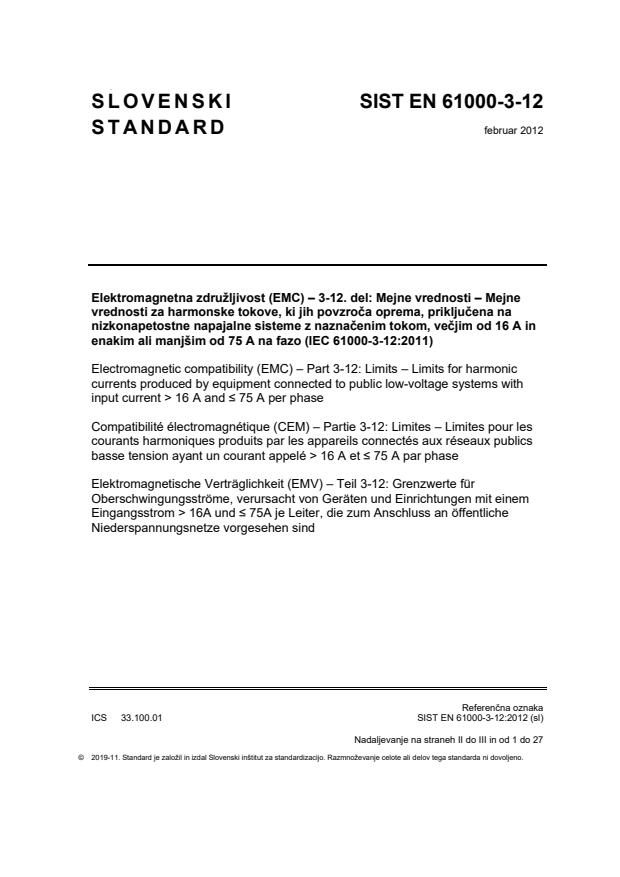
SLOVENSKI STANDARD
01-februar-2012
Nadomešča:
SIST EN 61000-3-12:2005
Elektromagnetna združljivost (EMC) – 3-12. del: Mejne vrednosti – Mejne vrednosti
za harmonske tokove, ki jih povzroča oprema, priključena na nizkonapetostne
napajalne sisteme z naznačenim tokom, večjim od 16 A in enakim ali manjšim od
75 A na fazo (IEC 61000-3-12:2011)
Electromagnetic compatibility (EMC) - Part 3-12: Limits - Limits for harmonic currents
produced by equipment connected to public low-voltage systems with input current > 16
A and <= 75 A per phase
Elektromagnetische Verträglichkeit (EMV) - Teil 3-12: Grenzwerte für
Oberschwingungsströme, verursacht von Geräten und Einrichtungen mit einem
Eingangsstrom > 16A und ≤ 75A je Leiter, die zum Anschluss an öffentliche
Niederspannungsnetze vorgesehen sind
Compatibilité électromagnétique (CEM) - Partie 3-12: Limites - Limites pour les courants
harmoniques produits par les appareils connectés aux réseaux publics basse tension
ayant un courant appelé > 16 A et <= 75 A par phase
Ta slovenski standard je istoveten z: EN 61000-3-12:2011
ICS:
33.100.01 Elektromagnetna združljivost Electromagnetic compatibility
na splošno in general
2003-01.Slovenski inštitut za standardizacijo. Razmnoževanje celote ali delov tega standarda ni dovoljeno.
EUROPEAN STANDARD
EN 61000-3-12
NORME EUROPÉENNE
December 2011
EUROPÄISCHE NORM
ICS 33.100.10 Supersedes EN 61000-3-12:2005
English version
Electromagnetic compatibility (EMC) -
Part 3-12: Limits -
Limits for harmonic currents produced by equipment connected to public
low-voltage systems with input current > 16 A and ≤ 75 A per phase
(IEC 61000-3-12:2011)
Compatibilité électromagnétique (CEM) - Elektromagnetische Verträglichkeit (EMV)
Partie 3-12: Limites - -
Limites pour les courants harmoniques Teil 3-12: Grenzwerte für
produits par les appareils connectés aux Oberschwingungsströme, verursacht von
réseaux publics basse tension ayant un Geräten und Einrichtungen mit einem
courant appelé > 16 A et ≤ 75 A par phase Eingangsstrom > 16A und ≤ 75A je Leiter,
(CEI 61000-3-12:2011) die zum Anschluss an öffentliche
Niederspannungsnetze vorgesehen sind.
(IEC 61000-3-12:2011)
This European Standard was approved by CENELEC on 2011-06-16. CENELEC members are bound to comply
with the CEN/CENELEC Internal Regulations which stipulate the conditions for giving this European Standard
the status of a national standard without any alteration.
Up-to-date lists and bibliographical references concerning such national standards may be obtained on
application to the CEN-CENELEC Management Centre or to any CENELEC member.
This European Standard exists in three official versions (English, French, German). A version in any other
language made by translation under the responsibility of a CENELEC member into its own language and notified
to the CEN-CENELEC Management Centre has the same status as the official versions.
CENELEC members are the national electrotechnical committees of Austria, Belgium, Bulgaria, Croatia, Cyprus,
the Czech Republic, Denmark, Estonia, Finland, France, Germany, Greece, Hungary, Iceland, Ireland, Italy,
Latvia, Lithuania, Luxembourg, Malta, the Netherlands, Norway, Poland, Portugal, Romania, Slovakia, Slovenia,
Spain, Sweden, Switzerland and the United Kingdom.
CENELEC
European Committee for Electrotechnical Standardization
Comité Européen de Normalisation Electrotechnique
Europäisches Komitee für Elektrotechnische Normung
Management Centre: Avenue Marnix 17, B - 1000 Brussels
© 2011 CENELEC - All rights of exploitation in any form and by any means reserved worldwide for CENELEC members.
Ref. No. EN 61000-3-12:2011 E
Foreword
The text of document 77A/740/FDIS, future edition 2 of IEC 61000-3-12, prepared by SC 77A, "Low
frequency phenomena", of IEC TC 77, "Electromagnetic compatibility" was submitted to the
IEC-CENELEC parallel vote and approved by CENELEC as EN 61000-3-12:2011.
The following dates are fixed:
– latest date by which the EN has to be implemented
at national level by publication of an identical
national standard or by endorsement (dop) 2012-06-16
– latest date by which the national standards conflicting
with the EN have to be withdrawn (dow) 2014-06-16
This European Standard supersedes EN 61000-3-12:2005.
The significant technical changes with respect to EN 61000-3-12:2005 are listed below:
– the reference fundamental current I is replaced by the reference current I for the calculation of
1 ref
emission limits;
– a new table of current emission limits (Table 5) is added;
– a new annex (Annex A) is added to define test conditions for some types of equipment;
– former Annexes B (Approximate interpolation formulas) and D (Information on the PWHD factor) are
deleted.
Attention is drawn to the possibility that some of the elements of this document may be the subject of
patent rights. CEN and CENELEC shall not be held responsible for identifying any or all such patent
rights.
This European Standard has been prepared under a mandate given to CENELEC by the European
Commission and the European Free Trade Association and covers essential requirements of
EC Directives EMC (2004/108/EC) and RTTED (1999/5/EC).
For the relationship with EU Directive(s) see informative Annex ZZ, which is an integral part of this
document.
__________
Endorsement notice
The text of the International Standard IEC 61000-3-12:2011 was approved by CENELEC as a European
Standard without any modification.
__________
- 3 - EN 61000-3-12:2011
Annex ZA
(normative)
Normative references to international publications
with their corresponding European publications
The following referenced documents are indispensable for the application of this document. For dated
references, only the edition cited applies. For undated references, the latest edition of the referenced
document (including any amendments) applies.
NOTE When an international publication has been modified by common modifications, indicated by (mod), the relevant EN/HD
applies.
Publication Year Title EN/HD Year
IEC 60038 - IEC standard voltages EN 60038 -
IEC 60050-161 1990 International Electrotechnical Vocabulary - -
+ A1 1997 (IEV) -
+ A2 1998 Chapter 161: Electromagnetic compatibility
IEC 61000-2-2 - Electromagnetic compatibility (EMC) - EN 61000-2-2 -
Part 2-2: Environment - Compatibility levels
for low-frequency conducted disturbances and
signalling in public low-voltage power supply
systems
IEC 61000-2-4 - Electromagnetic compatibility (EMC) - EN 61000-2-4 -
Part 2-4: Environment - Compatibility levels in
industrial plants for low-frequency conducted
disturbances
IEC 61000-3-2 - Electromagnetic compatibility (EMC) - EN 61000-3-2 -
Part 3-2: Limits - Limits for harmonic current
emissions (equipment input current ≤ 16 A per
phase)
IEC 61000-4-7 - Electromagnetic compatibility (EMC) - EN 61000-4-7 -
Part 4-7: Testing and measurement
techniques - General guide on harmonics and
interharmonics measurements and
instrumentation, for power supply systems
and equipment connected thereto
Annex ZZ
(informative)
Coverage of Essential Requirements of EU Directives
This European Standard has been prepared under a mandate given to CENELEC by the European
Commission and the European Free Trade Association and within its scope the standard covers
protection requirements of Annex I, Article 1(a) of the EU Directive 2004/108/EC, and essential
requirements of Article 3.1(b) (emission only) of the EU Directive 1999/5/EC.
Compliance with this standard provides presumption of conformity with the specified essential
requirements of the Directives concerned.
NOTE Other requirements and other EU Directives may be applicable to the products falling within the scope of this
standard.
IEC 61000-3-12 ®
Edition 2.0 2011-05
INTERNATIONAL
STANDARD
NORME
INTERNATIONALE
Electromagnetic compatibility (EMC) –
Part 3-12: Limits – Limits for harmonic currents produced by equipment
connected to public low-voltage systems with input current >16 A and ≤75 A per
phase
Compatibilité électromagnétique (CEM) –
Partie 3-12: Limites – Limites pour les courants harmoniques produits par les
appareils connectés aux réseaux publics basse tension ayant un courant
appelé >16 A et ≤75 A par phase
INTERNATIONAL
ELECTROTECHNICAL
COMMISSION
COMMISSION
ELECTROTECHNIQUE
PRICE CODE
INTERNATIONALE
CODE PRIX U
ICS 33.100.10 ISBN 978-2-88912-486-2
– 2 – 61000-3-12 IEC:2011
CONTENTS
FOREWORD . 3
INTRODUCTION . 5
1 Scope . 6
2 Normative references. 7
3 Terms and definitions . 7
4 Measurement conditions . 11
4.1 Determination of the reference current . 11
4.2 Harmonic current measurement . 11
4.2.1 General . 11
4.2.2 Measurement procedure . 11
4.2.3 Repeatability . 11
4.2.4 Starting and stopping . 12
4.2.5 Application of limits . 12
4.2.6 Test report . 12
4.2.7 Test observation period. 12
4.3 Equipment consisting of several self-contained items . 12
5 Requirements and limits for equipment . 13
5.1 Control methods . 13
5.2 Limits for emission . 13
6 Product documentation . 17
7 Test and simulation conditions . 17
7.1 General . 17
7.2 Requirements for direct measurement . 17
7.3 Requirements for simulation . 18
7.4 General conditions for test and simulation . 19
Annex A (normative) Type test conditions . 21
Annex B (informative) Illustration of limits for harmonic currents . 23
Annex C (informative) Equipment not complying with the requirements and limits of this
standard . 24
Bibliography . 25
th
Figure 1 – Definition of the 5 harmonic current phase angle (I leads U , α > 0) . 10
5 p1 5
th
Figure 2 – Definition of the 5 harmonic current phase angle (I lags U , α < 0) . 10
5 p1 5
Figure 3 – Flowchart of the application procedure . 16
th
Figure B.1 – Limits of the 5 harmonic current as functions of R . 23
sce
Table 1 – Values of the observation period . 12
Table 2 – Current emission limits for equipment other than balanced three-phase
equipment . 15
Table 3 – Current emission limits for balanced three-phase equipment . 15
Table 4 – Current emission limits for balanced three-phase equipment under specified
conditions (a, b, c) . 15
Table 5 – Current emission limits for balanced three-phase equipment under specified
conditions (d, e, f) . 16
61000-3-12 IEC:2011 – 3 –
INTERNATIONAL ELECTROTECHNICAL COMMISSION
____________
ELECTROMAGNETIC COMPATIBILITY (EMC) –
Part 3-12: Limits –
Limits for harmonic currents produced
by equipment connected to public low-voltage systems
with input current >16 A and ≤75 A per phase
FOREWORD
1) The International Electrotechnical Commission (IEC) is a worldwide organization for standardization comprising
all national electrotechnical committees (IEC National Committees). The object of IEC is to promote
international co-operation on all questions concerning standardization in the electrical and electronic fields. To
this end and in addition to other activities, IEC publishes International Standards, Technical Specifications,
Technical Reports, Publicly Available Specifications (PAS) and Guides (hereafter referred to as “IEC
Publication(s)”). Their preparation is entrusted to technical committees; any IEC National Committee interested
in the subject dealt with may participate in this preparatory work. International, governmental and non-
governmental organizations liaising with the IEC also participate in this preparation. IEC collaborates closely
with the International Organization for Standardization (ISO) in accordance with conditions determined by
agreement between the two organizations.
2) The formal decisions or agreements of IEC on technical matters express, as nearly as possible, an international
consensus of opinion on the relevant subjects since each technical committee has representation from all
interested IEC National Committees.
3) IEC Publications have the form of recommendations for international use and are accepted by IEC National
Committees in that sense. While all reasonable efforts are made to ensure that the technical content of IEC
Publications is accurate, IEC cannot be held responsible for the way in which they are used or for any
misinterpretation by any end user.
4) In order to promote international uniformity, IEC National Committees undertake to apply IEC Publications
transparently to the maximum extent possible in their national and regional publications. Any divergence
between any IEC Publication and the corresponding national or regional publication shall be clearly indicated in
the latter.
5) IEC itself does not provide any attestation of conformity. Independent certification bodies provide conformity
assessment services and, in some areas, access to IEC marks of conformity. IEC is not responsible for any
services carried out by independent certification bodies.
6) All users should ensure that they have the latest edition of this publication.
7) No liability shall attach to IEC or its directors, employees, servants or agents including individual experts and
members of its technical committees and IEC National Committees for any personal injury, property damage or
other damage of any nature whatsoever, whether direct or indirect, or for costs (including legal fees) and
expenses arising out of the publication, use of, or reliance upon, this IEC Publication or any other IEC
Publications.
8) Attention is drawn to the Normative references cited in this publication. Use of the referenced publications is
indispensable for the correct application of this publication.
9) Attention is drawn to the possibility that some of the elements of this IEC Publication may be the subject of
patent rights. IEC shall not be held responsible for identifying any or all such patent rights.
International Standard IEC 61000-3-12 has been prepared by subcommittee 77A: Low
frequency phenomena, of IEC technical committee 77: Electromagnetic compatibility.
This second edition cancels and replaces the first edition published in 2004 and constitutes a
technical revision.
The significant technical changes with respect to the previous edition are listed below:
– the reference fundamental current I is replaced by the reference current I for the
1 ref
calculation of emission limits;
– a new table of current emission limits (Table 5) is added;
– a new annex (Annex A) is added to define test conditions for some types of equipment;
– 4 – 61000-3-12 IEC:2011
– former Annexes B (Approximate interpolation formulas) and D (Information on the PWHD
factor) are deleted.
The text of this standard is based on the following documents:
FDIS Report on voting
77A/740/FDIS 77A/747/RVD
Full information on the voting for the approval of this standard can be found in the report on
voting indicated in the above table.
This publication has been drafted in accordance with the ISO/IEC Directives, Part 2.
A list of all parts of the IEC 61000 series, published under the general title Electromagnetic
compatibility (EMC), can be found on the IEC website.
The committee has decided that the contents of this publication will remain unchanged until the
stability date indicated on the IEC web site under "http://webstore.iec.ch" in the data related to
the specific publication. At this date, the publication will be
• reconfirmed,
• withdrawn,
• replaced by a revised edition, or
• amended.
61000-3-12 IEC:2011 – 5 –
INTRODUCTION
IEC 61000 is published in separate parts according to the following structure:
Part 1: General
General considerations (introduction, fundamental principles)
Definitions, terminology
Part 2: Environment
Description of the environment
Classification of the environment
Compatibility levels
Part 3: Limits
Emission limits
Immunity limits
(in so far as they do not fall under the responsibility of the product committees)
Part 4: Testing and measurement techniques
Measurement techniques
Testing techniques
Part 5: Installation and mitigation guidelines
Installation guidelines
Mitigation methods and devices
Part 6: Generic standards
Part 9: Miscellaneous
Each part is further subdivided into several parts, published either as International Standards
or as technical specifications or technical reports, some of which have already been published
as sections. Others will be published with the part number followed by a dash and a second
number identifying the subdivision (example: IEC 61000-6-1).
This International Standard is a Product Family Standard.
– 6 – 61000-3-12 IEC:2011
ELECTROMAGNETIC COMPATIBILITY (EMC) –
Part 3-12: Limits –
Limits for harmonic currents produced
by equipment connected to public low-voltage systems
with input current >16 A and ≤75 A per phase
1 Scope
This part of IEC 61000 deals with the limitation of harmonic currents injected into the public
supply system. The limits given in this International Standard are applicable to electrical and
electronic equipment with a rated input current exceeding 16 A and up to and including 75 A
per phase, intended to be connected to public low-voltage a.c. distribution systems of the
following types:
• nominal voltage up to 240 V, single-phase, two or three wires;
• nominal voltage up to 690 V, three-phase, three or four wires;
• nominal frequency 50 Hz or 60 Hz.
Other distribution systems are excluded. The limits given in this edition apply to equipment
when connected to 230/400 V, 50 Hz systems. See also Clause 5.
NOTE 1 The limits for the other systems will be added in a future edition of this standard.
NOTE 2 Equipment with a rated input current exceeding 75 A per phase should be considered in the harmonic
current requirements for installations. See IEC/TR 61000-3-6 and future IEC/TR 61000-3-14.
This standard applies to equipment intended to be connected to low-voltage systems
interfacing with the public supply at the low-voltage level. It does not apply to equipment
intended to be connected only to private low-voltage systems interfacing with the public supply
only at the medium- or high-voltage level.
NOTE 3 The scope of this standard is limited to equipment connected to public low voltage systems because
emissions from equipment installed in private low voltage systems can be controlled in aggregate at the MV point of
common coupling using procedures defined in IEC/TR 61000-3-6 and/or by means of contractual agreements
between the distribution network operator and the customer. It is expected that operators of private systems will
manage the EMC environment in a manner that ensures compliance with the provisions given in IEC/TR 61000-3-6
and/or the contractual agreements.
NOTE 4 If the equipment is intended to be connected only to private systems, the manufacturer should make this
very clear in the product documentation.
NOTE 5 Professional equipment with input current ≤16 A per phase and that does not comply with the
requirements and limits of standard IEC 61000-3-2 may be permitted to be connected to certain types of low voltage
supplies, in the same way as equipment with input current >16 A per phase and that does not comply with the
requirements and limits of the present standard (see Annex C).
NOTE 6 The limits in this standard are not applicable to stand-alone harmonic filters.
This standard defines:
a) requirements and emission limits for equipment;
b) methods for type tests and simulations.
Tests according to this International Standard are type tests of complete pieces of equipment.
Conformity with this standard can also be determined by validated simulations.
61000-3-12 IEC:2011 – 7 –
2 Normative references
The following referenced documents are indispensable for the application of this document. For
dated references, only the edition cited applies. For undated references, the latest edition of
the referenced document (including any amendments) applies.
IEC 60038, IEC standard voltages
IEC 60050(161):1990, International Electrotechnical Vocabulary – Chapter 161: Electro-
magnetic compatibility
Amendment 1 (1997)
Amendment 2 (1998)
IEC 61000-2-2, Electromagnetic compatibility (EMC) – Part 2-2: Environment – Compatibility
levels for low-frequency conducted disturbances and signalling in public low-voltage power
supply systems
IEC 61000-2-4, Electromagnetic compatibility (EMC) – Part 2-4: Environment – Compatibility
levels in industrial plants for low-frequency conducted disturbances
IEC 61000-3-2, Electromagnetic compatibility (EMC) – Part 3-2: Limits – Limits for harmonic
current emissions (equipment input current ≤16 A per phase)
IEC 61000-4-7, Electromagnetic compatibility (EMC) – Part 4-7: Testing and measurement
techniques – General guide on harmonics and interharmonics measurements and
instrumentation, for power supply systems and equipment connected thereto
3 Terms and definitions
For the purposes of this document, the definitions given in IEC 60050(161) and the following
definitions apply.
3.1
total harmonic current
THC
total r.m.s. value of the harmonic current components of orders 2 to 40
THC= I
h
∑
h=2
3.2
partial weighted harmonic current
PWHC
total r.m.s. value of a selected group of higher order harmonic current components (in this
International Standard from order 14 to order 40), weighted with the harmonic order h
PWHC= h⋅ I
∑ h
h=14
NOTE The partial weighted harmonic current is employed in order to ensure that the effects of the higher order
harmonic currents on the results are reduced sufficiently and individual limits need not be specified.
– 8 – 61000-3-12 IEC:2011
3.3
point of common coupling
PCC
point in the public system which is closest to the customer concerned and to which other
customers are or may be connected
3.4
single-phase equipment
equipment connected between one line conductor and the neutral conductor
NOTE This includes equipment in which separate loads are connected from one or more line conductors to the
neutral conductor
3.5
interphase equipment
equipment connected between two line conductors (phases)
NOTE The neutral conductor is not used as a current-carrying conductor under normal operating conditions.
3.6
three-phase equipment
equipment connected to the three line conductors
NOTE 1 The neutral conductor is not used as a current-carrying conductor under normal operating conditions.
NOTE 2 Equipment intended to be connected to all three phases and to the neutral and where the neutral
conductor is used as a current-carrying conductor, is considered as three separate single-phase items.
3.7
balanced three-phase equipment
three-phase equipment connected to the three line conductors of a three-phase supply and in
which the three line or phase currents are designed to be identical in amplitude and wave-
shape, each being displaced from the other two by one-third of a fundamental period
3.8
unbalanced three-phase equipment
three-phase equipment connected to the three line conductors of a three-phase supply and in
which the three line or phase currents are not designed to be identical in amplitude or wave-
shape, or the displacement between any two is other than one-third of a fundamental period
3.9
hybrid equipment
combination of a balanced three-phase load and one or more loads connected between phase
and neutral or between phases
3.10
short-circuit power
S
sc
value of the three-phase short-circuit power calculated from the nominal interphase system
voltage U and the line impedance Z of the system at the PCC:
nominal
S = U / Z
sc nominal
where Z is the system impedance at the power frequency
3.11
rated apparent power of the equipment
S
equ
value calculated from the rated current I of the piece of equipment stated by the
equ
manufacturer and the rated voltage U (single phase) or U (interphase) as follows:
p i
61000-3-12 IEC:2011 – 9 –
a) S = U I for single-phase equipment and the single-phase part of hybrid
equ p equ
equipment;
b) S = U I for interphase equipment;
equ i equ
c) S = 3 U I for balanced three-phase equipment and the three-phase part of
equ i equ
hybrid equipment;
d) S = 3 U I for unbalanced three-phase equipment, where I is the
equ i equ max equ max
maximum of the r.m.s. currents flowing in any one of the three
phases
NOTE In the case of a voltage range, U or U is a nominal system voltage according to IEC 60038 (for example:
p i
120 V or 230 V for single-phase or 400 V line-to-line for three-phase).
3.12
reference current
I
ref
value of the r.m.s. input current of the equipment determined according to 4.1 and used to
establish emission limits
3.13
rated current of the equipment
I
equ
input current of the piece of equipment as declared by the manufacturer and marked as such
on the rating plate of the piece of equipment or stated in the product documents
3.14
short-circuit ratio
R
sce
characteristic value of a piece of equipment defined as follows:
a) R = S / (3 S ) for single-phase equipment and the single-phase part of hybrid
sce sc equ
equipment;
b) R = S / (2 S ) for interphase equipment;
sce sc equ
c) R = S / S for all three-phase equipment and the three-phase part of hybrid
sce sc equ
equipment
NOTE 1 R may be related directly to basic known quantities by means of the equations:
sce
R = U/(√3 × Z × I ) for single-phase equipment and the single phase part of hybrid equipment;
sce equ
R = U/(2 × Z × I ) for interphase equipment;
sce equ
R = U/(√3 × Z × I ) for balanced three-phase equipment and the three-phase part of hybrid equipment;
sce equ
R = U/(√3 × Z × I ) for unbalanced three-phase equipment
sce equ max
where U = U , and is assumed to be equal to U or √3 × U , whichever is relevant.
nominal i p
NOTE 2 R is not the same as R , as defined in IEC 61000-2-6.
sce sc
NOTE 3 For hybrid equipment, the method of calculating a single R value is given in 5.2.
sce
3.15
stand-by mode
non-operational, low power consumption mode (usually indicated in some way on the
equipment) that can persist for an indefinite time
NOTE This mode is sometimes termed sleep mode.
– 10 – 61000-3-12 IEC:2011
3.16
phase angle of I related to the fundamental phase-to-neutral voltage U
5 p1
th
phase angle of the 5 harmonic current determined as described in Figures 1 and 2
3.17
professional equipment
equipment for use in trades, professions, or industries and which is not intended for sale to the
general public
NOTE The designation is specified by the manufacturer.
U
P1
I
α
+180°
IEC 1007/11
th
Figure 1 – Definition of the 5 harmonic current phase angle
(I leads U , α > 0)
5 p1 5
U
p1
I
α
−180°
IEC 1008/11
th
Figure 2 – Definition of the 5 harmonic current phase angle
(I lags U , α < 0)
5 p1 5
61000-3-12 IEC:2011 – 11 –
4 Measurement conditions
4.1 Determination of the reference current
The average r.m.s. input current shall be measured using the averaging method defined in
4.2.2 for harmonic currents. Except for dimmers, the measurement shall be made under the
conditions specified in 7.4. For dimmers, the average r.m.s. input current shall be determined
with the dimmer set to its maximum conduction angle.
The manufacturer may specify any value of r.m.s. current which is within ± 10 % of the actual
measured value and use it as the reference current for the original manufacturer's conformity
assessment test. The measured and specified values of current, as defined in this clause, shall
be documented in the test report.
For emission tests other than the original manufacturer’s conformity assessment test, the value
of the reference current shall be determined as follows. If the value of the average r.m.s. input
current found by measurement during these emission tests, measured according to the terms
of this clause, is not less than 90 % nor greater than 110 % of the value of current specified by
the manufacturer in the test report (see 4.2.6), the reference current is equal to the specified
value. If the new measured value is outside of this tolerance band around the specified value,
the reference current is equal to the new measured value.
4.2 Harmonic current measurement
4.2.1 General
The harmonic current limits for equipment as specified apply to line currents for all types of
power connections and load.
4.2.2 Measurement procedure
The measurement of harmonic currents shall be performed as follows:
• for each harmonic order, measure the 1,5 s smoothed r.m.s. harmonic current in each
Discrete Fourier Transform (DFT) time window as defined in IEC 61000-4-7;
• for each harmonic order, calculate the arithmetic average of the measured values from the
DFT time windows, over the entire test observation period as defined in 4.2.7.
Test conditions for the measurement or calculation of harmonic currents are given in Clause 7.
4.2.3 Repeatability
The repeatability of the average value for the individual harmonic currents over the entire test
observation period shall be better than ± 5 % of the applicable limit, when the following
conditions are met:
• the same equipment under test (EUT) (not another of the same type, however similar);
• identical test conditions;
• the same test system;
• identical climatic conditions, if relevant.
NOTE This repeatability requirement serves the purpose of defining the necessary test observation period,
see 4.2.7. It is not intended to serve as a pass/fail criterion for the assessment of compliance with the requirements
of this standard.
– 12 – 61000-3-12 IEC:2011
4.2.4 Starting and stopping
When a piece of equipment is brought into operation or is taken out of operation, manually or
automatically, harmonic currents are not taken into account for the first 10 s, or until the
equipment is fully in or out of operation, whichever is longer, following the switching event.
The equipment under test shall not be in stand-by mode (see 3.15) for more than 10 % of any
observation period.
4.2.5 Application of limits
The average value for the individual harmonic currents, taken over the entire test observation
period shall be less than or equal to the applicable limits in Tables 2 to 5.
For each harmonic order, all 1,5 s smoothed r.m.s. harmonic current values, as defined in
4.2.2, shall be less than or equal to 150 % of the applicable limits.
For the calculation of THC and PWHC, individual harmonic currents below 1 % of the reference
current are disregarded.
4.2.6 Test report
The test report may be based on information supplied by the manufacturer to a testing facility,
or be a document recording details of the manufacturer’s own tests. It shall include all relevant
information for the test conditions, the test observation period and the determination of the
reference current showing compliance with the present standard.
The test report shall include:
• the values of the input current measured and specified by the manufacturer for the
determination of the reference current I , according to 4.1;
ref
• the short circuit ratio used for calculation or test;
• the required minimum short circuit ratio;
• and a statement about the table applied (i.e. about the type of equipment).
4.2.7 Test observation period
Observation periods (T ) for four different types of equipment behavior are considered and
obs
described in Table 1.
Table 1 – Values of the observation period
Type of equipment behavior Observation period
Quasi-stationary T of sufficient duration to meet the requirements for repeatability in 4.2.3.
obs
Short cyclic (T ≤ 2,5 min) T ≥ 10 cycles (reference method) or T of sufficient duration or synchronization
cycle obs obs
a
to meet the requirements for repeatability in 4.2.3.
Random T of sufficient duration to meet the requirements for repeatability in 4.2.3.
obs
Full equipment program cycle (reference method) or a representative 2,5 min period
Long cyclic (T > 2,5 min)
cycle
considered by the manufacturer as the operating period with the highest THC.
a
By synchronization is meant that the total observation period is sufficiently close to including an exact integral
number of equipment cycles in such a way that the requirements for repeatability in 4.2.3 are met.
4.3 Equipment consisting of several self-contained items
Where individual self-contained items of equipment (possibly, but not necessarily, of different
manufacture) are assembled in a rack or case, compliance with the present standard shall be
61000-3-12 IEC:2011 – 13 –
achieved either for the system as a whole or for each individual self-contained item at the
manufacturer’s discretion.
5 Requirements and limits for equipment
5.1 Control methods
Only symmetrical control methods (see IEC 60050:1990, 161-07-11) are allowed under normal
operating conditions.
Symmetrical control methods which are not multicycle control (see IEC 60050:1990, 161-07-05)
and which are used for the control of the power supplied to heating elements are only allowed
for professional equipment whose primary purpose considered as a whole is not for heating. In
addition, all the three following conditions apply:
a) the relevant limits are not exceeded when tested at the supply input terminals;
b) it is necessary to control precisely the temperature of a heater whose thermal time
constant is less than 2 s;
c) there is no other technique economically available.
NOTE For the purposes of this standard, burst firing is deemed to be symmetrical multicycle control.
5.2 Limits for emission
The limits given apply to 230/400 V, 50 Hz systems. The limits for the other systems will be
added in a future edition of this standard.
NOTE 1 In some non-European countries, the proposed methodology cannot be applied because the short-circuit
power data is not always available.
The harmonic current limits specified in the tables apply to each of the line currents and not to
current in the neutral conductor.
For equipment with multiple rated currents, an assessment is made for each current.
As an example (for the same equipment):
Rated voltage: 230 V single phase, rated current: x A per phase, assessment and test at 230 V.
Rated voltage: 400 V three phase, rated current: y A per phase, assessment and test at 400 V.
The harmonic current limits are specified in Tables 2 to 5.
Equipment complying with the harmonic current emission limits corresponding to R = 33 is
sce
suitable for connection at any point of the supply system.
NOTE 2 Values are based on a minimum value of R = 33. Short-circuit ratios less than 33 are not considered.
sce
NOTE 3 In order to reduce the depth of commutation notches of converters, a short-circuit ratio higher than 33
may be necessary.
For equipment not complying with the harmonic current emission limits corresponding to
R = 33, higher emission values are allowed, under the assumption that the short-circuit ratio
sce
R is greater than 33. It is expected that this will apply to the majority of equipment with input
sce
current above 16 A per phase. See requirement for product documentation in Clause 6.
Table 2 is applied to equipment other than balanced three-phase equipment and Tables 3, 4
and 5 are applied to balanced three-phase equipment.
Table 3 may be used for any balanced three-phase piece of equipment.
– 14 – 61000-3-12 IEC:2011
Table 4 may be used with balanced three-phase equipment if any one of these conditions is
met.
th th
a) The 5 and 7 harmonic currents are each less than 5 % of the reference current during
the whole test observation period.
NOTE This condition is normally fulfilled by 12 pulse pieces of equipment.
th
b) The design of the piece of equipment is such that the phase angle of the 5 harmonic
current has no preferential value over time and can take any value in the whole interval
[0 °, 360 °].
NOTE This condition is normally fulfilled by converters with fully controlled thyristor bridges.
th
c) The phase angle of the 5 harmonic current related to the fundamental phase-to-neutral
voltage (see 3.16) is in the range of 90 ° to 150 ° during the whole test observation period.
NOTE This condition is normally fulfilled by equipment with an uncontrolled rectifier bridge and capacitive
filter, including a 3 % a.c. or 4 % d.c. reactor.
Table 5 may be used with balanced three-phase equipment if any one of these conditions is
met:
th th
d) The 5 and 7 harmonic currents are each less than 3 % of the reference current during
the whole test observation period.
th
e) The design of the piece of equipment is such that the phase angle of the 5 harmonic
current has no preferential value over time and can take any value in the whole interval
[0 °, 360 °].
th
f) The phase angle of the 5 harmonic current related to the fundamental phase-to-neutral
voltage (see 3.16) is in the range of 150 ° to 210 ° during the whole test observation period.
NOTE This condition is normally fulfilled by a 6 pulse converter with a small d.c. link capacitance, operating
as a load.
Table 3, Table 4 or Table 5 can be applied to hybrid equipment in one of the following
circumstances:
rd
a) hybrid equipment having a maximum 3 harmonic current of less than 5 % of the reference
current, or
b) there is provision in the construction of hybrid equipment to separate the balanced three-
phase and the single-phase or interphase loads for the measurement of supply currents,
and when the current is being measured, the part of the equipment being measured draws
the same current as under normal operating conditions. In that case, the relevant limits
shall be applied separately to the single-phase or interphase part and to the balanced
three-phase part. Table 3, Table 4 or Table 5 applies to the current of the balanced three-
phase part, even if the rated current of the balanced three-phase part is less than or equal
to 16 A per phase. Table 2 applies to the current of the single-phase or interphase part, but
if the rated current of the single-phase or interphase part is less than or equal to 16 A, the
manufacturer may apply the relevant limits of IEC 61000-3-2 to the single-phase or
interphase part instead of the limits stated in Table 2.
For verification purposes, when circumstance b) above applies, the manufacturer shall state in
the product documentation the rated current and give in the test report the measured and
specified values of the input current as defined in 4.1, for each separate load. The value of
R for this type of hybrid equipment is determined as follows:
sce
• the minimum R value is first determined for each of the two loads, using the
sce
reference current of the considered part for the calculation of the harmonic current
emissions to be compared to the limit values given in Tables 2 to 5; in case
IEC 61000-3-2 is applied to the single-phase or interphase part instead of Table 2 limits,
the minimum R value for this part is deemed to be equal to 33;
sce
• then, for each of the two parts, the minimum value of S is calculated from its minimum
sc
R value and its rated current (see 3.11 and 3.14);
sce
61000-3-12 IEC:2011 – 15 –
• finally, the value of R for the hybrid equipment is determined from the highest of both
sce
minimum values of S and the rated apparent power of the whole hybrid equipment.
sc
Table 2 – Current emission limits for equipment
other than balanced three-phase equipment
Admissible individual Admissible harmonic
a
Minimum R harmonic current I /I parameters
h
sce ref
% %
I I I I I I THC/ I PWHC / I
3 5 7 9 11 13 ref ref
33 21,6 10,7 7,2 3,8 3,1 2 23 23
66 24 13 8 5 4 3 26 26
120 27 15 10 6 5
...
ba
SLOVENSKI SIST EN 61000-3-12
STANDARD februar 2012
Elektromagnetna združljivost (EMC) – 3-12. del: Mejne vrednosti – Mejne
vrednosti za harmonske tokove, ki jih povzroča oprema, priključena na
nizkonapetostne napajalne sisteme z naznačenim tokom, večjim od 16 A in
enakim ali manjšim od 75 A na fazo (IEC 61000-3-12:2011)
Electromagnetic compatibility (EMC) – Part 3-12: Limits – Limits for harmonic
currents produced by equipment connected to public low-voltage systems with
input current > 16 A and ≤ 75 A per phase
Compatibilité électromagnétique (CEM) – Partie 3-12: Limites – Limites pour les
courants harmoniques produits par les appareils connectés aux réseaux publics
basse tension ayant un courant appelé > 16 A et ≤ 75 A par phase
Elektromagnetische Verträglichkeit (EMV) – Teil 3-12: Grenzwerte für
Oberschwingungsströme, verursacht von Geräten und Einrichtungen mit einem
Eingangsstrom > 16A und ≤ 75A je Leiter, die zum Anschluss an öffentliche
Niederspannungsnetze vorgesehen sind
Referenčna oznaka
ICS 33.100.01 SIST EN 61000-3-12:2012 (sl)
Nadaljevanje na straneh II do III in od 1 do 27
© 2019-11. Standard je založil in izdal Slovenski inštitut za standardizacijo. Razmnoževanje celote ali delov tega standarda ni dovoljeno.
SIST EN 61000-3-12 : 2012
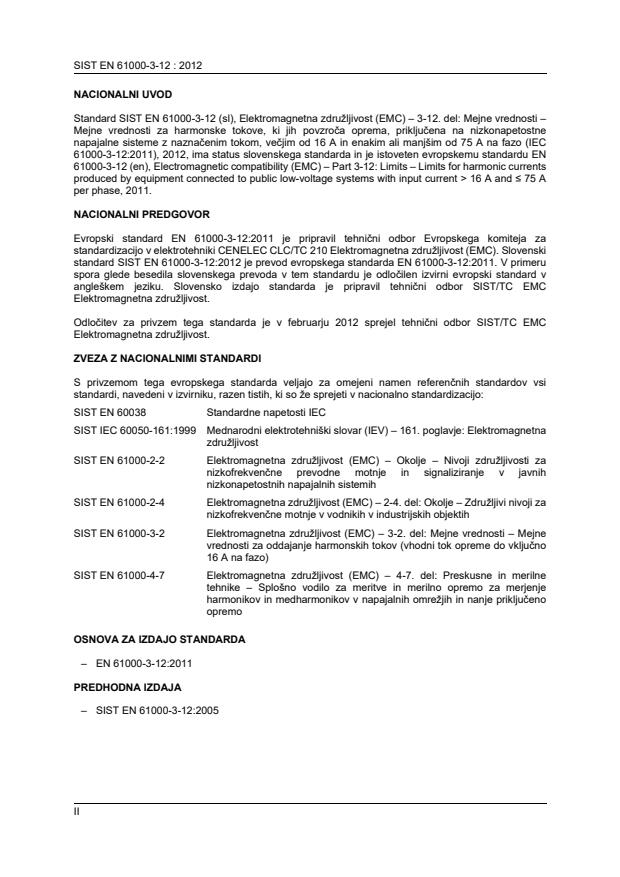
NACIONALNI UVOD
Standard SIST EN 61000-3-12 (sl), Elektromagnetna združljivost (EMC) – 3-12. del: Mejne vrednosti –
Mejne vrednosti za harmonske tokove, ki jih povzroča oprema, priključena na nizkonapetostne
napajalne sisteme z naznačenim tokom, večjim od 16 A in enakim ali manjšim od 75 A na fazo (IEC
61000-3-12:2011), 2012, ima status slovenskega standarda in je istoveten evropskemu standardu EN
61000-3-12 (en), Electromagnetic compatibility (EMC) – Part 3-12: Limits – Limits for harmonic currents
produced by equipment connected to public low-voltage systems with input current > 16 A and ≤ 75 A
per phase, 2011.
NACIONALNI PREDGOVOR
Evropski standard EN 61000-3-12:2011 je pripravil tehnični odbor Evropskega komiteja za
standardizacijo v elektrotehniki CENELEC CLC/TC 210 Elektromagnetna združljivost (EMC). Slovenski
standard SIST EN 61000-3-12:2012 je prevod evropskega standarda EN 61000-3-12:2011. V primeru
spora glede besedila slovenskega prevoda v tem standardu je odločilen izvirni evropski standard v
angleškem jeziku. Slovensko izdajo standarda je pripravil tehnični odbor SIST/TC EMC
Elektromagnetna združljivost.
Odločitev za privzem tega standarda je v februarju 2012 sprejel tehnični odbor SIST/TC EMC
Elektromagnetna združljivost.
ZVEZA Z NACIONALNIMI STANDARDI
S privzemom tega evropskega standarda veljajo za omejeni namen referenčnih standardov vsi
standardi, navedeni v izvirniku, razen tistih, ki so že sprejeti v nacionalno standardizacijo:
SIST EN 60038 Standardne napetosti IEC
SIST IEC 60050-161:1999 Mednarodni elektrotehniški slovar (IEV) – 161. poglavje: Elektromagnetna
združljivost
SIST EN 61000-2-2 Elektromagnetna združljivost (EMC) – Okolje – Nivoji združljivosti za
nizkofrekvenčne prevodne motnje in signaliziranje v javnih
nizkonapetostnih napajalnih sistemih
SIST EN 61000-2-4 Elektromagnetna združljivost (EMC) – 2-4. del: Okolje – Združljivi nivoji za
nizkofrekvenčne motnje v vodnikih v industrijskih objektih
SIST EN 61000-3-2 Elektromagnetna združljivost (EMC) – 3-2. del: Mejne vrednosti – Mejne
vrednosti za oddajanje harmonskih tokov (vhodni tok opreme do vključno
16 A na fazo)
SIST EN 61000-4-7 Elektromagnetna združljivost (EMC) – 4-7. del: Preskusne in merilne
tehnike – Splošno vodilo za meritve in merilno opremo za merjenje
harmonikov in medharmonikov v napajalnih omrežjih in nanje priključeno
opremo
OSNOVA ZA IZDAJO STANDARDA
– EN 61000-3-12:2011
PREDHODNA IZDAJA
– SIST EN 61000-3-12:2005
II
SIST EN 13108-7 : 2017
OPOMBE
– Povsod, kjer se v besedilu standarda uporablja izraz "evropski standard", v SIST EN 61000-3-
12:2012 to pomeni "slovenski standard".
– Nacionalni uvod in nacionalni predgovor nista sestavni del standarda.
– Ta nacionalni dokument je istoveten EN 61000-3-12:2011 in je objavljen z dovoljenjem
CEN-CENELEC
Upravni center
Avenue Marnix 17
B-1000 Bruselj
This national document is identical with EN 61000-3-12:2011 and is published with the permission
of
CEN-CENELEC
Management Centre
Avenue Marnix 17
B -1000 Brussels
III
SIST EN 61000-3-12 : 2012
(prazna stran)
IV
EVROPSKI STANDARD EN 61000-3-12
EUROPEAN STANDARD
NORME EUROPÉENNE
december 2011
EUROPÄISCHE NORM
ICS 33.100.01 Nadomešča EN 61000-3-12:2005
Slovenska izdaja
Elektromagnetna združljivost (EMC) – 3-12. del: Mejne vrednosti – Mejne
vrednosti za harmonske tokove, ki jih povzroča oprema, priključena na
nizkonapetostne napajalne sisteme z naznačenim tokom, večjim od 16 A
in enakim ali manjšim od 75 A na fazo (IEC 61000-3-12:2011)
Electromagnetic compatibility Compatibilité électromagnétique Elektromagnetische
(EMC) – Part 3-12: Limits – (CEM) – Partie 3-12: Limites – Verträglichkeit (EMV) –
Limits for harmonic currents Limites pour les courants Teil 3-12: Grenzwerte für
produced by equipment harmoniques produits par les Oberschwingungsströme,
connected to public low-voltage appareils connectés aux verursacht von Geräten und
systems with input current réseaux publics basse tension Einrichtungen mit einem
> 16 A and ≤ 75 A per phase ayant un courant appelé Eingangsstrom > 16A und ≤ 75A
> 16 A et ≤ 75 A par phase je Leiter, die zum Anschluss an
öffentliche Niederspannungs-
netze vorgesehen sind
Ta evropski standard je CENELEC sprejel 16. junija 2011. Člani CENELEC morajo izpolnjevati notranje
predpise CEN/CENELEC, s katerimi so predpisani pogoji za privzem tega evropskega standarda na
nacionalno raven brez kakršnihkoli sprememb.
Najnovejši seznami teh nacionalnih standardov z njihovimi bibliografskimi podatki se na zahtevo lahko
dobijo pri Upravnem centru CEN-CENELEC ali kateremkoli članu CENELEC.
Ta evropski standard obstaja v treh uradnih izdajah (angleški, francoski in nemški). Izdaje v drugih
jezikih, ki jih člani CENELEC na lastno odgovornost prevedejo in izdajo ter prijavijo pri Centralnem
sekretariatu, veljajo kot uradne izdaje.
Člani CENELEC so nacionalni elektrotehniški komiteji Avstrije, Belgije, Bolgarije, Hrvaške, Cipra,
Češke, Danske, Estonije, Finske, Francije, Nemčije, Grčije, Madžarske, Islandije, Irske, Italije, Latvije,
Litve, Luksemburga, Malte, Nizozemske, Norveške, Poljske, Portugalske, Romunije, Slovaške,
Slovenije, Španije, Švedske, Švice in Združenega kraljestva.
CENELEC
Evropski komite za standardizacijo v elektrotehniki
European Committee for Electrotechnical Standardization
Comité Européen de Normalisation Electrotechnique
Europäisches Komitee für Elektrotechnische Normung
Upravni center CEN-CENELEC: Avenue Marnix 17, B-1000 Bruselj
© 2011 CENELEC Lastnice avtorskih pravic so vse države članice CENELEC. Ref. oznaka EN 61000-3-12:2011 E
SIST EN 61000-3-12 : 2012
VSEBINA Stran
Predgovor k mednarodnemu standardu . 6
Uvod . 8
1 Področje uporabe . 9
2 Zveze s standardi . 10
3 Izrazi in definicije . 10
4 Merilni pogoji . 13
4.1 Določitev referenčnega toka . 13
4.2 Meritve harmonskega toka . 14
4.2.1 Splošno . 14
4.2.2 Merilni postopek . 14
4.2.3 Ponovljivost . 14
4.2.4 Začetek in zaustavitev . 14
4.2.5 Uporaba mejnih vrednosti . 14
4.2.6 Poročilo o preskusu . 15
4.2.7 Opazovalno obdobje preskusa . 15
4.3 Oprema, ki je sestavljena iz več samostojnih enot . 15
5 Zahteve in mejne vrednosti za opremo . 15
5.1 Postopki krmiljenja . 15
5.2 Mejne vrednosti oddajanja . 16
6 Dokumentacija o proizvodu . 20
7 Pogoji za preskušanje in simulacijo . 20
7.1 Splošno . 20
7.2 Zahteve za neposredno merjenje . 20
7.3 Zahteve za simulacijo . 21
7.4 Splošne zahteve za preskus in simulacijo . 22
Dodatek A (normativni): Pogoji za preskus tipa . 23
Dodatek B (informativni): Ponazoritev mejnih vrednosti za harmonske toke . 25
Dodatek C (informativni): Oprema, ki ne izpolnjuje zahtev in mejnih vrednosti tega standarda . 26
Literatura . 27
Slika 1: Določitev faznega kota petega harmonskega toka (I prehiteva U , α > 0) . 13
5 p1 5
Slika 2: Določitev faznega kota petega harmonskega toka (I zaostaja za U , α < 0) . 13
5 p1 5
Slika 3: Diagram poteka postopka uporabe . 19
Slika B.1: Mejne vrednosti petega harmonskega toka kot funkcija R . 25
sce
Preglednica 1: Vrednosti opazovalnega obdobja . 15
Preglednica 2: Oddajne mejne vrednosti toka za opremo, ki ni uravnotežena trifazna oprema . 18
Preglednica 3: Oddajne mejne vrednosti toka za uravnoteženo trifazno opremo . 18
Preglednica 4: Oddajne mejne vrednosti toka za uravnoteženo trifazno opremo
pod določenimi pogoji (a, b, c) . 18
Preglednica 5: Oddajne mejne vrednosti toka za uravnoteženo trifazno opremo
pod določenimi pogoji (d, e, f) . 19
SIST EN 61000-3-12 : 2012
Predgovor k evropskemu standardu
Besedilo dokumenta 77A/740/FDIS, prihodnje druge izdaje IEC 61000-3-12, ki ga je pripravil pododbor
SC 77A "Nizkofrekvenčni pojavi" pri tehničnem odboru IEC/TC 77 "Elektromagnetna združljivost", je
CENELEC po vzporednem glasovanju v IEC in CENELEC sprejel kot EN 61000-3-12:2011.
Določena sta bila naslednja datuma:
– zadnji datum, do katerega mora EN dobiti status
nacionalnega standarda bodisi z objavo istovetnega besedila
ali z razglasitvijo (dop) 2012-06-16
– zadnji datum, ko je treba razveljaviti nacionalne standarde,
ki so z EN v nasprotju (dow) 2014-06-16
Ta evropski standard nadomešča EN 61000-3-12:2005.
Pomembne tehnične spremembe glede na EN 61000-3-12:2005 so navedene spodaj:
– referenčni temeljni tok I je zamenjan z referenčnim tokom I za izračun oddajnih mejnih vrednosti;
1 ref
– dodana je nova preglednica oddajnih mejnih vrednosti toka (preglednica 5);
– dodan je nov dodatek (dodatek A), ki določa preskusne pogoje za nekatere vrste opreme;
– prejšnja dodatka B (Približne interpolacijske formule) in D (Informacije o faktorju PWHD) sta
izbrisana.
Opozoriti je treba na možnost, da bi lahko bil kateri od elementov tega dokumenta predmet patentnih
pravic. CEN in CENELEC nista odgovorna za identificiranje nobene od teh patentnih pravic.
Ta evropski standard je bil pripravljen v okviru mandata, ki sta ga Evropska komisija in Evropsko
združenje za prosto trgovino dala CENELEC, in podpira bistvene zahteve direktiv EMC (2004/108/ES)
in RTTED (1999/5/ES).
Za zveze z direktivo(-ami) EU glej dodatek ZZ, ki je sestavni del tega dokumenta.
Razglasitvena objava
Besedilo mednarodnega standarda IEC 61000-3-12:2011 je CENELEC odobril kot evropski standard
brez kakršnihkoli sprememb.
SIST EN 61000-3-12 : 2012
Dodatek ZA
(normativni)
Sklicevanje na mednarodne publikacije z njihovimi ustreznimi evropskimi
publikacijami
Pri uporabi tega dokumenta so nujno potrebni naslednji referenčni dokumenti. Pri datiranih sklicevanjih
velja le navedena izdaja dokumenta. Pri nedatiranih sklicevanjih se uporablja zadnja izdaja publikacije
(vključno z dopolnili).
OPOMBA: Kadar je mednarodna publikacija spremenjena s skupnimi spremembami, ki so označene z (mod), se uporablja
ustrezni dokument EN/HD.
Publikacija Leto Naslov EN/HD Leto
IEC 60038 - Standardne napetosti IEC EN 60038 -
IEC 60050-161 1990 Mednarodni elektrotehniški slovar - -
(IEV) – 161. poglavje:
+ A1 1997
Elektromagnetna združljivost
+ A2 1998
IEC 61000-2-2 - Elektromagnetna združljivost (EMC) – EN 61000-2-2 -
Okolje – Nivoji združljivosti za
nizkofrekvenčne prevodne motnje in
signaliziranje v javnih nizkonapetostnih
napajalnih sistemih
IEC 61000-2-4 - Elektromagnetna združljivost (EMC) – EN 61000-2-4 -
2-4. del: Okolje – Združljivi nivoji za
nizkofrekvenčne motnje v vodnikih v
industrijskih objektih
IEC 61000-3-2 - Elektromagnetna združljivost (EMC) – EN 61000-3-2 -
3-2. del: Mejne vrednosti – Mejne
vrednosti za oddajanje harmonskih
tokov (vhodni tok opreme do vključno
16 A na fazo)
IEC 61000-4-7 - Elektromagnetna združljivost (EMC) – EN 61000-4-7 -
4-7. del: Preskusne in merilne tehnike
– Splošno vodilo za meritve in merilno
opremo za merjenje harmonikov in
medharmonikov v napajalnih omrežjih
in nanje priključeno opremo
SIST EN 61000-3-12 : 2012
Dodatek ZZ
(informativni)
Vključitev bistvenih zahtev direktiv EU
Ta evropski standard je bil pripravljen v okviru mandata, ki sta ga Evropska komisija in Evropsko
združenje za prosto trgovino dala CENELEC, in v obsegu svojega področja uporabe vključuje zaščitne
zahteve Priloge I, člena 1(a) Direktive 2004/108/ES in bistvene zahteve člena 3.1(b) (samo oddajanje)
Direktive 1999/5/ES.
Skladnost s tem standardom zagotavlja domnevo o skladnosti z določenimi bistvenimi zahtevami
zadevnih direktiv.
OPOMBA: Za proizvode, ki spadajo v področje uporabe tega standarda, se lahko uporabljajo druge zahteve in druge direktive
EU.
SIST EN 61000-3-12 : 2012
MEDNARODNA ELEKTROTEHNIŠKA KOMISIJA
Elektromagnetna združljivost (EMC) –
Elektromagnetna združljivost (EMC) – 3-12. del: Mejne vrednosti – Mejne
vrednosti za harmonske tokove, ki jih povzroča oprema, priključena na
nizkonapetostne napajalne sisteme z naznačenim tokom, večjim od 16 A in
enakim ali manjšim od 75 A na fazo (IEC 61000-3-12:2011)
Predgovor k mednarodnemu standardu
1) IEC (Mednarodna elektrotehniška komisija) je svetovna organizacija za standardizacijo, ki združuje vse nacionalne
elektrotehnične komiteje (nacionalni komiteji IEC). Cilj IEC je pospeševati mednarodno sodelovanje v vseh vprašanjih
standardizacije s področja elektrotehnike in elektronike. V ta namen poleg drugih aktivnosti izdaja mednarodne standarde,
tehnične specifikacije, tehnična poročila, javnosti dostopne specifikacije (PAS) in vodila (v nadaljevanju: publikacije IEC). Za
njihovo pripravo so odgovorni tehnični odbori. Vsak nacionalni komite IEC, ki ga zanima obravnavana tema, lahko sodeluje v
tem pripravljalnem delu. Prav tako lahko v pripravi sodelujejo mednarodne organizacije ter vladne in nevladne ustanove, ki
so povezane z IEC. IEC deluje v tesni povezavi z mednarodno organizacijo za standardizacijo ISO skladno s pogoji,
določenimi v soglasju med obema organizacijama.
2) Uradne odločitve ali sporazumi IEC o tehničnih vprašanjih, pripravljeni v tehničnih odborih, v katerih so prisotni vsi nacionalni
komiteji, ki jih tema zanima, izražajo, kolikor je mogoče, mednarodno soglasje o obravnavani temi.
3) Publikacije IEC imajo obliko priporočil za njihovo uporabo na mednarodni ravni in jih kot takšne sprejmejo nacionalni komiteji
IEC. Čeprav IEC skuša na vse primerne načine zagotavljati točnost tehničnih vsebin v publikacijah IEC, IEC ne more biti
odgovoren za način, kako se določila uporabljajo, ter za morebitne napačne razlage končnih uporabnikov.
4) Da bi pospeševali mednarodno poenotenje, so se nacionalni komiteji IEC zavezali, da bodo v svojih nacionalnih in regionalnih
standardih čim pregledneje uporabljali mednarodne standarde. Vsako odstopanje med standardom IEC in ustreznim
nacionalnim ali regionalnim standardom je treba v slednjem jasno označiti.
5) IEC ni določil nobenega postopka označevanja, ki bi kazal na njegovo potrditev, in ne more biti odgovoren za katerokoli
opremo, ki bi bila deklarirana kot skladna z eno od njegovih publikacij.
6) Vsi uporabniki naj bi si zagotovili zadnjo izdajo teh publikacij.
7) IEC ali njegovi direktorji, zaposleni, uslužbenci ali agenti, vključno s samostojnimi strokovnjaki ter člani tehničnih odborov in
nacionalnih komitejev IEC, ne prevzemajo nobene odgovornosti za kakršnokoli osebno poškodbo, škodo na premoženju ali
katerokoli drugo škodo kakršnekoli vrste, bodisi posredne ali neposredne, ali za stroške (vključno z zakonitim lastništvom) in
izdatke, povezane s publikacijo, njeno uporabo ali zanašanjem na to publikacijo IEC ali katerokoli drugo publikacijo IEC.
8) Pozornost je treba posvetiti normativnim virom, na katere se sklicuje ta publikacija. Uporaba navedenih publikacij je nujna za
pravilno uporabo te publikacije.
9) Opozoriti je treba na možnost, da bi lahko bil kateri od elementov tega mednarodnega standarda predmet patentnih pravic.
IEC ni odgovoren za identificiranje nobene od teh patentnih pravic.
Mednarodni standard IEC 61000-3-12 je pripravil pododbor 77A Nizkofrekvenčni pojavi pri tehničnem
odboru IEC/TC 77 Elektromagnetna združljivost.
Ta druga izdaja razveljavlja in nadomešča prvo izdajo, ki je bila objavljena v letu 2004. Ta izdaja
predstavlja tehnično revizijo.
Bistvene tehnične spremembe glede na prejšnjo izdajo so navedene spodaj:
– referenčni temeljni tok I je zamenjan z referenčnim tokom I za izračun oddajnih mejnih vrednosti;
1 ref
– dodana je nova preglednica oddajnih mejnih vrednosti toka (preglednica 5);
– dodan je nov dodatek (dodatek A), ki določa preskusne pogoje za nekatere vrste opreme;
– prejšnja dodatka B (Približne interpolacijske formule) in D (Informacije o faktorju PWHD) sta
zbrisana.
SIST EN 61000-3-12 : 2012
Besedilo tega standarda je osnovano na naslednjih dokumentih:
FDIS Poročilo o glasovanju
77A/740/FDIS 77A/747/RVD
Vse informacije o glasovanju za potrditev tega standarda lahko najdete v poročilu o glasovanju,
navedenem v gornji preglednici.
Ta publikacija je bila pripravljena v skladu z 2. delom Direktiv ISO/IEC.
Seznam vseh delov skupine standardov IEC 61000 s skupnim naslovom Elektromagnetna združljivost
(EMC) je mogoče najti na spletni strani IEC.
Tehnični odbor je sklenil, da bo vsebina tega standarda ostala nespremenjena do datuma, določenega
za zaključek periodičnega pregleda, ki je določen na spletni strani IEC "http://webstore.iec.ch" pri
podatkih za to publikacijo. Po tem datumu bo publikacija:
– ponovno potrjena,
– razveljavljena,
– zamenjana z novo izdajo ali
– dopolnjena.
SIST EN 61000-3-12 : 2012
Uvod
IEC 61000 je objavljen v ločenih delih ustrezno z naslednjo strukturo:
1. del: Splošno
Splošni vidiki (uvod, temeljna načela)
Definicije, terminologija
2. del: Okolje
Opis okolja
Klasifikacija okolja
Ravni združljivosti
3. del: Mejne vrednosti
Mejne vrednosti oddajanja
Mejne vrednosti odpornosti
(dokler niso uvrščene v delovno področje odborov za proizvode)
4. del: Preskusne in merilne tehnike
Merilne tehnike
Preskusne tehnike
5. del: Navodila za namestitev in ublažitev
Navodila za namestitev
Metode in naprave za blaženje
6. del: Osnovni standardi
9. del: Razno
Vsak del je v nadaljevanju razdeljen v več delov, ki so objavljeni kot mednarodni standardi ali tehnična
poročila/specifikacije, nekateri od njih so bili tudi objavljeni kot sekcije. Drugi bodo objavljeni s številko
dela, ki ji sledi črtica in druga številka, ki označuje poddelitev (primer: IEC 61000-6-1).
Ta mednarodni standard je iz družine standardov za proizvod.
SIST EN 61000-3-12 : 2012
Elektromagnetna združljivost (EMC) – 3-12. del: Mejne vrednosti – Mejne
vrednosti za harmonske tokove, ki jih povzroča oprema, priključena na
nizkonapetostne napajalne sisteme z naznačenim tokom, večjim od 16 A in
enakim ali manjšim od 75 A na fazo (IEC 61000-3-12:2011)
1 Področje uporabe
Ta del IEC 61000 obravnava omejevanje harmonskih tokov, ki so injicirani v javni sistem napajanja.
Mejne vrednosti, podane v tem mednarodnem standardu, so uporabne za električno in elektronsko
opremo z naznačenim tokom, večjim od 16 A in manjšim ali enakim 75 A na fazo, in namenjeno za
priključitev v javne nizkonapetostne izmenične distribucijske sisteme naslednjih tipov:
– nazivna napetost do 240 V, enofazno, dva ali trije vodniki,
– nazivna napetost do 690 V, trifazno, trije ali štirje vodniki,
– nazivna frekvenca 50 Hz ali 60 Hz.
Drugi distribucijski sistemi so izključeni. Mejne vrednosti v tej izdaji se nanašajo na opremo, kadar je
priključena v sisteme 230/400 V, 50 Hz. Glej tudi točko 5.
OPOMBA 1: Mejne vrednosti za druge sisteme bodo dodane v prihodnjih izdajah tega standarda.
OPOMBA 2: Oprema z naznačenim vhodnim tokom, ki presega 75 A na fazo, naj se upošteva v zahtevah za harmonski tok
naprave. Glej IEC/TR 61000-3-6 in prihodnji IEC/TR 61000-3-14.
Ta standard se uporablja za opremo, ki je namenjena za priključitev v nizkonapetostne sisteme, ki so
povezani z javnim napajalnim omrežjem na nizki napetosti. Ta standard se ne uporablja za opremo, ki
je namenjena za priključitev v zasebne nizkonapetostne sisteme, ki so povezani z javnim napajalnim
omrežjem samo na srednji ali visoki napetosti.
OPOMBA 3: Področje uporabe tega standarda je omejeno na opremo, priključeno na javne nizkonapetostne sisteme, ker se
lahko oddajanje iz opreme, nameščene v zasebnih nizkonapetostnih sistemih, zbirno nadzoruje na
srednjenapetostnem skupnem priključnem mestu z uporabo postopkov, določenih v IEC/TR 61000-3-6, in/ali s
pogodbami med operaterjem distribucijskega omrežja in uporabnikom. Pričakuje se, da bodo upravljavci zasebnih
sistemov upravljali okolje elektromagnetne združljivosti na način, ki zagotavlja skladnost z določbami iz IEC/TR
61000-3-6 in/ali pogodbenih sporazumov.
OPOMBA 4: Če je oprema namenjena za priključitev samo na zasebne sisteme, naj to proizvajalec jasno navede v
dokumentaciji izdelka.
OPOMBA 5: Profesionalno opremo z vhodnim tokom ≤ 16 A na fazo in ki ni skladna z zahtevami in mejnimi vrednostmi
standarda IEC 61000-3-2, je morda dovoljeno priključiti na določene vrste nizkonapetostnega napajanja na enak
način kot opremo z vhodnim tokom > 16 A na fazo in ki ni skladna z zahtevami in mejnimi vrednostmi tega
standarda (glej dodatek C).
OPOMBA 6: Mejne vrednosti v tem standardu ne veljajo za samostojne harmonske filtre.
Ta standard določa:
a) zahteve in mejne vrednosti oddajanja za opremo,
b) metode za preskuse tipa in simulacije.
Preskusi v skladu s tem mednarodnim standardom so preskusi tipa celotne opreme.
Skladnost s tem standardom se lahko določi tudi z validiranimi simulacijami.
SIST EN 61000-3-12 : 2012
2 Zveze s standardi
Za uporabo tega standarda so nujno potrebni spodaj navedeni referenčni dokumenti. Pri datiranih
sklicevanjih se uporablja le navedena izdaja. Pri nedatiranih sklicevanjih se uporablja zadnja izdaja
publikacije (vključno z dopolnili).
IEC 60038 Standardne napetosti IEC
IEC 60050(161):1990 Mednarodni elektrotehniški slovar (IEV) – 161. poglavje: Elektromagnetna
združljivost
Dopolnilo 1 (1997)
Dopolnilo 2 (1998)
IEC 61000-2-2 Elektromagnetna združljivost (EMC) – Okolje – Nivoji združljivosti za
nizkofrekvenčne prevodne motnje in signaliziranje v javnih nizkonapetostnih
napajalnih sistemih
IEC 61000-2-4 Elektromagnetna združljivost (EMC) – 2-4. del: Okolje – Združljivi nivoji za
nizkofrekvenčne motnje v vodnikih v industrijskih objektih
IEC 61000-3-2 Elektromagnetna združljivost (EMC) – 3-2. del: Mejne vrednosti – Mejne
vrednosti za oddajanje harmonskih tokov (vhodni tok opreme do vključno 16
A na fazo)
IEC 61000-4-7 Elektromagnetna združljivost (EMC) – 4-7. del: Preskusne in merilne tehnike
– Splošno vodilo za meritve in merilno opremo za merjenje harmonikov in
medharmonikov v napajalnih omrežjih in nanje priključeno opremo
3 Izrazi in definicije
V tem standardu veljajo definicije iz IEC 60050(161) in naslednje definicije:
3.1
celotni harmonski tok
THC
celotna efektivna vrednost komponent harmonskega toka redov 2 do 40
3.2
delni uteženi harmonski tok
PWHC
celotna efektivna vrednost izbrane skupine komponent harmonskega toka višjih redov (v tem
mednarodnem standardu od reda 14 do reda 40), utežena s harmonskim redom h
OPOMBA: Z uporabo delnega uteženega harmonskega toka se zagotovi, da so učinki harmonskih tokov višjega reda v
rezultatih dovolj zmanjšani in ni potrebe po določitvi posameznih mejnih vrednosti.
3.3
skupna priključna točka
PCC
točka v javnem omrežju, ki je najbližje obravnavanemu odjemalcu in na katero so ali so lahko priključeni
drugi odjemalci
SIST EN 61000-3-12 : 2012
3.4
enofazna oprema
oprema, ki je priključena med linijski in nevtralni vodnik
OPOMBA: To vključuje opremo, pri kateri so ločena bremena priključena med enim ali več linijskimi vodniki in nevtralnim
vodnikom.
3.5
medfazna oprema
oprema, priključena med dva linijska vodnika (med dve fazi)
OPOMBA: Nevtralni vodnik ni uporabljen kot vodnik, po katerem teče tok v normalnih obratovalnih pogojih.
3.6
trifazna oprema
oprema, priključena na tri linijske vodnike
OPOMBA 1: Nevtralni vodnik ni uporabljen kot vodnik, po katerem teče tok v normalnih obratovalnih pogojih.
OPOMBA 2: Oprema, namenjena za priključitev na vse tri linijske vodnike in nevtralni vodnik, kjer po nevtralnem vodniku teče
tok, se obravnava kot tri posamezne enofazne opreme.
3.7
uravnotežena trifazna oprema
oprema, ki je priključena na tri linijske vodnike trifaznega napajanja in pri kateri so trije linijski ali fazni
toki načrtovani tako, da so identični po amplitudi in valovni obliki, vsak pa je od drugih dveh odmaknjen
za eno tretjino temeljne periode
3.8
neuravnotežena trifazna oprema
oprema, ki je priključena na tri linijske vodnike trifaznega napajanja in pri kateri trije linijski ali fazni toki
niso načrtovani tako, da bi bili identični po amplitudi ali valovni obliki, ali pa je razmik med poljubno
dvojico različen od ene tretjine temeljne periode
3.9
hibridna oprema
kombinacija uravnotežene trifazne opreme in enega ali več bremen, priključenega(-ih) med linijskim
(faznim) in nevtralnim vodnikom ali med linijskima (faznima) vodnikoma
3.10
kratkostična moč
S
sc
vrednost trifazne kratkostične moči, izračunana iz nazivne medfazne napetosti sistema U in linijske
nominal
impedance Z sistema v PCC:
2 I Z
S U
sc = nominal
kjer je Z sistemska impedanca pri omrežni frekvenci
3.11
naznačena navidezna moč opreme
Sequ
vrednost, izračunana iz naznačenega toka I dela opreme, ki jo poda proizvajalec, in naznačene
equ
napetosti U (enofazno) ali U (medfazno):
p i
a) S = U I za enofazno opremo in enofazni del hibridne opreme
equ p equ
b) S = U I za medfazno opremo
equ i equ
c) S = 3 U I za uravnoteženo trifazno opremo in za trifazni del hibridne opreme
√
equ i equ
SIST EN 61000-3-12 : 2012
d) S = 3 U I za neuravnoteženo trifazno opremo, kjer je U I največji od efektivnih
equ √ i equ max i equ max
tokov, ki teče v katerikoli izmed treh faz
OPOMBA: Pri napetostnem območju sta U ali U nazivna sistemska napetost v skladu z IEC 60038 (na primer: 120 V ali
p i
230 V za enofazni sistem ali 400 V medfazno za trifazni sistem).
3.12
referenčni tok
Iref
efektivna vrednost vhodnega toka opreme, ki je določena v skladu s točko 4.1 in se uporabi za določitev
oddajnih meja
3.13
naznačeni tok opreme
Iequ
vhodni tok dela opreme, kot ga določi proizvajalec in je tako označen na napisni ploščici dela opreme
ali naveden v dokumentaciji o proizvodu
3.14
razmerje kratkostičnih moči
Rsce
značilna vrednost dela opreme, definirana kot:
a) R = S / (3 S ) za enofazno opremo in enofazni del hibridne opreme
sce sc equ
b) R = S / (2 S ) za medfazno opremo
sce sc equ
c) R = S / S za vso trifazno opremo in za trifazni del hibridne opreme
sce sc equ
OPOMBA 1: R se lahko nanaša neposredno na osnovne poznane veličine z uporabo enačb:
sce
R = U/(√3 Z l ) za enofazno opremo in enofazni del hibridne opreme
sce equ
R = U/(2 Z l ) za medfazno opremo
sce equ
R = U/(√3 Z l ) za uravnoteženo trifazno opremo in za trifazni del hibridne opreme
sce equ
R = U/(√3 Z l ) za neuravnoteženo trifazno opremo
sce equ max
kjer je napetost U = U in se predpostavlja, da je enaka U ali √3 U , katerakoli ustreza.
nominal i p
OPOMBA 2: R ni enak kot R , ki ga določa IEC 61000-2-6.
sce sc
OPOMBA 3: Za hibridno opremo je metoda izračuna ene vrednosti R podana v 5.2.
sce
3.15
stanje pripravljenosti
stanje, v katerem oprema ne obratuje in njena majhna poraba energije (navadno na določen način
označeno na opremi) lahko traja nedoločen čas
OPOMBA: Ta način delovanja se včasih imenuje tudi stanje mirovanja.
3.16
fazni kot I5 glede na temeljno napetost med linijskim in nevtralnim vodnikom Up1
fazni kot petega harmonskega toka, določen in opisan na slikah 1 in 2
3.17
profesionalna oprema
oprema za uporabo v trgovini, obrti ali industriji, ki ni namenjena za prodajo širši javnosti
OPOMBA: Označbo določi proizvajalec.
SIST EN 61000-3-12 : 2012
Slika 1: Določitev faznega kota petega harmonskega toka
(
...