

prEN 61010-1
(Main)Safety requirements for electrical equipment for measurement, control and laboratory use - Part 1: General requirements
General Information
- Abstract
66/378/RVC: 66/369/CDV rejected - Covered by work on new CDV (see PR=22196)
- Status
- Not Published
- Publication Date
- 08-Oct-2007
- Technical Committee
- CLC/SR 66 - Safety of measuring, control, and laboratory equipment
- Drafting Committee
- IEC/TC 66 - IEC_TC_66
- Parallel Committee
- IEC/TC 66 - IEC_TC_66
- Current Stage
- 4097 - End of interruption of work - split/merged
- Start Date
- 24-May-2006
- Completion Date
- 25-Aug-2026

Overview
prEN 61010-1 (aligned with IEC 61010-1, Ed.3) defines safety requirements for electrical equipment for measurement, control and laboratory use - Part 1: General requirements. This CLC draft (Committee Draft for Vote) sets out the general safety framework used by manufacturers, test laboratories and conformity assessors to design, test and document electrical measurement and laboratory instruments. The third edition separates unique test & measurement circuit requirements into a companion Part 2-030.
Key topics and technical requirements
The document covers the full lifecycle of safety for electrical test, control and laboratory equipment. Major technical topics include:
- Scope and object - definition of equipment included/excluded and special notes on computing equipment and verification.
- Tests and test sequences - reference test conditions, single-fault testing and conformity after faults.
- Marking and documentation - mandatory identification, ratings, installation, operation and maintenance information.
- Protection against electric shock - determination of accessible parts, protection in normal and single-fault conditions, protective bonding, double/reinforced insulation.
- Insulation and clearances - requirements for clearances, creepage distances, solid insulation and printed wiring boards; procedures for voltage tests and humidity preconditioning.
- Mechanical safety - protection against sharp edges, moving parts, stability, lifting and mounting.
- Mechanical resistance - enclosure rigidity, shock and drop tests for different equipment types.
- Fire and thermal safety - elimination/containment of ignition sources, limited-energy circuits, flammable liquids, overcurrent protection and temperature limits.
- Special annexes - includes informative Annex L on “Safety testing after repair or modification”.
Practical applications and users
Who uses prEN 61010-1:
- Manufacturers of laboratory instruments, test & measurement equipment and control devices - to design compliant products.
- Test laboratories and conformity assessors - to develop and run test programs and issue certificates.
- Product safety engineers and R&D teams - to apply insulation, creepage, clearance and mechanical-safety rules.
- Quality, regulatory and compliance officers - to prepare documentation, markings and service instructions.
- Standards committees and national bodies - for national adoption and harmonization (CLC/IEC processes).
Practical benefits include clearer design requirements to reduce electric shock, fire and mechanical hazards, consistent test methods and harmonized documentation for market access.
Related standards
- IEC 61010-2-030 (Part 2-030) - special requirements for testing and measuring circuits (companion document).
- Other IEC/CENELEC standards on EMC, environmental and product-specific safety may be relevant when applying prEN 61010-1.
Keywords: prEN 61010-1, IEC 61010-1, safety requirements, electrical equipment, measurement, control, laboratory use, insulation, creepage, clearances, testing, marking, protection against electric shock.
Relations
- Effective Date
- 29-Jan-2023
Get Certified
Connect with accredited certification bodies for this standard

ECOCERT
Organic and sustainability certification.

Eurofins Food Testing Global
Global leader in food, environment, and pharmaceutical product testing.

IMP NDT d.o.o.
Non-destructive testing services. Radiography, ultrasonic, magnetic particle, penetrant, visual inspection.
Sponsored listings
Frequently Asked Questions
prEN 61010-1 is a draft published by CLC. Its full title is "Safety requirements for electrical equipment for measurement, control and laboratory use - Part 1: General requirements". This standard covers: 66/378/RVC: 66/369/CDV rejected - Covered by work on new CDV (see PR=22196)
66/378/RVC: 66/369/CDV rejected - Covered by work on new CDV (see PR=22196)
prEN 61010-1 is classified under the following ICS (International Classification for Standards) categories: 19.080 - Electrical and electronic testing; 71.040.10 - Chemical laboratories. Laboratory equipment. The ICS classification helps identify the subject area and facilitates finding related standards.
prEN 61010-1 has the following relationships with other standards: It is inter standard links to EN 61010-1:2001. Understanding these relationships helps ensure you are using the most current and applicable version of the standard.
prEN 61010-1 is associated with the following European legislation: EU Directives/Regulations: 2006/95/EC, 73/23/EEC. When a standard is cited in the Official Journal of the European Union, products manufactured in conformity with it benefit from a presumption of conformity with the essential requirements of the corresponding EU directive or regulation.
prEN 61010-1 is available in PDF format for immediate download after purchase. The document can be added to your cart and obtained through the secure checkout process. Digital delivery ensures instant access to the complete standard document.
Standards Content (Sample)
SLOVENSKI OSIST prEN 61010-1:2004
PREDSTANDARD
oktober 2004
Varnostne zahteve za električno opremo za meritve, nadzorovanje in
laboratorijsko uporabo – 1. del: Splošne zahteve
Safety requirements for electrical equipment for measurement, control and
laboratory use – Part 1: General requirements
ICS 19.080; 71.040.10 Referenčna številka
© Standard je založil in izdal Slovenski inštitut za standardizacijo. Razmnoževanje ali kopiranje celote ali delov tega dokumenta ni dovoljeno
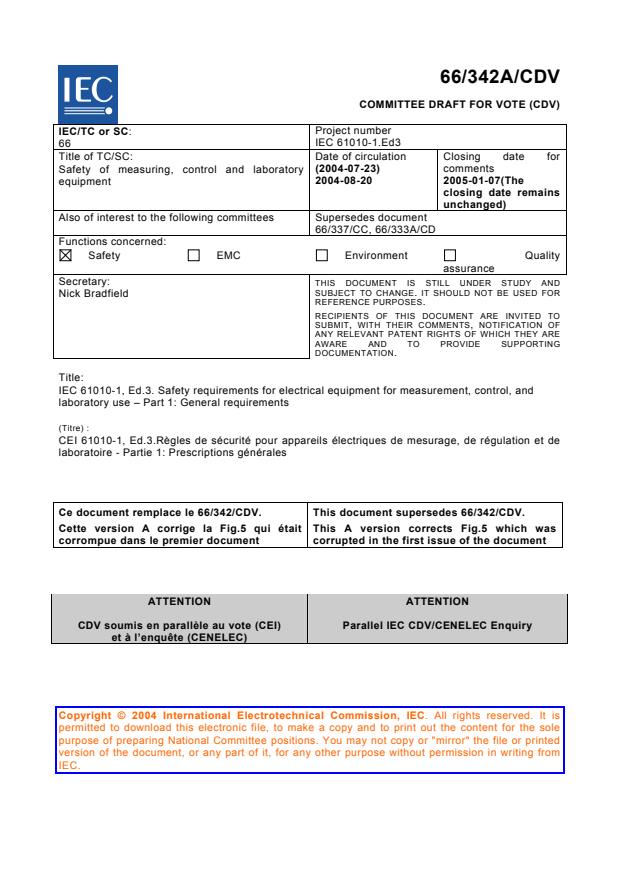
66/342A/CDV
COMMITTEE DRAFT FOR VOTE (CDV)
Project number
IEC/TC or SC:
IEC 61010-1.Ed3
Title of TC/SC: Date of circulation Closing date for
Safety of measuring, control and laboratory (2004-07-23) comments
2004-08-20 2005-01-07(The
equipment
closing date remains
unchanged)
Also of interest to the following committees Supersedes document
66/337/CC, 66/333A/CD
Functions concerned:
Safety EMC Environment Quality
assurance
Secretary:
THIS DOCUMENT IS STILL UNDER STUDY AND
SUBJECT TO CHANGE. IT SHOULD NOT BE USED FOR
Nick Bradfield
REFERENCE PURPOSES.
RECIPIENTS OF THIS DOCUMENT ARE INVITED TO
SUBMIT, WITH THEIR COMMENTS, NOTIFICATION OF
ANY RELEVANT PATENT RIGHTS OF WHICH THEY ARE
AWARE AND TO PROVIDE SUPPORTING
DOCUMENTATION.
Title:
IEC 61010-1, Ed.3. Safety requirements for electrical equipment for measurement, control, and
laboratory use – Part 1: General requirements
(Titre) :
CEI 61010-1, Ed.3.Règles de sécurité pour appareils électriques de mesurage, de régulation et de
laboratoire - Partie 1: Prescriptions générales
Ce document remplace le 66/342/CDV. This document supersedes 66/342/CDV.
Cette version A corrige la Fig.5 qui était This A version corrects Fig.5 which was
corrompue dans le premier document corrupted in the first issue of the document
ATTENTION ATTENTION
CDV soumis en parallèle au vote (CEI) Parallel IEC CDV/CENELEC Enquiry
et à l’enquête (CENELEC)
permitted to download this electronic file, to make a copy and to print out the content for the sole
purpose of preparing National Committee positions. You may not copy or "mirror" the file or printed
version of the document, or any part of it, for any other purpose without permission in writing from
IEC.
66/342A/CDV
– 2 –
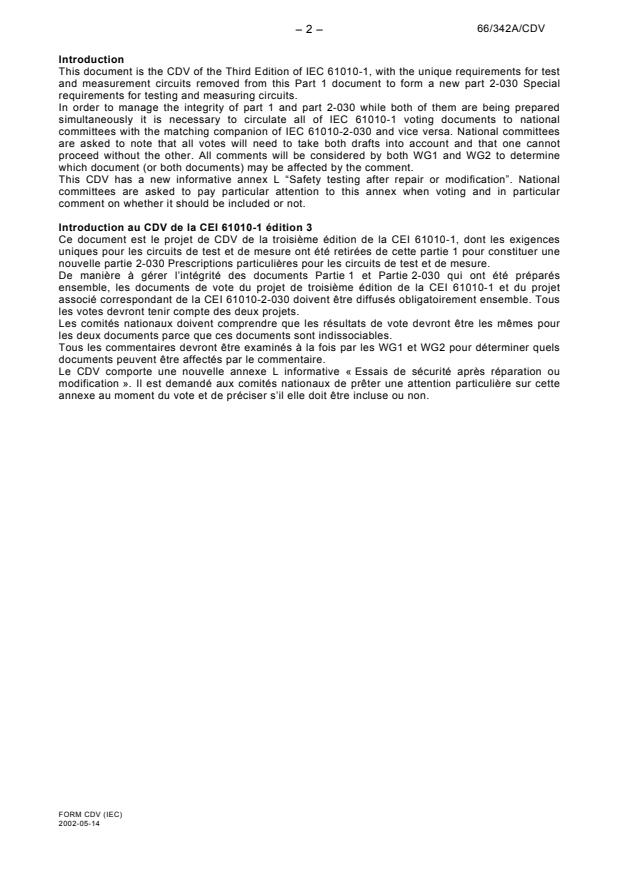
Introduction
This document is the CDV of the Third Edition of IEC 61010-1, with the unique requirements for test
and measurement circuits removed from this Part 1 document to form a new part 2-030 Special
requirements for testing and measuring circuits.
In order to manage the integrity of part 1 and part 2-030 while both of them are being prepared
simultaneously it is necessary to circulate all of IEC 61010-1 voting documents to national
committees with the matching companion of IEC 61010-2-030 and vice versa. National committees
are asked to note that all votes will need to take both drafts into account and that one cannot
proceed without the other. All comments will be considered by both WG1 and WG2 to determine
which document (or both documents) may be affected by the comment.
This CDV has a new informative annex L “Safety testing after repair or modification”. National
committees are asked to pay particular attention to this annex when voting and in particular
comment on whether it should be included or not.
Introduction au CDV de la CEI 61010-1 édition 3
Ce document est le projet de CDV de la troisième édition de la CEI 61010-1, dont les exigences
uniques pour les circuits de test et de mesure ont été retirées de cette partie 1 pour constituer une
nouvelle partie 2-030 Prescriptions particulières pour les circuits de test et de mesure.
De manière à gérer l’intégrité des documents Partie 1 et Partie 2-030 qui ont été préparés
ensemble, les documents de vote du projet de troisième édition de la CEI 61010-1 et du projet
associé correspondant de la CEI 61010-2-030 doivent être diffusés obligatoirement ensemble. Tous
les votes devront tenir compte des deux projets.
Les comités nationaux doivent comprendre que les résultats de vote devront être les mêmes pour
les deux documents parce que ces documents sont indissociables.
Tous les commentaires devront être examinés à la fois par les WG1 et WG2 pour déterminer quels
documents peuvent être affectés par le commentaire.
Le CDV comporte une nouvelle annexe L informative « Essais de sécurité après réparation ou
modification ». Il est demandé aux comités nationaux de prêter une attention particulière sur cette
annexe au moment du vote et de préciser s’il elle doit être incluse ou non.
FORM CDV (IEC)
2002-05-14
61010-1 Ed.3/CDV © IEC:2004 – 3 – 66/342/CDV
CONTENTS
Page
1 Scope and object.13
1.1 Scope.13
1.1.1 Equipment included in scope.13
1.1.2 Equipment excluded from scope.13
1.1.3 Computing equipment .14
1.2 Object .14
1.2.1 Aspects included in scope .14
1.2.2 Aspects excluded from scope .14
1.3 Verification .15
1.4 Environmental conditions .15
1.4.1 Normal environmental conditions.15
1.4.2 Extended environmental conditions .15
2 Normative references .15
3 Terms and definitions .17
3.1 Equipment and states of equipment .17
3.2 Parts and accessories .17
3.3 Quantities.18
3.4 Tests.18
3.5 Safety terms .18
3.6 Insulation .20
4 Tests.22
4.1 General .22
4.2 Sequence of tests.22
4.3 Reference test conditions .22
4.3.1 Environmental conditions .22
4.3.2 State of equipment.22
4.4 Testing in SINGLE FAULT CONDITION.24
4.4.1 General .24
4.4.2 Application of fault conditions.24
4.4.3 Duration of tests .27
4.4.4 Conformity after application of fault conditions.27
5 Marking and documentation .28
5.1 Marking .28
5.1.1 General .28
5.1.2 Identification .28
5.1.3 MAINS supply .28
5.1.4 Fuses .30
5.1.5 TERMINALS, connections and operating devices .31
5.1.6 Switches and circuit-breakers.31
5.1.7 Equipment protected by DOUBLE INSULATION or REINFORCED INSULATION .31
5.1.8 Field-wiring TERMINAL boxes .32
5.2 Warning markings.32
5.3 Durability of markings .32
5.4 Documentation .33
5.4.1 General .33
FORM CDV (IEC)
2002-05-14
61010-1 Ed.3/CDV © IEC:2004 – 4 – 66/342/CDV
5.4.2 Equipment RATINGS .33
5.4.3 Equipment installation .34
5.4.4 Equipment operation .34
5.4.5 Equipment maintenance and service .35
6 Protection against electric shock.35
6.1 General .35
6.1.1 Requirements .35
6.1.2 Exceptions.35
6.2 Determination of ACCESSIBLE parts .36
6.2.1 General .36
6.2.2 Examination.36
6.2.3 Openings above parts that are HAZARDOUS LIVE.36
6.2.4 Openings for pre-set controls .37
6.3 Permissible limits for ACCESSIBLE parts.37
6.3.1 Values in NORMAL CONDITION.37
6.3.2 Values in SINGLE FAULT CONDITION .37
6.4 Protection in NORMAL CONDITION.40
6.5 Protection in SINGLE FAULT CONDITION .40
6.5.1 General .40
6.5.2 PROTECTIVE BONDING .41
6.5.3 DOUBLE INSULATION and REINFORCED INSULATION .43
6.5.4 PROTECTIVE IMPEDANCE.44
6.5.5 Automatic disconnection of the supply .44
6.6 Connections to external circuits .44
6.6.1 General .44
6.6.2 TERMINALS for external circuits.45
6.6.3 Circuits with TERMINALS which are HAZARDOUS LIVE .45
6.6.4 ACCESSIBLE TERMINALS for stranded conductors.45
6.7 Insulation requirements .45
6.7.1 General .45
6.7.2 CLEARANCES.46
6.7.3 CREEPAGE DISTANCES .52
6.7.4 Solid insulation and printed wiring boards.56
6.8 Procedure for voltage tests .60
6.8.1 General .60
6.8.2 Humidity preconditioning .60
6.8.3 Conduct of tests.60
6.8.4 Test voltages .61
6.9 Constructional requirements for protection against electric shock .64
6.9.1 General .64
6.9.2 ENCLOSUREs of equipment with DOUBLE INSULATION or REINFORCED
INSULATION .65
6.10 Connection to MAINS supply source and connections between parts of equipment.65
6.10.1 MAINS supply cords .65
6.10.2 Fitting of non-detachable MAINS supply cords .66
6.10.3 Plugs and connectors.67
6.11 Disconnection from supply source.68
6.11.1 General .68
6.11.2 Requirements according to type of equipment.68
61010-1 Ed.3/CDV © IEC:2004 – 5 – 66/342/CDV
6.11.3 Disconnecting devices.69
7 Protection against mechanical HAZARDS .69
7.1 General .69
7.2 Sharp edges.70
7.3 Moving parts.70
7.3.1 General .70
7.3.2 Exceptions.70
7.3.3 RISK assessment for mechanical HAZARDS .70
7.3.4 Limitation of force and pressure .72
7.3.5 Gap limitations between moving parts .74
7.4 Stability.76
7.5 Provisions for lifting and carrying .77
7.6 Wall mounting .77
7.7 Expelled parts .77
7.8 Lifting devices and supporting parts .78
8 Mechanical resistance to shock and impact.78
8.1 General .78
8.2 ENCLOSURE rigidity tests .78
8.2.1 Static test .78
8.2.2 Dynamic test.79
8.2.3 Specially protected equipment.80
8.3 Drop test .80
8.3.1 Equipment other than HAND-HELD EQUIPMENT and direct plug-in equipment.80
8.3.2 HAND-HELD EQUIPMENT and direct plug-in equipment.81
9 Protection against the spread of fire.81
9.1 General .81
9.2 Eliminating or reducing the sources of ignition within the equipment .83
9.3 Containment of fire within the equipment, should it occur.83
9.3.1 General .83
9.3.2 Constructional requirements.83
9.4 Limited-energy circuit .85
9.5 Requirements for equipment containing or using flammable liquids .86
9.6 Overcurrent protection .87
9.6.1 General .87
9.6.2 PERMANENTLY CONNECTED EQUIPMENT .87
9.6.3 Other equipment .87
10 Equipment temperature limits and resistance to heat.87
10.1 Surface temperature limits for protection against burns .87
10.2 Temperatures of windings.88
10.3 Other temperature measurements .88
10.4 Conduct of temperature tests .89
10.4.1 General .89
10.4.2 Temperature measurement of heating equipment.89
10.4.3 Equipment intended for installation in a cabinet or a wall .89
10.5 Resistance to heat.90
10.5.1 Integrity of CLEARANCES and CREEPAGE DISTANCES .90
10.5.2 Non-metallic ENCLOSURES.90
10.5.3 Insulating material.90
61010-1 Ed.3/CDV © IEC:2004 – 6 – 66/342/CDV
11 Protection against HAZARDS from fluids.91
11.1 General .91
11.2 Cleaning.91
11.3 Spillage.91
11.4 Overflow.92
11.5 Battery electrolyte .92
11.6 Specially protected equipment .92
11.7 Fluid pressure and leakage.92
11.7.1 Maximum pressure.92
11.7.2 Leakage and rupture at high pressure .93
11.7.3 Leakage from low-pressure parts.93
11.7.4 Overpressure safety device .93
12 Protection against radiation, including laser sources, and against sonic and ultrasonic
pressure.94
12.1 General .94
12.2 Equipment producing ionizing radiation .94
12.2.1 Ionizing radiation .94
12.2.2 Accelerated electrons.94
12.3 Ultraviolet (UV) radiation.95
12.4 Microwave radiation.95
12.5 Sonic and ultrasonic pressure .95
12.5.1 Sound level.95
12.5.2 Ultrasonic pressure .96
12.6 Laser sources.96
13 Protection against liberated gases, explosion and implosion.96
13.1 Poisonous and injurious gases.96
13.2 Explosion and implosion .96
13.2.1 Components .96
13.2.2 Batteries and battery charging.96
13.2.3 Implosion of cathode ray tubes.97
14 Components and subassemblies.97
14.1 General .97
14.2 Motors.99
14.2.1 Motor temperatures.99
14.2.2 Series excitation motors.99
14.3 Overtemperature protection devices.99
14.4 Fuse holders .99
14.5 MAINS voltage selection devices.99
14.6 HIGH INTEGRITY electrical components .100
14.7 MAINS transformers tested outside equipment.100
14.8 Printed wiring boards.100
14.9 Circuits or components used as transient overvoltage limiting devices .100
14.9.1 General .100
14.9.2 Varistors .101
15 Protection by interlocks .102
15.1 General .102
15.2 Prevention of reactivating .102
15.3 Reliability .103
61010-1 Ed.3/CDV © IEC:2004 – 7 – 66/342/CDV
16 HAZARDS resulting from application .103
16.1 REASONABLY FORESEEABLE MISUSE .103
16.2 Ergonomic aspects .103
17 RISK assessment .103
Annex A (normative) Measuring circuits for touch current (see 6.3) .105
A.1 Measuring circuits for a.c. with frequencies up to 1 MHz and for d.c. .105
A.2 Measuring circuits for a.c. with sinusoidal frequencies up to 100 Hz and for d.c. .106
A.3 Current measuring circuit for electrical burns at high frequencies .106
A.4 Current measuring circuit for WET LOCATION .107
Annex B (normative) Standard test fingers (see 6.2) .108
Annex C (normative) Measurement of CLEARANCES and CREEPAGE DISTANCES.110
Annex D (normative) Parts between which insulation requirements are specified (see 6.4 and
6.5.3) .115
Annex E (normative) Reduction of POLLUTION degrees .119
Annex F (normative) Routine tests .120
F.1 Protective earth .120
F.2 MAINS CIRCUITS .120
F.3 Floating circuits .121
Annex G (informative) Leakage and rupture from fluids under pressure.122
G.1 General .122
G.2 Pressures above 2 MPa and a product pressure and volume greater than 200 kPa⋅l122
G.3 Pressures between 50 kPa and 2 MPa, and pressure times volume above 200 kPa⋅l126
G.4 Pressures below 50 kPa, or pressure times volume below 200 kPa⋅l.126
G.5 Overpressure safety devices .126
Annex J (informative) RISK Assessment.128
Annex K (normative) OVERVOLTAGE CATEGORIES.130
K.1 General.130
K.2 CREEPAGE DISTANCES and CLEARANCES for OVERVOLTAGE CATEGORIES III and IV .131
K.3 Tables for CLEARANCES for circuits derived from OVERVOLTAGE CATEGORY III or IV
MAINS CIRCUITS.132
K.4 Circuits or components used as transient overvoltage limiting devices in
OVERVOLTAGE CATEGORY III or IV circuits.134
K.5 Test voltages for for MAINS CIRCUITS routine tests of equipment RATED for
OVERVOLTAGE CATEGORIES III and IV (see F.2).134
Annex L.135
L.1 Terminology used in this annex .135
L.2 Tests.135
L.2.1 Sequence of tests .135
L.2.2 Visual inspection.136
L.2.3 Measurement of impedance of protective bonding.136
L.2.4 Measurement of insulation resistance .136
L.2.5 Measurement of protective conductor current .137
L.2.6 Measurement of touch current .137
L.3 Requirements and limits .137
L.3.1 Requirement for visual inspection.137
L.3.2 Limits for impedances of protective bonding .137
L.3.3 Limits for values of insulation resistance.137
L.3.4 Limit of value for protective conductor current .138
61010-1 Ed.3/CDV © IEC:2004 – 8 – 66/342/CDV
L.3.5 Limit of value for touch current .138
L.4 Documentation .138
L.4.1 Manufacturer’s Service Instructions .138
L.4.2 Equipment Test Results Report .138
Bibliography .139
Index of defined terms .141
Figure 1 – Maximum duration of short-term temporary ACCESSIBLE voltages in SINGLE FAULT
CONDITION (see 6.3.2 a)).38
Figure 2 – Capacitance level versus voltage in NORMAL CONDITION and SINGLE FAULT CONDITION
(see 6.3.1 c) and 6.3.2 c)).39
Figure 3 - Acceptable arrangement of protection means against electric shock.40
Figure 4 – Determination and conformity of CLEARANCES .47
Figure 5 – Determination and conformity of CREEPAGE DISTANCES .53
Figure 6 – Typical construction of printed wiring boards.59
Figure 7 – Detachable MAINS supply cords and connections .66
Figure 8) - Broad-area contact (above 3 cm ) .73
Figure 9) - Small-area contact (3 cm or less).73
Figure 10 - Principle of function of a measuring device .73
Figure 11 – Impact test using a sphere.80
Figure 12 – Flow chart to explain the requirements for protection against the spread of fire.82
Figure 13 – Baffle .84
Figure 14 – Area of the bottom of an ENCLOSURE to be constructed as specified in 9.3.1 c)1)85
Figure 15 – Ball-pressure test apparatus .91
Figure 16 – Flow chart for conformity options 14.1 a), b), c) and d) .98
Figure 17 - Use of varistors in cord connected equipment .102
Figure A.1 – Measuring circuit for a.c. with frequencies up to 1 MHz and for d.c.105
Figure A.2 – Measuring circuits for a.c. with sinusoidal frequencies up to 100 Hz and for d.c.106
Figure A.3 – Current measuring circuit for electrical burns .107
Figure A.4 – Current measuring circuit for wet contact .107
Figure B.1 – Rigid test finger (test probe 11 of IEC 61032) .108
Figure B.2 – Jointed test finger (test probe B of IEC 61032).109
Figure C.1 – Examples of methods of measuring CLEARANCE and CREEPAGE DISTANCES.114
Figures D.1 e) to D.1 h) – Protection between HAZARDOUS LIVE circuits and other circuits which
do not exceed the values of 6.3.1 in NORMAL CONDITION and which have external TERMINALS116
Figure D.2 a) and D.2 b) – Protection between a HAZARDOUS LIVE internal circuit and an
ACCESSIBLE part which is not bonded to other ACCESSIBLE parts.117
Figure D.2 c) and D.2 d) – Protection betweena HAZARDOUS LIVE primary circuit and
ACCESSIBLE TERMINALS of a secondary circuit which does not exceed the values of 6.3.2 in
NORMAL CONDITION.117
Figure D.3 – Protection of external ACCESSIBLE TERMINALS of two HAZARDOUS LIVE circuits.118
Figure G.1 – Conformity verification process (see G.2) .123
Table 1 – Symbols .30
Table 2 – Tightening torque for screw assemblies .42
61010-1 Ed.3/CDV © IEC:2004 – 9 – 66/342/CDV
Table 3 – Multiplication factors for CLEARANCE for altitudes up to 5 000 m .46
Table 4 – CLEARANCES and CREEPAGE DISTANCES for MAINS CIRCUITS of OVERVOLTAGE CATEGORY
II .48
Table 5 – CLEARANCES in circuits derived from MAINS CIRCUITS of OVERVOLTAGE CATEGORY II .49
Table 6 Maximum peak transient overvoltages in OVERVOLTAGE CATEGORY II .50
Table 7 – CLEARANCE values for the calculation of 6.7.2.4.51
Table 8 – CREEPAGE DISTANCES .55
Table 9 – Test voltages for transient overvoltages and temporary overvoltages in MAINS
CIRCUITS of OVERVOLTAGE CATEGORY II .56
Table 10 . Minimum distances between conductors on layered moulded parts, type 2 coatings
(see 6.7.4.5 a)), and inner layers of printed wiring boards (see 6.7.4.6.b)) .57
Table 11 – Test voltages based on values for CLEARANCES.62
Table 12 – Test voltages for solid insulation, based on values for maximum overvoltages .63
Table 13 – Correction factors for test voltage according to test site altitude.64
Table 14 – Physical tests on power supply cords .67
Table 15 Protective measures against mechanical HAZARDS to hands.71
Table 16 Protective measures against mechanical HAZARDS to body parts other than hands .72
Table 17 - Minimum gaps for different body parts .75
Table 18 - Maximum gaps for different body parts .76
Table 19 – Acceptable perforation of the bottom of an ENCLOSURE .84
Table 20 – Limits of maximum available current and power.86
Table 21 – Overcurrent protective device .86
Table 22 – Surface temperature limits in NORMAL CONDITION.88
Table 23 – Insulation material of windings .88
Table 24 – Impulse withstand voltages for OVERVOLTAGECATEGORY II.100
Table C.1 .110
Table E.1 – Reduction of the POLLUTION degree of internal environment through the use of
additional protection .119
Table F.1 – Test voltages for MAINS CIRCUITS for routine tests, for equipment RATED for
OVERVOLTAGE CATEGORY II.120
Table G.1 – Test pressures for equipment with pressures above 14 Mpa.125
Table J.1 Severity of RISK.128
Table J.2 Probability of RISK .128
Table J.3 RISK classification.129
Table K.1 – CLEARANCES and CREEPAGE DISTANCES for MAINS CIRCUITS of OVERVOLTAGE
CATEGORY III .131
Table K.2 – CLEARANCES and CREEPAGE DISTANCES for MAINS CIRCUITS of OVERVOLTAGE
CATEGORY IV.131
Table K.3 – CLEARANCES in circuits derived from MAINS CIRCUITS of OVERVOLTAGE CATEGORY III132
Table K.4 – CLEARANCES in circuits derived from MAINS CIRCUITS of OVERVOLTAGE CATEGORY IV133
Table K.5 – Impulse withstand voltages.134
Table K.6 – Test voltages for MAINS CIRCUITS for routine tests, for equipment RATED for
OVERVOLTAGE CATEGORY III.134
Table K.7 – Test voltages for MAINS CIRCUITS for routine tests, for equipment RATED for
OVERVOLTAGE CATEGORY IV.134
61010-1 Ed.3/CDV © IEC:2004 – 10 – 66/342/CDV
INTERNATIONAL ELECTROTECHNICAL COMMISSION
–––––––––––
SAFETY REQUIREMENTS FOR ELECTRICAL EQUIPMENT FOR
MEASUREMENT, CONTROL, AND LABORATORY USE –
Part 1: General requirements
FOREWORD
1) The IEC (International Electrotechnical Commission) is a worldwide organization for standardization comprising
all national electrotechnical committees (IEC National Committees). The object of the IEC is to promote
international co-operation on all questions concerning standardization in the electrical and electronic fields. To
this end and in addition to other activities, the IEC publishes International Standards. Their preparation is
entrusted to technical committees; any IEC National Committee interested in the subject dealt with may
participate in this preparatory work. International, governmental and non-governmental organizations liaising
with the IEC also participate in this preparation. The IEC collaborates closely with the International
Organization for Standardization (ISO) in accordance with conditions determined by agreement between the
two organizations.
2) The formal decisions or agreements of the IEC on technical matters express, as nearly as possible, an
international consensus of opinion on the relevant subjects since each technical committee has representation
from all interested National Committees.
3) The documents produced have the form of recommendations for international use and are published in the form
of standards, technical specifications, technical reports or guides and they are accepted by the National
Committees in that sense.
4) In order to promote international unification, IEC National Committees undertake to apply IEC International
Standards transparently to the maximum extent possible in their national and regional standards. Any
divergence between the IEC Standard and the corresponding national or regional standard shall be clearly
indicated in the latter.
5) The IEC provides no marking procedure to indicate its approval and cannot be rendered responsible for any
equipment declared to be in conformity with one of its standards.
6) Attention is drawn to the possibility that some of the elements of this International Standard may be the subject
of patent rights. The IEC shall not be held responsible for identifying any or all such patent rights.
International Standard IEC 61010-1 has been prepared by IEC technical committee 66: Safety
of measuring, control and laboratory equipment.
It has the status of a group safety publication, as specified in IEC Guide 104.
This third edition cancels and replaces the second edition published in 2001. It constitutes a
technical revision.
The text of this standard is based on the following documents:
FDIS Report on voting
/FDIS /RVD
Full information on the voting for the approval of this standard can be found in the report on
voting indicated in the abo
...