

EN 50065-2-3:2024
(Main)Signalling on low-voltage electrical installations in the frequency range 3 kHz to 148,5 kHz - Part 2-3: Immunity requirements for mains communicating equipment operating in the range of frequencies 3 kHz to 95 kHz and intended for use by electricity suppliers and distributors
General Information
- Abstract
This document applies to electrical equipment using signals in the frequency range 3 kHz to 95 kHz to transmit or receive information on low voltage electrical systems, for electricity suppliers and distributors. Mains communicating equipment (MCE) may fall into one of the two following categories: - MCE implementing transmission or reception of information on LV distribution networks or installations of network users connected to the public electricity distribution network as the sole function. Immunity requirements for such equipment are entirely covered by this document; - MCE being equipment covered by the scope of other standards, integrating mains communication as one of their functions. In this case, only the immunity requirements for the mains communication function of such equipment are covered by the scope of this document. Immunity requirements for all other available functions of this equipment are covered by the relevant product standard or generic standard. The object of this document is to contribute to ensuring EMC in general. It specifies essential immunity requirements and test methods, including those tests which are to be performed during type-testing of MCE, for electromagnetic interference (EMI) generated on LV installations. It defines the methods and requirements for testing immunity of MCE on meeting the essential requirements of the EMCD. Test requirements are specified for each port considered. Furthermore, it provides guidelines for the assessment of the performance of the communication function of an MCE. Normative specifications are under consideration. This document gives immunity requirements which are applicable to MCE used by electricity suppliers and distributors (e.g. DSOs) for purposes like energy management and network monitoring and automation. The levels do not however cover extreme cases which could occur in any location but with a low probability of occurrence. In special cases situations will arise where the level of disturbances could exceed the levels specified in this document, e.g. where a hand-held transmitter is used in proximity of an apparatus. In these instances special mitigation measures might have to be employed. It does not specify immunity of MCE to signals from other MCE operating in the same nominal frequency band or immunity to signals originating from power line carrier systems operating on high or medium-voltage networks. Safety considerations are not included in this document.
- Status
- Published
- Publication Date
- 25-Jul-2024
- Withdrawal Date
- 18-Sep-2022
- Technical Committee
- CLC/TC 205A - Mains communicating systems
- Drafting Committee
- CLC/TC 205A/WG 11 - Immunity
- Current Stage
- 6060 - Document made available - Publishing
- Start Date
- 26-Jul-2024
- Due Date
- 01-May-2022
- Completion Date
- 26-Jul-2024

Overview
EN 50065-2-3:2024 defines immunity requirements and test methods for mains communicating equipment (MCE) that use signals in the 3 kHz to 95 kHz band on low-voltage (LV) electrical installations. Published by CLC and approved June 2024, this Part 2‑3 of the EN 50065 series targets equipment intended for use by electricity suppliers and distributors (e.g., DSOs) for energy management, network monitoring and automation. The standard focuses on ensuring reliable electromagnetic compatibility (EMC) of power line communication systems on LV networks and supports compliance with the essential requirements of the EMCD.
Key topics and requirements
- Scope and applicability
- Applies to MCE whose primary or integrated function is communication over mains conductors within the 3 kHz–95 kHz range.
- Covers immunity requirements only for the mains communication function when MCE are part of multi‑function devices.
- Excludes immunity to signals from other MCE in the same nominal band and immunity to HV/MV power line carrier systems; safety requirements are out of scope.
- Immunity test types and references
- Specifies immunity tests and type‑testing procedures referencing established EMC test standards (EN/IEC 61000 series), including ESD, radiated RF, EFT/burst, surge, conducted disturbances, power‑frequency magnetic fields, and voltage dips/interruptions.
- Test requirements are port‑specific (tests and limits apply per input/output port).
- Performance criteria and assessment
- Defines performance criteria for acceptable communication function under disturbance.
- Provides guidelines for assessing MCE communication performance and for applying mitigation where real‑world disturbances exceed specified levels.
- Normative and informative annexes
- Annex A (normative): updated test circuit and method for immunity testing (addresses prior issues, e.g., voltage dips/interruption testing).
- Annex B (informative): optional/additional test specifications and performance characterizations.
Practical applications and users
- Who uses it:
- Manufacturers of mains communicating equipment and PLC modules.
- Utility engineers and DSOs specifying equipment for grid monitoring, demand response, AMI and automation.
- Test laboratories performing type‑testing and EMC conformity assessments.
- Standards writers and compliance officers aligning product standards with EMCD requirements.
- Practical value:
- Ensures robust PLC/mains communication performance under realistic EMI conditions on LV networks.
- Helps reduce service interruptions and false signals in energy management and distribution automation applications.
- Provides a harmonized test basis for procurement and regulatory compliance in Europe.
Related standards
- EN 50065-1:2011 (general requirements and frequency bands)
- EN 50065-2-1 / EN 50065-2-2 (immunity requirements for residential/commercial and industrial environments)
- EN/IEC 61000 series (4‑2, 4‑3, 4‑4, 4‑5, 4‑6, 4‑11, 4‑19, 4‑20 etc.) for detailed EMC test methods
Keywords: EN 50065-2-3:2024, mains communicating equipment, power line communication, immunity requirements, low-voltage electrical installations, EMC testing, DSOs, 3 kHz–95 kHz.
Relations
- Effective Date
- 13-Jun-2017
- Effective Date
- 13-Jun-2017
- Effective Date
- 03-Feb-2026
- Effective Date
- 03-Feb-2026
- Effective Date
- 03-Feb-2026
- Effective Date
- 03-Feb-2026
Get Certified
Connect with accredited certification bodies for this standard

ANCE
Mexican certification and testing association.

Intertek Slovenia
Intertek testing, inspection, and certification services in Slovenia.

LNE (Laboratoire National de Métrologie et d'Essais)
French national laboratory for metrology and testing.
Sponsored listings
Frequently Asked Questions
EN 50065-2-3:2024 is a standard published by CLC. Its full title is "Signalling on low-voltage electrical installations in the frequency range 3 kHz to 148,5 kHz - Part 2-3: Immunity requirements for mains communicating equipment operating in the range of frequencies 3 kHz to 95 kHz and intended for use by electricity suppliers and distributors". This standard covers: This document applies to electrical equipment using signals in the frequency range 3 kHz to 95 kHz to transmit or receive information on low voltage electrical systems, for electricity suppliers and distributors. Mains communicating equipment (MCE) may fall into one of the two following categories: - MCE implementing transmission or reception of information on LV distribution networks or installations of network users connected to the public electricity distribution network as the sole function. Immunity requirements for such equipment are entirely covered by this document; - MCE being equipment covered by the scope of other standards, integrating mains communication as one of their functions. In this case, only the immunity requirements for the mains communication function of such equipment are covered by the scope of this document. Immunity requirements for all other available functions of this equipment are covered by the relevant product standard or generic standard. The object of this document is to contribute to ensuring EMC in general. It specifies essential immunity requirements and test methods, including those tests which are to be performed during type-testing of MCE, for electromagnetic interference (EMI) generated on LV installations. It defines the methods and requirements for testing immunity of MCE on meeting the essential requirements of the EMCD. Test requirements are specified for each port considered. Furthermore, it provides guidelines for the assessment of the performance of the communication function of an MCE. Normative specifications are under consideration. This document gives immunity requirements which are applicable to MCE used by electricity suppliers and distributors (e.g. DSOs) for purposes like energy management and network monitoring and automation. The levels do not however cover extreme cases which could occur in any location but with a low probability of occurrence. In special cases situations will arise where the level of disturbances could exceed the levels specified in this document, e.g. where a hand-held transmitter is used in proximity of an apparatus. In these instances special mitigation measures might have to be employed. It does not specify immunity of MCE to signals from other MCE operating in the same nominal frequency band or immunity to signals originating from power line carrier systems operating on high or medium-voltage networks. Safety considerations are not included in this document.
This document applies to electrical equipment using signals in the frequency range 3 kHz to 95 kHz to transmit or receive information on low voltage electrical systems, for electricity suppliers and distributors. Mains communicating equipment (MCE) may fall into one of the two following categories: - MCE implementing transmission or reception of information on LV distribution networks or installations of network users connected to the public electricity distribution network as the sole function. Immunity requirements for such equipment are entirely covered by this document; - MCE being equipment covered by the scope of other standards, integrating mains communication as one of their functions. In this case, only the immunity requirements for the mains communication function of such equipment are covered by the scope of this document. Immunity requirements for all other available functions of this equipment are covered by the relevant product standard or generic standard. The object of this document is to contribute to ensuring EMC in general. It specifies essential immunity requirements and test methods, including those tests which are to be performed during type-testing of MCE, for electromagnetic interference (EMI) generated on LV installations. It defines the methods and requirements for testing immunity of MCE on meeting the essential requirements of the EMCD. Test requirements are specified for each port considered. Furthermore, it provides guidelines for the assessment of the performance of the communication function of an MCE. Normative specifications are under consideration. This document gives immunity requirements which are applicable to MCE used by electricity suppliers and distributors (e.g. DSOs) for purposes like energy management and network monitoring and automation. The levels do not however cover extreme cases which could occur in any location but with a low probability of occurrence. In special cases situations will arise where the level of disturbances could exceed the levels specified in this document, e.g. where a hand-held transmitter is used in proximity of an apparatus. In these instances special mitigation measures might have to be employed. It does not specify immunity of MCE to signals from other MCE operating in the same nominal frequency band or immunity to signals originating from power line carrier systems operating on high or medium-voltage networks. Safety considerations are not included in this document.
EN 50065-2-3:2024 is classified under the following ICS (International Classification for Standards) categories: 33.040.30 - Switching and signalling systems; 33.100.01 - Electromagnetic compatibility in general. The ICS classification helps identify the subject area and facilitates finding related standards.
EN 50065-2-3:2024 has the following relationships with other standards: It is inter standard links to EN 50065-2-3:2003, EN 50065-2-3:2003/A1:2005, EN 50065-4-5:2023, EN 50065-4-6:2023, EN 50065-4-4:2023, EN 50065-4-3:2023. Understanding these relationships helps ensure you are using the most current and applicable version of the standard.
EN 50065-2-3:2024 is associated with the following European legislation: EU Directives/Regulations: 2014/30/EU; Standardization Mandates: M/404, M/490, M/552. When a standard is cited in the Official Journal of the European Union, products manufactured in conformity with it benefit from a presumption of conformity with the essential requirements of the corresponding EU directive or regulation.
EN 50065-2-3:2024 is available in PDF format for immediate download after purchase. The document can be added to your cart and obtained through the secure checkout process. Digital delivery ensures instant access to the complete standard document.
Standards Content (Sample)
SLOVENSKI STANDARD
01-september-2024
Nadomešča:
SIST EN 50065-2-3:2004
SIST EN 50065-2-3:2004/A1:2006
Signalizacija po vodnikih nizkonapetostnih električnih inštalacij v frekvenčnem
območju od 3 kHz do 148,5 kHz – 2-3. del: Zahteve za odpornost omrežne
komunikacijske opreme, ki obratuje v frekvenčnem območju od 3 kHz do 95 kHz in
je namenjena za uporabo prii dobaviteljih električne energije in distributerjih
Signalling on low-voltage electrical installations in the frequency range 3 kHz to 148,5
kHz - Part 2-3: Immunity requirements for mains communicating equipment operating in
the range of frequencies 3 kHz to 95 kHz and intended for use by electricity suppliers
and distributors
Signalübertragung auf elektrischen Niederspannungsnetzen im Frequenzbereich 3 kHz
bis 148,5 kHz - Teil 2-3: Störfestigkeitsanforderungen an Netz-Datenübertragungsgeräte,
die im Frequenzbereich 3 kHz bis 95 kHz betrieben werden und für den Gebrauch durch
Stromversorgungs- und verteilungsunternehmen bestimmt sind
Transmission de signaux sur les réseaux électriques basse tension dans la bande de
fréquences de 3 kHz à 148,5 kHz - Partie 2-3 : Exigences d’immunité pour les appareils
de communication par le réseau électrique dans la bande de fréquences de 3 kHz à 95
kHz et destinés à être utilisés par les fournisseurs et les distributeurs d’énergie électrique
Ta slovenski standard je istoveten z: EN 50065-2-3:2024
ICS:
33.040.30 Komutacijski in signalizacijski Switching and signalling
sistem systems
33.100.20 Imunost Immunity
2003-01.Slovenski inštitut za standardizacijo. Razmnoževanje celote ali delov tega standarda ni dovoljeno.
EUROPEAN STANDARD EN 50065-2-3
NORME EUROPÉENNE
EUROPÄISCHE NORM July 2024
ICS 33.040.30; 33.100.01 Supersedes EN 50065-2-3:2003/corrigendum Aug. 2003;
EN 50065-2-3:2003; EN 50065-2-3:2003/A1:2005
English Version
Signalling on low-voltage electrical installations in the frequency
range 3 kHz to 148,5 kHz - Part 2-3: Immunity requirements for
mains communicating equipment operating in the range of
frequencies 3 kHz to 95 kHz and intended for use by electricity
suppliers and distributors
Transmission de signaux sur les réseaux électriques basse Signalübertragung auf elektrischen Niederspannungsnetzen
tension dans la plage de fréquences de 3 kHz à 148,5 kHz - im Frequenzbereich 3 kHz bis 148,5 kHz - Teil 2-3:
Partie 2-3: Exigences d'immunité pour les appareils de Störfestigkeitsanforderungen an Netz-
communication par le réseau électrique dans la plage de Datenübertragungsgeräte, die im Frequenzbereich 3 kHz
fréquences de 3 kHz à 95 kHz et destinés à être utilisés par bis 95 kHz betrieben werden und für den Gebrauch durch
les fournisseurs et les distributeurs d'énergie électrique Stromversorgungs- und verteilungsunternehmen bestimmt
sind
This European Standard was approved by CENELEC on 2024-06-03. CENELEC members are bound to comply with the CEN/CENELEC
Internal Regulations which stipulate the conditions for giving this European Standard the status of a national standard without any alteration.
Up-to-date lists and bibliographical references concerning such national standards may be obtained on application to the CEN-CENELEC
Management Centre or to any CENELEC member.
This European Standard exists in three official versions (English, French, German). A version in any other language made by translation
under the responsibility of a CENELEC member into its own language and notified to the CEN-CENELEC Management Centre has the
same status as the official versions.
CENELEC members are the national electrotechnical committees of Austria, Belgium, Bulgaria, Croatia, Cyprus, the Czech Republic,
Denmark, Estonia, Finland, France, Germany, Greece, Hungary, Iceland, Ireland, Italy, Latvia, Lithuania, Luxembourg, Malta, the
Netherlands, Norway, Poland, Portugal, Republic of North Macedonia, Romania, Serbia, Slovakia, Slovenia, Spain, Sweden, Switzerland,
Türkiye and the United Kingdom.
European Committee for Electrotechnical Standardization
Comité Européen de Normalisation Electrotechnique
Europäisches Komitee für Elektrotechnische Normung
CEN-CENELEC Management Centre: Rue de la Science 23, B-1040 Brussels
© 2024 CENELEC All rights of exploitation in any form and by any means reserved worldwide for CENELEC Members.
Ref. No. EN 50065-2-3:2024 E
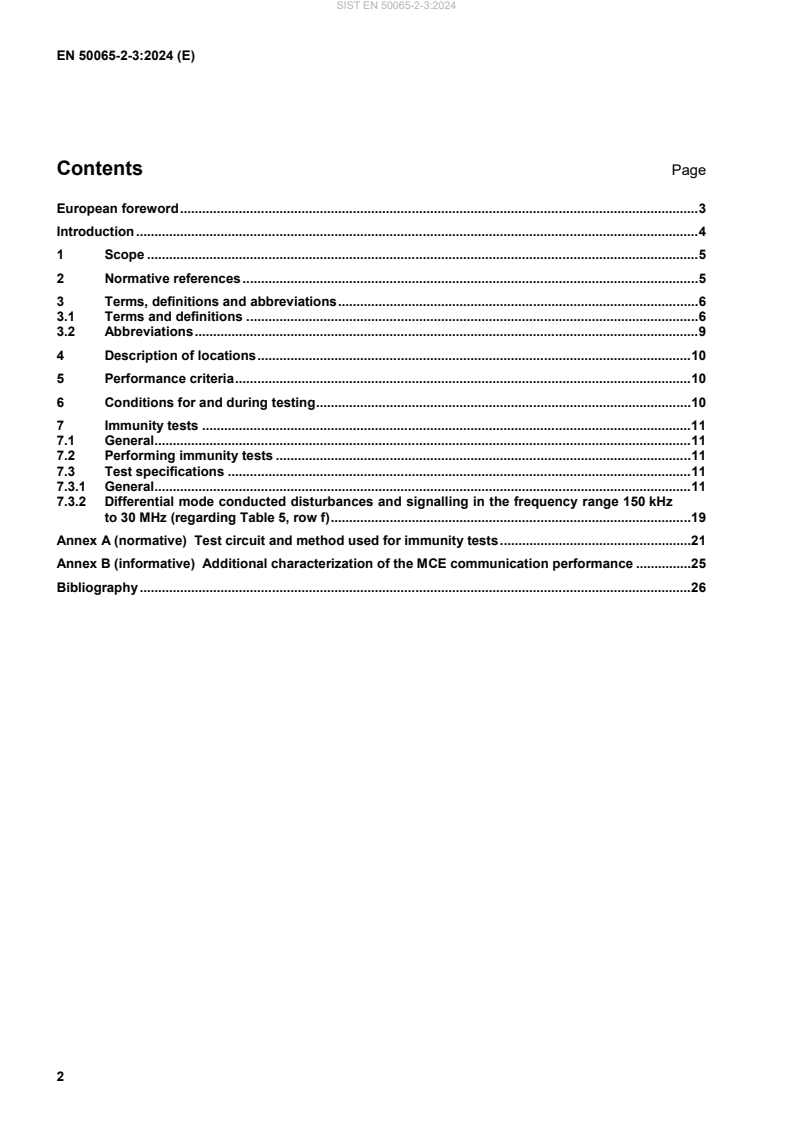
Contents Page
European foreword . 3
Introduction . 4
1 Scope . 5
2 Normative references . 5
3 Terms, definitions and abbreviations . 6
3.1 Terms and definitions . 6
3.2 Abbreviations . 9
4 Description of locations . 10
5 Performance criteria . 10
6 Conditions for and during testing . 10
7 Immunity tests . 11
7.1 General . 11
7.2 Performing immunity tests . 11
7.3 Test specifications . 11
7.3.1 General . 11
7.3.2 Differential mode conducted disturbances and signalling in the frequency range 150 kHz
to 30 MHz (regarding Table 5, row f) . 19
Annex A (normative) Test circuit and method used for immunity tests . 21
Annex B (informative) Additional characterization of the MCE communication performance . 25
Bibliography . 26
European foreword
This document (EN 50065-2-3:2024) has been prepared by WG 11 “Immunity” of CLC/TC 219 “Mains
communicating systems”.
The following dates are fixed:
• latest date by which this document has to be (dop) 2025–06–03
implemented at national level by publication of
an identical national standard or by
endorsement
• latest date by which the national standards (dow) 2027–06–03
conflicting with this document have to be
withdrawn
This document supersedes EN 50065-2-3:2003 and all of its amendments and corrigenda (if any).
— adaptation of title as well as generally focussing on mains communicating equipment (MCE);
— adaptation of the Scope precising clarifying the applicability of the standard;
— completion and update of normative references;
— completion of Definitions;
— update of the Performance criteria;
— update of the Test specifications;
— improvement of the test circuit and method used for immunity tests, in the normative Annex A,
considering also problems at testing immunity from voltage dips and voltage interruptions having been
recognized at application of the test circuit defined in EN 50065-2-3:2003;
— addition of an Annex B (informative) with optional test specifications.
Attention is drawn to the possibility that some of the elements of this document may be the subject of patent
rights. CENELEC shall not be held responsible for identifying any or all such patent rights.
Any feedback and questions on this document should be directed to the users’ national committee. A
complete listing of these bodies can be found on the CENELEC website.
Introduction
This document defines limits and test methods for the immunity of mains communicating equipment (MCE)
operating in the range of frequencies from 3 kHz to 95 kHz and intended for monitoring or controlling the low-
voltage (LV) distribution network, including energy usage of connected equipment and premises, used by
electricity suppliers and distributors (e.g. Distribution System Operators (DSOs)).
Immunity requirements for MCE intended for operation in residential, commercial and light industrial
environments are given in Part 2-1 of the EN 50065-2 series.
Immunity requirements and tests applicable to MCE intended for operation in industrial environments are
given in Part 2-2 of the EN 50065-2 series.
For MCE intended to be operated by utilities in the frequency range 3 kHz to 95 kHz, with lower immunity
requirements than specified in this Part 2-3, the specifications of Part 2-2 or Part 2-1 of the EN 50065-2 series
may be applied.
These tests and limits represent essential electromagnetic compatibility (EMC) and immunity requirements for
the environment according to the scope. Not all known disturbances have been included for testing purposes
which have been limited to those disturbances known to be critical for the operation of such equipment
including specific MCE disturbances such as conducted narrow band.
The immunity requirements have been selected to ensure an adequate level of immunity for MCE for use by
electricity utilities. The levels do not however cover extreme cases which could occur in any location but with
an extremely low probability of occurrence.
Annexes designated “normative” are part of the body of the standard.
In this document, Annex A is normative, and Annex B is informative.
1 Scope
This document applies to electrical equipment using signals in the frequency range 3 kHz to 95 kHz to
transmit or receive information on low voltage electrical systems, for electricity suppliers and distributors.
Mains communicating equipment (MCE) may fall into one of the two following categories:
— MCE implementing transmission or reception of information on LV distribution networks or installations of
network users connected to the public electricity distribution network as the sole function. Immunity
requirements for such equipment are entirely covered by this document;
— MCE being equipment covered by the scope of other standards, integrating mains communication as one
of their functions. In this case, only the immunity requirements for the mains communication function of
such equipment are covered by the scope of this document. Immunity requirements for all other available
functions of this equipment are covered by the relevant product standard or generic standard.
The object of this document is to contribute to ensuring EMC in general. It specifies essential immunity
requirements and test methods, including those tests which are to be performed during type-testing of MCE,
for electromagnetic interference (EMI) generated on LV installations.
It defines the methods and requirements for testing immunity of MCE on meeting the essential requirements
of the EMCD. Test requirements are specified for each port considered.
Furthermore, it provides guidelines for the assessment of the performance of the communication function of
an MCE. Normative specifications are under consideration.
This document gives immunity requirements which are applicable to MCE used by electricity suppliers and
distributors (e.g. DSOs) for purposes like energy management and network monitoring and automation. The
levels do not however cover extreme cases which could occur in any location but with a low probability of
occurrence. In special cases situations will arise where the level of disturbances could exceed the levels
specified in this document, e.g. where a hand-held transmitter is used in proximity of an apparatus. In these
instances special mitigation measures might have to be employed.
It does not specify immunity of MCE to signals from other MCE operating in the same nominal frequency band
or immunity to signals originating from power line carrier systems operating on high or medium-voltage
networks.
Safety considerations are not included in this document.
2 Normative references
The following documents are referred to in the text in such a way that some or all of their content constitutes
requirements of this document. For dated references, only the edition cited applies. For undated references,
the latest edition of the referenced document (including any amendments) applies.
EN 50065-1:2011, Signalling on low-voltage electrical installations in the frequency range 3 kHz to 148,5 kHz -
Part 1: General requirements, frequency bands and electromagnetic disturbances
EN 61000-4-2:2009, Electromagnetic compatibility (EMC) - Part 4-2: Testing and measurement techniques -
Electrostatic discharge immunity test (IEC 61000-4-2:2008)
EN 61000-4-3:2020, Electromagnetic compatibility (EMC) - Part 4-3: Testing and measurement techniques -
Radiated, radio-frequency, electromagnetic field immunity test (IEC 61000-4-3:2020)
EN 61000-4-4:2012, Electromagnetic compatibility (EMC) - Part 4-4: Testing and measurement techniques -
Electrical fast transient/burst immunity test (IEC 61000-4-4:2012)
EN 61000-4-5:2014, Electromagnetic compatibility (EMC) - Part 4-5: Testing and measurement techniques -
Surge immunity test (IEC 61000-4-5:2014)
EN 61000-4-5:2014/A1:2017, Electromagnetic compatibility (EMC) - Part 4-5: Testing and measurement
techniques - Surge immunity test (IEC 61000-4-5:2014/AMD1:2017)
EN 61000-4-6:2014, Electromagnetic compatibility (EMC) - Part 4-6: Testing and measurement techniques -
Immunity to conducted disturbances, induced by radio-frequency fields (IEC 61000-4-6:2013)
EN 61000-4-6:2014/AC:2015, Electromagnetic compatibility (EMC) - Part 4-6: Testing and measurement
techniques - Immunity to conducted disturbances, induced by radio-frequency fields (IEC 61000-4-6:2013/
COR1:2015)
EN 61000-4-8:2010, Electromagnetic compatibility (EMC) - Part 4-8: Testing and measurement techniques -
Power frequency magnetic field immunity test (IEC 61000-4-8:2009)
EN IEC 61000-4-11:2020, Electromagnetic compatibility (EMC) - Part 4-11: Testing and measurement
techniques - Voltage dips, short interruptions and voltage variations immunity tests for equipment with input
current up to 16 A per phase (IEC 61000-4-11:2020)
EN IEC 61000-4-11:2020/AC:2020-06, Electromagnetic compatibility (EMC) - Part 4-11: Testing and
measurement techniques - Voltage dips, short interruptions and voltage variations immunity tests for
equipment with input current up to 16 A per phase (IEC 61000-4-11:2020/COR1:2020)
EN 61000-4-19:2014, Electromagnetic compatibility (EMC) - Part 4-19: Testing and measurement techniques
- Test for immunity to conducted, differential mode disturbances and signalling in the frequency range 2 kHz to
150 kHz at a.c. power ports (IEC 61000-4-19:2014)
EN IEC 61000-4-20:2022, Electromagnetic compatibility (EMC) - Part 4-20: Testing and measurement
techniques - Emission and immunity testing in transverse electromagnetic (TEM) waveguides
(IEC 61000-4-20:2022)
EN 61000-4-21:2011, Electromagnetic compatibility (EMC) - Part 4-21: Testing and measurement techniques
- Reverberation chamber test methods (IEC 61000-4-21:2011)
EN 61000-4-22:2011, Electromagnetic compatibility (EMC) - Part 4-22: Testing and measurement techniques
- Radiated emission and immunity measurements in fully anechoic rooms (FARs) (IEC 61000-4-22:2010)
EN 61000-4-29:2000, Electromagnetic compatibility (EMC) - Part 4-29: Testing and measurement techniques
- Voltage dips, short interruptions and voltage variations on d.c. input power port immunity tests
(IEC 61000-4-29:2000)
3 Terms, definitions and abbreviations
For the purposes of this document, the following terms, definitions and abbreviations apply.
ISO and IEC maintain terminology databases for use in standardization at the following addresses:
— ISO Online browsing platform: available at https://www.iso.org/obp
— IEC Electropedia: available at https://www.electropedia.org/
3.1 Terms and definitions
3.1.1
mains communicating equipment
MCE
electrical equipment using mains power lines either on the public electricity distribution network or within
installations of network users connected to the public electricity distribution network, for transmission and
reception of information signals
3.1.2
mains communicating system
MCS
electrical system using mains power lines to transmit information signals, either on the public electricity
distribution network or within installations of network users
[SOURCE: EN 61000-2-2:2002/A1:2017, definition 3.1.8]
3.1.3
signal
physical phenomenon whose presence, absence or variation is considered as representing information
[SOURCE: IEC 60050, definition 171-01-03]
3.1.4
(mains) signalling (voltage)
signal superimposed on the voltage for the purpose of transmission of information in electrical power system
and to users’ premises
[SOURCE: IEC 60050, definition 614-01-35]
3.1.5
electromagnetic compatibility
EMC
ability of equipment or a system to function satisfactorily in its electromagnetic environment without
introducing intolerable electromagnetic disturbances to anything in that environment
[SOURCE: IEC 60050, definitions 161-01-07, 702-08-66]
3.1.6
electromagnetic disturbance
any electromagnetic phenomenon which can degrade the performance of a device, equipment or system, or
adversely affect living or inert matter
Note 1 to entry: An electromagnetic disturbance can be an electromagnetic noise, an unwanted signal or a change in the
propagation medium itself.
[SOURCE: IEC 60050, definitions 161-01-05, 702-08-04]
3.1.7
electromagnetic interference
EMI
degradation of the performance of an equipment, transmission channel or system caused by an electro-
magnetic disturbance
[SOURCE: IEC 60050, definitions 161-01-06, 702-08-29]
3.1.8
immunity
ability of an MCE to perform within specified limits in the presence of an electromagnetic
disturbance
3.1.9
port
particular interface of the specified accessory with the external electromagnetic environment
Note 1 to entry: See Figure 1.
[SOURCE: IEC 60050, definition 131-12-60, modified – reference to MCE only, addition of a figure]
Figure 1 — Examples of ports
3.1.10
enclosure port
physical boundary of the MCE through which electromagnetic fields can radiate or impinge
[SOURCE: IEC 60050, definition 445-07-04, modified – reference to MCE (instead of time relay)]
3.1.11
immunity test level
level of a test signal used to simulate an electromagnetic disturbance when performing an immunity test
[SOURCE: IEC 60050, definition 161-04-41]
3.1.12
stimulus
auxiliary equipment to be used during the tests for exercising the PLC communication together with the EUT
3.1.13
nominal frequency band
band used by an MCE or a mains communicating system (MCS), to be specified in the MCE product
declaration, which includes the transmit frequency band(s) of an MCE determined according to EN 50065-
1:2011, 6.2.1, and frequency intervals adjacent to the transmit frequency band(s)
Note 1 to entry: In some cases, the nominal frequency band could be also fragmented allowing for notching of frequency
ranges used by other MCS.
3.1.14
block error ratio
BLER
ratio of the number of erroneous blocks received (EB) to the total number of correct blocks (TB) sent during a
given time interval
EB
BLER=
TB
Note 1 to entry: Here, the term “block” means a datagram used by a service primitive (e.g. request/response, see
Clause A.2) in the layered architecture based on the OSI Reference model.
[SOURCE: IEC 60050, definition 721-08-13, modified – Addition of a note]
3.2 Abbreviations
AC Alternating current
AM Amplitude modulation
AMN Artificial mains network
BLER Block error ratio
CDN Coupling/Decoupling network
CISPR International Special Committee on Radio Interference
CLF Chamber loading factor
CRT Cathode Ray Tube
CW Continuous wave
DC Direct current
DSO Distribution System Operator
EB Erroneous Blocks
EMC Electromagnetic compatibility
EMI Electromagnetic interference
ETSI European Telecommunication Standardization Institute
EU European Union
EUT Equipment under test
FAR Fully anechoic room
HBES Home and Building Electronic Systems
IEC International Electrotechnical Commission
ITU International Telecommunication Union
LCD Liquid crystal display
LED Light-emitting diode
LV Low voltage
MCE Mains communicating equipment
MCS Mains communicating system
OJEU Official Journal of the European Union
PLT Power Line Telecommunication
r.m.s. Root mean square
RVC Reverberation chamber
SNR Signal-to-Noise Ratio
TB Total Blocks
TEM Transverse electromagnetic waveguide
TX Transmitter
PLC Powerline communication
SNR Signal-to-noise ratio
4 Description of locations
The environments encompassed by this document are any locations in the public LV supply network or in
installations of network users connected to the public electricity distribution network.
MCE covered by this document is not intended to be connected to a power network supplied from a high- or
medium-voltage transformer dedicated to the supply of an installation feeding manufacturing or similar plant.
5 Performance criteria
The electrical mains are a hostile communications environment and many MCS operate using sophisticated
protocol services which permit the recovery of data corrupted by interference or cause re-transmission of data
in the event of corruption.
Errors caused by the application of the tests in this standard and which are subsequently corrected by the
protocol services are regarded as normal and the equipment is regarded as operating as intended in such
circumstances.
For the purpose of MCE immunity, communication performance requirements can be expressed in terms of
maximum level of block error ratio (BLER).
Stored data directly related to the intended function of the equipment, are considered as critical ones.
Changes in stored data referring only to the internal operation of the EUT, such as communication error logs,
and which are not directly related to the intended function of the equipment, shall be ignored.
For the purposes of this document the performance criteria are:
A) The EUT shall continue to operate as intended. No unintended change of operational state is allowed.
No loss or unintentional change in critical stored data shall occur and no more than a 15 % degradation in
communication performance (i.e. BLER degradation) is allowed during the test.
B) A temporary degradation of performance below the level defined in criterion A or temporary loss of
communication is permitted during the disturbance provided the MCE automatically resumes the
condition established prior to the application of the test following the removal of the disturbance.
When the disturbance is removed after the test, the MCE shall restart to operate as intended without user
intervention.
No change of actual operating state or critical stored data is allowed.
C) A degradation of performance or loss of communication is permitted during the test, provided that the
MCE automatically resumes the condition established prior to the application of the test, or can be
restored by manual intervention or system reset after the test.
No change of critical stored data is all
...