


prEN IEC 60079-42:2025
(Main)Explosive atmospheres - Part 42: Electrical safety devices for the control of potential ignition sources for ex-equipment, type of protection "f"
Explosive atmospheres - Part 42: Electrical safety devices for the control of potential ignition sources for ex-equipment, type of protection "f"
Explosionsgefährdete Bereiche - Teil 42: Elektrische Sicherheitseinrichtungen zur Überwachung potenzieller Zündquellen von Ex-Geräten
Atmosphères explosives - Partie 42: Dispositifs électriques de sécurité pour la commande des sources potentielles d’inflammation des appareils ex, protection de type "f"
Eksplozivne atmosfere - 42. del: Električne varnostne naprave za nadzor potencialnih virov vžiga ex- opreme
General Information
- Status
- Not Published
- Publication Date
- 03-Jan-2027
- Technical Committee
- CLC/TC 31 - Electrical apparatus for explosive atmospheres - General requirements
- Drafting Committee
- IEC/TC 31 - Electrical apparatus for potentially explosive atmospheres
- Current Stage
- 4060 - Enquiry results established and sent to TC, SR, BTTF - Enquiry
- Start Date
- 29-Aug-2025
- Completion Date
- 29-Aug-2025
Overview
prEN IEC 60079-42:2025 - "Explosive atmospheres - Part 42: Electrical safety devices for the control of potential ignition sources for ex-equipment, type of protection 'f'" - is a draft international standard developed by the International Electrotechnical Commission (IEC) and adopted by CLC (CENELEC). This standard focuses on the construction and testing requirements for electrical safety devices that are designed to control potential ignition sources in equipment used in explosive atmospheres (Ex Equipment). Type of protection “f” involves the use of specific safety functions to reduce ignition risk where traditional protection methods are insufficient or not applicable.
Compliance with this standard ensures that safety devices used with Ex Equipment effectively control hazards in environments where explosive gases, vapors, or dusts may be present, addressing both electrical and non-electrical sources of ignition.
Key Topics
Scope: The standard specifies requirements for electrical safety devices intended to mitigate potential ignition sources in Ex Equipment for use in explosive atmospheres. It applies to devices that are integral to, or associated with, Ex Equipment, and covers both manual and automatic safety functions.
Definitions and Terminology: prEN IEC 60079-42:2025 defines terms such as ‘Ex Equipment under control (ExEUC)’, ‘risk reduction factor (RRF)’, and ‘safety device’, establishing a consistent language for manufacturers and end users.
Equipment Protection Level (EPL): The standard outlines how safety devices can help achieve different EPLs (Ga, Gb, Gc, Da, Db, Dc, Ma, Mb, Mc), which correspond to the required level of explosion protection according to the risk and zone of installation.
Basic Requirements: Safety functions must be specified, and the device must ensure reliability under all stated operating conditions. Both simple (mechanical or basic electrical) and complex (microprocessor-based or software-driven) safety devices are covered, with guidance for assessment and testing.
Testing and Verification: The standard includes requirements for type tests and proof tests, ensuring safety devices operate as intended under all anticipated conditions.
Marking and Instructions: Clear requirements are provided for product marking and the content of operating instructions, ensuring traceability, safe installation, and maintenance.
Applications
prEN IEC 60079-42:2025 is essential for industries that operate in hazardous locations where explosive atmospheres are possible, including:
- Oil and Gas Facilities: For controlling ignition sources in motors, pumps, and other process equipment in refineries, gas plants, and drilling operations.
- Chemical and Pharmaceutical Plants: Where dust, vapors, or gases may form explosive mixtures.
- Grain Handling and Food Processing: For controlling ignition risks in equipment generating heat or friction.
- Manufacturing and Processing Plants: Especially those using process automation with potential non-electrical ignition sources.
- Mining Operations: Where both gas and dust explosions present significant hazards.
Safety devices covered by the standard may include temperature sensors, logic controllers, safety switches, or complex safety control systems integrated into or added to Ex Equipment, either in hazardous areas or at safe locations outside.
Related Standards
prEN IEC 60079-42:2025 is part of the wider IEC 60079 and ISO 80079 series relating to equipment and protective systems for explosive atmospheres. Important related standards include:
- IEC 60079-0: Explosive atmospheres - General requirements
- ISO 80079-37: Non-electrical equipment for explosive atmospheres
- IEC 61508 and IEC 61511: Functional safety standards for safety-related systems
- IEC 60079-14: Selection and installation of electrical equipment in explosive atmospheres
- IEC 60079-33/46: Equipment assemblies and constructional safety
Practical Value
- Risk Reduction: The standard provides a framework for identifying, evaluating, and controlling ignition risks where existing protection methods may not be sufficient.
- Compliance and Certification: Adhering to prEN IEC 60079-42:2025 supports product certification, regulatory compliance, and safety management for equipment used in ATEX and IECEx regulated environments.
- Safety Design: The guidance enables engineers and manufacturers to specify, test, and document safety devices with the necessary reliability and performance, from simple switches to advanced electronic systems.
- Maintenance and Operation: Clearly defined marking and documentation requirements facilitate safe operation and routine proof testing of safety devices in the field.
By aligning with prEN IEC 60079-42:2025, organizations enhance operational safety, demonstrate due diligence, and contribute to a safer working environment in explosive atmospheres.

Get Certified
Connect with accredited certification bodies for this standard

IMQ S.p.A. (Certification)
Italian electrical product certification.

SLG Prüf- und Zertifizierungs GmbH
German testing and certification body.

UL Solutions
Global safety science company with testing, inspection and certification.
Sponsored listings
Frequently Asked Questions
prEN IEC 60079-42:2025 is a draft published by CLC. Its full title is "Explosive atmospheres - Part 42: Electrical safety devices for the control of potential ignition sources for ex-equipment, type of protection "f"". This standard covers: Explosive atmospheres - Part 42: Electrical safety devices for the control of potential ignition sources for ex-equipment, type of protection "f"
Explosive atmospheres - Part 42: Electrical safety devices for the control of potential ignition sources for ex-equipment, type of protection "f"
prEN IEC 60079-42:2025 is classified under the following ICS (International Classification for Standards) categories: 29.260.20 - Electrical apparatus for explosive atmospheres. The ICS classification helps identify the subject area and facilitates finding related standards.
prEN IEC 60079-42:2025 is available in PDF format for immediate download after purchase. The document can be added to your cart and obtained through the secure checkout process. Digital delivery ensures instant access to the complete standard document.
Standards Content (Sample)
SLOVENSKI STANDARD
oSIST prEN IEC 60079-42:2024
01-november-2024
Eksplozivne atmosfere - 42. del: Električne varnostne naprave za nadzor
potencialnih virov vžiga ex- opreme
Explosive atmospheres - Part 42: Electrical safety devices for the control of potential
ignition sources for ex-equipment
Atmosphères explosive - Partie 42: Dispositifs électriques de sécurité pour la commande
des sources potentielles d’inflammation des appareils ex
Ta slovenski standard je istoveten z: prEN IEC 60079-42:2024
ICS:
29.260.20 Električni aparati za Electrical apparatus for
eksplozivna ozračja explosive atmospheres
oSIST prEN IEC 60079-42:2024 en,fr,de
2003-01.Slovenski inštitut za standardizacijo. Razmnoževanje celote ali delov tega standarda ni dovoljeno.
oSIST prEN IEC 60079-42:2024
oSIST prEN IEC 60079-42:2024
31/1797/CDV
COMMITTEE DRAFT FOR VOTE (CDV)
PROJECT NUMBER:
IEC 60079-42 ED1
DATE OF CIRCULATION: CLOSING DATE FOR VOTING:
2024-09-27 2024-12-20
SUPERSEDES DOCUMENTS:
31/1706/CD, 31/1735A/CC
IEC TC 31 : EQUIPMENT FOR EXPLOSIVE ATMOSPHERES
SECRETARIAT: SECRETARY:
United Kingdom Mr Tom Stack
OF INTEREST TO THE FOLLOWING COMMITTEES: HORIZONTAL FUNCTION(S):
ASPECTS CONCERNED:
SUBMITTED FOR CENELEC PARALLEL VOTING NOT SUBMITTED FOR CENELEC PARALLEL VOTING
Attention IEC-CENELEC parallel voting
The attention of IEC National Committees, members of
CENELEC, is drawn to the fact that this Committee Draft for Vote
(CDV) is submitted for parallel voting.
The CENELEC members are invited to vote through the
CENELEC online voting system.
This document is still under study and subject to change. It should not be used for reference purposes.
Recipients of this document are invited to submit, with their comments, notification of any relevant patent rights of which they are
aware and to provide supporting documentation.
Recipients of this document are invited to submit, with their comments, notification of any relevant “In Some Countries” clau ses to
be included should this proposal proceed. Recipients are reminded that the CDV stage is the final stage for submitting ISC c lauses.
(SEE AC/22/2007 OR NEW GUIDANCE DOC).
TITLE:
Explosive atmospheres - Part 42: Electrical safety devices for the control of potential ignition sources for
Ex-Equipment
PROPOSED STABILITY DATE: 2029
NOTE FROM TC/SC OFFICERS:
electronic file, to make a copy and to print out the content for the sole purpose of preparing National Committee positions. You
may not copy or "mirror" the file or printed version of the document, or any part of it, for any other purpose without permis sion in
writing from IEC.
oSIST prEN IEC 60079-42:2024
31/1797/CDV – 2 – IEC CDV 60079-42 © IEC 2024
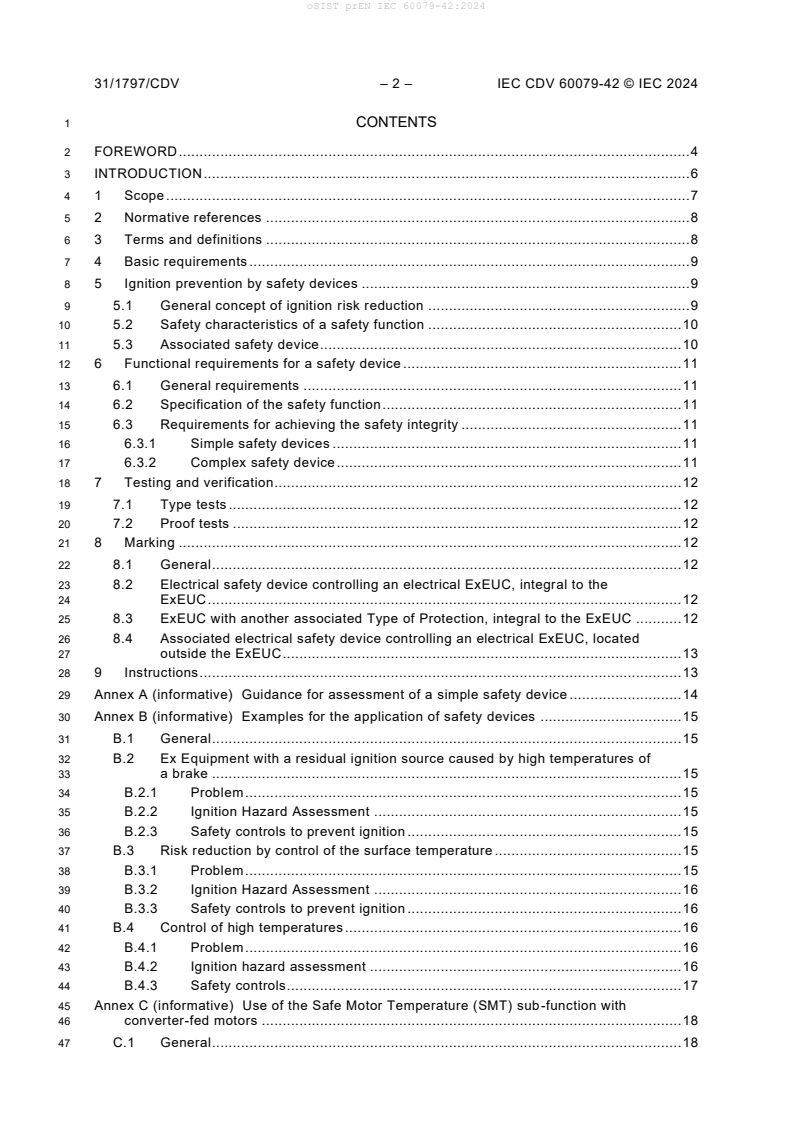
1 CONTENTS
2 FOREWORD . 4
3 INTRODUCTION . 6
4 1 Scope . 7
5 2 Normative references . 8
6 3 Terms and definitions . 8
7 4 Basic requirements . 9
8 5 Ignition prevention by safety devices . 9
9 5.1 General concept of ignition risk reduction . 9
10 5.2 Safety characteristics of a safety function . 10
11 5.3 Associated safety device . 10
12 6 Functional requirements for a safety device . 11
13 6.1 General requirements . 11
14 6.2 Specification of the safety function . 11
15 6.3 Requirements for achieving the safety integrity . 11
16 6.3.1 Simple safety devices . 11
17 6.3.2 Complex safety device . 11
18 7 Testing and verification. 12
19 7.1 Type tests . 12
20 7.2 Proof tests . 12
21 8 Marking . 12
22 8.1 General . 12
23 8.2 Electrical safety device controlling an electrical ExEUC, integral to the
24 ExEUC . 12
25 8.3 ExEUC with another associated Type of Protection, integral to the ExEUC . 12
26 8.4 Associated electrical safety device controlling an electrical ExEUC, located
27 outside the ExEUC . 13
28 9 Instructions . 13
29 Annex A (informative) Guidance for assessment of a simple safety device . 14
30 Annex B (informative) Examples for the application of safety devices . 15
31 B.1 General . 15
32 B.2 Ex Equipment with a residual ignition source caused by high temperatures of
33 a brake . 15
34 B.2.1 Problem . 15
35 B.2.2 Ignition Hazard Assessment . 15
36 B.2.3 Safety controls to prevent ignition . 15
37 B.3 Risk reduction by control of the surface temperature . 15
38 B.3.1 Problem . 15
39 B.3.2 Ignition Hazard Assessment . 16
40 B.3.3 Safety controls to prevent ignition . 16
41 B.4 Control of high temperatures . 16
42 B.4.1 Problem . 16
43 B.4.2 Ignition hazard assessment . 16
44 B.4.3 Safety controls. 17
45 Annex C (informative) Use of the Safe Motor Temperature (SMT) sub-function with
46 converter-fed motors . 18
47 C.1 General . 18
oSIST prEN IEC 60079-42:2024
IEC CDV 60079-42 © IEC 2024 – 3 – 31/1797/CDV
48 C.2 Reliability of the safety motor temperature control function. . 19
49 C.3 Control without temperature sensors . 19
50 C.4 Control with temperature sensors . 20
51 Bibliography . 21
53 Figure B.1 – Safety device to limit the temperature rise . 16
54 Figure C.1 – Overview . 18
55 Figure C.2 – Control without temperature sensors . 19
56 Figure C.3 – Control with temperature sensors . 20
58 Table 1 – Minimum RRF for a safety function for ignition risk reduction . 10
59 Table C.1 – SMT safety sub function Risk Reduction Factors (RRF) . 19
oSIST prEN IEC 60079-42:2024
31/1797/CDV – 4 – IEC CDV 60079-42 © IEC 2024
64 INTERNATIONAL ELECTROTECHNICAL COMMISSION
65 ____________
67 EXPLOSIVE ATMOSPHERES
69 Part 42: Electrical safety devices for the control of potential ignition
70 sources from Ex Equipment, Type of Protection "f"
72 FOREWORD
73 1) The International Electrotechnical Commission (IEC) is a worldwide organization for standardization comprising
74 all national electrotechnical committees (IEC National Committees). The object of IEC is to promote international
75 co-operation on all questions concerning standardization in the electrical and electronic fields. To this end and
76 in addition to other activities, IEC publishes International Standards, Technical Specifications, Technical Reports,
77 Publicly Available Specifications (PAS) and Guides (hereafter referred to as “IEC Publication(s)”). Their
78 preparation is entrusted to technical committees; any IEC National Committee interested in the subject dealt with
79 may participate in this preparatory work. International, governmental and non-governmental organizations liaising
80 with the IEC also participate in this preparation. IEC collaborates closely with the International Organization for
81 Standardization (ISO) in accordance with conditions determined by agreement between the two organizations.
82 2) The formal decisions or agreements of IEC on technical matters express, as nearly as possible, an international
83 consensus of opinion on the relevant subjects since each technical committee has representation from all
84 interested IEC National Committees.
85 3) IEC Publications have the form of recommendations for international use and are accepted by IEC National
86 Committees in that sense. While all reasonable efforts are made to ensure that the technical content of IEC
87 Publications is accurate, IEC cannot be held responsible for the way in which they are used or for any
88 misinterpretation by any end user.
89 4) In order to promote international uniformity, IEC National Committees undertake to apply IEC Publications
90 transparently to the maximum extent possible in their national and regional publications. Any divergence between
91 any IEC Publication and the corresponding national or regional publication shall be clearly indicated in the latter.
92 5) IEC itself does not provide any attestation of conformity. Independent certification bodies provide conformity
93 assessment services and, in some areas, access to IEC marks of conformity. IEC is not responsible for any
94 services carried out by independent certification bodies.
95 6) All users should ensure that they have the latest edition of this publication.
96 7) No liability shall attach to IEC or its directors, employees, servants or agents including individual experts and
97 members of its technical committees and IEC National Committees for any personal injury, property damage or
98 other damage of any nature whatsoever, whether direct or indirect, or for costs (including legal fees) and
99 expenses arising out of the publication, use of, or reliance upon, this IEC Publication or any other IEC
100 Publications.
101 8) Attention is drawn to the Normative references cited in this publication. Use of the referenced publications is
102 indispensable for the correct application of this publication.
103 9) Attention is drawn to the possibility that some of the elements of this IEC Publication may be the subject of patent
104 rights. IEC shall not be held responsible for identifying any or all such patent rights.
105 International Technical Specification IEC 60079-42 has been prepared by IEC technical
106 committee 31: Equipment for explosive atmospheres.
107 Users of this document are advised that interpretation sheets clarifying the interpretation of this
108 document can be published. Interpretation sheets are available from the IEC webstore and can
109 be found in the “history” tab of the page for each document.
110 The text of this Technical Specification is based on the following documents:
FDIS Report on voting
31/1418/DTS 31/1441/RVDTS
111 Full information on the voting for the approval of this Technical Specification can be found in
112 the report on voting indicated in the above table.
113 This publication has been drafted in accordance with the ISO/IEC Directives, Part 2.
oSIST prEN IEC 60079-42:2024
IEC CDV 60079-42 © IEC 2024 – 5 – 31/1797/CDV
114 The committee has decided that the contents of this publication will remain unchanged until the
115 stability date indicated on the IEC web site under "http://webstore.iec.ch" in the data related to
116 the specific publication. At this date, the publication will be
117 • reconfirmed,
118 • withdrawn,
119 • replaced by a revised edition, or
120 • amended.
121 This International Technical Specification is to be read in conjunction with the International
122 Standards for the specific types of protection listed in the ISO 80079-37 and the IEC 60079
123 series.
IMPORTANT – The 'colour inside' logo on the cover page of this publication indicates that it
contains colours which are considered to be useful for the correct understanding of its
contents. Users should therefore print this document using a colour printer.
oSIST prEN IEC 60079-42:2024
31/1797/CDV – 6 – IEC CDV 60079-42 © IEC 2024
125 INTRODUCTION
126 Generally, the probability of potential ignition sources becoming effective is mitigated by
127 applying the protection measures according to the IEC 60079 and the ISO 80079 series. If the
128 probability of an ignition source becoming effective and none of the aforementioned protection
129 measures can be applied, this probability could be reduced by using a suitable safety device.
130 The combination of the safety device and the Ex Equipment could then comply with the relevant
131 standards of the IEC 60079 series and the ISO 80079 series with respect to the Equipment
132 Protection Level.
133 Safety devices, which are used as part of the protection of Ex Equipment for control of potential
134 ignition sources, should consider reliability for the intended purpose to recognise the principles
135 for the classification of hazardous areas and explosion protection techniques. This document
136 provides requirements for the application of safety functions to provide a reduction of ignition
137 risk for Ex Equipment as part of the IEC 60079 series and ISO 80079 series. It relies on relevant
138 IEC and ISO standards for safety related control systems. However, some of the Functional
139 Safety concepts can’t be related directly to the Hazardous Area classification.
140 This document does not specify the standard that will be used for the assessment of the integrity
141 of the safety function (for example, IEC 61508, IEC 61511, IEC 62061 or ISO 13849-1/2) to
142 give the manufacturer of the equipment and the safety device the opportunity to choose the
143 relevant standard. The main requirements are based on risk reduction factors. This addresses
144 the plurality of safety functions and different types of reaction to different situations (energize
145 to trip, de-energize to trip, immediate reaction, delayed reaction, …).
oSIST prEN IEC 60079-42:2024
IEC CDV 60079-42 © IEC 2024 – 7 – 31/1797/CDV
147 EXPLOSIVE ATMOSPHERES
149 Part 42: Electrical safety devices for the control of potential ignition
150 sources from Ex Equipment, Type of Protection "f"
151 1 Scope
152 This part of IEC 60079 specifies the construction and testing of electrical safety devices to
153 reduce the likelihood of potential ignition sources becoming effective in Ex Equipment located
154 in Explosive Atmospheres. In the context of this document electrical safety devices perform a
155 safety function to control potential ignition sources from both, electrical or non-electrical Ex
156 Equipment in explosive atmospheres.
157 In the context of this document, a safety device could be an element of a safety function, for
158 example, sensor, logic or final element, or a combination of elements performing a complete
159 safety function.
160 A safety function can be a manual or an automatic action.
161 This document can also be used for assessing the safety device independently, without being
162 designed for a specific Ex Equipment.
163 A safety device can be a measure to achieve a required Equipment Protection Level (EPL) of
164 the Ex Equipment with respect to a potential ignition source. The combination of the safety
165 device and the Ex Equipment could then comply with the relevant standards of the IEC 60079
166 series and the ISO 80079 series with respect to the Equipment Protection Level. Increasing the
167 EPL of Ex Equipment by the simple addition of a safety device is not within the scope of this
168 document.
169 This document does not apply to:
170 • mechanical control equipment such as pressure relief valves, mechanical governors and
171 other mechanical safety devices;
172 • the use of gas detection;
173 • safety devices to prevent the occurrence of explosive atmospheres, for example inerting
174 systems, pressurization systems and ventilation systems; or
175 • mitigation of an explosion.
176 NOTE Some potential ignition sources might not be practicably controlled by safety devices.
177 For electrical safety devices, where the level of safety integrity is identified under other parts of
178 the IEC 60079 series, this document can be used as a reference for the realization of the level
179 of safety integrity.
180 Electrical safety devices could be installed either as part of or separate to the Ex Equipment
181 under control (ExEUC) and could be located inside or outside the hazardous area.
182 This document is not applicable where another Type of Protection requires a Specific Condition
183 of Use for a safety device but does not reference this document. For example an overload
184 protective device for and Ex “e” motor.
oSIST prEN IEC 60079-42:2024
31/1797/CDV – 8 – IEC CDV 60079-42 © IEC 2024
185 2 Normative references
186 The following documents are referred to in the text in such a way that some or all of their content
187 constitutes requirements of this document. For dated references, only the edition cited applies.
188 For undated references, the latest edition of the referenced document (including any
189 amendments) applies.
190 IEC 60079-0, Explosive atmospheres - Part 0: Equipment - General requirements
191 IEC 61508-4, Functional safety of electrical/electronic/programmable electronic safety-related
192 systems – Part 4: Definitions and abbreviations (see http://www.iec.ch/functionalsafety)
193 IEC 61511-1, Functional safety - Safety instrumented systems for the process industry sector -
194 Part 1: Framework, definitions, system, hardware and application programming requirements
195 ISO 80079-37, Non Electrical Equipment for Explosive Atmospheres – Non electrical Type of
196 Protection constructional safety ‘c’, control of ignition Source ‘b’, liquid immersion ‘k ’
197 3 Terms and definitions
198 For the purposes of this document, the terms and definitions given in IEC 60079-0, IEC 61508-4,
199 IEC 61511-1, ISO 80079-37 and the following apply.
200 ISO and IEC maintain terminological databases for use in standardization at the following
201 addresses:
202 • IEC Electropedia: available at http://www.electropedia.org/
203 • ISO Online browsing platform: available at http://www.iso.org/obp
204 3.1
205 control of potential ignition source “f”
206 Type of Protection whereby the potential ignition source of an ExEUC needs to be controlled
207 by a safety device
208 3.2
209 safety device
210 device intended for use inside or outside explosive atmospheres but required for or
211 contributing to the safe functioning of Ex Equipment and protective systems with respect to
212 the risks of explosion
213 Note 1 to entry: For the context of this document safety devices differ from the term devices used in the IEC
214 61508 and IEC 61511 series. Safety devices can be compared to the terms like “safety -related system (IEC
215 61508)” or “safety instrumented system (IEC 61511)”.
216 [SOURCE: IEC 60079-0:202X with Note 1 to entry added.]
217 3.3
218 Ex Equipment under control
219 ExEUC
220 equipment which contains a potential ignition source and requires a safety device
221 3.4
222 risk reduction factor
223 RRF
224 factor by which the probability of the occurrence of a hazardous condition is reduced by the
225 safety device
oSIST prEN IEC 60079-42:2024
IEC CDV 60079-42 © IEC 2024 – 9 – 31/1797/CDV
226 3.5
227 regular expected occurrence
228 reasonably foreseeable condition that could result in a hazard
229 Note 1 to entry: Regular expected occurrences include anticipated conditions, for example high temperatures on a
230 brake, failure of a lamp, a blocked filter or other items that require routine actions to maintain normal function.
231 Note 2 to entry: Additional measures are provided to avoid regular expected occurrences becoming effective ignition
232 sources (see IEC 60079-0, definition EPL Gc).
233 Note 3 to entry: Occurrences that could be due to conditions external to the Ex Equipment are not considered as
234 regular expected occurrences. For example, a change in process conditions. It is expected that changes in process
235 conditions would be managed by the user of the Ex Equipment including possible additional safety measures.
236 4 Basic requirements
237 Ex Equipment with control of potential ignition source “f” shall be one of the following:
238 a) Level of Protection “fa” (for EPL “Ma, Ga, Da”),
239 b) Level of Protection “fb” (for EPL “Mb, Gb, Db”), or
240 c) Level of Protection “fc” (for EPL “Gc, Dc”).
241 The requirements of this document apply to all Levels of Protection for control of potential
242 ignition source “f” unless otherwise stated.
243 Safety functions shall initiate an action before a potential ignition source of the ExEUC becomes
244 effective.
245 The detection of a dangerous failure in a safety device (by diagnostic tests, proof tests or by
246 any other means) shall result in a specified action to achieve or maintain a safe state of
247 the ExEUC.
248 The safety device and the Ex Equipment shall be assessed for use as a combination according
249 to the relevant standards of the IEC 60079 series and the ISO 80079 series and shall be marked
250 accordingly.
251 Safety devices can either be integral to the equipment or added as part of the site installation.
252 Where installation of the safety device is by the end user, the certificate number shall include
253 the "X" suffix in accordance with the marking requirements of IEC 60079-0 and the Specific
254 Conditions of Use listed on the certificate shall detail the installation requirements.
255 NOTE IEC 60079-14 contains the requirements for selection and installation of any safety devices located in a
256 hazardous area.
257 5 Ignition prevention by safety devices
258 5.1 General concept of ignition risk reduction
259 To comply with a defined EPL, Ex Equipment shall first be protected against potential ignition
260 sources by applying the measures according to the IEC 60079 and the ISO 80079 series. If an
261 ignition source cannot be prevented by these measures, it may be controlled by using a suitable
262 safety function consisting of one or more safety devices.
263 The ignition hazard assessment of Ex Equipment starts with the evaluation of potential ignition
264 sources including the assessment of regular occurrences and potential malfunctions related to
265 the Ex Equipment. The Ex Equipment to be controlled and the safety devices shall first be
266 assessed as a combination r
...
Questions, Comments and Discussion
Ask us and Technical Secretary will try to provide an answer. You can facilitate discussion about the standard in here.
Loading comments...