

CLC/TS 50152-4:2021
(Main)Railway applications - Fixed installations - Particular requirements for AC switchgear - Part 4: AC metal-enclosed traction switchgear
General Information
- Abstract
This document specifies requirements for prefabricated metal-enclosed traction switchgear for alternating current with traction voltages and frequencies as specified in EN 50163:2004 and used in indoor and outdoor installations. Enclosures may include fixed and removable components and may be filled with fluid (liquid or gas) to provide insulation. NOTE 1 EN 50163 specifies the AC traction systems 15 kV 16,7 Hz and 25 kV 50 Hz. NOTE 2 This document applies to single-phase or two-phase systems. For metal-enclosed traction switchgear containing gas-filled compartments, the design pressure is limited to a maximum of 300 kPa (relative pressure). NOTE 3 EN 62271 203 can be used as a guide for design and testing in case the design pressure of gas-filled compartments exceeds 300 kPa (relative pressure). Components contained in metal-enclosed traction switchgear are to be designed and tested in accordance with their various relevant standards. This document supplements the standards for the individual components regarding their installation in traction switchgear assemblies. This document does not preclude that other equipment may be included in the same enclosure. In such a case, any possible influence of that equipment on the traction switchgear is to be taken into account. NOTE 4 Traction switchgear having an insulation enclosure is covered by EN 62271 201. For definition see there or IEV 441 12 06.
- Status
- Published
- Publication Date
- 26-Aug-2021
- Technical Committee
- CLC/TC 9X - Electrical and electronic applications for railways
- Current Stage
- 6060 - Document made available - Publishing
- Start Date
- 27-Aug-2021
- Due Date
- 05-Mar-2022
- Completion Date
- 27-Aug-2021



Overview
CLC/TS 50152-4:2021 - "Railway applications - Fixed installations - Particular requirements for AC switchgear - Part 4: AC metal-enclosed traction switchgear" defines requirements for prefabricated metal-enclosed AC traction switchgear used in railway fixed installations. It covers single‑phase and two‑phase traction systems operating at the AC traction voltages and frequencies specified in EN 50163 (notably 15 kV 16.7 Hz and 25 kV 50 Hz). The Technical Specification applies to indoor and outdoor enclosures, including fluid‑insulated (liquid or gas) compartments, and supplements component standards by specifying installation, testing and safety requirements for traction switchgear assemblies.
Key topics and technical requirements
- Scope and ratings: nominal and rated voltages, rated frequency, rated currents, short‑time and peak withstand currents, insulation coordination and internal arc classification (IAC).
- Design and construction: prefabricated metal enclosures (fixed and removable parts), creepage distances, nameplates and EMC considerations.
- Gas‑filled compartments: design pressure limited to 300 kPa (relative) for traction switchgear; EN 62271‑203 may guide designs exceeding this pressure.
- Type and routine tests: dielectric and temperature‑rise tests, mechanical operation, making/breaking verification, EMC tests, auxiliary/control circuit testing.
- Internal arc and partial discharge: normative Annex A (internal arc test method) and Annex B (partial discharge measurement) set verification methods and acceptance criteria.
- Duty cycles and traction loads: guidance (informative Annex C) for evaluating traction load profiles and selecting appropriate duty classes for equipment sizing.
- Safety, installation and maintenance: requirements for transport, storage, installation, operation and maintenance instructions; influence on the environment and protection of personnel.
Practical applications
- Design, manufacture and commissioning of metal‑enclosed traction switchgear for electrified railways (substations, feeder stations, and depot power distribution).
- Specification and procurement of prefabricated switchgear assemblies for mainline rail, mass transit and light rail systems.
- Factory and site testing, type certification and routine quality checks for switchgear intended for 15 kV/16.7 Hz or 25 kV/50 Hz traction systems.
- Risk assessment and protection design where internal arc resistance, partial discharge behavior and EMC are critical.
Who should use this standard
- Railway infrastructure engineers and asset owners
- Switchgear manufacturers and OEMs
- System integrators and electrical designers for traction systems
- Test laboratories, certification bodies and procurement specialists
- Maintenance teams and safety/compliance officers
Related standards
- EN 50163 (AC traction system voltages and frequencies)
- EN 62271‑1 and EN IEC 62271‑200 (high‑voltage switchgear general requirements)
- EN 62271‑201 (insulation enclosures) and EN 62271‑203 (guidance for gas pressure >300 kPa)
Keywords: AC metal-enclosed traction switchgear, railway switchgear, EN 50163, internal arc, partial discharge, traction switchgear design, 15 kV, 25 kV, EN 62271.
Relations
- Effective Date
- 19-May-2026
Get Certified
Connect with accredited certification bodies for this standard

IMQ S.p.A. (Certification)
Italian electrical product certification.

SLG Prüf- und Zertifizierungs GmbH
German testing and certification body.

UL Solutions
Global safety science company with testing, inspection and certification.
Sponsored listings
Frequently Asked Questions
CLC/TS 50152-4:2021 is a technical specification published by CLC. Its full title is "Railway applications - Fixed installations - Particular requirements for AC switchgear - Part 4: AC metal-enclosed traction switchgear". This standard covers: This document specifies requirements for prefabricated metal-enclosed traction switchgear for alternating current with traction voltages and frequencies as specified in EN 50163:2004 and used in indoor and outdoor installations. Enclosures may include fixed and removable components and may be filled with fluid (liquid or gas) to provide insulation. NOTE 1 EN 50163 specifies the AC traction systems 15 kV 16,7 Hz and 25 kV 50 Hz. NOTE 2 This document applies to single-phase or two-phase systems. For metal-enclosed traction switchgear containing gas-filled compartments, the design pressure is limited to a maximum of 300 kPa (relative pressure). NOTE 3 EN 62271 203 can be used as a guide for design and testing in case the design pressure of gas-filled compartments exceeds 300 kPa (relative pressure). Components contained in metal-enclosed traction switchgear are to be designed and tested in accordance with their various relevant standards. This document supplements the standards for the individual components regarding their installation in traction switchgear assemblies. This document does not preclude that other equipment may be included in the same enclosure. In such a case, any possible influence of that equipment on the traction switchgear is to be taken into account. NOTE 4 Traction switchgear having an insulation enclosure is covered by EN 62271 201. For definition see there or IEV 441 12 06.
This document specifies requirements for prefabricated metal-enclosed traction switchgear for alternating current with traction voltages and frequencies as specified in EN 50163:2004 and used in indoor and outdoor installations. Enclosures may include fixed and removable components and may be filled with fluid (liquid or gas) to provide insulation. NOTE 1 EN 50163 specifies the AC traction systems 15 kV 16,7 Hz and 25 kV 50 Hz. NOTE 2 This document applies to single-phase or two-phase systems. For metal-enclosed traction switchgear containing gas-filled compartments, the design pressure is limited to a maximum of 300 kPa (relative pressure). NOTE 3 EN 62271 203 can be used as a guide for design and testing in case the design pressure of gas-filled compartments exceeds 300 kPa (relative pressure). Components contained in metal-enclosed traction switchgear are to be designed and tested in accordance with their various relevant standards. This document supplements the standards for the individual components regarding their installation in traction switchgear assemblies. This document does not preclude that other equipment may be included in the same enclosure. In such a case, any possible influence of that equipment on the traction switchgear is to be taken into account. NOTE 4 Traction switchgear having an insulation enclosure is covered by EN 62271 201. For definition see there or IEV 441 12 06.
CLC/TS 50152-4:2021 is classified under the following ICS (International Classification for Standards) categories: 29.130.10 - High voltage switchgear and controlgear; 29.280 - Electric traction equipment. The ICS classification helps identify the subject area and facilitates finding related standards.
CLC/TS 50152-4:2021 has the following relationships with other standards: It is inter standard links to CLC/TS 50711:2026. Understanding these relationships helps ensure you are using the most current and applicable version of the standard.
CLC/TS 50152-4:2021 is available in PDF format for immediate download after purchase. The document can be added to your cart and obtained through the secure checkout process. Digital delivery ensures instant access to the complete standard document.
Standards Content (Sample)
SLOVENSKI STANDARD
01-november-2021
Železniške naprave - Stabilne naprave električne vleke - Posebne zahteve za
stikalne naprave za izmenični tok - 4. del: Stikalne naprave za izmenični tok v
kovinskih ohišjih vlečnih sistemov
Railway applications - Fixed installations - Particular requirements for AC switchgear -
Part 4: AC metal-enclosed traction switchgear
Bahnanwendungen - Ortsfeste Anlagen - Besondere Anforderungen an Wechselstrom-
Schalteinrichtungen - Teil 4: Metallgekapselte Wechselstrom-Bahnschaltanlagen
Applications ferroviaires - Installations fixes - Exigences particulières pour appareillage à
courant alternatif ? Partie 4: Appareillage ferroviaires sous enveloppe métallique pour
courant alternatif
Ta slovenski standard je istoveten z: CLC/TS 50152-4:2021
ICS:
29.130.99 Druge stikalne in krmilne Other switchgear and
naprave controlgear
29.280 Električna vlečna oprema Electric traction equipment
2003-01.Slovenski inštitut za standardizacijo. Razmnoževanje celote ali delov tega standarda ni dovoljeno.
TECHNICAL SPECIFICATION CLC/TS 50152-4
SPÉCIFICATION TECHNIQUE
TECHNISCHE SPEZIFIKATION
August 2021
ICS 29.130.10; 29.280
English Version
Railway applications - Fixed installations - Particular
requirements for AC switchgear - Part 4: AC metal-enclosed
traction switchgear
Applications ferroviaires - Installations fixes - Exigences Bahnanwendungen - Ortsfeste Anlagen - Besondere
particulières pour appareillage à courant alternatif - Partie 4: Anforderungen an Wechselstrom-Schalteinrichtungen -
Appareillage ferroviaires sous enveloppe métallique pour Teil 4: Metallgekapselte Wechselstrom-Bahnschaltanlagen
courant alternatif
This Technical Specification was approved by CENELEC on 2021-07-19.
CENELEC members are required to announce the existence of this TS in the same way as for an EN and to make the TS available promptly
at national level in an appropriate form. It is permissible to keep conflicting national standards in force.
CENELEC members are the national electrotechnical committees of Austria, Belgium, Bulgaria, Croatia, Cyprus, the Czech Republic,
Denmark, Estonia, Finland, France, Germany, Greece, Hungary, Iceland, Ireland, Italy, Latvia, Lithuania, Luxembourg, Malta, the
Netherlands, Norway, Poland, Portugal, Republic of North Macedonia, Romania, Serbia, Slovakia, Slovenia, Spain, Sweden, Switzerland,
Turkey and the United Kingdom.
European Committee for Electrotechnical Standardization
Comité Européen de Normalisation Electrotechnique
Europäisches Komitee für Elektrotechnische Normung
CEN-CENELEC Management Centre: Rue de la Science 23, B-1040 Brussels
© 2021 CENELEC All rights of exploitation in any form and by any means reserved worldwide for CENELEC Members.
Ref. No. CLC/TS 50152-4:2021 E
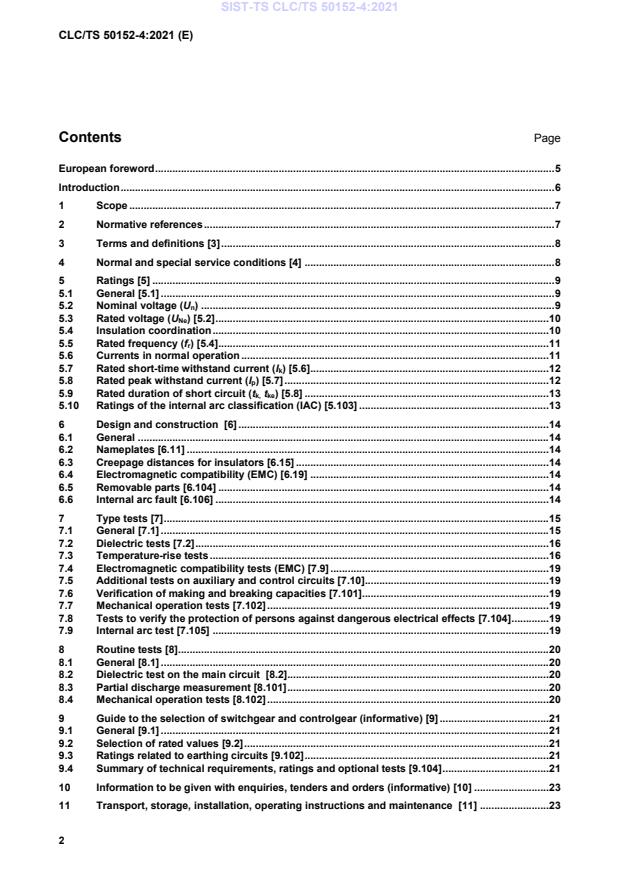
Contents Page
European foreword . 5
Introduction . 6
1 Scope . 7
2 Normative references . 7
3 Terms and definitions [3] . 8
4 Normal and special service conditions [4] . 8
5 Ratings [5] . 9
5.1 General [5.1] . 9
5.2 Nominal voltage (U ) . 9
n
5.3 Rated voltage (U ) [5.2] . 10
Ne
5.4 Insulation coordination . 10
5.5 Rated frequency (f ) [5.4] . 11
r
5.6 Currents in normal operation . 11
5.7 Rated short-time withstand current (I ) [5.6] . 12
k
5.8 Rated peak withstand current (I ) [5.7] . 12
p
5.9 Rated duration of short circuit (t t ) [5.8] . 13
k, ke
5.10 Ratings of the internal arc classification (IAC) [5.103] . 13
6 Design and construction [6] . 14
6.1 General . 14
6.2 Nameplates [6.11] . 14
6.3 Creepage distances for insulators [6.15] . 14
6.4 Electromagnetic compatibility (EMC) [6.19] . 14
6.5 Removable parts [6.104] . 14
6.6 Internal arc fault [6.106] . 14
7 Type tests [7] . 15
7.1 General [7.1] . 15
7.2 Dielectric tests [7.2] . 16
7.3 Temperature-rise tests . 16
7.4 Electromagnetic compatibility tests (EMC) [7.9] . 19
7.5 Additional tests on auxiliary and control circuits [7.10]. 19
7.6 Verification of making and breaking capacities [7.101] . 19
7.7 Mechanical operation tests [7.102] . 19
7.8 Tests to verify the protection of persons against dangerous electrical effects [7.104] . 19
7.9 Internal arc test [7.105] . 19
8 Routine tests [8] . 20
8.1 General [8.1] . 20
8.2 Dielectric test on the main circuit [8.2]. 20
8.3 Partial discharge measurement [8.101] . 20
8.4 Mechanical operation tests [8.102] . 20
9 Guide to the selection of switchgear and controlgear (informative) [9] . 21
9.1 General [9.1] . 21
9.2 Selection of rated values [9.2] . 21
9.3 Ratings related to earthing circuits [9.102] . 21
9.4 Summary of technical requirements, ratings and optional tests [9.104] . 21
10 Information to be given with enquiries, tenders and orders (informative) [10] . 23
11 Transport, storage, installation, operating instructions and maintenance [11] . 23
12 Safety [12] . 23
13 Influence of the product on the environment [13] . 24
Annex A (normative) Internal arc fault – Method to verify the internal arc classification
(IAC) . 25
A.1 Room simulation [A.1]. 25
A.2 Indicators (for assessing the thermal effects of the gases) [A.2] . 25
A.3 Tolerances for geometrical dimensions of test arrangements [A.3] . 25
A.4 Test parameters [A.4] . 25
A.5 Test procedure [A.5] . 25
Annex B (normative) Partial discharge measurement . 27
B.1 General [B.1] . 27
B.2 Application [B.2] . 27
B.3 Test circuits and measuring instruments [B.3] . 27
B.4 Test procedure [B.4] . 29
B.5 Maximum permissible partial discharge quantity [B.5] . 30
Annex C (informative) Traction load and duty cycle . 31
C.1 Background . 31
C.2 Evaluation of traction load . 31
C.3 Transformation of time-weighted RMS into basic current and duty class . 33
C.4 Examples . 33
Bibliography . 41
Figures
Figure 1 — Test cycle for duty class IB and ID . 17
Figure 2 — Determination of times for duty class IB and ID . 18
Figure B.1 — Partial discharge test circuit (two-phase arrangement) . 29
Figure C.1 — Moving window in the time domain demonstrated on a theoretical traction
load 1 with 60 min cycle time . 33
Figure C.2 — Transfer of highest values from moving window calculation into the time-
weighted RMS graph . 34
Figure C.3 — Theoretical traction load 2, 10 min cycle time. 35
Figure C.4 — Time-weighted RMS values of theoretical traction load 1 and 2 . 36
Figure C.5 — Typical load current of a mass transit traction load . 37
Figure C.6 — Time-weighted RMS graph of the traction load in Figure C.5 . 38
Figure C.7 — Comparison of traction load with duty classes . 40
Tables
Table 1 — Nominal voltages (U ), rated impulse voltages (U ) and short-duration power-
n Ni
) for circuits connected to the contact line . 11
frequency withstand voltage (Ud
Table 2 — Preferred duty classes . 12
Table 3 — Additional nameplate information for traction switchgear . 14
Table 4 — Summary of technical requirements, ratings and optional tests for traction
switchgear . 21
Table A.1 — Parameters for internal fault test of traction switchgear according to
compartment construction . 26
Table B.1 — Partial discharge - test arrangements for traction switchgear . 28
Table B.2 — Partial discharge - test voltages and permissible levels for traction
switchgear . 30
European foreword
This document (CLC/TS 50152-4:2021) has been prepared by CLC/SC 9XC “Electric supply and earthing
systems for public transport equipment and ancillary apparatus (Fixed installations)”.
controlgear which are operated at traction system voltages 15 kV 16,7 Hz or 25 kV 50 Hz named traction
switchgear in this document.
The EN 50152 series under the generic title “Railway applications - Fixed installations - Particular requirements
for a.c. switchgear” is divided as follows:
— Part 1: Circuit-breakers with nominal voltage above 1 kV;
— Part 2: Disconnectors, earthing switches and switches with nominal voltage above 1 kV;
— Part 3-1: Measurement, control and protection devices for specific use in a.c. traction systems — Devices;
— Part 3-2: Measurement, control and protection devices for specific use in a.c. traction systems — Current
transformers;
— Part 3-3: Measurement, control and protection devices for specific use in a.c. traction systems — Voltage
transformers.
— Part 4: AC metal-enclosed traction switchgear.
Attention is drawn to the possibility that some of the elements of this document may be the subject of patent
rights. CENELEC shall not be held responsible for identifying any or all such patent rights.
Any feedback and questions on this document should be directed to the users’ national committee. A complete
listing of these bodies can be found on the CENELEC website.
Introduction
This document needs to be read in conjunction with EN 62271-1:2017 and EN IEC 62271-200:2021.
Where a particular clause of EN IEC 62271-200:2021 is not mentioned in this standard, that clause applies as
far as reasonable. Where requirements relate exclusively to three-phase systems or to voltages outside those
in use in traction systems, they are not applicable. Where this standard states “addition” or “replacement”, the
relevant text of EN IEC 62271-200:2021 needs to be adapted accordingly.
The numbering of clauses in the EN 62271 series is not used in this document. For easier understanding the
numbering of clauses in EN IEC 62271-200:2021 is given in square brackets.
Where terms defined in EN 62271-1:2017 and EN IEC 62271-200:2021 conflict with definitions of the same
terms as given in IEC 60050-811:1991 or of the other railway application documents listed in the normative
references, the definitions in EN 62271-1:2017 and EN IEC 62271-200:2021 need to be used.
The term ‘traction switchgear’ is used whenever EN 62271 series uses ‘switchgear and controlgear’, except
for headlines which are kept.
NOTE The suffix N which appears in this standard for rated values is not present in EN 62271-1:2017 and
EN IEC 62271-200:2021.
References in subclauses of EN 62271-1:2017 and EN IEC 62271-200:2021 need to be replaced by
references to applicable subclauses in this document as far as reasonably possible.
1 Scope
This document specifies requirements for prefabricated metal-enclosed traction switchgear for alternating
current with traction voltages and frequencies as specified in EN 50163:2004 and used in indoor and outdoor
installations. Enclosures may include fixed and removable components and may be filled with fluid (liquid or
gas) to provide insulation.
NOTE 1 EN 50163 specifies the AC traction systems 15 kV 16,7 Hz and 25 kV 50 Hz.
NOTE 2 This document applies to single-phase or two-phase systems.
For metal-enclosed traction switchgear containing gas-filled compartments, the design pressure is limited to a
maximum of 300 kPa (relative pressure).
NOTE 3 EN 62271-203 can be used as a guide for design and testing in case the design pressure of gas-filled
compartments exceeds 300 kPa (relative pressure).
Components contained in metal-enclosed traction switchgear are to be designed and tested in accordance
with their various relevant standards. This document supplements the standards for the individual components
regarding their installation in traction switchgear assemblies.
This document does not preclude that other equipment may be included in the same enclosure. In such a
case, any possible influence of that equipment on the traction switchgear is to be taken into account.
NOTE 4 Traction switchgear having an insulation enclosure is covered by EN 62271-201. For definition see there or
IEV 441-12-06.
2 Normative references
The following documents are referred to in the text in such a way that some or all of their content constitutes
requirements of this document. For dated references, only the edition cited applies. For undated references,
the latest edition of the referenced document (including any amendments) applies.
EN 50121-5:2017, Railway applications - Electromagnetic compatibility - Part 5: Emission and immunity of
fixed power supply installations and apparatus
EN 50124-1:2017, Railway applications - Insulation coordination - Part 1: Basic requirements - Clearances
and creepage distances for all electrical and electronic equipment
EN 50152-1:2012, Railway applications - Fixed installations - Particular requirements for alternating current
switchgear - Part 1: Circuit-breakers with nominal voltage above 1 kV
EN 50152-2:2012, Railway applications - Fixed installations - Particular requirements for alternating current
switchgear - Part 2: Disconnectors, earthing switches and switches with nominal voltage above 1 kV
EN 50163:2004, Railway applications - Supply voltages of traction systems
EN 62271-1:2017, High-voltage switchgear and controlgear - Part 1: Common specifications for alternating
current switchgear and controlgear
EN IEC 62271-200:2021, High-voltage switchgear and controlgear – Part 200: AC metal-enclosed switchgear
and controlgear for rated voltages above 1 kV and up to and including 52 kV (IEC 62271-200:2021)
3 Terms and definitions [3]
For the purposes of this document, the terms and definitions given in EN 50152-1:2012, EN 50152-2:2012,
EN 62271-1:2017, EN IEC 62271-200:2021 and the following apply.
3.1
traction switchgear
metal-enclosed high-voltage switchgear operated at an AC-supply voltage of traction systems according to
EN 50163:2004
3.2
basic current
I
B
current value of the main circuit which is assumed to last for longer periods and represents the load carried
continuously by the traction switchgear assembly and on which the overloads are imposed
[SOURCE: EN 50329:2003, 1.3.13, modified – application has been added, “(I , I ,
BL BP
IBS, IBV, IBGL, IBGS)” has been replaced by “IB”, “in a winding” has been replaced by “of a main circuit”, “according
to a given duty class (see 1.3.18)” has been deleted, “transformer” has been replaced by “switchgear
assembly” and “By consequence are defined” has been removed]
3.3
duty class
conventional classification of the current capability of traction switchgear expressed in per unit of the basic
current (IB)
Note 1 to entry : The duty classes, associated with other rated values, define the characteristics of the traction
switchgear.
[SOURCE: EN 50329:2003, 1.3.19, modified - “transformer” has been replaced by “switchgear”, Second
sentence moved to a new Note to entry and "transformer" has been replaced by "switchgear", “Annex A
indicates preferred duty classes and the corresponding basic and rated values” has been removed and NOTE
has been removed]
4 Normal and special service conditions [4]
EN 62271-1:2017, Clause 4 is applicable with the following addition:
Unless otherwise specified in this standard, the traction switchgear is designed to be used under normal
service conditions.
For special service conditions, agreement shall be made between purchaser and supplier. EN 50125-2:2002
should be taken as guidance for the selection of appropriate classifications.
NOTE 1 The altitude reference condition is 1 000 m as per EN 62271-1. The altitude reference of EN 50124-1 (up to
2 000 m) applies to insulation coordination only and is not considered as a reference condition in this document.
NOTE 2 EN 50125-2:2002 uses classifications of EN 60721-3-3:1995 and EN 60721-3-4:1993 which have been
revised in 2019. Some classifications of EN 50125-2 are only available in the older versions.
5 Ratings [5]
5.1 General [5.1]
EN IEC 62271-200:2021, Clause 5 is applicable with the following modifications given hereafter and in 5.2 to
5.10.
NOTE 1 References in this document typically name EN IEC 62271-200:2021. Nevertheless clauses of
EN IEC 62271-200:2021 normally contain references to EN 62271-1 and specify the deviations to it.
EN IEC 62271-200:2021, 5.1 is replaced by the following:
The ratings of traction switchgear are the following:
a) nominal voltage (U ) and number of poles;
n
);
b) rated voltage (UNe
and U );
c) rated insulation level (UNi d
);
d) rated frequency (fr
);
e) rated continuous current (Ir
);
f) rated short-time withstand current (Ik
);
g) rated peak withstand current (Ip
, t ) (for main and earthing circuits);
h) rated duration of short circuit (tk ke
);
i) rated supply voltage of auxiliary and control circuits (Ua
j) rated supply frequency of auxiliary and control circuits;
k) rated values of the components forming part of the traction switchgear including their operating devices
and auxiliary equipment;
l) rated pressure of compressed gas supply for controlled pressure systems;
m) rated filling level (of fluid-filled compartments);
Optional ratings:
(AC));
n) rated voltage for AC cable test voltage (Uct
(DC));
o) rated voltage for DC cable test voltage (Uct
(DC));
p) rated duration for DC cable test voltage, (tct
) and duty class;
q) basic current (IB
r) ratings of the internal arc classifications (IAC).
5.2 Nominal voltage (U )
n
The standard values of nominal voltage Un are 15 kV and 25 kV as listed in EN 50163:2004, Table 1.
5.3 Rated voltage (U ) [5.2]
Ne
EN IEC 62271-200:2021, 5.2 is replaced by the following:
The rated voltage U shall be chosen taking into consideration the maximum voltage level suitable to be
Ne
permanently applied to the traction switchgear (e.g. highest permanent voltage U as defined in
max1
EN 50163:2004).
The value of U shall be used whenever EN 62271-1:2017 or EN IEC 62271-200:2021 reference U unless
Ne r
another value is named explicitly.
NOTE 1 The rated voltage for fixed installations in railway applications is a phase-to-earth value. This also applies to
AT systems having a system voltage of 2x U .
n
NOTE 2 Making and breaking also under out-of-phase situations applies to conventional and AT systems. They are
specified in EN 50152-1.
NOTE 3 Components forming part of traction switchgear may have individual values of rated voltage in accordance
with their relevant standards.
5.4 Insulation coordination
5.4.1 General
Insulation coordination shall be conducted according to EN 50124-1:2017 e.g. selection of values for Over
Voltage category (OV) and Pollution Degree (PD).
The rated voltage U shall be used when EN 50124-1:2017 refers to the rated insulation voltage U .
Ne Nm
NOTE The insulation characteristics determined by applying U are expected to be suitable to allow the highest
max1
non-permanent voltage U taken from EN 50163.
max2
The definition of the four overvoltage categories shall be as in EN 50124-1:2017, 4.2.3.2.
The definition of the seven pollution degrees shall be as in EN 50124-1:2017, 4.4 and Table A.4. The typical
pollution degrees of the locations to install traction switchgear are:
— for indoor switchgear: PD3
— for outdoor switchgear: PD4A
The location of the switchgear may provide different environmental conditions and pollution degrees need to
be adapted accordingly, please refer to EN 50124-1:2017, Table E.1
The inside of the switchgear may provide different environmental conditions e.g. by the degree of ingress
protection (IP class) and pollution degrees may be adapted accordingly.
5.4.2 Rated insulation level [5.3]
EN 62271 1:2017, 5.3 is replaced by the following:
The value of the rated impulse withstand voltage UNi and of the power frequency withstand voltage Ud shall be
as given in Table 1, taken from the values listed in EN 50124-1:2017.
Table 1 — Nominal voltages (U ), rated impulse voltages (U ) and short-duration power-frequency
n Ni
) for circuits connected to the contact line
withstand voltage (Ud
U U OV U U
n Ne Ni d
(kV) (kV) (kV) (kV)
17,25 4 125 50
a
17,25 4 170 70
3 170 70
27,5
4 200 95
3 200 95
a
27,5
4 250 95
NOTE The rated short-duration power-frequency withstand voltage is represented by Ud as used in EN 62271-1:2017
not by U as used in EN 50124-1:2017. U is used in EN 62271-1:2017 for the rated auxiliary voltage.
a a
a
For more demanding requirements on insulation system
This is common practice in some countries with larger number of installations at altitude up to 2 000 m without
additionally applying an altitude correction factor.
All test voltages for dielectric tests on the main circuit shall be taken from Table 1 .
5.5 Rated frequency (f ) [5.4]
r
EN IEC 62271-200:2021, 5.4 is replaced by the following:
The standard values of the rated frequency are 16,7 Hz and 50 Hz as listed in EN 50163:2004, Table 1.
5.6 Currents in normal operation
5.6.1 Rated continuous current (I ) [5.5]
r
EN IEC 62271-200:2021, 5.5 is applicable.
5.6.2 Basic current (I ) and duty class
B
Manufacturers should also assign one or more sets of basic current (IB) and duty class to the traction
switchgear.
NOTE 1 Traction switchgear is subject to loads with significant and rapid variations in amplitude and duration. Assigning
of basic current (IB) and duty class can support adequate selection of traction switchgear in relation to the traction load.
Any value may be selected as basic current (IB).
NOTE 2 Values for current ratings are typically selected from the R 10 series, specified in IEC 60059. For traction
switchgear this unnecessarily reduces the possibilities of selecting a basic current (IB) in conjunction with a rated continuous
current (Ir) and is therefore not deemed adequate.
Table 2 gives the preferred duty classes for the design of traction switchgear.
Table 2 — Preferred duty classes
Initial Cool down
Duty class Id. p.u. of I p.u. of I Duration
B N
condition period
I - 1 1 - Cont. -
IB a 1 0,873 - Cont. -
b 2,2 1,903 a 300 s 3 300 s
ID a 1 0,668 - Cont. -
b 3,7 2,446 a 180 s 1 620 s
NOTE 1 Values of basic current (I ) and duty classes are aligned with EN 50329:2003, Table A.1 to allow
B
harmonization with traction transformers.
NOTE 2 Duty class I corresponds to the rated continuous current
NOTE 3 A comparison of the time-weighted RMS graphs of different duty classes has shown that the
preferred duty classes are most appropriate to cover a wide range of traction loads with an acceptable effort
on type testing.
NOTE 4 Figure 1 in 7.3.2.4.1 shows the test cycle for duty class IB and ID
IN equals the rated current of a traction transformer of the same duty class, see Table A.1 of
EN 50329:2003.
Other sets of basic current (IB) and duty class may be selected from EN 50329:2003, Table A.1. If specific load
cycles are required by purchasers these shall be agreed between purchaser and manufacturer.
A guide to determine the basic current (IB) based on a selected duty class and given traction load is provided
in Annex C.
NOTE 3 It is not possible to provide a general link between Ir and IB due to the differences in thermal characteristics
between traction switchgears. This is different for traction transformers where a large thermal capacity can be assumed.
5.7 Rated short-time withstand current (I ) [5.6]
k
EN IEC 62271-200:2021, 5.6 is applicable with the following addition:
The rated short-time withstand current (I ) applies to the main and the earthing circuit.
k
NOTE 1 AC traction systems are operated with the return circuit solidly earthed. Therefore the rated short-time
phase-to-earth withstand current (I ) is the same as the rated short-time withstand current (I ).
ke k
NOTE 2 The earthing circuit does not form part of the return circuit. The definition of earthing circuit is given in
EN IEC 62271-200:2021, 3.5.107.
5.8 Rated peak withstand current (Ip) [5.7]
EN IEC 62271-200:2021, 5.7 is applicable with the following addition:
The rated peak withstand current (Ip) applies to the main and the earthing circuit.
NOTE 1 AC traction systems are operated with the return circuit solidly earthed. Therefore the rated peak
phase-to-earth withstand current (Ipe) is the same as the rated peak withstand current (Ip).
NOTE 2 The earthing circuit does not form part of the return circuit. The definition of earthing circuit is given in
EN IEC 62271-200:2021, 3.5.107.
5.9 Rated duration of short circuit (t t ) [5.8]
k, ke
EN IEC 62271-200:2021, 5.8 is applicable with the following addition:
The rated duration of short circuit (tk) applies to the main circuit only.
The rated duration of phase-to-earth short circuit (tke) applies to the earthing circuit.
NOTE 1 It is possible that the rated duration of phase-to-earth short circuit (t ) is shorter than the rated duration of
ke
short circuit (t ) e.g. when the earthed structure of the switchgear is monitored by a protection system.
k
NOTE 2 In principle, the rated duration of short circuit of a main circuit cannot exceed the corresponding rated values
of the weakest of its series connected components.
NOTE 3 Smaller ratings for circuits or high-voltage compartments can be assigned in case of apparatus limiting the
short-circuit current, such as current-limiting fuses, reactors, etc
5.10 Ratings of the internal arc classification (IAC) [5.103]
EN IEC 62271-200:2021, 5.103 is applicable with the following addition:
For traction switchgear the rated arc fault current (IA) and the rated single-phase-to-earth arc fault current (IAe)
are the same irrespective of number of poles. This also applies to the rated arc fault duration (tA) and the rated
single-phase-to-earth arc fault duration (tAe). Therefore IAC ratings are identified by the rated arc fault current
(IA) and the rated arc fault duration (tA) only.
There may be more than one set of IAC ratings assigned to a traction switchgear.
Selection of the rated arc fault current (IA) and the rated arc fault duration (tA) should be based on the short
circuit conditions of the related traction system. Short circuit conditions are typically determined by system
analysis. EN 50388:2012, Table 6 provides maximum fault currents that may occur on contact lines of
interoperable rail systems.
NOTE IAC classification as defined in this document does not apply to opened compartments and to arc protection
between compartments. IEEE C.37.20.7 addresses these topics in Suffix B designation for opened low-voltage
compartments and in Suffix C designation for arc protection between compartments [4].
6 Design and construction [6]
6.1 General
EN IEC 62271-200:2021, Clause 6 is applicable with the following modifications given in 6.2 to 6.6.
6.2 Nameplates [6.11]
EN IEC 62271-200:2021, 6.11 is applicable with the following additions:
The abbreviation of the rated voltage shall be U as defined in this document.
Ne
Table 3 shall be added following EN IEC 62271-200:2021, Table 1:
Table 3 — Additional nameplate information for traction switchgear
Marking Condition:
Abbreviation Unit
(**) Marking only required if
(1) (2) (3) (4) (5)
Nominal voltage Un kV X
Basic current I A (X)
B
Duty class (X)
Legend and Notes of EN IEC 62271-200:2021, Table 1 also apply to this table.
NOTE The conditional elements Rated short-time phase-to-earth withstand current (I ), Rated peak phase-to-earth
ke
withstand current (I ), Single-phase-to-earth arc fault current and duration (I , t ) of EN IEC 62271-200:2021, Table 1
pe ke Ae
are not present in traction switchgear.
6.3 Creepage distances for insulators [6.15]
EN IEC 62271-200:2021, 6.15 is replaced by:
All creepage distances in air irrespective of indoor or outdoor shall be based on the rated voltage UNe and
determined according to EN 50124-1:2017, Clause 6.
Creepage distances other than in air are fixed by the manufacturer according to the insulation system.
NOTE The title of EN IEC 62271-200:2021, 5.15 reads “Creepage distances for outdoor insulators”
6.4 Electromagnetic compatibility (EMC) [6.19]
EN 62271-1:2017, 6.19 is amended by the following NOTE:
NOTE Emission and immunity levels also test criteria are from EN 50121-5:2017.
6.5 Removable parts [6.104]
EN IEC 62271-200:2021, 6.104 is applicable with the following modification:
References to EN 62271-102:2018 shall be replaced by EN 50152-2:2012.
NOTE EN 50152-2 amends EN 62271-102 with requirements specific for railway applications.
6.6 Internal arc fault [6.106]
EN 62271 200:2012, 6.106 is applicable except as follows:
Selection of ratings shall include the requirements of Annex A.
7 Type tests [7]
7.1 General [7.1]
EN IEC 62271-200:2021, Clause 7 is applicable with the following modifications given hereafter and in 7.2 to
7.9.
EN IEC 62271-200:2021, 7.1.1 is applicable with the following modification:
The list of type tests and verifications shall be replaced by the following list:
Mandatory type tests to verify the:
a) rated insulation level of the equipment (see 7.2);
b) measurement of the resistance of circuits (see EN IEC 62271-200:2021, 7.4);
c) rated continuous current of any part of the equipment (see 7.3.1);
d) capability of the main and earthing circuits to be subjected to the rated peak and the rated short-time
withstand currents (EN IEC 62271-200:2021, 7.6);
e) making and breaking capacity of the included switching devices (see 7.6);
f) mechanical operation of the included switching devices and removable parts (see 7.7);
g) IP protection code (EN IEC 62271-200:2021, 7.7.1);
h) protection of the equipment against mechanical impact (EN IEC 62271-200:2021, 7.7.2).
Mandatory type tests, where applicable, to verify the:
i) basic current (IB) and duty class (see 7.3.2);
j) auxiliary and control circuits (see 7.5);
k) protection of persons against dangerous electrical effects (see 7.8);
l) pressure withstand of gas-filled compartments (EN IEC 62271-200:2021, 7.103);
m) tightness of gas-filled or liquid-filled compartments (EN IEC 62271-200:2021, 7.8);
n) IAC classification (see 7.9);
o) electromagnetic compatibility (EMC) (see 7.4);
p) x-radiation level for vacuum interrupters (EN IEC 62271-200:2021, 7.11);
q) protection of the equipment against external effects due to weather (EN IEC 62271-200:2021, 7.7.1);
r) rated cable test voltages (EN IEC 62271-200:2021, 7.2.101).
Optional type tests (subject to agreement between manufacturer and user):
s) tests to evaluate the insulation of the equipment by the measurement of partial discharges (see 7.2.3).
7.2 Dielectric tests [7.2]
7.2.1 General
EN IEC 62271-200:2021, 7.2 is applicable with the following modifications:
7.2.2 Application of the test voltage and test conditions [7.2.6]
EN IEC 62271-200:2021, 7.2.6 is applicable with the following modifications:
All test voltages to earth and between phases shall be taken from Table 1.
All test voltages across isolating distances shall be taken from EN 50152-2:2012, Table 1.
7.2.3 Partial discharge tests [7.2.10]
EN 62271-1:2017, 7.2.10 is applicable with the following addition:
If the test is performed, it shall be according to Annex B.
NOTE It is good engineering practice to carry out a partial discharge type test on a complete functional unit or
assembly (where possible).
7.2.4 Voltage test as condition check [7.2.12]
EN 62271-1:2017, 7.2.12 is applicable with the following modification:
The test voltage of 80 % of Ud shall be based on the values given in Table 1.
7.3 Temperature-rise tests
7.3.1 Continuous current tests [7.5]
EN IEC 62271-200:2021, 7.5 is applicable.
7.3.2 Basic current tests
7.3.2.1 General
Basic current tests shall be carried out when the manufacturer has assigned one or more sets of a basic current
(IB) and duty class to the traction switchgear.
7.3.2.2 Condition of the test object
EN 62271-1:2017, 7.5.1 is applicable.
7.3.2.3 Arrangement of the equipment
EN IEC 62271-200:2021, 7.5.2 is applicable.
7.3.2.4 Test current and duration
7.3.2.4.1 Test on main circuit
EN IEC 62271-200:2021, 7.5.3.1 is applicable with the following modifications:
The temperature-rise test shall be conducted for a duty class at basic current (IB) and the overload current for
the duration indicated in the duty class.
The test shall start with the basic current (IB) until the initial criterion - variation of temperature rise does not
exceed 1 K in 1 h – is reached.
The test shall be continued with the test cycle as specified in Table 2 and shown in Figure 1 for the duty class.
At the beginning of the cycle the test current shall be increased to the value of the overload current (Ib) and
kept constant for the duration (tb). Thereafter the test current shall be decreased to the basic current (IB) and
kept constant for the cool down period (t ). This cycle shall be repeated until the temperature rise at the end
a_b
of a cycle has not increased by more than 5 K compared to the start of that cycle (main criterion).
NOTE 1 The main criterion has been set to limit the number of test cycles to an accountable degree. It considers the
fact of traction loads having significant and rapid variations which ensures fast succession of heating up and cooling down
times. Applying the overload cumulatively as done under test is more onerous.
Preheating the circuit with a higher value of current is permitted and may be used to reduce the time to:
— achieve the initial criterion 1 K in 1 h
) until the main criterion is met
— limit the number of cycles by applying a current higher than basic current (IB
Key
pre-heating period, injection of current until steady-state temperatures at I are reached
cont. a
I
a service current in basic load condition
I overload current b
b
I
r rated current
t cool down period at current I after overload at current I
a_b a b
t duration of overload current I
b b
Δt
duration of the test cycle consisting of overload and cool down period
Figure 1 — Test cycle for duty class IB and ID
The test shall be performed under the conditions for rate of rise and evaluation of times as stated hereafter
and shown in Figure 2. The rate of rise of the test current shall be as high and as constant as allowed by the
test circuit. It shall be the same for increasing and decreasing. The times for increasing (t ) respectively
r1
decreasing (t ) shall not be longer than 30 s and shall not differ by more than 20 %. The time measurement
r2
of t (duration of overload current I ) shall not start before the value of the test current has passed 50 % of its
b b
rise ((I + I )/2). The time between 50 % of its rise and reaching 99 % of the overload current I shall not be
a b b
longer than 15 s. The time measurement of the duration ends as soon as the test current is decreased. The
2 2
I t value of the real test current and real test duration shall be equal to or greater than the I t value of I and t .
b b
NOTE 2 It is well understood that the rate of rise of a test laboratory is limited. The measurement of the duration
considers this fact and also intends to prevent unclear and unnecessary overloading of the switchgear under test.
NOTE 3 The factor 99 %
...