

prEN IEC 60068-3-11:2024
(Main)Environmental testing - Part 3-11: Supporting documentation and guidance - Calculation of uncertainty of conditions in climatic test chambers
General Information
- Abstract
- Status
- Not Published
- Publication Date
- 01-Jan-2026
- Technical Committee
- CLC/SR 104 - Environmental conditions, classification and methods of test
- Current Stage
- 4098 - Decision to drop project - Standstill maintained / released - Enquiry
- Start Date
- 05-Jan-2026
- Completion Date
- 25-Aug-2026

Overview
prEN IEC 60068-3-11:2024 is an international standard developed by the International Electrotechnical Commission (IEC) and CENELEC for environmental testing, specifically focusing on the calculation of uncertainty of conditions in climatic test chambers. This document provides supporting documentation and guidance for establishing and interpreting environmental test sequences and understanding the effects and uncertainties involved when using climatic test chambers for electronic, electrical, and electromechanical products.
With increasing demand for reliable product performance under varying environmental conditions, precise determination and documentation of climate chamber conditions are critical. This standard targets engineers, technicians, testing laboratories, and quality assurance professionals involved in environmental testing or product certification.
Key Topics
- Climatic Test Chambers: Provides guidance on evaluating and managing uncertainties related to temperature, humidity, pressure, and other environmental factors.
- Uncertainty Calculation: Describes methods to assess and document uncertainty in environmental conditions, essential for test repeatability, reproducibility, and international alignment.
- Test Sequence Development: Outlines a systematic process for creating and refining environmental test sequences using multiple climatic stressors.
- Product Life Cycle Consideration: Emphasizes the assessment of environmental effects throughout product storage, transport, operation, and disposal.
- Critical Environmental Conditions: Identification and prioritization of environmental stressors affecting product reliability and safety.
Applications
This standard is highly applicable for organizations and industries requiring reliable environmental testing and robust product validation:
- Product Design Validation: Ensures that products, components, or subassemblies meet environmental resilience requirements across their expected lifecycle.
- Quality Assurance & Certification: Supports quality systems such as the IEC Quality Assessment System for Electronic Components (IECQ) by establishing transparent and reproducible test procedures.
- Laboratory Measurement Reliability: Helps laboratories and test centers determine, minimize, and report the uncertainty of controlled environmental parameters in climatic chambers.
- Failure Analysis: Assists in identifying potential failure mechanisms activated under sequential or combined climatic conditions, informing both product improvement and customer communication.
- Specification Writing: Offers guidance for specification writers in establishing clear environmental performance criteria and test methods for compliance and tender documents.
- Combined and Sequential Testing: Clarifies the importance of test order and the combination of environmental factors, ensuring more realistic simulation of real-world conditions.
Related Standards
For comprehensive implementation and cross-referencing, the following international standards are closely related or referenced in prEN IEC 60068-3-11:2024:
- IEC 60068-1: General and guidance-related environmental testing procedures.
- IEC 60068-2 series: Detailed test methods for various environmental factors, such as temperature, humidity, and vibration.
- IEC 60721-1, -2, -3, -4: Classification of environmental conditions, transformation, and correlation with testing requirements.
- ISO/IEC Directives: Framework for the preparation and structure of international standards.
Users are encouraged to refer to these documents for broader context and to ensure full compliance with international testing and documentation requirements.
By following the guidance of prEN IEC 60068-3-11:2024, organizations can achieve higher accuracy in environmental testing, deliver more reliable products, and demonstrate compliance with global quality expectations. This standard is a crucial reference for environmental simulation, product durability assessment, and the calculation of measurement uncertainty in climatic test chambers.
Relations
- Effective Date
- 23-May-2023
Get Certified
Connect with accredited certification bodies for this standard

IMP NDT d.o.o.
Non-destructive testing services. Radiography, ultrasonic, magnetic particle, penetrant, visual inspection.
Inštitut za kovinske materiale in tehnologije
Institute of Metals and Technology. Materials testing, metallurgical analysis, NDT.
Q Techna d.o.o.
NDT and quality assurance specialist. 30+ years experience. NDT personnel certification per ISO 9712, nuclear and thermal power plant inspections, QA/
Sponsored listings
Frequently Asked Questions
prEN IEC 60068-3-11:2024 is a draft published by CLC. Its full title is "Environmental testing - Part 3-11: Supporting documentation and guidance - Calculation of uncertainty of conditions in climatic test chambers". This standard covers: Environmental testing - Part 3-11: Supporting documentation and guidance - Calculation of uncertainty of conditions in climatic test chambers
Environmental testing - Part 3-11: Supporting documentation and guidance - Calculation of uncertainty of conditions in climatic test chambers
prEN IEC 60068-3-11:2024 is classified under the following ICS (International Classification for Standards) categories: 19.040 - Environmental testing. The ICS classification helps identify the subject area and facilitates finding related standards.
prEN IEC 60068-3-11:2024 has the following relationships with other standards: It is inter standard links to EN 60068-3-11:2007. Understanding these relationships helps ensure you are using the most current and applicable version of the standard.
prEN IEC 60068-3-11:2024 is available in PDF format for immediate download after purchase. The document can be added to your cart and obtained through the secure checkout process. Digital delivery ensures instant access to the complete standard document.
Standards Content (Sample)
SLOVENSKI STANDARD
01-april-2024
Okoljsko preskušanje - 3-11. del: Spremljajoča dokumentacija in vodila -
Izračunavanje nezanesljivosti pogojev v komorah za klimatsko preskušanje
Environmental testing - Part 3-11: Supporting documentation and guidance - Calculation
of uncertainty of conditions in climatic test chambers
Umgebungseinflüsse - Teil 3-11: Unterstützende Dokumentation und Leitfaden -
Berechnung der Messunsicherheit von Umgebungsbedingungen in Klimaprüfkammern
Essais d'environnement - Partie 3-11: Documentation d'accompagnement et guide -
Calcul de l'incertitude des conditions en chambres d'essais climatiques
Ta slovenski standard je istoveten z: prEN IEC 60068-3-11:2024
ICS:
01.110 Tehnična dokumentacija za Technical product
izdelke documentation
19.040 Preskušanje v zvezi z Environmental testing
okoljem
29.020 Elektrotehnika na splošno Electrical engineering in
general
2003-01.Slovenski inštitut za standardizacijo. Razmnoževanje celote ali delov tega standarda ni dovoljeno.
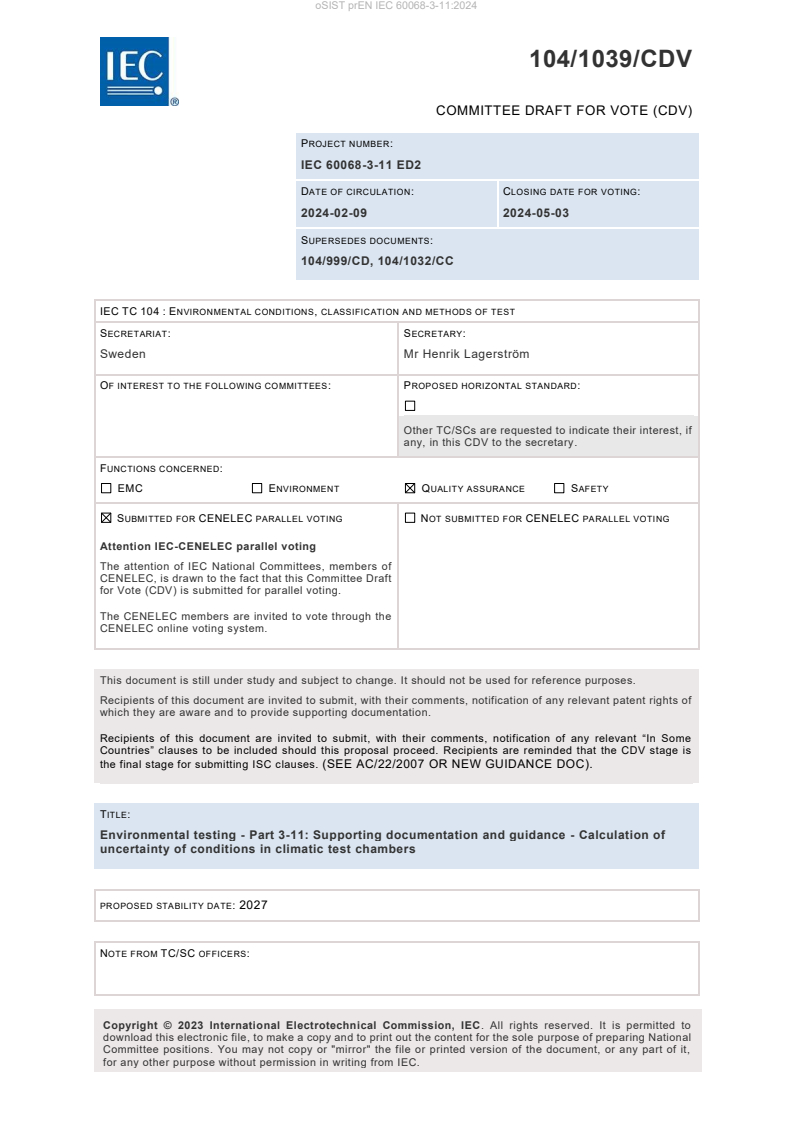
104/1039/CDV
COMMITTEE DRAFT FOR VOTE (CDV)
PROJECT NUMBER:
IEC 60068-3-11 ED2
DATE OF CIRCULATION: CLOSING DATE FOR VOTING:
2024-02-09 2024-05-03
SUPERSEDES DOCUMENTS:
104/999/CD, 104/1032/CC
IEC TC 104 : ENVIRONMENTAL CONDITIONS, CLASSIFICATION AND METHODS OF TEST
SECRETARIAT: SECRETARY:
Sweden Mr Henrik Lagerström
OF INTEREST TO THE FOLLOWING COMMITTEES: PROPOSED HORIZONTAL STANDARD:
Other TC/SCs are requested to indicate their interest, if
any, in this CDV to the secretary.
FUNCTIONS CONCERNED:
EMC ENVIRONMENT QUALITY ASSURANCE SAFETY
SUBMITTED FOR CENELEC PARALLEL VOTING NOT SUBMITTED FOR CENELEC PARALLEL VOTING
Attention IEC-CENELEC parallel voting
The attention of IEC National Committees, members of
CENELEC, is drawn to the fact that this Committee Draft
for Vote (CDV) is submitted for parallel voting.
The CENELEC members are invited to vote through the
CENELEC online voting system.
This document is still under study and subject to change. It should not be used for reference purposes.
Recipients of this document are invited to submit, with their comments, notification of any relevant patent rights of
which they are aware and to provide supporting documentation.
Recipients of this document are invited to submit, with their comments, notification of any relevant “In Some
Countries” clauses to be included should this proposal proceed. Recipients are reminded that the CDV stage is
the final stage for submitting ISC clauses. (SEE AC/22/2007 OR NEW GUIDANCE DOC).
TITLE:
Environmental testing - Part 3-11: Supporting documentation and guidance - Calculation of
uncertainty of conditions in climatic test chambers
PROPOSED STABILITY DATE: 2027
NOTE FROM TC/SC OFFICERS:
download this electronic file, to make a copy and to print out the content for the sole purpose of preparing National
Committee positions. You may not copy or "mirror" the file or printed version of the document, or any part of it,
for any other purpose without permission in writing from IEC.
IEC CDV 60068-3-11 © IEC 2023 2 104/1039/CDV
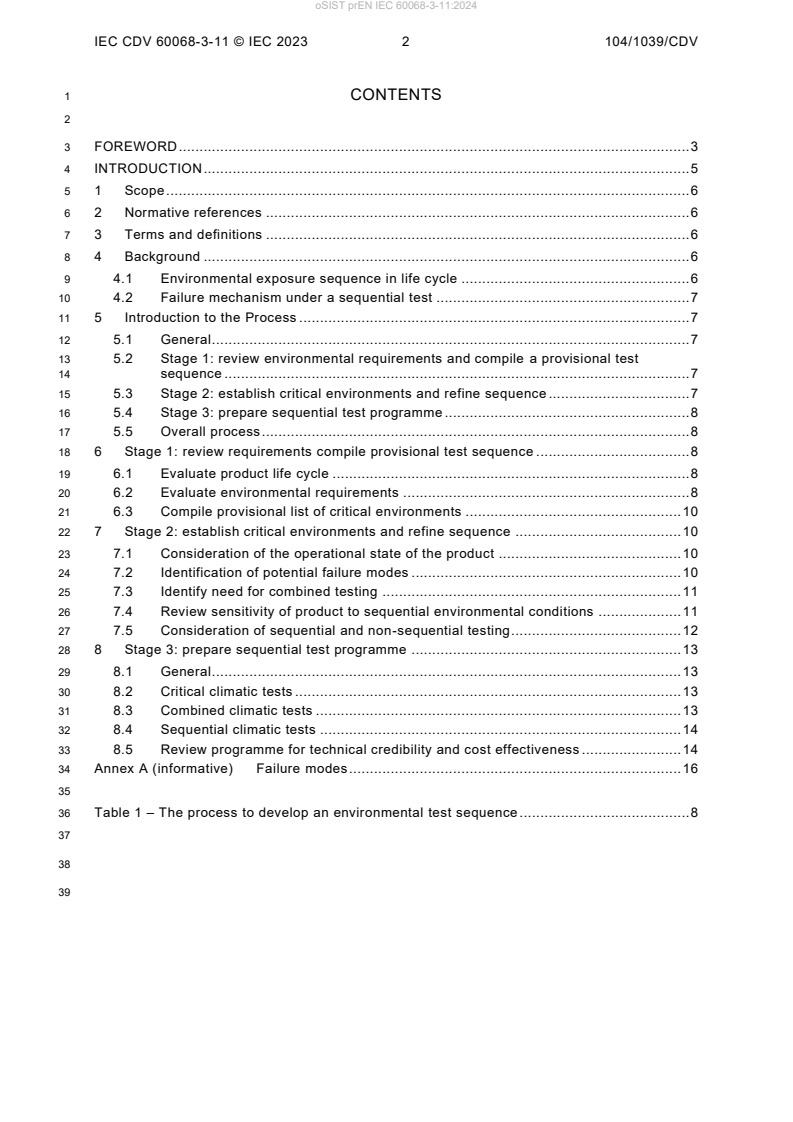
1 CONTENTS
3 FOREWORD . 3
4 INTRODUCTION . 5
5 1 Scope . 6
6 2 Normative references . 6
7 3 Terms and definitions . 6
8 4 Background . 6
9 4.1 Environmental exposure sequence in life cycle . 6
10 4.2 Failure mechanism under a sequential test . 7
11 5 Introduction to the Process . 7
12 5.1 General . 7
13 5.2 Stage 1: review environmental requirements and compile a provisional test
14 sequence . 7
15 5.3 Stage 2: establish critical environments and refine sequence . 7
16 5.4 Stage 3: prepare sequential test programme . 8
17 5.5 Overall process . 8
18 6 Stage 1: review requirements compile provisional test sequence . 8
19 6.1 Evaluate product life cycle . 8
20 6.2 Evaluate environmental requirements . 8
21 6.3 Compile provisional list of critical environments . 10
22 7 Stage 2: establish critical environments and refine sequence . 10
23 7.1 Consideration of the operational state of the product . 10
24 7.2 Identification of potential failure modes . 10
25 7.3 Identify need for combined testing . 11
26 7.4 Review sensitivity of product to sequential environmental conditions . 11
27 7.5 Consideration of sequential and non-sequential testing . 12
28 8 Stage 3: prepare sequential test programme . 13
29 8.1 General . 13
30 8.2 Critical climatic tests . 13
31 8.3 Combined climatic tests . 13
32 8.4 Sequential climatic tests . 14
33 8.5 Review programme for technical credibility and cost effectiveness . 14
34 Annex A (informative) Failure modes . 16
36 Table 1 – The process to develop an environmental test sequence . 8
IEC CDV 60068-3-11 © IEC 2023 3 104/1039/CDV
40 INTERNATIONAL ELECTROTECHNICAL COMMISSION
41 ____________
43 ENVIRONMENTAL TESTING –
45 Part 3-11: Supporting documentation and guidance - Developing a
46 climatic sequential test
50 FOREWORD
51 1) The International Electrotechnical Commission (IEC) is a worldwide organization for standardization comprising
52 all national electrotechnical committees (IEC National Committees). The object of IEC is to promote international
53 co-operation on all questions concerning standardization in the electrical and electronic fields. To this end and
54 in addition to other activities, IEC publishes International Standards, Technical Specifications, Technical Reports,
55 Publicly Available Specifications (PAS) and Guides (hereafter referred to as “IEC Publication(s)”). Their
56 preparation is entrusted to technical committees; any IEC National Committee interested in the subject dealt with
57 may participate in this preparatory work. International, governmental and non-governmental organizations liaising
58 with the IEC also participate in this preparation. IEC collaborates closely with the International Organization for
59 Standardization (ISO) in accordance with conditions determined by agreement between the two organizations.
60 2) The formal decisions or agreements of IEC on technical matters express, as nearly as possible, an international
61 consensus of opinion on the relevant subjects since each technical committee has representation from all
62 interested IEC National Committees.
63 3) IEC Publications have the form of recommendations for international use and are accepted by IEC National
64 Committees in that sense. While all reasonable efforts are made to ensure that the technical content of IEC
65 Publications is accurate, IEC cannot be held responsible for the way in which they are used or for any
66 misinterpretation by any end user.
67 4) In order to promote international uniformity, IEC National Committees undertake to apply IEC Publications
68 transparently to the maximum extent possible in their national and regional publications. Any divergence between
69 any IEC Publication and the corresponding national or regional publication shall be clearly indicated in the latter.
70 5) IEC itself does not provide any attestation of conformity. Independent certification bodies provide conformity
71 assessment services and, in some areas, access to IEC marks of conformity. IEC is not responsible for any
72 services carried out by independent certification bodies.
73 6) All users should ensure that they have the latest edition of this publication.
74 7) No liability shall attach to IEC or its directors, employees, servants or agents including individual experts and
75 members of its technical committees and IEC National Committees for any personal injury, property damage or
76 other damage of any nature whatsoever, whether direct or indirect, or for costs (including legal fees) and
77 expenses arising out of the publication, use of, or reliance upon, this IEC Publication or any other IEC Publications.
78 8) Attention is drawn to the Normative references cited in this publication. Use of the referenced publications is
79 indispensable for the correct application of this publication.
80 9) Attention is drawn to the possibility that some of the elements of this IEC Publication may be the subject of patent
81 rights. IEC shall not be held responsible for identifying any or all such patent rights.
82 International Standard IEC 60068-3-14 has been prepared by IEC technical committee 104:
83 Environmental conditions, classification and methods of test.
84 The text of this International Standard is based on the following documents:
FDIS Report on voting
XX/XX/FDIS XX/XX/RVD
86 Full information on the voting for the approval of this International Standard can be found in the
87 report on voting indicated in the above table.
88 This document has been drafted in accordance with the ISO/IEC Directives, Part 2.
89 The committee has decided that the contents of this document will remain unchanged until the
90 stability date indicated on the IEC website under "http://webstore.iec.ch" in the data related to
91 the specific document. At this date, the document will be
IEC CDV 60068-3-11 © IEC 2023 4 104/1039/CDV
92 • reconfirmed,
93 • withdrawn,
94 • replaced by a revised edition, or
95 • amended.
IEC CDV 60068-3-11 © IEC 2023 5 104/1039/CDV
97 INTRODUCTION
98 The IEC 60068-2 series includes a variety of single and combined climatic condition tests. Some
99 of these tests can give cumulative effects or hysteretic effects, causing the unit-under-test
100 deteriorates, making it more vulnerable to the follow-up tests. Thus, the determination of test
101 sequence can have significant influence to the conclusion of a test.
102 This part of IEC 60068 provides guidance for developing a climatic sequential test for a certain
103 type of product (electrical, electromechanical or electronic equipment and devices, as well as
104 their subassemblies, constituent parts and components). It is written for technicians, engineers
105 and managers in environment testing, and for those who need to understand the results of
106 sequential climatic environment tests.
107 With the increasing importance of the IEC Quality Assessment System for Electronic
108 Components (IECQ), it has become necessary to define the test sequence more precisely than
109 could be done in clause 7 of IEC 60068-1, in order to provide a satisfactory reproducibility of
110 the test. This International Standard describes in detail a composite test specifying a “climatic
111 sequence” for specimens of products, and it includes guidance in informative annexes for
112 specification writers and those performing the test.
IEC CDV 60068-3-11 © IEC 2023 6 104/1039/CDV
114 ENVIRONMENTAL TESTING –
116 Part 3-14: Supporting documentation and guidance - Developing a
117 climatic sequential test
119 1 Scope
120 This part of IEC 60068-3 describes a generic process for developing a climatic sequential test
121 programme by sequencing the test methods selected from IEC 60068-2 series. The generic
122 process comprises a systematic approach to the development of a sequential environmental
123 test programme. The process is applicable to electrical product, and can be customized
124 according to specific product requirements and applications. The process is designed for use
125 by both product suppliers and purchasers. The full process is particularly relevant to electrical
126 products, which would include products containing any components or material that have the
127 potential to degrade, as a consequence of environmental exposure.
128 2 Normative references
129 There are no normative references in this document.
130 3 Terms and definitions
131 For the purposes of this document, the following terms and definitions apply.
132 ISO and IEC maintain terminological databases for use in standardization at the following
133 addresses:
134 • IEC Electropedia: available at http://www.electropedia.org/
135 • ISO Online browsing platform: available at http://www.iso.org/obp
136 3.1
137 cumulative effects
138 permanently remained consequences of environmental conditions imposed on a product after
139 the environmental exposures are removed
140 3.2
141 hysteretic effects
142 gradually attenuated consequences of an environmental condition after the environmental
143 exposure are removed
144 3.3
145 Life Cycle Environmental Profile
146 LCEP
147 design and test decision baseline document outlining real-world environmental conditions that
148 a product or component will experience during usage-related events (e.g., transportation,
149 storage, operational usage, maintenance) from its release/ manufacturing to the end of its
150 useful life
151 4 Background
152 4.1 Environmental exposure sequence in life cycle
153 When exposed to environmental conditions, products will be influenced by the surrounding
154 environment. The influence is related to the environmental severity, the mechanism of
155 environment effect to the product and the initial state. To provide confidence that a product is
156 capable of surviving and operating in the environmental conditions which will encounter during
157 its life cycle, it is necessary to evaluate the product against those conditions. As far as
158 practicable, such evaluations need to consider all environmental conditions and their sequence
159 the product can experience during its life cycle. An environmental test programme should, as
160 far as practicable, replicate the usage environment and expose the product to the environmental
161 conditions so that the product would experience from the point of manufacture to the end of its
162 life. The environmental conditions that exist during storage, transportation, handling and
163 operation should be contained.
IEC CDV 60068-3-11 © IEC 2023 7 104/1039/CDV
164 See IEC 60721-1, IEC 60721-2 and IEC 60721-3 for the classification of environmental
165 conditions.
166 4.2 Failure mechanism under a sequential test
167 The environmental worthiness assessment of products is generally conducted by serial
168 laboratory environmental tests according to a specified environmental test programme. See IEC
169 60721-4 for guidance for the correlation and transformation of environmental condition classes
170 to the environmental tests. While a specimen is exposed to one environmental test, its state
171 changes somehow. The changes can be some permanent damages due to the previous
172 environment exposed onto the specimen, or some remaining effects by the previous
173 environmental exposure, which will disappear gradually in a long duration.
174 When an environmental test programme is to be specified for a particular product, the sequence
175 in which tests are carried out is important. That is because damage or effect, initiated by the
176 previous environmental test, will not probably become apparent or significant, until another is
177 applied. Specifically, a product can survive from an environmental test programme if the test is
178 carried out in one particular order, but fail if carry out the test in another order. Therefore, the
179 order in which environmental tests are undertaken, should ideally reflect the order in wh ich they
180 appear in the life cycle. In practice, it is usually not possible to exactly reproduce every aspect
181 of a product life cycle, as environmental exposure can vary, especially during operational
182 conditions.
183 5 Introduction to the Process
184 5.1 General
185 The process to develop a climatic environmental test sequence, as set out in this document, is
186 considered in three stages:
187 a) Stage 1: review environmental requirements of products and compile a provisional
188 sequence;
189 b) Stage 2: establish critical environments, based upon knowledge and refine sequence ;
190 c) Stage 3: prepare a technically reliable, cost-effective sequential test programme.
191 5.2 Stage 1: review environmental requirements and compile a provisional test
192 sequence
193 Stage 1 of the process, considers the product usage requirements to establish a provisional
194 environmental sequence. Generally, the requirements of specific concerns are; the product life
195 cycle, usually contained within the technical requirement, as well as the product environmental
196 requirements. Together these can be used to generate a provisional list of environmental
197 requirements and sequence. At this stage, the environmental sequence will comprise a list of
198 environmental conditions arising from each phase of the product life cycle. This provisional
199 environmental sequence will be extensive, with many similar environmental conditions
200 appearing within a number of different phases, of the life cycle.
201 5.3 Stage 2: establish critical environments and refine sequence
202 Stage 2 of the process, refines the provisional environmental sequence to eliminate
203 unnecessary repetition of environmental conditions, as well as consider the effects of the
204 sequence and of potential product failure modes. The elimination of unnecessary repetition of
205 environmental conditions is achieved by consideration of the operational state. For example,
206 the environmental conditions occurring when the product is packaged and non-operational,
207 have the potential to be merged.
208 It is possible for coincident environmental conditions to have an effect on the product, which is
209 greater than the case if they are applied separately. In such cases, the coincident environmental
210 conditions sometimes have a synergistic effect. If the synergistic effect is likely to be significant
211 for a particular product, consideration should be given to undertaking combined environmental
212 testing.
213 In parallel, consideration of the potential failure modes of the product, should allow a sequential
214 order of the environmental conditions to be established. For example, if temperature variation
215 testing degrades seals and joints, allowing moisture around to pass through these seals and
IEC CDV 60068-3-11 © IEC 2023 8 104/1039/CDV
216 joints when the product is exposed to a damp heat condition, the temperature variation test
217 should be done before the humidity test. Conversely, when moisture penetrates into electrical
218 box during the humidity test, a following low temperature test can cause the test sample to
219 condense or freeze inside. It is for this reason that recursive and iterative philosophy (so called
220 “shake it, bake it and shake it again”) to refine test sequence is generally the keyword
221 throughout the whole process to develop a test programme. Stage 2 of the process, also
222 considers the environmental conditions which need to be considered as part of a sequential
223 programme and those than can be considered separately, as non-sequential tests.
224 5.4 Stage 3: prepare sequential test programme
225 Stage 3 of the process considers the environmental sequence generated by the preceding
226 stages and then generates a technically reliable, cost-effective test programme. Having
227 identified the appropriate sequences of environments these can be converted into a test
228 programme. This should also consider the need to include appropriate functional testing of the
229 product during and after the testing as well as the need for any post-test destructive or non-
230 destructive inspection. In certain cases, greater technical credibility and cost effectiveness can
231 be achieved by modifying the sequence, to allow more effective use and time. Although, such
232 modifications should not override the order identified in Stage 2, some adjustments can still be
233 achieved.
234 5.5 Overall process
235 The overall process is illustrated in Table 1 and is discussed in detail hereinafter .
236 Table 1 – The process to develop an environmental test sequence
Stage Task Sub-Task
evaluate life cycle
review equirements and compile a
1 evaluate environmental requirements
provisional test sequence
compile provisional lists of critical environments
consideration of the operational state of the product
identification of potential failure modes
review sensitivity of the product to sequential
establish critical environments,
environmental conditions
2 based upon knowledge of product
identify need for combined testing, and refine test
and refine test sequence
programme
consideration of sequential and non-sequential
testing
review programme for technical credibility and cost
3 prepare a sequential test programme
effectiveness
237 6 Stage 1: review requirements and compile provisional test sequence
238 6.1 Evaluate product life cycle
239 Consideration of the product life cycle should have occurred as part of the exercise to generate
240 the environmental requirements document. The environmental requirements document should
241 reflect the predominant phases of the life cycle. However, a product life cycle can contain
242 multiple iterations of some events, such as the product has the potential to be transported
243 several times in its entire life. As a consequence, even a well-constructed environmental
244 requirements document should be considered alongside the life cycle, when identifying all the
245 sequential conditions the particular equipment experiences.
246 The product life cycle can also be used to identify whether changes in logistics and operational
247 usage will occur in the future. For example, one type of transport vehicle can be replaced by
248 another. Even when information of future potential environmental conditions is not known,
249 identifying the possibility permits the management of potential consequences. It is also
250 necessary to consider a worst-case usage to future proof against unknown usage requirements.
251 6.2 Evaluate environmental requirements
252 6.2.1 Identify major phases
253 The information in the environmental requirements document can be presented in several ways.
254 Whichever approach is used, the logistical and operational requirements should be broken down
IEC CDV 60068-3-11 © IEC 2023 9 104/1039/CDV
255 into their major phases. The phases will differ for each type of product, but typically will consist
256 of the following, which reflect the layout used in other parts of this standard .
257 a) Delivery: This phase should encompass the types of transportation to be used and the
258 associated worldwide regions, from which the product is delivered. The most common form
259 of transportation is by road, but air, rail and sea transportation are sometimes also required.
260 Delivery is usually undertaken with the product packaged. Handling of ISO containers as
261 well as individual pallets of product, using forklift trucks and cranes need to be addressed.
262 b) Storage: The main environments of concern during long term storage are, climatic along
263 with some potential for contamination. Storage can be within conditioned or non-
264 conditioned buildings. Handling using forklift trucks and also manhandling, for low mass
265 product, needs to be considered.
266 c) Transportation to depot: This phase should encompass the types of transportation to be
267 used, along with the associated worldwide regions, in which the product is transported. The
268 most common forms of transportation are by road, rail, air and sea. Transportation to the
269 depot is usually undertaken, with the packaged. Handling using forklift trucks and cranes
270 need to be considered.
271 d) Transportation beyond the depot: The environments experienced during delivery beyond
272 the depot, can be more severe than those during delivery to the depot. In addition to road,
273 air and sea transportation, the product can experience off-road transportation and poor-
274 quality handling.
275 e) Short Term Storage: The main environments of concern during short term storage are,
276 climatic and contamination. Storage can be within conditioned or non-conditioned buildings,
277 partially protected (open sided) buildings, under temporary covers such as a tarpaulin or
278 fully exposed to climatic conditions. Poor quality handling products or manual handling can
279 be chosen for handling products. Packaging can be the same as for the situation of
280 transporting to the depot. Alternatively, it involves degraded packaging or no packaging.
281 f) Operation: The environmental conditions during operation, can be severe and also unique.
282 They can occur in conjunction with those of installation/operation. The product is likely to
283 be required to operate during this phase.
284 g) Return: In some cases, products need to be returned to the depot or country of origin for
285 storage, repair, upgrade or disposal, etc. Returned products are possible to have been
286 'broken out' of its packaging during earlier phases and consequently have become
287 contaminated.
288 h) Product disposal: There might be no control over the storage and transportation
289 environmental conditions imposed on product during the disposal phase.
290 6.2.2 Determine typical environmental conditions
291 For each phase of the logistical and operational requirements identified for particular product,
292 the individual environmental conditions should be specified in detail. Typical environmental
293 conditions, which should be encompassed, are indicated below. In each case, the information
294 should provide the conditions causing the environment (especially for self-induced
295 environments), a description of the environment and quantifiable values. More detailed
296 information can be found in IEC 60721-2 and IEC 60721-3.
297 a) Mechanical environments: These environments include acceleration, vibration and shock
298 as well as acoustic noise, impact (drop and crane swing) and bounce, etc. The
299 environments can also include the mechanical loading environments, associated with
300 handling packaged.
301 b) Climatic environments: These environments include temperature, humidity, solar radiation,
302 pressure and maybe rapid or explosive decompression, icing, thermal shock, winds, freeze-
303 thaw and snow load etc.
304 c) Chemical, biological and contamination environments: These environments include fungal
305 growth, salt, acid corrosion, dust and sand, mist and fog, driving rain, driving snow and
306 immersion, etc. as well as a whole range of potential chemical and biological contaminants .
IEC CDV 60068-3-11 © IEC 2023 10 104/1039/CDV
307 d) Electrical environments: Electrical and related environments also need to be considered.
308 e) Combined environments: For each environment it is necessary to indicate whether it occur
309 in conjunction with other environments and if appropriate, the probability of their joint
310 occurrence.
311 6.3 Compile provisional list of critical environments
312 The provisional environmental sequence can be deduced from the environmental requirement
313 and the product life cycle. At this stage the environmental sequence will comprise a list of
314 groups of environmental conditions, arising from each and every phase of the product life cycle.
315 This list comprises provisional environmental conditions and sequence and will be extensive,
316 with many environmental conditions appearing, within a number of different phases of the life
317 cycle. The purpose of the subsequent stages is, to refine this sequence and reduce any
318 unnecessary repetition of the environmental conditions within the test programme.
319 7 Stage 2: establish critical environments and refine sequence
320 7.1 Consideration of the operational state of the product
321 The preliminary step in the elimination of unnecessary repetition of environmental conditions in
322 the provisional environmental sequence, is achieved by consideration of the various operational
323 states of the product. If the product is in the same operational state, the potential exists to
324 merge similar environmental conditions. Considered in this way, a significant reduction in the
325 provisional environmental test sequence is usually possible. For example, many transportation
326 phases take place on similar platforms and are likely to occur with the product in the same
327 operational state (packaged and non-operating).
328 Similar environmental conditions, but with the product in a different operational state cannot
329 usually be accumulated, unless it can be shown that the environmental conditions have a similar
330 effect on the product.
331 For most product, the relevant states are likely to be; “packaged and non-operating”,
332 “unpackaged and non-operating”, “unpackaged and operating” and “re-packaged and non-
333 operating”. For some product, an intermediate level of packaging need to be considered. This
334 could include situations when the product is unpackaged, but still has limited protection.
335 Similarly different levels of operation/function need to be considered when the product has, for
336 example, a standby and fully operational state. “Re-packaged and non-operating” product has
337 been specifically included here, because the re-packaging process can occur under poor
338 conditions and the product maybe returns to its package (or another package) in a contaminated
339 or incomplete state.
340 Generally, if product is non-operating, it will be expected to operate after the applicable
341 environmental conditions but not during. However, if product is operating, it will be expected to
342 meet its operational requirements, during the applicable environmental conditions as well as
343 after. An exception to these categories is the case of abnormal environmental conditions (e.g.
344 extreme normal or accidental conditions). Products that are exposed to abnormal environmental
345 conditions, usually have specific requirements which only a few would need consideration as
346 part of the environmental sequential test programme. Others are considered as potential non-
347 sequential tests, which will be addressed later.
348 7.2 Identification of potential failure modes
349 Identifying potential failure modes of product is undertaken to allow a sequential order of the
350 priority of environmental conditions to be established. The need to identify potential failure
351 modes is of particular importance, when the environmental testing is intended to demonstrate
352 survival and function, after exposure to environmental conditions. The key activity, for
353 identifying potential failure modes, is the examination of the design details of the product, to
354 ascertain the potential failure modes, its subsystems and components. The aim is to identify
355 any sensitivity or design weaknesses of the product, to specific environmental conditions.
356 However, a specific design weakness needs to be exercised by the test and is not a reason for
357 limiting the testing if the environments are likely to be experienced in actual use. The
358 examination of product to identify failure modes might need to draw on the design data and
359 knowledge of potential failure modes from past experience of similar scenarios. The identified
360 failure modes of the product will be used to establish a priority order, within the environmental
IEC CDV 60068-3-11 © IEC 2023 11 104/1039/CDV
361 test sequence. They will also be used in the next stage as the basis for identifying the need to
362 consider combined environmental conditions.
363 Additional advice on some more critical product failure modes is set out in Annex A.
364 7.3 Identify need for combined testing
365 This stage of the process takes consideration of combined environments conditions. This is
366 specifically relevant where combined testing has the potential to exercise potential failure
367 modes, which would not be adequately exercised, if the environmental conditions were applied
368 separately or out of sequence.
369 Many environmental conditions occur, in conjunction with other environmental conditions. In
370 either case, it is possible for the coincident environmental conditions to have an effect on the
371 product, which is greater than would be the case if they were applied separately. The most
372 common of these is the effects of low air pressure and high temperature on a heat-dissipating
373 product, each can make the product have an additional temperature increase separately and
374 higher increase when combined .
375 The process for identifying combined conditions, worthy of consideration, should be based upon
376 the product failure modes, identified in 6.2. These failure modes and associated degradation
377 mechanisms should be reviewed, to identify which would be exacerbated by two or more
378 simultaneously applied environmental conditions. If the effect of applying those environmental
379 conditions together is worse than applying them separately or the consequences on safety or
380 mission are significant, the use of combined environmental testing should always be considered.
381 It is frequently the case, that in order to undertake combined environmental testing, special test
382 facilities are required. Also testing certain combined conditions, can be difficult and expensive
383 to perform. The following supplies guidance on the most commonly encountered combined
384 conditions.
385 a) The vast majority of the test procedures can be undertaken in combination with temperature.
386 This is because temperature can change material properties and therefore the response to
387 other environmental stimuli. As a consequence, environmental testing, undertaken in
388 conjunction with temperature, comprises the most common group of combined conditions
389 encountered. In most cases, applying environmental conditions in-conjunction with
390 temperature, is undemanding and does not unduly complicate a test or make it
391 unreasonably costly. Combining environmental testing, with temperature, within an
392 environmental sequential test programme, can have detrimental effects if the product
393 contains components, which can be degraded by exposure to the high temperatures.
394 b) The effects of several of environmental conditions are exacerbated in the presence of
395 humidity. As a consequence, several of test procedures, can be undertaken in combination
396 with humidity (most high humidity levels but some low). Generally, if testing is undertaken
397 inside a climatic chamber, to achieve a specific temperature requirement, humidity can also
398 be applied. A number of the test procedures intrinsically apply environmental conditions,
399 combined with a high humidity environment, to encourage corrosion or mould growth and
400 to facilitate icing.
401 c) Low-pressure and high-pressure testing is usually undertaken in conjunction with
402 temperature (mostly low temperature but sometimes high temperature). Some pressure test
403 procedure encompasses the combined application of both pressure and temperature .
404 d) The effects of wind exacerbate several environmental conditions, including rain, snow, hail,
405 dust and sand. In each of these cases, the appropriate test procedure can include a wind
406 component or its effect.
407 7.4 Review sensitivity of product to sequential environmental conditions
408 Having identified potential product failure modes, it is necessary to identify the sensitivity of
409 those modes, to the order in which environmental conditions are applied. For example, if
410 exposure to temperature is possible to permanently degrade the physical properties of a
411 material, temperature testing might need to occur before mechanical testing. Whilst, in practice
412 the vast majority of environmental conditions will generate some degradation of the product, in
413 many cases the degradation is not sufficient to make the product particularly susceptible to
414 subsequent environmental conditions. However, when the product is safety or mission critical,
IEC CDV 60068-3-11 © IEC 2023 12 104/1039/CDV
415 even marginal degradation would cause unacceptable consequences. When considering
416 potential susceptibility to subsequent environmental exposure, the following are worthy of
417 consideration, but should not be considered an exhaustive list.
418 a) The ability of seals and joints to withstand penetration by air, moisture, humidity and
419 contaminants etc. can be degraded by the previous application of temperature testing,
420 especially temperature variation testing. For this reason, a temperature variation testing is
421 sometimes undertaken before humidity and wetting tests.
422 b) Low air pressure atmosphere can extract air inside the product with a sealing but not
423 hermetic structure, such as packaged components and electrical boxes. Pressure inside
424 will decrease gradually to that outside. When the atmosphere pressure increases, internal
425 pressure variation will be a hysteretic curve. There can be a pressure difference between
426 the interior of product and the surround atmosphere. Product can be more vulnerable to a
427 damp environment after exposed to a low air pressure condition.
428 c) Water penetrating product can degrade its physical properties, making it more susceptible
429 to subsequent physical loadings (pressure, acceleration, crushing, vibration, shock etc.). If
430 product can be degraded by water penetration, the appropriate wetting test should be
431 undertaken before low air pressure testing.
432 d) Water or moisture penetrating product would subsequently freeze at cold temperatures,
433 causing loss of function. Similarly, recovery from a low-pressure environment might allow
434 water or moisture to enter and subsequently freeze at cold temperatures. A freeze-thaw
435 test procedure or a pressure-temperature-humidity test is necessary to apply the
436 appropriate conditions in an appropriate order.
437 e) Dust can penetrate product and sand can erode surface finishes. As a consequence, the
438 product could be degraded against some subsequent environmental conditions, typically,
439 temperature variation for penetration and moisture for corrosion. In such cases, it is
440 appropriate to undertake dust and sand testing, early in the unpacked phase of the
441 sequential testing.
442 7.5 Consideration of sequential and non-sequential testing
443 Not all environmental conditions need be considered as part of an environmental test sequence.
444 However, it is still necessary to evaluate survival and/or function of the product, against these
445 conditions. In such cases, those particular environmental conditions will need to be considered,
446 as part of a non-sequential environmental trials programme. There can be no hard and fast rule,
447 as to which environmental conditions are considered part of the non-sequential, rather than the
448 sequential programme. Such a decision will usually be dependent upon the nature of the product
449 in question and its potential failure modes. The following environmental conditions are
450 sometimes considered to be non-sequential, although the list is not exhaustive.
451 a) Mould. The evaluation of product against mould or bacteria, is in most cases, component
452 material evaluations. As such, evaluation against mould is not usually considered as part
453 of the sequential test programme. However, the effectiveness of some approaches, used
454 to protect product susceptible to mould, can be degraded by prior environmental conditions,
455 such as high temperature, solar radiation. In such cases, testing for mould (or possible
456 moisture penetration) need to be considered, as part of the sequential test programme.
457 b) Corrosive atmosphere (including salt atmosphere). Generally, the evaluation of product
458 against corrosive chemical atmospheres and salt (maritime) atmospheres are component
459 material evaluations. In that case, evaluation against corrosive atmospheres is not
460 considered, as part of the sequential test programme. However, corrosive and salt
461 atmospheres need to be considered as part of a test sequence testing when the product is
462 composed of different materials, such that bimetallic electrolytic corrosion can occur.
463 Consideration for sequential testing is also required. The effectiveness of some approaches
464 used to protect product susceptibility to corrosive atmospheres, can be degraded by prior
465 environmental conditions. However, salt mist residue will inhibit mould to grow, a mould
466 test should be always prior to salt mist test if conducted using same test item.
467 c) Snow load. The evaluation of product against snow load is usually to establish operational
468 capability. The ability of an product to withstand snow load, is usually neither influenced by
469 previous environmental conditions or degrades the product against subsequent conditions.
oSIST p
...