

prEN IEC 60205:2024
(Main)Calculation of the effective parameters of magnetic piece parts
General Information
- Abstract
IEC 60205:2026 specifies uniform rules for the calculation of the effective parameters of closed circuits of ferromagnetic material. This edition includes the following significant technical changes with respect to the previous edition: a) addition, in 5.1, of the drawing and the formulae of pair of URS-cores of rectangular-circular section; b) using, in 5.9, 5.10, 5.11 and 5.13, the conventional calculation formula that includes "B1‑D" is limited for the x-x cores (x is EL, ER, PQ or E) and addition new formulae for x‑PLT cores that replaces "B1-D" with "(B1-D+B2)/2"; c) addition, in 5.9, 5.10, 5.11 and 5.13, of formulae of l1 and l3 for x-PLT cores (x is EL, ER, PQ or E) which is different from the l1 and l3 of x-x cores; d) addition of formula Amin in each subclause from 5.2.1 to 5.14.
- Status
- Not Published
- Publication Date
- 03-Nov-2025
- Technical Committee
- CLC/SR 51 - Magnetic components and ferrite materials
- Current Stage
- 4098 - Decision to drop project - Standstill maintained / released - Enquiry
- Start Date
- 19-Jul-2024
- Completion Date
- 25-Aug-2026

Overview
prEN IEC 60205:2024 - "Calculation of the effective parameters of magnetic piece parts" is a CLC-adopted IEC Committee Draft for Vote that defines uniform rules and formulae for computing the effective magnetic parameters of closed ferromagnetic circuits. The standard specifies how to determine the effective magnetic length (le), effective cross‑sectional area (Ae), effective volume (Ve) and core constants (C1, C2) for a wide range of core geometries used in magnetic components and ferrite parts. Units are millimetres and numerical accuracy requirements are specified to ensure repeatable results.
Key topics and technical requirements
- Definition and calculation of the effective parameters: le, Ae, Ve and core constants C1, C2 (expressed in mm-based units).
- Required numerical accuracy: results to three significant figures; C1 and C2 to five significant figures when deriving le, Ae, Ve.
- Applicability: closed magnetic circuits only; use mean dimensional values from piece‑part drawings; ignore small irregularities unless noted.
- Special rules for corners: mean flux path and averaged cross‑section for sharp corners.
- Extensive formulae and geometric drawings provided for many common core families:
- Ring cores (rectangular, trapezoidal, rounded, chamfered)
- U-, UR-, URS-cores
- E-, ETD-, EER-, EFD-, E planar-cores
- Pot, RM, EP, PM, EL, ER, PQ, EC and PLT (plate) cores
- Edition updates: fifth edition includes additions such as URS core formulas, revised calculation conventions for PLT cores, new l1/l3 expressions for several core families, and formula A additions across subclauses.
Practical applications
- Design and modelling of inductors, transformers, chokes and other magnetic components where accurate magnetic geometry parameters are needed for:
- Magnetic circuit analysis and finite element modelling (FEM)
- Core loss and saturation assessments
- Winding design (ampere‑turns and flux density calculations)
- Specification and procurement of ferrite and powder cores
- Laboratory and test-house use for consistent parameter reporting and comparison across suppliers.
Who should use this standard
- Magnetic component designers and electrical engineers
- Ferrite core and magnetic-powder manufacturers
- Test labs, procurement specialists and quality assurance teams
- Standards committees and anyone needing consistent core parameter calculations per IEC 60205 conventions
Related information
- Prepared by IEC TC 51 (Magnetic components, ferrite and magnetic powder materials). The document is a technical revision of IEC 60205 and is proposed stable until 2030. No normative references are listed in this draft. Keywords: IEC 60205, magnetic core calculation, effective parameters, ferrite cores, core constants, magnetic piece parts.
Relations
- Effective Date
- 10-Oct-2023
- Effective Date
- 10-Oct-2023
Get Certified
Connect with accredited certification bodies for this standard

IMQ S.p.A. (Certification)
Italian electrical product certification.

SLG Prüf- und Zertifizierungs GmbH
German testing and certification body.

UL Solutions
Global safety science company with testing, inspection and certification.
Sponsored listings
Frequently Asked Questions
prEN IEC 60205:2024 is a draft published by CLC. Its full title is "Calculation of the effective parameters of magnetic piece parts". This standard covers: IEC 60205:2026 specifies uniform rules for the calculation of the effective parameters of closed circuits of ferromagnetic material. This edition includes the following significant technical changes with respect to the previous edition: a) addition, in 5.1, of the drawing and the formulae of pair of URS-cores of rectangular-circular section; b) using, in 5.9, 5.10, 5.11 and 5.13, the conventional calculation formula that includes "B1‑D" is limited for the x-x cores (x is EL, ER, PQ or E) and addition new formulae for x‑PLT cores that replaces "B1-D" with "(B1-D+B2)/2"; c) addition, in 5.9, 5.10, 5.11 and 5.13, of formulae of l1 and l3 for x-PLT cores (x is EL, ER, PQ or E) which is different from the l1 and l3 of x-x cores; d) addition of formula Amin in each subclause from 5.2.1 to 5.14.
IEC 60205:2026 specifies uniform rules for the calculation of the effective parameters of closed circuits of ferromagnetic material. This edition includes the following significant technical changes with respect to the previous edition: a) addition, in 5.1, of the drawing and the formulae of pair of URS-cores of rectangular-circular section; b) using, in 5.9, 5.10, 5.11 and 5.13, the conventional calculation formula that includes "B1‑D" is limited for the x-x cores (x is EL, ER, PQ or E) and addition new formulae for x‑PLT cores that replaces "B1-D" with "(B1-D+B2)/2"; c) addition, in 5.9, 5.10, 5.11 and 5.13, of formulae of l1 and l3 for x-PLT cores (x is EL, ER, PQ or E) which is different from the l1 and l3 of x-x cores; d) addition of formula Amin in each subclause from 5.2.1 to 5.14.
prEN IEC 60205:2024 is classified under the following ICS (International Classification for Standards) categories: 29.100.10 - Magnetic components. The ICS classification helps identify the subject area and facilitates finding related standards.
prEN IEC 60205:2024 has the following relationships with other standards: It is inter standard links to EN 60205:2017/AC:2018-09, EN 60205:2017. Understanding these relationships helps ensure you are using the most current and applicable version of the standard.
prEN IEC 60205:2024 is available in PDF format for immediate download after purchase. The document can be added to your cart and obtained through the secure checkout process. Digital delivery ensures instant access to the complete standard document.
Standards Content (Sample)
SLOVENSKI STANDARD
01-junij-2024
Izračun efektivnih parametrov magnetnih sestavnih delov
Calculation of the effective parameters of magnetic piece parts
Berechnung der effektiven Kernparameter magnetischer Formteile
Calcul des paramètres effectifs des pièces magnétiques
Ta slovenski standard je istoveten z: prEN IEC 60205:2024
ICS:
29.100.10 Magnetne komponente Magnetic components
2003-01.Slovenski inštitut za standardizacijo. Razmnoževanje celote ali delov tega standarda ni dovoljeno.
51/1486/CDV
COMMITTEE DRAFT FOR VOTE (CDV)
PROJECT NUMBER:
IEC 60205 ED5
DATE OF CIRCULATION: CLOSING DATE FOR VOTING:
2024-04-12 2024-07-05
SUPERSEDES DOCUMENTS:
51/1456/CD, 51/1478/CC
IEC TC 51 : MAGNETIC COMPONENTS, FERRITE AND MAGNETIC POWDER MATERIALS
SECRETARIAT: SECRETARY:
Japan Mr Naoki Kawakubo
OF INTEREST TO THE FOLLOWING COMMITTEES: PROPOSED HORIZONTAL STANDARD:
Other TC/SCs are requested to indicate their interest, if
any, in this CDV to the secretary.
FUNCTIONS CONCERNED:
EMC ENVIRONMENT QUALITY ASSURANCE SAFETY
SUBMITTED FOR CENELEC PARALLEL VOTING NOT SUBMITTED FOR CENELEC PARALLEL VOTING
Attention IEC-CENELEC parallel voting
The attention of IEC National Committees, members of
CENELEC, is drawn to the fact that this Committee Draft
for Vote (CDV) is submitted for parallel voting.
The CENELEC members are invited to vote through the
CENELEC online voting system.
This document is still under study and subject to change. It should not be used for reference purposes.
Recipients of this document are invited to submit, with their comments, notification of any relevant patent rights of
which they are aware and to provide supporting documentation.
Recipients of this document are invited to submit, with their comments, notification of any relevant “In Some
Countries” clauses to be included should this proposal proceed. Recipients are reminded that the CDV stage is the
final stage for submitting ISC clauses. (SEE AC/22/2007 OR NEW GUIDANCE DOC).
TITLE:
Calculation of the effective parameters of magnetic piece parts
PROPOSED STABILITY DATE: 2030
NOTE FROM TC/SC OFFICERS:
electronic file, to make a copy and to print out the content for the sole purpose of preparing National Committee positions.
You may not copy or "mirror" the file or printed version of the document, or any part of it, for any other purpose without
permission in writing from IEC.
IEC CDV 60205 © IEC 2024 2 51/1486/CDV
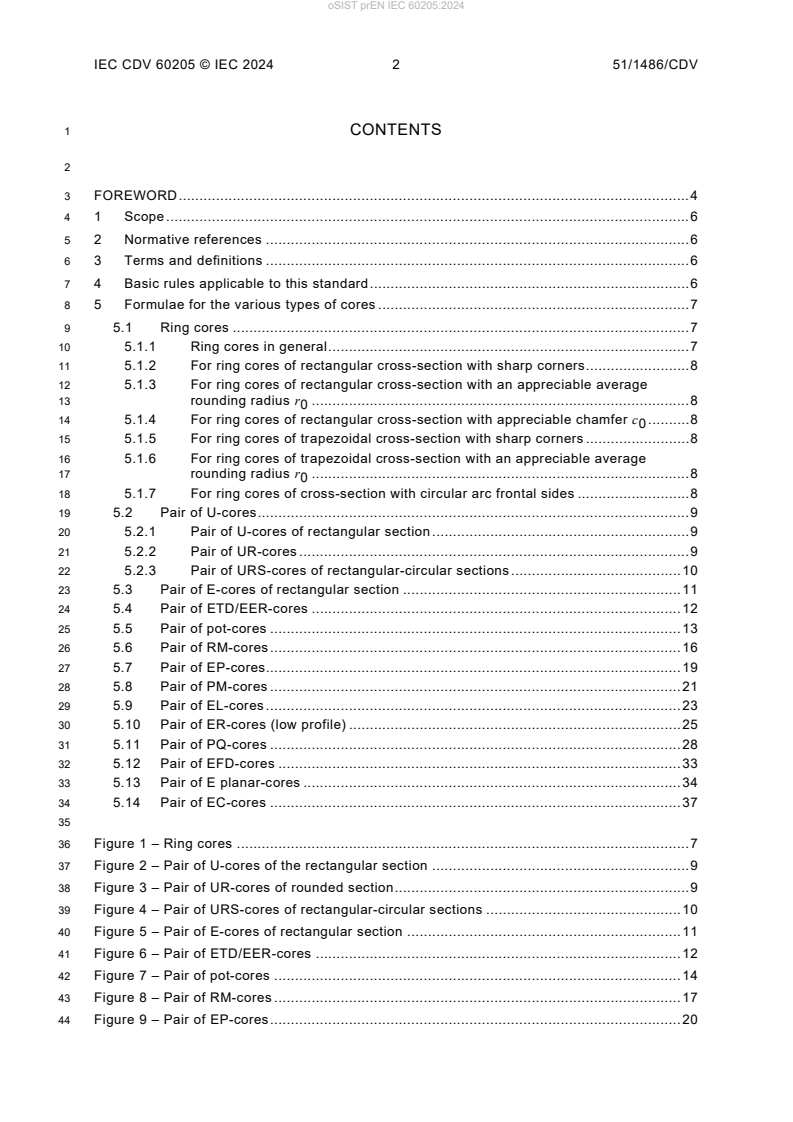
1 CONTENTS
3 FOREWORD . 4
4 1 Scope . 6
5 2 Normative references . 6
6 3 Terms and definitions . 6
7 4 Basic rules applicable to this standard . 6
8 5 Formulae for the various types of cores . 7
9 5.1 Ring cores . 7
10 5.1.1 Ring cores in general . 7
11 5.1.2 For ring cores of rectangular cross-section with sharp corners . 8
12 5.1.3 For ring cores of rectangular cross-section with an appreciable average
13 rounding radius r . 8
14 5.1.4 For ring cores of rectangular cross-section with appreciable chamfer c . 8
15 5.1.5 For ring cores of trapezoidal cross-section with sharp corners . 8
16 5.1.6 For ring cores of trapezoidal cross-section with an appreciable average
17 rounding radius r . 8
18 5.1.7 For ring cores of cross-section with circular arc frontal sides . 8
19 5.2 Pair of U-cores . 9
20 5.2.1 Pair of U-cores of rectangular section . 9
21 5.2.2 Pair of UR-cores . 9
22 5.2.3 Pair of URS-cores of rectangular-circular sections . 10
23 5.3 Pair of E-cores of rectangular section . 11
24 5.4 Pair of ETD/EER-cores . 12
25 5.5 Pair of pot-cores . 13
26 5.6 Pair of RM-cores . 16
27 5.7 Pair of EP-cores. 19
28 5.8 Pair of PM-cores . 21
29 5.9 Pair of EL-cores . 23
30 5.10 Pair of ER-cores (low profile) . 25
31 5.11 Pair of PQ-cores . 28
32 5.12 Pair of EFD-cores . 33
33 5.13 Pair of E planar-cores . 34
34 5.14 Pair of EC-cores . 37
36 Figure 1 – Ring cores . 7
37 Figure 2 – Pair of U-cores of the rectangular section . 9
38 Figure 3 – Pair of UR-cores of rounded section . 9
39 Figure 4 – Pair of URS-cores of rectangular-circular sections . 10
40 Figure 5 – Pair of E-cores of rectangular section . 11
41 Figure 6 – Pair of ETD/EER-cores . 12
42 Figure 7 – Pair of pot-cores . 14
43 Figure 8 – Pair of RM-cores . 17
44 Figure 9 – Pair of EP-cores . 20
51/1486/CDV 3 IEC CDV 60205 © IEC 2024
45 Figure 10 – Pair of PM-cores . 21
46 Figure 11 – Pair of EL-cores . 23
47 Figure 12 – PLT(plate)-cores . 23
48 Figure 13 – Pair of ER-cores (low profile) . 26
49 Figure 14 – PLT(plate)-cores . 26
50 Figure 15 – Pair of PQ-cores . 29
51 Figure 16 – PQ-cores . 30
52 Figure 17 – PLT(plate)-cores . 30
53 Figure 18 – Pair of EFD-cores . 33
54 Figure 19 – Pair of E planar-cores . 35
55 Figure 20 – PLT(plate)-cores . 35
56 Figure 21 – Pair of EC-cores . 37
IEC CDV 60205 © IEC 2024 4 51/1486/CDV
59 INTERNATIONAL ELECTROTECHNICAL COMMISSION
60 ____________
62 CALCULATION OF THE EFFECTIVE PARAMETERS
63 OF MAGNETIC PIECE PARTS
65 FOREWORD
66 1) The International Electrotechnical Commission (IEC) is a worldwide organization for standardization comprising
67 all national electrotechnical committees (IEC National Committees). The object of IEC is to promote
68 international co-operation on all questions concerning standardization in the electrical and electronic fields. To
69 this end and in addition to other activities, IEC publishes International Standards, Technical Specifications,
70 Technical Reports, Publicly Available Specifications (PAS) and Guides (hereafter referred to as “IEC
71 Publication(s)”). Their preparation is entrusted to technical committees; any IEC National Committee interested
72 in the subject dealt with may participate in this preparatory work. International, governmental and non-
73 governmental organizations liaising with the IEC also participate in this preparation. IEC collaborates closely
74 with the International Organization for Standardization (ISO) in accordance with conditions determined by
75 agreement between the two organizations.
76 2) The formal decisions or agreements of IEC on technical matters express, as nearly as possible, an international
77 consensus of opinion on the relevant subjects since each technical committee has representation from all
78 interested IEC National Committees.
79 3) IEC Publications have the form of recommendations for international use and are accepted by IEC National
80 Committees in that sense. While all reasonable efforts are made to ensure that the technical content of IEC
81 Publications is accurate, IEC cannot be held responsible for the way in which they are used or for any
82 misinterpretation by any end user.
83 4) In order to promote international uniformity, IEC National Committees undertake to apply IEC Publications
84 transparently to the maximum extent possible in their national and regional publications. Any divergence
85 between any IEC Publication and the corresponding national or regional publication shall be clearly indicated in
86 the latter.
87 5) IEC itself does not provide any attestation of conformity. Independent certification bodies provide conformity
88 assessment services and, in some areas, access to IEC marks of conformity. IEC is not responsible for any
89 services carried out by independent certification bodies.
90 6) All users should ensure that they have the latest edition of this publication.
91 7) No liability shall attach to IEC or its directors, employees, servants or agents including individual experts and
92 members of its technical committees and IEC National Committees for any personal injury, property damage or
93 other damage of any nature whatsoever, whether direct or indirect, or for costs (including legal fees) and
94 expenses arising out of the publication, use of, or reliance upon, this IEC Publication or any other IEC
95 Publications.
96 8) Attention is drawn to the Normative references cited in this publication. Use of the referenced publications is
97 indispensable for the correct application of this publication.
98 9) IEC draws attention to the possibility that the implementation of this document may involve the use of a patent.
99 IEC takes no position concerning the evidence, validity or applicability of any claimed patent rights in respect
100 thereof. As of the date of publication of this document, IEC had not received notice of a patent, which may be
101 required to implement this document. However, implementers are cautioned that this may not represent the
102 latest information, which may be obtained from the patent database available at https://patents.iec.ch and/or
103 www.iso.org/patents. IEC shall not be held responsible for identifying any or all such patent rights.
104 International Standard IEC 60205 has been prepared by IEC technical committee 51:
105 Magnetic components, ferrite and magnetic powder materials.
106 This fifth edition cancels and replaces the fourth edition published in 2016. This edition
107 constitutes a technical revision.
108 This edition includes the following significant technical changes with respect to the previous
109 edition:
110 a) addition, in 5.2.3, of the drawing and the formulae of pair of URS-cores of rectangular-
111 circular section;
51/1486/CDV 5 IEC CDV 60205 © IEC 2024
112 b) using, in 5.9, 5.10, 5.11 and 5.13, of the conventional calculation formula that includes " B1-D " is
113 limited for the x-x cores (x is EL, ER, PQ or E) and addition new formulae for x-PLT cores that
114 replaces " B -D " with "(B -D+B )/2";
1 1 2
115 c) addition, in 5.9, 5.10, 5.11 and 5.13, of formulae of l1 and l3 for x-PLT cores (x is EL, ER,
116 PQ or E) which is different from the l and l of x-x cores;
1 3
117 d) addition of formula A in each subclause from 5.2.1 to 5.14.
min
119 The text of this standard is based on the following documents:
FDIS Report on voting
51/xxxx/FDIS 51/xxxx/RVD
121 Full information on the voting for its approval can be found in the report on voting indicated in
122 the above table.
123 The language used for the development of this International Standard is English.
124 This document was drafted in accordance with ISO/IEC Directives, Part 2, and developed in
125 accordance with ISO/IEC Directives, Part 1 and ISO/IEC Directives, IEC Supplement,
126 available at www.iec.ch/members_experts/refdocs. The main document types developed by
127 IEC are described in greater detail at www.iec.ch/publications.
129 The committee has decided that the contents of this document will remain unchanged until the
130 stability date indicated on the IEC website under "webstore.iec.ch" in the data related to the
131 specific document. At this date, the document will be
132 • reconfirmed,
133 • withdrawn,
134 • replaced by a revised edition, or
135 • amended.
136 The contents of the corrigendum of July 2018 have been included in this copy.
IEC CDV 60205 © IEC 2024 6 51/1486/CDV
138 CALCULATION OF THE EFFECTIVE PARAMETERS
139 OF MAGNETIC PIECE PARTS
143 1 Scope
144 This document specifies uniform rules for the calculation of the effective parameters of closed
145 circuits of ferromagnetic material.
146 2 Normative references
147 There are no normative references in this document.
148 3 Terms and definitions
149 No terms and definitions are listed in this document.
150 ISO and IEC maintain terminological databases for use in standardization at the following
151 addresses:
152 • IEC Electropedia: available at http://www.electropedia.org/
153 • ISO Online browsing platform: available at http://www.iso.org/obp
154 4 Basic rules applicable to this standard
155 4.1 All results shall be expressed in units based on millimetres, shall be accurate to three
156 significant figures, but to derive l , A and V the values of C and C shall be calculated to
e e e 1 2
157 five significant figures. All angles are in radians.
158 NOTE The purpose of specifying this degree of accuracy is only to ensure that parameters calculated at different
159 establishments are identical and it is not intended to imply that the parameters are capable of being determined to
160 this accuracy.
161 4.2 A is the nominal value of the smallest cross-section. A is the geometrical cross-
min g
162 section of a ring core with rectangular shape. All the dimensions used to calculate A shall
min
163 be the mean values between the tolerance limits quoted on the appropriate piece part drawing.
164 All results shall be expressed in units based on millimetres and shall be accurate to three
165 significant figures.
166 NOTE A to be used for the measurement of the saturation flux density B on ring cores with rectangular cross-
g max
167 section.
168 4.3 Calculations are only applicable to the component parts of a closed magnetic circuit.
169 4.4 All dimensions used for the purpose of calculations shall be the mean value within the
170 tolerance limits quoted on the appropriate piece part drawing.
171 4.5 All irregularities in the outline of the core, such as small cut-outs, notches, chamfers,
172 etc. shall be ignored unless otherwise described.
51/1486/CDV 7 IEC CDV 60205 © IEC 2024
173 4.6 When the calculation involves the sharp corner of a piece part, then the mean length of
174 flux path for that corner shall be taken as the mean circular path joining the centres of area of
175 the two adjacent uniform sections, and the cross-sectional area associated with that length
176 shall be taken as the average area of the two adjacent uniform sections.
177 Calculation of effective parameters l , A and V .
e e e
178 The effective parameters can be defined as
2 3 2
179 l = C /C A = C / C V = l A = C / C
e 1 2 e 1 2 e e e 1 2
180 where
181 l is the effective magnetic length of the core (mm);
e
182 A is the effective cross-sectional area (mm );
e
183 V is the effective volume (mm );
e
−1
184 C is the core constant (mm );
−3
185 C is the core constant (mm ).
186 5 Formulae for the various types of cores
187 5.1 Ring cores
188 5.1.1 Ring cores in general
189 Drawings of ring cores are shown in Figure 1.
X
α
β
c0
r
r
4×
4×
r
ϕ
h
X h h h
X-X X-X X-X X-X
IEC
191 Figure 1 – Ring cores
2π
192 C =
h ln(d / d )
e 1 2
4π(1/ d − 1/ d )
2 1
193 C =
2 3
h ln (d / d )
e 1 2
d /2
d /2
c
d /2
d /2
IEC CDV 60205 © IEC 2024 8 51/1486/CDV
194 5.1.2 For ring cores of rectangular cross-section with sharp corners
195 h = h
e
196 The geometrical cross-section of a ring core with rectangular shape A is given as:
g
d − d
2 1
A = h
g
198 5.1.3 For ring cores of rectangular cross-section with an appreciable average
199 rounding radius r
200 h = h(1− k )
e 1
202 5.1.4 For ring cores of rectangular cross-section with appreciable chamfer c
4c
203 h = h(1− k ) k =
e 3 3
h(d − d )
1 2
204 The geometrical cross-section of a ring core with appreciable chamfer shape A is given as:
g
d − d
2 1 2
A = h − 2c
g 0
206 5.1.5 For ring cores of trapezoidal cross-section with sharp corners
( )
h tanα + tan β
207 h = h(1− k ) k =
e 2 2
d − d
1 2
208 5.1.6 For ring cores of trapezoidal cross-section with an appreciable average
209 rounding radius r
h = h(1− k − k )
e 1 2
211 5.1.7 For ring cores of cross-section with circular arc frontal sides
d − d ϕ sinϕ ϕ
1 2
h = h − 2sin − −
e
2 2 2
4 sin (ϕ / 2)
d − d
1 2
ϕ = 2arcsin
4r
213 .
214 When the winding is uniformly distributed over a ring core, it may be expected that, at all
215 points inside the ring core, the flux lines will be parallel to its surface.
216 No leakage flux will therefore leave or enter the ring core. This justifies the use of a
217 theoretically more correct derivation of the effective parameters, which does not make use of
218 the assumption that the flux is uniformly distributed over the cross-section.
51/1486/CDV 9 IEC CDV 60205 © IEC 2024
219 5.2 Pair of U-cores
220 5.2.1 Pair of U-cores
...