

prEN IEC 62446-1:2025
(Main)Photovoltaic (PV) systems - Requirements for testing, documentation and maintenance - Part 1: Grid connected systems - Documentation, commissioning tests and inspection
- Status
- Not Published
- Publication Date
- 06-Sep-2026
- Technical Committee
- CLC/TC 82 - Solar photovoltaic energy systems
- Current Stage
- 4060 - Enquiry results established and sent to TC, SR, BTTF - Enquiry
- Start Date
- 20-Jun-2025
- Completion Date
- 20-Jun-2025

Overview
prEN IEC 62446-1:2025 is the Committee Draft for Vote (CDV) of the revised standard for photovoltaic (PV) systems addressing documentation, commissioning tests and inspection for grid connected systems. Published under IEC TC 82, this Part 1 of the IEC 62446 series defines requirements for testing, documentation and maintenance activities required to verify safe, compliant and performant grid-tied PV installations. Note: as a CDV, the document is under review and subject to change.
Key topics and requirements
The standard sets out technical requirements and test procedures to support consistent verification and handover of PV systems. Major topics include:
- System documentation requirements: mandatory content such as basic system data, supplier/designer/installer information, wiring diagrams, string layout, AC system and earthing details, equipment manuals and grid connection information.
- Verification and inspection: guidance on initial (commissioning) and periodic verification, inspection checklists, safety considerations and required verification documentation.
- Testing regimes:
- Category 1 tests (fundamental commissioning checks) - continuity, polarity, string open-circuit voltage/current, combiner box tests, insulation resistance and functional tests.
- Category 2 tests (advanced diagnostics) - IV curve measurements, module/array defect identification and infrared (IR) camera inspection.
- Additional tests - wet insulation tests, blocking diode checks, voltage-to-ground on resistive systems, grid interface tests (external protection relays, export limiting, smart grid features).
- Protection and safety: DC and AC protection against electric shock, overcurrent, lightning/overvoltage, earthing/bonding and labelling requirements.
- Model reports and forms: informative annexes include model verification certificates, inspection and PV array test reports, IV curve interpretation guidance and supplementary tests.
Practical applications and users
prEN IEC 62446-1:2025 is practical for:
- PV system designers and installers preparing compliant project documentation and commissioning plans.
- Commissioning engineers and test technicians performing on-site PV system verification, IV curve-tests, IR inspections and insulation resistance testing.
- Operations & maintenance (O&M) teams conducting periodic inspections and condition-based testing.
- Asset owners, grid operators and inspection bodies seeking standardized evidence of safe grid connection and ongoing performance.
- Regulators and certification bodies assessing compliance with PV commissioning and inspection practices.
Related standards
- IEC 62446 family (Part 1 is for grid-connected systems) and other IEC TC 82 publications on PV system safety and performance. The CDV references normative and informative annexes to harmonize testing, reporting and safety practices.
Keywords: prEN IEC 62446-1:2025, photovoltaic (PV) systems, grid connected systems, commissioning tests, documentation, inspection, PV system verification, IV curve, insulation resistance, infrared inspection.
Relations
- Effective Date
- 14-Apr-2025
- Effective Date
- 14-Apr-2025
Get Certified
Connect with accredited certification bodies for this standard

DNV
DNV is an independent assurance and risk management provider.

Lloyd's Register
Lloyd's Register is a global professional services organisation specialising in engineering and technology.
DNV Energy Systems
Energy and renewable energy certification.
Sponsored listings
Frequently Asked Questions
prEN IEC 62446-1:2025 is a draft published by CLC. Its full title is "Photovoltaic (PV) systems - Requirements for testing, documentation and maintenance - Part 1: Grid connected systems - Documentation, commissioning tests and inspection". This standard covers: Photovoltaic (PV) systems - Requirements for testing, documentation and maintenance - Part 1: Grid connected systems - Documentation, commissioning tests and inspection
Photovoltaic (PV) systems - Requirements for testing, documentation and maintenance - Part 1: Grid connected systems - Documentation, commissioning tests and inspection
prEN IEC 62446-1:2025 is classified under the following ICS (International Classification for Standards) categories: 27.160 - Solar energy engineering. The ICS classification helps identify the subject area and facilitates finding related standards.
prEN IEC 62446-1:2025 has the following relationships with other standards: It is inter standard links to EN 62446-1:2016, EN 62446-1:2016/A1:2018. Understanding these relationships helps ensure you are using the most current and applicable version of the standard.
prEN IEC 62446-1:2025 is available in PDF format for immediate download after purchase. The document can be added to your cart and obtained through the secure checkout process. Digital delivery ensures instant access to the complete standard document.
Standards Content (Sample)
SLOVENSKI STANDARD
01-junij-2025
Fotonapetostni sistemi – Zahteve za preskušanje, dokumentiranje in vzdrževanje –
1. del: Sistemi, priključeni na omrežje – Dokumentacija, prevzemni preskusi in
nadzor
Photovoltaic (PV) systems - Requirements for testing, documentation and maintenance -
Part 1: Grid connected systems - Documentation, commissioning tests and inspection
Ta slovenski standard je istoveten z: prEN IEC 62446-1:2025
ICS:
27.160 Sončna energija Solar energy engineering
2003-01.Slovenski inštitut za standardizacijo. Razmnoževanje celote ali delov tega standarda ni dovoljeno.
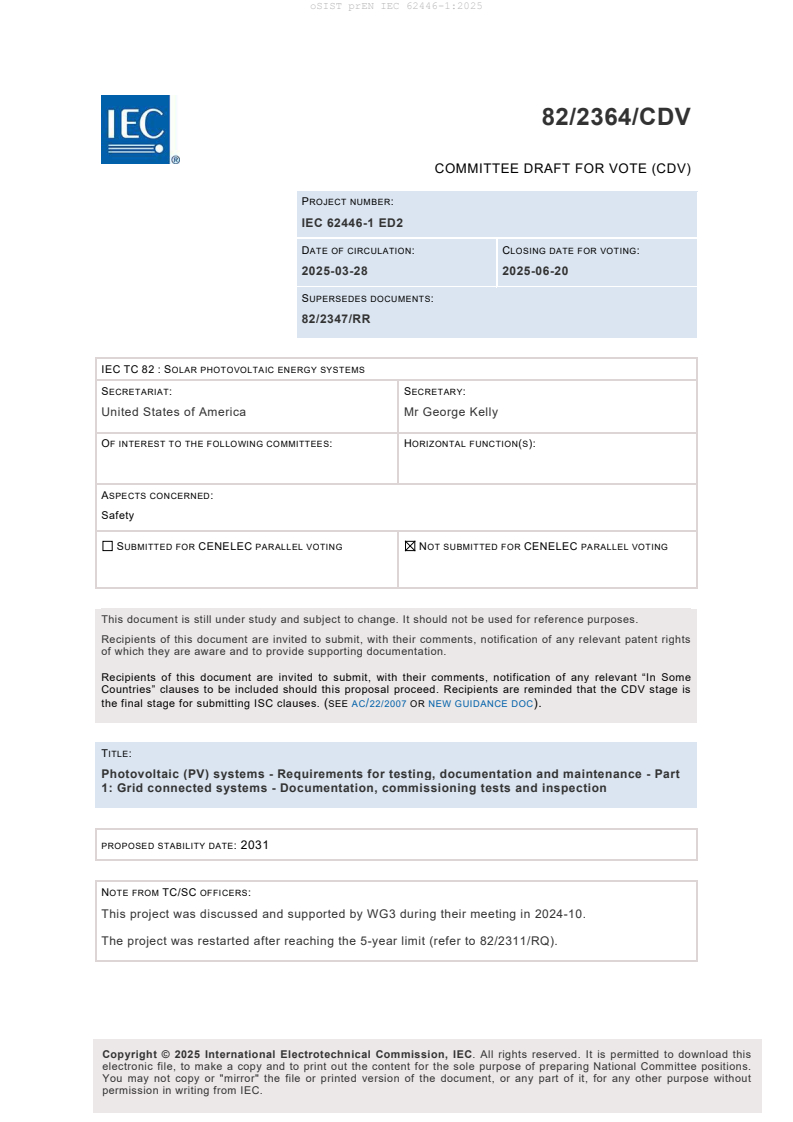
82/2364/CDV
COMMITTEE DRAFT FOR VOTE (CDV)
PROJECT NUMBER:
IEC 62446-1 ED2
DATE OF CIRCULATION: CLOSING DATE FOR VOTING:
2025-03-28 2025-06-20
SUPERSEDES DOCUMENTS:
82/2347/RR
IEC TC 82 : SOLAR PHOTOVOLTAIC ENERGY SYSTEMS
SECRETARIAT: SECRETARY:
United States of America Mr George Kelly
OF INTEREST TO THE FOLLOWING COMMITTEES: HORIZONTAL FUNCTION(S):
ASPECTS CONCERNED:
Safety
SUBMITTED FOR CENELEC PARALLEL VOTING NOT SUBMITTED FOR CENELEC PARALLEL VOTING
This document is still under study and subject to change. It should not be used for reference purposes.
Recipients of this document are invited to submit, with their comments, notification of any relevant patent rights
of which they are aware and to provide supporting documentation.
Recipients of this document are invited to submit, with their comments, notification of any relevant “In Some
Countries” clauses to be included should this proposal proceed. Recipients are reminded that the CDV stage is
the final stage for submitting ISC clauses. (SEE AC/22/2007 OR NEW GUIDANCE DOC).
TITLE:
Photovoltaic (PV) systems - Requirements for testing, documentation and maintenance - Part
1: Grid connected systems - Documentation, commissioning tests and inspection
PROPOSED STABILITY DATE: 2031
NOTE FROM TC/SC OFFICERS:
This project was discussed and supported by WG3 during their meeting in 2024-10.
The project was restarted after reaching the 5-year limit (refer to 82/2311/RQ).
electronic file, to make a copy and to print out the content for the sole purpose of preparing National Committee positions.
You may not copy or "mirror" the file or printed version of the document, or any part of it, for any other purpose without
permission in writing from IEC.
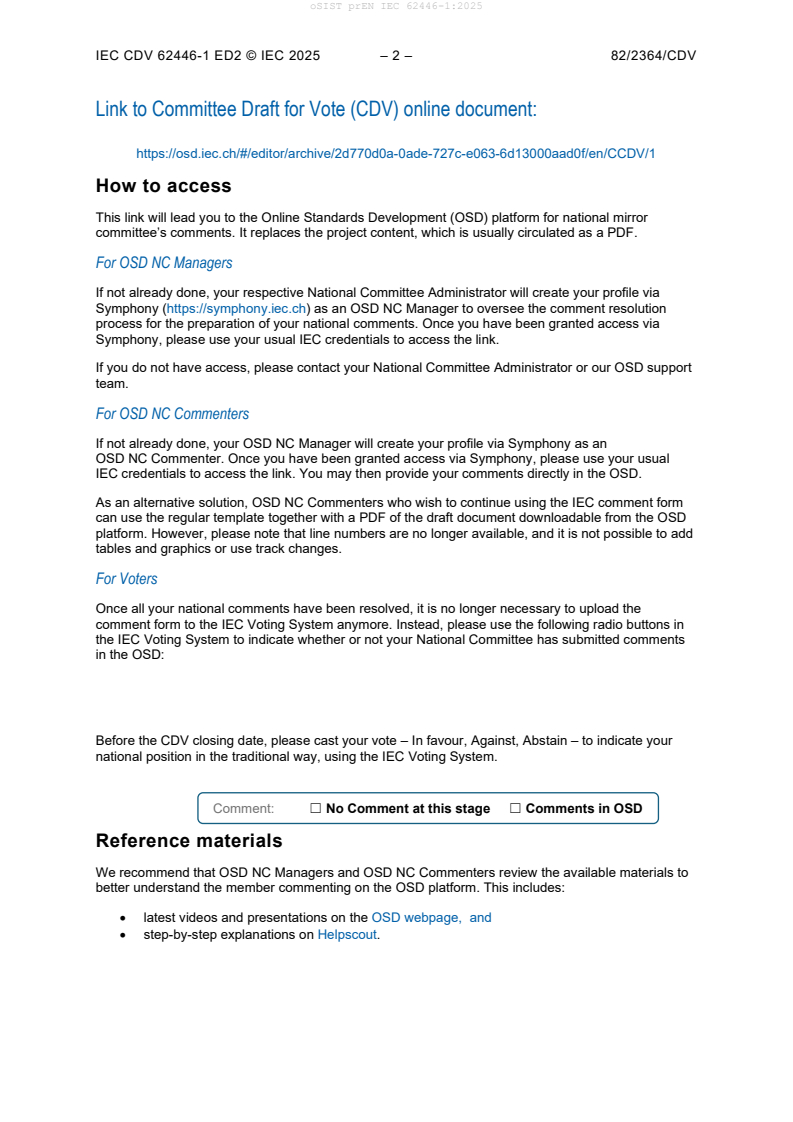
IEC CDV 62446-1 ED2 © IEC 2025 – 2 – 82/2364/CDV
Link to Committee Draft for Vote (CDV) online document:
https://osd.iec.ch/#/editor/archive/2d770d0a-0ade-727c-e063-6d13000aad0f/en/CCDV/1
How to access
This link will lead you to the Online Standards Development (OSD) platform for national mirror
committee’s comments. It replaces the project content, which is usually circulated as a PDF.
For OSD NC Managers
If not already done, your respective National Committee Administrator will create your profile via
Symphony (https://symphony.iec.ch) as an OSD NC Manager to oversee the comment resolution
process for the preparation of your national comments. Once you have been granted access via
Symphony, please use your usual IEC credentials to access the link.
If you do not have access, please contact your National Committee Administrator or our OSD support
team.
For OSD NC Commenters
If not already done, your OSD NC Manager will create your profile via Symphony as an
OSD NC Commenter. Once you have been granted access via Symphony, please use your usual
IEC credentials to access the link. You may then provide your comments directly in the OSD.
As an alternative solution, OSD NC Commenters who wish to continue using the IEC comment form
can use the regular template together with a PDF of the draft document downloadable from the OSD
platform. However, please note that line numbers are no longer available, and it is not possible to add
tables and graphics or use track changes.
For Voters
Once all your national comments have been resolved, it is no longer necessary to upload the
comment form to the IEC Voting System anymore. Instead, please use the following radio buttons in
the IEC Voting System to indicate whether or not your National Committee has submitted comments
in the OSD:
Before the CDV closing date, please cast your vote – In favour, Against, Abstain – to indicate your
national position in the traditional way, using the IEC Voting System.
Comment: ☐ No Comment at this stage ☐ Comments in OSD
Reference materials
We recommend that OSD NC Managers and OSD NC Commenters review the available materials to
better understand the member commenting on the OSD platform. This includes:
• latest videos and presentations on the OSD webpage, and
• step-by-step explanations on Helpscout.
IEC CDV 62446-1 ED2 © IEC 2025 – 3 – 82/2364/CDV
How to download PDF file
This link will lead you to the Online Standards Development (OSD) platform where you may download
the PDF file by following the steps shown below.
How to receive the Word file
Should your national mirror committee wish to receive the Word file for translation purposes only,
please contact our OSD support at osd_support@iec.ch.
Translation integration mechanisms for OSD documents are still being studied for development. The
solution above is a temporary measure.
Contact
Should you require any assistance, please contact the OSD project team at osd_support@iec.ch.
IEC CDV 62446-1 ED2 © IEC 2025 – 1 – 82/2364/CDV
CONTENTS
FOREWORD . 4
INTRODUCTION . 6
1 Scope . 7
2 Normative references . 7
3 Terms, definitions and symbols . 8
4 System documentation requirements . 11
4.1 General . 11
4.2 System Information . 11
4.2.1 Basic system information . 11
4.2.2 System supplier information . 11
4.2.3 System designer information . 11
4.2.4 Codes and standards . 11
4.2.5 System installer information . 12
4.3 Wiring diagram . 12
4.3.1 General . 12
4.3.2 Array - General specifications . 12
4.3.3 PV string information . 12
4.3.4 PV array electrical details . 12
4.4 String layout . 13
4.5 AC system . 13
4.6 Earthing and overvoltage protection . 13
4.7 Anti-PID systems . 13
4.8 Batteries . 13
4.9 Cable routing and controlled areas by shutdown measures . 14
4.10 Structural design information . 14
4.11 Equipment documentation . 14
4.12 System performance information . 14
4.13 Operation and maintenance information . 15
4.14 Grid connection information . 15
5 Verification . 15
5.1 General . 15
5.2 Safety considerations . 16
5.3 Verification documentation . 16
5.3.1 General . 16
5.3.2 Initial verification (commissioning) . 16
5.3.3 Periodic verification . 17
5.4 Inspection . 17
5.4.1 General . 17
5.4.2 DC system - General . 17
5.4.3 DC system - Protection against electric shock . 17
5.4.4 DC system - Protection against the effects of insulation faults . 18
5.4.5 DC system - Protection against overcurrent . 18
5.4.6 DC system - Earthing and bonding arrangements . 18
IEC CDV 62446-1 ED2 © IEC 2025 – 2 – 82/2364/CDV
5.4.7 DC system - Protection against the effects of lightning and overvoltage
5.4.8 DC system - Selection and erection of electrical equipment . 19
5.4.9 Ancillary and safety systems . 19
5.4.10 AC system . 20
5.4.11 Structural elements . 20
5.4.12 Labelling and identification . 20
5.5 Testing . 21
5.5.1 General . 21
5.5.2 Test regimes and additional tests . 21
5.5.3 Test regimes for systems incorporating a HSA . 21
5.5.4 Test regimes for systems with module level electronics . 21
5.5.5 Category 1 test regime - All systems . 22
5.5.6 Category 2 test regime . 23
5.5.7 Additional tests . 23
5.5.8 Periodic test procedures . 23
6 Test procedures - Category 1 . 24
6.1 Continuity of protective earthing and equipotential bonding conductors . 24
6.2 Polarity test . 24
6.3 PV string combiner box test . 24
6.4 PV string - Open circuit voltage measurement . 25
6.5 PV string - Current measurement test . 25
6.5.1 General . 25
6.5.2 Evaluating results . 26
6.5.3 PV string - Short circuit test . 26
6.5.4 PV string - Operational test . 27
6.6 Functional tests . 27
6.7 PV array insulation resistance test . 28
6.7.1 General . 28
6.7.2 Insulation resistance - pass/fail criteria. 28
6.7.3 Insulation resistance - test configuration . 28
6.7.4 Earth connection test point . 28
6.7.5 Safety considerations . 29
6.7.6 Circuit considerations . 29
6.7.7 Insulation resistance - String test method . 29
6.7.8 Insulation resistance - combined strings method . 30
6.7.9 Insulation resistance - shorted strings method . 30
6.8 PV array insulation monitoring - functionality test . 30
6.8.1 General . 30
6.8.2 Test procedure . 30
6.9 Protective equipment - self-test functionality test . 31
7 Test procedures - Category 2 . 31
7.1 General . 31
7.2 String IV curve measurement. 31
7.2.1 General . 31
7.2.2 IV curve measurement - Identification of module / array defects or
shading issues . 31
7.3 PV array infrared camera inspection procedure . 32
IEC CDV 62446-1 ED2 © IEC 2025 – 3 – 82/2364/CDV
7.3.1 General . 32
7.3.2 IR test procedure . 32
7.3.3 Interpreting IR test results . 33
8 Test procedures - Additional tests . 33
8.1 Voltage to ground - Resistive ground systems . 33
8.2 Blocking diode test . 33
8.3 PV array - Wet insulation resistance test . 33
8.3.1 General . 33
8.3.2 Wet insulation test procedure . 34
8.4 Shade evaluation . 34
8.5 Grid interface tests . 35
8.5.1 General . 35
8.5.2 External protection relays . 35
8.5.3 Export limiting systems. 35
8.5.4 Smart grid features . 35
Annex A (informative) Model verification certificate . 36
Annex B (informative) Model inspection report . 38
Annex C (informative) Model PV array test report . 41
Annex D (informative) Interpreting IV curve shapes . 42
D.1 General . 42
D.2 Variation 1 - Steps or notches in curve . 42
D.3 Variation 2 - Low current . 43
D.4 Variation 3 - Low voltage . 43
D.5 Variation 4 - Rounder knee . 44
D.6 Variation 5 - Shallower slope in vertical leg . 44
D.7 Variation 6 - Steeper slope in horizontal leg . 44
Annex E (informative) Model IV curve diagnosis report . 46
Annex F (informative) Supplementary tests . 47
Annex G (normative) Safety considerations . 48
G.1 Qualified persons . 48
G.2 General safety considerations . 48
G.3 Personal protective equipment (PPE) . 49
G.4 Isolation procedures . 49
G.5 Lock-out tag-out . 49
G.6 PV specific signs and labelling . 50
Bibliography . 51
Figure 1 – Example sun-path diagram . 34
Figure D.1 – IV curve shapes . 42
Table 1 – Minimum values of insulation resistance . 28
Table A.1 – . 36
IEC CDV 62446-1 ED2 © IEC 2025 – 4 – 82/2364/CDV
INTERNATIONAL ELECTROTECHNICAL COMMISSION
____________
Photovoltaic (PV) systems - Requirements for testing, documentation and
maintenance - Part 1: Grid connected systems - Documentation,
commissioning tests and inspection –
FOREWORD
1) The International Electrotechnical Commission (IEC) is a worldwide organization for
standardization comprising all national electrotechnical committees (IEC National
Committees). The object of IEC is to promote international co-operation on all questions
concerning standardization in the electrical and electronic fields. To this end and in addition to
other activities, IEC publishes International Standards, Technical Specifications, Technical
Reports, Publicly Available Specifications (PAS) and Guides (hereafter referred to as "IEC
Publication(s)"). Their preparation is entrusted to technical committees; any IEC National
Committee interested in the subject dealt with may participate in this preparatory work.
International, governmental and non-governmental organizations liaising with the IEC also
participate in this preparation. IEC collaborates closely with the International Organization for
Standardization (ISO) in accordance with conditions determined by agreement
between the two organizations.
2) The formal decisions or agreements of IEC on technical matters express, as nearly as
possible, an international consensus of opinion on the relevant subjects since each technical
committee has representation from all interested IEC National Committees.
3) IEC Publications have the form of recommendations for international use and are accepted
by IEC National Committees in that sense. While all reasonable efforts are made to ensure that
the technical content of IEC Publications is accurate, IEC cannot be held responsible for the
way in which they are used or for any misinterpretation by any end user.
4) In order to promote international uniformity, IEC National Committees undertake to apply
IEC Publications transparently to the maximum extent possible in their national and regional
publications. Any divergence between any IEC Publication and the corresponding national or
regional publication shall be clearly indicated in the latter.
5) IEC itself does not provide any attestation of conformity. Independent certification bodies
provide conformity assessment services and, in some areas, access to IEC marks of
conformity. IEC is not responsible for any services carried out by independent certification
bodies.
6) All users should ensure that they have the latest edition of this publication.
7) No liability shall attach to IEC or its directors, employees, servants or agents including
individual experts and members of its technical committees and IEC National Committees for
any personal injury, property damage or other damage of any nature whatsoever, whether
direct or indirect, or for costs (including legal fees) and expenses arising out of the publication,
use of, or reliance upon, this IEC Publication or any other IEC Publications.
8) Attention is drawn to the Normative references cited in this publication. Use of the referenced
publications is indispensable for the correct application of this publication.
9) IEC draws attention to the possibility that the implementation of this document may involve
the use of (a) patent(s). IEC takes no position concerning the evidence, validity or applicability
of any claimed patent rights in respect thereof. As of the date of publication of this document,
IEC [had/had not] received notice of (a) patent(s), which may be required to implement this
document. However, implementers are cautioned that this may not represent the latest
IEC CDV 62446-1 ED2 © IEC 2025 – 5 – 82/2364/CDV
information, which may be obtained from the patent database available at
https://patents.iec.ch. IEC shall not be held responsible for identifying any or all such patent
rights.
IEC 62446-1 has been prepared by IEC technical committee 82: Solar photovoltaic energy
systems. It is an International Standard.
This second edition cancels and replaces the first edition, published in 2016, and its
Amendment 1:2018. This edition constitutes a technical revision.
This edition includes the following significant technical changes with respect to the previous
edition:
a) .;
The text of this International Standard is based on the following documents:
Draft Report on voting
XX/XX/FDIS XX/XX/RVD
Full information on the voting for its approval can be found in the report on voting indicated in
the above table.
The language used for the development of this International Standard is English.
This document was drafted in accordance with ISO/IEC Directives, Part 2, and developed in
accordance with ISO/IEC Directives, Part 1 and ISO/IEC Directives, IEC Supplement, available
at www.iec.ch/members_experts/refdocs. The main document types developed by IEC are
described in greater detail at www.iec.ch/publications.
A list of all parts in the IEC 62446 series, published under the general title Photovoltaic (PV)
systems - Requirements for testing, documentation and maintenance, can be found on the IEC
website.
The committee has decided that the contents of this document will remain unchanged until the
stability date indicated on the IEC website under webstore.iec.ch in the data related to the
specific document. At this date, the document will be
– reconfirmed,
– withdrawn, or
– revised.
IEC CDV 62446-1 ED2 © IEC 2025 – 6 – 82/2364/CDV
INTRODUCTION
Grid-connected PV systems are expected to have a lifetime of decades, with maintenance or
modifications likely at some point over this period. The ownership of a system may also change
over time, particularly for systems mounted on buildings. Only by the provision of adequate
documentation at the outset can the long-term performance and safety of the PV system and
works, on or adjacent to the PV system, be ensured.
This document is split into two:
– System documentation requirements (Clause 4) - These clauses detail the information
provided to the customer following installation of a grid-connected PV system.
– Verification (Clause 5, Clause 6, Clause 7 and Clause 8) - These clauses provide the
information expected to be provided following initial (or periodic) verification of an installed
system. It includes requirements for inspection and testing.
IEC CDV 62446-1 ED2 © IEC 2025 – 7 – 82/2364/CDV
Photovoltaic (PV) systems - Requirements for testing, documentation and
maintenance - Part 1: Grid connected systems - Documentation,
commissioning tests and inspection –
1 Scope
This part of IEC 62446 defines the information and documentation required to be handed over
to a customer following the installation of a grid-connected PV system. It also describes the
commissioning tests, inspection criteria and documentation expected to verify the safe
installation and correct operation of the system. It can also be used for periodic retesting.
This document is for use by system designers and installers of grid-connected solar PV systems
as a template to provide effective documentation to a customer. By detailing the expected
commissioning tests and inspection criteria, it is also intended to assist in the
verification/inspection of a grid-connected PV system after installation and for subsequent re-
inspection, maintenance or modifications.
This document defines the different test regimes expected for different solar PV system types
to ensure that the test regime applied is appropriate to the scale, type and complexity of the
system in question.
Throughout this document, there are various requirements highlighted from the "Applicable
Installation Standard" (AIS). Where a local AIS does not have the specific requirement detailed
in this document, then the requirement from IEC 62548-1 shall be used.
Documentation, test and inspection requirements for systems incorporating a DC coupled
battery are included in the scope of this document.
NOTE 1 Batteries may also be AC coupled to a PV system, but as such are considered out of the scope of this
document.
Detailed system performance validation is not within the scope of this document.
NOTE 2 IEC 61724 series should be consulted for PV system performance validation
This document does not address off-grid systems, or concentrating PV systems, however many
of the parts may apply.
NOTE 3 IEC TS 62257-100 provides an overview of the 62257 series, which cover off-grid renewable energy and
hybrid products and systems.
2 Normative references
The following documents are referred to in the text in such a way that some or all of their
content constitutes requirements of this document. For dated references, only the edition cited
applies. For undated references, the latest edition of the referenced document (including any
amendments) applies.
IEC 60364 (all parts), Low-voltage electrical installations
IEC 60364-4-41, Low-voltage electrical installations - Part 4-41: Protection for safety -
Protection against electric shock
IEC 60364-5-52, Low-voltage electrical installations - Part 5-52: Selection and erection of
electrical equipment - Wiring systems
IEC 60364-6, Low voltage electrical installations - Part 6: Verification
IEC 60891, Photovoltaic devices - Procedures for temperature and irradiance corrections to
measured I-V characteristics
IEC CDV 62446-1 ED2 © IEC 2025 – 8 – 82/2364/CDV
IEC 61010 (all parts), Safety requirements for electrical equipment for measurement, control,
and laboratory use
IEC 61215-1, Terrestrial photovoltaic (PV) modules - Design qualification and type approval -
Part 1: Test requirements
IEC 61557 (all parts), Electrical safety in low voltage distribution systems up to 1 000 V a.c.
and 1 500 V d.c. - Equipment for testing, measuring or monitoring of protective measures
IEC 61724-1, Photovoltaic system performance - Part 1: Monitoring
IEC 61730 (all parts), Photovoltaic (PV) module safety qualification
IEC 61730-1, Photovoltaic (PV) module safety qualification - Part 1: Requirements for
construction
IEC TS 61836, Solar photovoltaic energy systems - Terms, definitions and symbols
IEC TS 62446-3, Photovoltaic (PV) systems - requirements for testing, documentation and
maintenance - Part 3 - Photovoltaic modules and plants - Outdoor infrared thermography
IEC 62548, Photovoltaic (PV) arrays - Design requirements
IEC 62933-5-2, Electrical energy storage (EES) systems - Part 5-2: Safety requirements for
grid-integrated EES systems - Electrochemical-based systems
3 Terms, definitions and symbols
For the purposes of this document, the terms and definitions given in IEC TS 61836 and the
following apply.
ISO and IEC maintain terminology databases for use in standardization at the following
addresses:
– IEC Electropedia: available at https://www.electropedia.org/
– ISO Online browsing platform: available at https://www.iso.org/obp
3.1
AC module
PV module with an integrated inverter in which the electrical terminals are AC only
3.2
Applicable Installation Standard (AIS)
relevant installation standard for the PV system that applies in that region/country (for example:
IEC 62548, IEC 60364-7-712)
3.3
bifacial PV module
device where both surfaces (front and back sides) of the PV module are used for electricity
generation
3.4
cable type
description of a cable to enable its rating and suitability for a particular use or environment to
be determined
3.5
data sheet
basic product description and specification
Note 1 to entry: Typically one or two pages. Not a full product manual.
IEC CDV 62446-1 ED2 © IEC 2025 – 9 – 82/2364/CDV
3.6
inspection
examination of an electrical installation in order to ascertain correct selection and proper
erection of electrical equipment
3.7
grid code
regulations defining the voltage, frequency and other parameters / functionality an inverter (or
other generator) must implement in order to connect to the electricity grid at that location
3.8
inverter
electric energy converter that changes direct electric current to single-phase or polyphase
alternating current
3.9
DC current rating adjustment factor, K
I
factor dependent on site PV module type and installation properties such as module orientation,
module shading or module rear side irradiance
Note 1 to entry: See the AIS for calculation of k
I.
3.10
Micro-inverter
small inverter designed to be connected directly to the PV module leads, or integrated into the
PV module.
3.11
module level electronics
any electronic device fitted to a PV module intended to provide control, monitoring or power
conversion functions
Note 1 to entry: Module-integrated electronics may be factory fitted or assembled on site.
Note 2 to entry: A micro-inverter may sometimes also be a module-integrated electronic device.
3.12
potential induced degradation
(Abbreviation: PID)
performance degradation in some types of photovoltaic modules influenced by environmental
factors such as humidity and temperature
Note 1 to entry: Some module technologies require "anti-PID" measures to be implemented to prevent permanent
damage, for example, a bias voltage applied at certain times of the day.
Note 2 to entry: IEC 62548-1 Annex H provide examples of anti-PID system configurations
3.13
PV array
assembly of electrically interconnected PV modules, PV strings or PV sub-arrays
3.14
PV cell
most elementary device within a PV module that exhibits the photovoltaic effect, i.e the direct
non-thermal conversion of radiant energy into electrical energy
3.15
PV module
smallest complete environmentally protected assembly of interconnected PV cells
3.16
PV string
circuit of one or more series-connected PV modules
IEC CDV 62446-1 ED2 © IEC 2025 – 10 – 82/2364/CDV
3.17
PV string combiner box
junction box where PV strings are connected, which may also contain items including:
overcurrent protection devices, electronics and switch-disconnectors
3.18
PV sub-array
electrical subset of a PV array formed of parallel connected PV strings
3.19
PV sub-array combiner box
junction box where PV sub-arrays are connected, which may contain items including:
overcurrent protection devices, electronics and switch-disconnectors
3.20
I
MOD_MAX_OCPR
PV module maximum overcurrent protection rating determined by the test described in IEC
61730-2 [1]
Note 1 to entry: This is sometimes specified by module manufacturers as the maximum series fuse rating.
3.21
reports
recording of the results of inspection and testing
3.22
testing
implementation of measures in an electrical installation by means of which its effectiveness is
proved
Note 1 to entry: It includes ascertaining values by means of appropriate measuring instruments, said values not
being detectable by inspection.
3.23
verification
all measures by means of which compliance of the electrical installation to the relevant
standards is checked
Note 1 to entry: It comprises inspection, testing and report.
3.24
string wiring harness
prefabricated cable assembly that aggregates the output of multiple PV string conductors along
a single main cable
Note 1 to entry: The harness may or may not include fusing on the individual string conductors. The wiring harness
typically does not include a disconnect device in line.
Note 2 to entry: An IEC standard for string wiring harnesses is under development.
3.25
harness sub-array
HSA
group of PV strings connected in parallel using a string wiring harness. In the context of this
document, a HSA shall have a combined I of no greater than 30 A and combine no more
SC-STC
than 10 PV strings
3.26
module level monitoring
MLM
device or equipment used at module level to monitor at least voltage at module level
Note 1 to entry: Micro-inverter and DC-DC converters can include such functions
IEC CDV 62446-1 ED2 © IEC 2025 – 11 – 82/2364/CDV
3.27
shutdown equipment
equipment that provides DC isolation or disconnection functions for all or sections of the PV
array
Note 1 to entry: Shutdown equipment may operate by manual local control or via remote control (for example
operating in the case of a fault or upon AC isolation).
Note 2 to entry: In some countries automatically operating shutdown equipment is described as "rapid shutdown"
equipment for emergency services.
4 System documentation requirements
4.1 General
The purpose of Clause 4 is to list the minimum documentation that shall be provided following
the installation of a grid-connected PV system. This information will ensure key system data is
readily available to a customer, inspector or maintenance engineer. The documentation
includes basic system data and the information expected to be provided in the operation and
maintenance manual.
4.2 System Information
4.2.1 Basic system information
As a minimum, the following basic system information shall be provided. This "nameplate"
information would typically be presented on the cover page of the system documentation pack.
a) Project identification reference (where applicable);
b) Rated (nameplate) system power (kW DC and kVA AC);
c) PV modules and inverters - manufacturer, model and quantity;
d) Installation date;
e) Customer name;
f) Site address.
Where systems use bifacial modules, this should be noted next to the PV module information.
This shall also include an instruction to refer to the module data sheet for information on
parameter increase due to bifacial gain.
4.2.2 System supplier information
As a minimum, the following information shall be provided for the company supplying the PV
system (the company selling the system to the customer).
a) Supplier, company;
b) Supplier, contact person;
c) Supplier, postal address, telephone number and e-mail address.
4.2.3 System designer information
As a minimum, the following information shall be provided for all bodies responsible for the
design of the system. Where more than one company has responsibility for the design of the
system, the following information should be provided for all companies together with a
description of their role in the project.
a) System designer, company;
b) System designer, contact person;
c) System designer, postal address, telephone number and e-mail address.
4.2.4 Codes and standards
A list of the codes, applicable regulations and standard(s) to which the system has been
designed shall be provided. This information shall include the document number, title and year
of issue.
IEC CDV 62446-1 ED2 © IEC 2025 – 12 – 82/2364/CDV
NOTE This is intended to capture the main standards used in the system design, not individual products.
4.2.5 System installer information
As a minimum, the following information shall be provided for all bodies responsible for the
installation of the system. Where more than one company has responsibility for the installation
of the system, the following information should be provided for all companies together with a
description of their role in the project.
a) System installer, company;
b) System installer, contact person;
c) System installer, postal address, telephone number and e-mail address.
4.3 Wiring diagram
4.3.1 General
As a minimum, a wiring diagram with single line presentation shall be provided. This diagram
shall be annotated to include the information detailed in 4.3.2 to 4.3.4.
In general, it is expected that this information will be presented as annotations to the single
line wiring diagram. In some circumstances, typically for larger systems where space on the
diagram may be limited, this information may be presented in table form.
4.3.2 Array - General specifications
The wiring diagram or system specification shall include the following array design information:
a) Module manufacturer and model;
b) Total number of modules;
c) The DC current rating adjustment factor, K , used in all sizing calculations;
I
d) General string configuration, including:
1) Number of modules per string. Where applicable, this should include clear identification
of strings of differing lengths;
2) Number of strings per inverter;
3) Identification of which strings connect to which inverter;
4) Identification of any inverter with differing number of strings;
e) Where a system includes module-level electronics (e.g. DC-DC converters):
1) Manufacturer and model;
2) Connection to PV modules;
f) Inverter manufacturer and model;
g) Total number of inverters;
h) Where an array is split into sub-arrays, the wiring diagram shall show the array - sub-array
design and include all of the above information for each sub-array.
4.3.3 PV string information
The wiring diagram or system specification shall include the following PV string information.
a) PV string cable specifications - size and type / ratings;
b) PV string overcurrent protective device specifications (where installed) - type and
voltage/current ratings;
c) Blocking diode type (if relevant).
4.3.4 PV array electrical details
The wiring diagram or system specification shall include the following array / sub-array,
electrical information (where applicable).
IEC CDV 62446-1 ED2 © IEC 2025 – 13 – 82/2364/CDV
a) PV string and PV sub-array combiner box - location;
b) PV array cable specifications - size and type / ratings;
c) DC switch disconnector - location and rating;
d) Array overcurrent protective devices - type, location and rating;
e) Other array protective circuitry (such as arc fault detection or ground fault protection) - type,
location and rating;
f) Rating information shall include DC voltage and current ratings.
4.4 String layout
For systems with three or more strings, and optionally for smaller systems, a string layout
drawing of the PV system showing how the array is split and connected into strings shall be
provided. From the string layout, it shall be possible to trace modules in the array to their
respective string and inverter, and vice versa.
For large systems, a physical layout including the string layout and the location of inverters,
any major pieces of equipment, and key access concerns should be included.
NOTE This is particularly useful for finding faults in larger systems and on building mounted arrays where access
to the modules is difficult.
The identification of modules within strings can also be achieved by marking each module using
a unique reference, in accordance with IEC 81346.
4.5 AC system
The wiring diagram or system specification shall include the following AC system information.
a) AC isolator location, type and rating;
b) AC overcurrent protective device location, type and rating;
c) Residual current device location, type and rating (where applicable);
d) Transformer location, type and rating (where applicable);
e) Rating information shall include AC voltage and current ratings.
NOTE Typically, information contained in the wiring diagram / system specification would be up to the point of
connection to the AC electrical power network.
4.6 Earthing and overvoltage protection
The wiring diagram or system specification shall include the following earthing and overvoltage
protection information.
a) Details of all earth bonding conductors - size and type; Including details of array frame
equipotential bonding cables, where applicable;
b) Details of any connections to a Lightning Protection System (LPS);
c) Details of any surge protection device installed (on both AC and DC lines) - location, type
and rating.
4.7 Anti-PID systems
The type, location and rating of anti-PID systems shall be documented, where applicable.
Operating information shall also be provided, including:
a) The times of the day the system i
...