

EN IEC 62618:2024
(Main)Radiation protection instrumentation - Spectroscopy-based alarming personal radiation detectors (SPRD) for the detection of illicit trafficking of radioactive material
General Information
- Abstract
This document applies to Spectroscopy-based alarming Personal Radiation Detectors (SPRD). SPRDs detect and identify gamma radiation and may detect neutron radiation. SPRDs can be worn on a belt or in a pocket to alert the wearer of the presence of a radiation source. SPRDs provide search, similar to that of a Personal Radiation Device (PRD), and identification capability to identify radiation sources. They can discriminate between alarms caused by Naturally Occurring Radioactive Materials (NORM) or medical radionuclides and alarms from industrial sources or Special Nuclear Material (SNM).
- Status
- Published
- Publication Date
- 01-Feb-2024
- Technical Committee
- CLC/TC 45B - Radiation protection instrumentation
- Current Stage
- 6060 - Document made available - Publishing
- Start Date
- 02-Feb-2024
- Due Date
- 05-Jan-2026
- Completion Date
- 02-Feb-2024

Overview
EN IEC 62618:2024 (CLC / CENELEC adoption of IEC 62618:2022) defines requirements and test methods for Spectroscopy-based Alarming Personal Radiation Detectors (SPRD) used to detect and identify radioactive material in the context of illicit trafficking. SPRDs are compact, wearable detectors (belt or pocket) that combine search capability similar to a Personal Radiation Device (PRD) with onboard spectroscopy to identify gamma-emitting radionuclides and optionally detect neutrons. The standard is part of the radiation protection instrumentation family and replaces EN 62618:2016.
Key topics and technical requirements
- Detection & identification performance
- Gamma alarm and personal-protection alarm behavior, including criteria for radionuclide identification (single and simultaneous sources).
- False alarm rate limits and procedures for test analysis.
- Requirements for detection of gradually increasing radiation fields and over-range behavior.
- Optional neutron detection performance and gamma response of any neutron sensor.
- Test procedures and environmental conditions
- Standard test setups, background handling, statistical uncertainty considerations and speed/scaling of moving sources.
- Environmental requirements: ambient temperature, temperature shock, humidity, dust/moisture protection.
- Mechanical and electromagnetic robustness
- Vibration, drop, microphonics/impact and electromagnetic compatibility (ESD, RF immunity, emissions, magnetic fields).
- User interface, data and marking
- Required user indications, alarm signaling, data output formats and documentation (operation/maintenance manual, test certificate, declaration of conformity).
- Quality and conformity
- Test acceptance ranges, documentation of test results and conformity evidence for procurement and certification.
Practical applications and users
- Front-line detection of illicit trafficking of radioactive materials at:
- Customs and border control
- Ports, airports and checkpoints
- Law enforcement and first responders
- Nuclear security and port/transport security teams
- Users also include: instrument manufacturers, independent test laboratories, procurement officers specifying SPRD performance, and radiation protection specialists integrating SPRDs into detection architectures.
- SPRDs are used where a lightweight, wearable detector that can both search and provide on-the-spot radionuclide ID is required to discriminate NORM and medical sources from industrial or Special Nuclear Material (SNM).
Related standards
- IEC 62755 (data format for illicit trafficking detectors)
- IEC/TR 62971 (guidance on radiation sources used in trafficking detection)
- IEC 60068 series (environmental testing)
- Other referenced IEC standards for EMC, performance and safety
For procurement, certification or operational integration, consult the full EN IEC 62618:2024 text and associated normative references to ensure compliance with the specified test methods and acceptance criteria.
Relations
- Effective Date
- 25-Apr-2023
- Effective Date
- 10-Feb-2026
- Effective Date
- 10-Feb-2026
- Effective Date
- 10-Feb-2026
- Refers
EN IEC 60079-11:2024 - Explosive atmospheres - Part 11: Equipment protection by intrinsic safety "i" - Effective Date
- 03-Feb-2026
Get Certified
Connect with accredited certification bodies for this standard

CIS Institut d.o.o.
Personal Protective Equipment (PPE) certification body. Notified Body NB-2890 for EU Regulation 2016/425 PPE.

Kiwa BDA Testing
Building and construction product certification.
Kmetijski inštitut Slovenije
Agricultural Institute of Slovenia. Soil testing, plant health, agricultural product analysis.
Sponsored listings
Frequently Asked Questions
EN IEC 62618:2024 is a standard published by CLC. Its full title is "Radiation protection instrumentation - Spectroscopy-based alarming personal radiation detectors (SPRD) for the detection of illicit trafficking of radioactive material". This standard covers: This document applies to Spectroscopy-based alarming Personal Radiation Detectors (SPRD). SPRDs detect and identify gamma radiation and may detect neutron radiation. SPRDs can be worn on a belt or in a pocket to alert the wearer of the presence of a radiation source. SPRDs provide search, similar to that of a Personal Radiation Device (PRD), and identification capability to identify radiation sources. They can discriminate between alarms caused by Naturally Occurring Radioactive Materials (NORM) or medical radionuclides and alarms from industrial sources or Special Nuclear Material (SNM).
This document applies to Spectroscopy-based alarming Personal Radiation Detectors (SPRD). SPRDs detect and identify gamma radiation and may detect neutron radiation. SPRDs can be worn on a belt or in a pocket to alert the wearer of the presence of a radiation source. SPRDs provide search, similar to that of a Personal Radiation Device (PRD), and identification capability to identify radiation sources. They can discriminate between alarms caused by Naturally Occurring Radioactive Materials (NORM) or medical radionuclides and alarms from industrial sources or Special Nuclear Material (SNM).
EN IEC 62618:2024 is classified under the following ICS (International Classification for Standards) categories: 13.280 - Radiation protection. The ICS classification helps identify the subject area and facilitates finding related standards.
EN IEC 62618:2024 has the following relationships with other standards: It is inter standard links to EN 62618:2016, IEC 62706:2012, IEC 62755:2012, IEC 60050-395:2014, EN IEC 60079-11:2024. Understanding these relationships helps ensure you are using the most current and applicable version of the standard.
EN IEC 62618:2024 is available in PDF format for immediate download after purchase. The document can be added to your cart and obtained through the secure checkout process. Digital delivery ensures instant access to the complete standard document.
Standards Content (Sample)
SLOVENSKI STANDARD
01-maj-2024
Instrumenti za zaščito pred sevanjem - Spektroskopski alarmni osebni detektorji
sevanja za odkrivanje nedovoljenega prometa z radioaktivnimi snovmi (IEC
62618:2022)
Radiation protection instrumentation - Spectroscopy-based alarming personal radiation
detectors (SPRD) for the detection of illicit trafficking of radioactive material (IEC
62618:2022)
Strahlenschutz-Messgeräte - Spektroskopie-basierte alarmgebende persönliche
Strahlungsdetektoren für den Nachweis von unerlaubt transportiertem radioaktivem
Material (IEC 62618:2022)
Instrumentation pour la radioprotection - Détecteurs individuels spectroscopiques
d'alarme aux rayonnements (SPRD) pour la détection du trafic illicite des matières
radioactives (IEC 62618:2022)
Ta slovenski standard je istoveten z: EN IEC 62618:2024
ICS:
13.280 Varstvo pred sevanjem Radiation protection
13.320 Alarmni in opozorilni sistemi Alarm and warning systems
2003-01.Slovenski inštitut za standardizacijo. Razmnoževanje celote ali delov tega standarda ni dovoljeno.
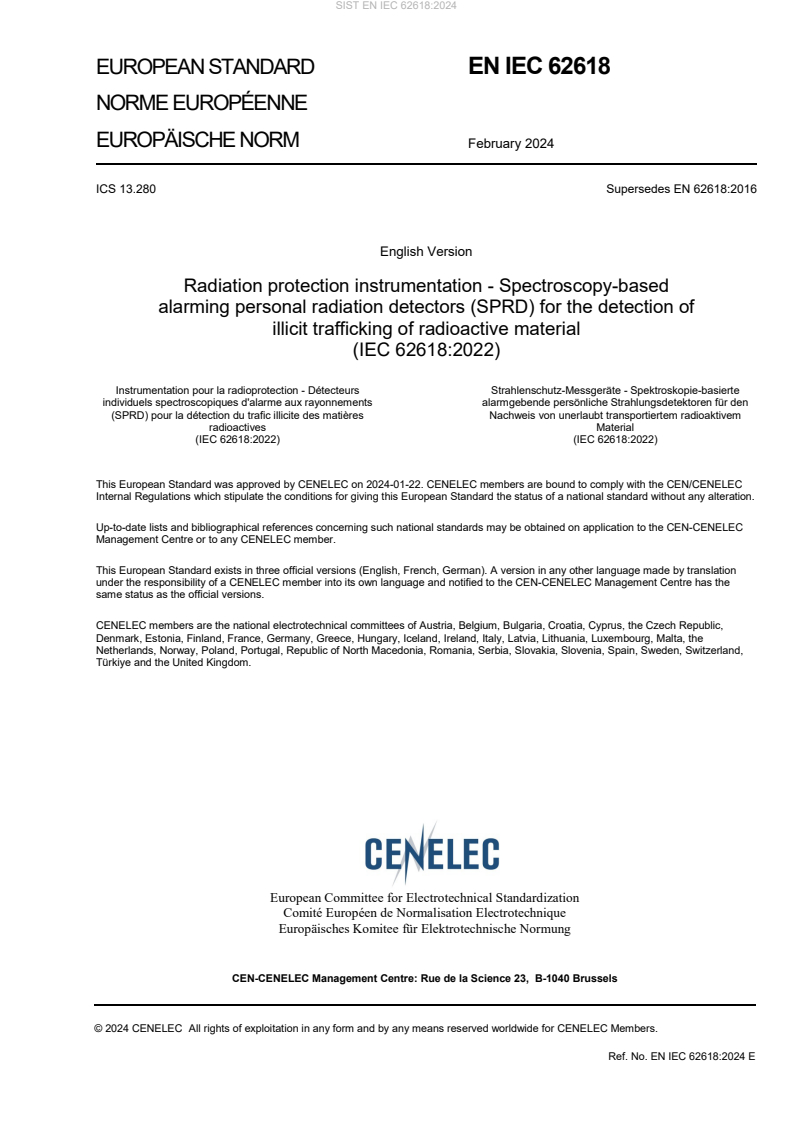
EUROPEAN STANDARD EN IEC 62618
NORME EUROPÉENNE
EUROPÄISCHE NORM February 2024
ICS 13.280 Supersedes EN 62618:2016
English Version
Radiation protection instrumentation - Spectroscopy-based
alarming personal radiation detectors (SPRD) for the detection of
illicit trafficking of radioactive material
(IEC 62618:2022)
Instrumentation pour la radioprotection - Détecteurs Strahlenschutz-Messgeräte - Spektroskopie-basierte
individuels spectroscopiques d'alarme aux rayonnements alarmgebende persönliche Strahlungsdetektoren für den
(SPRD) pour la détection du trafic illicite des matières Nachweis von unerlaubt transportiertem radioaktivem
radioactives Material
(IEC 62618:2022) (IEC 62618:2022)
This European Standard was approved by CENELEC on 2024-01-22. CENELEC members are bound to comply with the CEN/CENELEC
Internal Regulations which stipulate the conditions for giving this European Standard the status of a national standard without any alteration.
Up-to-date lists and bibliographical references concerning such national standards may be obtained on application to the CEN-CENELEC
Management Centre or to any CENELEC member.
This European Standard exists in three official versions (English, French, German). A version in any other language made by translation
under the responsibility of a CENELEC member into its own language and notified to the CEN-CENELEC Management Centre has the
same status as the official versions.
CENELEC members are the national electrotechnical committees of Austria, Belgium, Bulgaria, Croatia, Cyprus, the Czech Republic,
Denmark, Estonia, Finland, France, Germany, Greece, Hungary, Iceland, Ireland, Italy, Latvia, Lithuania, Luxembourg, Malta, the
Netherlands, Norway, Poland, Portugal, Republic of North Macedonia, Romania, Serbia, Slovakia, Slovenia, Spain, Sweden, Switzerland,
Türkiye and the United Kingdom.
European Committee for Electrotechnical Standardization
Comité Européen de Normalisation Electrotechnique
Europäisches Komitee für Elektrotechnische Normung
CEN-CENELEC Management Centre: Rue de la Science 23, B-1040 Brussels
© 2024 CENELEC All rights of exploitation in any form and by any means reserved worldwide for CENELEC Members.
Ref. No. EN IEC 62618:2024 E
European foreword
This document (EN IEC 62618:2024) consists of the text of IEC 62618:2022 prepared by IEC/SC 45B
“Radiation protection instrumentation” of IEC/TC 45 "Nuclear instrumentation".
The following dates are fixed:
• latest date by which this document has to be (dop) 2025-01-22
implemented at national level by publication of
an identical national standard or by
endorsement
• latest date by which the national standards (dow) 2027-01-22
conflicting with this document have to be
withdrawn
This document supersedes EN 62618:2016 and all of its amendments and corrigenda (if any).
Attention is drawn to the possibility that some of the elements of this document may be the subject of
patent rights. CENELEC shall not be held responsible for identifying any or all such patent rights.
Any feedback and questions on this document should be directed to the users’ national committee. A
complete listing of these bodies can be found on the CENELEC website.
Endorsement notice
The text of the International Standard IEC 62618:2022 was approved by CENELEC as a European
Standard without any modification.
In the official version, for Bibliography, the following notes have to be added for the standard indicated:
IEC 60068-2-11 NOTE Approved as EN IEC 60068-2-11
IEC 60846-1 NOTE Approved as EN 60846-1
IEC 61526 NOTE Approved as EN 61526
IEC 62244 NOTE Approved as EN IEC 62244
IEC 62327 NOTE Approved as EN IEC 62327
IEC 62401 NOTE Approved as EN IEC 62401
IEC 62484 NOTE Approved as EN IEC 62484
IEC 62533 NOTE Approved as EN 62533
IEC 62534 NOTE Approved as EN 62534
IEC 62694 NOTE Approved as EN 62694
IEC 63121 NOTE Approved as EN IEC 63121
Annex ZA
(normative)
Normative references to international publications
with their corresponding European publications
The following documents are referred to in the text in such a way that some or all of their content
constitutes requirements of this document. For dated references, only the edition cited applies. For
undated references, the latest edition of the referenced document (including any amendments) applies.
NOTE 1 Where an International Publication has been modified by common modifications, indicated by (mod), the
relevant EN/HD applies.
NOTE 2 Up-to-date information on the latest versions of the European Standards listed in this annex is available
here: www.cencenelec.eu.
Publication Year Title EN/HD Year
IEC 60050-395 2014 International Electrotechnical Vocabulary - - -
Part 395: Nuclear instrumentation: Physical
phenomena, basic concepts, instruments,
systems, equipment and detectors
+ A1 2016 - -
+ A2 2020 - -
IEC 60079-11 - Explosive atmospheres - Part 11: Equipment - -
protection by intrinsic safety "i"
IEC 62706 - Radiation protection instrumentation - - -
Environmental, electromagnetic and
mechanical performance requirements
IEC 62755 - Radiation protection instrumentation - Data - -
format for radiation instruments used in the
detection of illicit trafficking of radioactive
materials
IEC/TR 62971 2015 Radiation instrumentation - Radiation sources - -
used in illicit trafficking detection standards -
Guidance and recommendations
UL 913 - Standard for Intrinsically Safe Apparatus and - -
Associated Apparatus for Use in Class I, II, III,
Division 1, Hazardous (Classified) Locations
ICRU report 39 - Determination of Dose Equivalents Resulting - -
from External Radiation Sources
ICRU report 47 - Measurement of Dose Equivalents from - -
External Photon and Electron Radiations
IEC 62618 ®
Edition 2.0 2022-11
INTERNATIONAL
STANDARD
NORME
INTERNATIONALE
Radiation protection instrumentation – Spectroscopy-based alarming personal
radiation detectors (SPRD) for the detection of illicit trafficking of radioactive
material
Instrumentation pour la radioprotection – Détecteurs individuels
spectroscopiques d'alarme aux rayonnements (SPRD) pour la détection du trafic
illicite de matières radioactives
INTERNATIONAL
ELECTROTECHNICAL
COMMISSION
COMMISSION
ELECTROTECHNIQUE
INTERNATIONALE
ICS 13.280 ISBN 978-2-8322-6050-0
– 2 – IEC 62618:2022 © IEC 2022
CONTENTS
FOREWORD . 4
INTRODUCTION . 6
1 Scope . 7
2 Normative references . 7
3 Terms and definitions, abbreviated terms and symbols, quantities and units . 8
3.1 Terms and definitions . 8
3.2 Abbreviated terms and symbols . 10
3.3 Quantities and units . 10
4 General test procedure . 11
4.1 Standard test conditions . 11
4.2 Uncertainties. 11
4.3 Statistical fluctuations . 11
4.4 Background radiation during testing . 12
4.5 Operating parameters and set up . 12
4.6 Radiation sources . 12
4.7 Special nuclear material (SNM) and depleted uranium (DU) sources . 12
4.8 Speed of moving sources including scaling . 12
4.9 Functionality test and test acceptance range requirements . 13
4.10 Neutron measurement requirements . 15
5 General requirements . 16
5.1 Basic information . 16
5.2 Mechanical characteristics . 16
5.3 Data output . 17
5.4 User indications . 17
5.5 Markings . 17
5.6 Alarms . 18
6 Radiation detection requirements . 18
6.1 False alarm rate . 18
6.2 Gamma alarm . 18
6.3 Personal protection alarm . 19
6.4 Relative intrinsic error . 19
6.5 Detection of gradually increasing radiation levels . 20
6.6 Over-range . 20
6.7 Detection of neutrons (if provided) . 20
6.8 Gamma response of neutron detector (if provided) . 21
6.9 Identification of single radionuclides . 22
6.10 Simultaneous radionuclide identification . 23
6.11 Low-exposure rate identification . 23
6.12 Over range characteristics for identification . 23
7 Environmental requirements . 24
7.1 Ambient temperature. 24
7.2 Temperature shock . 24
7.3 Relative humidity . 24
7.4 Dust and moisture protection . 25
8 Mechanical requirements . 25
8.1 Vibration . 25
IEC 62618:2022 © IEC 2022 – 3 –
8.2 Microphonics/Impact . 26
8.3 Drop . 26
9 Electromagnetic requirements . 26
9.1 Electrostatic discharge (ESD) . 26
9.2 Radio frequency (RF) . 27
9.3 Radiated RF emissions . 27
9.4 Magnetic fields . 27
10 Documentation . 28
10.1 Operation and maintenance manual . 28
10.2 Test certificate . 28
10.3 Declaration of conformity . 28
Bibliography . 29
Table 1 – Overview of IEC radiation protection instrumentation standards . 6
Table 2 – Standard test conditions . 11
Table 3 – Test results analysis . 15
Table 4 – Identification acceptance criteria . 22
– 4 – IEC 62618:2022 © IEC 2022
INTERNATIONAL ELECTROTECHNICAL COMMISSION
____________
RADIATION PROTECTION INSTRUMENTATION –
SPECTROSCOPY-BASED ALARMING PERSONAL
RADIATION DETECTORS (SPRD) FOR THE DETECTION
OF ILLICIT TRAFFICKING OF RADIOACTIVE MATERIAL
FOREWORD
1) The International Electrotechnical Commission (IEC) is a worldwide organization for standardization comprising
all national electrotechnical committees (IEC National Committees). The object of IEC is to promote international
co-operation on all questions concerning standardization in the electrical and electronic fields. To this end and
in addition to other activities, IEC publishes International Standards, Technical Specifications, Technical Reports,
Publicly Available Specifications (PAS) and Guides (hereafter referred to as “IEC Publication(s)”). Their
preparation is entrusted to technical committees; any IEC National Committee interested in the subject dealt with
may participate in this preparatory work. International, governmental and non-governmental organizations liaising
with the IEC also participate in this preparation. IEC collaborates closely with the International Organization for
Standardization (ISO) in accordance with conditions determined by agreement between the two organizations.
2) The formal decisions or agreements of IEC on technical matters express, as nearly as possible, an international
consensus of opinion on the relevant subjects since each technical committee has representation from all
interested IEC National Committees.
3) IEC Publications have the form of recommendations for international use and are accepted by IEC National
Committees in that sense. While all reasonable efforts are made to ensure that the technical content of IEC
Publications is accurate, IEC cannot be held responsible for the way in which they are used or for any
misinterpretation by any end user.
4) In order to promote international uniformity, IEC National Committees undertake to apply IEC Publications
transparently to the maximum extent possible in their national and regional publications. Any divergence between
any IEC Publication and the corresponding national or regional publication shall be clearly indicated in the latter.
5) IEC itself does not provide any attestation of conformity. Independent certification bodies provide conformity
assessment services and, in some areas, access to IEC marks of conformity. IEC is not responsible for any
services carried out by independent certification bodies.
6) All users should ensure that they have the latest edition of this publication.
7) No liability shall attach to IEC or its directors, employees, servants or agents including individual experts and
members of its technical committees and IEC National Committees for any personal injury, property damage or
other damage of any nature whatsoever, whether direct or indirect, or for costs (including legal fees) and
expenses arising out of the publication, use of, or reliance upon, this IEC Publication or any other IEC
Publications.
8) Attention is drawn to the Normative references cited in this publication. Use of the referenced publications is
indispensable for the correct application of this publication.
9) Attention is drawn to the possibility that some of the elements of this IEC Publication may be the subject of patent
rights. IEC shall not be held responsible for identifying any or all such patent rights.
IEC 62618 has been prepared by subcommittee 45B: Radiation protection instrumentation, of
IEC technical committee 45: Nuclear instrumentation. It is an International Standard.
This second edition cancels and replaces the first edition published in 2013. This edition
constitutes a technical revision.
This edition includes the following significant technical changes with respect to the previous
edition:
a) making the standard consistent with the new standards for detection of illicit trafficking of
radioactive material (see the Introduction);
b) creating unformed functionality test for all environmental, electromagnetic and mechanical
tests and a requirement for the coefficient of variation of each nominal mean reading;
c) reference to IEC 62706 for the environmental, electromagnetic and mechanical test
conditions;
d) adding information regarding climatic exposures.
IEC 62618:2022 © IEC 2022 – 5 –
The text of this International Standard is based on the following documents:
Draft Report on voting
45B/1011/FDIS 45B/1017/RVD
Full information on the voting for its approval can be found in the report on voting indicated in
the above table.
The language used for the development of this International Standard is English.
This document was drafted in accordance with ISO/IEC Directives, Part 2, and developed in
accordance with ISO/IEC Directives, Part 1 and ISO/IEC Directives, IEC Supplement, available
at www.iec.ch/members_experts/refdocs. The main document types developed by IEC are
described in greater detail at www.iec.ch/standardsdev/publications.
The committee has decided that the contents of this document will remain unchanged until the
stability date indicated on the IEC website under webstore.iec.ch in the data related to the
specific document. At this date, the document will be
• reconfirmed,
• withdrawn,
• replaced by a revised edition, or
• amended.
– 6 – IEC 62618:2022 © IEC 2022
INTRODUCTION
It is important to detect illicit and inadvertent movement of radioactive materials in the form of
radiation sources and contaminated metallurgical scrap. Radioactive sources out of regulatory
control, so-called “orphan sources”, have frequently caused serious radiation exposures and
widespread contamination. Although illicit trafficking of nuclear and other radioactive materials
is not a new problem, concern about a nuclear “black market” has increased particularly in view
of its terrorist potential.
In response to the technical policy of the International Atomic Energy Agency (IAEA), the World
Customs Organization (WCO), and the International Criminal Police Organization (Interpol)
related to the detection and identification of special nuclear materials and security trends,
nuclear instrumentation companies have developed and manufactured radiation
instrumentation to assist in the detection of illicit movement of radioactive and special nuclear
materials. This type of instrumentation is widely used for security purposes at nuclear facilities,
border control checkpoints, and international seaports and airports.
To ensure that measurement results made at different locations are consistent, it is imperative
that radiation instrumentation be designed to specifications based upon agreed performance
requirements. IEC standards have been developed to establish performance requirements for
personal radiation detectors, radiation portal monitors, highly sensitive gamma and neutron
detection systems, spectrometric personal radiation detectors, and backpack-based radiation
detection and identification systems. Table 1 contains a list of those standards.
Table 1 – Overview of IEC radiation protection instrumentation standards
Type of IEC
Title of the standard
instrumentation number
Radiation protection instrumentation – Alarming Personal Radiation Devices
(PRDs) for the detection of illicit trafficking of radioactive material
Radiation protection instrumentation – Spectroscopy-Based Alarming Personal
Body-worn 62618 Radiation Detectors (SPRD) for the detection of illicit trafficking of radioactive
material
Radiation protection instrumentation – Backpack-type radiation detector (BRD)
for the detection of illicit trafficking of radioactive material
Radiation protection instrumentation – Hand-held instruments for the detection
62327 and identification of radionuclides and for the estimation of ambient dose
equivalent rate from photon radiation
Portable or
Radiation protection instrumentation – Highly sensitive hand-held instruments
hand-held
for photon detection of radioactive material
Radiation protection instrumentation – Highly sensitive hand-held instruments
for neutron detection of radioactive material
Radiation protection instrumentation – Installed radiation portal monitors
(RPMs) for the detection of illicit trafficking of radioactive and nuclear materials
Portal
Radiation protection instrumentation – Spectrometric radiation portal monitors
62484 (SRPMs) used for the detection and identification of illicit trafficking of
radioactive material
Radiation protection instrumentation – Data format for radiation instruments
Data format 62755
used in the detection of illicit trafficking of radioactive materials
Radiation protection instrumentation – Vehicle-mounted mobile systems for the
Mobile system 63121
detection of illicit trafficking of radioactive materials
IEC 62618:2022 © IEC 2022 – 7 –
RADIATION PROTECTION INSTRUMENTATION –
SPECTROSCOPY-BASED ALARMING PERSONAL
RADIATION DETECTORS (SPRD) FOR THE DETECTION
OF ILLICIT TRAFFICKING OF RADIOACTIVE MATERIAL
1 Scope
This document applies to Spectroscopy-based alarming Personal Radiation Detectors (SPRD).
SPRDs detect and identify gamma radiation and may detect neutron radiation. SPRDs can be
worn on a belt or in a pocket to alert the wearer of the presence of a radiation source. SPRDs
provide search, similar to that of a Personal Radiation Device (PRD), and identification
capability to identify radiation sources. They can discriminate between alarms caused by
Naturally Occurring Radioactive Materials (NORM) or medical radionuclides and alarms from
industrial sources or Special Nuclear Material (SNM).
This document establishes performance requirements and specifies general characteristics,
general test conditions, radiological, climatic, mechanical, and electromagnetic characteristics.
This document also provides test methods that are used to determine if an SPRD meets the
stated requirements.
This document does not apply to the performance of radiation protection instrumentation which
is covered in IEC 61526 and IEC 60846-1. SPRDs are not intended for accurate measurement
of personal (H (10)) or ambient (H*(10)) dose equivalent (rate).
p
2 Normative references
The following documents are referred to in the text in such a way that some or all of their content
constitutes requirements of this document. For dated references, only the edition cited applies.
For undated references, the latest edition of the referenced document (including any
amendments) applies.
IEC 60050-395:2014, International Electrotechnical Vocabulary (IEV) – Part 395: Nuclear
instrumentation – Physical phenomena, basic concepts, instruments, systems, equipment and
detectors
IEC 60050-395:2014/AMD1:2016
IEC 60050-395:2014/AMD2:2020
IEC 60079-11, Explosive atmospheres – Part 11: Equipment protection by intrinsic safety "i"
IEC 62706, Radiation protection instrumentation – Recommended climatic, electromagnetic and
mechanical performance requirements and methods of tests
IEC 62755, Radiation protection instrumentation – Data format for radiation instruments used
in the detection of illicit trafficking of radioactive materials
IEC TR 62971:2015, Radiation instrumentation – Radiation sources used in illicit trafficking
detection standards – Guidance and recommendations
UL 913, Standard for Intrinsically Safe Apparatus and Associated Apparatus for Use in Class I,
II, III, Division 1, Hazardous (Classified) Locations
ICRU report 39, Determination of Dose Equivalents Resulting from External Radiation Sources
– 8 – IEC 62618:2022 © IEC 2022
ICRU report 47, Measurement of Dose Equivalents from External Photon and Electron
Radiations
3 Terms and definitions, abbreviated terms and symbols, quantities and units
3.1 Terms and definitions
For the purposes of this document, the terms and definitions given in IEC 60050-395, as well
as the following apply.
ISO and IEC maintain terminology databases for use in standardization at the following
addresses:
• IEC Electropedia: available at https://www.electropedia.org/
• ISO Online browsing platform: available at https://www.iso.org/obp
3.1.1
acceptable identification
correct identification
when an instrument correctly identifies only the radionuclides present
3.1.2
accuracy of measurement
closeness of the agreement between the result of a measurement and the conventionally true
value of the measurand
Note 1 to entry: “Accuracy” is a quantitative concept.
Note 2 to entry: The term precision should not be used for “accuracy”.
[SOURCE: IEC 60050-395:2014/AMD2:2020, 395-16-14]
3.1.3
alarm
audible, visual, or other signal activated when the instrument reading exceeds a pre-set value
or falls outside of a pre-set range
3.1.4
alarm criteria
condition that causes an instrument to alarm
3.1.5
background radiation level
radiation field in which there are no external radioactive sources present other than those in
the natural background at the location of the measurements
3.1.6
confidence indication
indication provided by the instrument to assess the reliability assigned to the validity of the
identification. For each identified radionuclide, the instrument indicates the likelihood of its
correct identification.
3.1.7
coefficient of variation
ratio of the standard deviation σ to the arithmetic mean x of a set of n measurements x given
i
by the following formula:
IEC 62618:2022 © IEC 2022 – 9 –
n
s 11
COV x− x
( )
∑ i
x xn−1
i=1
3.1.8
conventionally true value of a quantity
value attributed to a particular quantity and accepted, sometimes by convention, as having an
uncertainty appropriate for a given purpose
Note 1 to entry: "Conventionally true value of a quantity" is sometimes called assigned value, best estimate of the
value, conventional value or reference value.
Note 2 to entry: A conventionally true value is, in general, regarded as sufficiently close to the true value for the
difference to be insignificant for the given purpose. For example, a value determined from a primary or secondary
standard or by a reference instrument, may be taken as the conventionally true value.
3.1.9
false alarm
alarm not caused by an increase in radiation level over background conditions
3.1.10
functionality test
procedure to measure potential changes in the instrument response, such as drift in energy
calibration or sensitivity
3.1.11
influence quantity
quantity that is not the measurand but that affects the result of the measurement
Note 1 to entry: For example, temperature of a micrometer used to measure length.
3.1.12
precision
degree to which repeated measurements under unchanged conditions show the same result
(also called reproducibility or repeatability)
3.1.13
radioactive material
material containing one or more constituents exhibiting radioactivity
Note 1 to entry: For the purpose of this document, radioactive material includes special nuclear material.
3.1.14
reference point of an instrument
mark on the equipment at which the instrument is positioned for the purpose of calibration
Note 1 to entry: The point from which the distance to the source is measured.
Note 2 to entry: The reference point for calibration is also used as reference point for testing.
3.1.15
reference source
radioactive secondary standard source for use in calibration of the measuring instrument
Note 1 to entry: In this document, reference sources for calibration are used for testing.
3.1.16
relative intrinsic error
difference between the instrument’s reading, 𝑀𝑀, and the conventionally true value, 𝐶𝐶𝐶𝐶𝐶𝐶, of the
quantity being measured divided by the conventionally true value when subjected to a specified
reference quantity under specified reference conditions
= =
– 10 – IEC 62618:2022 © IEC 2022
M−CTV
ε =
REL
CTV
3.1.17
safety alarm
audible and visual signal for detection of high radiation levels, which requires immediate
radiation safety measures
3.1.18
source indication alarm
audible and/or visual signal to indicate the presence of a radiation source
3.1.19
standard test conditions
range of values of a set of influence quantities under which a test, calibration or measurement
of response is carried out
3.1.20
performance test
environmental, mechanical or electrical test taken from IEC 62706
[SOURCE: IEC 60050-395:2014/AMD2:2020, 395-14-9]
3.2 Abbreviated terms and symbols
CISPR Comité International Spécial des Perturbations Radioélectriques (Special
International Committee on Radio Interference)
CLYC Cs2LiYCl6:Ce
COV coefficient of variation
CZT cadmium zinc telluride
DU depleted uranium
ESD electrostatic discharge
HDPE highly-density polyethylene
HEU highly-enriched uranium
ICRU International commission on radiation units and measurements
NORM naturally occurring radioactive material
PMMA polymethyl methacrylate
RF radio frequency
SNM special nuclear material
SPRD spectroscopy based personal radiation detector
WGPu weapons-grade plutonium
3.3 Quantities and units
1.
In this document, units of the International System (SI) are used The definitions of radiation
quantities are given in IEC 60050-395.
___________
International Bureau of Weights and Measures: The International System of Units, 8th edition, 2006.
IEC 62618:2022 © IEC 2022 – 11 –
The following units may also be used:
−19
– for energy: electron-volt (symbol: eV), 1 eV = 1,602 × 10 J;
– for time: years (symbol: y), days (symbol: d), hours (symbol: h), minutes (symbol: min);
– for temperature: degrees Celsius (symbol: °C), 0 °C = 273,15 K.
Multiples and submultiples of SI units are used, when practicable, according to the SI system.
4 General test procedure
4.1 Standard test conditions
Except where otherwise specified, the tests described in this document should be performed
under the standard test conditions given in Table 2. The ambient temperature, relative humidity,
and atmospheric pressure shall be recorded during testing.
Table 2 – Standard test conditions
Influence quantity Standard test conditions
Ambient temperature 18 °C to 25 °C
Relative humidity ≤ 75 %
Atmospheric pressure 70 kPa to 103,3 kPa
−1
Ambient dose equivalent rate less than or equal to 0,15 μSv•h
Gamma radiation background
Natural conditions without the presence of man-made emitters
Neutron background Natural conditions without the presence of man-made emitters
NOTE SPRDs are typically used in non-radiological areas, e.g., shipping ports and border locations. Man-made
radiological materials such as radiation sources are not expected to be present in these areas. Non-radiological
areas are expected to be used when testing SPRDs.
4.2 Uncertainties
Unless otherwise stated for a specific quantity, the uncertainties for measurable quantities
should not exceed 15 % with a coverage factor of k = 1, except for background radiation
measurements that may exceed this value.
4.3 Statistical fluctuations
For tests involving the use of radioactive sources to verify susceptibility to a climatic,
electromagnetic, or mechanical condition (Clauses 7, 8, and 9), the radiation field produced by
the sources to verify an SPRD’s response shall be adjusted to reduce the magnitude of the
statistical fluctuations.
For measurements without sources (i.e., at the level of background radiation), the SPRD is
observed in order to verify that alarms and spurious indications are not produced by an influence
quantity (e.g., temperature, humidity, RF, impact, vibration), as readings are expected to display
large fluctuations.
– 12 – IEC 62618:2022 © IEC 2022
4.4 Background radiation during testing
Testing shall be performed in an area having a radiation background as defined in Table 2. The
background shall be measured prior to testing and monitored during testing. A background
spectrum shall also be acquired using a high-resolution gamma-ray spectroscopy (e.g., high-
purity germanium [HPGe]) detector to ensure that only naturally-occurring radionuclides (e.g.,
40 232 238
K, Th series, U series) are present in the testing area. The neutron background should
be measured unless it can be confirmed that no neutron sources are in the test area. The
elevation of the test location shall be recorded.
4.5 Operating parameters and set up
SPRDs shall be set up based on the manufacturer’s specifications. Operating parameters such
as alarm settings should remain unchanged throughout the test.
For testing purposes, the reference point of the SPRD is the centre of the front face unless
otherwise defined by the manufacturer. If the SPRD requires a background measurement, it
shall be allowed to acquire the data in a manner specified by the manufacturer prior to the start
of a test.
4.6 Radiation sources
-1
For alarm tests, an ambient dose equivalent rate level of 0,5 μSv•h (-0 %, +20 %) above
241 137 60
background for Am, Cs, and Co is used. For identification tests, an ambient dose
-1
equivalent rate level of 1,0 μSv•h (-0 %, +20 %) above background for DU, HEU, WGPu,
137 60 67 131 99m 201
Cs, Co, Ga, I, Tc, Tl is used. The ambient dose equivalent rate can be
calculated or measured and shall be documented.
252 244 248
Cf, Cm or Cm is the reference source for neutron alarm testing. The source shall have
−1
a neutron emission rate of 20 000 s (−10 %, +40 %) and, unless otherwise stated, be
−3
surrounded by a high-density polyethylene (HDPE) moderator (density between 0,93 g·cm to
−3
0,97 g·cm ). The HDPE moderator can be spherical or cylindrical and shall have a wall
thickness of 4 cm on all sides and an inner cavity no larger than 3 cm in diameter or length.
The source shall be positioned at the centre of the cavity.
99m 67 131 201
The medical radionuclides ( Tc, Ga, I, and Tl) shall be surrounded by 8 cm of PMMA
for test purposes as a means to represent in-vivo conditions, the ambient dose equivalent rate
is measured outside the PMMA.
4.7 Special nuclear material (SNM) and depleted uranium (DU) sources
Different masses, shapes, and forms may be used for testing as long as the required ambient
dose equivalent rate is obtained. For this document, highly-enriched uranium (HEU) has an
235 235
U, depleted uranium (DU) has a U abundance of 0,2 % to 0,4 %,
enrichment that is ≥90 %
240 239
and weapons-grade plutonium (WGPu) has a composition of ≤6,5 % Pu and >93 % Pu.
The 60 keV Am emission rate shall not be more than a factor of 10 greater than the 375 keV
239 241
Pu emission rate. The shielding shall reduce the 60 keV Am emission rate so that it is not
more than a factor of 10 greater than the 375 keV Pu emission rate.
NOTE The factor 10 is determined from source material measurements.
4.8 Speed of moving sources including scaling
For dynamic tests, the source or SPRD shall be moved in a configuration that provides no
shielding around the source other than that required for the specific test. The source speed
−1
shall be 1 m·s when tested at a distance of closest approach of 1,5 m, unless otherwise
required in a test.
IEC 62618:2022 © IEC 2022 – 13 –
During the dynamic tests, there shall be a 10 s minimum delay, unless otherwise stated,
between each trial with the source positioned at a distance where it does not affect the
background surrounding the SPRD. Shielding can be used to reduce the background at the
SPRD.
To achieve the required ambient dose equivalent rate at the test point, the distance of closest
approach, d, can be adjusted within a range of 0,5 m and 3 m. If the distance of closest
approach, d , is modified then the passage speed, v, shall be adjusted to:
d
vv= (1)
d
where
−1
v = 1 m·s , and
d = 1,5 m.
4.9 Functionality test and test acceptance range requirements
4.9.1 General requirements
For most tests in Clauses 7, 8, and 9, the SPRD functionality is evaluated prior to and after the
test and in some cases during the test. The response of the SPRD after the test (post-test
measurement) is compared with the response prior to the test (pre-test measurement).
When applicable, depending on the test method, the source shall be kept in the same location
throughout the duration of the test (pre-test measurements through post-test measurements).
Otherwise, if the source needs to be removed during the test, to account for any possible bias
introduced by the source placement, the source shall be placed at the same location used for
the pre-test measurements.
241 60
Gamma-ray measurements are performed using Am and Co sources (or other sources that
emit low- and high-energy gamma-rays) and the neutron measurements are performed using a
252 244 248 241 241 60
neutron source, e.g., Cf, Cm, Cm, or AmBe. The Am and Co sources should
be positioned so that the COV of each nominal mean reading is less than or equal to 12 %. The
following guidance regarding sources applies:
• The same sources shall be used in the pre- and post-tests.
• The sources should activate the appropriate alarms during the pre-test measurements.
• For identification verification, the dead time should be small (e.g., less than 5 %) in order to
avoid pile-up effects.
The pre-test, intermediate-test, and post-test measurements shall be carried out on the
instrument under test as follows.
– 14 – IEC 62618:2022 © IEC 2022
4.9.2 Pre-test measurements
a) With the SPRD in position for test, expose it to a gamma-radiation field using Am and
Co simultaneously. Source positions shall be marked or otherwise noted to ensure
repeatability for the intermediate and post-test measurements.
b) Record 10 gamma radiation readings (e.g., ambient dose-equivalent rates, exposure rates,
count rates) with the source(s) present, in order to obtain the mean and standard deviation.
The time between readings should be at least 1 s. The time between readings shall be long
enough to ensure that the readings are independent. The selected time between readings
is dependent on the integration time of the SPRD and the update time of the response
indication.
c) Calculate the mean, x , and standard deviation, s , of the count-rate or ambient dose
pre
pre
equivalent rate readings.
d) Calculate the COV and verify that it is ≤12 %. If the value is larger than 12 %, adjust the
radiation field or the number of readings.
241 60
Am and Co. Record the
e) Perform a series of 10 radionuclide identifications with
identification results. Save at least one spectrum from the 10-trial series.
f) Verify that the gamma alarm is activated by increasing the radiation field above the gamma
alarm threshold. Remove the sources.
g) If applicable, using a neutron source, increase the radiation field above the neutron alarm
threshold to verify that the neutron alarm is activated. Remove the neutron source.
4.9.3 Intermediate-test measurements
4.9.3.1 Without sources present
If the intermediate-test is performed without sources present, the SPRD shall be observed to
verify that alarms or spurious indications are not produced as a result of the influence quantity
(e.g., temperature, humidity, RF, impact, vibration).
4.9.3.2 With sources present
a) If the intermediate-test is required with sources present, position each test source in the
same location as in the pre-test.
b) Record the same number of readings as in the pre-test (e.g., ambient dose-equivalent rates,
exposure rates, count rates) with the source(s) present.
241 60
Am and Co. Record the
c) Perform a series of 10 radionuclide identifications with
identification results. Save at least one spectrum f
...