

EN ISO/IEC 22989:2023
(Main)Information technology - Artificial intelligence - Artificial intelligence concepts and terminology (ISO/IEC 22989:2022, Corrected version 2025-12)
General Information
- Abstract
This document establishes terminology for AI and describes concepts in the field of AI. This document can be used in the development of other standards and in support of communications among diverse, interested parties or stakeholders. This document is applicable to all types of organizations (e.g. commercial enterprises, government agencies, not-for-profit organizations).
- Status
- Published
- Publication Date
- 27-Jun-2023
- Technical Committee
- CEN/CLC/JTC 21 - Artificial Intelligence
- Drafting Committee
- CEN/CLC/JTC 21 - Artificial Intelligence
- Current Stage
- 6060 - Document made available - Publishing
- Start Date
- 28-Jun-2023
- Due Date
- 08-Mar-2025
- Completion Date
- 28-Jun-2023


Overview
EN ISO/IEC 22989:2023 (ISO/IEC 22989:2022) defines core artificial intelligence concepts and terminology for information technology. The standard establishes a common vocabulary and conceptual framework for AI - covering terms related to data, machine learning, neural networks, trustworthiness, natural language processing, and computer vision. Intended for use across sectors, it supports consistent communication among developers, regulators, standards writers, procurement teams and other stakeholders. EN ISO/IEC 22989:2023 is the European adoption of the international ISO/IEC document and is applicable to all organization types.
Key topics
- Standardized terminology: comprehensive terms and definitions grouped by topic (AI general, data, machine learning, neural networks, trustworthiness, NLP, CV).
- AI concepts: foundational concepts such as agents, knowledge, cognition, symbolic vs subsymbolic approaches, soft computing and genetic algorithms.
- Machine learning taxonomy: supervised, unsupervised, semi‑supervised, reinforcement, transfer learning, training/validation/test data, trained models and retraining.
- Neural networks and algorithms: descriptions of key algorithm families and examples used in AI systems.
- Trustworthiness and governance: concepts like robustness, reliability, resilience, controllability, explainability, transparency, bias and fairness, and verification/validation.
- AI system life cycle: a life‑cycle model and staged processes for AI system development, deployment and maintenance.
- Application domains: terminology and concepts for NLP and computer vision to align cross‑discipline communication.
Practical applications
- Standards development: provides the foundational vocabulary to draft consistent, interoperable AI standards and technical specifications.
- Procurement and contracts: clarifies expectations by using agreed definitions for capabilities, requirements and metrics.
- Regulation and policy: assists regulators and legal teams in interpreting laws and guidelines with consistent meanings for AI terms.
- Engineering and testing: helps engineers, QA and validation teams align on lifecycle activities, data roles, model definitions and trustworthiness criteria.
- Education and training: useful for curricula and corporate training to ensure consistent understanding of AI concepts.
Who should use this standard
- Standards bodies and technical committees
- AI system designers, architects and developers
- Regulators, auditors and compliance teams
- Procurement officers and contract managers
- Academic researchers, trainers and policy makers
Related standards
EN ISO/IEC 22989:2023 is part of the broader ISO/IEC JTC 1 work on AI. Use it alongside sector‑specific AI standards and other ISO/IEC AI guidance to ensure consistent terminology across documents.
Keywords: ISO/IEC 22989, EN ISO/IEC 22989:2023, AI concepts and terminology, artificial intelligence terminology, AI lifecycle, machine learning, trustworthiness, natural language processing, computer vision.
Relations
- Effective Date
- 10-Feb-2026
- Effective Date
- 10-Feb-2026
Get Certified
Connect with accredited certification bodies for this standard

BSI Group
BSI (British Standards Institution) is the business standards company that helps organizations make excellence a habit.

NYCE
Mexican standards and certification body.
Sponsored listings
Frequently Asked Questions
EN ISO/IEC 22989:2023 is a standard published by CLC. Its full title is "Information technology - Artificial intelligence - Artificial intelligence concepts and terminology (ISO/IEC 22989:2022, Corrected version 2025-12)". This standard covers: This document establishes terminology for AI and describes concepts in the field of AI. This document can be used in the development of other standards and in support of communications among diverse, interested parties or stakeholders. This document is applicable to all types of organizations (e.g. commercial enterprises, government agencies, not-for-profit organizations).
This document establishes terminology for AI and describes concepts in the field of AI. This document can be used in the development of other standards and in support of communications among diverse, interested parties or stakeholders. This document is applicable to all types of organizations (e.g. commercial enterprises, government agencies, not-for-profit organizations).
EN ISO/IEC 22989:2023 is classified under the following ICS (International Classification for Standards) categories: 01.040.35 - Information technology (Vocabularies); 35.020 - Information technology (IT) in general. The ICS classification helps identify the subject area and facilitates finding related standards.
EN ISO/IEC 22989:2023 has the following relationships with other standards: It is inter standard links to EN ISO/IEC 22989:2023, EN ISO/IEC 22989:2023/prA1:2025. Understanding these relationships helps ensure you are using the most current and applicable version of the standard.
EN ISO/IEC 22989:2023 is available in PDF format for immediate download after purchase. The document can be added to your cart and obtained through the secure checkout process. Digital delivery ensures instant access to the complete standard document.
Standards Content (Sample)
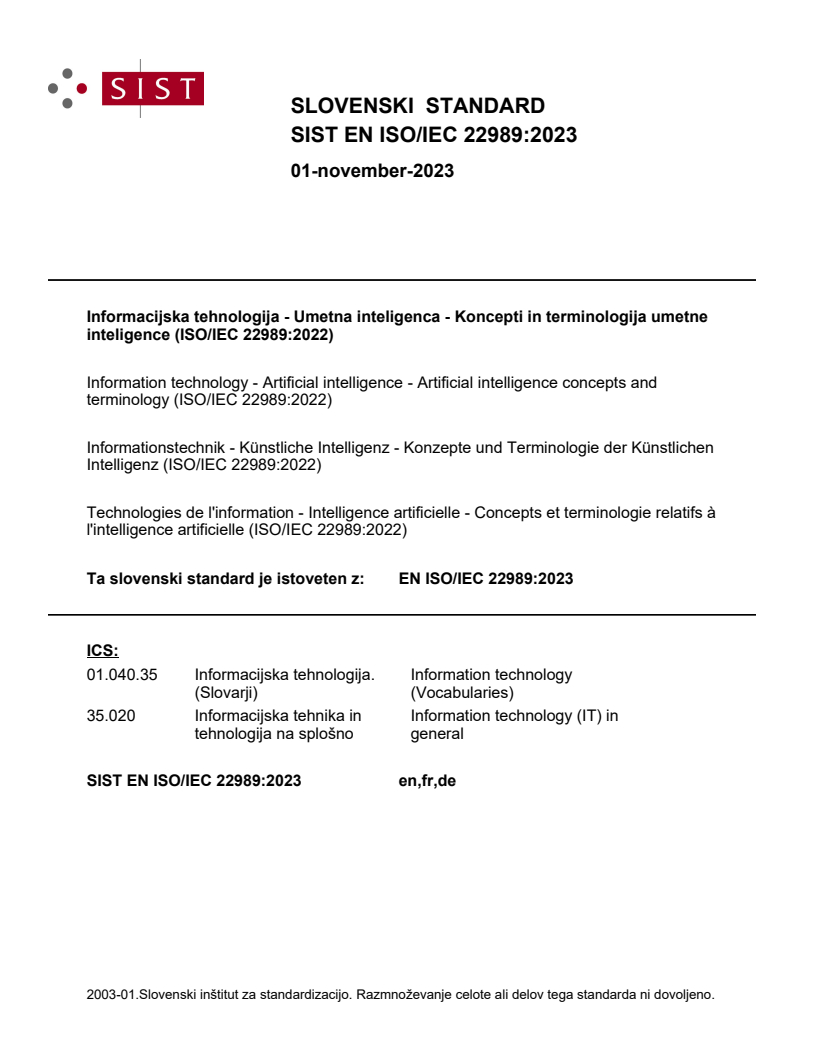
SLOVENSKI STANDARD
01-november-2023
Informacijska tehnologija - Umetna inteligenca - Koncepti in terminologija umetne
inteligence (ISO/IEC 22989:2022)
Information technology - Artificial intelligence - Artificial intelligence concepts and
terminology (ISO/IEC 22989:2022)
Informationstechnik - Künstliche Intelligenz - Konzepte und Terminologie der Künstlichen
Intelligenz (ISO/IEC 22989:2022)
Technologies de l'information - Intelligence artificielle - Concepts et terminologie relatifs à
l'intelligence artificielle (ISO/IEC 22989:2022)
Ta slovenski standard je istoveten z: EN ISO/IEC 22989:2023
ICS:
01.040.35 Informacijska tehnologija. Information technology
(Slovarji) (Vocabularies)
35.020 Informacijska tehnika in Information technology (IT) in
tehnologija na splošno general
2003-01.Slovenski inštitut za standardizacijo. Razmnoževanje celote ali delov tega standarda ni dovoljeno.
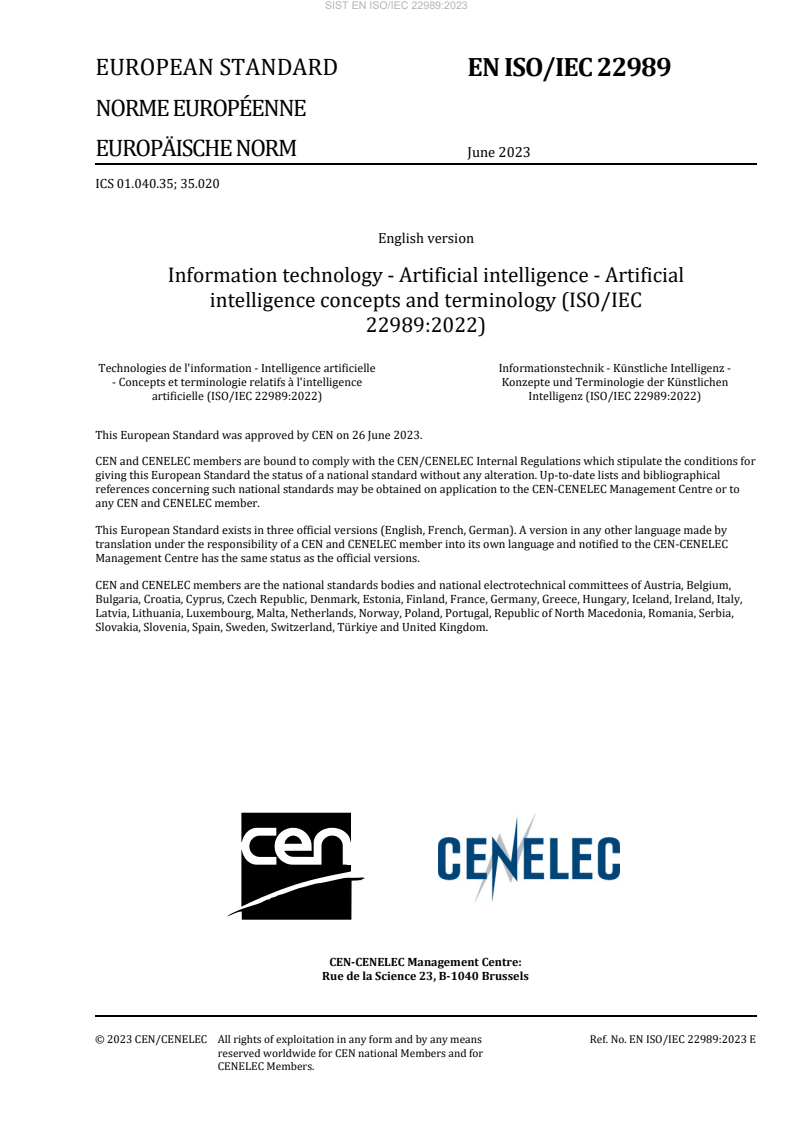
EUROPEAN STANDARD EN ISO/IEC 22989
NORME EUROPÉENNE
EUROPÄISCHE NORM
June 2023
ICS 01.040.35; 35.020
English version
Information technology - Artificial intelligence - Artificial
intelligence concepts and terminology (ISO/IEC
22989:2022)
Technologies de l'information - Intelligence artificielle Informationstechnik - Künstliche Intelligenz -
- Concepts et terminologie relatifs à l'intelligence Konzepte und Terminologie der Künstlichen
artificielle (ISO/IEC 22989:2022) Intelligenz (ISO/IEC 22989:2022)
This European Standard was approved by CEN on 26 June 2023.
CEN and CENELEC members are bound to comply with the CEN/CENELEC Internal Regulations which stipulate the conditions for
giving this European Standard the status of a national standard without any alteration. Up-to-date lists and bibliographical
references concerning such national standards may be obtained on application to the CEN-CENELEC Management Centre or to
any CEN and CENELEC member.
This European Standard exists in three official versions (English, French, German). A version in any other language made by
translation under the responsibility of a CEN and CENELEC member into its own language and notified to the CEN-CENELEC
Management Centre has the same status as the official versions.
CEN and CENELEC members are the national standards bodies and national electrotechnical committees of Austria, Belgium,
Bulgaria, Croatia, Cyprus, Czech Republic, Denmark, Estonia, Finland, France, Germany, Greece, Hungary, Iceland, Ireland, Italy,
Latvia, Lithuania, Luxembourg, Malta, Netherlands, Norway, Poland, Portugal, Republic of North Macedonia, Romania, Serbia,
Slovakia, Slovenia, Spain, Sweden, Switzerland, Türkiye and United Kingdom.
CEN-CENELEC Management Centre:
Rue de la Science 23, B-1040 Brussels
© 2023 CEN/CENELEC All rights of exploitation in any form and by any means
Ref. No. EN ISO/IEC 22989:2023 E
reserved worldwide for CEN national Members and for
CENELEC Members.
Contents Page
European foreword . 3
European foreword
The text of ISO/IEC 22989:2022 has been prepared by Technical Committee ISO/IEC JTC 1 "Information
technology” of the International Organization for Standardization (ISO) and has been taken over as
secretariat of which is held by DS.
This European Standard shall be given the status of a national standard, either by publication of an
identical text or by endorsement, at the latest by December 2023, and conflicting national standards
shall be withdrawn at the latest by December 2023.
Attention is drawn to the possibility that some of the elements of this document may be the subject of
patent rights. CEN-CENELEC shall not be held responsible for identifying any or all such patent rights.
Any feedback and questions on this document should be directed to the users’ national standards body.
A complete listing of these bodies can be found on the CEN and CENELEC websites.
According to the CEN-CENELEC Internal Regulations, the national standards organizations of the
following countries are bound to implement this European Standard: Austria, Belgium, Bulgaria,
Croatia, Cyprus, Czech Republic, Denmark, Estonia, Finland, France, Germany, Greece, Hungary, Iceland,
Ireland, Italy, Latvia, Lithuania, Luxembourg, Malta, Netherlands, Norway, Poland, Portugal, Republic of
North Macedonia, Romania, Serbia, Slovakia, Slovenia, Spain, Sweden, Switzerland, Türkiye and the
United Kingdom.
Endorsement notice
The text of ISO/IEC 22989:2022 has been approved by CEN-CENELEC as EN ISO/IEC 22989:2023
without any modification.
INTERNATIONAL ISO/IEC
STANDARD 22989
First edition
2022-07
Information technology — Artificial
intelligence — Artificial intelligence
concepts and terminology
Technologies de l'information — Intelligence artificielle — Concepts
et terminologie relatifs à l'intelligence artificielle
Reference number
ISO/IEC 22989:2022(E)
© ISO/IEC 2022
ISO/IEC 22989:2022(E)
© ISO/IEC 2022
All rights reserved. Unless otherwise specified, or required in the context of its implementation, no part of this publication may
be reproduced or utilized otherwise in any form or by any means, electronic or mechanical, including photocopying, or posting on
the internet or an intranet, without prior written permission. Permission can be requested from either ISO at the address below
or ISO’s member body in the country of the requester.
ISO copyright office
CP 401 • Ch. de Blandonnet 8
CH-1214 Vernier, Geneva
Phone: +41 22 749 01 11
Email: copyright@iso.org
Website: www.iso.org
Published in Switzerland
ii
© ISO/IEC 2022 – All rights reserved
ISO/IEC 22989:2022(E)
Contents Page
Foreword . vi
Introduction .vii
1 Scope . 1
2 Normative references . 1
3 Terms and definitions . 1
3.1 Terms related to AI . 1
3.2 Terms related to data. 6
3.3 Terms related to machine learning . 8
3.4 Terms related to neural networks . 10
3.5 Terms related to trustworthiness . 11
3.6 Terms related to natural language processing . 13
3.7 Terms related to computer vision . 16
4 Abbreviated terms .16
5 AI concepts .17
5.1 General . 17
5.2 From strong and weak AI to general and narrow AI . 17
5.3 Agent . 17
5.4 Knowledge . 18
5.5 Cognition and cognitive computing . 19
5.6 Semantic computing . 19
5.7 Soft computing . 19
5.8 Genetic algorithms . 19
5.9 Symbolic and subsymbolic approaches for AI . 19
5.10 Data . 20
5.11 Machine learning concepts . 21
5.11.1 Supervised machine learning . 21
5.11.2 Unsupervised machine learning . 21
5.11.3 Semi-supervised machine learning . 22
5.11.4 Reinforcement learning .22
5.11.5 Transfer learning . 22
5.11.6 Training data . .22
5.11.7 Trained model .22
5.11.8 Validation and test data . 22
5.11.9 Retraining .23
5.12 Examples of machine learning algorithms . 24
5.12.1 Neural networks . 24
5.12.2 Bayesian networks . 25
5.12.3 Decision trees . 25
5.12.4 Support vector machine .25
5.13 Autonomy, heteronomy and automation . 26
5.14 Internet of things and cyber-physical systems . 27
5.14.1 General . 27
5.14.2 Internet of things . 27
5.14.3 Cyber-physical systems . 27
5.15 Trustworthiness .28
5.15.1 General .28
5.15.2 AI robustness . .28
5.15.3 AI reliability .29
5.15.4 AI resilience . 29
5.15.5 AI controllability .29
5.15.6 AI explainability . .29
5.15.7 AI predictability .30
iii
© ISO/IEC 2022 – All rights reserved
ISO/IEC 22989:2022(E)
5.15.8 AI transparency .30
5.15.9 AI bias and fairness .30
5.16 AI verification and validation . . 31
5.17 Jurisdictional issues . 31
5.18 Societal impact . 32
5.19 AI stakeholder roles . 32
5.19.1 General . 32
5.19.2 AI provider . 33
5.19.3 AI producer . 33
5.19.4 AI customer .34
5.19.5 AI partner .34
5.19.6 AI subject .34
5.19.7 Relevant authorities . 35
6 AI system life cycle .35
6.1 AI system life cycle model . 35
6.2 AI system life cycle stages and processes . 37
6.2.1 General . 37
6.2.2 Inception . 37
6.2.3 Design and development .38
6.2.4 Verification and Validation . 39
6.2.5 Deployment . 39
6.2.6 Operation and monitoring . 39
6.2.7 Continuous validation .40
6.2.8 Re-evaluation .40
6.2.9 Retirement .40
7 AI system functional overview .40
7.1 General .40
7.2 Data and information . . 41
7.3 Knowledge and learning . 41
7.4 From predictions to actions . . 42
7.4.1 General . 42
7.4.2 Prediction . 42
7.4.3 Decision . 43
7.4.4 Action . 43
8 AI ecosystem .43
8.1 General . 43
8.2 AI systems. 45
8.3 AI function . 45
8.4 Machine learning . 45
8.4.1 General . 45
8.5 Engineering .46
8.5.1 General .46
8.5.2 Expert systems .46
8.5.3 Logic programming .46
8.6 Big data and data sources — cloud and edge computing .46
8.6.1 Big data and data sources.46
8.6.2 Cloud and edge computing .48
8.7 Resource pools .50
8.7.1 General .50
8.7.2 Application-specific integrated circuit .50
9 Fields of AI.51
9.1 Computer vision and image recognition. 51
9.2 Natural language processing . 51
9.2.1 General . 51
9.2.2 Natural language processing components . 52
9.3 Data mining .54
iv
© ISO/IEC 2022 – All rights reserved
ISO/IEC 22989:2022(E)
9.4 Planning .54
10 Applications of AI systems .54
10.1 General .54
10.2 Fraud detection . 55
10.3 Automated vehicles .55
10.4 Predictive maintenance.56
Annex A (informative) Mapping of the AI system life cycle with the OECD’s definition of an
AI system life cycle .57
Bibliography .59
v
© ISO/IEC 2022 – All rights reserved
ISO/IEC 22989:2022(E)
Foreword
ISO (the International Organization for Standardization) and IEC (the International Electrotechnical
Commission) form the specialized system for worldwide standardization. National bodies that are
members of ISO or IEC participate in the development of International Standards through technical
committees established by the respective organization to deal with particular fields of technical
activity. ISO and IEC technical committees collaborate in fields of mutual interest. Other international
organizations, governmental and non-governmental, in liaison with ISO and IEC, also take part in the
work.
The procedures used to develop this document and those intended for its further maintenance are
described in the ISO/IEC Directives, Part 1. In particular, the different approval criteria needed for
the different types of document should be noted. This document was drafted in accordance with the
editorial rules of the ISO/IEC Directives, Part 2 (see www.iso.org/directives or www.iec.ch/members_
experts/refdocs).
Attention is drawn to the possibility that some of the elements of this document may be the subject
of patent rights. ISO and IEC shall not be held responsible for identifying any or all such patent
rights. Details of any patent rights identified during the development of the document will be in the
Introduction and/or on the ISO list of patent declarations received (see www.iso.org/patents) or the IEC
list of patent declarations received (see patents.iec.ch).
Any trade name used in this document is information given for the convenience of users and does not
constitute an endorsement.
For an explanation of the voluntary nature of standards, the meaning of ISO specific terms and
expressions related to conformity assessment, as well as information about ISO's adherence to the
World Trade Organization (WTO) principles in the Technical Barriers to Trade (TBT) see www.iso.org/
iso/foreword.html. In the IEC, see www.iec.ch/understanding-standards.
This document was prepared by Joint Technical Committee ISO/IEC JTC 1, Information technology,
Subcommittee SC 42, Artificial Intelligence.
Any feedback or questions on this document should be directed to the user’s national standards body. A
complete listing of these bodies can be found at www.iso.org/members.html and www.iec.ch/national-
committees.
vi
© ISO/IEC 2022 – All rights reserved
ISO/IEC 22989:2022(E)
Introduction
Advancements in computing capacity, reduction of costs of computation, availability of large amounts
of data from many sources, inexpensive online learning curricula and algorithms capable of meeting or
exceeding human level performance in particular tasks for speed and accuracy have enabled practical
applications of AI, making it an increasingly important branch of information technology.
AI is a highly interdisciplinary field broadly based on computer science, data science, natural sciences,
humanities, mathematics, social sciences and others. Terms such as “intelligent”, “intelligence”,
“understanding”, “knowledge”, “learning”, “decisions”, “skills”, etc. are used throughout this document.
However, it is not the intention to anthropomorphize AI systems, but to describe the fact that some AI
systems can rudimentarily simulate such characteristics.
There are many areas of AI technology. These areas are intricately linked and developing rapidly so it is
difficult to fit the relevance of all technical fields into a single map. Research of AI includes aspects such
as aspects including “learning, recognition and prediction”, “inference, knowledge and language” and
[23]
“discovery, search and creation”. Research also addresses interdependencies among these aspects .
The concept of AI as an input and output process flow is shared by many AI researchers, and research on
each step of this process is ongoing. Standardized concepts and terminology are needed by stakeholders
of the technology to be better understood and adopted by a broader audience. Furthermore, concepts
and categories of AI allow for a comparison and classification of different solutions with respect
to properties like trustworthiness, robustness, resilience, reliability, accuracy, safety, security and
privacy. This enables stakeholders to select appropriate solutions for their applications and to compare
the quality of available solutions on the market.
As this document does provide a definition for the term AI in the sense of a discipline only, the context
for its usage can be described as follows: AI is a technical and scientific field devoted to the engineered
system that generates outputs such as content, forecasts, recommendations or decisions for a given set
of human-defined objectives.
This document provides standardized concepts and terminology to help AI technology to be better
understood and used by a broader set of stakeholders. It is intended for a wide audience including
experts and non-practitioners. The reading of some specific clauses can however be easier with a
stronger background in computer science. These concerns are described primarily Clauses 5.10, 5.11
and 8, which are more technical than the rest of the document.
vii
© ISO/IEC 2022 – All rights reserved
INTERNATIONAL STANDARD ISO/IEC 22989:2022(E)
Information technology — Artificial intelligence —
Artificial intelligence concepts and terminology
1 Scope
This document establishes terminology for AI and describes concepts in the field of AI.
This document can be used in the development of other standards and in support of communications
among diverse, interested parties or stakeholders.
This document is applicable to all types of organizations (e.g. commercial enterprises, government
agencies, not-for-profit organizations).
2 Normative references
There are no normative references in this document.
3 Terms and definitions
For the purposes of this document, the following terms and definitions apply.
ISO and IEC maintain terminology databases for use in standardization at the following addresses:
— ISO Online browsing platform: available at https:// www .iso .org/ obp
— IEC Electropedia: available at https:// www .electropedia .org/
3.1 Terms related to AI
3.1.1
AI agent
automated (3.1.7) entity that senses and responds to its environment and takes actions to achieve its
goals
3.1.2
AI component
functional element that constructs an AI system (3.1.4)
3.1.3
artificial intelligence
AI
research and development of mechanisms and applications of AI systems (3.1.4)
Note 1 to entry: Research and development can take place across any number of fields such as computer science,
data science, humanities, mathematics and natural sciences.
3.1.4
artificial intelligence system
AI system
engineered system that generates outputs such as content, forecasts, recommendations or decisions for
a given set of human-defined objectives
Note 1 to entry: The engineered system can use various techniques and approaches related to artificial intelligence
(3.1.3) to develop a model (3.1.23) to represent data, knowledge (3.1.21), processes, etc. which can be used to
conduct tasks (3.1.35).
© ISO/IEC 2022 – All rights reserved
ISO/IEC 22989:2022(E)
Note 2 to entry: AI systems are designed to operate with varying levels of automation (3.1.7).
3.1.5
autonomy
autonomous
characteristic of a system that is capable of modifying its intended domain of use or goal without
external intervention, control or oversight
3.1.6
application specific integrated circuit
ASIC
integrated circuit customized for a particular use
[SOURCE: ISO/IEC/IEEE 24765:2017, 3.193, modified — Acronym has been moved to separate line.]
3.1.7
automatic
automation
automated
pertaining to a process or system that, under specified conditions, functions without human
intervention
[SOURCE: ISO/IEC 2382:2015, 2121282, modified — In the definition, “a process or equipment” has
been replaced by “a process or system” and preferred terms of “automated and automation” are added.]
3.1.8
cognitive computing
category of AI systems (3.1.4) that enables people and machines to interact more naturally
Note 1 to entry: Cognitive computing tasks are associated with machine learning (3.3.5), speech processing,
natural language processing (3.6.9), computer vision (3.7.1) and human-machine interfaces.
3.1.9
continuous learning
continual learning
lifelong learning
incremental training of an AI system (3.1.4) that takes place on an ongoing basis during the operation
phase of the AI system life cycle
3.1.10
connectionism
connectionist paradigm
connectionist model
connectionist approach
form of cognitive modelling that uses a network of interconnected units that generally are simple
computational units
3.1.11
data mining
computational process that extracts patterns by analysing quantitative data from different perspectives
and dimensions, categorizing them, and summarizing potential relationships and impacts
[SOURCE: ISO 16439:2014, 3.13, modified — replace “categorizing it” with “categorizing them” because
data is plural.]
3.1.12
declarative knowledge
knowledge represented by facts, rules and theorems
Note 1 to entry: Usually, declarative knowledge cannot be processed without first being translated into procedural
knowledge (3.1.28).
© ISO/IEC 2022 – All rights reserved
ISO/IEC 22989:2022(E)
[SOURCE: ISO/IEC 2382-28:1995, 28.02.22, modified — Remove comma after “rules” in the definition.]
3.1.13
expert system
AI system (3.1.4) that accumulates, combines and encapsulates knowledge (3.1.21) provided by a human
expert or experts in a specific domain to infer solutions to problems
3.1.14
general AI
AGI
artificial general intelligence
type of AI system (3.1.4) that addresses a broad range of tasks (3.1.35) with a satisfactory level of
performance
Note 1 to entry: Compared to narrow AI (3.1.24).
Note 2 to entry: AGI is often used in a stronger sense, meaning systems that not only can perform a wide variety
of tasks, but all tasks that a human can perform.
3.1.15
genetic algorithm
GA
algorithm which simulates natural selection by creating and evolving a population of individuals
(solutions) for optimization problems
3.1.16
heteronomy
heteronomous
characteristic of a system operating under the constraint of external intervention, control or oversight
3.1.17
inference
reasoning by which conclusions are derived from known premises
Note 1 to entry: In AI, a premise is either a fact, a rule, a model, a feature or raw data.
Note 2 to entry: The term "inference" refers both to the process and its result.
[SOURCE: ISO/IEC 2382:2015, 2123830, modified – Model, feature and raw data have been added.
Remove “Note 4 to entry: 28.03.01 (2382)”. Remove “Note 3 to entry: inference: term and definition
standardized by ISO/IEC 2382-28:1995”.]
3.1.18
internet of things
IoT
infrastructure of interconnected entities, people, systems and information resources together with
services that process and react to information from the physical world and virtual world
[SOURCE: ISO/IEC 20924:2021, 3.2.4, modified – “…services which processes and reacts to…” has been
replaced with “…services that process and react to…” and acronym has been moved to separate line.]
3.1.19
IoT device
entity of an IoT system (3.1.20) that interacts and communicates with the physical world through
sensing or actuating
Note 1 to entry: An IoT device can be a sensor or an actuator.
[SOURCE: ISO/IEC 20924:2021, 3.2.6]
© ISO/IEC 2022 – All rights reserved
ISO/IEC 22989:2022(E)
3.1.20
IoT system
system providing functionalities of IoT (3.1.18)
Note 1 to entry: An IoT system can include, but not be limited to, IoT devices, IoT gateways, sensors and actuators.
[SOURCE: ISO/IEC 20924:2021, 3.2.9]
3.1.21
knowledge
abstracted information about objects, events, concepts or rules, their
relationships and properties, organized for goal-oriented systematic use
Note 1 to entry: Knowledge in the AI domain does not imply a cognitive capability, contrary to usage of the term
in some other domains. In particular, knowledge does not imply the cognitive act of understanding.
Note 2 to entry: Information can exist in numeric or symbolic form.
Note 3 to entry: Information is data that has been contextualized, so that it is interpretable. Data is created
through abstraction or measurement from the world.
3.1.22
life cycle
evolution of a system, product, service, project or other human-made entity, from conception through
retirement
[SOURCE: ISO/IEC/IEEE 15288:2015, 4.1.23]
3.1.23
model
physical, mathematical or otherwise logical representation of a system, entity, phenomenon, process or
data
[SOURCE: ISO/IEC 18023-1:2006, 3.1.11, modified – Remove comma after “mathematical” in the
definition. "or data" is added at the end.]
3.1.24
narrow AI
type of AI system (3.1.4) that is focused on defined tasks (3.1.35) to address a specific problem
Note 1 to entry: Compared to general AI (3.1.14).
3.1.25
performance
measurable result
Note 1 to entry: Performance can relate either to quantitative or qualitative findings.
Note 2 to entry: Performance can relate to managing activities, processes, products (including services), systems
or organizations.
3.1.26
planning
computational processes that compose a workflow out of a set of actions,
aiming at reaching a specified goal
Note 1 to entry: The meaning of the “planning” used in AI life cycle or AI management standards can be also
actions taken by human beings.
© ISO/IEC 2022 – All rights reserved
ISO/IEC 22989:2022(E)
3.1.27
prediction
primary output of an AI system (3.1.4) when provided with input data (3.2.9) or information
Note 1 to entry: Predictions can be followed by additional outputs, such as recommendations, decisions and
actions.
Note 2 to entry: Prediction does not necessarily refer to predicting something in the future.
Note 3 to entry: Predictions can refer to various kinds of data analysis or production applied to new data or
historical data (including translating text, creating synthetic images or diagnosing a previous power failure).
3.1.28
procedural knowledge
knowledge which explicitly indicates the steps to be taken in order to solve a problem or to reach a goal
[SOURCE: ISO/IEC 2382-28:1995, 28.02.23]
3.1.29
robot
automation system with actuators that performs intended tasks (3.1.35) in the physical world, by
means of sensing its environment and a software control system
Note 1 to entry: A robot includes the control system and interface of a control system.
Note 2 to entry: The classification of a robot as industrial robot or service robot is done according to its intended
application.
Note 3 to entry: In order to properly perform its tasks (3.1.35), a robot makes use of different kinds of sensors to
confirm its current state and perceive the elements composing the environment in which it operates.
3.1.30
robotics
science and practice of designing, ma
...