

EN 62841-2-1:2018/A1:2022
(Amendment)Electric motor-operated hand-held tools, transportable tools and lawn and garden machinery - Safety - Part 2-1: Particular requirements for hand-held drills and impact drills
General Information
- Abstract
The content of the corrigendum 1 (2025-11) has been included in this copy.
- Status
- Published
- Publication Date
- 28-Jul-2022
- Technical Committee
- CLC/TC 116 - Safety of hand-held motor-operated electric tools
- Current Stage
- 9093 - Decision to confirm - Review Enquiry
- Start Date
- 17-Aug-2026
- Completion Date
- 25-Aug-2026
- Directive
- 2006/42/EC - Directive 2006/42/EC of the European Parliament and of the Council of 17 May 2006 on machinery, and amending Directive 95/16/EC (recast)OJ Ref: OJ L 194 OJ Date: 02-Aug-2023



Overview
EN 62841-2-1:2018/A1:2022 is the CLC-adopted European version of IEC 62841-2-1 with Amendment 1 (approved 2021) and includes the corrigendum noted in the document scope. It sets safety and performance requirements for electric motor‑operated hand‑held drills and impact (percussion) drills, including diamond core drills and drills that can accept screwdriver bits. The amendment clarifies applicability, test methods and performance levels and is published to support EU regulatory compliance.
Key topics and technical requirements
- Scope and exclusions
- Applies to hand-held drills, impact drills and certain screw‑driving applications.
- Explicitly excludes rotary hammers, screwdrivers, impact wrenches and ratchet drivers (covered by other parts of IEC/EN 62841).
- Safety‑critical functions (SCFs) and performance levels
- Amendment replaces and updates Table 4, defining required performance levels (PL) for key SCFs such as prevention of unwanted switch‑on, desired switch‑off, lock‑on prevention and torque limiting.
- Mechanical and electrical limits
- No‑load speed requirement: spindle speed at rated voltage shall not exceed 120% of rated no‑load speed after 5 min run‑in (test condition specified).
- Abnormal operation and testing
- Detailed procedures for torque measurement (clause 19.102 series) including test equipment (torque transducer, rotational angle sensor, oscilloscope/data acquisition), configuration assessment for electronic controls, and a seven‑trial test protocol where M is computed from the middle five results (highest/lowest discarded).
- Considerations for soft‑start functions and electronically commutated motors to select the configuration producing the greatest output torque.
- Marking and instructions
- Amendments modify article structure (e.g., deletion of Subclause 8.3) - see standard text for precise marking/instruction obligations.
- Harmonization and legal status
- Identical adoption of IEC amendment; intended to be implemented by CENELEC members and supports essential requirements of EU directives (see informative Annex ZZ).
Applications and who uses it
- Manufacturers of hand‑held and impact drills for design, safety integration and CE marking.
- Test laboratories and conformity assessment bodies conducting performance and safety tests (speed, torque, SCF verification).
- Product safety and compliance engineers ensuring products meet EN/IEC requirements.
- Procurement and quality teams specifying compliant tools for professional and industrial use.
Related standards
- IEC/EN 62841-1 (general requirements)
- IEC/EN 62841-2-2, -2-6 (covers screwdrivers, rotary hammers and other tool types referenced in this amendment)
Keywords: EN 62841-2-1, IEC 62841-2-1, hand-held drills, impact drills, safety standard, torque test, no-load speed, CENELEC, conformity, electric power tools.
Relations
- Effective Date
- 05-May-2020
- Effective Date
- 06-Jul-2021
Get Certified
Connect with accredited certification bodies for this standard

DVS-ZERT GmbH
German welding certification society.
CARES (UK Certification Authority for Reinforcing Steels)
UK certification for reinforcing steels and construction.
EWF/IIW (European/International Welding Federation)
International welding personnel certification.
Sponsored listings
Frequently Asked Questions
EN 62841-2-1:2018/A1:2022 is a amendment published by CLC. Its full title is "Electric motor-operated hand-held tools, transportable tools and lawn and garden machinery - Safety - Part 2-1: Particular requirements for hand-held drills and impact drills". This standard covers: The content of the corrigendum 1 (2025-11) has been included in this copy.
The content of the corrigendum 1 (2025-11) has been included in this copy.
EN 62841-2-1:2018/A1:2022 is classified under the following ICS (International Classification for Standards) categories: 25.140.20 - Electric tools. The ICS classification helps identify the subject area and facilitates finding related standards.
EN 62841-2-1:2018/A1:2022 has the following relationships with other standards: It is inter standard links to EN 62841-2-1:2018, EN 62841-2-1:2018/A12:2022. Understanding these relationships helps ensure you are using the most current and applicable version of the standard.
EN 62841-2-1:2018/A1:2022 is associated with the following European legislation: EU Directives/Regulations: 2006/42/EC; Standardization Mandates: M/396. When a standard is cited in the Official Journal of the European Union, products manufactured in conformity with it benefit from a presumption of conformity with the essential requirements of the corresponding EU directive or regulation.
EN 62841-2-1:2018/A1:2022 is available in PDF format for immediate download after purchase. The document can be added to your cart and obtained through the secure checkout process. Digital delivery ensures instant access to the complete standard document.
Standards Content (Sample)
SLOVENSKI STANDARD
01-november-2022
Elektromotorna ročna orodja, prenosna orodja ter stroji za trato in vrt - Varnost - 2-
1. del: Posebne zahteve za ročne vrtalnike in udarne (vibracijske) vrtalnike -
Dopolnilo A1
Electric motor-operated hand-held tools, transportable tools and lawn and garden
machinery - Safety - Part 2-1: Particular requirements for hand-held drills and impact
drills
Ta slovenski standard je istoveten z: EN 62841-2-1:2018/A1:2022
ICS:
25.080.40 Vrtalniki Drilling machines
25.140.20 Električna orodja Electric tools
2003-01.Slovenski inštitut za standardizacijo. Razmnoževanje celote ali delov tega standarda ni dovoljeno.
EUROPEAN STANDARD EN 62841-2-1:2018/A1
NORME EUROPÉENNE
EUROPÄISCHE NORM July 2022
ICS 25.140.20
English Version
Electric motor-operated hand-held tools, transportable tools and
lawn and garden machinery - Safety - Part 2-1: Particular
requirements for hand-held drills and impact drills
(IEC 62841-2-1:2017/AMD1:2021)
Outils électroportatifs à moteur, outils portables et machines Elektrische Motorbetriebene handgeführte Werkzeuge,
pour jardins et pelouses - Sécurité - Partie 2-1: Exigences transportable Werkzeuge und Rasen- und
particulières pour les perceuses portatives et les perceuses Gartenmaschinen - Sicherheit - Teil 2-1: Besondere
à percussion Anforderungen für handgeführte Bohrmaschinen und
(IEC 62841-2-1:2017/AMD1:2021) Schlagbohrmaschinen
(IEC 62841-2-1:2017/AMD1:2021)
This amendment A1 modifies the European Standard EN 62841-2-1:2018; it was approved by CENELEC on 2021-12-09. CENELEC
members are bound to comply with the CEN/CENELEC Internal Regulations which stipulate the conditions for giving this amendment the
status of a national standard without any alteration.
Up-to-date lists and bibliographical references concerning such national standards may be obtained on application to the CEN-CENELEC
Management Centre or to any CENELEC member.
This amendment exists in three official versions (English, French, German). A version in any other language made by translation under the
responsibility of a CENELEC member into its own language and notified to the CEN-CENELEC Management Centre has the same status as
the official versions.
CENELEC members are the national electrotechnical committees of Austria, Belgium, Bulgaria, Croatia, Cyprus, the Czech Republic,
Denmark, Estonia, Finland, France, Germany, Greece, Hungary, Iceland, Ireland, Italy, Latvia, Lithuania, Luxembourg, Malta, the
Netherlands, Norway, Poland, Portugal, Republic of North Macedonia, Romania, Serbia, Slovakia, Slovenia, Spain, Sweden, Switzerland,
Turkey and the United Kingdom.
European Committee for Electrotechnical Standardization
Comité Européen de Normalisation Electrotechnique
Europäisches Komitee für Elektrotechnische Normung
CEN-CENELEC Management Centre: Rue de la Science 23, B-1040 Brussels
© 2022 CENELEC All rights of exploitation in any form and by any means reserved worldwide for CENELEC Members.
Ref. No. EN 62841-2-1:2018/A1:2022 E
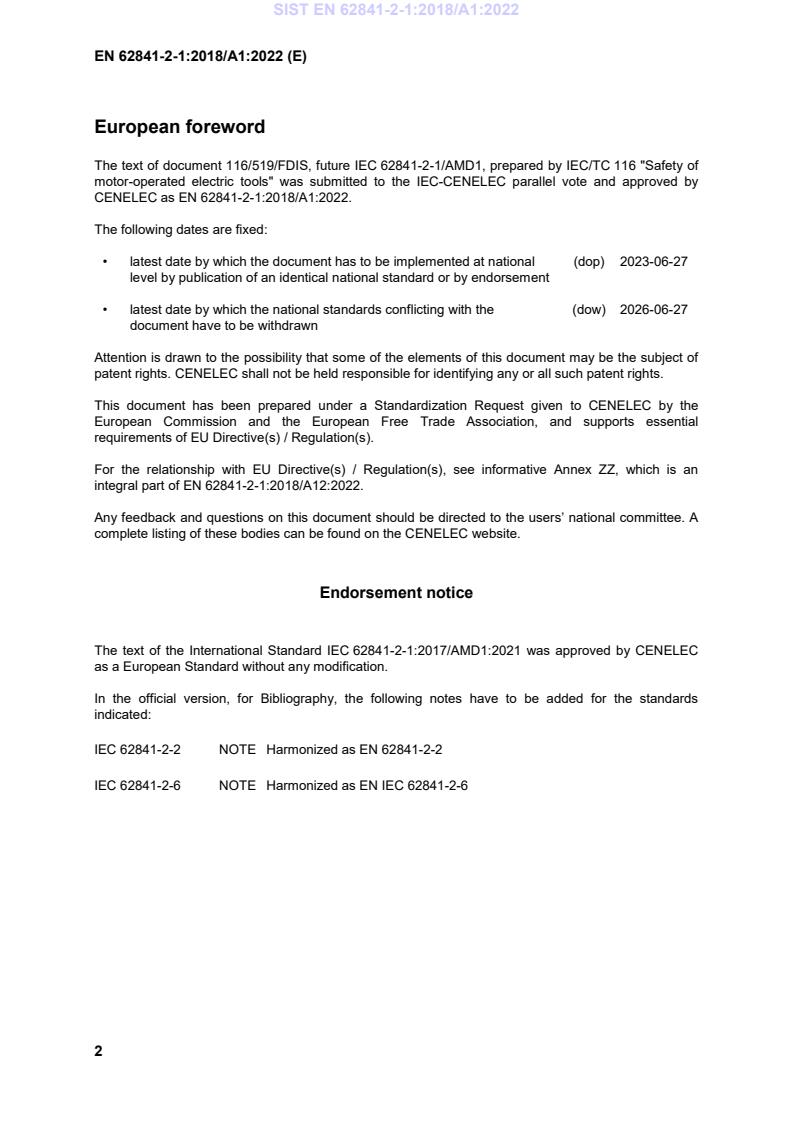
European foreword
The text of document 116/519/FDIS, future IEC 62841-2-1/AMD1, prepared by IEC/TC 116 "Safety of
motor-operated electric tools" was submitted to the IEC-CENELEC parallel vote and approved by
CENELEC as EN 62841-2-1:2018/A1:2022.
The following dates are fixed:
• latest date by which the document has to be implemented at national (dop) 2023-06-27
level by publication of an identical national standard or by endorsement
• latest date by which the national standards conflicting with the (dow) 2026-06-27
document have to be withdrawn
Attention is drawn to the possibility that some of the elements of this document may be the subject of
patent rights. CENELEC shall not be held responsible for identifying any or all such patent rights.
This document has been prepared under a Standardization Request given to CENELEC by the
European Commission and the European Free Trade Association, and supports essential
requirements of EU Directive(s) / Regulation(s).
For the relationship with EU Directive(s) / Regulation(s), see informative Annex ZZ, which is an
integral part of EN 62841-2-1:2018/A12:2022.
Any feedback and questions on this document should be directed to the users’ national committee. A
complete listing of these bodies can be found on the CENELEC website.
Endorsement notice
The text of the International Standard IEC 62841-2-1:2017/AMD1:2021 was approved by CENELEC
as a European Standard without any modification.
In the official version, for Bibliography, the following notes have to be added for the standards
indicated:
IEC 62841-2-2 NOTE Harmonized as EN 62841-2-2
IEC 62841-2-6 NOTE Harmonized as EN IEC 62841-2-6
IEC 62841-2-1 ®
Edition 1.0 2021-11
INTERNATIONAL
STANDARD
NORME
INTERNATIONALE
A MENDMENT 1
AM ENDEMENT 1
Electric motor-operated hand-held tools, transportable tools and lawn and
garden machinery –
Part 2-1: Particular requirements for hand-held drills and impact drills
Outils électroportatifs à moteur, outils portables et machines pour jardins et
pelouses –
Partie 2-1: Exigences particulières pour les perceuses portatives et les
perceuses à percussion
INTERNATIONAL
ELECTROTECHNICAL
COMMISSION
COMMISSION
ELECTROTECHNIQUE
INTERNATIONALE
ICS 25.140.20 ISBN 978-2-8322-5394-6
– 2 – IEC 62841-2-1:2017/AMD1:2021
© IEC 2021
INTERNATIONAL ELECTROTECHNICAL COMMISSION
____________
ELECTRIC MOTOR-OPERATED HAND-HELD TOOLS, TRANSPORTABLE
TOOLS AND LAWN AND GARDEN MACHINERY –
Part 2-1: Particular requirements for hand-held drills and impact drills
AMENDMENT 1
FOREWORD
1) The International Electrotechnical Commission (IEC) is a worldwide organization for standardization comprising
all national electrotechnical committees (IEC National Committees). The object of IEC is to promote
international co-operation on all questions concerning standardization in the electrical and electronic fields. To
this end and in addition to other activities, IEC publishes International Standards, Technical Specifications,
Technical Reports, Publicly Available Specifications (PAS) and Guides (hereafter referred to as “IEC
Publication(s)”). Their preparation is entrusted to technical committees; any IEC National Committee interested
in the subject dealt with may participate in this preparatory work. International, governmental and non-
governmental organizations liaising with the IEC also participate in this preparation. IEC collaborates closely
with the International Organization for Standardization (ISO) in accordance with conditions determined by
agreement between the two organizations.
2) The formal decisions or agreements of IEC on technical matters express, as nearly as possible, an international
consensus of opinion on the relevant subjects since each technical committee has representation from all
interested IEC National Committees.
3) IEC Publications have the form of recommendations for international use and are accepted by IEC National
Committees in that sense. While all reasonable efforts are made to ensure that the technical content of IEC
Publications is accurate, IEC cannot be held responsible for the way in which they are used or for any
misinterpretation by any end user.
4) In order to promote international uniformity, IEC National Committees undertake to apply IEC Publications
transparently to the maximum extent possible in their national and regional publications. Any divergence
between any IEC Publication and the corresponding national or regional publication shall be clearly indicated in
the latter.
5) IEC itself does not provide any attestation of conformity. Independent certification bodies provide conformity
assessment services and, in some areas, access to IEC marks of conformity. IEC is not responsible for any
services carried out by independent certification bodies.
6) All users should ensure that they have the latest edition of this publication.
7) No liability shall attach to IEC or its directors, employees, servants or agents including individual experts and
members of its technical committees and IEC National Committees for any personal injury, property damage or
other damage of any nature whatsoever, whether direct or indirect, or for costs (including legal fees) and
expenses arising out of the publication, use of, or reliance upon, this IEC Publication or any other IEC
Publications.
8) Attention is drawn to the Normative references cited in this publication. Use of the referenced publications is
indispensable for the correct application of this publication.
9) Attention is drawn to the possibility that some of the elements of this document may be the subject of patent
rights. IEC shall not be held responsible for identifying any or all such patent rights.
Amendment 1 to IEC 62841-2-1:2017 has been prepared by IEC technical committee 116:
Safety of motor-operated electric tools.
The text of this Amendment is based on the following documents:
Draft Report on voting
116/519/FDIS 116/525/RVD
Full information on the voting for its approval can be found in the report on voting indicated in
the above table.
The language used for the development of this Amendment is English.
IEC 62841-2-1:2017/AMD1:2021 – 3 –
© IEC 2021
This document was drafted in accordance with ISO/IEC Directives, Part 2, and developed in
accordance with ISO/IEC Directives, Part 1 and ISO/IEC Directives, IEC Supplement,
available at www.iec.ch/members_experts/refdocs. The main document types developed by
IEC are described in greater detail at www.iec.ch/standardsdev/publications/.
The committee has decided that the contents of this document will remain unchanged until the
stability date indicated on the IEC website under webstore.iec.ch in the data related to the
specific document. At this date, the document will be
• reconfirmed,
• withdrawn,
• replaced by a revised edition, or
• amended.
_____________
1 Scope
Replace the existing text with the following new text:
This clause of Part 1 is applicable except as follows:
Addition:
This part of IEC 62841 applies to hand-held drills and impact drills, including diamond core
drills. This document also applies to drills that can be used for driving screws by attaching
screwdriver bits.
This document does not apply to rotary hammers, screwdrivers, impact wrenches and ratchet
drivers even if they can be used as a drill.
NOTE 101 Rotary hammers are covered by IEC 62841-2-6.
NOTE 102 Screwdrivers, impact wrenches and ratchet drivers are covered by IEC 62841-2-2.
8 Marking and instructions
Delete existing Subclause 8.3.
18 Abnormal operation
Replace the existing text of 18.8 with the following new text:
– 4 – IEC 62841-2-1:2017/AMD1:2021
© IEC 2021
18.8 Replacement of Table 4:
Table 4 – Required performance levels
Type and purpose of SCF Minimum performance level
(PL)
Power switch – prevent unwanted switch-on for tools with M ≤ 25 Nm a
R
measured in accordance with 19.102
Power switch – prevent unwanted switch-on for tools with M > 25 Nm b
R
measured in accordance with 19.102
Power switch – provide desired switch-off for tools with M ≤ 25 Nm b
R
measured in accordance with 19.102
Power switch – provide desired switch-off for tools with M > 25 Nm c
R
measured in accordance with 19.102
Power switch – provide desired switch-off for tools that require bracing in Shall be evaluated using the
accordance with 8.14.1.101. fault conditions of 18.6.1 without
the loss of this SCF
Provide desired direction of rotation for tools that do not require bracing in Not an SCF
accordance with 8.14.1.101
Provide desired direction of rotation for tools that require bracing in c
accordance with 8.14.1.101
Any electronic control to pass the test of 18.3 a
-1
For tools with a rated no-load speed of less than 3 500 min , prevent a
output speed from exceeding 150 % of rated no-load speed as measured in
19.6
-1
For tools with a rated no-load speed of 3 500 min or greater, prevent a
output speed from exceeding 130 % of rated no-load speed as measured in
19.6
Prevent exceeding thermal limits as in 18.4 a
Prevent self-resetting as required in 23.3 for tools with M ≤ 25 Nm a
R
measured in accordance with 19.102
Prevent self-resetting as required in 23.3 for tools with M > 25 Nm b
R
measured in accordance with 19.102
Limit the torque to comply with 19.102 c
Prevent unwanted lock-on of the power switch function for tools with b
M ≤ 25 Nm measured in accordance with 19.102
R
Prevent unwanted lock-on of the power switch function for tools with c
M > 25 Nm measured in accordance with 19.102
R
19 Mechanical hazards
Add the following new subclause:
19.6 Replacement:
The no-load speed of the spindle at rated voltage shall not exceed 120 % of the rated no-
load speed.
Compliance is checked by measuring the speed of the spindle after the tool has been
operating for 5 min at no-load. During the test, separable accessories are not mounted.
IEC 62841-2-1:2017/AMD1:2021 – 5 –
© IEC 2021
19.102.1 General
Replace the existing text of the last paragraph with the following new text:
Compliance is checked by the tests specified in 19.102.2 to 19.102.4 and by the calculations
in Figures 104 to 107.
19.102.2 Test equipment
Replace the existing text of the first paragraph, item a) and item b) with the following new
text:
The test equipment used for the test of 19.102.4 shall meet the following requirements a) to
g):
a) The torque transducer and the rotational angle sensor shall continuously monitor the
torque and the rotation produced by the output spindle of the tool during the test of
19.102.4.
b) The output of the torque transducer shall be connected to an oscilloscope or other data
acquisition equipment capable of displaying the torque vs. time graph of the tool’s output
during the test of 19.102.4.
19.102.3 Test procedure
Insert the following new Subclause 19.2.103 before "19.102.3 Test procedure".
19.102.3 Assessment to determine tool configuration
This assessment is only applicable for tools that employ an electronic circuit(s) that affects
the output torque in the test of 19.102.4.
Prior to each measurement, the sample is operated for at least 5 min at no-load. After each
5 min operation period, the measurement shall be conducted within 20 min.
All measurements are made with the tool sample running in the forward position.
The sample is connected to the measurement fixture and is fixed during the test.
For tools with a soft start function, the test of 19.102.4 through steps 1) and 2) is conducted
on the sample with the soft start function enabled and then repeated with the soft start
function disabled. If analysis shows that the tool will not operate with the soft start function
disabled, then the test with the soft start function disabled is not conducted. For tools
employing electronically commutated motors, the configuration that results in the greatest
output torque shall be used for the test of 19.102.4. For tools other than those employing
electronically commutated motors, the configuration that results in the greatest output torque
shall be used for the following test.
For tools other than those employing electronically commutated motors, when all functions
affecting the test value of the output torque, except for any soft start function, are not
evaluated as SCFs according to 18.8 (e.g. current limit and stall detection), the tool
configuration for the test of 19.102.4 shall be the configuration that results in the greatest
output torque for one trial of the test of 19.102.4 through steps 1) and 2) as specified below:
– all functions affecting the output torque enabled; or
– each function not evaluated as an SCF affecting the output torque disabled one at a time.
– 6 – IEC 62841-2-1:2017/AMD1:2021
© IEC 2021
Renumber and replace 19.102.3 as follows.
19.102.4 Test procedure
If applicable, the sample is configured as specified in 19.102.3.
Prior to the test, the sample is operated for at least 5 min at no-load. After the 5 min operation
period, the test shall be conducted within 20 min.
All measurements are made with the tool sample running in the forward position.
The sample is connected to the measurement fixture and is fixed during the test. The
measurement is conducted by using seven trial measurements of the same sample, each trial
conducted as follows:
1) Energize the tool to the full "on" position as quickly as possible and allow the joint to be
tightened until it comes to a complete stop.
2) Record the measured output torque.
a) For tools without a mechanical overload clutch, the output torque is determined by
either i) or ii):
i) For signals that are stable for a minimum of 2 ms after the initial peak (if present),
the output torque value is determined by measuring over the stable region for an
interval T not exceeding 100 ms. If there is variation during this interval, the
average value shall be used. See Figure 108.
ii) For signals that are not stable for a minimum of 2 ms after the initial peak, the
output torque value shall be the RMS value of the signal over the rotation from off
until peak torque is achieved. See Figure 109.
NOTE 101 Torque signals can exhibit a transient peak with a relatively stable signal following the peak.
The stable signal can exhibit relatively slow change due to, for example, heating of the windings. The
stable signal can also exhibit periodic signal variation due to torque ripple. Averaging over this stable
period provides a meaningful torque value. The transient peak and the stable region are not always
present.
b) For tools with a mechanical overload clutch:
The output torque is determined by the peak value of the first peak that occurs after
starting the trial. Later peaks, even if they appear to have greater values, are not taken
into account. See Figure 110.
3) Before the next trial, disconnect the spindle from the test fixture and operate the tool
under no-load for a minimum of 3 s. Allow the tool to cool for a minimum of 2 min before
the next trial.
M is computed as the average of five of the measurements from each of the seven trials,
R
with the highest and lowest measurement eliminated. The standard deviation of the five
measurements shall also be computed and shall be less than 5 %. If it is not, then the fixture
shall be adjusted to achieve the required repeatability.
NOTE 102 It is recognized that disabling functions that affect the torque can result in a test where the tool is
permanently impaired after the test.
21 Construction
Add the following new subclause:
21.18.1.2 This subclause of Part 1 is not applicable.
IEC 62841-2-1:2017/AMD1:2021 – 7 –
© IEC 2021
Figures
Replace the existing Figure 105 with the following new figure:
M = 8 Nm
R,max
(For round handle
tools)
M = 10 Nm
R,max
(For non-round
handle tools)
Choose whichever
is greater:
M = 400 N × a
R,max 1
or
M = 400 N × a
R,max 2
Key
S location of the hand on the power switch where the operator naturally grasps and/or the least favourable
position on the power switch for the reactionary torque measurement
x measurement point that is 80 mm or the remaining length of the handle, whichever is less, from S in the
direction of where the hand grasps the tool
a , a lever arm distances
1 2
M maximum reaction torque
R,max
Figure 105 – Reaction torque measurement of single handle tools (2)
– 8 – IEC 62841-2-1:2017/AMD1:2021
© IEC 2021
Figure 106 – Reaction torque measurement of multi handle tools (1)
Replace the existing text for key item x with the following new text:
x measurement point that is 80 mm or the remaining length of the handle, whichever is less, from "S" or "F" in the
direction of where the hand grasps the tool
Figure 107 – Reaction torque measurement of multi handle tools (2)
Replace the existing text for key item x with the following new text:
x measurement point that is 80 mm or the remaining length of the handle, whichever is less, from "S" or "F" in the
direction of where the hand grasps the tool
Annex I – Measurement of noise and vibration emissions
Replace the existing text of Clause I.2 with the following new text:
I.2 Noise test code (grade 2)
This clause of Part 1 is applicable except as follows:
I.2.4 Installation and mounting conditions of the power tools during noise tests
Addition:
Drills, except for impact drills and diamond core drills, are suspended.
Impact drills and diamond core drills are held by the operator for drilling vertically down in
accordance with I.2.5.
I.2.5 Operating conditions
Addition:
Drills, except for impact drills and diamond core drills, are tested at no-load without any
accessory mounted, all speed setting devices adjusted to the highest value.
NOTE 101 Experimental investigations have shown that the noise emission values of drills, except for impact
drills and diamond core drills, at no-load and under load are very similar. For reasons of simplification, the noise
emission is therefore measured at no-load.
For impact drills, the speed setting shall be that recommended by the manufacturer for an
8 mm bit for drilling into concrete.
Impact drills are tested under load as shown in Figure I.101 and in accordance with the
conditions shown in Tables I.101 and I.102.
Diamond core drills are tested under load and in accordance with the conditions shown in
Table I.103.
IEC 62841-2-1:2017/AMD1:2021 – 9 –
© IEC 2021
Table I.101 – Concrete formulation for impact drills (per cubic metre)
b
Cement Water Aggregate
1 450 kg
Particle size Fraction
mm %
a a
450 kg 220 l 0 to 0,25 12 ± 3
0 to 0,50 50 ± 5
0 to 1,00 80 ± 5
0 to 4,00 100
The minimum compressive strength after at least 28 days shall be 40 N/mm .
a
The water/cement mass ratio shall be 0,49 ± 0,02 (the mass tolerance of cement and water is + 10 % to
enable the concrete manufacturer to ensure compressive strength with local cement).
b
Very hard aggregates such as flint or granite and very soft aggregates such as limestone shall not be used.
NOTE 102 In some parts of the world, concrete with a minimum compressive strength of 40 N/mm after 28 days
is readily available. In other parts of the world, it is possible that readily available concrete will take longer than 28
days to achieve a minimum compressive strength of 40 N/mm .
Table I.102 – Noise test conditions for impact drills
Orientation Drilling vertically down into a concrete block having the formulation specified in Table I.101
and having the minimum dimensions 500 mm × 500 mm and 200 mm in height and
supported on resilient material. The concrete block, its support and the tool shall be so
oriented that
– the geometric centre of the tool is 1 m above the reflecting plane;
– the centre of the
...