

FprEN IEC 63535:2026
(Main)Germicidal equipment - Germicidal ultraviolet (GUV) luminaires - Radiation safety
- Status
- Not Published
- Publication Date
- 03-Mar-2027
- Technical Committee
- CLC/TC 34 - 'Lamps and related equipment
- Current Stage
- 5020 - Vote circulated - Formal Approval
- Start Date
- 16-Oct-2026
- Due Date
- 31-Jul-2026
- Completion Date
- 16-Oct-2026

FprEN IEC 63535:2026 is a draft CLC standard for germicidal equipment. It specifies radiation safety requirements for germicidal UV (GUV) luminaires and systems that intentionally emit UV radiation for disinfection, including requirements for UV exposure control and ozone-related precautions. The document is aimed at equipment used in occupiable and unoccupied spaces.
What does FprEN IEC 63535:2026 specify?
FprEN IEC 63535:2026 specifies radiation safety requirements for GUV luminaires that emit UV radiation between 180 nm and 400 nm into the surroundings. It also covers safety requirements related to radiation-induced ozone and applies to whole-room GUV disinfection in both occupiable and unoccupied spaces.
FprEN IEC 63535:2026 does not cover other product safety aspects, handheld GUV luminaires, devices with self-contained UV radiation such as air cleaners with contained UV, biological safety cabinets, disinfection cabinets, performance or functional characteristics, or material degradation and damage.
The document is organized into six main clauses and three annexes.
| Annex | What it covers |
|---|---|
| Annex A | GUV luminaire types and how they are grouped |
| Annex B | Application assessment for GUV luminaires used in applications or systems |
| Annex C | Normative requirements for safety-related electronic circuits (SREC) |
What are the key requirements of FprEN IEC 63535:2026?
FprEN IEC 63535:2026 separates the safety approach by application: occupiable spaces and unoccupied spaces are treated differently, because the way people may be exposed to UV radiation is different in each case. That distinction affects how the luminaire is classified, tested, marked, installed, and supervised.
Clause 4 - classification and risk group assessment
Clause 4 classifies GUV luminaires by intended application as luminaires for occupiable spaces or luminaires for unoccupied spaces. It also requires a risk group assessment according to IEC 62471 at 200 mm from the radiation-emitting surface, using the Exempt group (RG-0), Risk group 1 (RG-1), Risk group 2 (RG-2), or Risk group 3 (RG-3) categories for actinic UV and near-UV. Controls that could interrupt operation or reduce radiation are disabled during this assessment, so the measurement reflects the worst credible operating condition.
Clause 5 - occupiable spaces
For occupiable spaces, Clause 5 requires the GUV luminaire to avoid personal injury from UV overexposure when installed and used as intended while people remain present. If the luminaire is assessed as RG-0, it can be used without further precautions; higher-risk classifications require additional precautions verified by UV irradiation measurements. These measurements are made according to IEC 62471, in a room with non-reflective UV surfaces, and any illumination function must also comply with IEC 62471-7 with the GUV output switched off during assessment.
Portable GUV luminaires used in occupiable spaces must have at least one protective sensor. For luminaires with protective sensors, the standard requires a delayed-start function, a warning during activation, a simple way to interrupt or cancel startup, and sensor checking before operation begins. The sensor must cover the full exempt perimeter, and the luminaire must switch to a safe mode if a person is detected inside that perimeter during operation. In practice, this means the design must keep users away from the hazardous zone and prove that the sensor protects the whole treated area.
Clause 5 - measurements for luminaires without protective sensors
For fixed luminaires without protective sensors in occupiable spaces, Clause 5 uses the General Use Distance (GUD) and a GUD plane to define where the measurements are made. Depending on mounting height, the measurement is made either on the GUD plane or at 200 mm from the luminaire, and the detector is moved to find the highest reading with an 80° field of view. The measured irradiance must remain within RG-0. For users and installers, this means the occupied zone above or below the luminaire must be checked at the most severe realistic position, not only at a convenient test point.
Clause 5 and Clause 6 - marking, instructions, and ozone precautions
Clauses 5 and 6 require marking that matches the risk group and the product type. The standard includes specific caution labels for RG-1, RG-2 and RG-3 luminaires, plus a disassembly caution warning that the equipment is not user-serviceable. It also requires an instruction manual covering installation, operation, maintenance, safety instructions, serviceable components, replacement UV sources, and dimming information where applicable.
Where the UV source emits below 240 nm, the document adds ozone precautions. The marking and manual must inform the user about ozone generation and the need to keep ozone concentration at a safe level after installation and when the treated space returns to occupied use.
Clause 6 - unoccupied spaces and GUV disinfection systems
For unoccupied spaces, Clause 6 requires the luminaire or system to prevent personal injury by ensuring the space is not occupied during treatment or by reducing UV exposure to a safe level. If an external sensor or control can stop or prevent operation, that circuit is treated as a critical control function and is evaluated as a safety-related component. GUV disinfection systems must use output-control components supplied by the luminaire manufacturer or clearly specified in the installation instructions, and they must include at least two independent safeguards, such as access control, interlocks, sensing networks, scheduling, arming steps, proximity detection, wireless control, or emergency stop functions.
Annex C - safety-related electronic circuits
Annex C gives two ways to evaluate safety-related electronic circuits: reliability evaluation or design review. Both approaches are tied to the critical control functions that prevent UV overexposure, and both are used when the circuit supports compliance with Clause 5.1.2.5 or Clause 6.1.2. In practice, manufacturers need to prove that the electronic control either keeps working safely or fails in a safe way.
What terms does FprEN IEC 63535:2026 define?
- Germicidal UV luminaire (GUV luminaire) - An apparatus for germicidal purposes that distributes, filters, or transforms UV radiation from at least one UV source and includes the parts needed for mounting, protection, and power connection.
- Occupiable space - A space where humans can be exposed to UV radiation from GUV luminaires during operation.
- Unoccupied space - A space where humans cannot be exposed to UV radiation from GUV luminaires during operation.
- Exempt perimeter - The boundary around a GUV luminaire where the assessed UV emissions are in the Exempt group (RG-0) for actinic UV and near-UV hazards.
- Mounting height - The vertical distance from the lowest emissive surface of the device to the floor.
- General Use Distance (GUD) - The distance used for measurement in fixed luminaires without protective sensors, referenced to the GUD plane or the luminaire surface depending on mounting height.
- Safety-related electronic circuit (SREC) - The electronic circuit that performs the critical control or protective function needed for radiation safety.
- Risk group classification - The IEC 62471 categorization used here to rate UV hazard as RG-0, RG-1, RG-2, or RG-3.
Who uses FprEN IEC 63535:2026?
FprEN IEC 63535:2026 is used by GUV luminaire manufacturers, UV disinfection system integrators, and lighting engineers who design products for occupiable or unoccupied spaces. It is also used by test laboratories, conformity assessment bodies, and safety engineers who evaluate UV exposure, protective sensors, marking, installation instructions, and safety-related control circuits.
In practice, the standard is relevant to product development, type testing, commissioning, maintenance planning, and application assessment for germicidal lighting and room disinfection systems.
What changed in FprEN IEC 63535:2026 from the previous edition?
FprEN IEC 63535:2026 supersedes IEC document 34/1344/CD and 34/1414A/CC.
Which standards are used with FprEN IEC 63535:2026?
- IEC 60417 - Provides the graphical symbols used for equipment marking, including the UV symbol referenced in the labels.
- IEC 60730-1:2022 - Provides the base requirements used in Annex C for evaluating safety-related electronic circuits.
- IEC 62046 - Supports verification of protective sensors used for presence detection.
- IEC 62471 - Provides the photobiological safety framework used for UV hazard assessment and risk group classification.
- IEC 62471-7 - Applies when the GUV luminaire also has an illumination function, with the GUV output switched off during assessment.
- ISO 15858 - Supports on-site UV assessment and safety information for UV-C devices in applications and systems.
What does the FprEN IEC 63535:2026 document contain?
FprEN IEC 63535:2026 contains a general clause structure, two application branches, and a dedicated annex for safety-related electronics. The body of the document covers classification, exposure assessment, containment assessment, marking, instruction manuals, installation instructions, and ozone precautions.
It includes a figure showing the main GUV luminaire types, a figure for the exempt perimeter concept, a general test setup figure for fixed luminaires without protective sensors, and marking label figures for RG-1, RG-2, and RG-3 products. Table 1 sets the operating-cycle limits by risk group, while Annex C gives the evaluation routes for SREC design and testing.
Annex A explains the product categories, Annex B covers application assessment during installation, maintenance, modification, or complaint handling, and Annex C defines how safety-related electronic circuits are assessed when they control UV output or protective functions.
Frequently Asked Questions
FprEN IEC 63535:2026 is a draft published by CLC. Its full title is "Germicidal equipment - Germicidal ultraviolet (GUV) luminaires - Radiation safety". This standard covers: Germicidal equipment - Germicidal ultraviolet (GUV) luminaires - Radiation safety
Germicidal equipment - Germicidal ultraviolet (GUV) luminaires - Radiation safety
FprEN IEC 63535:2026 is associated with the following European legislation: EU Directives/Regulations: 2014/35/EU; Standardization Mandates: M/511. When a standard is cited in the Official Journal of the European Union, products manufactured in conformity with it benefit from a presumption of conformity with the essential requirements of the corresponding EU directive or regulation.
FprEN IEC 63535:2026 is available in PDF format for immediate download after purchase. The document can be added to your cart and obtained through the secure checkout process. Digital delivery ensures instant access to the complete standard document.
Standards Content (Sample)
SLOVENSKI STANDARD
01-maj-2026
Germicidna oprema - Germicidne UV-svetilke - Varnost pred optičnim sevanjem
Germicidal equipment - Germicidal UV luminaires - Radiation safety
Ta slovenski standard je istoveten z: prEN IEC 63535:2026
ICS:
13.280 Varstvo pred sevanjem Radiation protection
29.140.40 Svetila Luminaires
2003-01.Slovenski inštitut za standardizacijo. Razmnoževanje celote ali delov tega standarda ni dovoljeno.
34/1429/CDV
COMMITTEE DRAFT FOR VOTE (CDV)
PROJECT NUMBER:
IEC 63535 ED1
DATE OF CIRCULATION: CLOSING DATE FOR VOTING:
2026-03-13 2026-06-05
SUPERSEDES DOCUMENTS:
34/1344/CD, 34/1414A/CC
IEC TC 34 : LIGHTING
SECRETARIAT: SECRETARY:
United Kingdom Mr Petar Luzajic
OF INTEREST TO THE FOLLOWING COMMITTEES: HORIZONTAL FUNCTION(S):
SC 34A,SC 34B,SC 34C,SC 34D,TC 76
ASPECTS CONCERNED:
Safety
SUBMITTED FOR CENELEC PARALLEL VOTING NOT SUBMITTED FOR CENELEC PARALLEL VOTING
Attention IEC-CENELEC parallel voting
The attention of IEC National Committees, members of
CENELEC, is drawn to the fact that this Committee Draft
for Vote (CDV) is submitted for parallel voting.
The CENELEC members are invited to vote through the
CENELEC online voting system.
This document is still under study and subject to change. It should not be used for reference purposes.
Recipients of this document are invited to submit, with their comments, notification of any relevant patent rights of
which they are aware and to provide supporting documentation.
Recipients of this document are invited to submit, with their comments, notification of any relevant “In Some
Countries” clauses to be included should this proposal proceed. Recipients are reminded that the CDV stage is
the final stage for submitting ISC clauses. (SEE AC/22/2007 OR NEW GUIDANCE DOC).
TITLE:
Germicidal equipment - Germicidal UV luminaires - Radiation safety
PROPOSED STABILITY DATE: 2029
NOTE FROM TC/SC OFFICERS:
download this electronic file, to make a copy and to print out the content for the sole purpose of preparing National
Committee positions. You may not copy or "mirror" the file or printed version of the document, o r any part of it,
for any other purpose without permission in writing from IEC.
IEC CDV 63535 © IEC 2026
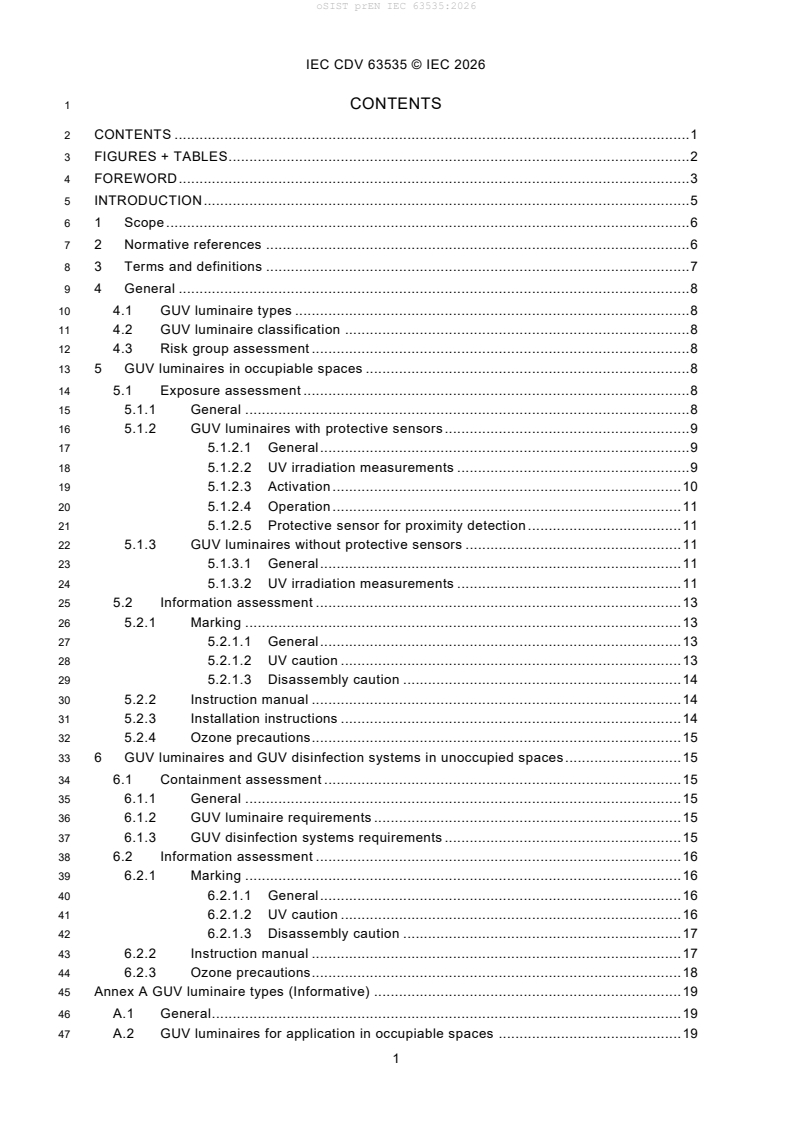
1 CONTENTS
2 CONTENTS . 1
3 FIGURES + TABLES . 2
4 FOREWORD . 3
5 INTRODUCTION . 5
6 1 Scope . 6
7 2 Normative references . 6
8 3 Terms and definitions . 7
9 4 General . 8
10 4.1 GUV luminaire types . 8
11 4.2 GUV luminaire classification . 8
12 4.3 Risk group assessment . 8
13 5 GUV luminaires in occupiable spaces . 8
14 5.1 Exposure assessment . 8
15 5.1.1 General . 8
16 5.1.2 GUV luminaires with protective sensors . 9
17 5.1.2.1 General . 9
18 5.1.2.2 UV irradiation measurements . 9
19 5.1.2.3 Activation . 10
20 5.1.2.4 Operation . 11
21 5.1.2.5 Protective sensor for proximity detection . 11
22 5.1.3 GUV luminaires without protective sensors . 11
23 5.1.3.1 General . 11
24 5.1.3.2 UV irradiation measurements . 11
25 5.2 Information assessment . 13
26 5.2.1 Marking . 13
27 5.2.1.1 General . 13
28 5.2.1.2 UV caution . 13
29 5.2.1.3 Disassembly caution . 14
30 5.2.2 Instruction manual . 14
31 5.2.3 Installation instructions . 14
32 5.2.4 Ozone precautions . 15
33 6 GUV luminaires and GUV disinfection systems in unoccupied spaces . 15
34 6.1 Containment assessment . 15
35 6.1.1 General . 15
36 6.1.2 GUV luminaire requirements . 15
37 6.1.3 GUV disinfection systems requirements . 15
38 6.2 Information assessment . 16
39 6.2.1 Marking . 16
40 6.2.1.1 General . 16
41 6.2.1.2 UV caution . 16
42 6.2.1.3 Disassembly caution . 17
43 6.2.2 Instruction manual . 17
44 6.2.3 Ozone precautions . 18
45 Annex A GUV luminaire types (Informative) . 19
46 A.1 General . 19
47 A.2 GUV luminaires for application in occupiable spaces . 19
IEC CDV 63535 © IEC 2026
48 A.2.1 GUV luminaires with protective sensors . 19
49 A.2.2 GUV luminaires without protective sensors . 19
50 A.3 GUV luminaires for application in unoccupied spaces . 19
51 Annex B (Informative) Application assessment . 20
52 Annex C (Normative) Safety-related electronic circuit (SREC) requirements . 21
53 C.1 General . 21
54 C.2 Reliability evaluation . 21
55 C.2.1 General . 21
56 C.2.2 Test conditions . 21
57 C.2.3 Requirements related to functional safety . 22
58 C.3 Design review . 22
59 Bibliography . 24
60 FIGURES + TABLES
61 Figure 1: Overview of GUV luminaire types . 8
62 Figure 2: Illustration of exempt perimeters for GUV luminaires with protective sensors . 10
63 Table 1: Maximum Allowed Operating Cycle Time by Risk Group . 11
64 Figure 3: General test setup for fixed GUV luminaires without protective sensors. . 12
65 Figure 4a: Label for RG-1 GUV luminaires . 13
66 Figure 4b: Label for RG-2 GUV luminaires . 13
67 Figure 4c: Label for RG-3 GUV luminaires . 14
68 Figure 4: Labels for marking RG-1, RG-2 and RG-3 GUV luminaires . 14
69 _Toc217049610
70 _Toc217049611
71 _Toc217049612
72 Figure 5: Labels for marking RG-1, RG-2 and RG-3 GUV luminaires . 17
IEC CDV 63535 © IEC 2026
74 INTERNATIONAL ELECTROTECHNICAL COMMISSION
75 ____________
76 Germicidal equipment
77 -
78 GERMICIDAL UV LUMINAIRES
79 -
80 Radiation safety
83 FOREWORD
84 1) The International Electrotechnical Commission (IEC) is a worldwide organization for standardization comprising
85 all national electrotechnical committees (IEC National Committees). The object of IEC is to promote international
86 co-operation on all questions concerning standardization in the electrical and electronic fields. To this end and
87 in addition to other activities, IEC publishes International Standards, Technical Specifications, Technical Reports,
88 Publicly Available Specifications (PAS) and Guides (hereafter referred to as “IEC Publication(s)”). Their
89 preparation is entrusted to technical committees; any IEC National Committee interested in the subject dealt with
90 may participate in this preparatory work. International, governmental and non-governmental organizations liaising
91 with the IEC also participate in this preparation. IEC collaborates closely with the International Organization for
92 Standardization (ISO) in accordance with conditions determined by agreement between the two organizations.
93 2) The formal decisions or agreements of IEC on technical matters express, as nearly as possible, an international
94 consensus of opinion on the relevant subjects since each technical committee has representation from all
95 interested IEC National Committees.
96 3) IEC Publications have the form of recommendations for international use and are accepted by IEC National
97 Committees in that sense. While all reasonable efforts are made to ensure that the technical content of IEC
98 Publications is accurate, IEC cannot be held responsible for the way in which they are used or for any
99 misinterpretation by any end user.
100 4) In order to promote international uniformity, IEC National Committees undertake to apply IEC Publications
101 transparently to the maximum extent possible in their national and regional publications. Any divergence between
102 any IEC Publication and the corresponding national or regional publication shall be clearly indicated in the latter.
103 5) IEC itself does not provide any attestation of conformity. Independent certification bodies provide conformity
104 assessment services and, in some areas, access to IEC marks of conformity. IEC is not responsible for any
105 services carried out by independent certification bodies.
106 6) All users should ensure that they have the latest edition of this publication.
107 7) No liability shall attach to IEC or its directors, employees, servants or agents including individual experts and
108 members of its technical committees and IEC National Committees for any personal injury, property damage or
109 other damage of any nature whatsoever, whether direct or indirect, or for costs (including legal fees) and
110 expenses arising out of the publication, use of, or reliance upon, this IEC Publication or any other IEC
111 Publications.
112 8) Attention is drawn to the Normative references cited in this publication. Use of the referenced publications is
113 indispensable for the correct application of this publication.
114 9) Attention is drawn to the possibility that some of the elements of this IEC Publication may be the subject of patent
115 rights. IEC shall not be held responsible for identifying any or all such patent rights.
116 IEC 63535 has been prepared by IEC technical committee 34: LIGHTING. It is an International
117 Standard.
118 The text of this International Standard is based on the following documents:
Draft Report on voting
XX/XX/FDIS XX/XX/RVD
120 Full information on the voting for its approval can be found in the report on voting indicated in
121 the above table.
122 The language used for the development of this International Standard is English.
123 This document was drafted in accordance with ISO/IEC Directives, Part 2, and developed in
124 accordance with ISO/IEC Directives, Part 1 and ISO/IEC Directives, IEC Supplement, available
IEC CDV 63535 © IEC 2026
125 at www.iec.ch/members_experts/refdocs. The main document types developed by IEC are
126 described in greater detail at www.iec.ch/publications.
127 The committee has decided that the contents of this document will remain unchanged until the
128 stability date indicated on the IEC website under webstore.iec.ch in the data related to the
129 specific document. At this date, the document will be
130 • reconfirmed,
131 • withdrawn,
132 • replaced by a revised edition, or
133 • amended.
IEC CDV 63535 © IEC 2026
135 INTRODUCTION
136 Germicidal UV (GUV) luminaires and systems comprising GUV luminaires intentionally emit UV
137 radiation into the surrounding area for disinfection purposes. Mitigation of the resulting
138 consequences of this UV radiation to humans and the surroundings is necessary.
139 Regarding the impact of intentional UV emission on humans this document will refer to available
140 information from the IEC 62471 series and offer complimentary requirements for specific TC 34
141 products and systems aspects.
142 This document is intended to serve as a general document for referencing radiation safety
143 aspects by TC / SC 34 product and systems standards covering all safety aspects. Additional
144 details for the radiation safety assessment and data presentation are specified in the product
145 and systems standards.
IEC CDV 63535 © IEC 2026
147 Germicidal equipment
148 -
149 Germicidal UV luminaires
150 -
151 Radiation safety
153 1 Scope
154 This document specifies radiation safety requirements for Germicidal UV (GUV) luminaires,
155 incorporating UV sources, and systems comprising GUV luminaires, which intentionally emit UV
156 radiation between 180 nm and 400 nm into the surroundings.
157 This document also specifies safety requirements regarding radiation-induced ozone.
158 This document does not cover other product safety aspects.
159 This document is applicable to GUV luminaires used for whole room GUV disinfection in both
160 occupiable and unoccupied spaces.
161 This document does not apply to:
*
162 – handheld GUV luminaires
163 – devices with self-contained UV radiation (not intentionally emitting UV radiation from the
164 device), e. g. air cleaners with contained UV, biological safety cabinets and disinfection
165 cabinets
166 – requirements for performance and functional characteristics
167 – requirements for preventing material degradation and material damage
168 Note 1: The biological impact of ultraviolet radiation which is most effective on pathogen inactivation found in GUV
169 luminaries primarily emit in the UV-C range between 180 nm and 280 nm wavelengths. The UV-B and UV-A
170 wavelengths between 280 nm and 400 nm tend to be less effective at inactivating pathogens.
171 Note 2: This document is intended to serve as a general document for referencing radiation safety aspects by
172 TC / SC 34 product and systems standards covering all safety aspects. Additional details for the radiation safety
173 assessment and data presentation are specified in the product and systems standards.
174 2 Normative references
175 The following documents are referred to in the text in such a way that some or all of their content
176 constitutes requirements of this document. For dated references, only the edition cited applies.
177 For undated references, the latest edition of the referenced document (including any
178 amendments) applies.
179 IEC 60417, Graphical symbols for use on equipment
180 IEC 60730-1:2022, Automatic electrical controls - Part 1: General requirements
181 IEC 62046, Safety of machinery – Application of protective equipment to detect the presence
182 of persons
183 IEC 62471, Photobiological safety of lamps and lamp systems
___________
*
Safety requirements for handheld devices are covered by a separate document: IEC 63628 ED1 under development.
IEC CDV 63535 © IEC 2026
184 IEC 62471-7, Photobiological safety of lamps and lamp systems - Part 7: Light sources and
185 luminaires primarily emitting visible radiation
186 ISO 15858, UV-C Devices - Safety information – Permissible human exposure
187 3 Terms and definitions
188 For the purposes of this document, the terms and definitions given in IEC 60050-845 and the
189 following apply.
190 ISO and IEC maintain terminology databases for use in standardization at the following
191 addresses:
192 • IEC Electropedia: available at https://www.electropedia.org/
193 • ISO Online browsing platform: available at https://www.iso.org/obp
194 3.1
195 germicidal UV luminaire
196 GUV luminaire
197 apparatus for germicidal purposes which distributes, filters or transforms UV radiation from at
198 least one UV source, and which includes all parts necessary for fixing and protecting the UV
199 source and, where necessary, circuit auxiliaries together with the means for connecting them
200 to the power supply
201 [SOURCE: IEC 60050-845; 845-30-001:2020 modified to refer to UV and skipping explicit
202 reference to source exclusion]
203 3.2
204 occupiable space
205 space where humans can be exposed to UV radiation from GUV luminaires in operation
206 3.3
207 unoccupied space
208 space where humans cannot be exposed to UV radiation from GUV luminaires in operation
209 Note to entry: When a GUV luminaire also includes an illumination function conforming to the requirements of
210 IEC 62471-7 and the GUV radiation is switched off, humans can be present in this space.
211 3.4
212 exempt perimeter
213 boundary around the GUV luminaire formed by the line-of-sight distance from its geometric
214 center to the horizontal points where UV emissions are assessed as Exempt group (RG-0) for
215 actinic UV and near-UV hazards
216 Note 1 to entry: By definition, persons standing at the edge of this boundary do not require additional safeguards
217 against UV overexposure, as defined by IEC 62471, when the GUV luminaire is operating.
218 Note 2 to entry: The perimeter’s shape will depend on device design and can be non-circular or asymmetrical.
219 3.5
220 mounting height
221 vertical distance between the lowest point of emissive surface on the device to the floor
IEC CDV 63535 © IEC 2026
222 4 General
223 4.1 GUV luminaire types
224 An overview of the types of GUV luminaires considered in this document is shown in Figure 1.
225 A description of these GUV luminaire types is given in Annex A.
227 Figure 1: Overview of GUV luminaire types
228 4.2 GUV luminaire classification
229 GUV luminaires shall be classified according to their intended application , as:
230 – luminaire for occupiable spaces
231 – luminaire for unoccupied spaces
232 4.3 Risk group assessment
233 The GUV luminaire shall be classified according to IEC 62471 as Exempt group (RG-0), Risk
234 group 1 (RG-1, Low-Risk), Risk Group 2 (RG-2, Moderate-Risk) or Risk Group 3 (RG-3, High-
235 Risk) for Actinic UV (180 nm – 400 nm) and Near-UV (315 – 400 nm) at 200 mm from the
236 radiation emitting surface.
237 Controls that can interrupt the operation of the GUV luminaire or reduce the amount of radiation
238 shall be disabled during the risk group assessment.
239 Note: When making measurements, appropriate measures need to be taken to protect eyes and skin.
240 5 GUV luminaires in occupiable spaces
241 5.1 Exposure assessment
242 5.1.1 General
243 The GUV luminaire shall not pose a risk of personal injury to persons due to UV overexposure
244 when installed and operated as intended when persons remain in the occupiable space.
245 If according to the risk group assessment of clause 4.3, GUV luminaires are classified Exempt
246 group (RG-0), these luminaires can be installed and used without further precautions.
247 If according to the risk group assessment of clause 4.3, GUV luminaires are classified Risk
248 group 1 (RG-1, Low-Risk), Risk group 2 (RG-2, Moderate-Risk) or Risk group 3 (RG-3, High-
IEC CDV 63535 © IEC 2026
249 Risk), these luminaires are installed with further applicable precautions and these precautions
250 are checked according to the UV irradiation measurements in the following clauses .
251 The UV irradiation measurements shall be done according to IEC 62471. The requirements
252 provided below also account for considerations of IEC 62471-6.
253 Note: IEC 62471 and all associated IEC, ISO and CIE standards currently reference the ICNIRP 2004 guidelines on
254 limits of exposure to ultraviolet radiation. Other limits, like the exposure limits offered in ACGIH:2022 can be used if
255 they are approved by ICNIRP.
256 GUV luminaires that are designed having an illumination purpose also shall comply with
257 IEC 62471-7 with the GUV radiation deactivated during assessment.
258 Measurements shall be made in a room with non-reflective surfaces in the UV wavelength
259 range.
260 Portable GUV luminaires shall be equipped with at least one protective sensor.
261 Clause 5.1.2 covers GUV luminaires with protective sensors and clause 5.1.3 covers
262 GUV luminaires without protective sensors.
263 5.1.2 GUV luminaires with protective sensors
264 5.1.2.1 General
265 GUV luminaires with protective sensors applied in occupiable spaces shall comply with the
266 requirements of the following clauses.
267 5.1.2.2 UV irradiation measurements
268 Details for specific GUV luminaires with protective sensors on UV irradiation measurements are
269 as follows.
270 Figure 2 illustrates the concept of exempt perimeter for some GUV luminaires with protective
271 sensors. These GUV luminaires are typically positioned in the occupiable space.
IEC CDV 63535 © IEC 2026
273 Figure 2: Illustration of exempt perimeters for GUV luminaires with protective sensors
274 The GUV luminaire being tested shall be installed in accordance with the installation
275 instructions. The GUV luminaire shall be oriented and operated to produce the most severe test
276 result permitted by its construction and installation instructions. In addition, the GUV luminaire
†
277 shall be offset from its intended mounting surface angle by 1 degree whenever such an offset
278 is likely to produce a more severe test result.
279 Measurements shall be conducted at a distance from the radiation source equal to the emitter’s
280 exempt perimeter in the direction likely to produce the worst-case test result. The equipment
281 shall be oriented and operated to produce the worst-case test result permitted by its
282 construction. The entire exempt perimeter is required to be covered by the detection boundary
283 of the protective sensor.
284 When compliance with the photobiological assessment relies on controls or timing circuits to
285 continuously operate the UV source on a duty cycle, or to vary the drive current or power to the
286 GUV luminaire over time, then the control shall be additionally evaluated as a safety -related
287 component (see also clause 5.1.2.5). All other controls intended to interrupt equipment
288 operation, like protective sensors, shall be bypassed or disabled so that the equipment will
289 operate continuously during the photobiological assessment.
290 The measured irradiance shall meet Exempt group (RG-0) at the declared exempt perimeter.
291 5.1.2.3 Activation
292 The control function shall address the following during the activation of GUV luminaires with
293 protective sensors.
294 – GUV luminaires with protective sensors shall have an integral control that employs a
295 delayed-start timer to permit users to leave the treated space before the operation is
296 (re)initiated.
___________
†
The intended mounting surface for a ceiling mounted product is horizontal and for a wall mounted product is vertical.
The offset is introduced to account for surface irregularities tilting the luminaire from its intended orientation.
IEC CDV 63535 © IEC 2026
297 – The delayed-start function time duration shall be no less than 30 seconds and no more than
298 5 minutes. The time duration shall be marked or displayed on the equipment at a location
299 that is evident to the user during equipment activation.
300 Note: A display that indicates the remaining time (countdown) to the operating cycle
...