


prEN IEC 60079-46:2025
(Main)Explosive atmospheres - Part 46: Equipment assemblies
General Information
- Abstract
- Status
- Not Published
- Publication Date
- 24-Jan-2027
- Technical Committee
- CLC/TC 31 - Electrical apparatus for explosive atmospheres - General requirements
- Drafting Committee
- IEC/TC 31 - Electrical apparatus for potentially explosive atmospheres
- Current Stage
- 4060 - Enquiry results established and sent to TC, SR, BTTF - Enquiry
- Start Date
- 26-Sep-2025
- Completion Date
- 26-Sep-2025

Overview
prEN IEC 60079-46:2025 - "Explosive atmospheres - Part 46: Equipment assemblies" is a CLC/IEC committee draft (CDV) for a first-edition standard that upgrades IEC TS 60079-46:2017 into a full IEC standard. It defines requirements for the design, construction, testing, documentation and marking of electrical and non-electrical equipment assemblies intended for use in explosive atmospheres. The document addresses assemblies that may be entirely or partially within hazardous areas and clarifies manufacturer responsibilities, competency, and certification expectations.
Key topics and technical requirements
- Scope and definitions: clarifies what constitutes an equipment assembly, Ex components and the role of the assembly manufacturer.
- General requirements: explosion protection details, degree of protection (IP code), ambient temperature and manufacturing date information.
- Design: ignition hazard assessment, Ex equipment interactions, calculations (examples listed), wiring systems and drawings.
- Item list & Schedule of Limitations: listing individual items, applicable Ex certificates, specific conditions of use and limitations for the assembly.
- Construction & assembly: system interfaces, inspection, testing, and rules for disassembly/reassembly and validation.
- Type and routine testing: consolidated test requirements for assemblies (new clause added).
- Certification & documentation: certificate content must identify items without their own Ex certificate and reference applicable IEC/ISO standards; it may need to note clauses of IEC 60079-14 that are not satisfied.
- Marking: guidance for marking assembly manufacturer, Equipment Protection Level (EPL), equipment group, temperature class/maximum surface temperature, ambient range and IP code, including cases with portions of an assembly having different Ex ratings.
- Annex A (informative): application examples and guidance on hazardous area classification related to assembly configurations.
Applications and who uses it
This standard is practical for:
- Manufacturers and system integrators creating packaged equipment assemblies for hazardous locations.
- Design and electrical engineers performing ignition-hazard assessments, wiring and enclosure design.
- Certification bodies and conformity assessors evaluating Ex assembly compliance and documentation.
- Safety managers and installers responsible for site classification, installation instructions and maintenance. The standard helps ensure assemblies meet recognized safety, marking and testing requirements for use in explosive atmospheres and supports regulatory compliance and market access (IEC/CENELEC contexts).
Related standards
- IEC 60079-0 (general requirements for Ex equipment)
- IEC 60079-14 (installation requirements) - clauses not satisfied should be identified
- ISO/IEC 80079 series (where applicable) (Note: IEC 60079-34 was clarified as not applicable to all applications in this revision.)
Keywords: explosive atmospheres, equipment assemblies, IEC 60079-46, Ex equipment, hazardous area classification, ignition hazard assessment, Equipment Protection Level, EPL, IP code, type testing, certification.
Get Certified
Connect with accredited certification bodies for this standard

IMQ S.p.A. (Certification)
Italian electrical product certification.

SLG Prüf- und Zertifizierungs GmbH
German testing and certification body.

UL Solutions
Global safety science company with testing, inspection and certification.
Sponsored listings
Frequently Asked Questions
prEN IEC 60079-46:2025 is a draft published by CLC. Its full title is "Explosive atmospheres - Part 46: Equipment assemblies". This standard covers: Explosive atmospheres - Part 46: Equipment assemblies
Explosive atmospheres - Part 46: Equipment assemblies
prEN IEC 60079-46:2025 is classified under the following ICS (International Classification for Standards) categories: 29.260.20 - Electrical apparatus for explosive atmospheres. The ICS classification helps identify the subject area and facilitates finding related standards.
prEN IEC 60079-46:2025 is available in PDF format for immediate download after purchase. The document can be added to your cart and obtained through the secure checkout process. Digital delivery ensures instant access to the complete standard document.
Standards Content (Sample)
SLOVENSKI STANDARD
01-september-2025
Eksplozivne atmosfere - 46. del: Sklopi opreme
Explosive atmospheres - Part 46: Equipment assemblies
Atmosphères explosives - Partie 46: Assemblages d'appareils
Ta slovenski standard je istoveten z: prEN IEC 60079-46:2025
ICS:
29.260.20 Električni aparati za Electrical apparatus for
eksplozivna ozračja explosive atmospheres
2003-01.Slovenski inštitut za standardizacijo. Razmnoževanje celote ali delov tega standarda ni dovoljeno.
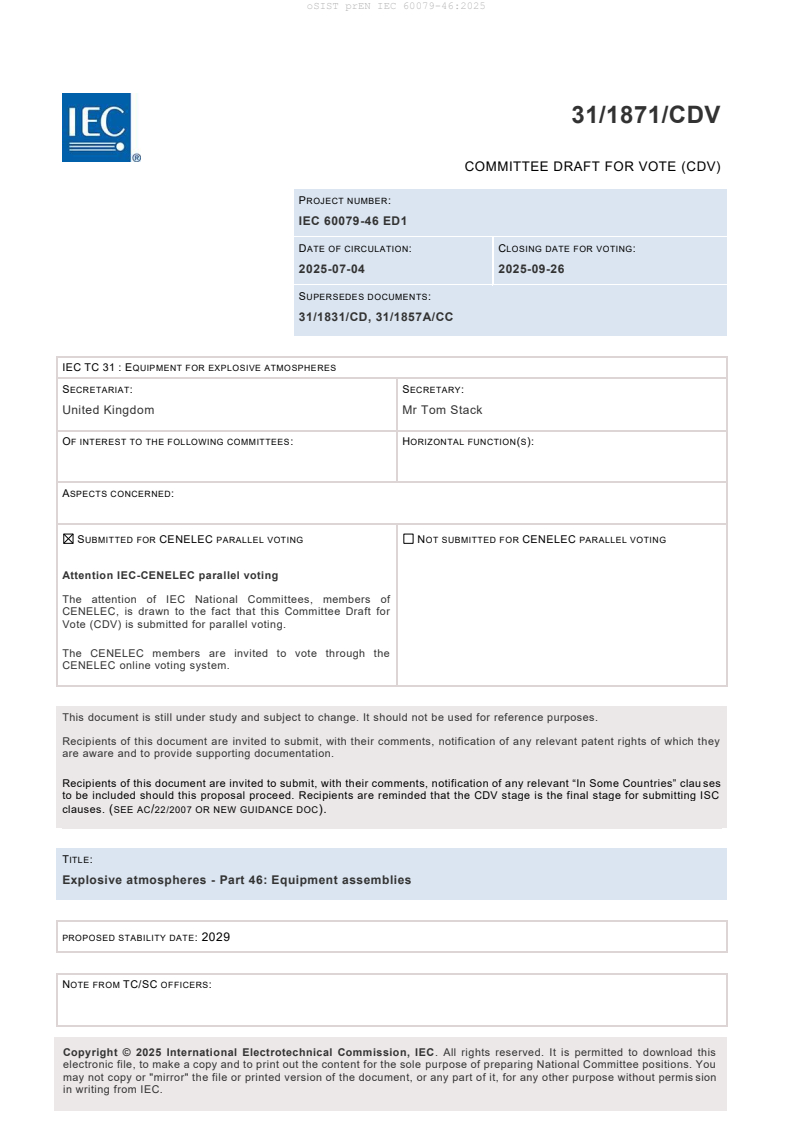
31/1871/CDV
COMMITTEE DRAFT FOR VOTE (CDV)
PROJECT NUMBER:
IEC 60079-46 ED1
DATE OF CIRCULATION: CLOSING DATE FOR VOTING:
2025-07-04 2025-09-26
SUPERSEDES DOCUMENTS:
31/1831/CD, 31/1857A/CC
IEC TC 31 : EQUIPMENT FOR EXPLOSIVE ATMOSPHERES
SECRETARIAT: SECRETARY:
United Kingdom Mr Tom Stack
OF INTEREST TO THE FOLLOWING COMMITTEES: HORIZONTAL FUNCTION(S):
ASPECTS CONCERNED:
SUBMITTED FOR CENELEC PARALLEL VOTING NOT SUBMITTED FOR CENELEC PARALLEL VOTING
Attention IEC-CENELEC parallel voting
The attention of IEC National Committees, members of
CENELEC, is drawn to the fact that this Committee Draft for
Vote (CDV) is submitted for parallel voting.
The CENELEC members are invited to vote through the
CENELEC online voting system.
This document is still under study and subject to change. It should not be used for reference purposes.
Recipients of this document are invited to submit, with their comments, notification of any relevant patent rights of which they
are aware and to provide supporting documentation.
Recipients of this document are invited to submit, with their comments, notification of any relevant “In Some Countries” clau ses
to be included should this proposal proceed. Recipients are reminded that the CDV stage is the final stage for submitting ISC
clauses. (SEE AC/22/2007 OR NEW GUIDANCE DOC).
TITLE:
Explosive atmospheres - Part 46: Equipment assemblies
PROPOSED STABILITY DATE: 2029
NOTE FROM TC/SC OFFICERS:
electronic file, to make a copy and to print out the content for the sole purpose of preparing National Committee positions. You
may not copy or "mirror" the file or printed version of the document, or any part of it, for any other purpose without permis sion
in writing from IEC.
IEC CDV 60070-46 © IEC 2025
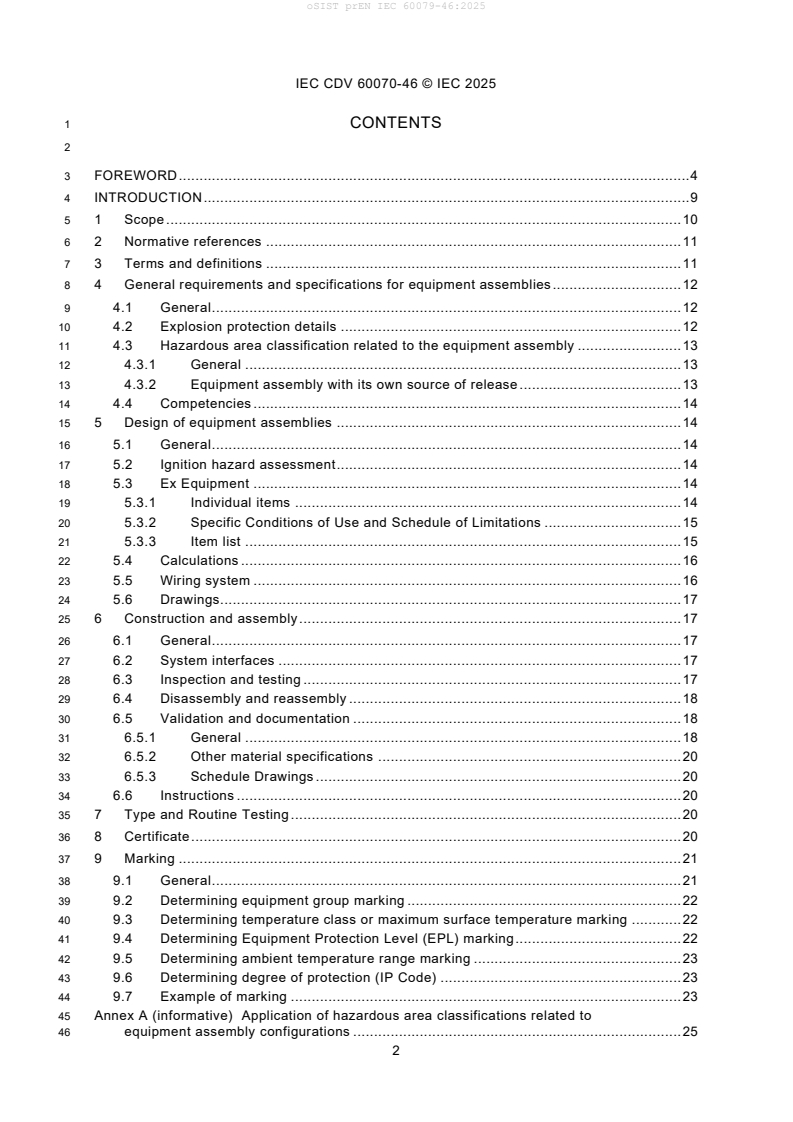
1 CONTENTS
3 FOREWORD . 4
4 INTRODUCTION . 9
5 1 Scope . 10
6 2 Normative references . 11
7 3 Terms and definitions . 11
8 4 General requirements and specifications for equipment assemblies . 12
9 4.1 General . 12
10 4.2 Explosion protection details . 12
11 4.3 Hazardous area classification related to the equipment assembly . 13
12 4.3.1 General . 13
13 4.3.2 Equipment assembly with its own source of release . 13
14 4.4 Competencies . 14
15 5 Design of equipment assemblies . 14
16 5.1 General . 14
17 5.2 Ignition hazard assessment . 14
18 5.3 Ex Equipment . 14
19 5.3.1 Individual items . 14
20 5.3.2 Specific Conditions of Use and Schedule of Limitations . 15
21 5.3.3 Item list . 15
22 5.4 Calculations . 16
23 5.5 Wiring system . 16
24 5.6 Drawings. 17
25 6 Construction and assembly . 17
26 6.1 General . 17
27 6.2 System interfaces . 17
28 6.3 Inspection and testing . 17
29 6.4 Disassembly and reassembly . 18
30 6.5 Validation and documentation . 18
31 6.5.1 General . 18
32 6.5.2 Other material specifications . 20
33 6.5.3 Schedule Drawings . 20
34 6.6 Instructions . 20
35 7 Type and Routine Testing . 20
36 8 Certificate . 20
37 9 Marking . 21
38 9.1 General . 21
39 9.2 Determining equipment group marking . 22
40 9.3 Determining temperature class or maximum surface temperature marking . 22
41 9.4 Determining Equipment Protection Level (EPL) marking. 22
42 9.5 Determining ambient temperature range marking . 23
43 9.6 Determining degree of protection (IP Code) . 23
44 9.7 Example of marking . 23
45 Annex A (informative) Application of hazardous area classifications related to
46 equipment assembly configurations . 25
IEC CDV 60070-46 © IEC 2025
47 A.1 General . 25
48 A.2 Example equipment assembly configurations . 25
49 A.2.1 Example 1 . 25
50 A.2.2 Example 2 . 25
51 A.2.3 Example 3 . 26
52 A.2.4 Example 4 . 27
53 A.2.5 Example 5 . 28
54 A.3 Verifying area classifications . 28
55 Bibliography . 29
57 Figure A.2 – Source of release associated with the assembly, Hazardous area
58 classified due to this source of release does not extend beyond assembly boundaries,
59 and Intended to be installed in a hazardous area classified due to a source of release
60 external to the assembly . 26
61 Figure A.3 – Source of release associated with the assembly, Hazardous area
62 classified due to this source of release extends beyond assembly boundaries, and
63 Intended to be installed in a hazardous area classified due to a source of release
64 external to the assembly . 27
65 Figure A.4 – Source of release associated with the assembly, and Intended to be
66 installed in a hazardous area classified due to the source of release associated with
67 the assembly . 27
68 Figure A.5 – Source of release associated with the assembly, but Not intended to be
69 installed in a hazardous area classified due to any source of release external to the
70 assembly . 28
IEC CDV 60070-46 © IEC 2025
73 INTERNATIONAL ELECTROTECHNICAL COMMISSION
74 ____________
76 EXPLOSIVE ATMOSPHERES –
78 Part 46: Equipment Assemblies
80 FOREWORD
81 1) The International Electrotechnical Commission (IEC) is a worldwide organization for
82 standardization comprising all national electrotechnical committees (IEC National Committees).
83 The object of IEC is to promote international co-operation on all questions concerning
84 standardization in the electrical and electronic fields. To this end and in addition to other
85 activities, IEC publishes International Standards, Technical Specifications, Technical Reports,
86 Publicly Available Specifications (PAS) and Guides (hereafter referred to as “IEC
87 Publication(s)”). Their preparation is entrusted to technical committees; any IEC National
88 Committee interested in the subject dealt with may participate in this preparatory work.
89 International, governmental and non-governmental organizations liaising with the IEC also
90 participate in this preparation. IEC collaborates closely with the International Organization for
91 Standardization (ISO) in accordance with conditions determined by agreement between the two
92 organizations.
93 2) The formal decisions or agreements of IEC on technical matters express, as nearly as
94 possible, an international consensus of opinion on the relevant subjects since each technical
95 committee has representation from all interested IEC National Committees.
96 3) IEC Publications have the form of recommendations for international use and are
97 accepted by IEC National Committees in that sense. While all reasonable efforts are made to
98 ensure that the technical content of IEC Publications is accurate, IEC cannot be held
99 responsible for the way in which they are used or for any misinterpretation by any end user.
100 4) In order to promote international uniformity, IEC National Committees undertake to apply
101 IEC Publications transparently to the maximum extent possible in their national and regional
102 publications. Any divergence between any IEC Publication and the corresponding national or
103 regional publication shall be clearly indicated in the latter.
104 5) IEC itself does not provide any attestation of conformity. Independent certification
105 bodies provide conformity assessment services and, in some areas, access to IEC marks of
106 conformity. IEC is not responsible for any services carried out by independent certification
107 bodies.
108 6) All users should ensure that they have the latest edition of this publication.
109 7) No liability shall attach to IEC or its directors, employees, servants or agents including
110 individual experts and members of its technical committees and IEC National Committees for
111 any personal injury, property damage or other damage of any nature whatsoever, whether direct
112 or indirect, or for costs (including legal fees) and expenses arising out of the publication, use
113 of, or reliance upon, this IEC Publication or any other IEC Publications.
114 8) Attention is drawn to the Normative references cited in this publication. Use of the
115 referenced publications is indispensable for the correct application of this publication.
116 9) Attention is drawn to the possibility that some of the elements of this IEC Publication
117 may be the subject of patent rights. IEC shall not be held responsible for identifying any or all
118 such patent rights.
120 International Standard IEC 60079-46 has been prepared by IEC technical committee TC 31:
121 Equipment for explosive atmospheres.
122 This first edition cancels and replaces the first edition of IEC TS 60079-46 published in 2017
123 and constitutes a technical revision.
IEC CDV 60070-46 © IEC 2025
124 Users of this document are advised that interpretation sheets clarifying the interpretation of this
125 document can be published. Interpretation sheets are available from the IEC webstore and can
126 be found in the “history” tab of the page for each document.
127 The significance of changes between IEC Technical Specification, IEC TS 60079-46:2017 are
128 as listed below:
Type
Major
Minor and
Changes Clause editorial Extension technical
changes
changes
Updated from technical
Annex A X
specification to standard
Scope extension equipment
assembly could be entirely or Annex A X
partially within a hazardous area.
Clarification of applications
Annex A X
outside the scope of this standard.
Clarification to remove IEC 60079-
34 as this is not applicable to all 2 X
applications
Clarification that an assembly has
3.1 X
Ex Components.
Added definition of manufacturer
3.4 X
for clarity.
Moved specifications in clause 4.1
4 X
to 4 for clarity.
Renamed Ingress Protection to
4.1 X
degree of protection (IP Code).
Clarified it is not relevant who
provides the general specifications 4.1 X
and included a new note.
Added manufacturing date. 4.1 X
Added more examples for process
4.1 X
conditions.
Changed title from “specification”
4.2 X
to “details”.
Reworded documentation
4.2 X
requirements for clarity.
Added paragraph to address
equipment assemblies with
different EPL specifications 4.2 X
including equipment partially in a
non-hazardous area.
Moved requirements into a list. 4.3.1 X
Clarified requirement to verify area
classification methodology due to 4.3.1 C1
internal sources of release.
Clarified documentation
requirement for area classification
4.3.2 C1
methodology due to internal
sources of release.
Reworded for clarity. 4.4 X
Reworded for clarity to reference
5.1 X
4.1.
IEC CDV 60070-46 © IEC 2025
Clarified non-electrical Ex
Equipment shall also be accounted 5.1 X
for.
Moved Ignition hazard assessment
from 6.4 to 5.2 and reworded for 5.2 X
clarity.
Combined “other items” into “item
5.3 X
list”.
Added Schedule of Limitations to
5.3.2 X
clause title for clarity.
Included conditions and limitations
related to the Ex Equipment or Ex
Component certificate and 5.3.2 X
conditions related to the Ex
Equipment Assembly.
Reworded for clarity and renamed
“ingress protection” to “degree of 5.3.3 X
protection (IP Code)”.
Moved calculations from 6.5 to 5.4
5.4 X
and included list of examples.
Reworded for clarity. 5.5 X
Added examples for drawings and
5.6 X
note for clarity.
Reworded for clarity. 6.1 X
Clarified references. 6.2 X
Reworded to clarify manufacturer’s
6.3 X
responsibility.
Reworded for clarity. 6.5.1 X
Clarified that non-conformances
6.5.1 X
are recorded and corrected.
Clarified competencies, schedule
of limitations, and clarified ignition 6.5.1 X
hazard results.
Changed title from Schedule
6.5.3 X
“documents” to “drawings”.
Added requirements for assembly
and disassembly and descriptions 6.6 X
of the assembly.
Added requirements for portions of
the Ex Equipment assembly with 6.6 C1
different Ex ratings.
Added new section “Type and
Routine Testing” to consolidate 7 X
testing requirements.
Added requirement to identify
items without its own Ex certificate
8 C2
to be included in the Ex Assembly
Certificate.
Added requirement to include IEC
60079-46, IEC 60079-0, and other
8 C3
IEC 60079 series and ISO/IEC
80079 series as applicable.
Revised requirement to include
clauses of IEC 60079-14 that have 8 C4
not been satisfied.
Clarified assembly manufacturer
9.1 X
name marking.
IEC CDV 60070-46 © IEC 2025
Added requirements for portions of
the Ex Equipment assembly with 9.1 C1
different Ex ratings.
Added “equipment” to clause title. 9.2 X
Added requirements for portions of
the Ex Equipment assembly with 9.2 C1
different Ex ratings.
Added requirements for portions of
the Ex Equipment assembly with 9.3 C1
different Ex ratings.
Added requirements for portions of
the Ex Equipment assembly with 9.4 C1
different Ex ratings.
Added requirements for portions of
the Ex Equipment assembly with 9.5 C1
different Ex ratings.
Revised title from “ingress
protection” to “degree of 9.6 X
protection”.
Added examples of marking. 9.7 X
Added application examples in
Annex A X
Annex A (informative)
129 NOTE The technical changes referred to include the significance of technical changes in the revised IEC Standard,
130 but they do not form an exhaustive list of all modifications from the previous version.
131 Explanation of the types of changes:
132 A) Definitions
133 1. Minor and editorial changes:
134 • Clarification
135 • Decrease of technical requirements
136 • Minor technical change
137 • Editorial corrections
138 These are changes which modify requirements in an editorial or a minor technical way. They
139 include changes of the wording to clarify technical requirements without any technical change,
140 or a reduction in level of existing requirement.
141 2. Extension: Addition of technical options
142 These are changes which add new or modify existing technical requirements, in a way that new
143 options are given, but without increasing requirements for equipment that was fully compliant
144 with the previous standard. Therefore, these will not have to be considered for products in
145 conformity with the preceding edition.
146 3. Major technical changes:
147 • addition of technical requirements
148 • increase of technical requirements
149 These are changes to technical requirements (addition, increase of the level or removal) made
150 in a way that a product in conformity with the preceding edition will not always be able to fulfil
151 the requirements given in the later edition. These changes have to be considered for products
152 in conformity with the preceding edition. For these changes additional information is provided
153 in clause B below.
IEC CDV 60070-46 © IEC 2025
154 NOTE These changes represent current technological knowledge. However, these changes should not normally have
155 an influence on equipment already placed on the market.
156 B) Information about the background of ‘Major technical changes’
157 C1 Added a requirement to verify the area classification methodology and documentation
158 associated with an internal source of release. Prior Technical Specification did not include any
159 verification of area classification.
160 C2 Added requirement to include in the Ex Equipment Assembly certificate items identified by
161 the Ignition Hazard Assessment with an ignition source. This was previously required in
162 documentation but not in the certificate.
163 C3 Added requirement to include minimum standards on a certificate as it was previously
164 unspecified.
165 C4 Changed requirement to only include specific clauses of IEC 60079-14 that have not been
166 satisfied for alignment with conditions of use methodology. Prior requirement was to include all
167 specific clauses of IEC 60079-14 that have been satisfied.
168 The text of this International Standard is based on the following documents:
FDIS Report on voting
31/XX/FDIS 31/XX/RVD
169 Full information on the voting for the approval of this International Standard can be found in the
170 report on voting indicated in the above table.
171 This document has been drafted in accordance with the ISO/IEC Directives, Part 2.
172 A list of all parts in the IEC 60079 series, published under the general title Explosive
173 atmospheres, can be found on the IEC website.
174 The committee has decided that the contents of this document will remain unchanged until the
175 stability date indicated on the IEC website under "http://webstore.iec.ch" in the data related to
176 the specific document. At this date, the document will be
177 • reconfirmed,
178 • withdrawn,
179 • replaced by a revised edition, or
180 • amended.
181 A bilingual version of this publication may be issued at a later date.
182 IMPORTANT – The 'colour inside' logo on the cover page of this publication indicates
183 that it contains colours which are considered to be useful for the correct understanding
184 of its contents. Users should therefore print this document using a colour printer.
IEC CDV 60070-46 © IEC 2025
187 INTRODUCTION
188 The provision of products into end markets for installation by end users may take the form of
189 either individual items of equipment or pre-manufactured assemblies comprising many items of
190 equipment. Pre-manufactured equipment assemblies may be as either subsystems requiring
191 integration as part of an installation at a site or complete functional machines which require
192 little or no additional reassembly on site.
193 This document is applied when multiple pieces of equipment are combined to form an equipment
194 assembly that creates a need for additional assessment that is not already completely covered
195 by the individual equipment certificates. Additional assessment might include (but is not limited
196 to) evaluation of wiring methods used to connect the equipment(s) or temperature rise within
197 the equipment assembly.
198 This document provides requirements for the design, construction, assembly, testing, inspection,
199 marking, documenting and assessment of equipment assemblies such that the items of Ex
200 Equipment and the interconnection of the items of equipment form an equipment assembly that
201 also meets other parts of the IEC 60079 and ISO/IEC 80079 series.
202 This document includes the requirements for an ignition hazard assessment of the equipment
203 assembly, and a determination of how the hazards were mitigated in the equipment assembly.
204 For ignition hazards directly related to the equipment assembly, but not mitigated in the
205 equipment assembly, the documentation addresses how to mitigate the hazard in the end-user
206 site installation. This document is intended to be used for verification of assemblies to assist in
207 ensuring products are in compliance with the requirements of the IEC 60079 and ISO/IEC 80079
208 series at the time of initial installation at the end user site.
209 After the initial installation, the equipment assembly is considered as part of the site installation
210 in accordance with other parts of the IEC 60079 and ISO/IEC 80079 series.
IEC CDV 60070-46 © IEC 2025
212 EXPLOSIVE ATMOSPHERES –
214 Part 46: Equipment Assemblies
218 1 Scope
219 This part of IEC 60079 specifies requirements for the design, construction, assembly, testing,
220 inspection, marking, documenting and assessment of equipment assemblies for explosive
221 atmospheres. The equipment assembly could be entirely or partially within a hazardous area
222 due to sources of release on the equipment assembly or external to the equipment assembly.
223 The requirements of this document apply to individual items according to the IEC 60079 series
224 or ISO/IEC 80079 series that comprise the equipment assembly and that have individual
225 certificates. These individual items are then integrated as part of the equipment assembly. Also
226 included are requirements to address aspects for the equipment assembly which are beyond
227 the certificates of the individual items forming the equipment assembly.
228 The scope of this document includes assessment of the additional requirements for assemblies
229 for hazardous areas and does not include requirements for non-hazardous areas.
230 This document does not apply to:
231 a) Ex Equipment and Ex Components which are covered entirely, by one or more IEC 60079
232 and ISO/IEC 80079 equipment Types of Protection;
233 b) pressurized or ventilated rooms, “p”, ”v”, in accordance with IEC 60079-13, artificial
234 ventilation for the protection of analyzer(s) houses in accordance with IEC TR 60079 -16,
235 and other standards addressing specific Ex assemblies;
236 c) installation of the equipment assembly by the end-user at the installation site;
237 NOTE 1 The use of the term “installation” in this instance does not include activities under the responsibility of the
238 assembly manufacturer involving reassembly of the equipment assembly at the installation site.
239 d) classification of the hazardous area due to a potential source of release external to the
240 equipment assembly (see 4.3.1);
241 e) equipment assemblies for mines susceptible to firedamp (Group I applications) ;
242 f) inherently explosive situations such as dust from explosives or pyrophoric substances (for
243 example explosives manufacturing and processing);
244 g) rooms used for medical purposes;
245 h) electrical installations in areas where the hazard is due to flammable mist.
246 This document is only intended to provide validation for the equipment assembly as provided.
247 Any subsequent changes made after installation are not covered by this document and are the
248 responsibility of the end-user to meet the applicable local legal requirements.
249 NOTE 2 Additional guidance on the requirements for hazards due to hybrid mixtures of dust or flyings and flammable
250 gas or vapour is provided in IEC 60079-14.
251 Where a requirement of this document conflicts with a requirement of either IEC 60079-0 or
252 ISO 80079-36, the requirement of this document takes precedence. Where a requirement of
253 this document conflicts with a requirement of IEC 60079-14, the requirement of IEC 60079-14
254 takes precedence.
IEC CDV 60070-46 © IEC 2025
256 2 Normative references
257 The following documents are referred to in the text in such a way that some or all of their content
258 constitutes requirements of this document. For dated references, only the edition cited applies.
259 For undated references, the latest edition of the referenced document (including any
260 amendments) applies.
261 IEC 60079-0, Explosive atmospheres - Part 0: Equipment - General requirements
262 IEC 60079-10-1, Explosive atmospheres - Part 10-1: Classification of areas - Explosive gas
263 atmospheres
264 IEC 60079-10-2, Explosive atmospheres - Part 10-2: Classification of areas - Explosive dust
265 atmospheres
266 IEC 60079-14, Explosive atmospheres - Part 14: Electrical installations design, selection and
267 installation of equipment, including initial inspection.
268 ISO 80079-36, Explosive atmospheres – Part 36: Non-electrical equipment for explosive
269 atmospheres — Basic method and requirements
270 3 Terms and definitions
271 For the purposes of this document, the terms and definitions given in IEC 60079-0, IEC 60079-
272 14, ISO 80079-36 and the following apply.
273 ISO and IEC maintain terminological databases for use in standardization at the following
274 addresses:
275 • IEC Electropedia: available at http://www.electropedia.org/
276 • ISO Online browsing platform: available at http://www.iso.org/obp
277 3.1
278 equipment assembly
279 pre-manufactured combination of Ex Equipment and Ex Components, together with other parts
280 (also referred to as other items) as necessary, that are electrically or mechanically
281 interconnected and that are pre-assembled prior to being placed into service at the end-user
282 site
283 Note 1 to entry: This definition includes parts of an equipment assembly (for example, parts forming a sub-assembly)
284 that could be dissembled and then re-assembled at the end-user site.
285 3.2
286 equipment assembly certificate
287 document that conveys the assurance of the conformity of an equipment assembly with
288 specified requirements
289 Note 1 to entry The certificate is either the supplier’s declaration of conformity or the purchaser’s recognition of
290 conformity where acceptable, or certification (as a result of action by a third party) as defined in ISO/IEC 17000.
291 3.3
292 pre-manufactured
293 equipment assembly produced at any location(s) other than the end-user site
294 3.4
295 manufacturer
296 organization, situated at a stated location or locations, that carries out or controls such stages
297 in the manufacture, assessment, handling and storage of a product that enables it to accept
298 responsibility for continued compliance of the product with the relevant requirements and
299 undertakes all obligations in that connection
IEC CDV 60070-46 © IEC 2025
300 Note 1 to entry In this document, the manufacturer that builds an equipment assembly is referred to as an assembly
301 manufacturer (and might be referred to as a system integrator or packager by industry) and the manufacturer that
302 builds the equipment used as part of an equipment assembly is referred to as an equipment manufacturer.
303 Note 2 to entry A manufacturer could be both an equipment manufacturer and an assembly manufacturer.
304 [SOURCE: ISO/IEC 80079-34:2018, 3.2, modified – Note 1 to entry has been revised. Note 2
305 to entry has been added.]
306 4 General requirements and specifications for equipment assemblies
307 4.1 General
308 The equipment assembly shall be verified for suitability against the requirements of this
309 document, IEC 60079-0, IEC 60079-14 and ISO 80079-36 as applicable.
310 The general specifications for the intended use of the equipment assembly shall cover the
311 following as a minimum:
312 a) assembly manufacturer’s unique equipment assembly identifier (for example serial number);
313 b) manufacturing date;
314 c) input and output ratings;
315 d) ambient temperature range;
316 e) degree of protection (IP code), if applicable;
317 f) applicable explosion protection codes, standards and regulations;
318 g) utility-related issues, including power supply;
319 h) any requirements for items to be used in the equipment assembly;
320 i) process conditions (for example, fluid compositions, pressures, temperatures, duty for the
321 expected range, flow rate);
322 j) external sources of heating and cooling; and
323 k) external interface parameters (for example for intrinsic safety, controls, shutdowns and
324 interlocks, including details regarding failure modes).
325 These general specifications related to the application of the equipment assembly shall be
326 documented by the assembly manufacturer.
327 NOTE It is common practice for the end-user to provide or approve the initial general specifications, operational
328 requirements, and environmental conditions.
329 4.2 Explosion protection details
330 The assembly manufacturer shall document (see 6.5 and 6.6) the following specifications
331 related to the installation of the equipment assembly if not specified as part of general
332 specifications in 4.1:
333 a) default Equipment Protection Level (EPL) as defined in IEC 60079-14, as a minimum
334 requirement;
335 b) equipment group;
336 c) temperature classification or maximum surface temperature;
337 d) allowances for dust layers as applicable; and
338 e) Specific Conditions of Use (“X” conditions).
339 An Ex Equipment assembly may have portions of the equipment assembly with different
340 explosion protection specifications. For example a portion of the equipment assembly might
IEC CDV 60070-46 © IEC 2025
341 require EPL Gb with the remainder as EPL Gc, or a portion of the equipment assembly might
342 require EPL Gc with the remainder as non-hazardous.
343 4.3 Hazardous area classification related to the equipment assembly
344 4.3.1 General
345 There are two aspects of area classification that can impact equipment assemblies . These
346 aspects are:
347 a) a potential source of release external to the equipment assembly, or
348 b) a potential source of release associated with the equipment assembly.
349 NOTE An equipment assembly containing flammable material will potentially have an internal source of release.
350 See IEC 60079-10-1 and IEC 60079-10-2 as applicable.
351 It is not a requirement of this document to review or verify the aspect of area classification due
352 to a potential source of release external to the equipment assembly.
353 Where there is a potential source of release associated with the equipment assembly, the area
354 classification shall be in accordance with 4.3.2.
355 The suitability of the equipment assembly for the intended hazardous area classification and
356 for the defined installation conditions shall be documented.
357 4.3.2 Equipment assembly with its own source of release
358 If the equipment assembly has its own source of release, the documentation shall include the
359 following as applicable for the hazardous area classification:
360 a) information relevant as to how the hazardous area was determined by the assembly
361 manufacturer, including:
362 1) identification and grade of sources of release (for example, primary or secondary);
363 2) factors relevant to the sources of release (for example, release rate, orifice size, joint
364 integrity, operating conditions);
365 3) factors relevant to dispersion or to the degree of dilution of the flammable or combustible
366 material (for example, availability and effectiveness of ventilation);
367 4) the methodology used;
368 5) any references used to arrive at the classification;
369 6) any other factors or recommendations for management of the hazard (for example,
370 housekeeping, for combustible dust classifications); and
371 7) any other information relevant to quantifying the hazardous area;
372 b) any conditions defined by the assembly manufacturer such that the suitability of the
373 equipment assembly for the hazardous area classification remains valid.
374 NOTE 1 This information is commonly provided in the form of a hazardous area classification report .
375 The classification of hazardous areas for the equipment assembly shall be in accordance with
376 IEC 60079-10-1 or IEC 60079-10-2 as applicable.
377 NOTE 2 It is not a requirement of this document that the conclusions of the specified area classification be verified.
378 NOTE 3 In some applications, the hazardous area classification is a collaboration of the assembly manufacturer
379 and the end user to ensure that both internal and external flammable sources of release are properly accounted for.
IEC CDV 60070-46 © IEC 2025
380 4.4 Competencies
381 For equipment assemblies, the manufacturing process and the competency of the related
382 personnel shall be as required by the applicable standards used for the equipment assembly.
383 The competency of these personnel shall be documented (See 6.5).
384 5 Design of equipment assemblies
385 5.1 General
386 The design of the equipment assembly shall be in accordance to 4.1.
387 The selection and installation of the electrical equipment in an equipment assembly shall be in
388 accordance with IEC 60079-14. The integration of non-electrical Ex Equipment into an
389 Equipment Assembly shall be in accordance with the instructions of the non-electrical Ex
390 Equipment.
391 NOTE Requirements for selection and installation of non-electrical Ex Equipment are currently in development.
392 5.2 Ignition hazard assessment
393 An assessment of the ignition hazards associated with the equipment assembly shall be
394 performed using the methodology from ISO 80079-36.
395 NOTE An ignition hazard assessment methodology specified by the end-user could also be performed as permitted
396 by ISO 80079-36.
397 The documentation shall address the ignition hazards as follows:
398 a) ignition hazards directly related to the equipment assembly, and how they were mitigated
399 in the equipment assembly; and
400 b) ignition hazards directly related to the equipment assembly, not mitigated in the equipment
401 assembly, but able to be mitigated in the end-user site installation.
402 For ignition hazards that are not mitigated in the equipment assembly, but that are able to be
403 mitigated in the end-user site installation, the equipment assembly certificate number shall include
404 the "X" suffix in accordance with the marking requirements of IEC 60079-0 and the Specific Conditions
405 of Use shall be listed on the certificate and the documentation shall provide guidance on any ignition
406 hazards that could not be mitigated in the equipment assembly and provide guidance to the user on the
407 mitigation measures to be implemented.
408 Ignition hazards for each item of Ex Equipment are addressed by the Ex Equipment certificates,
409 and therefore need not be reassessed.
410 It shall be verified that the Ignition Hazard Assessment has been carried out and documented,
411 along with any control measures and residual hazards as detailed above.
412 5.3 Ex Equipment
413 5.3.1 Individual items
414 Individual items that comprise the equipment assembly shall conform to the IEC 60079 series
415 or ISO/IEC 80079 series, as applicable, based on the associated ignition hazards, and shall
416 have individual Ex Equipment certificates or be assessed as part of the equipment assembly.
417 All individual items shall be suitably rated for the application and be utilized in accordance with
418 the equipment manufacturer’s instructions.
IEC CDV 60070-46 © IEC 2025
419 Where items other than suitably rated Ex Equipment were not separately assessed as part of
420 Ex Equipment, an assessment, including further tests according to the IEC 60079 series or
421 ISO/IEC 80079 series if necessary, shall be made as part of the equipment assembly evaluation.
422 NOTE Items other than Ex Equipment can include, for example, Ex Components, simple apparatus, general
423 industrial products within an Ex “d” or Ex “p” enclosure.
424 5.3.2 Specific Conditions of Use and Schedule of Limitations
425 Two aspects for Specific Conditions of Use shall be considered. These are:
426 a) Specific Conditions of Use as specified on Ex Equipment certificates, or Schedule of
427 Limitations as specified on Ex Component certificates. All of these Specific Conditions of
428 Use shall be considered and their application documented by the manufacturer as follows:
429 1) If directly related to the equipment assembly, how they were satisfied in the equipment
430 assembly.
431 2) If directly related to the equipment assembly, but not satisfied in the equipment assembly,
432 how they will be able to be satisfied in the end-user site installation.
433 3) If not directly related to the equipment assembly, why they were not directly related.
434 Specific Conditions of Use or Schedule of Limitations that are related to items of equipment
435 forming the equipment assembly, that are not addressed in the equipment assembly, but
436 able to be addressed in the end-user site installation, shall be included on the equipment
437 assembly certificate. Any schedule of limitations that cannot be completely addressed shall
438 be converted into specific conditions of use.
439 b) Specific Conditions of Use that arise due to the equipment assembly that are not part of the
440 Ex Equipment certificates.
441 In both cases, the certificate number for the equipment assembly shall include the “X” suffix in
442 accordance with the marking requirements of IEC 60079-0 and the Specific Conditions of Use.
443 Where Specific Conditions of Use are used to inform the user of additional actions that could
444 be needed to ensure the basis for the Ex protection to maintain the required EPL, guidance
445 shall be provided.
446 NOTE An example of Specific Conditions of Use could be for the location of an equipment assembly requiring
447 ventilation to ensure the hazardous area classification remains valid. In this case, the guidance might be to ensure
448 the equipment assembly is located in a well-ventilated area.
449 5.3.3 Item list
450 An item list shall be prepared by the equipment assembly manufacturer and included as part of
451 each equipment assembly certificate.
452 This list shall include an inventory of all Ex Equipment, including Ex Components that were
453 assessed as part of this equipment assembly, incorporated into the equipment assembly .
454 Regarding each item on this list, details shall be provided that indicate the:
455 a) description (type of device);
456 b) equipment manufacturer's name and model or part number (type designation);
457 c) identification number of each item (for example tag number);
458 d) Ex Equipment certificate number;
459 e) Ex Component certificate number for Ex Components that were assessed as part of this
460 equipment assembly;
IEC CDV 60070-46 © IEC 2025
461 f) Type of Protection, equipment group, temperature classification and EPL (which may be
462 provided as the complete Ex marking string);
463 g) ambient temperature range; and
464 h) degree of protection
...