

prEN IEC 63281-2-2:2025
(Main)E-transporters - Part 2-2: Safety requirements and test methods for autonomous cargo e-transporters
- Status
- Not Published
- Publication Date
- 05-Jul-2026
- Technical Committee
- CLC/SR 125 - Personal e-Transporters (PeTs)
- Drafting Committee
- IEC/TC 125 - Personal e-Transporters (PeTs)
- Current Stage
- 4060 - Enquiry results established and sent to TC, SR, BTTF - Enquiry
- Start Date
- 18-Apr-2025
- Completion Date
- 18-Apr-2025

Overview
prEN IEC 63281-2-2:2025 outlines the safety requirements and test methods for electrically powered autonomous cargo e-transporters (ACeTs). Developed by CLC and IEC Technical Committee 125, this draft standard addresses the unique safety challenges of integrating autonomous driving technologies into cargo e-transporters primarily operating in public road environments and public access spaces, such as shopping malls and airports.
Autonomous cargo e-transporters are vehicles designed for direct delivery of goods and able to operate without a human driver onboard. Their increasing presence in logistics and last-mile delivery applications necessitates international standards to ensure the safety of people, property, and infrastructure. This document specifies fundamental requirements and test methods for manufacturers, service providers, and testing bodies.
Key Topics
Scope and Applicability:
- Applies to fully autonomous cargo e-transporters without onboard drivers.
- Includes devices operated remotely by authorized users using wireless or telecommunication systems.
- Addresses operational scenarios in both public roads and public-access environments.
Safety Requirements:
- General safety and protective measures for both people and structures.
- Risk assessment and risk reduction strategies.
- Safety concerning the e-transporter's shape, mechanical strength, stability, and potential hazards during operation, loading, or unloading.
- Electric and fire hazard mitigation.
- Protection from hazardous environmental conditions.
- Fail-safe measures for control system malfunctions and powertrain management.
Operational Design Domain (ODD) and Functional Safety:
- Defines the operational environments and constraints (ODDa) specified by the manufacturer.
- Requirements for collision avoidance, presence awareness, and emergency stopping.
- Safety-related speed and stability control, including autonomous and manual operational modes.
Test Methods and Performance Verification:
- Procedures for testing braking performance, mechanical strength, durability, battery charging systems, and environmental resistance.
- Fatigue, vibration, and impact tests to ensure safe long-term operation.
- Criteria for successful safety function and hazard response evaluation.
Product Information and User Instructions:
- Requirements for durability and clarity of markings, warning signs, and user manual content.
- Education and training recommendations for operators and service personnel.
- Guidelines for periodic inspection and maintenance to ensure ongoing safety.
Applications
This standard is vital for:
- Manufacturers: Provides a baseline for designing and producing safe autonomous cargo e-transporters.
- Service Providers: Ensures operational safety in commercial logistics, last-mile delivery, and facility management contexts.
- Test Labs and Certification Bodies: Offers a clear set of test methods for product approval and compliance assessment.
- Public Authorities: Assists in regulatory formulation and review for integrating autonomous vehicles into public spaces.
- Operators and Users: Guides safe operation, handling, and routine maintenance of autonomous cargo vehicles.
Autonomous cargo e-transporters covered by this standard typically deliver goods directly for either private or commercial purposes but exclude shared-use services. Additional regulations may apply when transporting hazardous materials, requiring strict adherence to safety and environmental controls.
Related Standards
- EN IEC 63281-2-1: General requirements for e-transporters
- ISO 26262: Functional safety requirements for road vehicles
- IEC 61508: Functional safety of electrical/electronic/programmable systems
- IEC 62133: Safety for rechargeable battery systems
- Relevant regional laws and directives covering hazardous goods, electromagnetic compatibility, and vehicle safety
prEN IEC 63281-2-2:2025 contributes to the safe integration of autonomous cargo e-transporters, promoting reliable operation, user safety, and trust in e-mobility solutions across diverse environments.
Get Certified
Connect with accredited certification bodies for this standard

TÜV Rheinland
TÜV Rheinland is a leading international provider of technical services.

TÜV SÜD
TÜV SÜD is a trusted partner of choice for safety, security and sustainability solutions.

DEKRA Certification Inc.
DEKRA US certification services.
Sponsored listings
Frequently Asked Questions
prEN IEC 63281-2-2:2025 is a draft published by CLC. Its full title is "E-transporters - Part 2-2: Safety requirements and test methods for autonomous cargo e-transporters". This standard covers: E-transporters - Part 2-2: Safety requirements and test methods for autonomous cargo e-transporters
E-transporters - Part 2-2: Safety requirements and test methods for autonomous cargo e-transporters
prEN IEC 63281-2-2:2025 is classified under the following ICS (International Classification for Standards) categories: 43.120 - Electric road vehicles. The ICS classification helps identify the subject area and facilitates finding related standards.
prEN IEC 63281-2-2:2025 is available in PDF format for immediate download after purchase. The document can be added to your cart and obtained through the secure checkout process. Digital delivery ensures instant access to the complete standard document.
Standards Content (Sample)
SLOVENSKI STANDARD
01-april-2025
E-prevozniki - 2-2. del: Varnostne zahteve in preskusne metode za avtonomne e-
prevoznike tovora
E-transporters - Part 2-2: Safety requirements and test methods for autonomous cargo
e-transporters
E-transporteurs - Partie 2-2: Exigences de sécurité et méthodes d’essai relatives aux e-
transporteurs de marchandises autonomes
Ta slovenski standard je istoveten z: prEN IEC 63281-2-2:2025
ICS:
43.120 Električna cestna vozila Electric road vehicles
2003-01.Slovenski inštitut za standardizacijo. Razmnoževanje celote ali delov tega standarda ni dovoljeno.
125/110/CDV
COMMITTEE DRAFT FOR VOTE (CDV)
PROJECT NUMBER:
IEC 63281-2-2 ED1
DATE OF CIRCULATION: CLOSING DATE FOR VOTING:
2025-01-24 2025-04-18
SUPERSEDES DOCUMENTS:
125/88/CD, 125/97A/CC
IEC TC 125 : E-TRANSPORTERS
SECRETARIAT: SECRETARY:
Belgium Mr Bram Rotthier
OF INTEREST TO THE FOLLOWING COMMITTEES: HORIZONTAL FUNCTION(S):
ASPECTS CONCERNED:
Safety
SUBMITTED FOR CENELEC PARALLEL VOTING NOT SUBMITTED FOR CENELEC PARALLEL VOTING
Attention IEC-CENELEC parallel voting
The attention of IEC National Committees, members of
CENELEC, is drawn to the fact that this Committee Draft for
Vote (CDV) is submitted for parallel voting.
The CENELEC members are invited to vote through the
CENELEC online voting system.
This document is still under study and subject to change. It should not be used for reference purposes.
Recipients of this document are invited to submit, with their comments, notification of any relevant patent rights of which they
are aware and to provide supporting documentation.
Recipients of this document are invited to submit, with their comments, notification of any relevant “In Some Countries” clau ses
to be included should this proposal proceed. Recipients are reminded that the CDV stage is the final stage for submitting ISC
clauses. (SEE AC/22/2007 OR NEW GUIDANCE DOC).
TITLE:
E-Transporters – Part 2-2: Safety requirements and test methods for autonomous cargo e-Transporters
PROPOSED STABILITY DATE: 2029
NOTE FROM TC/SC OFFICERS:
electronic file, to make a copy and to print out the content for the sole purpose of preparing National Committee positions.
You may not copy or "mirror" the file or printed version of the document, or any part of it, for any other purpose without
permission in writing from IEC.
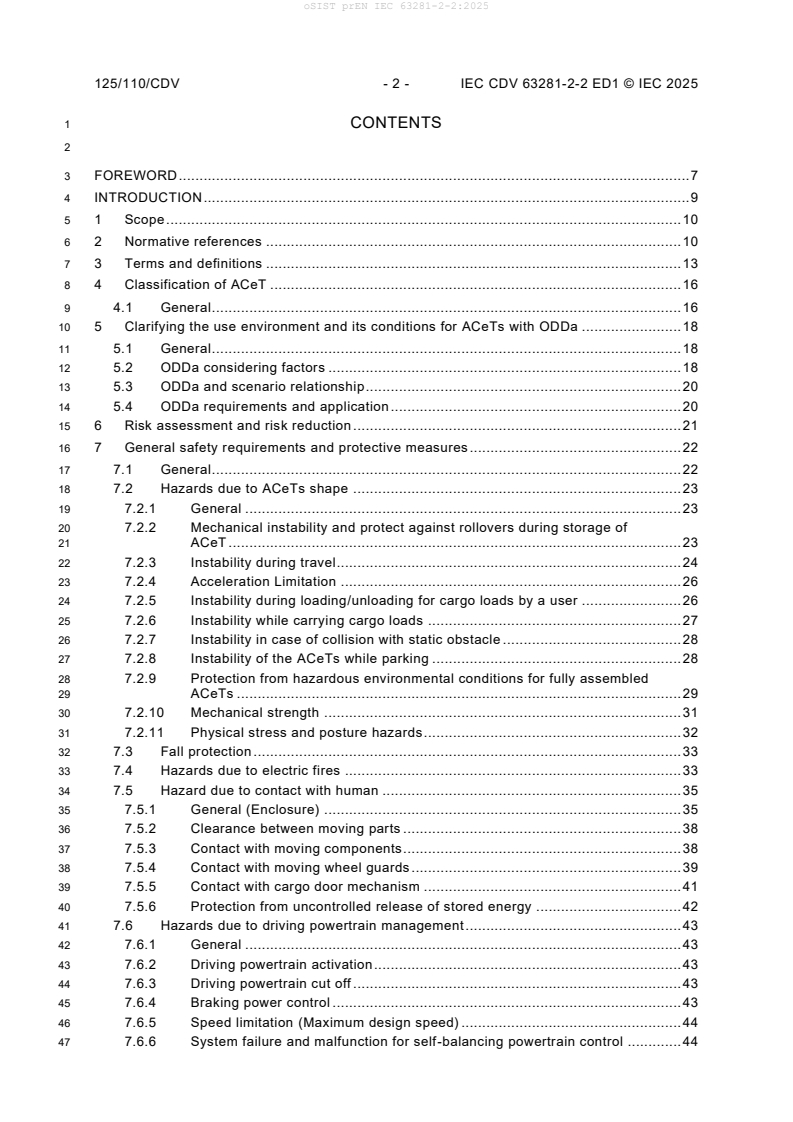
125/110/CDV - 2 - IEC CDV 63281-2-2 ED1 © IEC 2025
1 CONTENTS
3 FOREWORD . 7
4 INTRODUCTION . 9
5 1 Scope . 10
6 2 Normative references . 10
7 3 Terms and definitions . 13
8 4 Classification of ACeT . 16
9 4.1 General . 16
10 5 Clarifying the use environment and its conditions for ACeTs with ODDa . 18
11 5.1 General . 18
12 5.2 ODDa considering factors . 18
13 5.3 ODDa and scenario relationship . 20
14 5.4 ODDa requirements and application . 20
15 6 Risk assessment and risk reduction . 21
16 7 General safety requirements and protective measures . 22
17 7.1 General . 22
18 7.2 Hazards due to ACeTs shape . 23
19 7.2.1 General . 23
20 7.2.2 Mechanical instability and protect against rollovers during storage of
21 ACeT . 23
22 7.2.3 Instability during travel. 24
23 7.2.4 Acceleration Limitation . 26
24 7.2.5 Instability during loading/unloading for cargo loads by a user . 26
25 7.2.6 Instability while carrying cargo loads . 27
26 7.2.7 Instability in case of collision with static obstacle . 28
27 7.2.8 Instability of the ACeTs while parking . 28
28 7.2.9 Protection from hazardous environmental conditions for fully assembled
29 ACeTs . 29
30 7.2.10 Mechanical strength . 31
31 7.2.11 Physical stress and posture hazards . 32
32 7.3 Fall protection . 33
33 7.4 Hazards due to electric fires . 33
34 7.5 Hazard due to contact with human . 35
35 7.5.1 General (Enclosure) . 35
36 7.5.2 Clearance between moving parts . 38
37 7.5.3 Contact with moving components. 38
38 7.5.4 Contact with moving wheel guards . 39
39 7.5.5 Contact with cargo door mechanism . 41
40 7.5.6 Protection from uncontrolled release of stored energy . 42
41 7.6 Hazards due to driving powertrain management . 43
42 7.6.1 General . 43
43 7.6.2 Driving powertrain activation . 43
44 7.6.3 Driving powertrain cut off . 43
45 7.6.4 Braking power control . 43
46 7.6.5 Speed limitation (Maximum design speed) . 44
47 7.6.6 System failure and malfunction for self-balancing powertrain control . 44
IEC CDV 63281-2-2 ED1 © IEC 2025 - 3 - 125/110/CDV
48 7.7 Hazards due to electromagnetic interference . 45
49 7.8 Hazards due to carrying cargo loads . 45
50 7.9 Hazards due to emissions . 45
51 7.9.1 Hazardous acoustic noise . 45
52 7.9.2 Hazardous vibrations for cargo loads . 46
53 7.9.3 Hazardous non-ionizing (laser) radiation . 47
54 7.10 Hazard due to electrical cables and connections . 47
55 7.11 Braking devices . 48
56 7.12 Braking performance . 48
57 7.12.1 General . 48
58 7.12.2 Dry stop . 49
59 7.12.3 Behaviour during braking . 49
60 7.12.4 Electric failure braking compensation . 50
61 7.13 Presence awareness . 50
62 7.13.1 Lighting and reflectors . 50
63 7.13.2 Audible notification and warning to users and third parties . 50
64 7.14 Damp heat resistance . 51
65 7.15 Protection against unintended or unauthorized use . 52
66 7.15.1 General . 52
67 7.15.2 Protect against unauthorized users operation . 52
68 7.15.3 Remote control functions . 52
69 7.16 Hazards due to insufficient durability for whole ACeTs . 53
70 7.16.1 General . 53
71 7.16.2 Durability for vibration. 53
72 7.16.3 Durability for temperature shock . 54
73 8 Functional safety . 55
74 8.1 Required safety performance . 55
75 8.2 Stability control . 55
76 8.3 Emergency stop . 55
77 8.4 Protective stop . 56
78 8.5 Safety-related speed control . 56
79 8.6 Travel surface sensing . 57
80 8.7 Safety related object sensing . 57
81 8.8 Autonomous braking control system . 58
82 8.9 Power failure of control system . 58
83 9 Start-up regular operation and protection from unintended operation . 59
84 9.1 Start-up and restart of regular operation . 59
85 9.2 Protect against unintended operation and shutdown . 59
86 10 Collision with safety-related objects . 59
87 10.1 General . 59
88 10.2 Collision avoidance with safety-related objects . 60
89 10.3 Collision criterion with the human during ACeTs driving . 61
90 10.3.1 General . 61
91 10.3.2 Determining severity and classification of risk levels . 61
92 10.3.3 Determining probability of occurrence . 63
93 10.4 Required performance level for each collision avoidance function of the
94 ACeT . 65
95 11 Hazards due to incorrect autonomous decisions and actions . 66
125/110/CDV - 4 - IEC CDV 63281-2-2 ED1 © IEC 2025
96 12 Supplemental Remote control device . 66
97 13 Charging battery and charging systems . 67
98 13.1 General . 67
99 13.2 Overcharge protection . 67
100 13.3 Charging lock . 68
101 13.4 Battery charger . 68
102 13.4.1 General . 68
103 13.4.2 Off board charging . 68
104 13.4.3 On board charging . 68
105 13.5 Hazard due to insufficient battery . 68
106 14 Operational modes . 69
107 14.1 General . 69
108 14.2 Ready mode . 71
109 14.3 Autonomous driving mode . 71
110 14.4 Manual driving mode . 71
111 14.5 Revers mode . 72
112 14.6 Pedestrian mode . 72
113 14.7 Maintenance mode . 72
114 14.8 Protective stop mode . 73
115 14.9 Emergency evacuation mode . 73
116 15 User interface and information . 73
117 15.1 General . 73
118 15.2 Indications for users . 73
119 15.2.1 Status indication . 73
120 15.2.2 Warning indication and signals . 74
121 15.3 Hazard due to insufficient user interface and information . 75
122 16 Test methods and conditions . 75
123 16.1 General . 75
124 16.2 Environmental conditions . 75
125 16.3 Test travel surface . 76
126 16.4 Specimen function test . 76
127 16.4.1 General . 76
128 16.4.2 Maximum limited speed test . 76
129 16.4.3 Braking performance test . 76
130 16.4.4 Instability function test . 77
131 16.4.5 Driving powertrain function test . 78
132 16.4.6 Thermal test . 81
133 16.4.7 Strain relief test . 84
134 16.4.8 Partial water immersion test . 84
135 16.4.9 Signal function test . 84
136 16.4.10 Short circuit test . 84
137 16.4.11 Charging lock test . 85
138 16.4.12 Remote control functions test . 85
139 16.4.13 Functional check for movement test . 85
140 16.5 Fatigue test . 86
141 16.5.1 Test for cables and connections . 86
142 16.5.2 Durability test for vibration . 87
143 16.6 Load test. 89
IEC CDV 63281-2-2 ED1 © IEC 2025 - 5 - 125/110/CDV
144 16.6.1 Frontal impact resistance test . 89
145 16.6.2 Footsteps strength test . 91
146 16.6.3 Cargo door handlebar – Torque test . 92
147 16.6.4 Performance and endurance road test . 93
148 16.6.5 Instability test during loading/unloading of cargo loads . 93
149 17 Product information and instruction . 94
150 17.1 General . 94
151 17.2 Marking . 94
152 17.2.1 General . 94
153 17.2.2 Durability of marking of the frame or chassis . 95
154 17.2.3 Safety and warning instruction signs . 95
155 17.2.4 Battery specification . 96
156 17.2.5 Tires specification. 96
157 17.3 Purchase information . 96
158 17.3.1 General . 96
159 17.3.2 Information at point of sale . 96
160 17.3.3 Information on the packaging . 96
161 17.4 Instructions for use . 97
162 18 Restriction and control of use . 98
163 18.1 General . 98
164 18.2 Education and training . 98
165 18.3 Environmental maintenance . 99
166 18.4 Periodic inspection and maintenance . 99
167 Annex A (informative) List of significant hazards for ACeTs . 101
168 A.1 Hazards for ACeTs . 101
169 Annex B (informative) Typical situation in which ACeTs cause harm . 108
170 Annex C (normative) Light, warning device, on-off symbols . 109
171 Annex D . 110
172 D.1 General . 110
173 D.2 ODDa levels . 110
174 D.2.1 Scenery . 111
175 D.2.2 Environmental conditions . 118
176 D.2.3 Dynamic elements . 122
177 Annex E (informative) Specific examples of education and training . 124
178 Annex F . 125
179 Annex G (informative) Protective circuit and safety analysis . 126
180 Annex H (informative) Examples of operational spaces of ACeT . 127
181 Annex I . 128
182 Bibliography . 133
184 Figure 1 – Diagram of the relationship between strategic/tactical processing functions
185 of ACeTs for autonomous driving . 14
186 Figure 2 – Free space for use’s feet . 40
187 Figure 3 – Foot protection . 40
188 Figure 4 - Injury levels as regions of speed - gross mass of the colliding ACeT part. 64
189 Figure 5 - Determination of injury level during contact of ACeT with a person . 65
125/110/CDV - 6 - IEC CDV 63281-2-2 ED1 © IEC 2025
190 Figure 6 – Maximum Speed Test . 76
191 Figure 7 – Stop distance test . 77
192 Figure 8 – Circular-shaped track slope test . 78
193 Figure 9 – Determine method for the circular-shaped track width . 78
194 Figure 10 – Test path of ACeTs . 86
195 Figure 11 – Frontal impact test . 90
196 Figure 12 – Drop impact test . 90
197 Figure 13 – Drop load impact test . 91
198 Figure 14 – Footsteps strength test . 92
199 Figure 15 – Cargo door handlebar –Torque test . 92
200 Figure 16 – Instability test during loading/unloading of cargo loads . 93
201 Figure C.1 – Power On/Off symbol . 109
202 Figure C.2 – Light symbol . 109
203 Figure D.1 – Top level taxonomy with ODDa attributes . 110
204 Figure D.2 – Road Geometry configurations . 114
205 Figure D.3 – Junction configurations . 116
206 Figure D.4 – Crossing configurations . 117
207 Figure D.5 – Automatic entrance door . 118
208 Figure F.1 – Example of a foot shaped gauge . 125
209 Figure H.1 – Operational spaces of an ACeT . 127
211 Table 1 – Major classes code of ACeTs . 16
212 Table 2 – Sub-class code of monitored level for ACeTs . 17
213 Table 3 – Sub-classes of ACeTs design concept . 17
214 Table 4 – Factors to consider when designing ODDa of ACeTs . 19
215 Table 5 – Example of instability events and its factors during travel of ACeT . 24
216 Table 6 – Braking distances . 49
217 Table 7 - Permissible injury level region . 61
218 Table 8 - Required functional safety level for each kinetic energy level . 65
219 Table 9 - Example of a typical state of the ACeT and its task-based operational mode . 69
220 Table 10 – Acoustic warning indication signal level of driving speed of ACeT . 74
221 Table 11 – Temperature limits of motor winding in overload test . 80
222 Table 12 – Temperature limits of motor winding in locked-rotor test . 80
223 Table 13 – Sinusoidal vibration test parameters . 88
224 Table 14 – PSD value on X axis . 88
225 Table 15 – PSD value on Y axis . 88
226 Table 16 – PSD value on Y axis (the battery pack is located below the footrest) . 89
227 Table 17 – PSD value on Z axis . 89
228 Table 18 – Instability test record table . 94
229 Table A.1 – Hazard list for ACeTs . 101
230 Table B.1 – Typical situation in which ACeT cause harm . 108
231 Table I.1 – Comparison table regarding the verification method and related clauses . 129
IEC CDV 63281-2-2 ED1 © IEC 2025 - 7 - 125/110/CDV
234 INTERNATIONAL ELECTROTECHNICAL COMMISSION
235 ____________
237 E-TRANSPORTERS –
238 Part 2-2: Safety requirements and test methods
239 for autonomous cargo e-transporters
242 FOREWORD
243 1) The International Electrotechnical Commission (IEC) is a worldwide organization for standardization comprising
244 all national electrotechnical committees (IEC National Committees). The object of IEC is to promote international
245 co-operation on all questions concerning standardization in the electrical and electronic fields. To this end and
246 in addition to other activities, IEC publishes International Standards, Technical Specifications, Technical Reports,
247 Publicly Available Specifications (PAS) and Guides (hereafter referred to as “IEC Publication(s)”). Their
248 preparation is entrusted to technical committees; any IEC National Committee interested in the subject dealt with
249 may participate in this preparatory work. International, governmental and non-governmental organizations liaising
250 with the IEC also participate in this preparation. IEC collaborates closely with the International Organization for
251 Standardization (ISO) in accordance with conditions determined by agreement between the two organizations.
252 2) The formal decisions or agreements of IEC on technical matters express, as nearly as possible, an international
253 consensus of opinion on the relevant subjects since each technical committee has representation from all
254 interested IEC National Committees.
255 3) IEC Publications have the form of recommendations for international use and are accepted by IEC National
256 Committees in that sense. While all reasonable efforts are made to ensure that the technical content of IEC
257 Publications is accurate, IEC cannot be held responsible for the way in which they are used or for any
258 misinterpretation by any end user.
259 4) In order to promote international uniformity, IEC National Committees undertake to apply IEC Publications
260 transparently to the maximum extent possible in their national and regional publications. Any divergence between
261 any IEC Publication and the corresponding national or regional publication shall be clearly indicated in the latter.
262 5) IEC itself does not provide any attestation of conformity. Independent certification bodies provide conformity
263 assessment services and, in some areas, access to IEC marks of conformity. IEC is not responsible for any
264 services carried out by independent certification bodies.
265 6) All users should ensure that they have the latest edition of this publication.
266 7) No liability shall attach to IEC or its directors, employees, servants or agents including individual experts and
267 members of its technical committees and IEC National Committees for any personal injury, property damage or
268 other damage of any nature whatsoever, whether direct or indirect, or for costs (including legal fees) and
269 expenses arising out of the publication, use of, or reliance upon, this IEC Publication or any other IEC Publications.
270 8) Attention is drawn to the Normative references cited in this publication. Use of the referenced publications is
271 indispensable for the correct application of this publication.
272 9) Attention is drawn to the possibility that some of the elements of this IEC Publication may be the subject of patent
273 rights. IEC shall not be held responsible for identifying any or all such patent rights.
274 International Standard IEC 63281-2-2 has been prepared by IEC technical committee 125.
275 The text of this International Standard is based on the following documents:
DIS Report on voting
XX/XX/FDIS XX/XX/RVD
277 Full information on the voting for the approval of this International Standard can be found in the
278 report on voting indicated in the above table.
279 This document has been drafted in accordance with the ISO/IEC Directives, Part 2.
280 The committee has decided that the contents of this document will remain unchanged until the
281 stability date indicated on the IEC website under "http://webstore.iec.ch" in the data related to
282 the specific document. At this date, the document will be
283 • reconfirmed,
125/110/CDV - 8 - IEC CDV 63281-2-2 ED1 © IEC 2025
284 • withdrawn,
285 • replaced by a revised edition, or
286 • amended.
288 The National Committees are requested to note that for this document the stability date
289 is 20XX.
290 THIS TEXT IS INCLUDED FOR THE INFORMATION OF THE NATIONAL COMMITTEES AND WILL BE DELETED
291 AT THE PUBLICATION STAGE.
IEC CDV 63281-2-2 ED1 © IEC 2025 - 9 - 125/110/CDV
292 INTRODUCTION
293 This International Standard has been developed to cope with the rapidly evolving autonomous
294 driving ‘cargo’ e-transporters; ACeTs which mainly using in public road environments including
295 public access spaces and those are autonomously using robot technologies, but partly human
296 piloted at situation of over the operational design domain to be set by the manufacturer of
297 ACeTs. The global market sizes and applications are expected to grow significantly due to the
298 appearance of autonomous driving cargo e-transporters. Cargo e-Transporters are mainly
299 operated autonomously at speeds below 6 km/h equivalent to human walking speed, or up to
300 30 km/h. In addition, some products are recently operated at speeds exceeding 30 km/h, so it
301 is necessary to take additional factors into consideration as well. This means that different
302 hazards need to be considered than with conventional e-transporters that are used under the
303 precondition of human piloted devices. So, in order to protect safety for persons and public
304 facilities, besides basic safety requirements, comprehensive safety requirements and test
305 methods such as autonomous driving devices safety for people, and road structures and
306 specific signs for cargo e-transporters shall also be considered. Based on the current situation,
307 this international standard provides comprehensive safety requirements and corresponding test
308 methods for autonomous driving cargo e-transporters, which is convenient for manufacturers
309 and test departments to use. This international standard is specific for cargo e-transporters with
310 autonomous driving function.
125/110/CDV - 10 - IEC CDV 63281-2-2 ED1 © IEC 2025
312 E-TRANSPORTERS –
313 Part 2-2: Safety requirements and test methods
314 for autonomous cargo e-transporters
317 1 Scope
318 This international standard specifies that it applies to electrically powered autonomous driving
319 cargo e-transporters; Autonomous cargo e-Transporters (ACeTs) that do not intended to drive
320 by on boarded driver, that are primarily electrically/electronically controlled for speed and/or
321 steering autonomously without human intervention. Even if in case of over the operational
322 preconditions, an authorized users can operate remotely for the ACeTs manually via an external
323 systems or supplementary telecommunication control devices. It operates in an Operational
324 Design Domain(ODDa)-designated public road environments specified by a manufacturer and
325 include a public access space where not public road environment is such as big shopping mall,
326 airport facilities, big building corridor.
327 ACeT includes use cases where a remote monitoring operator is direct operating remotely by
328 an authorized user using wireless system and/or supplemental operating devices from the
329 outside.
330 ACeTs are design to purpose for direct delivery of cargo to personally and it may be for private
331 or commercial use. This document is intended to cargo delivery devices and services provided
332 user themselves and by service providers and not covered to purpose for ACeTs sharing service
333 applications.
334 ACeTs might need to adhere to additional standards and regulations, where appropriate, e.g.,
335 hazardous goods or materials that require special controls may be transported, or the
336 environment in which they operate may be subject to special regulations.
337 NOTE: Hazardous good or materials requiring special controls are explosive materials, radioactive controlled
338 materials, biohazardous materials, pressure vessels and high heat source objects, opioid such as morphine
339 and toxic substances.
340 ACeTs do not include non-autonomous driving e-transporters that are driven by an on-board
341 driver or that transport only passengers without a driver. In addition, ACeTs do not have the
342 function to loading and unloading cargo by itself, but the user has to loading and unloading
343 cargo on the halted ACeT.
344 Electrically powered control product such as e-trailers equipped with propulsion drive and
345 steering functions intended for cargo transport include hybrid assist or propelled power input
346 driving is not covered by this document. Also electrically powered bicycles, mopeds,
347 motorcycles and driver cars are not covered by this document because they are handled by
348 other TCs:
349 — ISO TC 22
350 — IEC TC 69
351 — ISO TC 110
352 — ISO TC 149
353 — ISO TC 299
355 2 Normative references
356 The following documents are referred to in the text in such a way that some or all of their content
357 constitutes requirements of this document. For dated references, only the edition cited applies.
IEC CDV 63281-2-2 ED1 © IEC 2025 - 11 - 125/110/CDV
358 For undated references, the latest edition of the referenced document (including any
359 amendments) applies.
360 IEC 60068-2-1:2007, Environmental testing - Part 2-1: Tests - Test A: Cold
361 IEC 60204-1:2016, Safety of machinery - Electrical equipment of machines - Part 1: General
362 requirements
363 IEC 60335-1:2020, Household and similar electrical appliances - Safety - Part 1: General
364 requirements
365 IEC 60335-2-29:2016, Household and similar electrical appliances - Safety - Part 2-29:
366 Particular requirements for battery chargers
367 IEC 60529:1989, Degrees of protection provided by enclosures (IP Code)
368 IEC 60825-1:2014, Safety of laser products - Part 1: Equipment classification and requirements
369 IEC 60950-1:2005, Information technology equipment - Safety - Part 1: General requirements
370 IEC 60695-11-10:2013, Fire hazard testing - Part 11-10: Test flames - 50 W horizontal and
371 vertical flame test method
372 IEC 61000-6-1:2005, Electromagnetic compatibility (EMC) - Part 6-1: Generic standards -
373 Immunity standard for residential, commercial and light-industrial environments
374 IEC 61000-6-2:2016, Electromagnetic compatibility (EMC) - Part 6-2: Generic standards -
375 Immunity standard for industrial environments
376 IEC 61000-6-3:2020, Electromagnetic compatibility (EMC) - Part 6-3: Generic standards -
377 Emission standard for equipment in residential environments
378 IEC 61000-6-4:2018, Electromagnetic compatibility (EMC) - Part 6-4: Generic standards -
379 Emission standard for industrial environments
380 IEC 63281-1:2023, E-Transporters - Part 1: Terminology and classification
381 IEC 61032:1997, Protection of persons and equipment by enclosures - Probes for verification
382 IEC 61140:2016, Protection against electric shock - Common aspects for installation and
383 equipment
384 IEC 61508-1:2010, Functional safety of electrical/electronic/programmable electronic safety-
385 related systems - Part 1: General requirements
386 IEC 61558-1:2017, Safety of transformers, reactors, power supply units and combinations
387 thereof - Part 1: General requirements and tests
388 IEC 61558-2-16:2021, Safety of transformers, reactors, power supply units and combinations
389 thereof - Part 2-16: Particular requirements and tests for switch mode power supply units and
390 transformers for switch mode power supply units for general applications
391 IEC 62061:2021, Safety of machinery - Functional safety of safety-related control systems
392 IEC 62368-1:2023, Audio/video, information and communication technology equipment - Part 1:
393 Safety requirements
394 IEC 62471:2006, Photobiological safety of lamps and lamp system
395 ISO 7010 :2019, Graphical symbols — Safety colours and safety signs — Registered safety
396 signs
397 ISO 7176-21:2009, Wheelchairs — Part 21: Requirements and test methods for electromagnetic
398 compatibility of electrically powered wheelchairs and scooters, and battery chargers
125/110/CDV - 12 - IEC CDV 63281-2-2 ED1 © IEC 2025
399 ISO 8124-1:2022, Safety of toys Part 1: Safety aspects related to mechanical and physical
400 properties
401 ISO 12100:2010, Safety of machinery — General principles for design — Risk assessment and
402 risk reduction
403 ISO 13482:2014, Robots and robotic devices — Safety requirements for personal care robots
404 ISO 13849-1:2023, Safety of machinery -- Safety-related parts of control systems -- Part 1:
405 General principles for design
IEC CDV 63281-2-2 ED1 © IEC 2025 - 13 - 125/110/CD
...