

prEN IEC 62040-1:2025
(Main)Uninterruptible power systems (UPS) - Part 1: Safety requirements
General Information
- Abstract
- Status
- Not Published
- Publication Date
- 01-Feb-2027
- Technical Committee
- CLC/TC 22X - Power electronics
- Drafting Committee
- IEC/SC 22H - IEC_SC_22H
- Current Stage
- 4060 - Enquiry results established and sent to TC, SR, BTTF - Enquiry
- Start Date
- 03-Oct-2025
- Completion Date
- 03-Oct-2025

Overview
prEN IEC 62040-1:2025 - "Uninterruptible power systems (UPS) - Part 1: Safety requirements" is the CLC-adopted draft of the IEC safety standard for UPS equipment. Published as a Committee Draft for Vote (CDV) by IEC SC 22H, this 2025 revision updates safety requirements for UPS design, construction, testing and marking. The document is currently in the CDV stage (parallel IEC‑CENELEC voting) and is subject to change; its proposed stability date is 2026. Keywords: prEN IEC 62040-1:2025, IEC 62040-1, UPS safety standard, uninterruptible power systems.
Key topics and technical requirements
The standard focuses on safety aspects across UPS products and includes both normative requirements and informative guidance. Major technical topics covered:
- Terms and definitions to establish consistent UPS safety vocabulary.
- Protection against hazards including single-fault conditions and abnormal operation.
- Short-circuit and overload protection: requirements for input/output withstand strength and device protection.
- Protection against electric shock and means for basic protection (direct contact prevention, touch current limits).
- Capacitor discharge and associated safety/marking requirements.
- Service access areas and maintainability for safe servicing.
- Limited power sources and multi-source UPS arrangements with backfeed protection.
- Battery energy storage device requirements: general safety, accessibility, spacing, case insulation, electrolyte spillage, ventilation and hydrogen management for lead‑acid/NiCd, charging voltages and additional requirements for lithium‑ion batteries.
- Environmental and acoustic hazards and UPS connection to telecommunication networks.
- Test requirements including electrical tests, short‑time withstand current tests, abnormal operation and simulated fault testing.
- Information and marking: installation guidance, labels, battery maintenance data and shipping/disconnection guidance.
- Annexes addressing ventilation of battery compartments, shipment battery disconnection, short‑time withstand procedures, transformer heating, and rack‑mounting mechanical tests.
Practical applications and who uses it
This safety standard is essential for:
- UPS manufacturers designing equipment to meet international safety norms.
- Test laboratories and certification bodies performing conformity assessment and type testing.
- System integrators and installers specifying compliant UPS for data centers, telecoms, healthcare, industrial and critical infrastructure.
- Facility and safety engineers managing battery safety, ventilation and maintenance procedures.
- Regulators and procurement teams requiring IEC-aligned safety evidence.
Keywords: UPS safety requirements, battery safety, backfeed protection, short-circuit withstand, IEC UPS standard.
Related standards
- IEC 62477-1 (now updated reference in this edition) - safety requirements for power electronic converters and related equipment.
- Other parts of IEC 62040 series (performance, electromagnetic compatibility, etc.) - for full UPS compliance and system design guidance.
Relations
- Effective Date
- 14-Jun-2022
- Revises
EN IEC 62040-1:2019/A11:2021 - Uninterruptible power systems (UPS) - Part 1: Safety requirements - Effective Date
- 14-Jun-2022
- Revises
EN IEC 62040-1:2019/A2:2025 - Uninterruptible power systems (UPS) - Part 1: Safety requirements - Effective Date
- 14-Jun-2022
- Revises
EN IEC 62040-1:2019/AC:2019-11 - Uninterruptible power systems (UPS) - Part 1: Safety requirements - Effective Date
- 14-Jun-2022
- Revises
EN IEC 62040-1:2019/A1:2023 - Uninterruptible power systems (UPS) - Part 1: Safety requirements - Effective Date
- 14-Jun-2022
Get Certified
Connect with accredited certification bodies for this standard

IMQ S.p.A. (Certification)
Italian electrical product certification.

SLG Prüf- und Zertifizierungs GmbH
German testing and certification body.

UL Solutions
Global safety science company with testing, inspection and certification.
Sponsored listings
Frequently Asked Questions
prEN IEC 62040-1:2025 is a draft published by CLC. Its full title is "Uninterruptible power systems (UPS) - Part 1: Safety requirements". This standard covers: Uninterruptible power systems (UPS) - Part 1: Safety requirements
Uninterruptible power systems (UPS) - Part 1: Safety requirements
prEN IEC 62040-1:2025 is classified under the following ICS (International Classification for Standards) categories: 29.200 - Rectifiers. Convertors. Stabilized power supply. The ICS classification helps identify the subject area and facilitates finding related standards.
prEN IEC 62040-1:2025 has the following relationships with other standards: It is inter standard links to EN IEC 62040-1:2019, EN IEC 62040-1:2019/A11:2021, EN IEC 62040-1:2019/A2:2025, EN IEC 62040-1:2019/AC:2019-11, EN IEC 62040-1:2019/A1:2023. Understanding these relationships helps ensure you are using the most current and applicable version of the standard.
prEN IEC 62040-1:2025 is associated with the following European legislation: EU Directives/Regulations: 2014/35/EU; Standardization Mandates: M/511. When a standard is cited in the Official Journal of the European Union, products manufactured in conformity with it benefit from a presumption of conformity with the essential requirements of the corresponding EU directive or regulation.
prEN IEC 62040-1:2025 is available in PDF format for immediate download after purchase. The document can be added to your cart and obtained through the secure checkout process. Digital delivery ensures instant access to the complete standard document.
Standards Content (Sample)
SLOVENSKI STANDARD
01-september-2025
Sistemi z neprekinjenim napajanjem (UPS) - 1. del: Varnostne zahteve
Uninterruptible power systems (UPS) - Part 1: Safety requirements
Unterbrechungsfreie Stromversorgungssysteme (USV) - Teil 1:
Sicherheitsanforderungen
Alimentations sans interruption (ASI) - Partie 1: Exigences de sécurité
Ta slovenski standard je istoveten z: prEN IEC 62040-1:2025
ICS:
29.200 Usmerniki. Pretvorniki. Rectifiers. Convertors.
Stabilizirano električno Stabilized power supply
napajanje
2003-01.Slovenski inštitut za standardizacijo. Razmnoževanje celote ali delov tega standarda ni dovoljeno.
22H/338/CDV
COMMITTEE DRAFT FOR VOTE (CDV)
PROJECT NUMBER:
IEC 62040-1 ED3
DATE OF CIRCULATION: CLOSING DATE FOR VOTING:
2025-07-11 2025-10-03
SUPERSEDES DOCUMENTS:
22H/329/CD, 22H/337A/CC
IEC SC 22H : UNINTERRUPTIBLE POWER SYSTEMS (UPS)
SECRETARIAT: SECRETARY:
France Mr Miao-Xin WANG
OF INTEREST TO THE FOLLOWING COMMITTEES: HORIZONTAL FUNCTION(S):
TC 22,SC 22E,SC 22G,SC 121B
ASPECTS CONCERNED:
Safety
SUBMITTED FOR CENELEC PARALLEL VOTING NOT SUBMITTED FOR CENELEC PARALLEL VOTING
Attention IEC-CENELEC parallel voting
The attention of IEC National Committees, members of
CENELEC, is drawn to the fact that this Committee Draft
for Vote (CDV) is submitted for parallel voting.
The CENELEC members are invited to vote through the
CENELEC online voting system.
This document is still under study and subject to change. It should not be used for reference purposes.
Recipients of this document are invited to submit, with their comments, notification of any relevant patent rights of
which they are aware and to provide supporting documentation.
Recipients of this document are invited to submit, with their comments, notification of any relevant “In Some Countries”
clauses to be included should this proposal proceed. Recipients are reminded that the CDV stage is the final stage for
submitting ISC clauses. (SEE AC/22/2007 OR NEW GUIDANCE DOC).
TITLE:
Uninterruptible power systems (UPS) - Part 1: Safety requirements
PROPOSED STABILITY DATE: 2026
NOTE FROM TC/SC OFFICERS:
electronic file, to make a copy and to print out the content for the sole purpose of preparing National Committee positions.
You may not copy or "mirror" the file or printed version of the document, or any part of it, for any other purpose without
permission in writing from IEC.
Internal
IEC CDV 62040-1 © IEC 2025
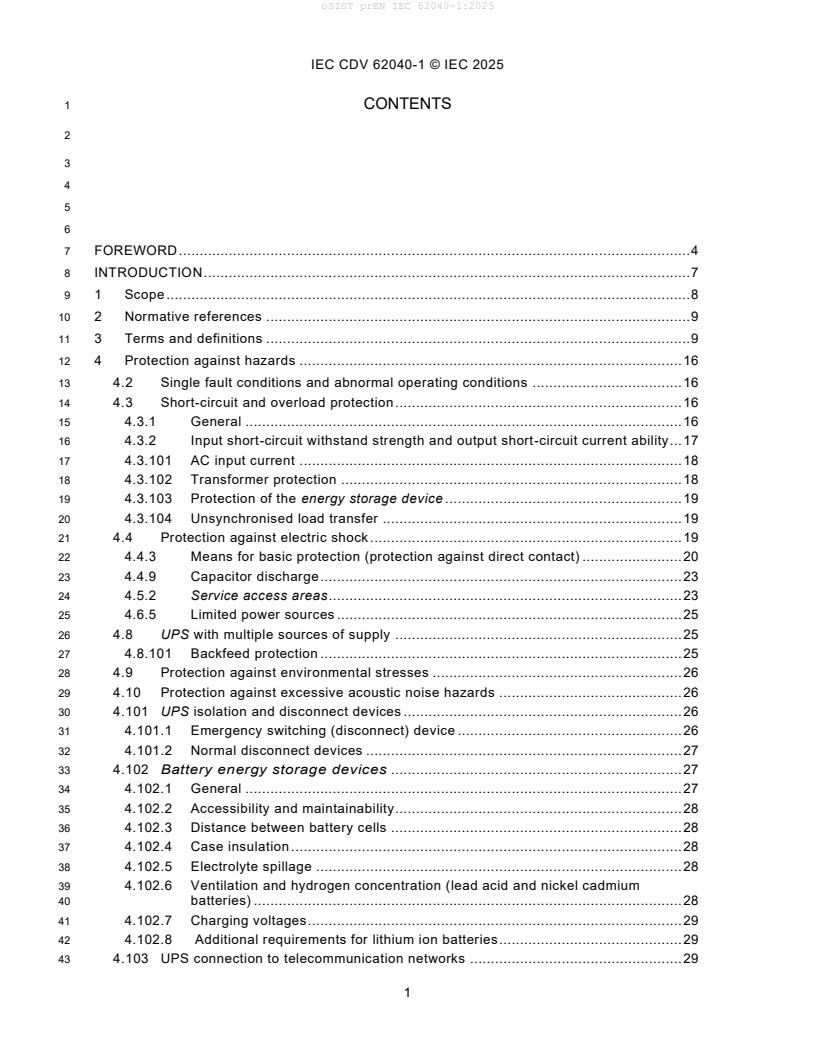
1 CONTENTS
7 FOREWORD . 4
8 INTRODUCTION . 7
9 1 Scope . 8
10 2 Normative references . 9
11 3 Terms and definitions . 9
12 4 Protection against hazards . 16
13 4.2 Single fault conditions and abnormal operating conditions . 16
14 4.3 Short-circuit and overload protection . 16
15 4.3.1 General . 16
16 4.3.2 Input short-circuit withstand strength and output short-circuit current ability . 17
17 4.3.101 AC input current . 18
18 4.3.102 Transformer protection . 18
19 4.3.103 Protection of the energy storage device . 19
20 4.3.104 Unsynchronised load transfer . 19
21 4.4 Protection against electric shock . 19
22 4.4.3 Means for basic protection (protection against direct contact) . 20
23 4.4.9 Capacitor discharge . 23
24 4.5.2 Service access areas . 23
25 4.6.5 Limited power sources . 25
26 4.8 UPS with multiple sources of supply . 25
27 4.8.101 Backfeed protection . 25
28 4.9 Protection against environmental stresses . 26
29 4.10 Protection against excessive acoustic noise hazards . 26
30 4.101 UPS isolation and disconnect devices . 26
31 4.101.1 Emergency switching (disconnect) device . 26
32 4.101.2 Normal disconnect devices . 27
33 4.102 Battery energy storage devices . 27
34 4.102.1 General . 27
35 4.102.2 Accessibility and maintainability. 28
36 4.102.3 Distance between battery cells . 28
37 4.102.4 Case insulation . 28
38 4.102.5 Electrolyte spillage . 28
39 4.102.6 Ventilation and hydrogen concentration (lead acid and nickel cadmium
40 batteries) . 28
41 4.102.7 Charging voltages . 29
42 4.102.8 Additional requirements for lithium ion batteries. 29
43 4.103 UPS connection to telecommunication networks . 29
IEC CDV 62040-1 © IEC 2025
44 5 Test requirements . 29
45 5.1.7 Test overview . 29
46 5.2.3 Electrical tests . 34
47 5.2.4 Abnormal operation and simulated faults tests . 37
48 6 Information and marking requirements . 45
49 6.1 General . 45
50 6.3.101 Guidance on UPS installation . 47
51 6.4.3 Labels, signs, symbols and signals . 47
52 6.5 Supplementary information . 49
53 6.5.2 Capacitor discharge . 49
54 6.5.101 Battery information for maintenance . 49
55 Annexes . 51
56 Annex AA (informative) Minimum and maximum cross-section of copper cables suitable
57 for connection to terminals for external cables . 52
58 Annex BB (informative) Comparison of limits of working voltage . 53
59 Annex CC (normative) Ventilation of lead-acid battery compartments . 55
60 CC.1 General . 55
61 CC.2 Normal conditions. 55
62 CC.3 Blocked conditions . 57
63 Annex DD (informative) Guidance for disconnection of batteries during shipment . 58
64 DD.1 Applicable products . 58
65 DD.2 Battery disconnection. 58
66 DD.3 Package labelling/marking . 58
67 DD.4 Damage inspection . 59
68 DD.5 The importance of safe handling procedures . 59
69 Annex EE (informative) Short-time withstand current test procedure – Guidance and
70 typical values . 60
71 EE.1 General . 60
72 EE.2 Test set up . 62
73 EE.3 Calibration of the test circuit. 62
74 EE.4 Test procedure . 63
75 EE.5 Test verification criteria . 63
76 Annex FF (informative) Maximum heating effect in transformer tests . 64
77 FF.1 Determination of maximum input current . 64
78 FF.2 Overload test procedure . 65
79 Annex GG (normative) Requirements for the mounting means of rack-mounted
80 equipment . 66
81 GG.1 General . 66
82 GG.2 Mechanical strength test, variable force . 66
83 GG.3 Mechanical strength test, 250 N force, including end stops. 67
84 GG.4 Compliance . 67
85 Bibliography . 68
87 Figure 101 – Examples of design of openings preventing vertical access . 18
IEC CDV 62040-1 © IEC 2025
88 Figure 102 – Test circuit for load-induced change of reference potential – Single-phase
89 output . 35
90 Figure 103 – Test circuit for load-induced change of reference potential – Three-phase
91 output . 35
92 Figure DD.1 – Example of precautionary labels for products shipped with the
93 battery disconnected . 56
94 Figure DD.2 – Example of precautionary label for products shipped with the
95 battery connected . 57
96 Figure EE.1 – 3-wire test circuit for UPS short-time withstand current . 59
97 Figure EE.2 – 4-wire test circuit for UPS short-time withstand current . 60
98 Figure EE.3 – 2-wire test circuit for single phase UPS short-time withstand current . 60
100 Table 1 – Alphabetical list of terms . 7
101 Table 101 – UPS AC input port configuration . 15
102 Table 5 – Limits for access of touch current . 19
103 Table 102 – Overvoltage categories . 20
104 Table 103 – Maximum temperature limits for magnetic components during stored
105 energy mode of operation . 22
106 Table 23 – Test overview . 28
107 Table 32 – AC short-time withstand current test, minimum UPS requirements . 39
108 Table 104 – Temperature limits for transformer windings . 40
109 Maximum temperature °C . 40
110 Table 33– Environmental tests . 42
111 Table 40 – Marking location . 43
112 Table AA.1 – Cable cross-sections . 50
113 Table BB.1 – Comparison of limits of working voltage. 51
114 Table FF.1 – Test steps . 62
IEC CDV 62040-1 © IEC 2025
118 -INTERNATIONAL ELECTROTECHNICAL COMMISSION
119 ____________
121 UNINTERRUPTIBLE POWER SYSTEMS (UPS) –
123 Part 1: Safety requirements
125 FOREWORD
126 1) The International Electrotechnical Commission (IEC) is a worldwide organization for standardization comprising all
127 national electrotechnical committees (IEC National Committees). The object of IEC is to promote international co -
128 operation on all questions concerning standardization in the electrical and electronic fields. To this end and in addition
129 to other activities, IEC publishes International Standards, Technical Specifications, Technical Reports, Publicly
130 Available Specifications (PAS) and Guides (hereafter referred to as “IEC Publication(s)”). Their preparation is
131 entrusted to technical committees; any IEC National Committee interested in the subject dealt with may participate in
132 this preparatory work. International, governmental and non-governmental organizations liaising with the IEC also
133 participate in this preparation. IEC collaborates closely with the International Organization for Standardization (ISO)
134 in accordance with conditions determined by agreement between the two organizations.
135 2) The formal decisions or agreements of IEC on technical matters express, as nearly as possible, an international
136 consensus of opinion on the relevant subjects since each technical committee has representation from all interested
137 IEC National Committees.
138 3) IEC Publications have the form of recommendations for international use and are accepted by IEC National
139 Committees in that sense. While all reasonable efforts are made to ensure that the technical content of IEC
140 Publications is accurate, IEC cannot be held responsible for the way in which they are used or for any misinterpretation
141 by any end user.
142 4) In order to promote international uniformity, IEC National Committees undertake to apply IEC Publications
143 transparently to the maximum extent possible in their national and regional publications. Any divergence between any
144 IEC Publication and the corresponding national or regional publication shall be clearly indicated in the latter.
145 5) IEC itself does not provide any attestation of conformity. Independent certification bodies provide conformity
146 assessment services and, in some areas, access to IEC marks of conformity. IEC is not responsible for any services
147 carried out by independent certification bodies.
148 6) All users should ensure that they have the latest edition of this publication.
149 7) No liability shall attach to IEC or its directors, employees, servants or agents including individual experts and members
150 of its technical committees and IEC National Committees for any personal injury, property damage or other damage
151 of any nature whatsoever, whether direct or indirect, or for costs (including legal fees) and expenses arising out of
152 the publication, use of, or reliance upon, this IEC Publication or any other IEC Publications.
153 8) Attention is drawn to the Normative references cited in this publication. Use of the referenced publications is
154 indispensable for the correct application of this publication.
155 9) Attention is drawn to the possibility that some of the elements of this IEC Publication may be the subject of patent
156 rights. IEC shall not be held responsible for identifying any or all such patent rights.
157 IEC 62040-1 has been prepared by subcommittee 22H: Uninterruptible power systems (UPS), of
158 IEC technical committee 22: Power electronic systems and equipment.
159 This third edition cancels and replaces the second edition published in 2017, Amendment 1:2021
160 and Amendment 2:2022. This edition constitutes a technical revision.
161 This edition includes the following significant technical changes with respect to the previous edition:
162 a) the reference document has been changed from IEC 62477-1:2012 to IEC 62477-1:2022;
163 b) clauses 4.4.7.1.7, 4.4.7.2.2, 4.4.7.7, 4.6.5,4.7, 4.8.101, 4.10 and 4.11.101 in Edition 2
164 considered in IEC 62477-1:2022;
165 c) protective bonding has been reinstated from Edition 1 in 4.4.4.2.101;
166 d) AC input current updated in 4.3.101;
IEC CDV 62040-1 © IEC 2025
167 e) touch current limits updated in 4.4.5.5;
168 f) capacitor discharge updated in 4.4.9;
169 g) components within a circuit representing a fire hazard updated in 4.6.2.2;
170 h) temperature limits for magnetics updated in 4.6.4.2;
171 i) free-fall on to a surface during handling added in 4.9;
172 j) requirements for lithium-ion batteries added in 4.102.8;
173 k) DC voltage test of battery case (type test) added in 5.2.3.4.101;
174 l) package labelling when shipping batteries updated in DD.3.
175 The text of this International Standard is based on the following documents:
Draft Report on voting
XX/XX/FDIS XX/XX/RVD
177 Full information on the voting for its approval can be found in the report on voting indicated in the
178 above table.
179 The language used for the development of this International Standard is English.
180 This document was drafted in accordance with ISO/IEC Directives, Part 2, and developed in
181 accordance with ISO/IEC Directives, Part 1 and ISO/IEC Directives, IEC Supplement, available at
182 www.iec.ch/members_experts/refdocs. The main document types developed by IEC are described
183 in greater detail at www.iec.ch/publications.
184 This International Standard is to be read in conjunction with IEC 62477-1:2022.
185 The provisions of the general rules dealt within IEC 62477-1:2022 are only applicable to this
186 document insofar as they are specifically cited. Clauses and subclauses of IEC 62477 -1:2022 that
187 are applicable in this document are identified by reference to IEC 62477-1:2022, for example,
188 "Clause 4 of IEC 62477-1:2022 applies, except as follows".
189 The exceptions are then listed. The exceptions can take the form of a deletion, a replacement or
190 an addition of subclauses, tables, figures or annexes.
191 Subclauses, tables and figures that are additional to those in IEC 62477-1:2022 are, in this
192 document, identified by a suffix in the format of X.10x, for example 4.3.101.
193 Annexes that are additional to those in IEC 62477-1:2022 are, in this document, lettered AA, BB,
194 etc.
195 In this document, the following print types are used:
196 • requirements and normative annexes: roman type
197 • notes and other informative matter: smaller roman type
198 • normative conditions within tables: smaller roman type
199 • terms that are defined in Clause 3: italic type
200 • terms in angle brackets are used to indicate the context in which it is used:
202 A list of all parts in the IEC 62040 series, published under the general title Uninterruptible Power
203 Systems (UPS), can be found on the IEC website.
IEC CDV 62040-1 © IEC 2025
204 The committee has decided that the contents of this document will remain unchanged until the
205 stability date indicated on the IEC website under webstore.iec.ch in the data related to the specific
206 document. At this date, the document will be
207 • reconfirmed,
208 • withdrawn,
209 • replaced by a revised edition, or
210 • amended.
IEC CDV 62040-1 © IEC 2025
212 INTRODUCTION
213 IEC technical sub-committee 22H: Uninterruptible power systems (UPS) carefully considered the
214 relevance of each paragraph of IEC 62477-1:2022 in UPS applications. This part of IEC 62040
215 utilizes IEC 62477-1:2022 as a reference document and references, adds, replaces, or modifies
216 requirements as relevant. This is because product-specific topics not covered by the reference
217 document are the responsibility of the technical committee using the reference document.
218 IEC 62477-1:2022 relates to products that include power electronic converters, with a rated system
219 voltage not exceeding 1 000 V AC or 1 500 V DC. It specifies requirements to reduce risks of fire,
220 electric shock, thermal, energy and mechanical hazards, except functional safety as defined in the
221 IEC 61508 series. The objectives of this document are to establish a common terminology and
222 basis for the safety requirements of products that contain power electronic converters across
223 several IEC technical committees.
224 IEC 62477-1:2022 was developed as a technical revision of the first edition published in 2012 and
225 Amendment 1:2016 with the intention:
226 • to be used as a reference document for product committees inside IEC technical committee 22:
227 Power electronic systems and equipment in the development of product standards for power
228 electronic converter systems and equipment; and
229 • to be used as a reference document for product committees outside TC 22 in the development
230 of product standards of power electronic converter systems and equipment intended for
231 renewable energy sources. TC 82, TC 88, TC 105 and TC 114, in particular, have been
232 identified as relevant technical committees at the time of publication.
233 The reference document, being a group safety standard, will not take precedence over this product -
234 specific standard according to IEC Guide 104. IEC Guide 104 provides information about the
235 responsibility of product committees to use group safety standards for the development of their
236 own product standards.
237 When reading this document together with the reference document, the term “power electronic
238 converter system” and its abbreviated form “PECS” shall be read as “uninterruptible power system”
239 and “UPS” respectively.
IEC CDV 62040-1 © IEC 2025
241 UNINTERRUPTIBLE POWER SYSTEMS (UPS) –
243 Part 1: Safety requirements
247 1 Scope
248 This part of IEC 62040 applies to movable, stationary, fixed, modular or built-in UPS for use in low-
249 voltage distribution systems, that are intended to be installed in an area accessible by an ordinary
250 person or in a restricted access area, that deliver fixed frequency AC output voltage with port
251 voltages not exceeding 1 000 V AC or 1 500 V DC and that include an energy storage device. It
252 applies to pluggable and to permanently connected UPS, whether consisting of a system of
253 interconnected units or of independent units, subject to installing, operating and maintaining the
254 UPS in the manner prescribed by the manufacturer.
255 NOTE 1 Typical UPS configurations, including voltage and/or frequency converters and other topologies, are described
256 in IEC 62040-3:2021, the test and performance product standard for UPS.
257 NOTE 2 UPS generally connect to their energy storage device through a DC link. A chemical battery is used throughout
258 the standard as an example of an energy storage device. Alternative devices exist, and as such, where "battery" appears
259 in the text of this document, this is to be understood as "energy storage device".
260 This document specifies requirements to ensure safety for the ordinary person who comes into
261 contact with the UPS and, where specifically stated, for the skilled person. The objective is to
262 reduce risks of fire, electric shock, thermal, energy and mechanical hazards during use and
263 operation and, where applicable and specifically stated, during service and maintenance.
264 This product standard is harmonized with the applicable parts of group safety publication IEC
265 62477-1:2022 for power electronic converter systems and contains additional requirements
266 relevant to UPS.
267 This document does not cover:
268 • UPS that have a DC output;
269 • systems for operation on moving platforms including, but not limited to, aircrafts, ships and
270 motor vehicles;
271 • external AC or DC input and output distribution boards covered by their specific product
272 standard;
273 • stand-alone static transfer systems (STS) covered by IEC 62310-1;
274 • grid-connected power converter systems with multiple DC ports covered by IEC 62909-1;
275 • systems wherein the output voltage is directly derived from a rotating machine covered by IEC
276 88528-11;
277 • telecommunications apparatus covered by IEC 62368-1, other than UPS for such apparatus;
278 • functional safety aspects covered by the IEC 61508 series.
280 NOTE 3 Even if this document does not cover the applications listed above, it is commonly taken as a guide for such
281 applications.
282 NOTE 4 Specialized UPS applications are generally governed by additional requirements covered elsewhere, for example
283 UPS for medical applications.
IEC CDV 62040-1 © IEC 2025
285 2 Normative references
286 The following documents are referred to in the text in such a way that some or all of their content
287 constitutes requirements of this document. For dated references, only the edition cited applies.
288 For undated references, the latest edition of the referenced document (including any
289 amendments) applies.
290 Clause 2 of IEC 62477-1:2022 applies, except as follows:
291 Add the following normative references:
292 ISO 4180:2019, Packaging – Complete, filled transport packages – General rules for the compilation of
293 performance test schedules
294 ISO 11014:2009, Safety data sheet for chemical products.
295 IEC 60085:2007, Electrical insulation - Thermal evaluation and designation
296 IEC 60364-4-42, Low-voltage electrical installations – Part 4-42: Protection for safety – Protection against
297 thermal effects
298 IEC 60950-1:2005, Information technology equipment – Safety – Part 1: General requirements
299 IEC 61008-1, Residual current operated circuit-breakers without integral overcurrent protection for
300 household and similar uses (RCCBs) – Part 1: General rules
301 IEC 61009-1, Residual current operated circuit-breakers with integral overcurrent protection for household
302 and similar uses (RCBOs) – Part 1: General rules
303 IEC 62040-2:2016, Uninterruptible power systems (UPS) – Part 2: Electromagnetic compatibility (EMC)
304 requirements
305 IEC 62040-3:2021, Uninterruptible power systems (UPS) - Part 3: Method of specifying the performance
306 and test requirements
307 IEC 62477-1:2022, Safety requirements for power electronic converter systems and equipment – Part 1:
308 General
309 IEC 62619:2022, Secondary cells and batteries containing alkaline or other non-acid electrolytes - Safety
310 requirements for secondary lithium cells and batteries, for use in industrial applications
311 3 Terms and definitions
312 Clause 3 of IEC 62477-1:2022 applies, except as follows:
313 Replace Table 1 in IEC 62477-1:2022 with the following table:
314 Table 1 – Alphabetical list of terms
Term Term number Term Term number
62040-1 62477-1 62040-1 62477-1
abnormal operating 3.1 minimum required 3.38
condition prospective short-circuit
current (I )
cp,mr
abnormal operation
AC input power 3.101 module 3.118
accessible 3.2 movable equipment 3.39
accessory 3.3 non-mains supply 3.40
IEC CDV 62040-1 © IEC 2025
active power 3.102 normal mode 3.119
adjacent circuit 3.4 open type PECS 3.41
apparent power 3.103 general access area 3.42
backfeed 3.104 ordinary person 3.43
backfeed protection 3.105 output short-circuit current 3.44
basic insulation 3.5 overcurrent 3.120
basic protection 3.6 overcurrent protective 3.45
device (OCPD)
battery management 3.106 overvoltage category 3.46
system (OVC)
(BMS)
battery pack 3.107 PE 3.47
battery system 3.108 peak withstand current 3.48
(Ipk)
bypass 3.109 PE conductor 3.49
bypass mode 3.110 permanently connected 3.50
equipment
charger 3.111 pluggable equipment type 3.51
A
class I equipment 3.7 pluggable equipment type 3.52
B
class II equipment 3.8 pollution degree 3.53
class III equipment 3.9 port 3.54
clearance 3.10 power electronic converter 3.55
(PEC)
commissioning test 3.11 power electronic converter 3.56
system (PECS)
component 3.12 power semiconductor 3.57
device
conditional short-circuit 3.13 prospective short-circuit 3.58
current (Icc) current (I )
cp
creepage distance 3.14 protective equipotential 3.59
bonding
decisive voltage class 3.15 protective impedance 3.60
(DVC)
de-energized 3.16 electrically protective 3.61
screening
protective screening
double insulation 3.17 rated capacity 3.121
direct plug-in equipment 3.18 rated load 3.122
DVC As 3.19 rated (value) 3.123
DVC B 3.20 rating 3.124
DVC C 3.21 reinforced insulation 3.62
earth fault 3.112 restricted access area 3.63
electric breakdown 3.22 routine test 3.64
electrical insulation 3.23 sample test 3.65
insulation
IEC CDV 62040-1 © IEC 2025
electronic power 3.24 service access area 3.66
conversion
enclosure 3.25 short-circuit backup 3.67
protection
energy storage device 3.113 short-circuit protective 3.68
device (SCPD)
enhanced protection 3.26 short-time withstand 3.69
current (I )
cw
fault protection 3.27 single fault condition 3.70
field wiring terminal 3.28 skilled person 3.71
fire enclosure 3.29 solid insulation 3.72
functional insulation 3.30 stored energy mode 3.125
general access area 3.42 supplementary insulation 3.73
surge protective device
hand-held equipment 3.31 3.74
(SPD)
hazardous energy 3.114 system 3.75
hazardous live part 3.32 system voltage 3.76
hazardous voltage 3.115 temporary overvoltage 3.77
installation 3.33 touch current 3.78
impulse withstand voltage 3.34 type test 3.79
live part 3.35 uninterruptible power 3.126
system
(UPS)
low impedance path 3.116 ventricular fibrillation 3.80
low voltage (LV) 3.36 visual inspection 3.81
mains (supply) 3.37 working voltage 3.82
maximum input current 3.117 zone of equipotential 3.83
bonding
316 Modified the terms 3.13 and 3.37 as follows:
317 3.13
318 conditional short-circuit current
319 I
cc
320 RMS value of prospective short-circuit current, declared by the UPS manufacturer, that can be
321 withstood for the total operating time (clearing time) of the short-circuit protective device (SCPD)
322 specified by the UPS manufacturer.
323 3.37
324 mains (supply)
325 low voltage AC power distribution system for supplying power to UPS
326 Note 1 to entry: In the USA and Canada, the term "mains supply" is called "utility".
328 Add the following new terms and definitions, and new notes:
329 Note 2 to entry: Where the terms "voltage" and "current" are used, RMS values are implied unless otherwise
330 specified.
331 Note 3 to entry: Non-sinusoidal signals are measured with appropriate true RMS measuring instruments.
IEC CDV 62040-1 © IEC 2025
332 3.66
333 service access area
334 enclosed area within the UPS intended for service, maintenance and commissioning while the
335 UPS is energized and to which only skilled persons are permitted access
337 Note 1 to entry: Access to service access areas requires the use of a tool or key
338 3.101
339 AC input power
340 external electrical power supplied to the UPS and, subject to satisfying the UPS output
341 specification, to any bypass circuits
342 Note 1 to entry: The AC input power is usually the mains or a private low-voltage power supply system.
343 [SOURCE: IEC 62040-3:2021, 3.2.8]
344 3.102
345 active power
346 P
347 under periodic conditions, mean value, taken over one period T, of the instantaneous
348 power p
350 Note 1 to entry: Under sinusoidal conditions, the active power is the real part of the complex power S, thus P = Re S
351 Note 2 to entry: The SI unit for active power is watt, W.
352 [SOURCE: IEC 60050-131: 2013, 131-11-42]
353 3.103
354 apparent power
355 S
356 product of the RMS voltage U between the terminals of a two-terminal element or two-
357 terminal circuit and the RMS electric current I in the element or circuit
358 S = U × I
359 Note 1 to entry: Under sinusoidal conditions, the apparent power is the modulus of the complex power S, thus S = |S|.
360 Note 2 to entry: The coherent SI unit for apparent power is voltampere, VA.
361 [SOURCE: IEC 60050-131:2013, 131-11-41]
362 3.104
363 backfeed
364 condition in which a voltage or energy available within the UPS is fed back to any of the input
365 terminals, either directly or by a leakage path while operating in the stored energy mode and
366 with AC input power not available
367 3.105
368 backfeed protection
369 control scheme that reduces the risk of electric shock due to backfeed
370 3.106
371 battery management system
372 BMS
373 electronic system associated with a battery system which has functions to control
374 current in case of overcharge, overcurrent, overdischarge and overheating and which
IEC CDV 62040-1 © IEC 2025
375 monitors and/or manages the battery system's state, calculates secondary data,
376 reports that data and/or controls its environment to influence the battery's safety,
377 performance and/or service life
378 Note 1 to entry: Overdischarge cut-off is not mandatory if there is an agreement between the cell manufacturer and the
379 UPS manufacturer.
380 Note 2 to entry: The function of the BMS can be assigned to the battery pack or to the UPS.
381 Note 3 to entry: The BMS can be divided and it can be found partially in the battery pack and partially on the UPS (see
382 Figure 102)
383 Note 4 to entry: The BMS is sometimes also referred to as a BMU (battery management unit).
384 [SOURCE: IEC 62619:2022, 3.12 modified – replaced “battery” with “battery system”]
385 3.107
386 battery pack
387 energy storage device, which comprises one or more cells or modules electrically
388 connected
389 Note 1 to entry: The battery pack may incorporate a protective housing and be provided with terminals or other
390 interconnection arrangements.
391 Note 2 to entry: A battery pack may have a monitoring circuitry which provides information (e.g. cell voltage) to a battery
392 system to influence the battery's safety, performance and/or service life.
393 [SOURCE: IEC 62619:2022, 3.10 modified – respecified the text in the definition as Note 2 to entry]
394 3.108
395 battery system
396 system which comprises one or more cells, modules or battery packs and has a battery
397 management system
398 Note 1 to entry: The battery system may have cooling or heating units. More than one battery system may constitute a
399 larger battery system.
400 [SOURCE: IEC 62619:2022, 3.11 modified - deleted the text "capable of controlling current in case
401 of overcharge, overcurrent, overdischarge, and overheating" and the first note to entry, and
402 modified the 2nd note to entry to delete the text "The battery system is sometimes also referred to
403 as a battery."]
404 3.109
405 bypass
406 alternative power path, either internal or external to the UPS
407 3.110
408 bypass mode
409 temporary mode of operation that the UPS attains when the load is
410 supplied via the bypass, resulting from abnormal conditions or a command
411 [SOURCE: IEC 62040-3:2021, 3.3.9]
412 3.111
413 charger
414 converter that provides DC power to an energy storage device for the purpose of
415 increasing or maintaining the amount of stored energy
416 [SOURCE: IEC 62040-3:2021, 3.2.21]
417 3.112
418 earth fault
419 occurrence of an accidental conductive path between a live conductor and the earth
IEC CDV 62040-1 © IEC 2025
420 [SOURCE: IEC 60050-195:2021, 195-04-14, modified – The second preferred term
421 "ground fault" has been deleted, as well as the notes.]
422 3.113
423 energy storage device
424 system consisting of a single or multiple devices designed to provide power to the UPS
425 inverter for the required stored energy time
426 Note 1 to entry: Examples of energy storage devices include, but are not limited to, battery, double-layer
427 capacitor ("super" or "ultra" capacitor), fuel cell and flywheel energy storage systems
428 [SOURCE: IEC 62040-3:2021, 3.2.18, modified – “fuel cell” has been added to the Note
429 1 to entry]
430 3.114
431 hazardous energy
432 available power level of 240 VA or more, having a duration of 60 s or more, or a stored
433 energy level of 20 J or more (for example, from one or more capacitors), at a potential
434 of 2 V or more
435 Note 1 to entry: See IEC 62477-1:2022, 4.5.1.2.
436 3.115
437 hazardous voltage
438 voltage exceeding 42,4 V peak, or 60 V DC, existing in a circuit that does not meet
439 the requirements for either a limited current circuit or a TNV-1 circuit
440 Note 1 to entry: A limited current circuit is understood in the context of "protection by means of protective
441 impedance" as described in IEC 62477-1:2022, 4.4.5.5.
442 [SOURCE: IEC 60950-1:2005, 1.2.8.6 modified – TNV has been replaced by TNV-1.]
443 3.116
444 low impedance path
445 path containing devices that for UPS load purposes present negligible impedance, such
446 as cabling, switching devices, protecting devices and filtering devices
447 Note 1 to entry: The devices in a low impedance path generally present current limiting characteristics
448 under short-circuit conditions.
449 Note 2 to entry: Examples include current limiting fuses, current limiting circuit-breakers, transformers and
450 inductors.
451 3.117
452 maximum input current
453 RMS current at the AC input port of the UPS while operating in normal mode, at worst case input
454 voltage, rated load and charging a fully depleted energy storage device
455 [SOURCE: IEC 62040-3:2021, 3.5.24]
456 3.118
457 module
458 group of cells connected together either in a series and/or parallel
459 configuration with or without protective devices (e.g. fuse or positive temperature
460 coefficient device (PTC)) and monitoring circuitry
461 [SOURCE: IEC 62619:2022, 3.9]
462 3.119
463 normal mode
464 stable mode of operation that the UPS attains under the following
465 conditions:
IEC CDV 62040-1 © IEC 2025
466 a) AC input power is within the specified tolerance band;
467 b) energy storage device is connected and charged or is under recharge;
468 c) load is within the specified rating;
469 d) bypass, if applicable, is within the specified tolerance band.
470 [SOURCE: IEC 62040-3:2021, 3.3.6]
471 3.120
472 overcurrent
473 current exceeding the rated current
474 [SOURCE: IEC 60050-442:1984, 442-01-20]
475 3.121
476 rated capacity
477 capacity value of a cell or battery determined under specified conditions and
478 declared by the manufacturer
479 Note 1 to entry: The rated capacity is the quantity of electricity Cn Ah (ampere-hours) which a single cell or battery can
480 deliver during an n-hour period when charging, storing and discharging under the conditions declared by the
481 manufacturer.
482 [SOURCE: IEC 60050-482:2004, 482-03-15, modified – Addition of Note 1 to entry.]
483 3.122
484 rated load
485 value of load used for specification purposes, generally established by a manufacturer
486 for a specified set of operating conditions of a component, device, equipment, or
487 system
488 Note 1 to entry: The rated load is expressed in apparent power [VA] and active power [W] resulting in a
489 power factor of the rated load that includes the effect of any applicable combination of linear and of non-
490 linear load
491 [SOURCE: IEC 62040-3:2021, 3.2.32]
492 3.123
493 rated (value)
494 value of a quantity used for specification purposes, generally established by a
495 manufacturer for a specified set of operating conditions of a component, device,
496 equipment, or system
497 Note 1 to entry: IEC 62040-3:2021 specifies rated values that are not declared in this document. For example, rated
498 voltage and rated current.
499 [SOURCE: IEC 60050-151:2001, 151-16-08, modified – The word "estab
...