

EN IEC 61010-031:2023
(Main)Safety requirements for electrical equipment for measurement, control, and laboratory use - Part 031: Safety requirements for hand-held and hand-manipulated probe assemblies for electrical test and measurement
- Abstract
IEC 61010-031:2022 specifies safety requirements for hand-held and hand-manipulated probe assemblies for electrical test and measurement, and their related accessories. These probe assemblies are for non-contact or direct electrical connection between a part and electrical test and measurement equipment. They can be fixed to the equipment or be detachable accessories for the equipment. It has the status of a group safety publication in accordance with IEC Guide 104. This third edition cancels and replaces the second edition published in 2015, and Amendment 1:2018. IEC 61010-031 is a stand-alone standard. This edition includes the following significant technical changes with respect to the previous edition:
the scope has been made succinct. General information from the scope of Edition 2 has been moved to a new Clause 4. Consequently, Clause 4 to Clause 8 of Edition 2 have been renumbered. Clause 9 of Edition 2 has been deleted;
in Clause 2, normative references have been dated and new normative references have been added;
in 3.1.4, the definition of probe tip has been modified;
in 4.1, there is no longer any differentiation between high voltage and low voltage probe assemblies. Type C probe assemblies have been merged with Type B probe assemblies;
in 4.1 d) "Kelvin" probes have been added to the list of probe assemblies as a new Type E and a new Figure 5;
in 4.1 e), probes for voltage measurement without electrical connection to conductors have been added to the list of probe assemblies as a new Type F and a new Figure 6;
in 4.2.1, spread of fire is no longer considered as a hazard;
Subclause 4.4.2.5 from Edition 2 has been deleted;
Subclause 4.4.4.3 from Edition 2 has been deleted;
in 5.4.4.1 consideration has been given to spacings and impedance;
in 6.1.1, removable parts of probe tips which bear markings are allowed;
in 6.1.5, the voltage to be marked for measurement categories is the AC line-to-neutral or DC voltage;
in 7.4.2, requirements for unmated connectors have been modified as follows:
Table 2 has been modified and expanded,
a calculation method for clearances of connectors above 20 kV has been defined,
creepage distances have been aligned with clearances;
in 7.4.3.1 and 7.4.3.5, requirements for IP2X probe tips with retractable sleeve have been added;
in 7.4.3.2, Probe tips are now applicable to non-contact probe assemblies;
in 7.5.2.3.2, the values of Table 5 have been modified;
- Status
- Published
- Publication Date
- 25-May-2023
- Technical Committee
- CLC/TC 66X - Safety of measuring, control, and laboratory equipment
- Drafting Committee
- IEC/TC 66 - IEC_TC_66
- Current Stage
- 6060 - Document made available - Publishing
- Start Date
- 26-May-2023
- Due Date
- 02-May-2023
- Completion Date
- 26-May-2023


Overview
EN IEC 61010-031:2023 (CLC) is the European adoption of IEC 61010-031:2022 and specifies safety requirements for hand‑held and hand‑manipulated probe assemblies and related accessories used with electrical test and measurement equipment. It is a group safety publication (IEC Guide 104) and the third edition, superseding the 2015 edition and its amendments. The standard covers probe assemblies that provide direct or non‑contact electrical connection between parts under test and measurement instruments, whether fixed or detachable.
Key topics and technical requirements
- Scope and structure updates: The scope has been streamlined and several clauses were renumbered; informational content was moved to a new Clause 4.
- Probe types: Clarifies probe classification - Type C merged into Type B; new Type E (Kelvin probes) and Type F (non‑contact voltage measurement probes) added, with corresponding new figures.
- Safety hazards and exclusions: Identified hazards and excluded aspects are redefined; spread of fire is no longer considered a hazard in this edition.
- Marking and documentation: Requirements updated - removable parts of probe tips may carry markings; voltage marking for measurement categories is specified as AC line‑to‑neutral or DC.
- Connectors and clearances: Unmated connector requirements revised - Table 2 expanded, a calculation method for clearances above 20 kV introduced, and creepage distances aligned with clearances.
- Probe tip requirements: IP2X probe tip provisions with retractable sleeves added; probe tips now applicable to non‑contact probe assemblies.
- Testing and verification: Tests in single‑fault conditions, environmental conditions, spacings, impedance considerations, and modified values in test tables (e.g., Table 5) are detailed.
- Other changes: New or dated normative references; modified definition of probe tip; deletion of some subclauses from Edition 2.
Applications and who uses this standard
- Manufacturers of hand‑held and hand‑manipulated probes and accessories - for product design and compliance.
- Test and measurement equipment designers - to ensure safe interface between probes and instruments.
- Compliance and safety engineers, test laboratories, and conformity assessment bodies - for type testing, verification and certification.
- Procurement and quality teams - to specify safe probe assemblies for laboratories, field testing, and industrial measurement.
- Typical use cases: multimeter probes, oscilloscope probes, Kelvin/4‑wire probes, non‑contact voltage detectors and other probe accessories used in electrical testing.
Related standards
Relevant cross‑references and harmonized documents include IEC/EN 61010‑1, IEC 61010‑2‑030, IEC 61010‑2‑032, IEC 60664‑1, IEC 60529 (IP Code), and other IEC publications cited in Annex ZA. Compliance with EN IEC 61010‑031 supports conformity to EU Low Voltage Directive requirements where applicable.
Keywords: EN IEC 61010-031, IEC 61010-031, probe assemblies, hand‑held probes, safety requirements, electrical test and measurement, Kelvin probes, non‑contact probes, connectors, clearances, marking.
Relations
- Effective Date
- 25-Jan-2022
- Effective Date
- 10-Aug-2021
- Effective Date
- 10-Aug-2021
- Effective Date
- 10-Feb-2026
- Effective Date
- 03-Feb-2026
- Effective Date
- 03-Feb-2026
- Effective Date
- 03-Feb-2026
- Effective Date
- 03-Feb-2026
- Refers
EN 60027-1:2006/A2:2007 - Letter symbols to be used in electrical technology - Part 1: General - Effective Date
- 03-Feb-2026
- Effective Date
- 03-Feb-2026
- Effective Date
- 03-Feb-2026
- Effective Date
- 03-Feb-2026
- Effective Date
- 03-Feb-2026
- Effective Date
- 03-Feb-2026
- Effective Date
- 03-Feb-2026
Get Certified
Connect with accredited certification bodies for this standard

IMP NDT d.o.o.
Non-destructive testing services. Radiography, ultrasonic, magnetic particle, penetrant, visual inspection.
Inštitut za kovinske materiale in tehnologije
Institute of Metals and Technology. Materials testing, metallurgical analysis, NDT.
Q Techna d.o.o.
NDT and quality assurance specialist. 30+ years experience. NDT personnel certification per ISO 9712, nuclear and thermal power plant inspections, QA/
Sponsored listings
Frequently Asked Questions
EN IEC 61010-031:2023 is a standard published by CLC. Its full title is "Safety requirements for electrical equipment for measurement, control, and laboratory use - Part 031: Safety requirements for hand-held and hand-manipulated probe assemblies for electrical test and measurement". This standard covers: IEC 61010-031:2022 specifies safety requirements for hand-held and hand-manipulated probe assemblies for electrical test and measurement, and their related accessories. These probe assemblies are for non-contact or direct electrical connection between a part and electrical test and measurement equipment. They can be fixed to the equipment or be detachable accessories for the equipment. It has the status of a group safety publication in accordance with IEC Guide 104. This third edition cancels and replaces the second edition published in 2015, and Amendment 1:2018. IEC 61010-031 is a stand-alone standard. This edition includes the following significant technical changes with respect to the previous edition: the scope has been made succinct. General information from the scope of Edition 2 has been moved to a new Clause 4. Consequently, Clause 4 to Clause 8 of Edition 2 have been renumbered. Clause 9 of Edition 2 has been deleted; in Clause 2, normative references have been dated and new normative references have been added; in 3.1.4, the definition of probe tip has been modified; in 4.1, there is no longer any differentiation between high voltage and low voltage probe assemblies. Type C probe assemblies have been merged with Type B probe assemblies; in 4.1 d) "Kelvin" probes have been added to the list of probe assemblies as a new Type E and a new Figure 5; in 4.1 e), probes for voltage measurement without electrical connection to conductors have been added to the list of probe assemblies as a new Type F and a new Figure 6; in 4.2.1, spread of fire is no longer considered as a hazard; Subclause 4.4.2.5 from Edition 2 has been deleted; Subclause 4.4.4.3 from Edition 2 has been deleted; in 5.4.4.1 consideration has been given to spacings and impedance; in 6.1.1, removable parts of probe tips which bear markings are allowed; in 6.1.5, the voltage to be marked for measurement categories is the AC line-to-neutral or DC voltage; in 7.4.2, requirements for unmated connectors have been modified as follows: Table 2 has been modified and expanded, a calculation method for clearances of connectors above 20 kV has been defined, creepage distances have been aligned with clearances; in 7.4.3.1 and 7.4.3.5, requirements for IP2X probe tips with retractable sleeve have been added; in 7.4.3.2, Probe tips are now applicable to non-contact probe assemblies; in 7.5.2.3.2, the values of Table 5 have been modified; <li style="text
IEC 61010-031:2022 specifies safety requirements for hand-held and hand-manipulated probe assemblies for electrical test and measurement, and their related accessories. These probe assemblies are for non-contact or direct electrical connection between a part and electrical test and measurement equipment. They can be fixed to the equipment or be detachable accessories for the equipment. It has the status of a group safety publication in accordance with IEC Guide 104. This third edition cancels and replaces the second edition published in 2015, and Amendment 1:2018. IEC 61010-031 is a stand-alone standard. This edition includes the following significant technical changes with respect to the previous edition: the scope has been made succinct. General information from the scope of Edition 2 has been moved to a new Clause 4. Consequently, Clause 4 to Clause 8 of Edition 2 have been renumbered. Clause 9 of Edition 2 has been deleted; in Clause 2, normative references have been dated and new normative references have been added; in 3.1.4, the definition of probe tip has been modified; in 4.1, there is no longer any differentiation between high voltage and low voltage probe assemblies. Type C probe assemblies have been merged with Type B probe assemblies; in 4.1 d) "Kelvin" probes have been added to the list of probe assemblies as a new Type E and a new Figure 5; in 4.1 e), probes for voltage measurement without electrical connection to conductors have been added to the list of probe assemblies as a new Type F and a new Figure 6; in 4.2.1, spread of fire is no longer considered as a hazard; Subclause 4.4.2.5 from Edition 2 has been deleted; Subclause 4.4.4.3 from Edition 2 has been deleted; in 5.4.4.1 consideration has been given to spacings and impedance; in 6.1.1, removable parts of probe tips which bear markings are allowed; in 6.1.5, the voltage to be marked for measurement categories is the AC line-to-neutral or DC voltage; in 7.4.2, requirements for unmated connectors have been modified as follows: Table 2 has been modified and expanded, a calculation method for clearances of connectors above 20 kV has been defined, creepage distances have been aligned with clearances; in 7.4.3.1 and 7.4.3.5, requirements for IP2X probe tips with retractable sleeve have been added; in 7.4.3.2, Probe tips are now applicable to non-contact probe assemblies; in 7.5.2.3.2, the values of Table 5 have been modified; <li style="text
EN IEC 61010-031:2023 is classified under the following ICS (International Classification for Standards) categories: 19.080 - Electrical and electronic testing. The ICS classification helps identify the subject area and facilitates finding related standards.
EN IEC 61010-031:2023 has the following relationships with other standards: It is inter standard links to EN 61010-031:2015/A11:2021, EN 61010-031:2015, EN 61010-031:2015/A1:2021, IEC 60027-1:1992, EN 61180:2016, EN 61010-1:2010, EN 60027-4:2007, EN IEC 60027-2:2019, EN 60027-1:2006/A2:2007, EN 60529:1991/A2:2013, EN 61010-1:2010/A1:2019, EN 60529:1991/A1:2000, EN 60529:1991, EN IEC 61557-9:2025, EN IEC 61557-7:2022. Understanding these relationships helps ensure you are using the most current and applicable version of the standard.
EN IEC 61010-031:2023 is associated with the following European legislation: EU Directives/Regulations: 2014/35/EU; Standardization Mandates: M/511. When a standard is cited in the Official Journal of the European Union, products manufactured in conformity with it benefit from a presumption of conformity with the essential requirements of the corresponding EU directive or regulation.
EN IEC 61010-031:2023 is available in PDF format for immediate download after purchase. The document can be added to your cart and obtained through the secure checkout process. Digital delivery ensures instant access to the complete standard document.
Standards Content (Sample)
SLOVENSKI STANDARD
01-november-2023
Varnostne zahteve za električno opremo za meritve, nadzor in laboratorijsko
uporabo - 031. del: Varnostne zahteve za sestave ročnih sond za električne
meritve in preskušanja (IEC 61010-031:2022)
Safety requirements for electrical equipment for measurement, control and laboratory
use - Part 031: Safety requirements for hand-held probe assemblies for electrical
measurement and test (IEC 61010-031:2022)
Sicherheitsbestimmungen für elektrische Mess-, Steuer-, Regel- und Laborgeräte - Teil
031: Sicherheitsbestimmungen für handgehaltenes Messzubehör zum elektrischen
Messen und Prüfen (IEC 61010-031:2022)
Règles de sécurité pour appareils électriques de mesurage, de régulation et de
laboratoire - Partie 031: Exigences de sécurité pour sondes équipées tenues à la main
pour mesurage et essais électriques (IEC 61010-031:2022)
Ta slovenski standard je istoveten z: EN IEC 61010-031:2023
ICS:
19.080 Električno in elektronsko Electrical and electronic
preskušanje testing
71.040.10 Kemijski laboratoriji. Chemical laboratories.
Laboratorijska oprema Laboratory equipment
2003-01.Slovenski inštitut za standardizacijo. Razmnoževanje celote ali delov tega standarda ni dovoljeno.
EUROPEAN STANDARD EN IEC 61010-031
NORME EUROPÉENNE
EUROPÄISCHE NORM May 2023
ICS 19.080 Supersedes EN 61010-031:2015; EN 61010-
031:2015/A1:2021; EN 61010-031:2015/A11:2021
English Version
Safety requirements for electrical equipment for measurement,
control, and laboratory use - Part 031: Safety requirements for
hand-held and hand-manipulated probe assemblies for electrical
test and measurement
(IEC 61010-031:2022)
Exigences de sécurité pour appareils électriques de Sicherheitsbestimmungen für elektrische Mess-, Steuer-,
mesurage, de régulation et de laboratoire - Partie 031: Regel- und Laborgeräte - Teil 031:
Exigences de sécurité pour sondes équipées tenues à la Sicherheitsbestimmungen für handgehaltenes und
main et manipulées pour mesurage et essais électriques handgeführtes Messzubehör zum elektrischen Messen und
(IEC 61010-031:2022) Prüfen
(IEC 61010-031:2022)
This European Standard was approved by CENELEC on 2023-03-06. CENELEC members are bound to comply with the CEN/CENELEC
Internal Regulations which stipulate the conditions for giving this European Standard the status of a national standard without any alteration.
Up-to-date lists and bibliographical references concerning such national standards may be obtained on application to the CEN-CENELEC
Management Centre or to any CENELEC member.
This European Standard exists in three official versions (English, French, German). A version in any other language made by translation
under the responsibility of a CENELEC member into its own language and notified to the CEN-CENELEC Management Centre has the
same status as the official versions.
CENELEC members are the national electrotechnical committees of Austria, Belgium, Bulgaria, Croatia, Cyprus, the Czech Republic,
Denmark, Estonia, Finland, France, Germany, Greece, Hungary, Iceland, Ireland, Italy, Latvia, Lithuania, Luxembourg, Malta, the
Netherlands, Norway, Poland, Portugal, Republic of North Macedonia, Romania, Serbia, Slovakia, Slovenia, Spain, Sweden, Switzerland,
Türkiye and the United Kingdom.
European Committee for Electrotechnical Standardization
Comité Européen de Normalisation Electrotechnique
Europäisches Komitee für Elektrotechnische Normung
CEN-CENELEC Management Centre: Rue de la Science 23, B-1040 Brussels
© 2023 CENELEC All rights of exploitation in any form and by any means reserved worldwide for CENELEC Members.
Ref. No. EN IEC 61010-031:2023 E
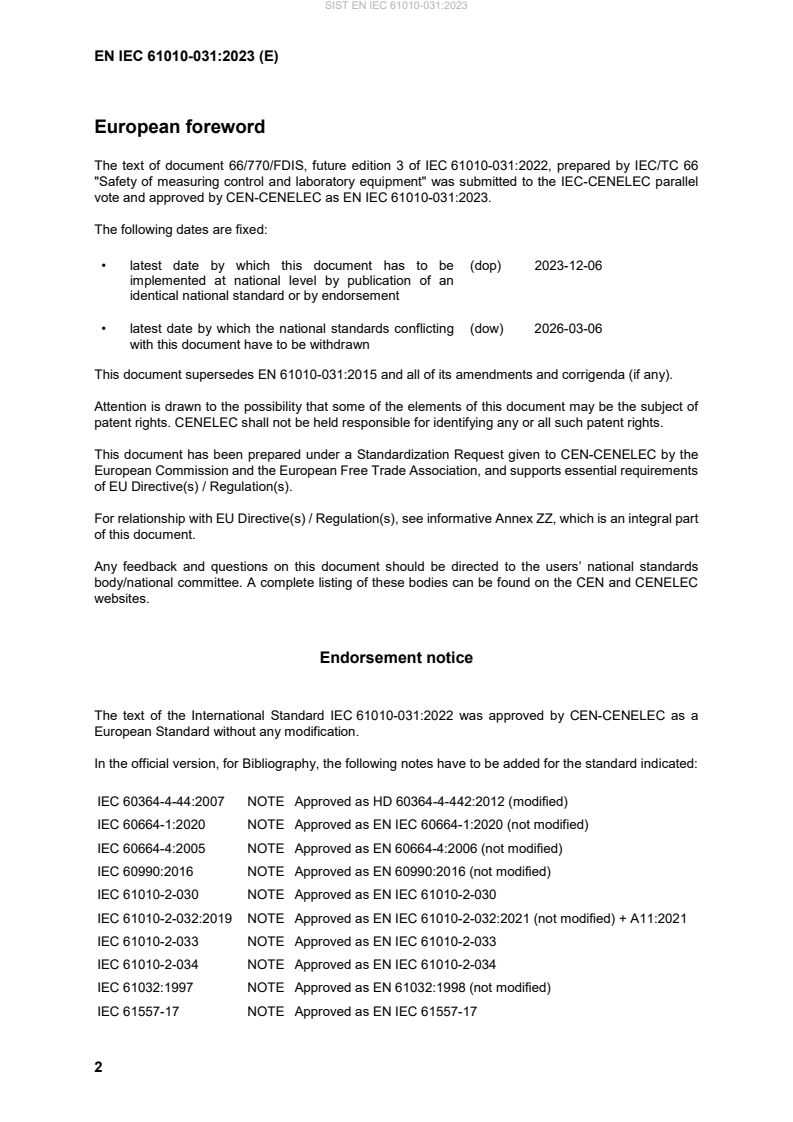
European foreword
The text of document 66/770/FDIS, future edition 3 of IEC 61010-031:2022, prepared by IEC/TC 66
"Safety of measuring control and laboratory equipment" was submitted to the IEC-CENELEC parallel
vote and approved by CEN-CENELEC as EN IEC 61010-031:2023.
The following dates are fixed:
• latest date by which this document has to be (dop) 2023-12-06
implemented at national level by publication of an
identical national standard or by endorsement
• latest date by which the national standards conflicting (dow) 2026-03-06
with this document have to be withdrawn
This document supersedes EN 61010-031:2015 and all of its amendments and corrigenda (if any).
Attention is drawn to the possibility that some of the elements of this document may be the subject of
patent rights. CENELEC shall not be held responsible for identifying any or all such patent rights.
This document has been prepared under a Standardization Request given to CEN-CENELEC by the
European Commission and the European Free Trade Association, and supports essential requirements
of EU Directive(s) / Regulation(s).
For relationship with EU Directive(s) / Regulation(s), see informative Annex ZZ, which is an integral part
of this document.
Any feedback and questions on this document should be directed to the users’ national standards
body/national committee. A complete listing of these bodies can be found on the CEN and CENELEC
websites.
Endorsement notice
The text of the International Standard IEC 61010-031:2022 was approved by CEN-CENELEC as a
European Standard without any modification.
In the official version, for Bibliography, the following notes have to be added for the standard indicated:
IEC 60364-4-44:2007 NOTE Approved as HD 60364-4-442:2012 (modified)
IEC 60664-1:2020 NOTE Approved as EN IEC 60664-1:2020 (not modified)
IEC 60664-4:2005 NOTE Approved as EN 60664-4:2006 (not modified)
IEC 60990:2016 NOTE Approved as EN 60990:2016 (not modified)
IEC 61010-2-030 NOTE Approved as EN IEC 61010-2-030
IEC 61010-2-032:2019 NOTE Approved as EN IEC 61010-2-032:2021 (not modified) + A11:2021
IEC 61010-2-033 NOTE Approved as EN IEC 61010-2-033
IEC 61010-2-034 NOTE Approved as EN IEC 61010-2-034
IEC 61032:1997 NOTE Approved as EN 61032:1998 (not modified)
IEC 61557-17 NOTE Approved as EN IEC 61557-17
Annex ZA
(normative)
Normative references to international publications
with their corresponding European publications
The following documents are referred to in the text in such a way that some or all of their content
constitutes requirements of this document. For dated references, only the edition cited applies. For
undated references, the latest edition of the referenced document (including any amendments) applies.
NOTE 1 When an International Publication has been modified by common modifications, indicated by (mod),
the relevant EN/HD applies.
NOTE 2 Up-to-date information on the latest versions of the European Standards listed in this annex is available
here: www.cencenelec.eu.
Publication Year Title EN/HD Year
IEC 60027-1 1992 Letters symbols to be used in electrical EN 60027-1 2006
+ AMD1 technology - Part 1: General + A2 2007
+ AMD2
IEC 60027-2 2019 Letter symbols to be used in electrical EN IEC 60027-2 2019
technology - Part 2: Telecommunications
and electronics
IEC 60027-4 2006 Letter symbols to be used in electrical EN 60027-4 2007
technology - Part 4: Rotating electric
machines
IEC 60529 1989 Degrees of protection provided by EN 60529 1991
enclosures (IP Code)
+ Corrigendum May 1993
+ AMD1 1999 + A1 2000
2013 + A2 2013
+ AMD2
+ A2:2013/AC 2019-02
+ AC 2016-12
IEC 61010-1 2010 Safety requirements for electrical EN 61010-1 2010
+ AMD1 2016 equipment for measurement, control and + A1 2019
laboratory use - Part 1: General
+ A1:2019/AC 2019-04
requirements
IEC 61180 2016 High-voltage test techniques for low- EN 61180 2016
voltage equipment - Definitions, test and
procedure requirements, test equipment
Annex ZZ
(informative)
Relationship between this European standard and the safety
objectives of Directive 2014/35/EU [2014 OJ L96] aimed to be
covered
This European Standard has been prepared under a Commission’s standardization request relating to
harmonized standards in the field of the Low Voltage Directive, M/511, to provide one voluntary means
of conforming to safety objectives of Directive 2014/35/EU of the European Parliament and of the
Council of 26 February 2014 on the harmonization of the laws of the Member States relating to the
making available on the market of electrical equipment designed for use within certain voltage limits
[2014 OJ L96].
Once this standard is cited in the Official Journal of the European Union under that Directive, compliance
with the normative clauses of this standard given in Table ZZ.1 confers, within the limits of the scope of
this standard, a presumption of conformity with the corresponding safety objectives of that Directive,
and associated EFTA regulations.
Table ZZ.1 — Correspondence between this European standard and Annex I of Directive
2014/35/EU [2014 OJ L96]
Clause(s) /
Safety objectives of Directive
subclause(s)
Remarks / Notes
2014/35/EU (Annex I)
of this EN
1. General conditions
1 (a) the essential characteristics, the 6 This standard only deals with
recognition and observance of which will accessories for measuring
ensure that electrical equipment will be equipment.
used safely and in applications for which
it was made, shall be marked on the
electrical equipment, or, if this is not
possible, on an accompanying document
1 (b) the electrical equipment, together 6.4
with its component parts, shall be made
in such a way as to ensure that it can be
safely and properly assembled and
connected
1 (c) the electrical equipment shall be so 6.4, Annex F
designed and manufactured as to ensure See also the
that protection against the hazards set details in points 2
out in points 2 and 3 is ensured, and 3
providing that the equipment is used in
applications for which it was made and is
adequately maintained
2. Protection against hazards arising from the electrical equipment
Measures of a technical nature shall be laid down in accordance with point 1, in order to ensure that:
2 (a) persons and domestic animals are 5, 7, 9.1, 9.2, 11,
adequately protected against the danger Annex A,
of physical injury or other harm which Annex D
might be caused by direct or indirect
contact
Clause(s) /
Safety objectives of Directive
subclause(s)
Remarks / Notes
2014/35/EU (Annex I)
of this EN
2 (b) temperatures, arcs or radiation 5, 5.5.2, 7.3.1, The products dealt with in this
which would cause a danger, are not 7.3.2, 9.2, 10, 12, standard are all passive
produced 13 accessories.
2 (c) persons, domestic animals and 8, 11.2 The products dealt with in this
property are adequately protected standard are all passive
against non-electrical dangers caused by accessories.
the electrical equipment which are
revealed by experience
2 (d) the insulation is suitable for 5, 7.7, 9
foreseeable conditions Annex D
3. Protection against hazards which may be caused by external influences on the electrical
equipment
Technical measures shall be laid down in accordance with point 1, in order to ensure that the electrical
equipment:
3 (a) meets the expected mechanical 5, 8, 9.1, 11.2
requirements in such a way that persons,
domestic animals and property are not
endangered
3 (b) is resistant to non-mechanical 5, 7.5, 9.2, 10
influences in expected environmental
conditions, in such a way that persons,
domestic animals and property are not
endangered
3 (c) does not endanger persons, 5, 9.1, 10, 12, 13
domestic animals and property in
foreseeable conditions of overload
WARNING 1 — Presumption of conformity stays valid only as long as a reference to this European
standard is maintained in the list published in the Official Journal of the European Union. Users of this
standard should consult frequently the latest list published in the Official Journal of the European Union.
WARNING 2 — Other Union legislation may be applicable to the product(s) falling within the scope of
this standard.
IEC 61010-031 ®
Edition 3.0 2022-12
INTERNATIONAL
STANDARD
NORME
INTERNATIONALE
colour
inside
GROUP SAFETY PUBLICATION
PUBLICATION GROUPÉE DE SÉCURITÉ
Safety requirements for electrical equipment for measurement, control, and
laboratory use –
Part 031: Safety requirements for hand-held and hand-manipulated probe
assemblies for electrical test and measurement
Exigences de sécurité pour appareils électriques de mesurage, de régulation
et de laboratoire –
Partie 031: Exigences de sécurité pour sondes équipées tenues à la main
et manipulées pour mesurage et essais électriques
INTERNATIONAL
ELECTROTECHNICAL
COMMISSION
COMMISSION
ELECTROTECHNIQUE
INTERNATIONALE
ICS 19.080 ISBN 978-2-8322-6196-5
– 2 – IEC 61010-031:2022 © IEC 2022
CONTENTS
FOREWORD . 7
1 Scope . 10
2 Normative references . 10
3 Terms and definitions . 11
3.1 Parts and accessories . 11
3.2 Quantities . 12
3.3 Tests . 12
3.4 Safety terms . 13
3.5 Insulation . 14
4 General . 15
4.1 Type of probe assemblies . 15
4.2 Safety aspects . 19
4.2.1 Identified HAZARDS . 19
4.2.2 Aspects excluded . 19
4.3 Verification. 19
4.4 Environmental conditions . 20
4.4.1 Normal environmental conditions . 20
4.4.2 Extended environmental conditions . 20
5 Tests . 20
5.1 General . 20
5.2 Sequence of tests . 21
5.3 Reference test conditions. 21
5.3.1 Environmental conditions . 21
5.3.2 State of probe assemblies . 21
5.3.3 Position of the probe assembly . 21
5.3.4 Accessories . 21
5.3.5 Covers and removable parts . 21
5.3.6 Input and output voltages . 22
5.3.7 Controls . 22
5.3.8 Connections . 22
5.3.9 Short-term or intermittent operation . 22
5.4 Testing in SINGLE FAULT CONDITION. 22
5.4.1 General . 22
5.4.2 Application of fault conditions . 22
5.4.3 Duration of tests . 23
5.4.4 Conformity after application of fault conditions . 23
5.5 Tests in REASONABLY FORESEEABLE MISUSE . 23
5.5.1 General . 23
5.5.2 Fuses . 23
6 Marking and documentation . 24
6.1 Marking . 24
6.1.1 General . 24
6.1.2 Identification . 24
6.1.3 Fuses . 25
6.1.4 CONNECTORS and operating devices . 25
6.1.5 RATING . 26
IEC 61010-031:2022 © IEC 2022 – 3 –
6.2 Warning markings . 26
6.3 Durability of markings . 26
6.4 Documentation . 27
6.4.1 General . 27
6.4.2 Probe assembly RATING . 27
6.4.3 Probe assembly operation . 27
6.4.4 Probe assembly maintenance and service . 28
7 Protection against electric shock . 28
7.1 General . 28
7.2 Determination of ACCESSIBLE parts . 29
7.2.1 General . 29
7.2.2 Examination . 29
7.2.3 Openings for pre-set controls . 30
7.3 Limit values for ACCESSIBLE parts . 30
7.3.1 General . 30
7.3.2 Levels in NORMAL CONDITION . 31
7.3.3 Levels in SINGLE FAULT CONDITION . 31
7.3.4 Measurement of voltage and touch current . 33
7.4 Means of protection against electric shock . 36
7.4.1 General . 36
7.4.2 CONNECTORS . 37
7.4.3 PROBE TIPS. 39
7.4.4 Impedance . 42
7.4.5 PROTECTIVE IMPEDANCE . 42
7.4.6 BASIC INSULATION, SUPPLEMENTARY INSULATION, DOUBLE INSULATION and
REINFORCED INSULATION . 42
7.5 Insulation requirements . 43
7.5.1 The nature of insulation . 43
7.5.2 CLEARANCES. 43
7.5.3 CREEPAGE DISTANCES . 48
7.5.4 Solid insulation for probe assemblies . 50
7.6 Procedure for voltage tests . 55
7.6.1 General . 55
7.6.2 Humidity preconditioning . 56
7.6.3 Conduct of tests . 56
7.6.4 Test voltages . 57
7.6.5 Test procedures . 59
7.7 Constructional requirements for protection against electric shock . 60
7.7.1 General . 60
7.7.2 Insulating materials . 60
7.7.3 ENCLOSURES of probe assemblies with DOUBLE INSULATION or
REINFORCED INSULATION . 60
7.7.4 PROBE WIRE attachment . 61
8 Protection against mechanical HAZARDS . 64
9 Resistance to mechanical stresses . 64
9.1 General . 64
9.2 Rigidity test . 65
9.3 Drop test . 65
9.4 Impact swing test . 65
– 4 – IEC 61010-031:2022 © IEC 2022
10 Temperature limits . 66
11 Protection against HAZARDS from fluids . 67
11.1 Cleaning . 67
11.2 Specially protected probe assemblies . 67
12 Components . 67
12.1 General . 67
12.2 Fuses. 67
12.3 PROBE WIRE . 68
12.3.1 General . 68
12.3.2 RATING of PROBE WIRE . 68
12.3.3 Pressure test at high temperature for insulations . 68
12.3.4 Tests for resistance of insulation to cracking . 70
12.3.5 Voltage test . 70
12.3.6 Tensile test . 71
13 Prevention of HAZARD from arc flash and short-circuits . 73
13.1 General . 73
13.2 Exposed conductive parts . 73
Annex A (normative) Measuring circuits for touch current (see 7.3) . 74
A.1 Measuring circuits for AC with frequencies up to 1 MHz and for DC . 74
A.2 Measuring circuits for AC with sinusoidal frequencies up to 100 Hz and
for DC . 74
A.3 Current measuring circuit for electrical burns at frequencies above 100 kHz . 75
A.4 Current measuring circuit for WET LOCATIONS . 76
Annex B (normative) Standard test fingers . 78
Annex C (normative) Measurement of CLEARANCES and CREEPAGE DISTANCES . 81
Annex D (normative) Routine spark tests on PROBE WIRE . 83
D.1 General . 83
D.2 Spark test procedure . 83
D.3 Routine spark test method for PROBE WIRE . 85
Annex E (informative) 4 mm CONNECTORS . 87
E.1 General . 87
E.2 Dimensions . 87
Annex F (normative) MEASUREMENT CATEGORIES . 89
F.1 General . 89
F.2 MEASUREMENT CATEGORIES . 89
F.2.1 MEASUREMENT CATEGORY II . 89
F.2.2 MEASUREMENT CATEGORY III . 89
F.2.3 MEASUREMENT CATEGORY IV . 89
F.2.4 Probe assemblies without a MEASUREMENT CATEGORY RATING. 90
Annex G (informative) Determination of CLEARANCES for Table 2 . 92
Annex H (informative) Line-to-neutral voltages for common mains supply systems . 93
Annex I (informative) Index of defined terms . 95
Bibliography . 97
Figure 1 – Example of a STACKABLE CONNECTOR with a male CONNECTOR and a female
TERMINAL . 12
Figure 2 – Examples of Type A probe assemblies . 16
IEC 61010-031:2022 © IEC 2022 – 5 –
Figure 3 – Example of Type B probe assemblies . 17
Figure 4 – Examples of Type D probe assemblies . 18
Figure 5 – Examples of Type E probe assemblies . 18
Figure 6 – Examples of Type F probe assemblies . 19
Figure 7 – Methods for determination of ACCESSIBLE parts . 30
Figure 8 – Capacitance level versus voltage in NORMAL CONDITION and SINGLE FAULT
CONDITION (see 7.3.2 c) and 7.3.3 c)) . 32
Figure 9 – Voltage and touch current measurement . 33
Figure 10 – Voltage and touch current measurement for the REFERENCE CONNECTOR . 34
Figure 11 – Voltage and touch current measurement with shielded test probe . 35
Figure 12 – Maximum test probe input voltage for 70 mA touch current. 36
Figure 13 – Protection by a PROTECTIVE FINGERGUARD . 40
Figure 14 – Protection by distance . 40
Figure 15 – Protection by tactile indicator . 41
Figure 16 – Example of probe assembly with IP2X PROBE TIP . 41
Figure 17 – Example of recurring peak voltage . 47
Figure 18 – Distance between conductors on an interface between two layers . 52
Figure 19 – Distance between adjacent conductors along an interface of two layers . 53
Figure 20 – Distance between adjacent conductors located between the same two
layers. 54
Figure 21 – Flexing test . 62
Figure 22 – Rotational flexing test . 64
Figure 23 – Impact swing test . 66
Figure 24 – Indentation device . 69
Figure A.1 – Measuring circuit for AC with frequencies up to 1 MHz and for DC . 74
Figure A.2 – Measuring circuits for AC with sinusoidal frequencies up to 100 Hz and
for DC . 75
Figure A.3 – Current measuring circuit for electrical burns . 76
Figure A.4 – Current measuring circuit for high frequency test probes . 76
Figure A.5 – Current measuring circuit for WET LOCATIONS . 77
Figure B.1 – Rigid test finger . 78
Figure B.2 – Jointed test finger . 79
Figure D.1 – Bead chain configuration (if applicable) . 84
Figure E.1 – Recommended dimensions of 4 mm CONNECTORS . 88
Figure F.1 – Example to identify the locations of MEASUREMENT CATEGORIES. 90
Table 1 – Symbols . 25
Table 2 – CLEARANCES for unmated CONNECTORS . 38
Table 3 – Multiplication factors for CLEARANCES of probe assembly RATED for operation
at altitudes up to 5 000 m . 44
Table 4 – CLEARANCES for probe assemblies RATED for MEASUREMENT CATEGORIES . 44
Table 5 – CLEARANCE values for the calculation of 7.5.2.3.2 . 46
Table 6 – CLEARANCES for BASIC INSULATION in probe assemblies subjected to recurring
WORKING VOLTAGES with frequencies above 30 kHz . 48
peak voltages or
Table 7 – CREEPAGE DISTANCES for BASIC INSULATION or SUPPLEMENTARY INSULATION . 49
– 6 – IEC 61010-031:2022 © IEC 2022
Table 8 – Impulse test voltages for testing electric strength of solid insulation for probe
assemblies RATED for MEASUREMENT CATEGORIES . 51
Table 9 – AC test voltages for testing electric strength of solid insulation for probe
RATED for MEASUREMENT CATEGORIES . 51
assemblies
Table 10 – Minimum values for distance or thickness of solid insulation for probe
assemblies RATED for MEASUREMENT CATEGORIES . 53
Table 11 – Test voltages based on CLEARANCES . 58
Table 12 – Correction factors according to test site altitude for test voltages for
CLEARANCES . 59
Table 13 – Pull forces for PROBE WIRE attachment tests . 63
Table 14 – Surface temperature limits in NORMAL CONDITION . 66
Table 15 – Diameter of mandrel and numbers of turns . 70
Table C.1 – Dimension of X . 81
Table C.2 – Methods of measuring CLEARANCES and CREEPAGE DISTANCES . 81
Table D.1 – Maximum centre-to-centre spacings of bead chains . 83
Table D.2 – Formula for maximum speed of wire in terms of electrode length L of link-
or bead-chain electrode . 85
Table F.1 – Characteristics of MEASUREMENT CATEGORIES . 91
Table G.1 – CLEARANCES values for Table 2 . 92
Table H.1 – Line-to-neutral voltages for common mains supply systems . 94
IEC 61010-031:2022 © IEC 2022 – 7 –
INTERNATIONAL ELECTROTECHNICAL COMMISSION
____________
SAFETY REQUIREMENTS FOR ELECTRICAL EQUIPMENT
FOR MEASUREMENT, CONTROL, AND LABORATORY USE –
Part 031: Safety requirements for hand-held and hand-manipulated
probe assemblies for electrical test and measurement
FOREWORD
1) The International Electrotechnical Commission (IEC) is a worldwide organization for standardization comprising
all national electrotechnical committees (IEC National Committees). The object of IEC is to promote international
co-operation on all questions concerning standardization in the electrical and electronic fields. To this end and
in addition to other activities, IEC publishes International Standards, Technical Specifications, Technical Reports,
Publicly Available Specifications (PAS) and Guides (hereafter referred to as "IEC Publication(s)"). Their
preparation is entrusted to technical committees; any IEC National Committee interested in the subject dealt with
may participate in this preparatory work. International, governmental and non-governmental organizations liaising
with the IEC also participate in this preparation. IEC collaborates closely with the International Organization for
Standardization (ISO) in accordance with conditions determined by agreement between the two organizations.
2) The formal decisions or agreements of IEC on technical matters express, as nearly as possible, an international
consensus of opinion on the relevant subjects since each technical committee has representation from all
interested IEC National Committees.
3) IEC Publications have the form of recommendations for international use and are accepted by IEC National
Committees in that sense. While all reasonable efforts are made to ensure that the technical content of IEC
Publications is accurate, IEC cannot be held responsible for the way in which they are used or for any
misinterpretation by any end user.
4) In order to promote international uniformity, IEC National Committees undertake to apply IEC Publications
transparently to the maximum extent possible in their national and regional publications. Any divergence between
any IEC Publication and the corresponding national or regional publication shall be clearly indicated in the latter.
5) IEC itself does not provide any attestation of conformity. Independent certification bodies provide conformity
assessment services and, in some areas, access to IEC marks of conformity. IEC is not responsible for any
services carried out by independent certification bodies.
6) All users should ensure that they have the latest edition of this publication.
7) No liability shall attach to IEC or its directors, employees, servants or agents including individual experts and
members of its technical committees and IEC National Committees for any personal injury, property damage or
other damage of any nature whatsoever, whether direct or indirect, or for costs (including legal fees) and
expenses arising out of the publication, use of, or reliance upon, this IEC Publication or any other IEC
Publications.
8) Attention is drawn to the Normative references cited in this publication. Use of the referenced publications is
indispensable for the correct application of this publication.
9) Attention is drawn to the possibility that some of the elements of this IEC Publication may be the subject of patent
rights. IEC shall not be held responsible for identifying any or all such patent rights.
IEC 61010-031 has been prepared by IEC technical committee 66: Safety of measuring, control
and laboratory equipment. It is an International Standard.
It has the status of a group safety publication in accordance with IEC Guide 104.
This third edition cancels and replaces the second edition published in 2015, and
Amendment 1:2018. IEC 61010-031 is a stand-alone standard.
This edition includes the following significant technical changes with respect to the previous
edition:
a) the scope has been made succinct. General information from the scope of Edition 2 has
been moved to a new Clause 4. Consequently, Clause 4 to Clause 8 of Edition 2 have been
renumbered. Clause 9 of Edition 2 has been deleted;
– 8 – IEC 61010-031:2022 © IEC 2022
b) in Clause 2, normative references have been dated and new normative references have
been added;
c) in 3.1.4, the definition of PROBE TIP has been modified;
d) in 4.1, there is no longer any differentiation between high voltage and low voltage probe
assemblies. Type C probe assemblies have been merged with Type B probe assemblies;
e) in 4.1 d) "Kelvin" probes have been added to the list of probe assemblies as a new Type E
and a new Figure 5;
f) in 4.1 e), probes for voltage measurement without electrical connection to conductors have
been added to the list of probe assemblies as a new Type F and a new Figure 6;
g) in 4.2.1, spread of fire is no longer considered as a HAZARD;
h) Subclause 4.4.2.5 from Edition 2 has been deleted;
i) Subclause 4.4.4.3 from Edition 2 has been deleted;
j) in 5.4.4.1 consideration has been given to SPACINGS and impedance;
k) in 6.1.1, removable parts of PROBE TIPS which bear markings are allowed;
l) in 6.1.5, the voltage to be marked for MEASUREMENT CATEGORIES is the AC line-to-neutral or
DC voltage;
m) in 7.4.2, requirements for unmated CONNECTORS have been modified as follows:
1) Table 2 has been modified and expanded,
2) a calculation method for CLEARANCES of CONNECTORS above 20 kV has been defined,
CREEPAGE DISTANCES have been aligned with CLEARANCES;
3)
n) in 7.4.3.1 and 7.4.3.5, requirements for IP2X PROBE TIPS with retractable sleeve have been
added;
o) in 7.4.3.2, PROBE TIPS are now applicable to non-contact probe assemblies;
p) in 7.5.2.3.2, the values of Table 5 have been modified;
q) in 7.6.2, voltage tests of CLEARANCES are done without humidity preconditioning;
r) pre-treatments for rigidity test from Clause 10 of Edition 2 have been moved to 9.2;
s) Subclause 11.1 of Edition 2 has been deleted;
t) addition of an exception for Type E probe assembly in 13.2. Removable parts of PROBE TIPS
which bear markings are allowed;
u) Figure F.1 has been modified;
v) Annex G has been added
...