

EN IEC 61820-3-2:2023
(Main)Electrical installations for lighting and beaconing of aerodromes - Part 3-2: Requirements for power supplies - Particular requirements for series circuits
General Information
- Abstract
IEC 61820-3-2:2023 specifies the requirements for power electronic converter systems (PECS) dedicated to powering aeronautical ground lighting (AGL) circuits with series circuit topology. An example of a traditional implementation is an AGL circuit with 6,6 A RMS nominal current, powered by a constant current regulator (CCR). In addition to revising the requirements for 6,6 A CCR setups, this document introduces requirements for general PECS for new AGL systems including systems specifically designed for LED based luminaires. This first edition cancels and replaces IEC 61822 published in 2009. This edition constitutes a technical revision. This edition includes the following significant technical changes with respect to IEC 61822:2009: a) introduction of power electronic converter systems (PECS) to be used in the aeronautical ground lighting systems other than the 6,6 A aeronautical ground lighting systems; b) introduction of classification for different device types; c) introduction of IEC 62477-1:2022 and IEC 62477-2:2018 as the basis for safety related requirements.
- Status
- Published
- Publication Date
- 23-Nov-2023
- Drafting Committee
- IEC/TC 97 - IEC_TC_97
- Current Stage
- 6060 - Document made available - Publishing
- Start Date
- 24-Nov-2023
- Due Date
- 03-Jul-2023
- Completion Date
- 24-Nov-2023

Overview
EN IEC 61820-3-2:2023 - Electrical installations for lighting and beaconing of aerodromes, Part 3-2 - specifies requirements for power supplies used with series circuit Aeronautical Ground Lighting (AGL) systems. It covers traditional constant current regulator (CCR) implementations (for example, 6,6 A RMS nominal CCR circuits) and introduces requirements for general power electronic converter systems (PECS), including systems designed for LED-based luminaires. This edition replaces IEC 61822:2009 and adds classifications for device types and new safety bases referencing IEC 62477-1:2022 and IEC 62477-2:2018.
Key topics and technical requirements
- Scope and classification
- Defines base, voltage and construction classes for series-circuit power supplies (PECS and CCR devices).
- Functional requirements
- Input voltage ranges, power ratings, brightness/level control, remote interface/communication, and field circuit isolation.
- Specific provisions for 6,6 A CCR behavior and for general PECS feeding LED luminaires.
- Performance requirements
- Efficiency, input power factor, output current/waveform characteristics, dynamic response and voltage limitation rules specific to CCRs and general PECS.
- Design and safety
- Mechanical and electrical design rules, local control and indication, nameplate information.
- Protection against hazards including surge protection device (SPD) monitoring, functional safety and cybersecurity considerations.
- Environmental and EMC
- Environmental conditions, EMC immunity/emission requirements relevant to airport and power-station environments.
- Testing
- Type and routine tests, visual and performance tests, EMC and environmental tests; test procedures for resistive/reactive loading and open-circuit scenarios.
Practical applications and who uses this standard
- Manufacturers of CCRs and PECS for AGL systems use the standard to design, certify and mark equipment compliant with aerodrome requirements.
- Airport electrical engineers and consultants reference it for specifying reliable series-circuit power supplies and integrating LED-based airfield lighting.
- Systems integrators and contractors apply the requirements during procurement, installation and commissioning of AGL circuits.
- Testing laboratories and conformity assessors use the test methods and type/routine test lists for verification and certification.
- Regulators and procurement authorities adopt EN IEC 61820-3-2:2023 in technical specifications to ensure safety, interoperability and maintainability.
Related standards
- IEC 61820-1 (Fundamental principles for AGL)
- IEC 62477-1:2022 and IEC 62477-2:2018 (safety requirements for PECS)
- EMC and surge standards referenced: IEC 61000 series, IEC 60099-4, IEC 60529, among others.
Keywords: EN IEC 61820-3-2:2023, aeronautical ground lighting, AGL, series circuits, power electronic converter systems, PECS, 6,6 A CCR, LED luminaires, power supplies, functional safety, EMC.
Relations
- Effective Date
- 22-Aug-2023
- Effective Date
- 03-Feb-2026
- Effective Date
- 03-Feb-2026
- Effective Date
- 03-Feb-2026
- Effective Date
- 03-Feb-2026
- Refers
EN IEC 61439-1:2021 - Low-voltage switchgear and controlgear assemblies - Part 1: General rules - Effective Date
- 03-Feb-2026
- Effective Date
- 03-Feb-2026
- Effective Date
- 03-Feb-2026
- Effective Date
- 03-Feb-2026
- Effective Date
- 03-Feb-2026
- Effective Date
- 03-Feb-2026
- Effective Date
- 03-Feb-2026
- Effective Date
- 03-Feb-2026
- Effective Date
- 03-Feb-2026
- Effective Date
- 03-Feb-2026
Get Certified
Connect with accredited certification bodies for this standard

IMQ S.p.A. (Certification)
Italian electrical product certification.

SLG Prüf- und Zertifizierungs GmbH
German testing and certification body.

UL Solutions
Global safety science company with testing, inspection and certification.
Sponsored listings
Frequently Asked Questions
EN IEC 61820-3-2:2023 is a standard published by CLC. Its full title is "Electrical installations for lighting and beaconing of aerodromes - Part 3-2: Requirements for power supplies - Particular requirements for series circuits". This standard covers: IEC 61820-3-2:2023 specifies the requirements for power electronic converter systems (PECS) dedicated to powering aeronautical ground lighting (AGL) circuits with series circuit topology. An example of a traditional implementation is an AGL circuit with 6,6 A RMS nominal current, powered by a constant current regulator (CCR). In addition to revising the requirements for 6,6 A CCR setups, this document introduces requirements for general PECS for new AGL systems including systems specifically designed for LED based luminaires. This first edition cancels and replaces IEC 61822 published in 2009. This edition constitutes a technical revision. This edition includes the following significant technical changes with respect to IEC 61822:2009: a) introduction of power electronic converter systems (PECS) to be used in the aeronautical ground lighting systems other than the 6,6 A aeronautical ground lighting systems; b) introduction of classification for different device types; c) introduction of IEC 62477-1:2022 and IEC 62477-2:2018 as the basis for safety related requirements.
IEC 61820-3-2:2023 specifies the requirements for power electronic converter systems (PECS) dedicated to powering aeronautical ground lighting (AGL) circuits with series circuit topology. An example of a traditional implementation is an AGL circuit with 6,6 A RMS nominal current, powered by a constant current regulator (CCR). In addition to revising the requirements for 6,6 A CCR setups, this document introduces requirements for general PECS for new AGL systems including systems specifically designed for LED based luminaires. This first edition cancels and replaces IEC 61822 published in 2009. This edition constitutes a technical revision. This edition includes the following significant technical changes with respect to IEC 61822:2009: a) introduction of power electronic converter systems (PECS) to be used in the aeronautical ground lighting systems other than the 6,6 A aeronautical ground lighting systems; b) introduction of classification for different device types; c) introduction of IEC 62477-1:2022 and IEC 62477-2:2018 as the basis for safety related requirements.
EN IEC 61820-3-2:2023 is classified under the following ICS (International Classification for Standards) categories: 29.140.50 - Lighting installation systems; 93.120 - Construction of airports. The ICS classification helps identify the subject area and facilitates finding related standards.
EN IEC 61820-3-2:2023 has the following relationships with other standards: It is inter standard links to EN 61822:2009, EN IEC 62477-1:2023, EN 61508-7:2010, EN 61508-3:2001, EN IEC 60076-11:2018, EN IEC 61439-1:2021, EN 61508-1:2010, EN 61508-4:2010, EN IEC 62477-2:2018, EN 61508-2:2010, EN 61508-5:2001, EN IEC 61439-2:2021, EN 61000-6-5:2015, EN 61508-2:2001, EN 61508-4:2001. Understanding these relationships helps ensure you are using the most current and applicable version of the standard.
EN IEC 61820-3-2:2023 is available in PDF format for immediate download after purchase. The document can be added to your cart and obtained through the secure checkout process. Digital delivery ensures instant access to the complete standard document.
Standards Content (Sample)
SLOVENSKI STANDARD
01-februar-2024
Električne inštalacije za razsvetljavo in signalizacijo na letališčih - 3-2. del: Zahteve
za napajalnike - Posebne zahteve za zaporedna vezja (IEC 61820-3-2:2023)
Electrical installations for lighting and beaconing of aerodromes - Part 3-2: Requirements
for power supplies - Particular requirements for series circuits (IEC 61820-3-2:2023)
Elektrische Anlagen für die Beleuchtung und Befeuerung von Flugplätzen – Besondere
Anforderungen an Serienkreisstromversorgungen (IEC 61820-3-2:2023)
Installations electriques d'eclairage et de balisage des aérodromes - Partie 3-2 :
Exigences relatives aux alimentations électriques - Exigences particulières aux circuits
en série (IEC 61820-3-2:2023)
Ta slovenski standard je istoveten z: EN IEC 61820-3-2:2023
ICS:
29.140.50 Instalacijski sistemi za Lighting installation systems
razsvetljavo
49.100 Oprema za servis in Ground service and
vzdrževanje na tleh maintenance equipment
93.120 Gradnja letališč Construction of airports
2003-01.Slovenski inštitut za standardizacijo. Razmnoževanje celote ali delov tega standarda ni dovoljeno.
EUROPEAN STANDARD EN IEC 61820-3-2
NORME EUROPÉENNE
EUROPÄISCHE NORM November 2023
ICS 29.140.50; 93.120 Supersedes EN 61822:2009
English Version
Electrical installations for lighting and beaconing of aerodromes -
Part 3-2: Requirements for power supplies - Particular
requirements for series circuits
(IEC 61820-3-2:2023)
Installations électriques pour l'éclairage et le balisage des Elektrische Anlagen für die Beleuchtung und Befeuerung
aérodromes - Partie 3-2 : Exigences relatives aux von Flugplätzen - Besondere Anforderungen an
alimentations électriques - Exigences particulières relatives Serienkreisstromversorgungen
aux circuits série (IEC 61820-3-2:2023)
(IEC 61820-3-2:2023)
This European Standard was approved by CENELEC on 2023-11-14. CENELEC members are bound to comply with the CEN/CENELEC
Internal Regulations which stipulate the conditions for giving this European Standard the status of a national standard without any alteration.
Up-to-date lists and bibliographical references concerning such national standards may be obtained on application to the CEN-CENELEC
Management Centre or to any CENELEC member.
This European Standard exists in three official versions (English, French, German). A version in any other language made by translation
under the responsibility of a CENELEC member into its own language and notified to the CEN-CENELEC Management Centre has the
same status as the official versions.
CENELEC members are the national electrotechnical committees of Austria, Belgium, Bulgaria, Croatia, Cyprus, the Czech Republic,
Denmark, Estonia, Finland, France, Germany, Greece, Hungary, Iceland, Ireland, Italy, Latvia, Lithuania, Luxembourg, Malta, the
Netherlands, Norway, Poland, Portugal, Republic of North Macedonia, Romania, Serbia, Slovakia, Slovenia, Spain, Sweden, Switzerland,
Türkiye and the United Kingdom.
European Committee for Electrotechnical Standardization
Comité Européen de Normalisation Electrotechnique
Europäisches Komitee für Elektrotechnische Normung
CEN-CENELEC Management Centre: Rue de la Science 23, B-1040 Brussels
© 2023 CENELEC All rights of exploitation in any form and by any means reserved worldwide for CENELEC Members.
Ref. No. EN IEC 61820-3-2:2023 E
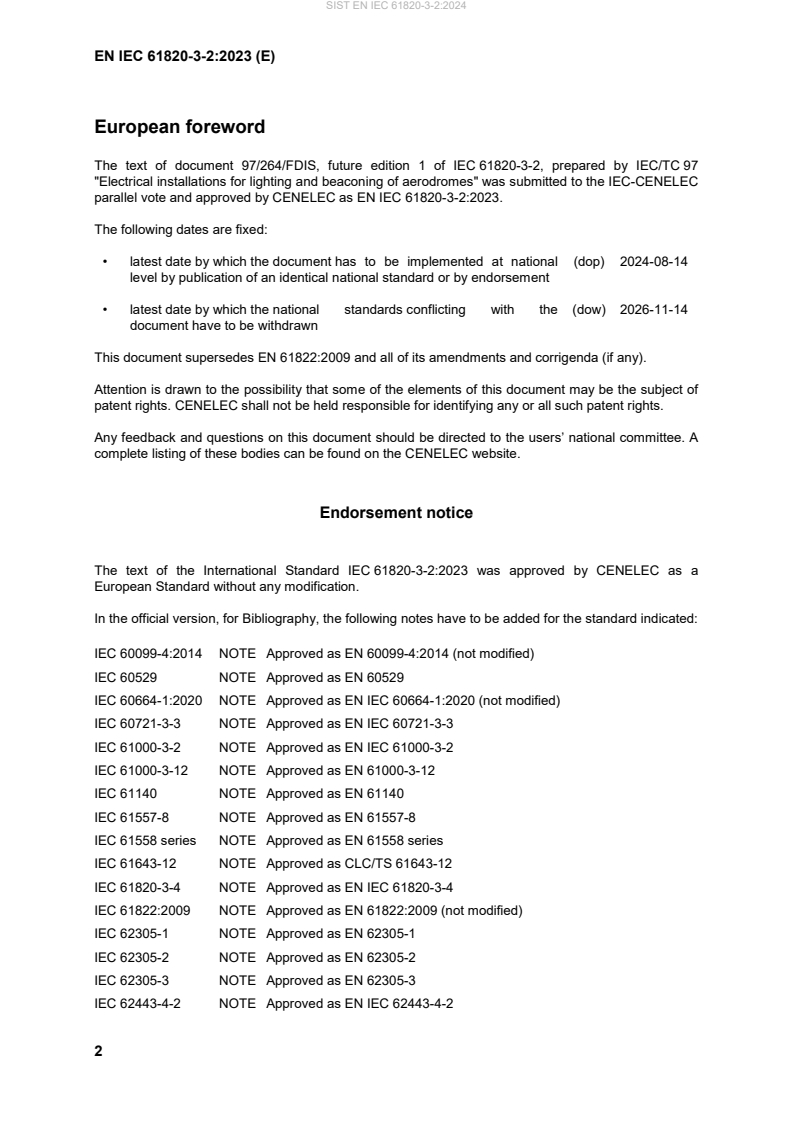
European foreword
The text of document 97/264/FDIS, future edition 1 of IEC 61820-3-2, prepared by IEC/TC 97
"Electrical installations for lighting and beaconing of aerodromes" was submitted to the IEC-CENELEC
parallel vote and approved by CENELEC as EN IEC 61820-3-2:2023.
The following dates are fixed:
• latest date by which the document has to be implemented at national (dop) 2024-08-14
level by publication of an identical national standard or by endorsement
• latest date by which the national standards conflicting with the (dow) 2026-11-14
document have to be withdrawn
This document supersedes EN 61822:2009 and all of its amendments and corrigenda (if any).
Attention is drawn to the possibility that some of the elements of this document may be the subject of
patent rights. CENELEC shall not be held responsible for identifying any or all such patent rights.
Any feedback and questions on this document should be directed to the users’ national committee. A
complete listing of these bodies can be found on the CENELEC website.
Endorsement notice
The text of the International Standard IEC 61820-3-2:2023 was approved by CENELEC as a
European Standard without any modification.
In the official version, for Bibliography, the following notes have to be added for the standard indicated:
IEC 60099-4:2014 NOTE Approved as EN 60099-4:2014 (not modified)
IEC 60529 NOTE Approved as EN 60529
IEC 60664-1:2020 NOTE Approved as EN IEC 60664-1:2020 (not modified)
IEC 60721-3-3 NOTE Approved as EN IEC 60721-3-3
IEC 61000-3-2 NOTE Approved as EN IEC 61000-3-2
IEC 61000-3-12 NOTE Approved as EN 61000-3-12
IEC 61140 NOTE Approved as EN 61140
IEC 61557-8 NOTE Approved as EN 61557-8
IEC 61558 series NOTE Approved as EN 61558 series
IEC 61643-12 NOTE Approved as CLC/TS 61643-12
IEC 61820-3-4 NOTE Approved as EN IEC 61820-3-4
IEC 61822:2009 NOTE Approved as EN 61822:2009 (not modified)
IEC 62305-1 NOTE Approved as EN 62305-1
IEC 62305-2 NOTE Approved as EN 62305-2
IEC 62305-3 NOTE Approved as EN 62305-3
IEC 62443-4-2 NOTE Approved as EN IEC 62443-4-2
Annex ZA
(normative)
Normative references to international publications
with their corresponding European publications
The following documents are referred to in the text in such a way that some or all of their content
constitutes requirements of this document. For dated references, only the edition cited applies. For
undated references, the latest edition of the referenced document (including any amendments)
applies.
NOTE 1 Where an International Publication has been modified by common modifications, indicated by (mod),
the relevant EN/HD applies.
NOTE 2 Up-to-date information on the latest versions of the European Standards listed in this annex is available
here: www.cencenelec.eu.
Publication Year Title EN/HD Year
IEC 60038 - IEC standard voltages EN 60038 -
IEC 60076-11 - Power transformers - Part 11: Dry-type EN IEC 60076-11 -
transformers
IEC 61000-6-4 - Electromagnetic compatibility (EMC) - Part EN IEC 61000-6-4 -
6-4: Generic standards - Emission standard
for industrial environments
IEC 61000-6-5 - Electromagnetic compatibility (EMC) - Part EN 61000-6-5 -
6-5: Generic standards - Immunity for
equipment used in power station and
substation environment
IEC 61439-1 - Low-voltage switchgear and controlgear EN IEC 61439-1 -
assemblies - Part 1: General rules
IEC 61439-2 - Low-voltage switchgear and controlgear EN IEC 61439-2 -
assemblies - Part 2: Power switchgear and
controlgear assemblies
IEC 61508 series Functional safety of EN 61508 series
electrical/electronic/programmable electronic
safety-related systems - Part 1: General
requirements
IEC 61820-1 2019 Electrical installations for aeronautical EN IEC 61820-1 2019
ground lighting at aerodromes - Part 1:
Fundamental principles
IEC 62477-1 2022 Safety requirements for power electronic EN IEC 62477-1 2023
converter systems and equipment - Part 1:
General
IEC 62477-2 2018 Safety requirements for power electronic EN IEC 62477-2 2018
converter systems and equipment - Part 2:
Power electronic converters from 1 000 V
AC or 1 500 V DC up to 36 kV AC or 54 kV
DC
Publication Year Title EN/HD Year
CISPR 11 - Industrial, scientific and medical equipment - EN 55011 -
Radio-frequency disturbance characteristics
- Limits and methods of measurement
CISPR 32 - Electromagnetic compatibility of multimedia - -
equipment - Emission requirements
IEC 61820-3-2 ®
Edition 1.0 2023-10
INTERNATIONAL
STANDARD
NORME
INTERNATIONALE
Electrical installations for lighting and beaconing of aerodromes –
Part 3-2: Requirements for power supplies – Particular requirements for series
circuits
Installations électriques pour l'éclairage et le balisage des aérodromes –
Partie 3-2 : Exigences relatives aux alimentations électriques – Exigences
particulières relatives aux circuits série
INTERNATIONAL
ELECTROTECHNICAL
COMMISSION
COMMISSION
ELECTROTECHNIQUE
INTERNATIONALE
ICS 29.140.50, 93.120 ISBN 978-2-8322-7604-4
– 2 – IEC 61820-3-2:2023 © IEC 2023
CONTENTS
FOREWORD . 4
INTRODUCTION . 6
1 Scope . 7
2 Normative references . 7
3 Terms and definitions . 8
4 Classification . 9
4.1 Base classes . 9
4.2 Voltage classes. 9
4.3 Construction classes . 10
5 Requirements . 10
5.1 General . 10
5.2 Environmental requirements . 10
5.2.1 General . 10
5.2.2 Environmental conditions . 10
5.2.3 Electromagnetic compatibility (EMC) . 11
5.3 Functional requirements . 11
5.3.1 Input voltage . 11
5.3.2 Power ratings . 11
5.3.3 Brightness level control . 11
5.3.4 Remote interface communication . 12
5.3.5 Field circuit isolator . 13
5.3.6 Output performance and regulation . 13
5.3.7 Protective functions . 15
5.3.8 Optional functional requirements . 16
5.4 Performance requirements . 18
5.4.1 Efficiency . 18
5.4.2 Input power factor . 18
5.4.3 Output voltage limitation specific to 6,6 A CCRs . 18
5.4.4 Output voltage limitation specific to general PECS for AGL systems . 18
5.4.5 Output current waveform specific to 6,6 A CCRs. 18
5.4.6 Dynamic response specific to 6,6 A CCRs . 18
5.5 Design requirements . 19
5.5.1 General . 19
5.5.2 Local control . 19
5.5.3 Local indication . 19
5.5.4 Mechanical design . 19
5.5.5 Electrical design . 20
5.5.6 Information and markings . 21
5.6 Protection against hazards . 23
5.6.1 General . 23
5.6.2 SPD monitoring . 23
5.6.3 Specific considerations for the series circuit . 23
5.6.4 Functional safety . 23
5.6.5 Cyber security . 23
6 Type and routine tests . 24
6.1 General . 24
IEC 61820-3-2:2023 © IEC 2023 – 3 –
6.2 Type tests . 24
6.3 Routine tests. 25
6.4 Test descriptions . 25
6.4.1 General . 25
6.4.2 Visual inspection . 25
6.4.3 Test of protective functions . 25
6.4.4 Operation test . 27
6.4.5 Performance tests . 28
6.4.6 Mechanical operation test . 30
6.4.7 Electromagnetic compatibility (EMC) . 30
6.4.8 Environmental tests . 31
6.4.9 Optional accessories . 32
Bibliography . 33
Figure 1 – Nameplate . 22
Figure 2 – Open circuit test schematic diagram . 26
Table 1 – Remote control and monitoring functions . 12
Table 2 – Standard 6,6 A CCR output current step pre-settings . 14
Table 3 – Lamp failure indicator . 17
Table 4 – Type and routine tests . 24
Table 5 – Resistive loading test . 28
Table 6 – Reactive loading test . 28
– 4 – IEC 61820-3-2:2023 © IEC 2023
INTERNATIONAL ELECTROTECHNICAL COMMISSION
____________
ELECTRICAL INSTALLATIONS FOR LIGHTING
AND BEACONING OF AERODROMES –
Part 3-2: Requirements for power supplies –
Particular requirements for series circuits
FOREWORD
1) The International Electrotechnical Commission (IEC) is a worldwide organization for standardization comprising
all national electrotechnical committees (IEC National Committees). The object of IEC is to promote international
co-operation on all questions concerning standardization in the electrical and electronic fields. To this end and
in addition to other activities, IEC publishes International Standards, Technical Specifications, Technical Reports,
Publicly Available Specifications (PAS) and Guides (hereafter referred to as “IEC Publication(s)”). Their
preparation is entrusted to technical committees; any IEC National Committee interested in the subject dealt with
may participate in this preparatory work. International, governmental and non-governmental organizations liaising
with the IEC also participate in this preparation. IEC collaborates closely with the International Organization for
Standardization (ISO) in accordance with conditions determined by agreement between the two organizations.
2) The formal decisions or agreements of IEC on technical matters express, as nearly as possible, an international
consensus of opinion on the relevant subjects since each technical committee has representation from all
interested IEC National Committees.
3) IEC Publications have the form of recommendations for international use and are accepted by IEC National
Committees in that sense. While all reasonable efforts are made to ensure that the technical content of IEC
Publications is accurate, IEC cannot be held responsible for the way in which they are used or for any
misinterpretation by any end user.
4) In order to promote international uniformity, IEC National Committees undertake to apply IEC Publications
transparently to the maximum extent possible in their national and regional publications. Any divergence between
any IEC Publication and the corresponding national or regional publication shall be clearly indicated in the latter.
5) IEC itself does not provide any attestation of conformity. Independent certification bodies provide conformity
assessment services and, in some areas, access to IEC marks of conformity. IEC is not responsible for any
services carried out by independent certification bodies.
6) All users should ensure that they have the latest edition of this publication.
7) No liability shall attach to IEC or its directors, employees, servants or agents including individual experts and
members of its technical committees and IEC National Committees for any personal injury, property damage or
other damage of any nature whatsoever, whether direct or indirect, or for costs (including legal fees) and
expenses arising out of the publication, use of, or reliance upon, this IEC Publication or any other IEC
Publications.
8) Attention is drawn to the Normative references cited in this publication. Use of the referenced publications is
indispensable for the correct application of this publication.
9) IEC draws attention to the possibility that the implementation of this document may involve the use of (a)
patent(s). IEC takes no position concerning the evidence, validity or applicability of any claimed patent rights in
respect thereof. As of the date of publication of this document, IEC had not received notice of (a) patent(s), which
may be required to implement this document. However, implementers are cautioned that this may not represent
the latest information, which may be obtained from the patent database available at https://patents.iec.ch. IEC
shall not be held responsible for identifying any or all such patent rights.
IEC 61820-3-2 has been prepared by IEC technical committee 97: Electrical installations for
lighting and beaconing of aerodromes. It is an International Standard.
This first edition cancels and replaces IEC 61822 published in 2009. This edition constitutes a
technical revision.
This edition includes the following significant technical changes with respect to
IEC 61822:2009:
a) introduction of power electronic converter systems (PECS) to be used in the aeronautical
ground lighting systems other than the 6,6 A aeronautical ground lighting systems;
b) introduction of classification for different device types;
IEC 61820-3-2:2023 © IEC 2023 – 5 –
c) introduction of IEC 62477-1:2022 and IEC 62477-2:2018 as the basis for safety related
requirements.
The text of this International Standard is based on the following documents:
Draft Report on voting
97/264/FDIS 97/265/RVD
Full information on the voting for its approval can be found in the report on voting indicated in
the above table.
The language used for the development of this International Standard is English.
This document was drafted in accordance with ISO/IEC Directives, Part 2, and developed in
accordance with ISO/IEC Directives, Part 1 and ISO/IEC Directives, IEC Supplement, available
at www.iec.ch/members_experts/refdocs. The main document types developed by IEC are
described in greater detail at www.iec.ch/publications.
A list of all parts in the IEC 61820 series, published under the general title Electrical installations
for lighting and beaconing of aerodromes, can be found on the IEC website.
Future documents in this series will carry the new general title as cited above. Titles of existing
documents in this series will be updated at the time of the next edition.
The committee has decided that the contents of this document will remain unchanged until the
stability date indicated on the IEC website under webstore.iec.ch in the data related to the
specific document. At this date, the document will be
• reconfirmed,
• withdrawn, or
• revised.
– 6 – IEC 61820-3-2:2023 © IEC 2023
INTRODUCTION
This document introduces an open specification for power electronic converter systems (PECS)
to be used in aeronautical ground lighting (AGL) series circuit systems. The aim of this open
specification is to enable various technologies to be used within AGL systems while ensuring
the safe operation and function of the AGL system based on specific items in a series circuit
topology.
This document also includes updated requirements for 6,6 A constant current regulators (CCR),
previously defined in IEC 61822:2009.
The PECS defined in this document are power supplies for AGL circuits with a series circuit
topology. It is possible that a PECS is not interoperable with AGL devices designed for the 6,6 A
system. It is also possible that a PECS is not interoperable with AGL devices from other PECS-
driven AGL systems. Special care should be taken to ensure the interoperability of the AGL
components unless they are specifically designed to be operated together.
To clarify the distinction between different series circuit power supplies, a new classification
system is introduced in Clause 4. A base class divides the power supplies into PECS and CCRs.
In this document the term PECS refers to series circuit power supplies belonging to the class
"General PECS for AGL systems" and the term CCR refers to series circuit power supplies
belonging to the class "CCR for 6,6 A systems". The term PECS/CCR refers to both device
classes. The class "CCR for 6,6 A AGL systems" corresponds to the traditional series circuit
power supplies as defined by IEC 61822:2009.
In addition to the base class, classes for voltage ranges and construction mechanics are
introduced. Where a part of this document only refers to one or more specific AGL systems, the
systems in question will be clearly indicated.
Meanwhile this updated edition can be partially applicable to PECS dedicated to converting
power from a mains supply to power suited for AGL other than series circuit topology. The
maintenance work of IEC 61822:2009 into IEC 61820-3-2 started before the writing of the
related subparts IEC 61820-3-1 and IEC 61820-3-3 had started. This updated version can
therefore be partially applicable to PECS dedicated to converting power from a mains supply to
power suited for AGL systems with other than series circuit topology.
IEC 61820-3-2:2023 © IEC 2023 – 7 –
ELECTRICAL INSTALLATIONS FOR LIGHTING
AND BEACONING OF AERODROMES –
Part 3-2: Requirements for power supplies –
Particular requirements for series circuits
1 Scope
This part of IEC 61820 specifies the requirements for power electronic converter systems
(PECS) dedicated to powering aeronautical ground lighting (AGL) circuits with series circuit
topology. An example of a traditional implementation is an AGL circuit with 6,6 A RMS nominal
current, powered by a constant current regulator (CCR). In addition to revising the requirements
for 6,6 A CCR setups, this document introduces requirements for general PECS for new AGL
systems including systems specifically designed for LED based luminaires.
2 Normative references
The following documents are referred to in the text in such a way that some or all of their content
constitutes requirements of this document. For dated references, only the edition cited applies.
For undated references, the latest edition of the referenced document (including any
amendments) applies.
IEC 60038, IEC standard voltages
IEC 60076-11, Power transformers – Part 11: Dry-type transformers
IEC 61000-6-4, Electromagnetic compatibility (EMC) – Part 6-4: Generic standards – Emission
standard for industrial environments
IEC 61000-6-5, Electromagnetic compatibility (EMC) – Part 6-5: Generic standards – Immunity
for equipment used in power station and substation environment
IEC 61439-1, Low-voltage switchgear and controlgear assemblies – Part 1: General rules
IEC 61439-2, Low-voltage switchgear and controlgear assemblies – Part 2: Power switchgear
and controlgear assemblies
IEC 61508 (all parts), Functional safety of electrical/electronic/programmable electronic
safety-related systems
IEC 61820-1:2019, Electrical installations for aeronautical ground lighting at aerodromes –
Part 1: Fundamental principles
IEC 62477-1:2022, Safety requirements for power electronic converter systems and equipment
– Part 1: General
IEC 62477-2:2018, Safety requirements for power electronic converter systems and equipment
– Part 2: Power electronic converters from 1 000 V AC or 1 500 V DC up to 36 kV AC or
54 kV DC
CISPR 11, Industrial, scientific and medical equipment – Radio-frequency disturbance
characteristics – Limits and methods of measurement
– 8 – IEC 61820-3-2:2023 © IEC 2023
CISPR 32, Electromagnetic compatibility of multimedia equipment – Emission requirements
3 Terms and definitions
For the purposes of this document, the following terms and definitions apply.
ISO and IEC maintain terminology databases for use in standardization at the following
addresses:
• IEC Electropedia: available at https://www.electropedia.org/
• ISO Online browsing platform: available at https://www.iso.org/obp
3.1
aeronautical ground lighting constant current series circuit
AGL constant current series circuit
apparatus configured as an electrical circuit designed to produce and operate with a constant
current, independent of variations in the load, in order to provide a specified light output for
aeronautical purposes
3.2
constant current regulator
CCR
apparatus which produces a current output at a constant root mean square (RMS) value
independent of variations in the constant current series circuit load, input voltage and service
conditions as specified
Note 1 to entry: Within this document, the term CCR is reserved for series circuit power supplies belonging to the
class CCR for 6,6 A AGL systems.
Note 2 to entry: It is acknowledged that legacy systems still in use across the world also use alternative current
ratings such as 8,33 A and 12 A but 6,6 A is the present standard. For the purposes of this document, 6,6 A systems
will be referenced only.
3.3
open circuit
AGL constant current series circuit with an unplanned interruption at any location of the primary
current line that produces a hazardous high voltage between the interrupted circuit sections
3.4
forced ventilation
cooling system in which the air is moved by external power
3.5
power electronic converter
PEC
device or part thereof for the purpose of electronic power conversion, including signalling,
measurement, control circuitries and other parts, if essential for the power conversion function
[SOURCE: IEC 62477-1:2022, 3.55]
3.6
power electronic converter system
PECS
one or more power electronic converters intended to work together with other equipment
Note 1 to entry: Within this document, the term PECS is reserved for series circuit power supplies belonging to the
class General PECS for AGL systems.
[SOURCE: IEC 62477-1:2022, 3.56, modified – "System consisting of" replaced with "one or
more" in the definition and Note 1 to entry added.]
IEC 61820-3-2:2023 © IEC 2023 – 9 –
3.7
PECS/CCR
series circuit power supply belonging to either base class
3.8
main transformer
transformer used for transferring energy and providing galvanic isolation between the mains
input of the PECS/CCR and the series circuit
3.9
local control
controlling functions affecting the output and thereby the AGL fixture brightness levels within
the series circuit power by the PECS/CCR from within the immediate vicinity of the PECS/CCR
(implemented on the PECS/CCR, or on a separate control device within the same substation in
which the PECS/CCR is installed) in order to allow a direct supervision and intervention only by
the operator acting on the device
3.10
remote control
control equipment which can alter the output state of the PECS/CCR and thereby the AGL
lighting fixture brilliancy and which is located remotely from the substation where the
PECS/CCR is installed, typically from the airfield control tower
Note 1 to entry: Remote control can be implemented by parallel wiring switched in response to airfield control tower
changes or via serial communications using a fibre optic or copper wire cable between the tower and the remotely
located equipment.
4 Classification
4.1 Base classes
The PECS or CCR shall be classified into one of the following base classes:
• General PECS for AGL systems
– The general PECS for AGL systems may control the AGL fixture brightness via stabilized
series circuit primary effective current. The AGL fixture brightness level may be
independent of the effective current in the primary series circuit and controlled through
a different information exchange mechanism.
• CCR for 6,6 A AGL systems
– The 6,6 A system CCR shall control the brightness levels of the AGL fixtures via
stabilized series circuit RMS current with precisely defined maximum current. The 6,6 A
CCR category closely follows the definitions from IEC 61822:2009 and is capable of
operating both halogen bulb and LED based AGL systems.
4.2 Voltage classes
The PECS/CCR shall be classified into one of the following categories based on the maximum
available output voltage:
• Low-voltage PECS/CCRs
– The rated system and output voltages of a low-voltage PECS/CCR shall not exceed
1 000 V AC.
• High-voltage PECS/CCRs
– The rated system and output voltages of a high-voltage PECS/CCR may be over
1 000 V AC, but shall not exceed 5 000 V AC.
NOTE 1 Within this document, the term "high voltage" refers to voltages greater than 1 kV. In other contexts, this
voltage range is often referred to as medium voltage.
– 10 – IEC 61820-3-2:2023 © IEC 2023
NOTE 2 For safety electrical low-voltage and protective extra-low-voltage circuits, refer to the dedicated standard
IEC 61820-3-4.
NOTE 3 The DC voltage definition of V2 in IEC 61820-1 is not applicable for series circuit systems.
4.3 Construction classes
The PECS/CCR shall be classified into one of the following categories based on the mechanical
construction:
• Self-contained PECS/CCR
A self-contained PECS/CCR is defined as a unit with all its components integral to one
individual and purpose-built housing. The self-contained unit takes an input power supply
and converts this to a series circuit primary current to power and control AGL fixtures. The
complete process of power conversion takes place within the housing of the PECS/CCR
with the input and output defined within this document. Self-contained PECS/CCRs are
typically delivered to the end user in its final form.
• Switchgear assemblies
A switchgear assembly is defined as a PECS or CCR consisting of an assembly of sub-parts
or modular parts. The complete assembly takes an input power supply and converts this to
a series circuit primary current to power and control AGL fixtures. These assemblies consist
of parts or modules that perform a subtask of process of the power electronic conversion.
The switchgear assembly can be used to separate low-voltage and high-voltage parts
physically in different enclosures or rooms. Switchgear assembly parts or modules are
typically connected and mounted by the end user to finalize the assembly.
The degree of interoperability of CCRs and PECS is defined by a reference to a specific primary
AGL series circuit system. The 6,6 A AGL system is an example of such a system.
5 Requirements
5.1 General
The following requirements are grouped into five categories: environmental, functional,
performance, design requirements and protection against electric shock.
5.2 Environmental requirements
5.2.1 General
The environmental condition classifications follow the definitions given in IEC 60721-3-3.
5.2.2 Environmental conditions
A PECS/CCR designed for continuous indoor operation without derating, shall follow the
provisions for environmental conditions of either class E20 or class E21, as defined in
IEC 61820-1:2019 and under one of the following temperature ranges:
• indoor temperature range: from +5 °C to +40 °C (class 3K3);
• normal temperature range: from +0 °C to +50 °C;
• extreme temperature range: from −40 °C to +55 °C (class 3K7 with 3Z11).
If the temperature range of the equipment is not explicitly specified, the PECS/CCR shall be
designed for operation under the normal temperature range.
A PECS/CCR designed for outdoor use shall follow the provisions for environmental conditions
of class E10, as defined in IEC 61820-1:2019.
IEC 61820-3-2:2023 © IEC 2023 – 11 –
A PECS/CCR following the climatic conditions of class 3K3 may be designed to operate in
altitude conditions from sea-level to 1 000 m. The limited altitude conditions of 1 000 m shall
be explicitly mentioned in the documentation.
A climate-controlled environment is recommended for PECS/CCR installations.
NOTE For PECS used externally, a specific temperature range can be defined if it is clearly mentioned in the
product documentation.
5.2.3 Electromagnetic compatibility (EMC)
5.2.3.1 Limits for emission
The PECS/CCR shall comply with IEC 61000-6-4, the EMC generic emission standard for
industrial environments. Radiated emission limits shall be in accordance with CISPR 11,
class A.
5.2.3.2 Limits for immunity
The PECS/CCR shall comply with the EMC immunity requirements of IEC 61000-6-5 for
substation, interface type 2.
5.2.3.3 Limits for harmonic current emissions on the PECS input
If specified in the data sheet, the emitted harmonic current should be stated in terms of
IEC 61000-3-2 and IEC 61000-3-12. Where possible, a 3-phase mains input should be used to
improve the harmonic content on the input current of the PECS/CCR.
5.3 Functional requirements
5.3.1 Input voltage
The rated input voltage to the PECS/CCR shall be in accordance with IEC 60038. The
PECS/CCR shall tolerate input voltage frequency changes up to ±7,5 % from the nominal value.
The PECS/CCR shall be designed to withstand momentary increases of voltage up to 120 %
and momentary decreases of voltage down to 80 % of the nominal input voltage without being
de-energized or damaged by such voltages. The PECS/CCR shall withstand such voltage
excursions for up to 50 ms within a 1 min period. The PECS/CCR shall automatically resume
normal operation when the input voltage returns to 90 % to 110 % of the nominal value.
5.3.2 Power ratings
The PECS/CCR can be manufactured in the following output power ratings:
1 kVA; 2 kVA; 2,5 kVA; 3 kVA; 4 kVA; 5 kVA; 7,5 kVA; 10 kVA; 15 kVA; 20 kVA; 25 kVA; and
30 kVA.
Greater power ratings than those specified in this document can be used to meet existing circuit
requirements. In this case, the PECS/CCR should meet the applicable performance,
qualification and safety requirements contained in this document.
5.3.3 Brightness level control
The PECS/CCR shall be capable of controlling the AGL fixture brightness on at least three
different illuminating levels. The steps shall correspond to the brightness levels required. If the
'step 0' exists, it shall correspond to no light output.
NOTE Five brightness levels are common, but additional brightness levels can be used.
– 12 – IEC 61820-3-2:2023 © IEC 2023
5.3.4 Remote interface communication
5.3.4.1 General
The PECS/CCR shall be capable of being controlled from a remote location allowing integration
into an airfield lighting control system. All pre-set brightness levels of the PECS/CCR shall be
selectable through the remote control. Feedback shall be available regardless of whether the
PECS/CCR is in local or remote-control mode.
5.3.4.2 Remote control and monitoring functions
The PECS/CCR shall provide at least the standard functions listed in Table 1. Additional control
and monitoring functions can be provided.
Table 1 – Remote control and monitoring functions
Control
Standard Optional
On/Off selection Non-illumination step (NVG – night vision goggles) or
black heat selection
Brightness selection Circuit selector switch
Monitoring
Standard Optional
On Non-illumination step obtained
Local/remote Circuit selector feedback
Brightness 1 obtained Circuit selector fault
Brightness 2 obtained Lamp fault warning
Brightness 3 obtained Lamp fault alarm
Brightness 4 obtained Earth fault warning
a
Earth fault alarm
Brightness 5 obtained
Brightness out of range Lamp fault detection level
Open circuit trip Earth fault detection value
Over current trip Input readings
Output readings
PECS/CCR status parameters
PECS/CCR errors
a
Three and five brightness levels are common, but additional brightness levels can be used.
5.3.4.3 Network interfaces
The PECS/CCR may be controlled and monitored through a network interface. It can also be
possible to combine parallel and serial or network interfaces. It can be possible to control the
PECS/CCR control through parallel wiring while monitoring is available through serial or a
network interface.
The data availability on the network interfaces shall be no less than that specified under
standard in Table 1. The interface may allow more elaborate interfacing for control and
monitoring to improve integration into a higher system.
Execution of mandatory commands and provision of feedback by the PECS/CCR shall be within
1 s.
IEC 61820-3-2:2023 © IEC 2023 – 13 –
Optionally, the network interfaces can be available redundantly.
5.3.4.4 Parallel interface
Remote control power can be provided from a source either external or internal to the
PECS/CCR.
Control and monitoring of the PECS/CCR shall be isolated through relays or other devices rated
at minimum 60 V DC and 50 mA. The rating can be increased to a higher voltage if required.
Remote control and monitoring cabling shall be connected through terminal blocks or
connectors with a minimum voltage rating of 300 V. These shall accommodate cables with a
2 2
cross-section ranging from 0,250 mm to 2,500 mm .
The data availability on the parallel interface shall be no less than that specified under standard
in Table 1.
5.3.5 Field circuit isolator
The PECS/CCR may contain an integral isolating device to allow the isolation of the outgoing
field cables for the purpose of load disconnection, cable insulation resistance testing, and
ground search capability. When operated, the device shall short out the PECS/CCR output
terminals and provide access for instrument connection to both of the load side terminals. If the
PECS/CCR is equipped with a field circuit isolator (FCI), a facility shall be provided for earthing
the primary series circuit.
NOTE Other parts of the IEC 61820 series can cover field circuit isolators.
5.3.6 Output performance and regulation
5.3.6.1 Functional requirements specific to general PECS for AGL systems
The PECS manufacturer shall undertake a proper technical analysis, taking into account the
applicable requirements for 6,6 A CCRs, to determine the critical parameters and the
acceptable limits that will affect the following performance of the AGL for systems, in particular
concerning:
• accuracy of the light output when stabilized;
• time for stabilization between transition between two brightness steps;
• start-up and shutdown time;
• minimum or maximum load limitations;
• misbehaviours during the start-up or shutdown time that can drive to unacceptable light
reaction (flicker, perturbing light intensity transition,…);
• behaviour during input power loss (as defined in 5.3.7.4).
This analysis shall demonstrate that the performance of the PECS when operated in a relevant
AGL system is equivalent to the performance required from a CCR for 6,6 A AGL systems.
These values shall be clearly visible in the documentation of the product delivered to the end
user.
Appropriate testing of these parameters shall be performed and documented as part of the
compliance to this document.
Generally it can be considered that the PECS control the brightness of the AGL fixtures via
brightness control messages. The messages can for example be in the form o
...