

EN IEC 62966-1:2019
(Main)Mechanical structures for electrical and electronic equipment - Aisle containment for IT cabinets - Part 1: Dimensions and mechanical requirements
General Information
- Abstract
IEC 62966-1:2019 defines the dimensions and mechanical requirements of aisle containment for information technology (IT) cabinets. The cabinets concerned are dealt with in the standard series IEC 60297 and IEC 60917. The objective of this document is to stipulate properties and requirements of aisle containment ensuring cost effective installation, energy efficient and user-friendly operation of IT equipment in data centres and server rooms. Key words: IT Cabinets, Aisle Containment
- Status
- Published
- Publication Date
- 25-Apr-2019
- Withdrawal Date
- 11-Apr-2022
- Technical Committee
- CLC/SR 48D - Mechanical structures for electronic equipment
- Drafting Committee
- IEC/SC 48D - IEC_SC_48D
- Current Stage
- 6060 - Document made available - Publishing
- Start Date
- 26-Apr-2019
- Completion Date
- 26-Apr-2019



Overview
EN IEC 62966-1:2019 - Mechanical structures for electrical and electronic equipment - Aisle containment for IT cabinets - Part 1: Dimensions and mechanical requirements defines the dimensional and mechanical criteria for aisle containment systems used with IT cabinets (those covered by the IEC 60297 and IEC 60917 series). The standard aims to ensure consistent, cost‑effective installation and energy‑efficient operation of containment systems in data centres and server rooms, improving airflow separation and equipment reliability.
Key topics and requirements
- Scope and intent: Applies to aisle containment that separates hot and cold aisles for rows of IT cabinets; intended to support energy‑efficient cooling of IT equipment.
- Design arrangements: Preferred and optional layout configurations for aisle containment, including arrangements for mixed cabinet sizes and integration with building structural elements or walls.
- Dimensions: Specifies required aisle widths and cabinet dimensional interfaces (height, width, plinth considerations) to guarantee compatibility with IEC 60297 / IEC 60917 cabinet families (tables in the standard list standardised dimensions).
- Top cover and ceiling design: Requirements for top cover elevation and the design of the containment ceiling to support airflow control, access and mechanical loads.
- Airflow orientation & ducts: Guidance for adapting airflow direction, and requirements for secure air duct connections and penetrations to avoid recirculation and leakage.
- Mechanical performance: Criteria for air tightness, structural stability and load‑bearing capability of containment components to ensure safety and durable operation.
- Testing & normative references: References to related tests and standards (e.g., IEC 61587 series) for environmental, seismic and mechanical verification.
Applications and users
EN IEC 62966-1:2019 is directly applicable to:
- Data centre designers and consultants specifying aisle containment for hot‑aisle/cold‑aisle layouts
- IT cabinet and containment manufacturers ensuring product compliance and interoperability with IEC 60297 / IEC 60917 cabinets
- HVAC and cooling engineers optimizing airflow separation and energy efficiency
- Facility managers and installers planning safe, maintainable containment installations
- Certification bodies and integrators verifying mechanical and dimensional conformity
Practical benefits include reduced cooling energy consumption, predictable airflow management, easier maintenance access, and standardized interfaces for modular installations.
Related standards
- IEC 60297 series (rack/cabinet dimensions)
- IEC 60917 series (cabinet/rack requirements)
- IEC 62966-2 (Aisle containment - air flow and cooling requirements)
- IEC 61587 series (Mechanical tests for cabinets and racks)
- IEC 62610-2 (referenced harmonized document)
By following EN IEC 62966-1:2019, organizations can standardize aisle containment design, improve data centre thermal performance, and ensure mechanical compatibility across manufacturers and installations.
Relations
- Effective Date
- 03-Feb-2026
- Effective Date
- 03-Feb-2026
- Effective Date
- 03-Feb-2026
Frequently Asked Questions
EN IEC 62966-1:2019 is a standard published by CLC. Its full title is "Mechanical structures for electrical and electronic equipment - Aisle containment for IT cabinets - Part 1: Dimensions and mechanical requirements". This standard covers: IEC 62966-1:2019 defines the dimensions and mechanical requirements of aisle containment for information technology (IT) cabinets. The cabinets concerned are dealt with in the standard series IEC 60297 and IEC 60917. The objective of this document is to stipulate properties and requirements of aisle containment ensuring cost effective installation, energy efficient and user-friendly operation of IT equipment in data centres and server rooms. Key words: IT Cabinets, Aisle Containment
IEC 62966-1:2019 defines the dimensions and mechanical requirements of aisle containment for information technology (IT) cabinets. The cabinets concerned are dealt with in the standard series IEC 60297 and IEC 60917. The objective of this document is to stipulate properties and requirements of aisle containment ensuring cost effective installation, energy efficient and user-friendly operation of IT equipment in data centres and server rooms. Key words: IT Cabinets, Aisle Containment
EN IEC 62966-1:2019 is classified under the following ICS (International Classification for Standards) categories: 31.240 - Mechanical structures for electronic equipment. The ICS classification helps identify the subject area and facilitates finding related standards.
EN IEC 62966-1:2019 has the following relationships with other standards: It is inter standard links to EN 61587-2:2011, EN IEC 62966-2:2020, EN IEC 61587-1:2022. Understanding these relationships helps ensure you are using the most current and applicable version of the standard.
EN IEC 62966-1:2019 is available in PDF format for immediate download after purchase. The document can be added to your cart and obtained through the secure checkout process. Digital delivery ensures instant access to the complete standard document.
Standards Content (Sample)
SLOVENSKI STANDARD
01-julij-2019
Mehanske strukture za električno in elektronsko opremo - Omejitev prehoda za IT-
omarice - 1. del: Mere in mehanske zahteve (IEC 62966-1:2019)
Mechanical structures for electrical and electronic equipment - Aisle containment for IT
cabinets - Part 1: Dimensions and mechanical requirements (IEC 62966-1:2019)
Mechanische Bauweisen für elektrische und elektronische Einrichtungen –
Gangeinhausung für IT-Schränke – Teil 1: Maße und mechanische Anforderungen (IEC
62966-1:2019)
Structures mécaniques pour équipements électriques et électroniques - Confinement
d'allées pour les baies informatiques - Partie 1: Dimensions et exigences mécaniques
(IEC 62966-1:2019)
Ta slovenski standard je istoveten z: EN IEC 62966-1:2019
ICS:
31.240 Mehanske konstrukcije za Mechanical structures for
elektronsko opremo electronic equipment
2003-01.Slovenski inštitut za standardizacijo. Razmnoževanje celote ali delov tega standarda ni dovoljeno.
EUROPEAN STANDARD EN IEC 62966-1
NORME EUROPÉENNE
EUROPÄISCHE NORM
April 2019
ICS 31.240
English Version
Mechanical structures for electrical and electronic equipment -
Aisle containment for IT cabinets - Part 1: Dimensions and
mechanical requirements
(IEC 62966-1:2019)
Structures mécaniques pour équipements électriques et Mechanische Bauweisen für elektrische und elektronische
électroniques - Confinement d'allées pour les baies Einrichtungen - Gangeinhausung für IT-Schränke - Teil 1:
informatiques - Partie 1: Dimensions et exigences Maße und mechanische Anforderungen
mécaniques (IEC 62966-1:2019)
(IEC 62966-1:2019)
This European Standard was approved by CENELEC on 2019-04-12. CENELEC members are bound to comply with the CEN/CENELEC
Internal Regulations which stipulate the conditions for giving this European Standard the status of a national standard without any alteration.
Up-to-date lists and bibliographical references concerning such national standards may be obtained on application to the CEN-CENELEC
Management Centre or to any CENELEC member.
This European Standard exists in three official versions (English, French, German). A version in any other language made by translation
under the responsibility of a CENELEC member into its own language and notified to the CEN-CENELEC Management Centre has the
same status as the official versions.
CENELEC members are the national electrotechnical committees of Austria, Belgium, Bulgaria, Croatia, Cyprus, the Czech Republic,
Denmark, Estonia, Finland, Former Yugoslav Republic of Macedonia, France, Germany, Greece, Hungary, Iceland, Ireland, Italy, Latvia,
Lithuania, Luxembourg, Malta, the Netherlands, Norway, Poland, Portugal, Romania, Serbia, Slovakia, Slovenia, Spain, Sweden,
Switzerland, Turkey and the United Kingdom.
European Committee for Electrotechnical Standardization
Comité Européen de Normalisation Electrotechnique
Europäisches Komitee für Elektrotechnische Normung
CEN-CENELEC Management Centre: Rue de la Science 23, B-1040 Brussels
© 2019 CENELEC All rights of exploitation in any form and by any means reserved worldwide for CENELEC Members.
Ref. No. EN IEC 62966-1:2019 E
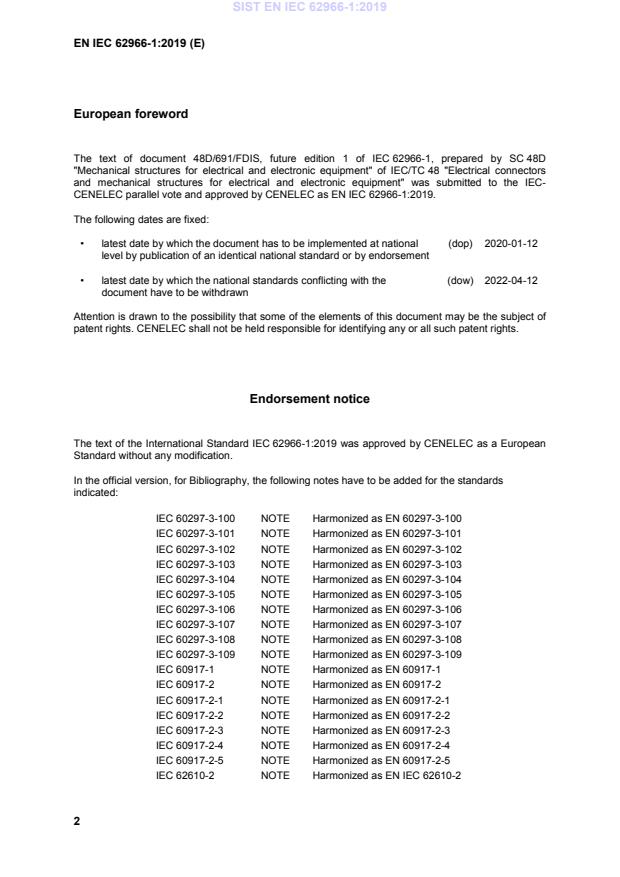
European foreword
The text of document 48D/691/FDIS, future edition 1 of IEC 62966-1, prepared by SC 48D
"Mechanical structures for electrical and electronic equipment" of IEC/TC 48 "Electrical connectors
and mechanical structures for electrical and electronic equipment" was submitted to the IEC-
CENELEC parallel vote and approved by CENELEC as EN IEC 62966-1:2019.
The following dates are fixed:
• latest date by which the document has to be implemented at national (dop) 2020-01-12
level by publication of an identical national standard or by endorsement
• latest date by which the national standards conflicting with the (dow) 2022-04-12
document have to be withdrawn
Attention is drawn to the possibility that some of the elements of this document may be the subject of
patent rights. CENELEC shall not be held responsible for identifying any or all such patent rights.
Endorsement notice
The text of the International Standard IEC 62966-1:2019 was approved by CENELEC as a European
Standard without any modification.
In the official version, for Bibliography, the following notes have to be added for the standards
indicated:
IEC 60297-3-100 NOTE Harmonized as EN 60297-3-100
IEC 60297-3-101 NOTE Harmonized as EN 60297-3-101
IEC 60297-3-102 NOTE Harmonized as EN 60297-3-102
IEC 60297-3-103 NOTE Harmonized as EN 60297-3-103
IEC 60297-3-104 NOTE Harmonized as EN 60297-3-104
IEC 60297-3-105 NOTE Harmonized as EN 60297-3-105
IEC 60297-3-106 NOTE Harmonized as EN 60297-3-106
IEC 60297-3-107 NOTE Harmonized as EN 60297-3-107
IEC 60297-3-108 NOTE Harmonized as EN 60297-3-108
IEC 60297-3-109 NOTE Harmonized as EN 60297-3-109
IEC 60917-1 NOTE Harmonized as EN 60917-1
IEC 60917-2 NOTE Harmonized as EN 60917-2
IEC 60917-2-1 NOTE Harmonized as EN 60917-2-1
IEC 60917-2-2 NOTE Harmonized as EN 60917-2-2
IEC 60917-2-3 NOTE Harmonized as EN 60917-2-3
IEC 60917-2-4 NOTE Harmonized as EN 60917-2-4
IEC 60917-2-5 NOTE Harmonized as EN 60917-2-5
IEC 62610-2 NOTE Harmonized as EN IEC 62610-2
Annex ZA
(normative)
Normative references to international publications
with their corresponding European publications
The following documents are referred to in the text in such a way that some or all of their content
constitutes requirements of this document. For dated references, only the edition cited applies. For
undated references, the latest edition of the referenced document (including any amendments)
applies.
NOTE 1 Where an International Publication has been modified by common modifications, indicated by (mod), the relevant
EN/HD applies.
NOTE 2 Up-to-date information on the latest versions of the European Standards listed in this annex is available here:
www.cenelec.eu.
Publication Year Title EN/HD Year
IEC 61587-1 - Mechanical structures for electronic EN 61587-1 -
equipment - Tests for IEC 60917 and IEC
60297 series - Part 1: Environmental
requirements, test set-up and safety
aspects for cabinets, racks, subracks and
chassis under indoor condition use and
transportation
IEC 61587-2 - Mechanical structures for electronic EN 61587-2 -
equipment - Tests for IEC 60917 and
60297 - Part 2: Seismic tests for cabinets
and racks
IEC 62966-2 - Mechanical structures for electrical and - -
electronic equipment - Aisle containment
for IT cabinets - Part 2: Details of air flow,
air separation and air cooling requirements
Under preparation. Stage at time of publication: CCDV.
IEC 62966-1 ®
Edition 1.0 2019-03
INTERNATIONAL
STANDARD
NORME
INTERNATIONALE
colour
inside
Mechanical structures for electrical and electronic equipment – Aisle
containment for it cabinets –
Part 1: Dimensions and mechanical requirements
Structures mécaniques pour équipements électriques et électroniques –
Confinement d'allées pour les baies informatiques –
Partie 1: Dimensions et exigences mécaniques
INTERNATIONAL
ELECTROTECHNICAL
COMMISSION
COMMISSION
ELECTROTECHNIQUE
INTERNATIONALE
ICS 31.240 ISBN 978-2-8322-6614-4
– 2 – IEC 62966-1:2019 © IEC 2019
CONTENTS
FOREWORD . 3
INTRODUCTION . 5
1 Scope . 7
2 Normative references . 7
3 Terms and definitions . 7
4 Design of a containment . 8
4.1 Preferred arrangement setup of aisle containment . 8
4.2 Optional arrangement set up of aisle containment . 9
4.2.1 Arrangement of different sized cabinets for an aisle containment . 9
4.2.2 Arrangement for an aisle containment with building structure elements . 10
4.2.3 Aisle containment at walls of buildings . 11
4.3 Top cover elevation . 12
4.4 Adaptation of air flow orientation . 13
4.5 Air duct connection . 13
5 Requirements of containment . 14
5.1 Air tightness . 14
5.2 Stability. 15
5.3 Design of the ceiling of the aisle containment . 15
6 Aisle containment dimensions . 15
6.1 General . 15
6.2 Width of the aisle . 16
6.3 Dimensions of cabinets . 16
6.4 Height of the elevated aisle top cover . 17
Bibliography . 18
Figure 1 – Examples of an aisle containment . 6
Figure 2 – Preferred arrangement setup of an aisle containment . 9
Figure 3 – Possible arrangement of an aisle containment . 10
Figure 4 – Aisle containment with an integrated structural element . 11
Figure 5 – Top view of aisle containment with an integrated structural element not in
line with the cabinet front . 11
Figure 6 – Aisle containment at a wall of a building . 12
Figure 7 – Elevated aisle height . 13
Figure 8 – Aisle containment with an air duct . 14
Figure 9 – Dimensions at an aisle containment . 16
Table 1 – Aisle widths . 16
Table 2 – Cabinet height including plinth. 17
Table 3 – Cabinet widths . 17
IEC 62966-1:2019 © IEC 2019 – 3 –
INTERNATIONAL ELECTROTECHNICAL COMMISSION
____________
MECHANICAL STRUCTURES FOR
ELECTRICAL AND ELECTRONIC EQUIPMENT –
AISLE CONTAINMENT FOR IT CABINETS –
Part 1: Dimensions and mechanical requirements
FOREWORD
1) The International Electrotechnical Commission (IEC) is a worldwide organization for standardization comprising
all national electrotechnical committees (IEC National Committees). The object of IEC is to promote
international co-operation on all questions concerning standardization in the electrical and electronic fields. To
this end and in addition to other activities, IEC publishes International Standards, Technical Specifications,
Technical Reports, Publicly Available Specifications (PAS) and Guides (hereafter referred to as “IEC
Publication(s)”). Their preparation is entrusted to technical committees; any IEC National Committee interested
in the subject dealt with may participate in this preparatory work. International, governmental and non-
governmental organizations liaising with the IEC also participate in this preparation. IEC collaborates closely
with the International Organization for Standardization (ISO) in accordance with conditions determined by
agreement between the two organizations.
2) The formal decisions or agreements of IEC on technical matters express, as nearly as possible, an international
consensus of opinion on the relevant subjects since each technical committee has representation from all
interested IEC National Committees.
3) IEC Publications have the form of recommendations for international use and are accepted by IEC National
Committees in that sense. While all reasonable efforts are made to ensure that the technical content of IEC
Publications is accurate, IEC cannot be held responsible for the way in which they are used or for any
misinterpretation by any end user.
4) In order to promote international uniformity, IEC National Committees undertake to apply IEC Publications
transparently to the maximum extent possible in their national and regional publications. Any divergence
between any IEC Publication and the corresponding national or regional publication shall be clearly indicated in
the latter.
5) IEC itself does not provide any attestation of conformity. Independent certification bodies provide conformity
assessment services and, in some areas, access to IEC marks of conformity. IEC is not responsible for any
services carried out by independent certification bodies.
6) All users should ensure that they have the latest edition of this publication.
7) No liability shall attach to IEC or its directors, employees, servants or agents including individual experts and
members of its technical committees and IEC National Committees for any personal injury, property damage or
other damage of any nature whatsoever, whether direct or indirect, or for costs (including legal fees) and
expenses arising out of the publication, use of, or reliance upon, this IEC Publication or any other IEC
Publications.
8) Attention is drawn to the Normative references cited in this publication. Use of the referenced publications is
indispensable for the correct application of this publication.
9) Attention is drawn to the possibility that some of the elements of this IEC Publication may be the subject of
patent rights. IEC shall not be held responsible for identifying any or all such patent rights.
International Standard IEC 62966-1 has been prepared by subcommittee 48D: Mechanical
structures for electrical and electronic equipment, of IEC technical committee 48: Electrical
connectors and mechanical structures for electrical and electronic equipment.
The text of this International Standard is based on the following documents:
FDIS Report on voting
48D/691/FDIS 48D/698/RVD
Full information on the voting for the approval of this International Standard can be found in
the report on voting indicated in the above table.
This document has been drafted in accordance with the ISO/IEC Directives, Part 2.
– 4 – IEC 62966-1:2019 © IEC 2019
A list of all parts in the IEC 62966 series, published under the general title Mechanical
structures for electrical and electronic equipment – Aisle containment for IT cabinets, can be
found on the IEC website.
The committee has decided that the contents of this document will remain unchanged until the
stability date indicated on the IEC website under "http://webstore.iec.ch" in the data related to
the specific document. At this date, the document will be
• reconfirmed,
• withdrawn,
• replaced by a revised edition, or
• amended.
IMPORTANT – The 'colour inside' logo on the cover page of this publication indicates
that it contains colours which are considered to be useful for the correct
understanding of its contents. Users should therefore print this document using a
colour printer.
IEC 62966-1:2019 © IEC 2019 – 5 –
INTRODUCTION
Cabinets of the IEC 60297 and IEC 60917 standard series are used as enclosures of
electronical and electric equipment in many different fields of application. A wide field of
application is represented by enclosures equipped with electronic information technology (IT)
equipment. They are frequently set up in large numbers in server rooms and data centres.
During their operation, the electronic equipment installed generates a considerable amount of
heat that must be dissipated from the equipment by means of cooling air. Precise adjustment
of the supply air temperature and a sufficient cooling air flow are indispensable prerequisites
for the fail-safe operation of equipment in information technology.
Currently, it is common use in data centres and server rooms to set up cabinets in rows. The
server cabinets along the rows are usually arranged in such a way that surfaces with cold
supply air inlets face each other across an aisle, and surfaces with hot exhaust air outlets
also face each other across an aisle. This row configuration is generally known as hot
aisle/cold aisle configuration. Moreover, air is supplied and discharged exclusively via the
front and rear panels of the server cabinets, which are frequently perforated doors. It is
assumed that inside the IT equipment, the cooling air is moved in horizontal direction, taking it
in at the front and discharging it at the rear.
The required cooling air is provided by room air or row air conditioners. Warm exhaust air is
moved by fans usually through a fluid/air heat exchanger that cools it.
In the arrangement described, considerable quantities of cooling air pass by the IT equipment,
especially servers, which it is expected to cool, without having any cooling effect.
Concurrently, recirculation within and outside the cabinet causes hot exhaust air to be
absorbed as cooling air, which results in faulty operation. In order to minimize such
recirculation, more cooling air than required needs to be supplied, this adversely affects the
energy efficiency of the data centre.
The separation of air flows into enclosed air volumes consisting of either cold supply air or hot
exhaust air precludes recirculation to the largest possible extent (see Figure 1). Such
separation reduces the required cooling air flow because re-circulations are ruled out. Air flow
separation can reduce power consumption by the fans in the cooling units once fan speed
control fans are used.
Separation of the cold supply air from the hot exhaust air is achieved by covering the aisles of
the same temperature level with top cover elements, adding doors or similar design elements
to the end of the aisles, and all openings inside the cabinets at the front 482,6mm (19”) rails
shall be closed.
The installations of aisle containments in data centres and IT rooms shall not restrict the air
intake demands for the correct usage and operation of servers or other IT equipment.
Especially the required supply air temperature and the cooling air flow rate needed shall not
be affected by the aisle containment. This can improve the energy efficiency as most of the
cooling infrastructure has a higher efficiency with a higher difference between the air intake
and the air exhaust temperature.
The temperature difference between supply and exhaust air rises due to the reduced cooling
air volume. As the supply air temperature of the cooling air is usually specified, thus being
kept constant, an increase in the temperature difference results in an increase of the
temperature of the warm exhaust air. This has a positive impact on the temperature difference
to the temperature of ambient air, as the energy efficiency of the cooling of the building and
infrastructure is improved by the raised temperature gradient.
The period during which system cooling is required to be supported by a mechanical cooling
machine is reduced. Both the reduction of the cooling air flow and the reduction of times of
mechanical cooling lead to considerable reduction in the consumption of electrical power. This
effects significant savings in operating costs for data centres and server rooms. This results in
– 6 – IEC 62966-1:2019 © IEC 2019
an environmentally-friendly use of resources, thereby relieving stress on the environment and
slowing down global warming by reduced CO emission.
Part 1 of the standard series defines geometric dimensions and mechanical properties
ensuring undisturbed, energy-efficient and user-friendly operation of the data centre.
Part 2 defines characteristics and requirements of air separation, especially the air leakage rate,
and determines the air leakage rate. Besides, operational parameters are determined,
especially temperatures at which IT equipment in aisle containment are operated.
Part 3 deals with aspects of safely operating IT equipment in aisle containment, discussing
special fire-protection and fire-fighting issues. It also provides required specifications of the
doors for access to the aisle containment and possible access control.
In the past years, widely varying forms of aisle containment have been installed in server
rooms and data centres. This document is in
...