


EN IEC 60444-11:2026
(Main)Measurement of quartz crystal unit parameters - Part 11: Standard method for the determination of the load resonance frequency fL and the effective load capacitance CLeff using automatic network analyzer techniques and error correction
General Information
- Abstract
IEC 60444-11:2026 defines the standard method of measuring load resonance frequency fL at the nominal value of CL, and the determination of the effective load capacitance CLeff at the nominal frequency for crystals with the figure of merit M > 4. This edition includes the following significant technical changes with respect to the previous edition: a) key content of withdrawn IEC TR 60444-4 is reproduced as Annex A; b) some formulae in the first edition have been corrected.
- Status
- Published
- Publication Date
- 04-Jun-2026
- Current Stage
- 6060 - Document made available - Publishing
- Start Date
- 05-Jun-2026
- Due Date
- 29-Aug-2025
- Completion Date
- 05-Jun-2026

Overview
EN IEC 60444-11:2026 specifies the standard method for measuring key parameters of quartz crystal units, focusing on the load resonance frequency (fL) at the nominal value of load capacitance (CL) and the effective load capacitance (CLeff) at the nominal frequency. Developed by CLC and aligned with International Electrotechnical Commission (IEC) requirements, this standard introduces advanced automatic network analyzer techniques with error correction for enhanced measurement accuracy and reproducibility. The publication applies to crystals with a figure of merit M > 4 and marks a significant update by incorporating critical content from the withdrawn IEC TR 60444-4 as Annex A, as well as correcting formulae from the first edition.
This standard is essential for professionals working with piezoelectric devices, particularly in frequency control, selection, and detection applications. EN IEC 60444-11:2026 supports precise measurement needs for both manufacturers and users of quartz crystal units across a wide frequency range, up to approximately 200 MHz.
Key Topics
- Load Resonance Frequency Measurement (fL):
- Defines the process for determining fL at nominal CL with high accuracy.
- Employs automatic network analyzer techniques to identify the resonance condition where the crystal's reactance offsets the load capacitance reactance.
- Effective Load Capacitance (CLeff):
- Standardizes the method for determining CLeff at the specified frequency.
- Avoids reliance on physical load capacitors, thereby reducing measurement errors.
- Error Correction Techniques:
- Utilizes a three-element calibration (short circuit, nominal resistor, open circuit or known capacitor) to ensure precise measurements.
- Includes error correction methods to improve the reliability and reproducibility of results.
- Comparison with Manual Method:
- Retains manual measurement procedures as an informative annex for reference, but standardizes automated methods as the principal approach.
- Measurement Accuracy and Reproducibility:
- Details sources of measurement error and procedural recommendations.
- Recommends techniques for optimizing accuracy, such as proper calibration, noise reduction, and bandwidth management.
- Test Conditions and Reference Planes:
- Specifies reference planes for measurements and outlines appropriate test setups and drive levels for quartz crystal units.
Applications
EN IEC 60444-11:2026 is vital in several practical scenarios, especially for:
- Quartz Crystal Unit Manufacturing:
- Enables manufacturers to deliver high-specification, reproducible quartz crystal units for use in oscillators and frequency control circuits.
- Oscillator and Filter Design:
- Assists in accurately measuring and specifying frequency response parameters, critical for designing reliable electronic oscillators and filters that depend on precise control.
- Quality Assurance and Standard Compliance:
- Provides standardized procedures for compliance testing and quality control, reducing disputes and discrepancies between manufacturers and users.
- Research and Development:
- Offers robust methods for R&D teams aiming to characterize novel piezoelectric or frequency control materials and devices.
- International Trade:
- Facilitates mutual recognition and comparability of measurements across borders due to harmonized and recognized methods.
Related Standards
EN IEC 60444-11:2026 references and builds upon several related standards in the field of piezoelectric device measurement:
- IEC 60122-1: Generic specification for quartz crystal units, including definitions and quality assessments.
- IEC 60444-1: Basic method for measurement of resonance frequency and resonance resistance using the zero phase technique in a π-network.
- IEC 60444-2: Phase offset method for measuring motional capacitance in quartz crystal units.
- IEC 60444-5: Protocols for determining equivalent electrical parameters with automatic network analyzer techniques and error correction.
- Withdrawn IEC TR 60444-4: Manual measurement methods, content now incorporated as informative annex.
Keywords: EN IEC 60444-11:2026, quartz crystal measurement, load resonance frequency, effective load capacitance, automatic network analyzer, error correction, piezoelectric devices, fL measurement, CLeff determination, frequency control standards, CLC, IEC standards.
This standard is an authoritative resource for those requiring accurate, internationally recognized methods for quartz crystal unit measurement, reflecting the latest industry best practices and technical requirements.
Relations
- Effective Date
- 26-Sep-2023
- Effective Date
- 19-May-2026
- Effective Date
- 19-May-2026
- Effective Date
- 19-May-2026
- Refers
EN 60122-1:2002/A1:2018 - Quartz crystal units of assessed quality - Part 1: Generic specification - Effective Date
- 19-May-2026
Frequently Asked Questions
EN IEC 60444-11:2026 is a standard published by CLC. Its full title is "Measurement of quartz crystal unit parameters - Part 11: Standard method for the determination of the load resonance frequency fL and the effective load capacitance CLeff using automatic network analyzer techniques and error correction". This standard covers: IEC 60444-11:2026 defines the standard method of measuring load resonance frequency fL at the nominal value of CL, and the determination of the effective load capacitance CLeff at the nominal frequency for crystals with the figure of merit M > 4. This edition includes the following significant technical changes with respect to the previous edition: a) key content of withdrawn IEC TR 60444-4 is reproduced as Annex A; b) some formulae in the first edition have been corrected.
IEC 60444-11:2026 defines the standard method of measuring load resonance frequency fL at the nominal value of CL, and the determination of the effective load capacitance CLeff at the nominal frequency for crystals with the figure of merit M > 4. This edition includes the following significant technical changes with respect to the previous edition: a) key content of withdrawn IEC TR 60444-4 is reproduced as Annex A; b) some formulae in the first edition have been corrected.
EN IEC 60444-11:2026 is classified under the following ICS (International Classification for Standards) categories: 31.140 - Piezoelectric devices. The ICS classification helps identify the subject area and facilitates finding related standards.
EN IEC 60444-11:2026 has the following relationships with other standards: It is inter standard links to EN 60444-11:2010, EN 60444-1:1997/A1:1999, EN 60444-1:1997, EN 60122-1:2002, EN 60122-1:2002/A1:2018. Understanding these relationships helps ensure you are using the most current and applicable version of the standard.
EN IEC 60444-11:2026 is available in PDF format for immediate download after purchase. The document can be added to your cart and obtained through the secure checkout process. Digital delivery ensures instant access to the complete standard document.
Standards Content (Sample)
SLOVENSKI STANDARD
01-julij-2026
Nadomešča:
SIST EN 60444-11:2011
Meritev parametrov kvarčnokristanih enot - 11. del: Standardne metode za
ugotavljanje obremenitvene resonančne frekvence fL in efektivne obremenitvene
kapacitivnosti CLeff z uporabo tehnik z avtomatičnim omrežnim analizatorjem in
popravljanjem napak (IEC 60444-11:2026)
Measurement of quartz crystal unit parameters - Part 11: Standard method for the
determination of the load resonance frequency fL and the effective load capacitance
CLeff using automatic network analyzer techniques and error correction (IEC 60444-
11:2026)
Messung von Schwingquarz-Parametern - Teil 11: Standardverfahren zur Bestimmung
der Lastresonanzfrequenz fL und der effektiven Lastkapazität CLeff mit automatischer
Netzwerkanalysatortechnik und Fehlerkorrektur (IEC 60444-11:2026)
Mesure des paramètres unitaires quartz - Partie 11: Méthode standard pour la
détermination de la fréquence de résonance de charge fl et de la capacité de charge
effective cleff à l'aide de techniques d'analyseur de réseau automatiques et de correction
d'erreur (IEC 60444-11:2026)
Ta slovenski standard je istoveten z: EN IEC 60444-11:2026
ICS:
31.140 Piezoelektrične naprave Piezoelectric devices
2003-01.Slovenski inštitut za standardizacijo. Razmnoževanje celote ali delov tega standarda ni dovoljeno.
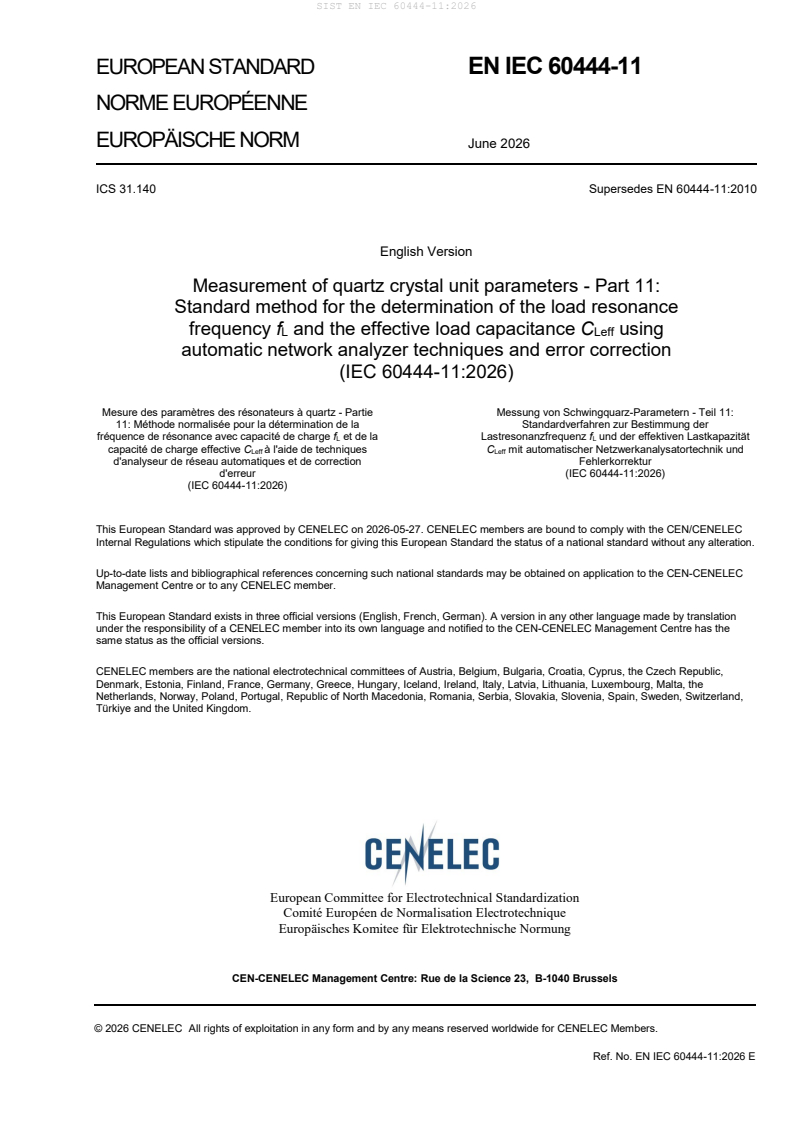
EUROPEAN STANDARD EN IEC 60444-11
NORME EUROPÉENNE
EUROPÄISCHE NORM June 2026
ICS 31.140 Supersedes EN 60444-11:2010
English Version
Measurement of quartz crystal unit parameters - Part 11:
Standard method for the determination of the load resonance
frequency f and the effective load capacitance C using
L Leff
automatic network analyzer techniques and error correction
(IEC 60444-11:2026)
Mesure des paramètres des résonateurs à quartz - Partie Messung von Schwingquarz-Parametern - Teil 11:
11: Méthode normalisée pour la détermination de la Standardverfahren zur Bestimmung der
fréquence de résonance avec capacité de charge f et de la Lastresonanzfrequenz f und der effektiven Lastkapazität
L L
capacité de charge effective C à l'aide de techniques C mit automatischer Netzwerkanalysatortechnik und
Leff Leff
d'analyseur de réseau automatiques et de correction Fehlerkorrektur
d'erreur (IEC 60444-11:2026)
(IEC 60444-11:2026)
This European Standard was approved by CENELEC on 2026-05-27. CENELEC members are bound to comply with the CEN/CENELEC
Internal Regulations which stipulate the conditions for giving this European Standard the status of a national standard without any alteration.
Up-to-date lists and bibliographical references concerning such national standards may be obtained on application to the CEN-CENELEC
Management Centre or to any CENELEC member.
This European Standard exists in three official versions (English, French, German). A version in any other language made by translation
under the responsibility of a CENELEC member into its own language and notified to the CEN-CENELEC Management Centre has the
same status as the official versions.
CENELEC members are the national electrotechnical committees of Austria, Belgium, Bulgaria, Croatia, Cyprus, the Czech Republic,
Denmark, Estonia, Finland, France, Germany, Greece, Hungary, Iceland, Ireland, Italy, Latvia, Lithuania, Luxembourg, Malta, the
Netherlands, Norway, Poland, Portugal, Republic of North Macedonia, Romania, Serbia, Slovakia, Slovenia, Spain, Sweden, Switzerland,
Türkiye and the United Kingdom.
European Committee for Electrotechnical Standardization
Comité Européen de Normalisation Electrotechnique
Europäisches Komitee für Elektrotechnische Normung
CEN-CENELEC Management Centre: Rue de la Science 23, B-1040 Brussels
© 2026 CENELEC All rights of exploitation in any form and by any means reserved worldwide for CENELEC Members.
Ref. No. EN IEC 60444-11:2026 E
European foreword
The text of document 49/1489/CDV, future edition 2 of IEC 60444-11, prepared by TC 49
"Piezoelectric, dielectric and electrostatic devices and associated materials for frequency control,
selection and detection" was submitted to the IEC-CENELEC parallel vote and approved by
CENELEC as EN IEC 60444-11:2026.
The following dates are fixed:
• latest date by which the document has to be implemented at national (dop) 2027-06-30
level by publication of an identical national standard or by endorsement
• latest date by which the national standards conflicting with the (dow) 2029-06-30
document have to be withdrawn
This document supersedes EN 60444-11:2010 and all of its amendments and corrigenda (if any).
Attention is drawn to the possibility that some of the elements of this document may be the subject of
patent rights. CENELEC shall not be held responsible for identifying any or all such patent rights.
Any feedback and questions on this document should be directed to the users’ national committee. A
complete listing of these bodies can be found on the CENELEC website.
Endorsement notice
The text of the International Standard IEC 60444-11:2026 was approved by CENELEC as a European
Standard without any modification.
In the official version, for Bibliography, the following notes have to be added for the standard indicated:
IEC 60122-2 NOTE Approved as EN IEC 60122-2
IEC 60444-2 NOTE Approved as EN 60444-2
IEC 60444-5:1995 NOTE Approved as EN 60444-5:1997 (not modified)
Annex ZA
(normative)
Normative references to international publications
with their corresponding European publications
The following documents are referred to in the text in such a way that some or all of their content
constitutes requirements of this document. For dated references, only the edition cited applies. For
undated references, the latest edition of the referenced document (including any amendments)
applies.
NOTE 1 Where an International Publication has been modified by common modifications, indicated by (mod),
the relevant EN/HD applies.
NOTE 2 Up-to-date information on the latest versions of the European Standards listed in this annex is available
here: www.cencenelec.eu.
Publication Year Title EN/HD Year
IEC 60122-1 2002 Quartz crystal units of assessed quality - Part 1: EN 60122-1 2002
Generic specification
+ A1 2017 + A1 2018
IEC 60444-1 1986 Measurement of quartz crystal unit parameters EN 60444-1 1997
by zero phase technique in a pi-network - Part 1:
Basic method for the measurement of resonance
frequency and resonance resistance of quartz
crystal units by zero phase technique in a pi-
network
+ A1 1999 + A1 1999
IEC 60444-11 ®
Edition 2.0 2026-04
INTERNATIONAL
STANDARD
Measurement of quartz crystal unit parameters -
Part 11: Standard method for the determination of the load resonance frequency
f and the effective load capacitance C using automatic network analyzer
L Leff
techniques and error correction
ICS 31.140 ISBN 978-2-8327-1199-6
IEC 60444-11:2026-04(en)
IEC 60444-11:2026 © IEC 2026
CONTENTS
FOREWORD . 3
INTRODUCTION . 5
1 Scope . 6
2 Normative references . 6
3 Terms and definitions . 6
4 General concepts . 6
4.1 Load resonance frequencies f and f . 6
Lr La
4.2 Effective load capacitance C . 7
Leff
5 Reference plane and test conditions . 8
5.1 General . 8
5.2 Principle of measurement . 8
5.3 Evaluation of errors. 12
5.3.1 General comments . 12
5.3.2 Accuracy of measurement . 12
5.3.3 Reproducibility . 13
5.3.4 Comparison with the manual method . 15
5.3.5 Limitations . 15
Annex A (informative) Manual measuring method of the load resonance frequency f
L
and load resonance resistance R using physical load capacitance . 16
L
A.1 General . 16
A.2 Measuring circuit . 16
A.2.1 The measuring circuit of a zero phase π-network system . 16
A.2.2 An outline description . 16
A.2.3 Load capacitor specification . 17
A.3 Method of measurement . 17
A.3.1 Initial adjustment . 17
A.3.2 The method for the measurement of load resonance frequency and
resistance . 17
A.4 Load capacitor design . 17
A.4.1 Mechanical features . 17
A.4.2 Insertion into π-network . 18
A.4.3 Calibration and measurement of load capacitors . 20
A.5 Measurement errors . 21
A.5.1 General . 21
A.5.2 Main sources of measurement errors . 21
A.5.3 Effects of the frequency/temperature characteristics of the crystal unit . 22
A.5.4 Accuracy of the frequency measurements . 22
A.6 Analysis of errors . 22
A.6.1 Measurement error of load resonance frequency f . 22
L
A.6.2 Measurement error of load resonance resistance R . 23
L
A.6.3 Measurement errors of C . 24
Bibliography . 27
Figure 1 – Admittance of a quartz crystal unit . 7
IEC 60444-11:2026 © IEC 2026
Figure 2 – X as a function of frequency (solid line) in the vicinity of f . 10
C L
Figure 3 – P as level of drive of a crystal in a π-network versus df/f as frequency . 11
eff nom
Figure 4 – Error of the load resonance frequency due to the inaccuracy of the
measured voltages (dashed line) and the calibration resistances (soft line) . 13
Figure 5 – Error of the load resonance frequency due to the change of the setting C
L
for the same crystal as in Figure 4 . 13
Figure 6 –Error of the load resonance frequency due to noise of V as the measured
C
voltages . 14
Figure 7 – Error of load resonance frequency f at different C for typical equivalent
L L
parameters of quartz crystal units . 14
Figure A.1 – Typical load capacitor with carrier . 18
Figure A.2 – Method of insertion of load capacitor into π-network . 19
Figure A.3 – Circuit diagram of π-network including load capacitor C . 20
L
Figure A.4 – Load capacitance inaccuracy as a function of frequency, for a load
capacitance of 30 pF inclusive of calibration inaccuracy and residual inductance
effects (worst case situation) . 22
Figure A.5 – Relative measurement error of f versus crystal pulling sensitivity for
L
various frequencies at a load capacitance of 30 pF . 23
Figure A.6 – Relative measurement error of R versus frequency, for
L
various values of C . 23
L
Figure A.7 – Relative measurement error of C as a function of frequency. 24
Figure A.8 – Relative measurement error of C as a function of C for various
1 1
frequency measurement errors C = 5 pF; C = 15 pF; C = 30 pF . 25
o L1 L2
Figure A.9 – Relative measurement error of C as a function of C for various values
1 1
of quality factor Q C = 3 pF; C = 15 pF; C = 30 pF . 26
o L1 L2
IEC 60444-11:2026 © IEC 2026
INTERNATIONAL ELECTROTECHNICAL COMMISSION
____________
Measurement of quartz crystal unit parameters -
Part 11: Standard method for the determination of the load resonance
frequency f and the effective load capacitance C using automatic
L Leff
network analyzer techniques and error correction
FOREWORD
1) The International Electrotechnical Commission (IEC) is a worldwide organization for standardization comprising
all national electrotechnical committees (IEC National Committees). The object of IEC is to promote international
co-operation on all questions concerning standardization in the electrical and electronic fields. To this end and
in addition to other activities, IEC publishes International Standards, Technical Specifications, Technical Reports,
Publicly Available Specifications (PAS) and Guides (hereafter referred to as "IEC Publication(s)"). Their
preparation is entrusted to technical committees; any IEC National Committee interested in the subject dealt with
may participate in this preparatory work. International, governmental and non-governmental organizations liaising
with the IEC also participate in this preparation. IEC collaborates closely with the International Organization for
Standardization (ISO) in accordance with conditions determined by agreement between the two organizations.
2) The formal decisions or agreements of IEC on technical matters express, as nearly as possible, an international
consensus of opinion on the relevant subjects since each technical committee has representation from all
interested IEC National Committees.
3) IEC Publications have the form of recommendations for international use and are accepted by IEC National
Committees in that sense. While all reasonable efforts are made to ensure that the technical content of IEC
Publications is accurate, IEC cannot be held responsible for the way in which they are used or for any
misinterpretation by any end user.
4) In order to promote international uniformity, IEC National Committees undertake to apply IEC Publications
transparently to the maximum extent possible in their national and regional publications. Any divergence between
any IEC Publication and the corresponding national or regional publication shall be clearly indicated in the latter.
5) IEC itself does not provide any attestation of conformity. Independent certification bodies provide conformity
assessment services and, in some areas, access to IEC marks of conformity. IEC is not responsible for any
services carried out by independent certification bodies.
6) All users should ensure that they have the latest edition of this publication.
7) No liability shall attach to IEC or its directors, employees, servants or agents including individual experts and
members of its technical committees and IEC National Committees for any personal injury, property damage or
other damage of any nature whatsoever, whether direct or indirect, or for costs (including legal fees) and
expenses arising out of the publication, use of, or reliance upon, this IEC Publication or any other IEC
Publications.
8) Attention is drawn to the Normative references cited in this publication. Use of the referenced publications is
indispensable for the correct application of this publication.
9) IEC draws attention to the possibility that the implementation of this document may involve the use of (a)
patent(s). IEC takes no position concerning the evidence, validity or applicability of any claimed patent rights in
respect thereof. As of the date of publication of this document, IEC had not received notice of (a) patent(s), which
may be required to implement this document. However, implementers are cautioned that this may not represent
the latest information, which may be obtained from the patent database available at https://patents.iec.ch. IEC
shall not be held responsible for identifying any or all such patent rights.
IEC 60444-11 has been prepared by IEC technical committee 49: Piezoelectric, dielectric and
electrostatic devices and associated materials for frequency control, selection and detection. It
is an International Standard.
This second edition cancels and replaces the first edition published in 2010. This edition
constitutes a technical revision.
This edition includes the following significant technical changes with respect to the previous
edition:
a) key content of withdrawn IEC TR 60444-4 is reproduced as Annex A;
b) some formulae in the first edition have been corrected.
IEC 60444-11:2026 © IEC 2026
The text of this International Standard is based on the following documents:
Draft Report on voting
49/1489/CDV 49/1515/RVC
Full information on the voting for its approval can be found in the report on voting indicated in
the above table.
The language used for the development of this International Standard is English.
This document was drafted in accordance with ISO/IEC Directives, Part 2, and developed in
accordance with ISO/IEC Directives, Part 1 and ISO/IEC Directives, IEC Supplement, available
at www.iec.ch/members_experts/refdocs. The main document types developed by IEC are
described in greater detail at www.iec.ch/publications.
A list of all parts in the IEC 60444 series, published under the general title Measurement of
quartz crystal unit parameters, can be found on the IEC website.
The committee has decided that the contents of this document will remain unchanged until the
stability date indicated on the IEC website under webstore.iec.ch in the data related to the
specific document. At this date, the document will be
– reconfirmed,
– withdrawn, or
– revised.
IEC 60444-11:2026 © IEC 2026
INTRODUCTION
This part of IEC 60444 defines the measuring method of load resonance frequency f using
L
automatic network analyzer techniques.
At the same time, even though IEC TR 60444-4 [8] specifying the manual measuring method
has been withdrawn, the main contents of the manual measuring method remain as Annex A
for the user's convenience. However, in case of dispute, the standard method as described
below should be used as reference.
The figure of merit M, according to IEC 60122-1:2002, Table 1, is expressed in the following
formula:
Q 1
M
(1)
r ωC R
This gives good results in a frequency range up to 200 MHz. This method allows the calculation
of load resonance frequency offset ∆f , frequency pulling range ∆f ∆f and pulling sensitivity
L L1, L2
S as described in IEC 60122-1:2002, 2.2.31. This measurement technique avoids the use of
physical load capacitors, and allows higher accuracy, better reproducibility and correlation to
the application. It extends the upper frequency limit from 30 MHz by the manual method to
200 MHz approximately. This method is based on the error-corrected measurement technique
of IEC 60444-5 [9] and therefore allows the measurement of f and C together with the
L Leff
determination of the equivalent crystal parameters in one sequence without changing the test
fixture.
With this method the frequency f is searched where the reactance X of the crystal has the
L C
opposite value of the reactance of the load capacitance.
XX=−=
(2)
C CL
ωC
LL
Furthermore, this method allows to determine the effective load capacitance C at the nominal
Leff
frequency f
nom.
___________
Numbers in square brackets refer to the Bibliography.
= =
IEC 60444-11:2026 © IEC 2026
1 Scope
This part of IEC 60444 defines the standard method of measuring load resonance frequency f
L
at the nominal value of C , and the determination of the effective load capacitance C at the
L Leff
nominal frequency for crystals with the figure of merit M > 4.
2 Normative references
The following documents are referred to in the text in such a way that some or all of their content
constitutes requirements of this document. For dated references, only the edition cited applies.
For undated references, the latest edition of the referenced document (including any
amendments) applies.
IEC 60122-1:2002, Quartz crystal units of assessed quality - Part 1: Generic specification
IEC 60122-1:2002/AMD1:2017
IEC 60444-1:1986, Measurement of quartz crystal unit parameters by zero phase technique in
a pi-network - Part 1: Basic method for the measurement of resonance frequency and resonance
resistance of quartz crystal units by zero phase technique in a pi-network
IEC 60444-1:1986/AMD1:1999
3 Terms and definitions
For the purposes of this document, the terms and definitions given in IEC 60122-1 apply.
ISO and IEC maintain terminology databases for use in standardization at the following
addresses:
– IEC Electropedia: available at https://www.electropedia.org/
– ISO Online browsing platform: available at https://www.iso.org/obp
4 General concepts
4.1 Load resonance frequencies f and f
Lr La
As can be seen in Figure 1, there are two intersection frequencies where XX= − , f with
C CL Lr
high admittance (low impedance) and f with low admittance (high impedance).
La
The load resonant frequency f is one of the two frequencies of a crystal unit in association with
L
a series or with a parallel load capacitance, at which the electrical admittance (respectively
impedance) of the combination is resistive. The load resonance frequency f is the lower of the
L
two frequencies.
In a first approximation f can be calculated by:
L
f =
S (3)
2π LC
IEC 60444-11:2026 © IEC 2026
C
ff≈+ 1
(4)
L S
2 CC+
( )
0L
NOTE f is the load resonance frequenc
...