

EN IEC 62841-4-3:2021/FprA1:2025
(Amendment)Electric motor-operated hand-held tools, transportable tools and lawn and garden machinery - Safety - Part 4-3: Particular requirements for pedestrian controlled walk-behind lawnmowers
General Information
- Abstract
CORRECTED VERSION 2026-08 The content of the corrigendum 1 (2026-08) has been included in this copy.
- Status
- Not Published
- Publication Date
- 07-Sep-2025
- Technical Committee
- CLC/TC 116 - Safety of hand-held motor-operated electric tools
- Drafting Committee
- CLC/TC 116/WG 05 - Gardening appliances
- Current Stage
- 5060 - Voting results sent to TC, SR - Formal Approval
- Start Date
- 06-Jun-2025
- Completion Date
- 06-Jun-2025

Overview
EN IEC 62841-4-3:2021/FprA1:2025 is an amendment (A1) to the international safety standard for electric motor‑operated pedestrian controlled walk‑behind lawnmowers. Developed by IEC TC 116 and adopted regionally (CLC/EN), this document updates particular safety requirements for walk‑behind mowers used in lawn and garden machinery. It clarifies definitions, expands marking and instruction requirements, and adds normative references for insulation, switches and acoustics. The amendment excludes machines with a swing‑over handle and targets manufacturers, test labs and conformity assessors.
Key Topics and Requirements
- Scope and exclusions: Applies to pedestrian controlled walk‑behind lawnmowers; explicitly excludes lawnmowers with a swing‑over handle in the EN implementation.
- Definitions: Revised definitions such as maximum speed (steady‑state cutting means speed) and a new term traction drive (system transmitting power from motor to ground drive means).
- Marking and instructions:
- Updated mandatory safety warnings (e.g., “WARNING – Beware of thrown objects – keep bystanders away”) and minimum bystander distance marking.
- Requirement to mark ear protection unless measured A‑weighted sound pressure at the operator’s ear (per Annex I) ≤ 85 dB(A).
- North American specific labeling guidance: conformity options with ANSI B71.1:2017 and 16 CFR 1205 labeling dimensions and placement for cylinder and rotary mowers.
- Requirements for machine mass marking and additional European marking for replaceable cutting‑means part identification.
- Safety instructions and user warnings: Harmonized text requirements (e.g., mandatory wording, French equivalents for Canada) and formatting (signal word sizes).
- Technical references: Adds or updates normative references on insulation coordination, switch requirements, acoustics and safety distances.
Applications and Users
- Manufacturers and designers of walk‑behind lawnmowers use this standard to design safer products and prepare compliant user manuals and labels.
- Test laboratories and certification bodies apply the standard for conformity assessment, marking inspection and acoustic testing.
- Safety engineers, product compliance teams and regulators reference it when assessing machine hazards, user warnings and labeling requirements across EU and North American markets.
Related Standards
Key normative references added or cited include:
- IEC 60664‑3, IEC 60664‑4 (insulation coordination)
- IEC 61058‑1 / IEC 61058‑2‑6 (switches)
- IEC 61672‑1; ISO 354; ISO 11201; ISO 3744 (acoustics and sound measurement)
- ISO 13857 (safety distances); ISO 11684 (safety labels)
- ANSI B71.1:2017 and 16 CFR 1205 (North American labeling)
This amendment is essential for ensuring regulatory compliance and practical safety controls in the design, labeling and testing of pedestrian controlled walk‑behind lawnmowers.
Relations
- Effective Date
- 26-Sep-2023
- Effective Date
- 30-Jan-2024
Get Certified
Connect with accredited certification bodies for this standard

Control Union Certifications
Global certification for agriculture and sustainability.

ECOCERT
Organic and sustainability certification.

FSC International
Forest Stewardship Council certification.
Sponsored listings
Frequently Asked Questions
EN IEC 62841-4-3:2021/FprA1:2025 is a draft published by CLC. Its full title is "Electric motor-operated hand-held tools, transportable tools and lawn and garden machinery - Safety - Part 4-3: Particular requirements for pedestrian controlled walk-behind lawnmowers". This standard covers: CORRECTED VERSION 2026-08 The content of the corrigendum 1 (2026-08) has been included in this copy.
CORRECTED VERSION 2026-08 The content of the corrigendum 1 (2026-08) has been included in this copy.
EN IEC 62841-4-3:2021/FprA1:2025 is classified under the following ICS (International Classification for Standards) categories: 65.060.70 - Horticultural equipment. The ICS classification helps identify the subject area and facilitates finding related standards.
EN IEC 62841-4-3:2021/FprA1:2025 has the following relationships with other standards: It is inter standard links to EN IEC 62841-4-3:2021, EN IEC 62841-4-3:2021/FprAB:2026. Understanding these relationships helps ensure you are using the most current and applicable version of the standard.
EN IEC 62841-4-3:2021/FprA1:2025 is associated with the following European legislation: EU Directives/Regulations: 2006/42/EC, 2023/1230; Standardization Mandates: M/396, M/605. When a standard is cited in the Official Journal of the European Union, products manufactured in conformity with it benefit from a presumption of conformity with the essential requirements of the corresponding EU directive or regulation.
EN IEC 62841-4-3:2021/FprA1:2025 is available in PDF format for immediate download after purchase. The document can be added to your cart and obtained through the secure checkout process. Digital delivery ensures instant access to the complete standard document.
Standards Content (Sample)
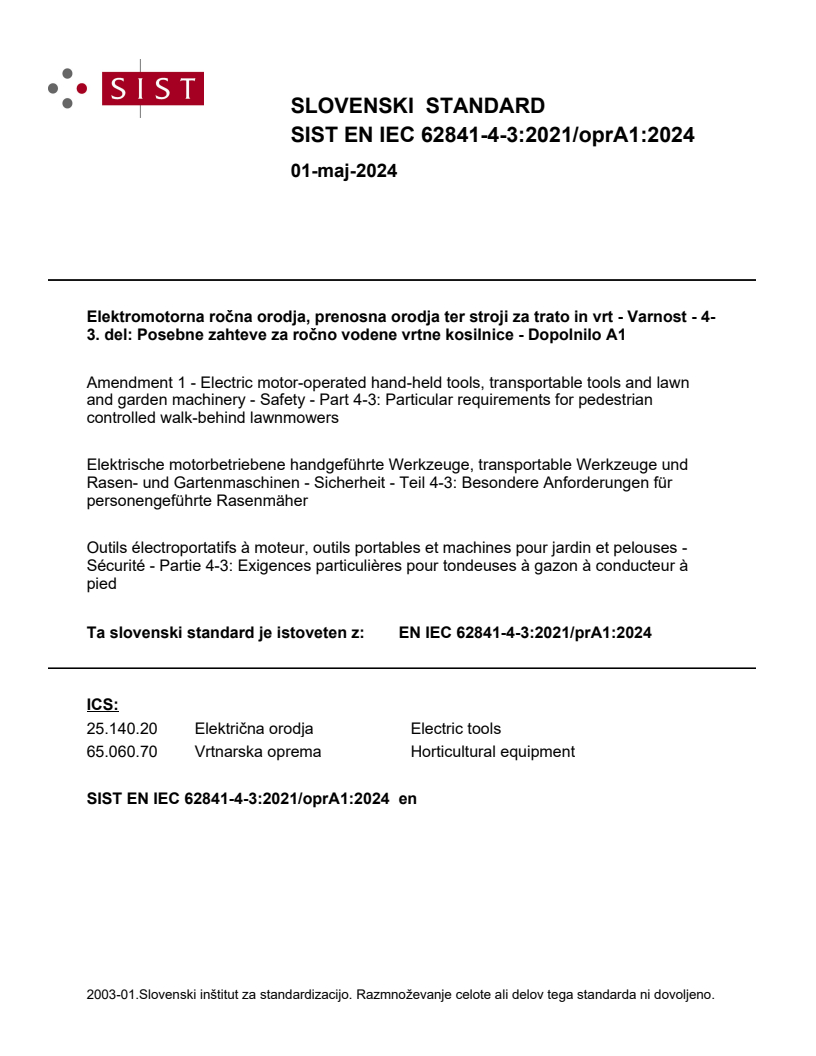
SLOVENSKI STANDARD
SIST EN IEC 62841-4-3:2021/oprA1:2024
01-maj-2024
Elektromotorna ročna orodja, prenosna orodja ter stroji za trato in vrt - Varnost - 4-
3. del: Posebne zahteve za ročno vodene vrtne kosilnice - Dopolnilo A1
Amendment 1 - Electric motor-operated hand-held tools, transportable tools and lawn
and garden machinery - Safety - Part 4-3: Particular requirements for pedestrian
controlled walk-behind lawnmowers
Elektrische motorbetriebene handgeführte Werkzeuge, transportable Werkzeuge und
Rasen- und Gartenmaschinen - Sicherheit - Teil 4-3: Besondere Anforderungen für
personengeführte Rasenmäher
Outils électroportatifs à moteur, outils portables et machines pour jardin et pelouses -
Sécurité - Partie 4-3: Exigences particulières pour tondeuses à gazon à conducteur à
pied
Ta slovenski standard je istoveten z: EN IEC 62841-4-3:2021/prA1:2024
ICS:
25.140.20 Električna orodja Electric tools
65.060.70 Vrtnarska oprema Horticultural equipment
SIST EN IEC 62841-4-3:2021/oprA1:2024 en
2003-01.Slovenski inštitut za standardizacijo. Razmnoževanje celote ali delov tega standarda ni dovoljeno.
SIST EN IEC 62841-4-3:2021/oprA1:2024
SIST EN IEC 62841-4-3:2021/oprA1:2024
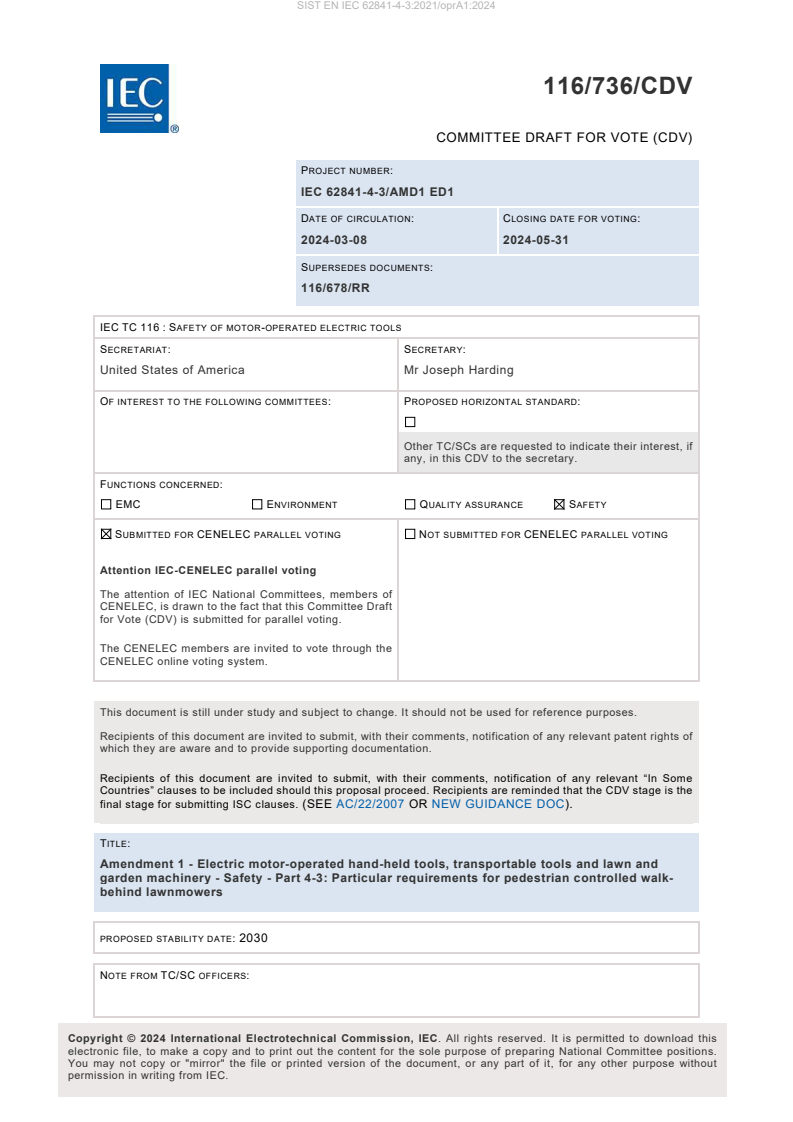
116/736/CDV
COMMITTEE DRAFT FOR VOTE (CDV)
PROJECT NUMBER:
IEC 62841-4-3/AMD1 ED1
DATE OF CIRCULATION: CLOSING DATE FOR VOTING:
2024-03-08 2024-05-31
SUPERSEDES DOCUMENTS:
116/678/RR
IEC TC 116 : SAFETY OF MOTOR-OPERATED ELECTRIC TOOLS
SECRETARIAT: SECRETARY:
United States of America Mr Joseph Harding
OF INTEREST TO THE FOLLOWING COMMITTEES: PROPOSED HORIZONTAL STANDARD:
Other TC/SCs are requested to indicate their interest, if
any, in this CDV to the secretary.
FUNCTIONS CONCERNED:
EMC ENVIRONMENT QUALITY ASSURANCE SAFETY
SUBMITTED FOR CENELEC PARALLEL VOTING NOT SUBMITTED FOR CENELEC PARALLEL VOTING
Attention IEC-CENELEC parallel voting
The attention of IEC National Committees, members of
CENELEC, is drawn to the fact that this Committee Draft
for Vote (CDV) is submitted for parallel voting.
The CENELEC members are invited to vote through the
CENELEC online voting system.
This document is still under study and subject to change. It should not be used for reference purposes.
Recipients of this document are invited to submit, with their comments, notification of any relevant patent rights of
which they are aware and to provide supporting documentation.
Recipients of this document are invited to submit, with their comments, notification of any relevant “In Some
Countries” clauses to be included should this proposal proceed. Recipients are reminded that the CDV stage is the
final stage for submitting ISC clauses. (SEE AC/22/2007 OR NEW GUIDANCE DOC).
TITLE:
Amendment 1 - Electric motor-operated hand-held tools, transportable tools and lawn and
garden machinery - Safety - Part 4-3: Particular requirements for pedestrian controlled walk-
behind lawnmowers
PROPOSED STABILITY DATE: 2030
NOTE FROM TC/SC OFFICERS:
electronic file, to make a copy and to print out the content for the sole purpose of preparing National Committee positions.
You may not copy or "mirror" the file or printed version of the document, or any part of it, for any other purpose without
permission in writing from IEC.
SIST EN IEC 62841-4-3:2021/oprA1:2024
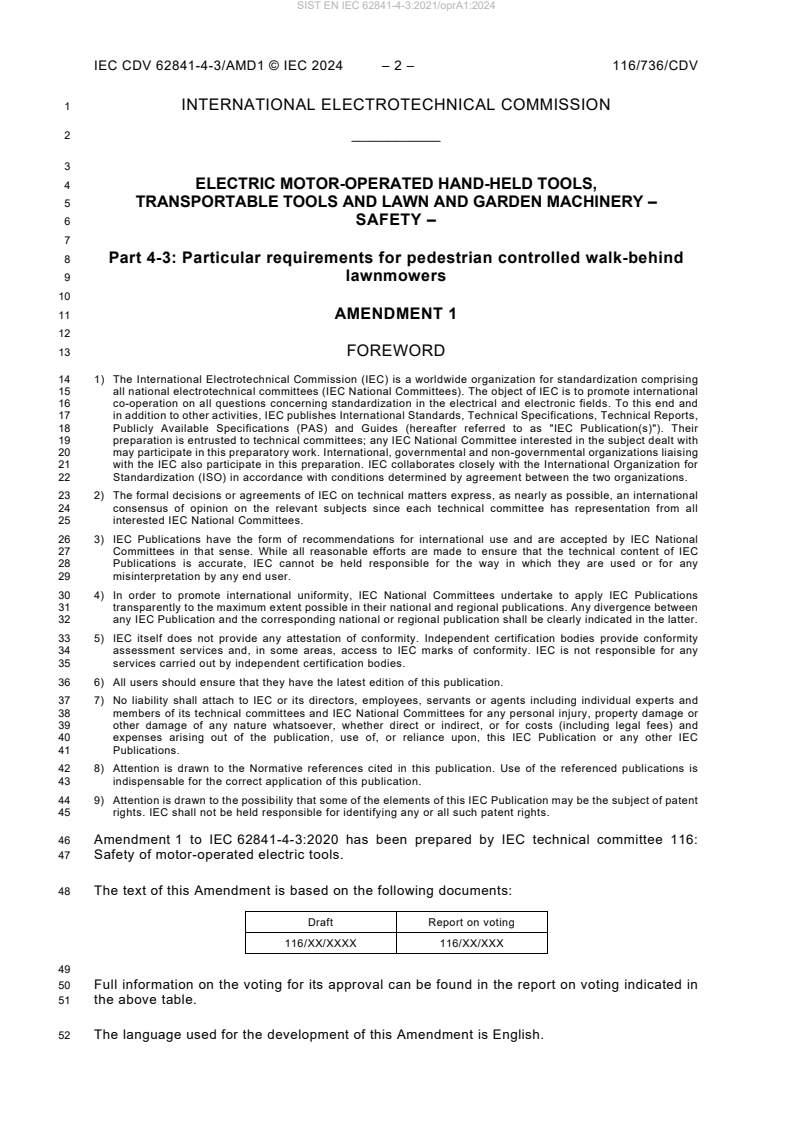
IEC CDV 62841-4-3/AMD1 © IEC 2024 – 2 – 116/736/CDV
1 INTERNATIONAL ELECTROTECHNICAL COMMISSION
2 ____________
4 ELECTRIC MOTOR-OPERATED HAND-HELD TOOLS,
5 TRANSPORTABLE TOOLS AND LAWN AND GARDEN MACHINERY –
6 SAFETY –
8 Part 4-3: Particular requirements for pedestrian controlled walk-behind
9 lawnmowers
11 AMENDMENT 1
13 FOREWORD
14 1) The International Electrotechnical Commission (IEC) is a worldwide organization for standardization comprising
15 all national electrotechnical committees (IEC National Committees). The object of IEC is to promote international
16 co-operation on all questions concerning standardization in the electrical and electronic fields. To this end and
17 in addition to other activities, IEC publishes International Standards, Technical Specifications, Technical Reports,
18 Publicly Available Specifications (PAS) and Guides (hereafter referred to as "IEC Publication(s)"). Their
19 preparation is entrusted to technical committees; any IEC National Committee interested in the subject dealt with
20 may participate in this preparatory work. International, governmental and non-governmental organizations liaising
21 with the IEC also participate in this preparation. IEC collaborates closely with the International Organization for
22 Standardization (ISO) in accordance with conditions determined by agreement between the two organizations.
23 2) The formal decisions or agreements of IEC on technical matters express, as nearly as possible, an international
24 consensus of opinion on the relevant subjects since each technical committee has representation from all
25 interested IEC National Committees.
26 3) IEC Publications have the form of recommendations for international use and are accepted by IEC National
27 Committees in that sense. While all reasonable efforts are made to ensure that the technical content of IEC
28 Publications is accurate, IEC cannot be held responsible for the way in which they are used or for any
29 misinterpretation by any end user.
30 4) In order to promote international uniformity, IEC National Committees undertake to apply IEC Publications
31 transparently to the maximum extent possible in their national and regional publications. Any divergence between
32 any IEC Publication and the corresponding national or regional publication shall be clearly indicated in the latter.
33 5) IEC itself does not provide any attestation of conformity. Independent certification bodies provide conformity
34 assessment services and, in some areas, access to IEC marks of conformity. IEC is not responsible for any
35 services carried out by independent certification bodies.
36 6) All users should ensure that they have the latest edition of this publication.
37 7) No liability shall attach to IEC or its directors, employees, servants or agents including individual experts and
38 members of its technical committees and IEC National Committees for any personal injury, property damage or
39 other damage of any nature whatsoever, whether direct or indirect, or for costs (including legal fees) and
40 expenses arising out of the publication, use of, or reliance upon, this IEC Publication or any other IEC
41 Publications.
42 8) Attention is drawn to the Normative references cited in this publication. Use of the referenced publications is
43 indispensable for the correct application of this publication.
44 9) Attention is drawn to the possibility that some of the elements of this IEC Publication may be the subject of patent
45 rights. IEC shall not be held responsible for identifying any or all such patent rights.
46 Amendment 1 to IEC 62841-4-3:2020 has been prepared by IEC technical committee 116:
47 Safety of motor-operated electric tools.
48 The text of this Amendment is based on the following documents:
Draft Report on voting
116/XX/XXXX 116/XX/XXX
50 Full information on the voting for its approval can be found in the report on voting indicated in
51 the above table.
52 The language used for the development of this Amendment is English.
SIST EN IEC 62841-4-3:2021/oprA1:2024
IEC CDV 62841-4-3/AMD1 © IEC 2024 – 3 – 116/736/CDV
53 This document was drafted in accordance with ISO/IEC Directives, Part 2, and developed in
54 accordance with ISO/IEC Directives, Part 1 and ISO/IEC Directives, IEC Supplement, available
55 at www.iec.ch/members_experts/refdocs. The main document types developed by IEC are
56 described in greater detail at www.iec.ch/publications/.
57 A list of all parts of the IEC 62841 series, under the general title: Electric motor-operated hand-
58 held tools, transportable tools and lawn and garden machinery – Safety, can be found on the
59 IEC website.
60 The committee has decided that the contents of this document will remain unchanged until the
61 stability date indicated on the IEC website under webstore.iec.ch in the data related to the
62 specific document. At this date, the document will be
63 • reconfirmed,
64 • withdrawn, or
65 • revised.
66 NOTE The attention of National Committees is drawn to the fact that equipment manufacturers and testing
67 organizations may need a transitional period following publication of a new, amended or revised IEC publication in
68 which to make products in accordance with the new requirements and to equip themselves for conducting new or
69 revised tests.
70 It is the recommendation of the committee that the content of this publication be adopted for implementation nationally
71 not earlier than 36 months from the date of publication.
72 ___________
73 1 Scope
74 Replace the existing text of NOTE 104 with the following new text:
75 NOTE 104 Lawn trimmers, lawn edge trimmers, grass trimmers, brush cutters and brush saws are covered by
76 IEC 62841-4-4.
77 Add the following new NOTE 106:
78 NOTE 106 In Europe (EN IEC 62841-4-3) the following requirements apply:
79 This document does not apply to lawnmowers with a swing-over handle.
80 This document covers all significant hazards, hazardous situations or hazardous events relevant for machines
81 covered by this document.
82 NOTE Z101 Essential requirements not mentioned in Table ZZ.1 are deemed to be not applicable, because the
83 corresponding hazards are either not relevant for machines covered by this document or do not require specific
84 action by the designer.
85 2 Normative references
86 Add the following new references:
87 IEC 60664-3:2016, Insulation coordination for equipment within low-voltage systems – Part 3:
88 Use of coating, potting or moulding for protection against pollution
89 IEC 60664-4:2005, Insulation coordination for equipment within low-voltage systems – Part 4:
90 Consideration of high-frequency voltage stress
91 IEC 61058-2-6:2018, Switches for appliances – Part 2-6: Particular requirements for switches
92 used in electric motor-operated hand-held tools, transportable tools and lawn and garden
93 machinery
94 IEC 61672-1:2013, Electroacoustics – Sound level meters – Part 1: Specifications
SIST EN IEC 62841-4-3:2021/oprA1:2024
IEC CDV 62841-4-3/AMD1 © IEC 2024 – 4 – 116/736/CDV
95 ISO 354:2003, Acoustics – Measurement of sound absorption in a reverberation room
96 ISO 2758:2014, Paper – Determination of bursting strength
97 ISO 11684:2023, Tractors, machinery for agriculture and forestry, powered lawn and garden
98 equipment – Safety labels – General principles
99 ISO 13857:2019, Safety of machinery – Safety distances to prevent hazard zones being
100 reached by upper and lower limbs
101 Replace the existing undated references with dated references as follows:
102 IEC 61058-1:2016, Switches for appliances – Part 1: General requirements
103 ISO 3744:2010, Acoustics – Determination of sound power levels and sound energy levels of
104 noise sources using sound pressure – Engineering methods for an essentially free field over a
105 reflecting plane
106 ISO 11201:2010, Acoustics – Noise emitted by machinery and equipment – Determination of
107 emission sound pressure levels at a work station and at other specified positions in an
108 essentially free field over a reflecting plane with negligible environmental corrections
109 3 Terms and definitions
110 Replace the existing text of 3.114 with the following new text:
111 3.114
112 maximum speed
113 highest steady-state cutting means speed attainable under all conditions of normal use,
114 including no-load, when adjusted in accordance with the manufacturer’s specifications and/or
115 instructions
116 Note 101 to entry: The steady-state cutting means speed excludes transients such as overshoot that may occur
117 before attaining a steady-state condition.
118 Replace the existing text of Note 101 to entry of 3.117 with the following new text:
119 Note 101 to entry: The device typically consists of a combination of a mechanical actuator and other mechanical
120 and electrical components (e.g. tactile switch, relays, load switches or electronic components).
121 Add the following new definition:
122 3.121
123 traction drive
124 means (system) used to transmit power from the motor to the ground drive means
125 8 Marking and instructions
126 Replace the existing text of the first dashed item of 8.2 with the following new text:
127 – “ WARNING – Beware of thrown objects – keep bystanders away”, “ WARNING - Keep
128 bystanders away by at least ____”, where “____” is the recommended minimum distance
129 between the machine and the bystander, or one of the safety signs specified in Figure AA.1;
130 Add, after the first dashed item in 8.2, the following new dashed item:
131 – “Wear ear protection” or a relevant safety sign of ISO 7010 or the product safety label
132 specified in Figure AA.9. This marking may be omitted if the measured A-weighted emission
133 sound pressure level at the operator’s ear in accordance with Annex I does not exceed
134 85 dB(A);
SIST EN IEC 62841-4-3:2021/oprA1:2024
IEC CDV 62841-4-3/AMD1 © IEC 2024 – 5 – 116/736/CDV
135 Replace the existing text of the second dashed item of 8.2 with the following new text:
136 – “ WARNING – Remove plug from mains before maintenance or if cord is damaged”,
137 symbol M006 of ISO 7010, or one of the safety signs specified in Figure AA.2;
138 Replace the existing NOTE 101 in 8.2 with the following new text:
139 NOTE 101 In Canada and the United States of America, the following requirements apply.
140 8.2 Addition:
141 Lawnmowers shall be marked with a safety warning in one of the following versions:
142 – “ WARNING – To reduce the risk of injury, user must read instruction manual”, or symbol M002 of ISO 7010.
143 In Canada, the equivalent French wording of the above warning is as follows: “AVERTISSEMENT – Pour réduire le
144 risque de blessure, l'utilisateur doit lire le manuel d'instructions”.
145 If used, the word “WARNING” shall be in capital letters not less than 2,4 mm high and shall not be separated from
146 either the cautionary statement or the symbol ISO 7000-0434A or ISO 7000-0434B (2004-01).
147 If used, the statement shall be verbatim except the term “operator’s manual” or “user guide” may be used for the
148 term “instruction manual”.
149 Cautionary statements having the same signal word such as “ WARNING” may be combined into one paragraph
150 under one signal word.
151 Lawnmowers shall be marked with the following safety warnings:
152 – “ WARNING – Beware of thrown objects – keep bystanders away” or one of the safety signs specified in
153 Figure AA.1;
154 In Canada, the equivalent French wording of the above warning is as follows: “AVERTISSEMENT - Attention aux
155 objets projetés - éloigner les passants”.
156 – For mains supplied machines:
157 – “ WARNING – Remove plug from mains before maintenance or if cord is damaged” or one of the safety signs
158 specified in Figure AA.2;
159 In Canada, the equivalent French wording of the above warning is as follows: “AVERTISSEMENT – Débranchez la
160 fiche du secteur avant l'entretien ou si le cordon est endommagé”.
161 – “ WARNING – Keep the supply cord away from the blades” or the safety sign specified in Figure AA.3.
162 In Canada, the equivalent French wording of the above warning is as follows: “AVERTISSEMENT – Gardez le cordon
163 d'alimentation éloigné des lames”.
164 Rotary lawnmowers shall be marked with the following safety warning:
165 – “ WARNING – Keep hands and feet away from the blades” or one of the safety signs specified in Figure AA.4.
166 In Canada, the equivalent French wording of the above warning is as follows: “AVERTISSEMENT – Gardez les mains
167 et les pieds éloignés des lames”.
168 Alternatively, the requirements of this subclause are considered to be fulfilled if the lawnmower complies with
169 ANSI B71.1:2017, subclause 12.1 (except for Item a)).
170 Compliance is checked by inspection and by measurement.
171 For applicable lawnmowers in the scope of 16 CFR 1205:
172 – Warning label for cylinder lawnmowers and rotary lawnmowers.
173 (a) General. Walk-behind cylinder lawnmowers and rotary lawnmowers shall be labeled on the blade (cutting
174 means) housing or, in the absence of a blade (cutting means) housing, on other blade (cutting means) shielding
175 or on an adjacent supporting structure or assembly, with the warning label shown in Figure AA.8. The label shall be
176 at least 82,5 mm high and 102 mm wide, and the lettering and symbol shall retain the same size relation to each
177 other and to the label as shown in Figure AA.8.
SIST EN IEC 62841-4-3:2021/oprA1:2024
IEC CDV 62841-4-3/AMD1 © IEC 2024 – 6 – 116/736/CDV
178 (b) Rotary lawnmowers. Walk-behind rotary lawnmowers shall have one label as shown in Figure AA.8, on the
179 blade (cutting means) housing. The label shall be located as close as possible to any discharge opening, or, if
180 there is no discharge opening, in a position that is conspicuous to an operator in the normal operating position.
181 (c) Cylinder lawnmowers. Walk-behind cylinder lawnmowers shall have one label as shown in Figure AA.8, located
182 as close to the centre of the cutting width of the blade (cutting means) as possible. However, in the absence of a
183 suitable mounting surface near the centre of the cutting width, the label shall be placed on the nearest suitable
184 mounting surface to the centre of the cutting width.
185 Compliance is checked by inspection and by measurement.
186 Replace the existing text of the dashed item and NOTE 102 of 8.3 with the following new text:
187 – if the mass of the machine is greater than 25 kg, either with “> 25 kg” or with the mass of
188 the machine in kg.
189 NOTE 102: In Europe (EN IEC 62841-4-3) the following requirement applies:
190 Replacement of the sixth dashed list item:
191 – the mass of the machine in kg. For this requirement, the mass of the machine includes the mass of a supply cord
192 with a length not less than 10 m, if any, in addition to the items specified in 5.17.
193 Add the following NOTES to 8.3:
194 NOTE 103 In Canada the United States of America, the sixth dashed list item is deleted.
195 NOTE 104 In Europe (EN IEC 62841-4-3), the following additional requirement applies:
196 For rotary lawnmowers, the cutting means, where replaceable during user maintenance, shall be marked to
197 identify the part number(s) and the manufacturer, importer or supplier. This marking is not required to be clearly
198 discernible from the outside of the machine.
199 Add the following new NOTES to 8.14.1:
200 NOTE 101 “General Machine Safety Warnings” are referred to as “General Power Tool Safety Warnings” in Part 1.
201 NOTE 102 In Canada and the United States of America, the following requirements apply:
202 8.14.1 Replacement:
203 The subjects of safety instructions are the warnings as given in 8.14.1.101 and any additional safety warning
204 statements deemed necessary by the manufacturer. The warnings given in 8.14.1.101, if in English, shall be verbatim
205 and in any other official language to be equivalent. The numbering of the safety instructions, as given in 8.14.1.101,
206 is not mandatory and may be omitted or replaced by other sorting means such as bullets. The warnings given in
207 8.14.1.101 may be separate from the instruction manual.
208 The term verbatim means word-for-word but permits the differences in spelling between English-speaking countries.
209 Format of all safety warnings must differentiate, by font, highlighting or similar means, the context of clauses as
210 illustrated below.
211 All notes in the safety instructions are not to be printed, they are information for the designer of the manual.
212 The safety instructions as specified in 8.14.1.101 shall be given.
213 Replace the existing text of 8.14.1 1 with the following new text:
214 8.14.1.1 Addition for item 2) c):
215 For machines classified at least IPX4, the warning may be replaced as specified below.
216 c) Do not operate the power tool in rain or wet conditions. This may increase the risk of
217 electric shock.
218 NOTE 101 In accordance with 8.14.1 of Part 1, it is possible to replace the term “power tool” with an appropriate
219 term such as “machine” in the warning above.
220 Add, after 8.14.1.1, the following new subclause:
221 8.14.1.2 Addition:
222 NOTE 101 In Canada and the United States of America, the following requirements apply:
SIST EN IEC 62841-4-3:2021/oprA1:2024
IEC CDV 62841-4-3/AMD1 © IEC 2024 – 7 – 116/736/CDV
223 8.14.1.2 Replacement:
224 The order of the safety warnings shall be in accordance with either item a) or b) and in accordance with item c):
225 a) The order of the warnings shall remain as given in 8.14.1.101
226 b) The warnings given in 8.14.1.101 may be divided into the sections defined by the numbered subtitles and the
227 associated warnings below the numbered subtitle. The order of warnings within each section shall remain as given
228 in 8.14.1.101.
229 When warnings are presented in this manner, the 1st sentence of the warnings in 8.14.1.101 and 8.14.1.3, if
230 applicable, shall be modified as follows:
231 – WARNING Read all safety warnings designated by the symbol and all instructions.
232 – The sections of the safety warnings shall be presented in the related topic of the instruction manual.
233 The instruction manual section titles shall have a format:
234 – Lawnmower Safety Warnings − [Section subtitle]
235 c) Any additional warnings deemed necessary by the manufacturer, shall not be inserted within any of the warnings
236 given in 8.14.1.101. They may be either appended to the section(s) of the warnings given in 8.14.1.101 in accordance
237 with the topic of the safety warnings or located in any other part of the instruction manual.
238 Add the following new text before the existing first paragraph of 8.14.1.101:
239 For the warnings below, the term “lawnmower” may be replaced by alternate wording (e.g.
240 “machine”).
241 Replace the existing NOTE 102 in of 8.14.1.101 f) with the following new text:
242 NOTE 102 The warning in item f) above is omitted for machines that are not designed to be used with a grass
243 catcher.
244 Add the following new item s) to 8.14.1.101:
245 a) Hold the lawnmower by insulated gripping surfaces only, because the blade(s) may
246 contact hidden wiring or its own cord. Blade(s) contacting a "live" wire may make
247 exposed metal parts of the machine "live" and could give the operator an electric shock.
248 Add the following new NOTE 103 to 8.14.1.101:
249 NOTE 103 In Canada and the United States of America, the following requirements apply:
250 8.14.1.101 Replacement:
251 Lawnmower safety warnings
252 WARNING Read all safety warnings, instructions, illustrations and specifications provided with this
253 lawnmower. Failure to follow all instructions listed below may result in electric shock, fire and/or serious
254 injury.
255 Save all warnings and instructions for future reference.
256 1) Work area safety
257 a) To avoid bystander contact with the moving blade or a thrown object injury, keep the area of operation
258 clear of all bystanders, particularly small children. Stop the lawnmower and any attachment(s) if anyone
259 enters the area. Contact with the moving blade or thrown objects may result in serious personal injury or death.
260 b) Only operate the lawnmower in daylight or good artificial light. Dark areas invite accidents.
261 c) Do not operate lawnmowers in explosive atmospheres, such as in the presence of flammable liquids, gases
262 or dust. Lawnmowers create sparks which may ignite the dust or fumes.
263 d) Do not use the lawnmower in bad weather conditions, especially when there is a risk of lightning. This
264 decreases the risk of being struck by lightning.
265 e) Thoroughly inspect the area where the lawnmower is to be used and remove all stones, sticks, wires,
266 bones, and other foreign objects. Thrown objects can cause personal injury.
SIST EN IEC 62841-4-3:2021/oprA1:2024
IEC CDV 62841-4-3/AMD1 © IEC 2024 – 8 – 116/736/CDV
267 2) Electrical safety
268 a) Lawnmower electrical plugs must match the outlet. Never modify the plug in any way. Do not use any
269 adapter plugs with earthed (grounded) lawnmowers. Unmodified plugs and matching outlets will reduce risk of
270 electric shock.
271 b) Do not abuse the cord. Never use the cord for carrying, pulling or unplugging the lawnmower. Keep the
272 cord away from heat, oil, sharp edges or moving parts. Damaged or entangled cords increase the risk of electric
273 shock.
274 c) Keep the supply cord away from the cutting blades. A damaged supply cord may result in electric shock, fire
275 and/or serious injury.
276 d) Switch off and remove plug from mains if the cord is entangled or damaged. Entangled or damaged cords
277 can increase the risk of electric shock.
278 e) When operating a lawnmower outdoors, use an extension cord suitable for outdoor use. Use of a cord
279 suitable for outdoor use reduces the risk of electric shock.
280 f) Avoid body contact with earthed or grounded surfaces, such as metal fences or signs. There is an increased
281 risk of electric shock if your body is earthed or grounded.
282 g) Do not expose the lawnmower to rain or wet conditions. Water entering a lawnmower may increase the risk of
283 electric shock.
284 NOTE 101 For machines classified at least IPX4, the words “expose the lawnmower to” in Item g) above can be
285 replaced by the words “operate the lawnmower in”.
286 h) If operating a lawnmower in a damp location is unavoidable, use a residual current device (RCD) protected
287 supply. Use of an RCD reduces the risk of electric shock.
288 NOTE 102 The term “residual current device (RCD)” in Item h) above can be replaced by the term “ground fault
289 circuit interrupter (GFCI)” or “earth leakage circuit breaker (ELCB)”.
290 3) Personal safety
291 a) Use personal protective equipment. Always wear eye protection. Protective equipment will reduce personal
292 injuries.
293 b) Dress properly. Do not wear loose clothing or jewellery. Keep your hair and clothing away from moving
294 parts. Loose clothes, jewellery or long hair can be caught in moving parts.
295 c) While operating the lawnmower, always wear long trousers. Exposed skin increases the likelihood of injury
296 from thrown objects.
297 d) While operating the lawnmower, always wear non-slip and protective footwear. Do not operate the
298 lawnmower when barefoot or wearing open sandals. This reduces the chance of injury to the feet from contact
299 with the moving blade.
300 e) Prevent unintentional starting. Ensure the switch is in the off-position before connecting to power source
301 and/or batteries, picking up or carrying the lawnmower. Carrying a lawnmower with your finger on the switch or
302 energising a lawnmower that has the switch on invites accidents.
303 f) Remove any adjusting key or wrench before turning the lawnmower on. A wrench or a key left attached to a
304 rotating part of the lawnmower may result in personal injury.
305 g) Keep proper footing and balance at all times. This enables better control of the lawnmower in unexpected
306 situations.
307 h) Stay alert, watch what you are doing and use common sense when operating a lawnmower. Do not use a
308 lawnmower while you are tired or under the influence of drugs, alcohol or medication. A moment of inattention
309 while operating a lawnmower may result in serious personal injury.
310 i) Do not let familiarity gained from frequent use of the lawnmower allow you to become complacent and
311 ignore lawnmower safety principles. A careless action can cause severe injury within a fraction of a second.
312 j) To avoid operator blade contact or a thrown object injury, stay in the operator zone behind the lawnmower
313 handles. Blade contact or thrown objects may result in serious personal injury.
314 k) Do not touch blades and other hazardous moving parts while they are still in motion. This reduces the risk
315 of injury from moving parts.
316 4) Lawnmower use and care
317 a) Use the lawnmower and accessories in accordance with these instructions, taking into account the working
318 conditions and the work to be performed. Use of the lawnmower for operations different from those intended may
319 result in a hazardous situation.
SIST EN IEC 62841-4-3:2021/oprA1:2024
IEC CDV 62841-4-3/AMD1 © IEC 2024 – 9 – 116/736/CDV
320 b) Before using the lawnmower, always visually inspect to see that the blade and the blade assembly are
321 properly secured and not worn or damaged. Loose, worn, or damaged parts may increase the risk of injury.
322 c) Before use, check the supply cord and any extension cord for signs of damage or aging. Do not use the
323 lawnmower if the cord is damaged or worn. If the cord is damaged or worn during use, switch off the
324 lawnmower and do not touch the cord before disconnecting it from the supply. A damaged supply cord or
325 extension cord may result in electric shock, fire and/or serious injury.
326 d) Keep guards and other safety devices in place, properly mounted, and in working order. A guard or other
327 safety device that is loose, damaged, or is not functioning correctly may result in personal injury.
328 e) Keep all cooling air inlets clear of debris. Blocked air inlets and debris may result in overheating or risk of fire.
329 f) Do not use the lawnmower if the switch does not turn it on and off. Any lawnmower that cannot be controlled
330 with the switch is dangerous and must be repaired.
331 g) Do not operate the lawnmower in wet grass. Walk, never run. This reduces the risk of slipping and falling which
332 may result in personal injury.
333 h) Do not operate the lawnmower on excessively steep slopes. This reduces the risk of loss of control, slipping
334 and falling which may result in personal injury.
335 i) Do not force the lawnmower. Use the correct lawnmower for your application. The correct lawnmower will do
336 the job better and safer at the rate for which it was designed.
337 j) Be aware of the lawnmower and attachment discharge direction and do not point the lawnmower discharge
338 at anyone. Thrown objects can cause personal injury.
339 k) Use extreme caution when reversing or pulling the lawnmower towards you. Always be aware of your
340 surroundings. This reduces the risk of tripping during operation.
341 l) When working on slopes, always be sure of your footing, always work across the face of slopes, never up
342 or down, and exercise extreme caution when changing direction. This reduces the risk of loss of control, slipping
343 and falling which may result in personal injury.
344 m) Disconnect the plug from the power source before making any adjustments, changing accessories, or
345 storing the lawnmower. Such preventive safety measures reduce the risk of starting the lawnmower accidentally.
346 n) Keep handles and grasping surfaces dry, clean and free from oil and grease. Slippery handles and grasping
347 surfaces do not allow for safe handling and control of the lawnmower in unexpected situations.
348 o) Check the grass catcher frequently for wear or deterioration. A worn or damaged grass catcher may increase
349 the risk of personal injury.
350 p) Before removing the grass catcher, turn off the motor and wait until the blade(s) comes to a complete stop.
351 The cutting blade(s) continues to rotate after the blade control is released. Never place any part of the body
352 in the blade(s) area until you are certain the motor is off and the blade(s) has stopped rotating. Contact with
353 the moving cutting blade(s) may result in serious personal injury.
354 NOTE 103 It is possible to replace the term “catcher” in Items o) and p) above by an alternative term such as
355 “collector” or “bag”.
356 NOTE 104 The warnings in Items o) and p) above are omitted for lawnmowers that can only be operated as a
357 mulching lawnmower.
358 q) Before unclogging the chute, turn off the motor, wait until the blade(s) comes to a complete stop and
359 disconnect the power cord. The cutting blade(s) continues to rotate after the blade control is released. Never
360 place any part of the body in the blade(s) area until you are certain the motor is off and the blade(s) has
361 stopped rotating. Contact with the moving cutting blade(s) may result in serious personal injury.
362 r) Before cleaning or inspecting the lawnmower, disconnect the power cord, turn off the power switch and
363 ensure the blade(s) and all moving parts have stopped. Accidental contact with the moving blade(s) and moving
364 parts may result in personal injury.
365 s) Maintain the lawnmower and accessories. Check for misalignment or binding of moving parts, breakage of
366 parts and any other condition that may affect the lawnmower’s operation. If damaged, have the lawnmower
367 repaired before use. Many accidents are caused by poorly maintained lawnmowers.
368 t) Store idle lawnmowers out of the reach of children and do not allow persons unfamiliar with the lawnmower
369 or these instructions to operate the lawnmower. Lawnmowers are dangerous in the hands of untrained users.
370 5) Service
371 a) Have your lawnmower serviced by a qualified repair person using only identical replacement parts. This
372 will ensure that the safety of the lawnmower is maintained. Use of parts which do not meet the original equipment
373 specifications may lead to improper performance and compromise safety.
SIST EN IEC 62841-4-3:2021/oprA1:2024
IEC CDV 62841-4-3/AMD1 © IEC 2024 – 10 – 116/736/CDV
374 Replace the existing item 109) of 8.14.2 c) with the following new text:
375 109) For machines where the cutting means may be serviced by user maintenance, advice
376 that when servicing the cutting means to be aware that, even though the power source
377 is switched off, the cutting means can still be moved.
378 Replace the existing text of the NOTE after 8.14.2 c) with the following new text:
379 NOTE In Europe (EN IEC 62841-4-3), the second dashed item of item 1) in Part 1 is replaced by the following:
380 – the A-weighted guaranteed sound power level L ;
WA
381 14 Moisture resistance
382 Replace the existing text of 14.2.1 with the following new text:
383 14.2.1 Replacement:
384 The machine is not connected to the supply.
385 Detachable parts are removed and subjected, if necessary, to the relevant treatment with the
386 main part. Movable covers that are non-detachable parts and are not self-restoring are placed
387 in the most unfavourable position. Machines fitted with an appliance inlet, plug or other
388 connector are tested without the mating connector in place. Air filters are not removed.
389 NOTE 101 Examples of self-restoring covers include those that are spring loaded or close by gravity.
390 Replace the existing text of 14.2.2 with the following new text:
391 14.2.2 Replacement:
392 Machines other than IPX0 are subjected to tests of IEC 60529, as follows:
393 – IPX1 machines are subjected to the test described in IEC 60529:1989, 14.2.1;
394 – IPX2 machines are subjected to the test described in IEC 60529:1989, 14.2.2;
395 – IPX3 machines are subjected to the test described in IEC 60529:1989, 14.2.3 a);
396 – IPX5 machines are subjected to the test described in IEC 60529:1989, 14.2.5. For this test,
397 the water stream is applied from all practicable directions, including the underside of the
398 machine;
399 – IPX6 machines are subjected to the test described in IEC 60529:1989, 14.2.6. For this test,
400 the water stream is applied from all practicable directions, including the underside of the
401 machine;
402 – IPX7 machines are subjected to the test described in IEC 60529:1989, 14.2.7. For this last
403 test, the machine is immersed in water containing approximately 1,0 % NaCl.
404 Machines classified as IPX4 are subjected to the test described in 14.2.4 a) of IEC 60529:1989,
405 except as follows:
406 – the test is conducted with a circular horizontal unperforated support having a diameter of
407 twice the oscillating tube radius minus 15 cm. The support is placed at the level of the pivot
408 axis of the oscillating tube. During the test, the support is rotated about its vertical axis at a
409 rate of (1 ± 0,1) r/min; and
410 – the machine is placed on the unperforated support; and
411 – the cutting height is set to 30 mm or the next higher cutting position when set on a hard
412 level surface. Machines with a maximum cutting height setting of 30 mm or less are set at
413 their maximum cutting height setting; and
414 – the horizontal centreline of the machine is aligned with the pivot axis of the oscillating tube
415 at the start of test. The movement of the oscillating tube is limited to 90° either side from
416 the vertical, the time for one complete oscillation (2 × 90°) being (6 ± 1) s; and
SIST EN IEC 62841-4-3:2021/oprA1:2024
IEC CDV 62841-4-3/AMD1 © IEC 2024 – 11 – 116/736/CDV
417 – the duration of the test is 10 min.
418 Immediately after the appropriate treatment, the machine shall withstand the electric strength
419 test of Annex D of Part 1 between live parts and accessible parts, the test voltage being 2
420 500 V. Afterwards, having carefully wiped the external enclosure to remove any surplus water,
421 inspection shall show that there is no trace of water on insulation which could result in a
422 reduction of creepage distances and clearances below the values specified in 28.1. Water
423 drops on an appliance inlet, plug or other connector are not considered.
424 The machine is then evaluated for
425 – the risk of fire in accordance with item a) of 18.6.1; and
426 – the loss of any SCF, unless the machine is rendered into a safe state.
427 18 Abnormal operation
428 Replace the existing text of 18.5 with the following new text:
429 18.5 Replacement:
430 Protection against electric shock shall not be impaired when a class II tool (machine) or a class I
431 tool (machine) employing a motor of class II construction (see 5.10 of Part 1) is subjected to
432 overload conditions according to the type of motor.
433 For machines with
434 – motors having electronically commutated stator windings, compliance is checked by the test
435 of 18.5.4;
436 – series motors that also employ non-metallic filaments or one or more pivotally mounted
437 cutting elements as the cutting means, compliance is checked by the test of 18.5.1;
438 – other constructions of motors and cutting means, compliance is checked by the test of
439 18.5.3.
440 NOTE 101 In Canada and the United States of America, the following requirements apply:
441 18.5 Replacement:
442 Protection against electric shock shall not be impaired when a class II tool (machine) is subjected to overload
443 conditions according to the type of motor.
444 For machines with
445 – motors having electronically commutated stator windings, compliance is checked by the test of 18.5.4;
446 – series motors that also employ non-metallic filaments or one or more pivotally mounted cutting elements as the
447 cutting means, compliance is checked by the test of 18.5.1;
448 For all other constructions of motors and cutting means (i.e., other than those specified in the first and second
449 dashed items above), compliance is checked by the test of 18.5.3.
450 Replace the existing Table 4 of 18.8 with the following new table:
SIST EN IEC 62841-4-3:2021/oprA1:2024
IEC CDV 62841-4-3/AMD1 © IEC 2024 – 12 – 116/736/CDV
451 Table 4 – Required performance levels
Type and purpose of SCF Minimum Performance Level
(PL)
Power switch (operator presence control) – prevent unwanted switch-on b
Power switch (operator presence control) – provide desired switch-off b
Provide desired direction of rotation of the cutting means Not an SCF
Provide desired direction of rotation of the traction drive a
Any electronic control to pass the test of 18.3 a
Service brake as in 19.101.1.2 b
Parking brake as in 19.101.1.3 b
Interlocked grass catcher or guard as in 19.102.2.1 b
Prevent machine operation while switching between operating positions of b
swing-over handles as in 19.102.3.2, if applicable
Prevent exceeding 150 % of the cutting means stopping time as required in a
19.102.4 and 19.103.4, which is only applicable under any single fault
a
condition (i.e. an abnormal condition)
Limit the cutting means stopping time that does not exceed 150 % of that Not an SCF
required in 19.102.4 and 19.103.4 under any single fault condition (i.e. an
a
abnormal condition)
Prevent increase of rotational speed of cutting means that would cause a
non-compliance with 19.102.5
Prevent increase of rotational speed of cutting means that would cause a
non-compliance with 20.101.1
Prevent increase of rotational speed of cutting means that would cause a
non-compliance with 20.101.2
Prevent increase of rotational speed of cutting means that would cause b
non-compliance with 20.101.3
Any other speed limiting device Not an SCF
Lock-off function as required by 21.104.2 b
Visual or audible indicator as referenced in 21.104.2 Not an SCF
Traction drive control system as in 21.104.3.1 b
Prevent self-resetting as required in 23.3 a
a
The cutting means stopping time shall still meet the requirements of 19.102.4 and 19.103.4 under normal
operation.
452 19 Mechanical hazards
453 Replace the existing text of 19.1 with the following new text:
454 19.1 Replacement:
455 All power-driven hazardous parts (e.g. drive belts), other than the cutting means, shall be so
456 positioned or enclosed to provide adequate protection. The guarding of the cutting means is
457 covered in 19.102.1 and 19.103.2. Ground contacting parts (e.g. wheels) are considered not to
458 be hazardous and are not required to be guarded.
459 All openings and safety distances shall conform to ISO 13857:2019, 4.2.4.1 and 4.2.4.3, unless
460 otherwise specified in this document.
461 Protective enclosures, covers, guards and the like shall have adequate mechanical strength
462 for their intended purpose.
463 Opening automatically closing guards for discharge chutes does not require the use of a tool.
SIST EN IEC 62841-4-3:2021/oprA1:2024
IEC CDV 62841-4-3/AMD1 © IEC 2024 – 13 – 116/736/CDV
464 The use of a guard shall not create other dangers, for example by reducing or obstructing the
465 operator's view or by transferring heat.
466 Compliance is checked by inspection, by measurement, by functional test, by the tests of
467 Clause 20 and by means of the test probe B of IEC 61032:1997 with a force not exceeding 5 N.
468 Prior to the application of the test probe any soft materials (elastomers), such as soft grip
469 coverings, shall be removed. It shall not be possible to touch power-driven hazardous parts with
470 this test probe.
471 NOTE 101 In Canada the United States of America, the following additional requirements apply:
472 The requirements of the second paragraph of 19.1 are not applicable.
473 A protective trailing shield of a rotary lawnmower shall have sufficient strength and resilience to sustain forces
474 associated with reasonably foreseeable misuse during operation.
475 Compliance is checked by the following test.
476 A 222 N static tensile force is to be uniformly distributed over not less than half the length of the shield. The force
477 shall be applied for at least 10 s in the direct
...