


prEN IEC 60079-13:2026
(Main)Explosive atmospheres - Part 13: Equipment protection by pressurized room "p" and artificially ventilated room "v"
General Information
- Abstract
- Status
- Not Published
- Publication Date
- 05-Dec-2027
- Current Stage
- 4060 - Enquiry results established and sent to TC, SR, BTTF - Enquiry
- Start Date
- 07-Aug-2026
- Completion Date
- 07-Aug-2026

Overview
prEN IEC 60079-13:2026 is an international standard developed by the International Electrotechnical Commission (IEC) and CENELEC (CLC) for ensuring safety in explosive atmospheres. Specifically, Part 13 addresses the equipment protection methods in hazardous areas by means of pressurized rooms ("p") and artificially ventilated rooms ("v"). This standard is essential for industries managing flammable gases, vapors, or combustible dusts, providing requirements for the design, construction, verification, and marking of such protected spaces.
By following prEN IEC 60079-13:2026, organizations can minimize the risk of explosion, optimize compliance with international regulations, and ensure safer operational environments where hazardous atmospheres may be present.
Key Topics
- Room Protection Methods: Guidelines for using pressurized ("p") or artificially ventilated ("v") rooms to prevent the ingress or buildup of explosive gases, vapors, or dust.
- Room Design & Construction: Requirements on structural integrity, penetrations, seals, access doors, air inlets/outlets, and ducts.
- Safety Devices & Controls: Specification of essential safety equipment, such as alarms, gas detectors, and ventilation controls, including their verification and regular maintenance.
- Purging and Cleaning Protocols: Directions for safe purging of rooms and managing cleaning operations to prevent accumulation of hazardous substances.
- Marking & Documentation: Mandatory marking rules for rooms and comprehensive documentation requirements for installation, assessment, and future modifications.
- Verification & Testing: Procedures for testing system performance (such as overpressure and velocity tests) and guidelines for ongoing verification and maintenance.
- Risk Assessment: Steps to assess risks in the event of system failure, including safety actions for loss of pressurization or ventilation.
Applications
Pressurized and artificially ventilated rooms are widely used in industries where hazardous materials are processed or stored. Main application areas include:
- Oil & Gas Facilities: Electrical equipment rooms, analyzer houses in gas plants, and enclosures on offshore platforms.
- Chemical Processing: Control rooms within chemical plants, and rooms or structures containing sensitive instrumentation.
- Manufacturing & Industrial Processing: Printing presses, compressor packages, and metal sheet or component assembly areas.
- Utilities & Power Generation: Gas turbine enclosures and metering houses in power stations or distribution facilities.
- Temporary or Mobile Installations: Transportable analyzer houses and temporary rooms for inspection or maintenance tasks in classified hazardous zones.
By applying the standard, facilities lower the likelihood of ignition and improve operational safety in environments classified under Zone 1, Zone 2, Zone 21, and Zone 22 (as defined by IEC 60079-10-1).
Related Standards
For comprehensive explosion protection and hazardous area compliance, the following standards are often used in conjunction with prEN IEC 60079-13:2026:
- IEC 60079-0: General requirements for explosive atmospheres
- IEC 60079-2: Pressurized enclosures protection for equipment (not intended for personnel entry)
- IEC 60079-10-1: Classification of hazardous areas - explosive gas atmospheres
- IEC 60079-10-2: Classification of hazardous areas - combustible dust atmospheres
- IEC 61285: Guidance for analyzer house design, safety, and operation
- IEC TR 61831: Additional information for analyzer houses and safety considerations
Implementing prEN IEC 60079-13:2026 helps organizations meet international best practices, satisfy regulatory compliance, and protect both personnel and assets in potentially explosive atmospheres. For long-term safety and efficacy, regular maintenance, periodic verification, and thorough documentation-outlined in this standard-are essential for any facility utilizing pressurized or artificially ventilated protection methods.
Relations
- Effective Date
- 08-Mar-2023
Get Certified
Connect with accredited certification bodies for this standard

IMQ S.p.A. (Certification)
Italian electrical product certification.

SLG Prüf- und Zertifizierungs GmbH
German testing and certification body.

UL Solutions
Global safety science company with testing, inspection and certification.
Sponsored listings
Frequently Asked Questions
prEN IEC 60079-13:2026 is a draft published by CLC. Its full title is "Explosive atmospheres - Part 13: Equipment protection by pressurized room "p" and artificially ventilated room "v"". This standard covers: Explosive atmospheres - Part 13: Equipment protection by pressurized room "p" and artificially ventilated room "v"
Explosive atmospheres - Part 13: Equipment protection by pressurized room "p" and artificially ventilated room "v"
prEN IEC 60079-13:2026 is classified under the following ICS (International Classification for Standards) categories: 29.260.20 - Electrical apparatus for explosive atmospheres. The ICS classification helps identify the subject area and facilitates finding related standards.
prEN IEC 60079-13:2026 has the following relationships with other standards: It is inter standard links to EN 60079-13:2017. Understanding these relationships helps ensure you are using the most current and applicable version of the standard.
prEN IEC 60079-13:2026 is available in PDF format for immediate download after purchase. The document can be added to your cart and obtained through the secure checkout process. Digital delivery ensures instant access to the complete standard document.
Standards Content (Sample)
SLOVENSKI STANDARD
01-september-2025
Eksplozivne atmosfere - 13. del: Zaščita opreme z zaprtimi prostori z nadtlakom
"p" in umetno prezračevani prostori "v"
Explosive atmospheres - Part 13: Equipment protection by pressurized room "p" and
artificially ventilated room "v"
Explosionsgefährdete Bereiche - Teil 13: Schutz von Einrichtungen durch einen
überdruckgekapselten Raum "p” und einen fremdbelüfteten Raum "v“
Atmosphères explosives - Partie 13: Protection du matériel par salle à surpression
interne "p" et salle à ventilation artificielle "v"
Ta slovenski standard je istoveten z: prEN 60079-13:2025
ICS:
29.260.20 Električni aparati za Electrical apparatus for
eksplozivna ozračja explosive atmospheres
2003-01.Slovenski inštitut za standardizacijo. Razmnoževanje celote ali delov tega standarda ni dovoljeno.
31J/391/CDV
COMMITTEE DRAFT FOR VOTE (CDV)
PROJECT NUMBER:
IEC 60079-13 ED3
DATE OF CIRCULATION: CLOSING DATE FOR VOTING:
2025-08-01 2025-10-24
SUPERSEDES DOCUMENTS:
31J/373/CD, 31J/388/CC
IEC SC 31J : CLASSIFICATION OF HAZARDOUS AREAS AND INSTALLATION REQUIREMENTS
SECRETARIAT: SECRETARY:
Croatia Mr Marino Kelava
OF INTEREST TO THE FOLLOWING COMMITTEES: HORIZONTAL FUNCTION(S):
TC 18,SC 65B
ASPECTS CONCERNED:
Environment,Safety
SUBMITTED FOR CENELEC PARALLEL VOTING NOT SUBMITTED FOR CENELEC PARALLEL VOTING
Attention IEC-CENELEC parallel voting
The attention of IEC National Committees, members of
CENELEC, is drawn to the fact that this Committee Draft
for Vote (CDV) is submitted for parallel voting.
The CENELEC members are invited to vote through the
CENELEC online voting system.
This document is still under study and subject to change. It should not be used for reference purposes.
Recipients of this document are invited to submit, with their comments, notification of any relevant patent rights of which they
are aware and to provide supporting documentation.
Recipients of this document are invited to submit, with their comments, notification of any relevant “In Some Countries”
clauses to be included should this proposal proceed. Recipients are reminded that the CDV stage is the final stage for
submitting ISC clauses. (SEE AC/22/2007 OR NEW GUIDANCE DOC).
TITLE:
Explosive atmospheres - Part 13: Equipment protection by pressurized room "p" and artificially
ventilated room "v"
PROPOSED STABILITY DATE: 2031
NOTE FROM TC/SC OFFICERS:
electronic file, to make a copy and to print out the content for the sole purpose of preparing National Committee positions.
You may not copy or "mirror" the file or printed version of the document, or any part of it, for any other purpose without
permission in writing from IEC.
IEC CDV 60079-13 © IEC 2025
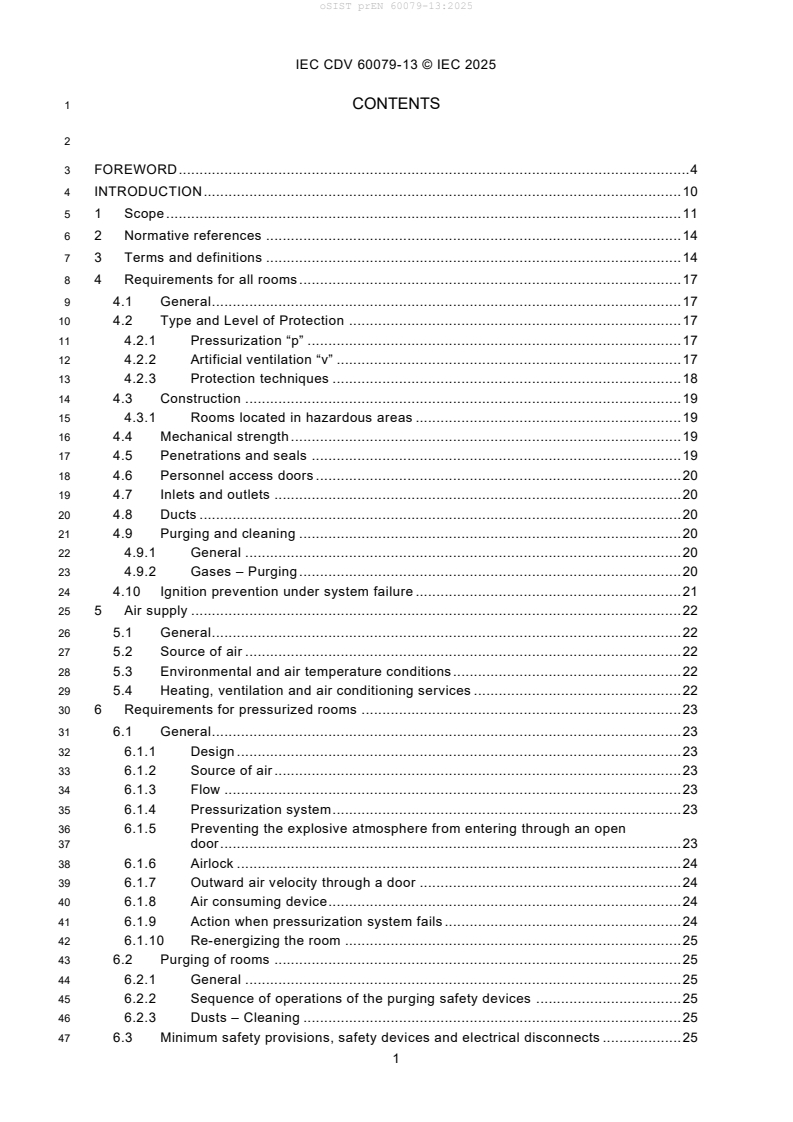
1 CONTENTS
3 FOREWORD . 4
4 INTRODUCTION . 10
5 1 Scope . 11
6 2 Normative references . 14
7 3 Terms and definitions . 14
8 4 Requirements for all rooms . 17
9 4.1 General . 17
10 4.2 Type and Level of Protection . 17
11 4.2.1 Pressurization “p” . 17
12 4.2.2 Artificial ventilation “v” . 17
13 4.2.3 Protection techniques . 18
14 4.3 Construction . 19
15 4.3.1 Rooms located in hazardous areas . 19
16 4.4 Mechanical strength . 19
17 4.5 Penetrations and seals . 19
18 4.6 Personnel access doors . 20
19 4.7 Inlets and outlets . 20
20 4.8 Ducts . 20
21 4.9 Purging and cleaning . 20
22 4.9.1 General . 20
23 4.9.2 Gases – Purging . 20
24 4.10 Ignition prevention under system failure . 21
25 5 Air supply . 22
26 5.1 General . 22
27 5.2 Source of air . 22
28 5.3 Environmental and air temperature conditions . 22
29 5.4 Heating, ventilation and air conditioning services . 22
30 6 Requirements for pressurized rooms . 23
31 6.1 General . 23
32 6.1.1 Design . 23
33 6.1.2 Source of air . 23
34 6.1.3 Flow . 23
35 6.1.4 Pressurization system . 23
36 6.1.5 Preventing the explosive atmosphere from entering through an open
37 door . 23
38 6.1.6 Airlock . 24
39 6.1.7 Outward air velocity through a door . 24
40 6.1.8 Air consuming device . 24
41 6.1.9 Action when pressurization system fails . 24
42 6.1.10 Re-energizing the room . 25
43 6.2 Purging of rooms . 25
44 6.2.1 General . 25
45 6.2.2 Sequence of operations of the purging safety devices . 25
46 6.2.3 Dusts – Cleaning . 25
47 6.3 Minimum safety provisions, safety devices and electrical disconnects . 25
IEC CDV 60079-13 © IEC 2025
48 6.3.1 Safety devices . 25
49 6.3.2 Safety devices based upon Level of Protection . 26
50 6.3.3 Gas detectors . 26
51 6.4 Verification for pressurized rooms . 27
52 6.4.1 General . 27
53 6.4.2 Tests . 27
54 6.4.3 Overpressure test . 27
55 6.4.4 Purging test . 27
56 6.4.5 Minimum pressure differential test . 27
57 6.4.6 Confirmation of the ratings of the safety devices . 27
58 6.4.7 Verification of sequence of operation of the safety devices . 28
59 6.4.8 Measurement of outward velocity . 28
60 7 Requirements for artificially ventilated rooms . 28
61 7.1 General . 28
62 7.1.1 Design . 28
63 7.1.2 Source of air . 28
64 7.1.3 Layout of equipment . 28
65 7.1.4 Ventilation system . 29
66 7.1.5 Air consuming device . 30
67 7.1.6 Safety actions when ventilation system fails . 30
68 7.1.7 Energizing the artificially ventilated area . 30
69 7.2 Purging of artificially ventilated rooms . 31
70 7.2.1 General . 31
71 7.2.2 Sequence of operations of the purging safety devices . 31
72 7.3 Minimum safety provisions, safety devices and electrical disconnects . 31
73 7.3.1 Safety devices . 31
74 7.3.2 Safety devices based upon Equipment Protection Level . 32
75 7.3.3 Artificial ventilation protection . 32
76 7.3.4 Gas and leak detectors . 32
77 7.4 Loss of artificial ventilation . 33
78 7.5 Verification for artificially ventilated rooms . 33
79 7.5.1 General . 33
80 7.5.2 Tests . 33
81 7.5.3 Minimum ventilation flow rate test . 33
82 7.5.4 Confirmation of the ratings of the safety devices . 33
83 7.5.5 Verification of sequence of operation of the safety devices . 33
84 7.5.6 Purging test . 33
85 7.5.7 Testing of ventilation system . 34
86 8 Marking . 34
87 8.1 General . 34
88 8.2 Marking of pressurized rooms . 35
89 8.3 Marking for artificially ventilated rooms . 36
90 9 Instructions . 36
91 9.1 General . 36
92 9.2 Technical documentation for pressurized rooms . 36
93 9.3 Technical documentation for artificially ventilated rooms . 37
94 9.4 Technical documentation for rooms protected by pressurization and artificial
95 ventilation combined . 38
96 9.5 Equipment assembly with its own source of release . 38
IEC CDV 60079-13 © IEC 2025
97 9.6 Modifications. 38
98 Annex A (informative) Maintenance. 39
99 A.1 Periodic verification . 39
100 A.2 Modifications. 39
101 Annex B (informative) Guidelines when pressurization or artificial ventilation is not
102 immediately restored . 40
103 B.1 Short term disruptions . 40
104 B.2 Longer term disruptions . 40
105 Annex C (informative) Examples of applications and associated guidelines . 41
106 C.1 Examples of applications . 41
107 C.2 Example of gas turbine enclosures or packages . 41
108 C.3 Example of electrical equipment room located inside a bunded gas plant
109 process train . 41
110 C.4 Example of crane operator cabin and drillers cabin . 42
111 C.5 Enclosed engine driven compressor package . 43
112 C.6 Gas Chromatograph or analyser and metering buildings . 44
113 C.7 Transportable gas chromatograph or analyser houses and metering houses . 45
114 C.8 Crane cabin located adjacent to but outside and above a hazardous area . 47
115 C.9 Metal sheet printing press . 50
116 Annex D (normative) Smoke Test Method . 52
117 D.1 Smoke Test. 52
118 Bibliography . 53
120 Figure C.1 – Electrical equipment room located in a bunded gas plant process train . 44
121 Figure C.2 – Crane operator cabin and drillers cabin . 45
122 Figure C.3 – Enclosed engine driven compressor package . 46
123 Figure C.4 – Gas chromatograph or analyser and metering buildings duct . 47
124 Figure C.5 – Gas chromatograph or analyser and metering buildings . 47
125 Figure C.6 – Transportable gas chromatograph or analyser and metering houses plan . 48
126 Figure C.7 – Transportable gas chromatograph or analyser and metering houses views . 49
127 Figure C.8 – Crane cabin . 50
128 Figure C.9 – Classification of platform deck . 51
129 Figure C.10 – Crane cabin located adjacent to but outside and above a hazardous area . 51
130 Figure C.11 – Printing press without artificial ventilation . 52
131 Figure C.12 – Printing press with artificial ventilation . 53
133 Table 1 – Applicability of specific clauses of IEC 60079-0 . 13
134 Table 2 – Types of protection for pressurisation and artificial ventilation of rooms . 19
135 Table 3 – Safety devices for pressurized rooms . 27
136 Table 4 – Safety actions for artificial ventilation failure . 32
137 Table 5 – Required safety devices for artificial ventilation . 34
IEC CDV 60079-13 © IEC 2025
140 INTERNATIONAL ELECTROTECHNICAL COMMISSION
141 ____________
143 EXPLOSIVE ATMOSPHERES –
145 Part 13: Equipment protection by pressurized
146 room "p" and artificially ventilated room "v"
148 FOREWORD
149 1) The International Electrotechnical Commission (IEC) is a worldwide organization for standardization comprising
150 all national electrotechnical committees (IEC National Committees). The object of IEC is to promote international
151 co-operation on all questions concerning standardization in the electrical and electronic fields. To this end and
152 in addition to other activities, IEC publishes International Standards, Technical Specifications, Technical Reports,
153 Publicly Available Specifications (PAS) and Guides (hereafter referred to as "IEC Publication(s)"). Their
154 preparation is entrusted to technical committees; any IEC National Committee interested in the subject dealt with
155 may participate in this preparatory work. International, governmental and non-governmental organizations liaising
156 with the IEC also participate in this preparation. IEC collaborates closely with the International Organization for
157 Standardization (ISO) in accordance with conditions determined by agreement between the two organizations.
158 2) The formal decisions or agreements of IEC on technical matters express, as nearly as possible, an international
159 consensus of opinion on the relevant subjects since each technical committee has representation from all
160 interested IEC National Committees.
161 3) IEC Publications have the form of recommendations for international use and are accepted by IEC National
162 Committees in that sense. While all reasonable efforts are made to ensure that the technical content of IEC
163 Publications is accurate, IEC cannot be held responsible for the way in which they are used or for any
164 misinterpretation by any end user.
165 4) In order to promote international uniformity, IEC National Committees undertake to apply IEC Publications
166 transparently to the maximum extent possible in their national and regional publications. Any divergence between
167 any IEC Publication and the corresponding national or regional publication shall be clearly indicated in the latter.
168 5) IEC itself does not provide any attestation of conformity. Independent certification bodies provide conformity
169 assessment services and, in some areas, access to IEC marks of conformity. IEC is not responsible for any
170 services carried out by independent certification bodies.
171 6) All users should ensure that they have the latest edition of this publication.
172 7) No liability shall attach to IEC or its directors, employees, servants or agents including individual experts and
173 members of its technical committees and IEC National Committees for any personal injury, property damage or
174 other damage of any nature whatsoever, whether direct or indirect, or for costs (including legal fees) and
175 expenses arising out of the publication, use of, or reliance upon, this IEC Publication or any other IEC
176 Publications.
177 8) Attention is drawn to the Normative references cited in this publication. Use of the referenced publications is
178 indispensable for the correct application of this publication.
179 9) Attention is drawn to the possibility that some of the elements of this IEC Publication may be the subject of patent
180 rights. IEC shall not be held responsible for identifying any or all such patent rights.
181 International Standard IEC 60079-13 has been prepared by IEC technical subcommittee SC
182 31J: Classification of Hazardous Areas and Installation Requirements.
183 This third edition cancels and replaces the second edition published in 2017 and also replaces
184 IEC 79-16. This edition constitutes a technical revision.
185 Users of this document are advised that interpretation sheets clarifying the interpretation of this
186 document can be published. Interpretation sheets are available from the IEC webstore and can
187 be found in the “history” tab of the page for each document.
188 This edition includes the following significant technical changes with respect to the previous
189 edition:
IEC CDV 60079-13 © IEC 2025
Type
Major
Minor and
Changes Clause editorial Extension technical
changes
changes
Clarification for room requirements after
1 X
initial installation.
Rearranged scope list to align with 4.2.3
1 X
and clarified scope wording.
Clarification that scope applies to analyser
1 X
houses.
Updated Table 1 for IEC 60079-0 Edition 7 1 X
Added IEC 60079-2 2 X
Revised definition to “source of release”
3.5 X
from “internal source of release”
Revised definition for “pressurization
3.10 X
system”
Deleted unused definition for “restricted
Former 3.11 X
access door”
Revised definition for safety device 3.11 X
Added definition for “ignition-capable
3.21 X
equipment”
Revised markings to “pb” and “pc” 4.2.1 X
Added clarification to protection technique
4.2.2 X
“v”.
Added clarification to first apply IEC
4.2.2 X
60079-10-1
Added Table 2 to summarize protection
techniques or combination of protection
4.2.3 X
techniques and their respective
requirements.
Introduced marking for equipment with an
internal source of release installed in a 4.2.3 C1
non-hazardous installations.
Added 4.3.1 to clarify room construction 4.3.1 X
Added clarification to clause for
4.4 X
consideration of external forces
Added requirements for controlled access
4.6 X
doors.
Moved administrative procedures to 4.10 4.9.1 X
Clarification of purge rate for continuous
4.9.2.2 X
or primary source of release
Clarification of requirements for
enclosures within the room in a Zone 1 4.9.2.3 X
and Zone 2 area.
Moved “administrative procedures” from
4.10 X
4.9.1.
Clarified source of air shall be from a non-
hazardous area or Zone 2 under certain 5.2 X
conditions.
Clarified gas detector shall be suitable for
use in turbulent airflow and when used in 5.2 X
duct application.
Clarified source of air requirements and
6.1.2 X
aligned with 5.2.
IEC CDV 60079-13 © IEC 2025
Clarified temperatures relevant to the
6.1.4.1 X
installation need to be accounted for.
Modified to include doors used in various
6.1.5 X
applications.
Clarified equipment between two airlock
doors are not protected and shall be 6.1.6 X
suitable for the EPL required.
Added reference to outward velocity
6.1.7 X
measurement in 6.4.8.
Combined section for “pc” and “pb”, moved
note for administrative controls to 6.1.9 X
Annex B.
Added requirements for risk assessment to
determine actions on pressurization 6.1.9 C2
system failure.
Clarified safety devices includes those
6.3.1 X
inside the ducting.
Clarification for alarm requirements. 6.3.1 X
Clarified heading and detecting open
6.3.2 X
doors.
Added outward velocity measurement per
6.4.2 X
6.4.8
Added options and suggestions for
6.4.4 X
verification method.
Added reference to smoke test procedure
6.4.4 X
in Annex D.
Added method for measurement of
outward velocity and included clarification 6.4.8 C3
to account for high wind velocity.
Added clarification to first classify an area
7.1.1 X
prior to application of artificial ventilation.
Clarified source of air requirements and
7.1.2 X
aligned with 5.2
Revised clause title from “Arrangement” to
7.1.3 X
“Layout of equipment”.
Clarified application of artificial ventilation
with or without an internal source of 7.1.3.1 B1
release
Clarified wording for accumulation of gas. 7.1.4.1 X
Clarified inlet refers to the extraction
7.1.4.3 X
system.
Added clarification for the ventilation to
7.1.4.4 X
remain energized.
Revised wording in Table 4 for clarity 7.1.6 X
Added requirements for risk assessment to
7.1.6 C2
permit operation for “limited duration”.
Clarified wording for alignment with Table
7.3.1 X
Clarification for gas and leak detection. 7.3.4 X
Removed omission of testing. 7.5.1 C4
Added options and suggestions for
7.5.2 X
verification method.
Clarified procedure for extraction systems. 7.5.3 X
Added reference to smoke test procedure
7.5.6 X
in Annex D
Revised wording for clarity and calculation
7.5.7.3 X
method has been permitted.
IEC CDV 60079-13 © IEC 2025
Included examples of markings. 8.1 C5
Revised wording for clarity. 8.3 X
Added note for clarification of IEC 60079-0 9.1 X
Added Zone and EPL inside room for
9.2 X
alignment with Table 5.
Added Zone and EPL inside room for
9.3 X
alignment with Table 5.
Added documentation requirements for
9.5 C6
area classification.
Added information to consider site specific
A.1 X
maintenance activities.
Revised to consider short-term disruptions
B.1 X
and longer-term disruptions.
Revised wording in C.2. Annex C X
Added examples C.3 to C.9 Annex C X
Added Smoke test method Annex D C7
191 NOTE The technical changes referred to include the significance of technical changes in the revised IEC Standard,
192 but they do not form an exhaustive list of all modifications from the previous version.
193 Explanation of the types of changes:
194 A) Definitions
195 1. Minor and editorial changes:
196 • Clarification
197 • Decrease of technical requirements
198 • Minor technical change
199 • Editorial corrections
200 These are changes which modify requirements in an editorial or a minor technical way. They
201 include changes of the wording to clarify technical requirements without any technical change,
202 or a reduction in level of existing requirement.
203 2. Extension: Addition of technical options
204 These are changes which add new or modify existing technical requirements, in a way that new
205 options are given, but without increasing requirements for equipment that was fully compliant
206 with the previous standard. Therefore, these will not have to be considered for products in
207 conformity with the preceding edition.
208 3. Major technical changes:
209 • addition of technical requirements
210 • increase of technical requirements
211 These are changes to technical requirements (addition, increase of the level or removal) made
212 in a way that a product in conformity with the preceding edition will not always be able to fulfil
213 the requirements given in the later edition. These changes have to be considered for products
214 in conformity with the preceding edition. For these changes additional information is provided
215 in clause B below.
216 NOTE These changes represent current technological knowledge. However, these changes should not normally have
217 an influence on equipment already placed on the market.
218 B) Information about the background of ‘changes’
IEC CDV 60079-13 © IEC 2025
219 B1 The scope permits using artificial ventilation to protect equipment located in a Zone 2 area
220 with or without an internal source of gas release.
221 B2 Included “[ ]” marking introduced in Table 2.
222 C1 Introduced “[ ]” marking for rooms with an internal source of released installed in a non-
223 hazardous area to cover applications in the scope of this standard. The form of the marking is
224 consistent with associated apparatus for intrinsically safe systems.
225 C2 Introduced risk assessment to determine continued operation of equipment for a limited
226 duration as this was not adequately covered in prior editions.
227 C3 Added procedure for measurement of outward velocity for consistent application.
228 C4 Removed omission of testing but included several options in lieu of physical testing such as
229 modelling or calculation.
230 C5 Introduced “[ ]” marking and EPL G- for rooms with an internal source of released installed
231 in a non-hazardous area.
232 C6 Added documentation requirements for area classification for equipment with an internal
233 source of release as this was not adequately covered in previous editions.
234 C7 Added Annex D for a smoke test procedure as previous editions did not include sufficient
235 details for consistent application.
236 The text of this International Standard is based on the following documents:
238 The text of this document is based on the following documents:
240 Full information on the voting for the approval of this document can be found in the report on
241 voting indicated in the above table.
242 This publication has been drafted in accordance with the ISO/IEC Directives, Part 2.
243 This document is to be used in conjunction with the principles of hazardous area classification
244 from IEC 60079-10-1. Additional information on the design, construction, operation and the
245 safety of analyser houses can be found in IEC 61285 and IEC TR 61831.
246 A list of all parts in the IEC 60079 series, published under the general title Explosive
247 atmospheres, can be found on the IEC website.
248 The committee has decided that the contents of this publication will remain unchanged until the
249 stability date indicated on the IEC website under "http://webstore.iec.ch" in the data related to
250 the specific publication. At this date, the publication will be
251 • reconfirmed,
252 • withdrawn,
253 • replaced by a revised edition, or
254 • amended.
IEC CDV 60079-13 © IEC 2025
255 A bilingual version of this publication may be issued at a later date.
IEC CDV 60079-13 © IEC 2025
257 INTRODUCTION
258 This part of IEC 60079 gives requirements for the design, construction, assessment, verification
259 and marking of rooms used to protect internal equipment by pressurization or artificial
260 ventilation or both as applicable when located in an explosive gas atmosphere or combustible
261 dust atmosphere hazardous area with or without an internal source of a flammable gas or
262 vapour. It also includes a room located in a non-hazardous area that has an internal source of
263 release of a flammable gas or vapour.
264 This document deals with rooms that are constructed in a manufacturer’s facility and intended
265 to have the final installation completed on-site, as well as rooms that are constructed completely
266 on-site. Rooms constructed in a manufacturer’s facility may include third-party verification. For
267 rooms built on-site, this document can be used by plant operators as a guide for assessment of
268 those facilities.
269 After the initial installation, a room constructed in a manufacture’s facility is considered as part
270 of the site installation in accordance with other parts of the ISO 80079 and IEC 60079 series.
IEC CDV 60079-13 © IEC 2025
272 EXPLOSIVE ATMOSPHERES –
274 Part 13: Equipment protection by pressurized
275 room "p" and artificially ventilated room "v"
279 1 Scope
280 This part of IEC 60079 gives requirements for the design, construction, assessment, verification
281 and marking of rooms used to protect internal equipment as either:
282 a) located in a Zone 1 or Zone 2 or Zone 21 or Zone 22 (an area normally requiring an
283 Equipment Protection Level (EPL) Gb, Gc, Db or Dc) without an internal source of gas or
284 vapour release and protected by pressurization; or
285 b) located in a Zone 1 or Zone 2 or Zone 21 or Zone 22 (an area normally requiring EPL Gb,
286 Gc, Db or Dc), containing an internal source of gas or vapour release and protected by both
287 pressurization and artificial ventilation; or
288 c) located in a Zone 2 (an area normally requiring EPL Gc) with or without an internal source
289 of gas or vapour release and protected by artificial ventilation; or
290 d) located in a non-hazardous area, containing an internal source of gas or vapour release and
291 protected by artificial ventilation.
292 Equipment with a minimum EPL of Gc or Dc permitted in a room located in a Zone 1 or
293 Zone 21 (EPL Gb or Db) is not addressed in this standard as it is considered not practical in
294 the context of rooms and the equipment that might be required.
295 NOTE 1 Internal releases of combustible dust are not considered as neither protection by ventilation nor protection
296 by pressurization can prevent hazardous areas from such releases.
297 NOTE 2 See Annex C for examples of applications.
298 The term "room" used in this document includes single rooms, multiple rooms, a complete
299 building or a room contained within a building. A room is intended to facilitate the entry of
300 personnel. Regions of the “room” where the protection is provided by local ventilation, for
301 example ventilation hoods, can also be considered in the evaluation of the “room”. Enclosures
302 designed to permit personnel to completely enter can also be considered as a room, for example
303 a large acoustic enclosure. This document is not intended to apply to temporary structures, for
304 example, to enable hot work to be completed in an operating plant.
305 Limitations in the use of protection by ventilation are specified in 7.1.1
306 NOTE 3 Notwithstanding the above intent for permanent structures, elements of this document are commonly used
307 as guidance for temporary structures.
308 This document also includes requirements for related safety devices and controls necessary to
309 ensure that artificial ventilation, purging and pressurization is established and maintained.
310 A room assembled or constructed on site, can be either land-based or off-shore. The room is
311 primarily intended for installation by an end-user but could be constructed and assessed at a
312 manufacturer’s facility, where the final construction such as ducting can be completed on site.
313 This document does not specify the methods that may be required to ensure adequate air quality
314 for personnel such as asphyxiation, toxicity and temperature hazards within the room. Additional
315 guidance on analyser houses and asphyxiation and toxicity hazards can be found in IEC 61285.
316 National or other regulations and requirements may also exist for the safety of personnel.
IEC CDV 60079-13 © IEC 2025
317 Protection of rooms by using an inert gas or a flammable gas is outside of the scope of this
318 document. It is recognized that such applications are special cases but are likely to be the
319 subject of additional, stringent engineering standards, procedures and practices. Pressurized
320 enclosures for equipment that are not intended to facilitate the entry of personnel are addressed
321 in IEC 60079-2 and are not in the scope of this document.
322 NOTE 4 Maintenance recommendations are contained in Annex A.
323 This document supplements and modifies the general requirements of IEC 60079-0, except as
324 indicated in Table 1. Where a requirement of this document conflicts with a requirement of
325 IEC 60079-0, the requirement of this document takes precedence.
326 Table 1 – Applicability of specific clauses of IEC 60079-0
Clause of IEC 60079-0
IEC 60079-0
Ed. 7.0 Clause / subclause title
application to
(2017) (Normative)
IEC 60079-13
(Informative)
4 Equipment grouping
4.1 General Applies
4.2 Group I Excluded
4.3 Group II Applies
4.4 Group III Applies
4.5 Equipment for a particular explosive atmosphere Applies
5 Temperatures
5.1.1 Ambient temperature Applies
5.1.2 External source of heating or cooling Applies
5.2 Service temperature Applies
5.3.1 Determination of maximum surface temperature Applies
5.3.2 Limitation of maximum surface temperature Applies
5.3.3 Small component temperature for Group I or Group II electrical equipment Excluded
5.3.4 Component temperatures of smooth surfaces for Group I or Group II Excluded
electrical equipment
6 Requirements for all equipment
6.1 General Applies
6.2 Mechanical strength of equipment Excluded
6.3 Opening times Excluded
6.4 Circulating currents in enclosures Excluded
6.5 Gasket retention Excluded
6.6 Electromagnetic and ultrasonic radiating equipment Applies
6.6.1 General Applies
6.6.2 Radio frequency sources Applies
6.6.3 Ultrasonic sources Applies
6.6.4 Lasers, luminaires, and other non-divergent continuous wave optical Applies
sources
7 Non-metallic enclosures and non-metallic parts of enclosures Excluded
8 Metallic enclosures and metallic parts of enclosures Excluded
9 Fasteners Excluded
10 Interlocking devices Excluded
11 Bushings Excluded
12 (Reserved for future use) Excluded
13 Ex Components Excluded
14 Connection facilities Excluded
15 Connection facilities for earthing and bonding conductors Excluded
IEC CDV 60079-13 © IEC 2025
Clause of IEC 60079-0
IEC 60079-0
Ed. 7.0 Clause / subclause title
application to
(2017) (Normative)
IEC 60079-13
(Informative)
16 Entries into enclosures Excluded
17 Supplementary requirements for rotating electrical machines Excluded
18 Supplementary requirements for switchgear Excluded
19 Reserved for future use Excluded
20 Supplementary requirements for external plugs, socket outlets and Excluded
connectors for field wiring connection
21 Supplementary requirements for luminaires Excluded
22 Supplementary requirements for caplights and handlights Excluded
23 Equipment incorporating cells and batteries Excluded
24 Documentation Applies
25 Compliance of prototype or sample with documents Applies
26 Type tests
26.1 General Applies
26.2 Test configuration Applies
26.3 Tests in explosive test mixtures Excluded
26.4 Tests of enclosures Excluded
26.5 Thermal tests Excluded
26.6 Torque test for bushings Excluded
26.7 Non-metallic enclosures or non-metallic parts of enclosures Excluded
26.8 Thermal endurance to heat Excluded
26.9 Thermal endurance to cold Excluded
26.10 Resistance to UV light Excluded
26.11 Resistance to chemical agents for Group I electrical equipment Excluded
26.12 Earth continuity Excluded
26.13 Surface resistance test of parts of enclosures of non-metallic materials Excluded
26.14 Measurement of capacitance Excluded
26.15 Verification of ratings of ventilating fans Excluded
26.16 Alternative qualification of elastomeric sealing O-rings Excluded
27 Routine tests Applies
28 Manufacturers responsibility
28.1 Conformity with the documentation Applies
28.2 Certificate Applies
28.3 Responsibility for marking Applies
29 Marking
29.1 Applicability Applies
29.2 Location Applies
29.3 General Applies
29.4 Ex marking for explosive gas atmospheres Applies
29.5 Ex marking for explosive dust atmospheres Applies
29.6 Combined types of protection Applies
29.7 Multiple types of protection Applies
29.8 Ga using two independent Gb types (or levels) of protection Excluded
29.9 Boundary wall Excluded
29.10 Ex Components Excluded
30 Instructions Modified
Annex A Supplementary requirements for cable glands Excluded
IEC CDV 60079-13 © IEC 2025
Clause of IEC 60079-0
IEC 60079-0
Ed. 7.0 Clause / subclause title
application to
(2017) (Normative)
IEC 60079-13
(Informative)
Applies: This Clause/Subclause of IEC 60079-0 is applied without change.
Excluded: This Clause/Subclause of IEC 60079-0 does not apply.
Modified: This Clause/Subclause of IEC 60079-0 is modified as detailed in this document.
NOTE The applicable requirements of IEC 60079-0 are identified by the clause title which is normative. This
table was written against the specific requirements of IEC 60079-0, Ed 7.0.
328 2 Normative references
329 The following documents are referred to in the text in such a way that some or all of their content
330 constitutes requirements of this document. For dated references, only the edition cited applies.
331 For undated references, the latest edition of the referenced document (including any
332 amendments) applies.
333 IEC 60079-0, Explosive atmospheres – Part 0: Equipment – General requirements
334 IEC 60079-2, Explosive atmospheres – Part 2: Equipment protection by pressurized enclosure
335 "p"
336 IEC 60079-10-1, Explosive atmospheres – Part 10-1: Classification of areas – Explosive gas
337 atmospheres
338 IEC 60079-29 (all parts), Explosive atmospheres – Gas detectors
339 3 Terms and definitions
340 For the purposes of this document, the terms and definitions given in IEC 60050-426,
341 IEC 60079-0 and the following apply.
342 ISO and IEC maintain terminological databases for use in standardization at the following
343 addresses:
344 • IEC Electropedia: available at http://www.electropedia.org/
345 • ISO Online browsing platform:
...