


CLC/TS 50136-9:2020
(Main)Alarm systems - Alarm transmission systems and equipment - Part 9: Requirements for common protocol for alarm transmission using the Internet Protocol (IP)
General Information
- Abstract
This document specifies a protocol for point-to-point transmission of alarms and faults, as well as communications monitoring, between a Supervised Premises Transceiver and a Receiving Centre Transceiver using the Internet Protocol (IP). The protocol is intended for use over any network that supports the transmission of IP data. These include Ethernet, xDSL, GPRS, WiFi, UMTS and WIMAX. The system performance characteristics for alarm transmission are specified in EN 50136-1. The performance characteristics of the supervised premises equipment should comply with the requirements of its associated alarm system standard and applies for transmission of all types of alarms including, but not limited to, fire, intrusion, access control and social alarms. Compliance with this document is voluntary.
- Status
- Published
- Publication Date
- 12-Nov-2020
- Technical Committee
- CLC/TC 79 - Alarm systems
- Drafting Committee
- CLC/TC 79/WG 05 - Alarm transmission systems (annunciation equipment)
- Current Stage
- 6060 - Document made available - Publishing
- Start Date
- 13-Nov-2020
- Due Date
- 30-Nov-2020
- Completion Date
- 13-Nov-2020


Overview
CLC/TS 50136-9:2020 specifies a common protocol for alarm transmission using the Internet Protocol (IP). It defines point-to-point communications between a Supervised Premises Transceiver (SPT) and a Receiving Centre Transceiver (RCT) over any IP-capable network (Ethernet, xDSL, GPRS, Wi‑Fi, UMTS, WiMAX, etc.). The Technical Specification covers messaging, commissioning, connection setup and security mechanisms for reliable alarm and fault reporting (fire, intrusion, access control, social alarms). Compliance is voluntary; system performance characteristics are specified separately in EN 50136‑1.
Key Topics
- Scope and objectives: Point-to-point alarm/fault transmission and communications monitoring between SPT and RCT.
- Message architecture: Standardized message formats for polls, events, responses, and transparent payloads; handling of padding and message length.
- Security: Hashing, encryption, shared secrets, key exchange and DTLS-related completion messages to protect integrity and confidentiality.
- Reliability: Timeouts, retries, path supervision and polling mechanisms to detect and report link failures.
- Operational controls: Versioning, reverse commands, set-time messages, protocol identifiers and result codes for interoperability.
- Commissioning & connection setup: Procedures and message flows to bring SPT devices online and establish secure connections with an RCT.
- Supporting material: Normative annexes for result codes, protocol identifiers and shared secret handling; informative annexes with messaging and application examples.
Applications
- Secure transmission of alarm and fault signals from residential, commercial or institutional premises to alarm receiving centres.
- Transport layer for diverse alarm types: fire detection, intrusion, access control and social alarm systems.
- Use in hybrid networks or mobile networks (GPRS/UMTS) where IP is the transport layer.
- Basis for integrating alarm panels, telecare devices and monitoring platforms with central monitoring stations.
Who should use this standard
- Alarm system manufacturers implementing IP-based communicators (SPT devices).
- Alarm receiving centre vendors and network operators deploying RCT implementations.
- System integrators, security engineers and installers designing IP alarm transmission solutions.
- Test laboratories and certification bodies assessing interoperability and protocol conformance.
Related Standards
- EN 50136‑1 - System performance characteristics for alarm transmission.
- Other parts of the EN/CLC 50136 series covering equipment and system requirements for alarm transmission.
This specification modernizes IP-based alarm transport by combining practical commissioning flows, robust message structures and security controls - enabling interoperable, secure alarm transmission across contemporary IP networks.
Relations
- Effective Date
- 17-Nov-2020
- Effective Date
- 03-Feb-2026
Get Certified
Connect with accredited certification bodies for this standard

ANCE
Mexican certification and testing association.

CIS Institut d.o.o.
Personal Protective Equipment (PPE) certification body. Notified Body NB-2890 for EU Regulation 2016/425 PPE.

Intertek Slovenia
Intertek testing, inspection, and certification services in Slovenia.
Sponsored listings
Frequently Asked Questions
CLC/TS 50136-9:2020 is a technical specification published by CLC. Its full title is "Alarm systems - Alarm transmission systems and equipment - Part 9: Requirements for common protocol for alarm transmission using the Internet Protocol (IP)". This standard covers: This document specifies a protocol for point-to-point transmission of alarms and faults, as well as communications monitoring, between a Supervised Premises Transceiver and a Receiving Centre Transceiver using the Internet Protocol (IP). The protocol is intended for use over any network that supports the transmission of IP data. These include Ethernet, xDSL, GPRS, WiFi, UMTS and WIMAX. The system performance characteristics for alarm transmission are specified in EN 50136-1. The performance characteristics of the supervised premises equipment should comply with the requirements of its associated alarm system standard and applies for transmission of all types of alarms including, but not limited to, fire, intrusion, access control and social alarms. Compliance with this document is voluntary.
This document specifies a protocol for point-to-point transmission of alarms and faults, as well as communications monitoring, between a Supervised Premises Transceiver and a Receiving Centre Transceiver using the Internet Protocol (IP). The protocol is intended for use over any network that supports the transmission of IP data. These include Ethernet, xDSL, GPRS, WiFi, UMTS and WIMAX. The system performance characteristics for alarm transmission are specified in EN 50136-1. The performance characteristics of the supervised premises equipment should comply with the requirements of its associated alarm system standard and applies for transmission of all types of alarms including, but not limited to, fire, intrusion, access control and social alarms. Compliance with this document is voluntary.
CLC/TS 50136-9:2020 is classified under the following ICS (International Classification for Standards) categories: 13.320 - Alarm and warning systems; 33.040.40 - Data communication networks. The ICS classification helps identify the subject area and facilitates finding related standards.
CLC/TS 50136-9:2020 has the following relationships with other standards: It is inter standard links to CLC/TS 50136-9:2017, EN 50136-1:2012. Understanding these relationships helps ensure you are using the most current and applicable version of the standard.
CLC/TS 50136-9:2020 is available in PDF format for immediate download after purchase. The document can be added to your cart and obtained through the secure checkout process. Digital delivery ensures instant access to the complete standard document.
Standards Content (Sample)
SLOVENSKI STANDARD
01-januar-2021
Nadomešča:
SIST-TS CLC/TS 50136-9:2017
Alarmni sistemi - Sistemi in oprema za prenos alarma - 9. del: Zahteve za skupni
protokol za prenos alarma po internetnem protokolu
Alarm systems - Alarm transmission systems and equipment - Part 9: Requirements for
common protocol for alarm transmission using the Internet Protocol (IP)
Alarmanlagen - Alarmübertragungsanlagen und -einrichtungen - Teil 9: Anforderungen
an standardisierte Protokolle zur Alarmübertragung unter Nutzung des Internetprotokolls
(IP)
Systèmes d'alarmes - Systèmes et équipements de transmission d'alarme - Partie 9 :
Exigences pour le protocole commun de transmission d'alarme utilisant le protocole
Internet (IP)
Ta slovenski standard je istoveten z: CLC/TS 50136-9:2020
ICS:
13.320 Alarmni in opozorilni sistemi Alarm and warning systems
33.040.40 Podatkovna komunikacijska Data communication
omrežja networks
2003-01.Slovenski inštitut za standardizacijo. Razmnoževanje celote ali delov tega standarda ni dovoljeno.
TECHNICAL SPECIFICATION CLC/TS 50136-9
SPÉCIFICATION TECHNIQUE
TECHNISCHE SPEZIFIKATION
November 2020
ICS 13.320; 33.040.40 Supersedes CLC/TS 50136-9:2017
English Version
Alarm systems - Alarm transmission systems and equipment -
Part 9: Requirements for common protocol for alarm
transmission using the Internet Protocol (IP)
Systèmes d'alarmes - Systèmes et équipements de Alarmanlagen - Alarmübertragungsanlagen und -
transmission d'alarme - Partie 9 : Exigences pour le einrichtungen - Teil 9: Anforderungen an standardisierte
protocole commun de transmission d'alarme utilisant le Protokolle zur Alarmübertragung unter Nutzung des
protocole Internet (IP) Internetprotokolls (IP)
This Technical Specification was approved by CENELEC on 2020-09-28.
CENELEC members are required to announce the existence of this TS in the same way as for an EN and to make the TS available promptly
at national level in an appropriate form. It is permissible to keep conflicting national standards in force.
CENELEC members are the national electrotechnical committees of Austria, Belgium, Bulgaria, Croatia, Cyprus, the Czech Republic,
Denmark, Estonia, Finland, France, Germany, Greece, Hungary, Iceland, Ireland, Italy, Latvia, Lithuania, Luxembourg, Malta, the
Netherlands, Norway, Poland, Portugal, Republic of North Macedonia, Romania, Serbia, Slovakia, Slovenia, Spain, Sweden, Switzerland,
Turkey and the United Kingdom.
European Committee for Electrotechnical Standardization
Comité Européen de Normalisation Electrotechnique
Europäisches Komitee für Elektrotechnische Normung
CEN-CENELEC Management Centre: Rue de la Science 23, B-1040 Brussels
© 2020 CENELEC All rights of exploitation in any form and by any means reserved worldwide for CENELEC Members.
Ref. No. CLC/TS 50136-9:2020 E
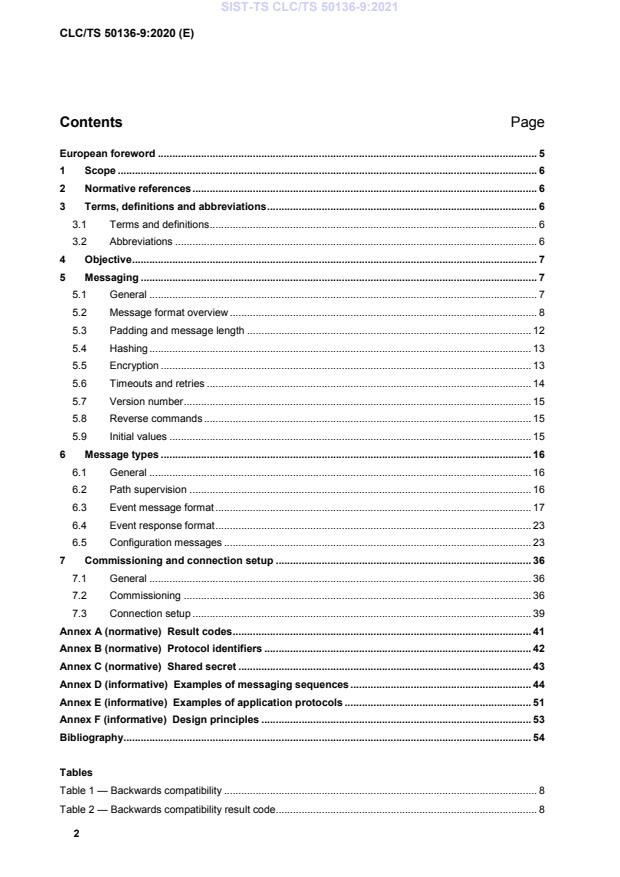
Contents Page
European foreword . 5
1 Scope . 6
2 Normative references . 6
3 Terms, definitions and abbreviations . 6
3.1 Terms and definitions . 6
3.2 Abbreviations . 6
4 Objective . 7
5 Messaging . 7
5.1 General . 7
5.2 Message format overview . 8
5.3 Padding and message length . 12
5.4 Hashing . 13
5.5 Encryption . 13
5.6 Timeouts and retries . 14
5.7 Version number . 15
5.8 Reverse commands . 15
5.9 Initial values . 15
6 Message types . 16
6.1 General . 16
6.2 Path supervision . 16
6.3 Event message format . 17
6.4 Event response format . 23
6.5 Configuration messages . 23
7 Commissioning and connection setup . 36
7.1 General . 36
7.2 Commissioning . 36
7.3 Connection setup . 39
Annex A (normative) Result codes . 41
Annex B (normative) Protocol identifiers . 42
Annex C (normative) Shared secret . 43
Annex D (informative) Examples of messaging sequences . 44
Annex E (informative) Examples of application protocols . 51
Annex F (informative) Design principles . 53
Bibliography. 54
Tables
Table 1 — Backwards compatibility . 8
Table 2 — Backwards compatibility result code. 8
Table 3 — Identifiers . 9
Table 4 — Basic unencrypted format of messages . 9
Table 5 — Basic encrypted format of messages . 10
Table 6 — Message ID overview . 11
Table 7 — Flags . 12
Table 8 — Hashing ID’s . 13
Table 9 — Encryption ID’s . 14
Table 10 — Reverse commands . 15
Table 11 — Initial values . 15
Table 12 — Poll message SPT ← → RCT . 16
Table 13 — Poll response RCT ← → SPT . 16
Table 14 — Poll response - result code . 17
Table 15 — Event message format – SPT → RCT. 17
Table 16 — Event message format – Fields . 18
Table 17 — Event field . 18
Table 18 — Time event field . 19
Table 19 — Time message field. 19
Table 20 — Link field – IP Address . 19
Table 21 — Link field – Port number . 20
Table 22 — Link field – URL . 20
Table 23 — Link field – Filename . 20
Table 24 — Alarm Text . 20
Table 25 — Site Name . 21
Table 26 — Building Name . 21
Table 27 — Location . 21
Table 28 — Room . 21
Table 29 — Alarm Trigger . 22
Table 30 — Longitude . 22
Table 31 — Latitude . 22
Table 32 — Altitude . 22
Table 33 — Event response message format . 23
Table 34 — Event response - result code . 23
Table 35 — Connection handle request message format . 24
Table 36 — Connection handle response message format . 24
Table 37 — Connection handle response - result code . 24
Table 38 — Device ID request message format . 25
Table 39 — Device ID request flags . 25
Table 40 — Device ID response message format . 25
Table 41 — Encryption selection request message format . 26
Table 42 — ‘Master Encryption Selection request’ flag . 26
Table 43 — Encryption selection response message format . 26
Table 44 — Encryption selection response - result code . 26
Table 45 — Encryption key exchange request message format . 27
Table 46 — ‘Master Key request’ flag . 27
Table 47 — Encryption key exchange response message format. 28
Table 48 — Encryption key - result code . 28
Table 49 — Hash selection request message format . 28
Table 50 — Hash selection response message format . 29
Table 51 — Path supervision request message format . 29
Table 52 — Path supervision response message format . 30
Table 53 — Path supervision response - result code . 30
Table 54 — Set time command message format . 30
Table 55 — Set time response message format . 31
Table 56 — Set time response - result code . 31
Table 57 — Protocol version request message format . 31
Table 58 — Protocol version response message format . 32
Table 59 — Protocol version response - result code . 32
Table 60 — Transparent message format . 32
Table 61 — Transparent response format . 33
Table 62 — Transparent response - result code. 33
Table 63 — DTLS completed request message format . 33
Table 64 — DTLS completed response message format . 34
Table 65 — DTLS completed response - result code . 34
Table 66 — RCT IP parameter request message format . 34
Table 67 — RCT IP parameter response message format . 35
Table 68 — RCT IP parameter response - result code . 35
Table 69 — Message flow during the commissioning of a new SPT . 37
Table 70 — Message flow during connection setup . 40
Table A.1 — Result codes . 41
Table B.1 — Protocol identifiers . 42
Table D.1 — Example of the commissioning messaging sequence . 45
Table D.2 — Example of the connection setup messaging sequence . 48
Table E.1 — VdS2465 message example . 52
European foreword
This document (CLC/TS 50136-9:2020) has been prepared by CLC/TC 79 “Alarm systems”.
This document supersedes CLC/TS 50136-9:2017.
Attention is drawn to the possibility that some of the elements of this document may be the subject of patent
rights. CENELEC shall not be held responsible for identifying any or all such patent rights.
This document specifies a common IP transport protocol for alarm transmission. The published version
(2017, second version) required solving both technical and security issues identified during the first actual
implementations of the protocol. The working group was working closely with the early adopters of the
protocol and has a very clear and complete list of issues and solutions. This revision supersedes the
previous version.
EN 50136 consists of the following parts, under the general title Alarm systems - Alarm transmission
systems and equipment:
— Part 1: General requirements for alarm transmission systems
— Part 2: General requirements for Supervised Premises Transceiver (SPT)
— Part 3: Requirements for Receiving Centre Transceiver (RCT)
— Part 4: Annunciation equipment used in alarm receiving centres
— Part 5: (Free)
— Part 6: (Free)
— Part 7: Application guidelines
— Part 8: (Free)
— Part 9: Requirements for a common protocol for alarm transmission using the Internet Protocol (IP)
1 Scope
This document specifies a protocol for point-to-point transmission of alarms and faults, as well as
communications monitoring, between a Supervised Premises Transceiver and a Receiving Centre
Transceiver using the Internet Protocol (IP).
The protocol is intended for use over any network that supports the transmission of IP data. These include
Ethernet, xDSL, GPRS, WiFi, UMTS and WIMAX.
The system performance characteristics for alarm transmission are specified in EN 50136-1.
The requirements for the performance of the alarm transmission system, the SPT and the RCT are
specified in the relevant parts of the EN 50136 series.
Compliance with this document is voluntary.
2 Normative references
The following documents are referred to in the text in such a way that some or all of their content constitutes
requirements of this document. For dated references, only the edition cited applies. For undated references,
the latest edition of the referenced document (including any amendments) applies.
EN 50136-1:2012, Alarm systems - Alarm transmission systems and equipment - Part 1: General
requirements for alarm transmission systems
3 Terms, definitions and abbreviations
3.1 Terms and definitions
For the purposes of this document, the terms and definitions given in EN 50136-1:2012 apply.
ISO and IEC maintain terminological databases for use in standardization at the following addresses:
— ISO Online browsing platform: available at https://www.iso.org/obp
— IEC Electropedia: available at http://www.electropedia.org/
3.2 Abbreviations
For the purposes of this document, the following abbreviations apply.
AES Advanced Encryption Standard
ARC Alarm Receiving Centre
ATP Alarm Transmission Path
ATS Alarm Transmission System
CA X.509 Certificate Authority
CBC Cipher Block Chaining
CRC Cyclic redundancy check
DNS Domain Name System
DTLS Datagram Transport Layer Security
HL Header Length
IP Internet Protocol
IV Initialization Vector
MAC Media Access Control
MTU Maximum Transmission Unit
NAT Network Address Translation
NIST National Institute of Standards and Technology
NTP Network Time Protocol
NVM Non-Volatile Memory
P-MTU Path Maximum Transmission Unit
RCT Receiver Centre Transceiver
RX Receive
SCTP Stream Control Transmission Protocol
SNTP Simple Network Time Protocol
SPT Supervised Premises Transceiver
TFTP Trivial File Transfer Protocol
TX Transmit
UDP User Datagram Protocol
URI Uniform Resource Identifier
URL Uniform Resource Locator
UTC Coordinated Universal Time
WS Window Size
4 Objective
The objective of this document is to specify the protocol details (transport and application layers) for alarm
transmission systems using Internet Protocol (IP), to ensure interoperability between SPTs and RCTs
supplied by different manufacturers. Mechanisms to commission SPT and RCT and build mutual trust
between the communicating parties are also described.
As compliance with this document is voluntary, any other alarm transmission protocol or equipment not
covered by this document may be used, provided that the requirements of EN 50136-1 are met.
The protocol and its elements concern one ATP only.
This protocol is designed to run on top of UDP and is designed to support both IPv4 and IPv6.
NOTE For more information on the use of IP and UDP in alarm transmission, please refer to Annex F.
5 Messaging
5.1 General
This clause defines the messaging layer, on top of which the alarm event data are transmitted using the
existing reporting formats such as, for example, Sia and Contact ID. Clause 7 defines the initial
commissioning of an SPT, as well as how SPTs connect to the RCT.
The functionality of the alarm messaging and polling protocol includes:
— exchanging master and session parameters;
— (alarm) event reporting (including linking to out-of-band additional data related to events, like
audio/video);
— line monitoring;
— transparent message transmission, e.g. vendor specific messages that, for example, can be used for
remote commands from RCT to SPT.
It fulfils the following requirements:
— encryption, fulfilling requirements for most demanding category of EN 50136-1;
— authentication, fulfilling requirements for most demanding category of EN 50136-1;
— SPT: allows a broad range of hardware (limited demands on memory footprint as well as CPU power);
— RCT: allows support for at least 10 000 SPTs in compliance with any category in EN 50136-1, using
modern general purpose server hardware;
— allow Dynamic IP addresses of the SPTs;
— allow one or more SPTs to be placed behind a NAT firewall.
5.2 Message format overview
5.2.1 General
This subclause describes the basic outline of all messages.
Each message shall be explicitly acknowledged, including line supervision messages.
Backwards compatibility is achieved by the implementation of a response with the same message id as
the unknown message, however with bit 7 set, with the result code:
“RESP_CMD_NOT_SUPPORTED”.
Table 1 — Backwards compatibility
Byte index Bytes Description
0 HL Header, Message ID and Message Length
HL 1 Result code
Padding
Hash
Table 2 — Backwards compatibility result code
Description Purpose
Description
RESP_CMD_NOT_SUPPORT If the message ID is not supported by the RCT
ED
Multi-byte values will be transmitted using network byte order (big-endian).
Examples:
1. Consider sending message: "Example message."In this case "E" is considered the most significant
byte and should therefore be sent first.
2. Consider sending the encryption key (hex): "363E-2B16-8DBB-5A95-7D5F-2BF4-25A4-5D7C-363E-
2B16-8DBB-5A95-7D5F-2BF4-25A4-5D7C" In this case 0x36 is considered the most significant byte
and should therefore be sent first.
This rule will follow the recommendations of the RFC 1700.
https://tools.ietf.org/html/rfc1700
5.2.2 Identifiers
The following identifiers exist:
Table 3 — Identifiers
Description Purpose Present in Encrypted See
Connection Look up the current All messages No 5.2.4
Handle symmetric encryption key
Device ID Uniquely identify the N / A 5.2.5
hardware
The Connection Handle is unencrypted. It is a unique number, initialized during the setup of the connection.
Its sole purpose is to be able to look up the encryption key. It is valid for the communication session only.
The Device ID uniquely identifies the hardware once the connection has been established.
NOTE Device ID is not equivalent to any account code or similar ID specified by application protocol.
The Device ID shall be stored in non-volatile memory within the SPT.
The IP address is not used for identification purposes, in order to allow for the use of dynamic or translated
IP addresses.
5.2.3 Message format
The basic unencrypted format of all messages is as follows. Message in this format is never transmitted. It
is described here only to clarify the hash value calculation.
Table 4 — Basic unencrypted format of messages
Byte Index Bytes Description See Group
0 4 Connection handle 5.2.4 Header
4 2 Tx Sequence number 5.2.8
6 2 Rx Sequence number 5.2.8
8 2 Flags 5.2.9
10 1 Protocol version number 5.7
11 1 Message ID 5.2.6
12 2 Message Length 5.2.7 Message
14 n Message data Clause 6
14 + n n Padding 6.4
The basic encrypted, transmitted format of all messages is as follows. Note that the Device ID field is not
included in the encrypted message and its value is not used to compute the message hash value, i.e. the
hash is calculated from the unencrypted version of the message described above.
Table 5 — Basic encrypted format of messages
Byte Index Bytes Description See Encrypted Group
0 4 Connection Handle 5.2.4 No Header
Message
4 2 Tx Sequence number 5.2.8 Yes
6 2 Rx Sequence number 5.2.8 Yes
8 2 Flags 5.2.9 Yes
10 1 Protocol version number 5.7 Yes
11 1 Message ID 5.2.6 Yes
12 2 Message Length 5.2.7 Yes
14 n Message data Clause 6 Yes
14 + n Padding 5.3.1 Yes Tail
32 Hash – SHA-256, or 5.4 Yes
Hash – RIPEMD-256
The Connection Handle is unencrypted; the remainder of the message (from Tx Sequence Number up to
and including Hash) is encrypted using the encryption method as negotiated during the commissioning
stage.
Message ID’s are defined in pairs: each message has its matching response. For responses the first byte
of the Message Data always holds a ‘Result code’ as defined in normative Annex A.
All fields are described in detail in the following subclauses.
5.2.4 Connection handle
The Connection Handle is assigned (uniquely for the RCT to which a SPT reports) using the commissioning
protocol. The RCT creates a unique Connection Handle and links this to the Device ID of the SPT in its
internal database. This translation results in a compact, fixed length Connection Handle.
The purpose of the Connection Handle is to be able to determine the encryption key to be used to decrypt
the received message, independent of the IP address of the message.
The Connection Handle is a 32-bit binary value.
For the purpose of commissioning a SPT, the RCT will present a one-time-connection-handle to the
installer/operator. It will be shared/represented as a hexadecimal number (consisting of eight characters).
The final Connection Handle as in use after the commissioning phase is not a (by the installer/operator)
configurable parameter, nor made visible on user interfaces. It is used internally by the SPT/RCT
equipment only.
5.2.5 Device ID
5.2.5.1 General
The Device ID uniquely identifies the SPT.
Within the message header, the Device ID itself is never transmitted.
Device ID is 16 bytes long.
5.2.5.2 SPT Device ID
The Device ID of the SPT is an ID that is random to the SPT, but fixed and read-only over the lifetime of
the SPT, i.e. a hardware serial number. It is unique within the SPT database in the RCT.
The Device ID is created during manufacturing time of the device; in messaging, it is never transmitted
itself in cleartext, but is needed to be known in cleartext for the ARC to configure the RCT accordingly.
Thus, it is only transmitted during initial commissioning phase to the RCT.
Uniqueness is ensured by the following principles:
— Each SPT manufacturer shall use his 24 bits “Organizationally Unique Identifier” as assigned to him
by the IEEE for MAC-address generation.
— Each SPT manufacturer not having such a code shall attend for such a code from IEEE.
— If an interface in the SPT makes use of a MAC address, the next 24 bits in the device ID shall be the
same as the rest of MAC address specified by the manufacturer. If such interface does not exist, the
manufacturer shall use another numbering scheme documented by the manufacturer.
— The manufacturer shall use non-consecutive, randomly distributed numbers for the rest of the device
ID field and guarantee uniqueness for all his delivered SPT devices.
5.2.6 Message ID
The Message ID’s as used are listed in the following Table 6:
Table 6 — Message ID overview
Message name Description Direction Version Message
ID
SPT ←▪→
RCT
POLL_MSG Poll message ← → 1 0x11
EVENT_MSG Event message → 1 0x30
CONN_HANDLE_REQ Connection handle request → 1 0x40
DEVICE_ID_REQ Device ID request → 1 0x41
ENCRYPT_SELECT_REQ Encryption selection request → 1 0x42
ENCRYPT_KEY_REQ Encryption key exchange ← → 1 0x43
HASH_SELECT_REQ Hash selection request → 1 0x44
PATH_SUPERVISION_RE Q Path supervision request ← → 1 0x45
SET_TIME_CMD Set time command ← 1 0x47
VERSION_REQ Protocol version request → 1 0x48
DTLS_COMPLETE_REQ DTLS completed request → 1 0x62
RCT_IP_REQ RCT IP parameter request → 1 0x63
TRANSPARENT_MSG Transparent message ← → 1 0x70
POLL_RESP Poll Response ← → 1 0x91
EVENT_RESP Event response ← 1 0xB0
CONN_HANDLE_RESP Connection handle response ← 1 0xC0
DEVICE_ID_RESP Device ID response ← 1 0xC1
ENCRYPT_SELECT_RES P Encryption selection response ← 1 0xC2
ENCRYPT_KEY_RESP Encryption key exchange ← → 1 0xC3
response
HASH_SELECT_RESP Hash selection response ← 1 0xC4
PATH_SUPERVISION_RE SP Path supervision response ← → 1 0xC5
SET_TIME_RESP Set time response → 1 0xC7
VERSION_RESP Protocol version response ← 1 0xC8
DTLS_COMPLETE_RESP DTLS completed response ← 1 0xE2
RCT_IP_RESP RCT IP parameter response ← 1 0xE3
TRANSPARENT_RESP Transparent response ← → 1 0xF0
The Message ID of any Response is the same as the Message ID of the corresponding Command, but
with bit 7 set.
5.2.7 Message length
This is the length of the Message Data (excluding Message ID and Message Length). This field is used:
— in variable length messages (see for example 6.3.1 and 6.5.19) to check for the end of data;
— to be able to determine the start of an embedded reverse command (see 5.8).
Possible padding is never considered when calculating the value of message length field.
5.2.8 Sequence numbers
The sequence number is used to determine if a message is missing or duplicated. Both ends have a
transmit sequence number and a receive sequence number.
These two counters exist at both ends (e.g. we are speaking about 4 counters in total), whereas the
RX_Sequence counters are used to realize a “state-full machine” implementation.
These counters are used to fulfil three simultaneous functions:
a) Initially, both the SPT and RCT choose their TX_seqs to be a random number, then they use it as a
datagram counter, incrementing them for each sent datagram by one. The RX_seqs are the expected
next TX_seqs from the other communication end-point. That is: If one did see “42” as the last TX_seq
coming in from the communication partner, oneself would send out “43” as next RX_seq. As the other
end does this in the same style, the TX_seq and RX_seq function as a mutual sequence control
mechanism.
b) Second, they can simultaneously function as a resend-mechanism: If one detected that one missed a
datagram (because for example, the incoming TX_seq is “44”, but one expected TX_seq = 43) or the
one got is corrupt (by checking the hash), one just resends the own old previously sent last datagram
and the other side will see by the old TX_seq that one wants to get a re-transmission.
c) Being chosen randomly and being part of the encrypted data block, they rule out replay attacks.
For each connection, every message shall be acknowledged before the next new (not retransmission)
message may be transmitted.
5.2.9 Flags
The following flags are defined:
Table 7 — Flags
Byte Bit Definition
0 0 Reverse command included in response:
– value 0 = no reverse command included,
– value 1 = reverse command included
0 1…7 Reserved
1 0…7 Reserved
5.3 Padding and message length
5.3.1 General
Padding is required for the following two reasons:
— create a message length which is a multiple of the block length of the encryption algorithm as used;
— make poll and alarm messages look alike.
Padding is done using random or pseudo-random data. Random bytes are appended to the actual
messages data until the total message length is one of those as specified in the next clause.
5.3.2 Message length
The message lengths as used fulfil the requirements as mentioned in 5.4.2 (using a 16 or 32 byte block
length), and are a compromise between obfuscation of alarm events and bandwidth usage.
This results message lengths that are a multiple of 128 + 4 bytes for the Connection Handle:
– 132 bytes (4 bytes Connection Handle + 8 × 16 bytes);
– 260 bytes (4 bytes Connection Handle + 16 × 16 bytes);
– etc.
5.4 Hashing
5.4.1 General
The following methods of message validation are supported:
Table 8 — Hashing ID’s
Hash ID Description Hash size in bytes
0 SHA-256 32
1 RIPEMD-256 32
RCTs shall implement all methods. However, it is permissible to configure a RCT not to accept all hash
methods.
SPTs shall at least implement the default method, but can implement all methods.
The default method is 0 (SHA-256) until explicitly updated using the messages as defined in 6.5.11 and
6.5.12.
The hashing method to be used is negotiated during session initialization, using the messages as defined
in 6.5.11 and 6.5.12.
The selectable hashing method allows for an upgrade of security in the future while maintaining backwards
compatibility.
The hash is included in the encrypted part of the message.
Faults processing is defined for following conditions.
5.4.2 Invalid hash – transmitter response
In the event of invalid hash the transmitter shall work in same way as if no response was received.
5.4.3 Invalid hash - receiver response
In the event of invalid hash the receiver shall ignore the message.
5.5 Encryption
5.5.1 General
Except for the Connection Handle, the entire message is encrypted. The encryption method to be used
has been negotiated during Commissioning. The following methods are supported:
Table 9 — Encryption ID’s
Encryption ID Description
0 Unencrypted
May only be used for debugging purposes or in test environments.
1 AES-128
2 AES-256
RCTs shall implement all methods. SPTs shall at least implement the default method, but can implement
all methods. The default method is 2 (AES-256) until explicitly updated using the messages as defined in
6.5.7 and 6.5.8.
The encryption key is valid only for one connection (one ATP) between an SPT and the RCT, e.g. the RCT
shall keep track of all different keys as used by the SPTs connected to it.
The operation mode to be used with AES is CBC (Cipher Block Chaining) as specified in NIST Special
Publication 800-38A (2001 edition). The IV (Initialization Vector) is all zeros.
The selectable encryption method allows for an upgrade of security in the future while maintaining
backwards compatibility.
The sole purpose of the non-encrypted mode is for implementation ease (the messaging layer can be
implemented without encryption in place, and only once this is ready one can add the encryption).
5.5.2 Key exchange
The lifetime of a key is determined by the number of transmitted packets. To ensure security, key updates
are triggered regularly by the RCT every N successfully transmitted packets (using the RCT’s sequence
counter as reference), with N being a value which is sent from the RCT to the SPT during the initial
commissioning phase.
To enforce security, a key exchange is to be triggered by the RCT at least once a week or at least every
2 = 65536 successful packets (whichever comes first).
In addition to that regular pattern, both RCT and SPT can invoke additional key exchanges.
To avoid RCT and SPT getting out of synchronisation when an alarm message is triggered exactly in
between an on-going session key exchange action, the RCT shall maintain the old session key until the
first successful transmission of a packet with the new session key is acknowledged.
5.6 Timeouts and retries
The timeouts (after which a message will be retried) will increase with each retry as defined in RFC 793.
In addition to RFC 793, the resulting time-out value is upper-bound by the reporting time of the ATP
plus/minus an evenly randomly distributed time offset of 10 %.
NOTE RFC 793 defines a learning algorithm, which tries to adapt to the available network capacity. To do so, it
tries to calculate a best-guess of the network’s round-trip-delay time, consisting of 90 % the time of the previously used
time-out value plus 10 % the round-trip-delay time of the last packet. Times a (safety) factor of 2, this value is used as
the next time-out value.
The intention is to adapt to the congestion state of the network: The more the network is congested, the
larger the timeout value grows, trying to avoid a flooding of the RCT in case of a network congestion.
To avoid too long a delay of a retry, this principle is upper-bound by a maximum time-out value.
Especially in case of an invent which could still lead to all SPTs trying to re-send to their RCT in parallel,
the upper limit defined by the reporting time of the ATP is changed by an evenly distributed random
component.
The random component shall be based on a (pseudo)random number generator which ensures randomly
distributed outputs from all SPTs, even if they generate the value at the same moment of time, e.g. by
taking the SPT’s Device ID into the random number calculation.
5.7 Version number
The version number in the message header is an unsigned numerical byte value, indicating the version of
the protocol actually being used.
It defaults to “2”, representing the first version of this protocol implementation. SPT and RCT shall mutually
agree upon the protocol version to be used during the commissioning phase. The RCT may be configured
to require a specified set of protocol versions and to refuse to communicate using other versions.
5.8 Reverse commands
To allow for an RCT to send commands to an SPT without depending on properties of the network
environment in between (e.g. any forwarding- or adopted firewall rules, especially on the side of the SPTs
networking equipment), a mechanism for packing reverse commands into response messages is
implemented.
The approach taken is to ‘piggy-pack’ an embedded reverse command in the response message. This is
indicated by the flag in the header of the response message (see 5.2.9).
The Message ID and the Message Data will be added to the message as follows:
Table 10 — Reverse commands
Byte Index Bytes Description What
0 HL Header, ‘Reverse command’-flag set to 1 Header
HL 1 Message ID Response message
HL + 1 2 Message Length of the response data
HL + 3 n Response message Data
HL + 3 + n 1 Message ID Embedded reverse
command message
HL + 4 + n 2 Message Length of the reverse
command
HL + 6 + n m Command message Data
HL + 6 + n + m Padding Tail
Hash
The Message Length of the response data shall be used to determine the start position of the Embedded
reverse command message.
It is still possible for an RCT to send commands asynchronously (without waiting for a poll), however,
depending on the network environment this command may not reach the SPT.
The response of a reverse command is send with a ‘piggy-pack’ response.
5.9 Initial values
The following values are used by the protocol until the variables are explicitly set by the corresponding
configuration messages.
Table 11 — Initial values
What Value Description
Connection handle 0 / Number Not set yet (DTLS) or shared secret
Hash 0 SHA-256
Encryption ID 2 AES-256
Heartbeat interval time 0 No Polling
TX sequence counter random Starts with random number
RX sequence counter 0 No packet received yet
6 Message types
6.1 General
This clause defines the messages as used in this protocol. Note that the examples show only the Message
Data; Header, Message ID and Message Length are not shown in the message overviews.
6.2 Path supervision
6.2.1 General
This clause describes the format of the poll message and its reply. A configuration message is used to
negotiate the Poll Rate during commissioning. This configuration message is described in 6.5.13. The Poll
Message itself does not include the Heartbeat interval time.
Path supervision works on heartbeat traffic from the SPT to the RCT.
Any other message can implicitly function as Poll Message, e.g. the polling device can reset
...