

prEN IEC 63203-401-1:2025
(Main)Wearable electronic devices and technologies - Part 401-1: Devices and systems: Functional elements - Measurement method of the stretchable resistive strain sensor
- Status
- Not Published
- Publication Date
- 16-May-2027
- Technical Committee
- CLC/SR 124 - Wearable Electronic Devices and Technologies
- Current Stage
- 4060 - Enquiry results established and sent to TC, SR, BTTF - Enquiry
- Start Date
- 27-Feb-2026
- Completion Date
- 27-Feb-2026

Overview
prEN IEC 63203-401-1:2025 (ED2) defines a standardized measurement method for stretchable resistive strain sensors used in wearable electronic devices and technologies. The standard targets sensor devices and systems - functional elements, and specifies how to determine the linear area, strain limits and gauge factor of stretchable resistive strain sensors that undergo large deformations. It is explicitly a measurement method for sensor devices, not for sensor materials, and does not apply to conventional thin‑metal‑film strain gauges.
Key topics and requirements
- Scope and focus
- Measurement method for stretchable resistive strain sensors (conductive filler dispersed in elastomeric polymers).
- Intended for large‑deformation sensors used in wearable electronics.
- Not applicable to thin metal film (conventional) strain gauges or to material‑only evaluation.
- Measured parameters
- Linear area (strain range where resistance vs. strain is linear).
- Strain limit (mechanical and electrical limits beyond which irreversible change occurs).
- Gauge factor (Gf): defined as (ΔR / R0) / ε along the stretching axis, where R0 is initial resistance and ε is engineering strain.
- Test specimen requirements
- Sensor device must provide measurement terminals or lead wires.
- Gauge length (sensing area) must be externally marked and observable.
- Sensors can be standalone devices or printed/integrated on substrates.
- Test environment and equipment
- Standard test atmosphere: 23 °C ± 2 °C and 50 % RH ± 10 % (ISO 291 class 2).
- Core equipment: tensile testing machine, resistance measurement device, and length measurement means.
- Procedure and reporting
- Tensile tests to identify mechanical/electrical linear regions and strain limits.
- Determination of gauge factor within the linear area.
- Guidance on error discussion and required test report content.
Practical applications
- Validating and characterizing stretchable strain sensors used in:
- Wearable health monitors (motion/respiration sensing).
- Textile-integrated sensors and soft robotics interfaces.
- Prototyping and quality control of printed/stretchable sensor devices.
- Provides repeatable, comparable test results for R&D labs, manufacturers, and test houses developing or certifying wearable sensor products.
Who should use this standard
- Sensor designers and manufacturers of stretchable resistive strain sensors.
- Test laboratories and quality assurance teams performing sensor characterization.
- Product integrators in wearable electronics, smart textiles and soft devices.
- Researchers comparing sensor device performance under standardized conditions.
Related standards
- IEC 63203 series (Wearable electronic devices and technologies) - broader series context.
- ISO 291 (Plastics - standard atmospheres for conditioning and testing) - referenced for test environment.
- Existing gauge factor measurement standards are listed in the document bibliography for cross-reference.
Keywords: stretchable resistive strain sensor, wearable electronic devices, gauge factor, linear area, strain limit, tensile testing machine, IEC 63203-401-1, measurement method.
Relations
- Effective Date
- 12-Dec-2023
Frequently Asked Questions
prEN IEC 63203-401-1:2025 is a draft published by CLC. Its full title is "Wearable electronic devices and technologies - Part 401-1: Devices and systems: Functional elements - Measurement method of the stretchable resistive strain sensor". This standard covers: Wearable electronic devices and technologies - Part 401-1: Devices and systems: Functional elements - Measurement method of the stretchable resistive strain sensor
Wearable electronic devices and technologies - Part 401-1: Devices and systems: Functional elements - Measurement method of the stretchable resistive strain sensor
prEN IEC 63203-401-1:2025 is classified under the following ICS (International Classification for Standards) categories: 31.020 - Electronic components in general. The ICS classification helps identify the subject area and facilitates finding related standards.
prEN IEC 63203-401-1:2025 has the following relationships with other standards: It is inter standard links to EN IEC 63203-401-1:2023. Understanding these relationships helps ensure you are using the most current and applicable version of the standard.
prEN IEC 63203-401-1:2025 is available in PDF format for immediate download after purchase. The document can be added to your cart and obtained through the secure checkout process. Digital delivery ensures instant access to the complete standard document.
Standards Content (Sample)
SLOVENSKI STANDARD
01-februar-2026
Nosljive elektronske naprave in tehnologije - 401-1. del: Naprave in sistemi:
Funkcionalni elementi - Merilna metoda raztegljivega uporovnega senzorja
napetosti
Wearable electronic devices and technologies - Part 401-1: Devices and systems:
Functional elements - Measurement method of the stretchable resistive strain sensor
Technologies et dispositifs électroniques prêt-à-porter - Partie 401-1: Dispositifs et
systèmes: éléments de fonctionnement - Méthode de mesure du capteur de déformation
extensible de type résistif
Ta slovenski standard je istoveten z: prEN IEC 63203-401-1:2025
ICS:
31.020 Elektronske komponente na Electronic components in
splošno general
2003-01.Slovenski inštitut za standardizacijo. Razmnoževanje celote ali delov tega standarda ni dovoljeno.
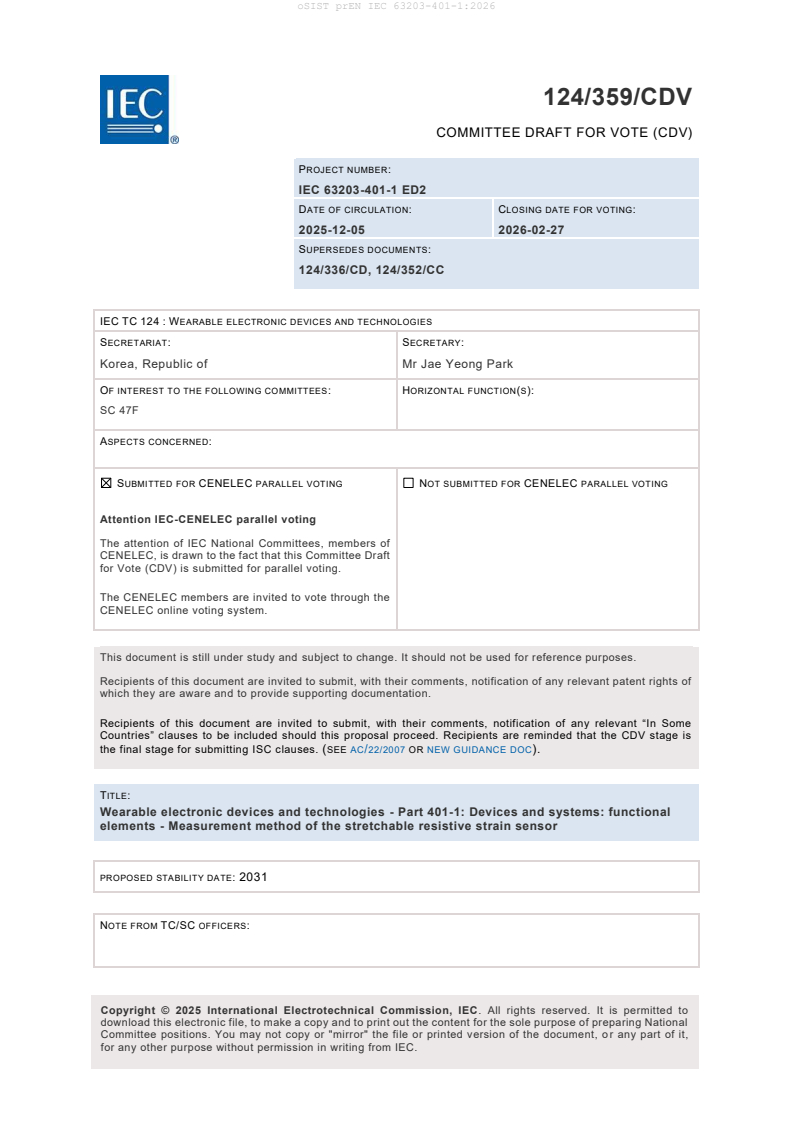
124/359/CDV
COMMITTEE DRAFT FOR VOTE (CDV)
PROJECT NUMBER:
IEC 63203-401-1 ED2
DATE OF CIRCULATION: CLOSING DATE FOR VOTING:
2025-12-05 2026-02-27
SUPERSEDES DOCUMENTS:
124/336/CD, 124/352/CC
IEC TC 124 : WEARABLE ELECTRONIC DEVICES AND TECHNOLOGIES
SECRETARIAT: SECRETARY:
Korea, Republic of Mr Jae Yeong Park
OF INTEREST TO THE FOLLOWING COMMITTEES: HORIZONTAL FUNCTION(S):
SC 47F
ASPECTS CONCERNED:
SUBMITTED FOR CENELEC PARALLEL VOTING NOT SUBMITTED FOR CENELEC PARALLEL VOTING
Attention IEC-CENELEC parallel voting
The attention of IEC National Committees, members of
CENELEC, is drawn to the fact that this Committee Draft
for Vote (CDV) is submitted for parallel voting.
The CENELEC members are invited to vote through the
CENELEC online voting system.
This document is still under study and subject to change. It should not be used for reference purposes.
Recipients of this document are invited to submit, with their comments, notification of any relevant patent rights of
which they are aware and to provide supporting documentation.
Recipients of this document are invited to submit, with their comments, notification of any relevant “In Some
Countries” clauses to be included should this proposal proceed. Recipients are reminded that the CDV stage is
the final stage for submitting ISC clauses. (SEE AC/22/2007 OR NEW GUIDANCE DOC).
TITLE:
Wearable electronic devices and technologies - Part 401-1: Devices and systems: functional
elements - Measurement method of the stretchable resistive strain sensor
PROPOSED STABILITY DATE: 2031
NOTE FROM TC/SC OFFICERS:
download this electronic file, to make a copy and to print out the content for the sole purpose of preparing National
Committee positions. You may not copy or "mirror" the file or printed version of the document, o r any part of it,
for any other purpose without permission in writing from IEC.
IEC CD 63203-401-1 ED2 © IEC 2025
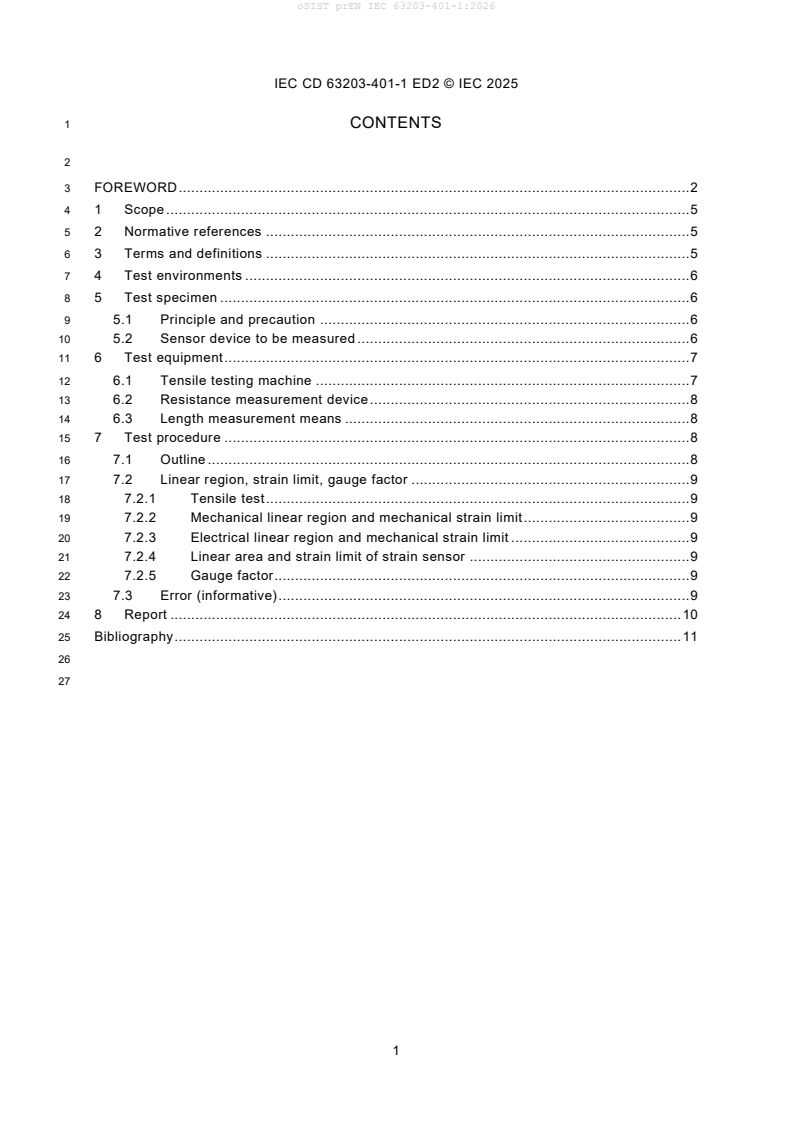
1 CONTENTS
3 FOREWORD . 2
4 1 Scope . 5
5 2 Normative references . 5
6 3 Terms and definitions . 5
7 4 Test environments . 6
8 5 Test specimen . 6
9 5.1 Principle and precaution . 6
10 5.2 Sensor device to be measured . 6
11 6 Test equipment . 7
12 6.1 Tensile testing machine . 7
13 6.2 Resistance measurement device . 8
14 6.3 Length measurement means . 8
15 7 Test procedure . 8
16 7.1 Outline . 8
17 7.2 Linear region, strain limit, gauge factor . 9
18 7.2.1 Tensile test . 9
19 7.2.2 Mechanical linear region and mechanical strain limit . 9
20 7.2.3 Electrical linear region and mechanical strain limit . 9
21 7.2.4 Linear area and strain limit of strain sensor . 9
22 7.2.5 Gauge factor . 9
23 7.3 Error (informative) . 9
24 8 Report . 10
25 Bibliography . 11
IEC CD 63203-401-1 ED2 © IEC 2025
28 INTERNATIONAL ELECTROTECHNICAL COMMISSION
29 ____________
31 WEARABLE ELECTRONIC DEVICES AND TECHNOLOGIES –
33 Part 401-1: Devices and systems: functional elements –
34 Measurement method of the stretchable resistive strain sensor
36 FOREWORD
37 1) The International Electrotechnical Commission (IEC) is a worldwide organization for standardization comprising
38 all national electrotechnical committees (IEC National Committees). The object of IEC is to promote international
39 co-operation on all questions concerning standardization in the electrical and electronic fields. To this end and
40 in addition to other activities, IEC publishes International Standards, Technical Specifications, Technical Reports,
41 Publicly Available Specifications (PAS) and Guides (hereafter referred to as “IEC Publication(s)”). Their
42 preparation is entrusted to technical committees; any IEC National Committee interested in the subject dealt with
43 may participate in this preparatory work. International, governmental and non-governmental organizations liaising
44 with the IEC also participate in this preparation. IEC collaborates closely with the International Organization for
45 Standardization (ISO) in accordance with conditions determined by agreement between the two organizations.
46 2) The formal decisions or agreements of IEC on technical matters express, as nearly as possible, an international
47 consensus of opinion on the relevant subjects since each technical committee has representation from all
48 interested IEC National Committees.
49 3) IEC Publications have the form of recommendations for international use and are accepted by IEC National
50 Committees in that sense. While all reasonable efforts are made to ensure that the technical content of IEC
51 Publications is accurate, IEC cannot be held responsible for the way in which they are used or for any
52 misinterpretation by any end user.
53 4) In order to promote international uniformity, IEC National Committees undertake to apply IEC Publications
54 transparently to the maximum extent possible in their national and regional publications. Any divergence between
55 any IEC Publication and the corresponding national or regional publication shall be clearly indicated in the latter.
56 5) IEC itself does not provide any attestation of conformity. Independent certification bodies provide conformity
57 assessment services and, in some areas, access to IEC marks of conformity. IEC is not responsible for any
58 services carried out by independent certification bodies.
59 6) All users should ensure that they have the latest edition of this publication.
60 7) No liability shall attach to IEC or its directors, employees, servants or agents including individual experts and
61 members of its technical committees and IEC National Committees for any personal injury, property damage or
62 other damage of any nature whatsoever, whether direct or indirect, or for costs (including legal fees) and
63 expenses arising out of the publication, use of, or reliance upon, this IEC Publication or any other IEC
64 Publications.
65 8) Attention is drawn to the Normative references cited in this publication. Use of the referenced publications is
66 indispensable for the correct application of this publication.
67 9) Attention is drawn to the possibility that some of the elements of this IEC Publication may be the subject of patent
68 rights. IEC shall not be held responsible for identifying any or all such patent rights.
69 IEC 63203-401-1 has been prepared by IEC technical committee 124: Wearable electronic
70 devices and technologies. It is an International Standard.
71 The text of this International Standard is based on the following documents:
Draft Report on voting
124/223/FDIS 124/239/RVD
73 Full information on the voting for its approval can be found in the report on voting indicated in
74 the above table.
75 The language used for the development of this International Standard is English.
IEC CD 63203-401-1 ED2 © IEC 2025
76 This document was drafted in accordance with ISO/IEC Directives, Part 2, and developed in
77 accordance with ISO/IEC Directives, Part 1 and ISO/IEC Directives, IEC Supplement, available
78 at www.iec.ch/members_experts/refdocs. The main document types developed by IEC are
79 described in greater detail at www.iec.ch/publications.
80 A list of all parts in the IEC 63203 series, published under the general title Wearable electronic
81 devices and technologies, can be found on the IEC website.
82 The committee has decided that the contents of this document will remain unchanged until the
83 stability date indicated on the IEC website under webstore.iec.ch in the data related to the
84 specific document. At this date, the document will be
85 • reconfirmed,
86 • withdrawn, or
87 • revised.
IMPORTANT – The "colour inside" logo on the cover page of this document indicates
that it contains colours which are considered to be useful for the correct understanding
of its contents. Users should therefore print this document using a colour printer.
IEC CD 63203-401-1 ED2 © IEC 2025
91 Introduction
92 Generally, strain sensors (strain gauges) utilize changes in the electrical resistance of a thin
93 copper-nickel alloy coating formed on a polymer film such as PET film. The strain sensor is
94 bonded to the object to be measured, and the strain in the strain sensor caused by the strain in
95 the object to be measured is detected as a change in resistance of the thin metal film.
96 As is obvious from the sensor’s material and structure, the object to be measured is mainly a
97 high elastic modulus member such as a metal material, the amount of strain detected is very
98 small, and the resistance change that is the output is also small. Therefore, it is common to
99 detect resistance changes as voltage changes using a Wheatstone bridge circuit, without
100 directly measuring resistance values. In the range where the relationship between strain change
101 and resistance value change is linear, the proportionality constant between the two is called
102 the gauge factor. Several existing standards are known for gauge factor measurement and are
103 listed in Bibliography.
104 On the other hand, the strain sensor covered by this standard utilizes the change in resistance
105 caused by the deformation of a conductive material in which conductive filler is dispersed in a
106 stretchable polymer material (such as an elastomer).
107 However, compared to the strain sensor using thin metal film described above, the target strain
108 range and resistance value change range are significantly different, so new testing methods for
109 this type of strain sensor are needed. ED1 of this standard was published with unresolved
110 technical issues such as the confusion between evaluation of sensor devices and evaluation of
111 sensor materials.
112 In ED2, the test method has been fundamentally reviewed and revised as a measurement
113 method for sensor devices.
IEC CD 63203-401-1 ED2 © IEC 2025
116 WEARABLE ELECTRONIC DEVICES AND TECHNOLOGIES –
118 Part 401-1: Devices and systems: functional elements –
119 Measurement method of the stretchable resistive strain
...