


EN IEC 62127-3:2023/prA1:2025
(Amendment)Ultrasonics - Hydrophones - Part 3: Properties of hydrophones for ultrasonic fields
Ultrasonics - Hydrophones - Part 3: Properties of hydrophones for ultrasonic fields
Ultraschall - Hydrophone - Teil 3: Eigenschaften von Hydrophonen zur Verwendung in Ultraschallfeldern
Ultrasons - Hydrophones - Partie 3: Propriétés des hydrophones pour les champs ultrasoniques
Ultrazvok - Hidrofoni - 3. del: Lastnosti hidrofonov za ultrazvočna polja - Dopolnilo A1
General Information
- Status
- Not Published
- Publication Date
- 09-Apr-2026
- Technical Committee
- CLC/SR 87 - CLC/SR 87
- Current Stage
- 4060 - Enquiry results established and sent to TC, SR, BTTF - Enquiry
- Start Date
- 22-Aug-2025
- Completion Date
- 22-Aug-2025
Relations
- Effective Date
- 09-Jul-2024
Overview
EN IEC 62127-3:2023/prA1:2025 - Amendment 1 to "Ultrasonics - Hydrophones - Part 3: Properties of hydrophones for ultrasonic fields" updates measurement and data-reporting requirements for hydrophones used in ultrasonic fields. Prepared by IEC TC 87, this amendment clarifies practical measurement procedures, refines reporting formats for sensitivity and frequency response, and improves consistency of effective hydrophone size data to support spatial averaging correction methods used in ultrasound metrology and biomedical ultrasound exposimetry.
Key Topics and Requirements
- Sensitivity reporting
- The calibration temperature to which the stated sensitivity relates must be given.
- Reporting the temperature dependence is now a recommendation (not mandatory) to reduce measurement burden where small temperature differences can be treated within uncertainty.
- Frequency dependence
- The modulus of end-of-cable sensitivity shall be stated as a list of values across the claimed frequency band. Graphical plots are optional in addition to the list.
- Phase may be provided as a list of values; a graphical representation may also be added.
- New example tables included (frequency response data for a 0.2 mm needle hydrophone from 0.1 MHz–40 MHz) illustrate recommended data presentation.
- Directional response and angular increment
- Angular sampling shall ensure variations ≤ 1 dB between adjacent points for frequencies up to 20 MHz. At higher frequencies, larger increments may be accepted for practicability.
- Effective hydrophone size and modeling
- The default theoretical model for deriving effective size remains the rigid baffle piston model, preserving a common data basis for spatial averaging correction methods.
- Alternative models may be used only with clear justification; notes explain elliptical effective areas (spot-poling effects) and rectangular membrane considerations.
- Rationale and bibliographic updates
- Amendment adds references and rationale supporting the changes, emphasizing usability and common data formats for spatial-averaging corrections.
Applications and Users
- Hydrophone manufacturers producing specification and calibration data
- Metrology and calibration laboratories performing ultrasonic field measurements
- Biomedical ultrasound researchers and regulatory testing labs doing exposimetry and acoustic output standards compliance
- Engineers performing spatial averaging corrections for ultrasonic transducer characterization and dosimetry
Practical benefits include improved data interoperability, reduced measurement burden for temperature dependence, and clearer guidance for measuring directional response, sensitivity, and frequency response - critical for accurate ultrasound field characterization.
Related Standards
- IEC 62127-2 - "Ultrasonics - Hydrophones - Part 2: Calibration for ultrasonic fields" (reference updated to remove the “up to 40 MHz” limitation)
- IEC 62127-1:2022 - referenced for spatial averaging correction methods and related guidance
Keywords: EN IEC 62127-3:2023/prA1:2025, hydrophones, ultrasonic fields, effective hydrophone size, directional response, sensitivity, frequency response, spatial averaging, ultrasound calibration, biomedical ultrasound.

Get Certified
Connect with accredited certification bodies for this standard

BSMI (Bureau of Standards, Metrology and Inspection)
Taiwan's standards and inspection authority.
Sponsored listings
Frequently Asked Questions
EN IEC 62127-3:2023/prA1:2025 is a draft published by CLC. Its full title is "Ultrasonics - Hydrophones - Part 3: Properties of hydrophones for ultrasonic fields". This standard covers: Ultrasonics - Hydrophones - Part 3: Properties of hydrophones for ultrasonic fields
Ultrasonics - Hydrophones - Part 3: Properties of hydrophones for ultrasonic fields
EN IEC 62127-3:2023/prA1:2025 is classified under the following ICS (International Classification for Standards) categories: 17.140.50 - Electroacoustics. The ICS classification helps identify the subject area and facilitates finding related standards.
EN IEC 62127-3:2023/prA1:2025 has the following relationships with other standards: It is inter standard links to EN IEC 62127-3:2023. Understanding these relationships helps ensure you are using the most current and applicable version of the standard.
EN IEC 62127-3:2023/prA1:2025 is available in PDF format for immediate download after purchase. The document can be added to your cart and obtained through the secure checkout process. Digital delivery ensures instant access to the complete standard document.
Standards Content (Sample)
SLOVENSKI STANDARD
01-julij-2025
Ultrazvok - Hidrofoni - 3. del: Lastnosti hidrofonov za ultrazvočna polja - Dopolnilo
A1
Amendment 1 - Ultrasonics - Hydrophones - Part 3: Properties of hydrophones for
ultrasonic fields
Ultraschall - Hydrophone - Teil 3: Eigenschaften von Hydrophonen zur Verwendung in
Ultraschallfeldern
Amendement 1 - Ultrasons - Hydrophones - Partie 3: Propriétés des hydrophones pour
les champs ultrasoniques
Ta slovenski standard je istoveten z: EN IEC 62127-3:2023/prA1:2025
ICS:
11.040.01 Medicinska oprema na Medical equipment in general
splošno
17.140.50 Elektroakustika Electroacoustics
2003-01.Slovenski inštitut za standardizacijo. Razmnoževanje celote ali delov tega standarda ni dovoljeno.
87/897/CDV
COMMITTEE DRAFT FOR VOTE (CDV)
PROJECT NUMBER:
IEC 62127-3/AMD1 ED2
DATE OF CIRCULATION: CLOSING DATE FOR VOTING:
2025-05-30 2025-08-22
SUPERSEDES DOCUMENTS:
87/880/CD, 87/888A/CC
IEC TC 87 : ULTRASONICS
SECRETARIAT: SECRETARY:
United Kingdom Mr Petar Luzajic
OF INTEREST TO THE FOLLOWING COMMITTEES: HORIZONTAL FUNCTION(S):
ASPECTS CONCERNED:
SUBMITTED FOR CENELEC PARALLEL VOTING NOT SUBMITTED FOR CENELEC PARALLEL VOTING
Attention IEC-CENELEC parallel voting
The attention of IEC National Committees, members of
CENELEC, is drawn to the fact that this Committee Draft
for Vote (CDV) is submitted for parallel voting.
The CENELEC members are invited to vote through the
CENELEC online voting system.
This document is still under study and subject to change. It should not be used for reference purposes.
Recipients of this document are invited to submit, with their comments, notification of any relevant patent rights of
which they are aware and to provide supporting documentation.
Recipients of this document are invited to submit, with their comments, notification of any relevant “In Some
Countries” clauses to be included should this proposal proceed. Recipients are reminded that the CDV stage is the
final stage for submitting ISC clauses. (SEE AC/22/2007 OR NEW GUIDANCE DOC).
TITLE:
Amendment 1 - Ultrasonics - Hydrophones - Part 3: Properties of hydrophones for ultrasonic
fields
PROPOSED STABILITY DATE: 2028
NOTE FROM TC/SC OFFICERS:
electronic file, to make a copy and to print out the content for the sole purpose of preparing National Committee positions.
You may not copy or "mirror" the file or printed version of the document, or any part of it, for any other purpose without
permission in writing from IEC.
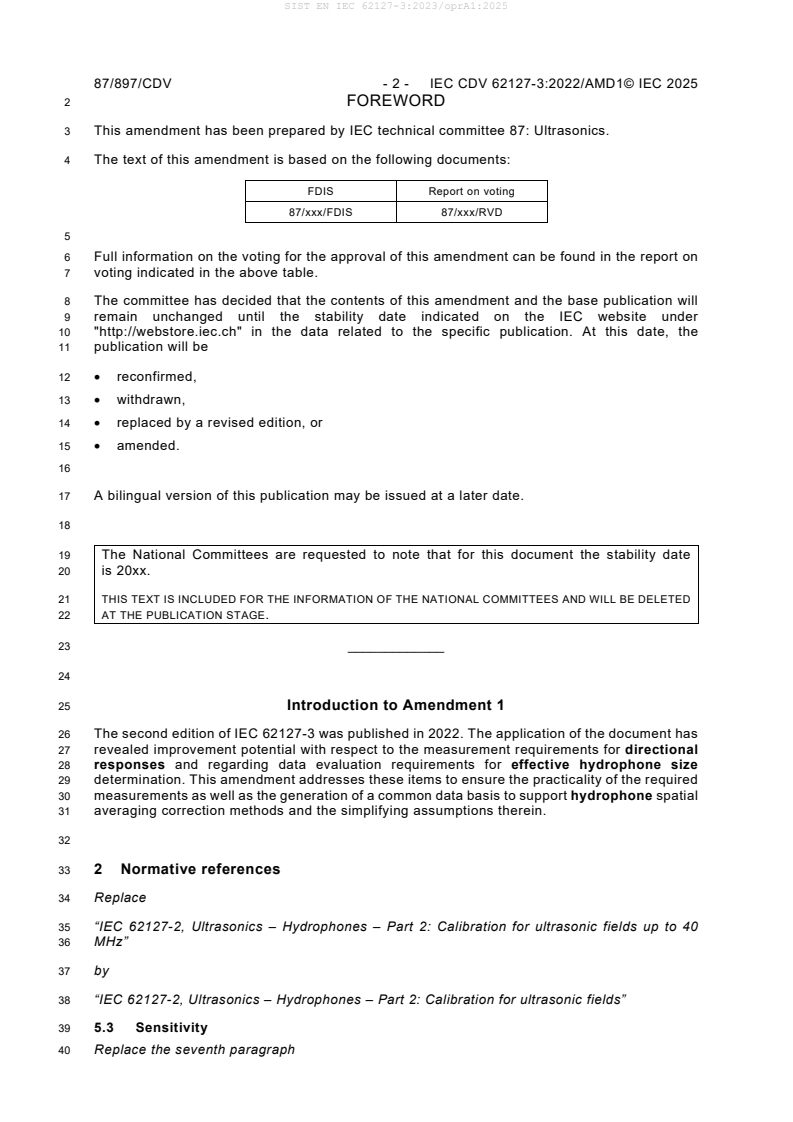
87/897/CDV - 2 - IEC CDV 62127-3:2022/AMD1© IEC 2025
2 FOREWORD
3 This amendment has been prepared by IEC technical committee 87: Ultrasonics.
4 The text of this amendment is based on the following documents:
FDIS Report on voting
87/xxx/FDIS 87/xxx/RVD
6 Full information on the voting for the approval of this amendment can be found in the report on
7 voting indicated in the above table.
8 The committee has decided that the contents of this amendment and the base publication will
9 remain unchanged until the stability date indicated on the IEC website under
10 "http://webstore.iec.ch" in the data related to the specific publication. At this date, the
11 publication will be
12 • reconfirmed,
13 • withdrawn,
14 • replaced by a revised edition, or
15 • amended.
17 A bilingual version of this publication may be issued at a later date.
19 The National Committees are requested to note that for this document the stability date
20 is 20xx.
21 THIS TEXT IS INCLUDED FOR THE INFORMATION OF THE NATIONAL COMMITTEES AND WILL BE DELETED
22 AT THE PUBLICATION STAGE.
23 _____________
25 Introduction to Amendment 1
26 The second edition of IEC 62127-3 was published in 2022. The application of the document has
27 revealed improvement potential with respect to the measurement requirements for directional
28 responses and regarding data evaluation requirements for effective hydrophone size
29 determination. This amendment addresses these items to ensure the practicality of the required
30 measurements as well as the generation of a common data basis to support hydrophone spatial
31 averaging correction methods and the simplifying assumptions therein.
33 2 Normative references
34 Replace
35 “IEC 62127-2, Ultrasonics – Hydrophones – Part 2: Calibration for ultrasonic fields up to 40
36 MHz”
37 by
38 “IEC 62127-2, Ultrasonics – Hydrophones – Part 2: Calibration for ultrasonic fields”
39 5.3 Sensitivity
40 Replace the seventh paragraph
IEC CDV 62127-3:2022/AMD1 © IEC 2025 - 3 - 87/897/CDV
41 “The temperature dependence of the sensitivity shall be given. The hydrophone sensitivity
42 shall be stated as a function of the water temperature, at least over the temperature range 19 °C
43 to 25 °C, or the particular water temperature to which the stated sensitivity relates shall be
44 stated together with the temperature coefficient of the sensitivity.”
45 by
46 “The particular water temperature to which the stated sensitivity relates shall be given. The
47 temperature dependence of the sensitivity should be described. The hydrophone sensitivity
48 should be stated as a function of the water temperature, at least over the temperature range
49 19 °C to 25 °C, or the particular water temperature to which the stated sensitivity relates should
50 be stated together with the temperature coefficient of the sensitivity.”
51 NOTE 2 The former requirement to state the temperature dependence has been modified to become a
52 recommendation for practical reasons. Though being of importance for some applications, the former general
53 requirement here posed disproportional measurement burden to conform with IEC 62127-3. As long as water
54 temperatures at calibration and measurement application differ by one or two degrees only, consideration of the
55 effect within an uncertainty component is reasonable [15,16,17].
57 Replace “NOTE 2” by “NOTE 3”.
58 Replace “NOTE 3” by “NOTE 4”.
60 5.4.2 Frequency dependence
61 Replace the first paragraph
62 “The modulus of the end-of-cable sensitivity or sensitivity level of the hydrophone or
63 hydrophone assembly as a function of frequency shall be stated either graphically or as a list
64 of values and over a frequency range containing at least the frequency band claimed under
65 5.4.1. If it is given as a list of values or as discrete points in a graph, the frequency distance
66 between adjacent points should be low enough so that all important details of the frequency
67 dependence are shown and the sensitivity level does not vary by more than ±1 dB between
68 adjacent points.”
69 by
70 “The modulus of the end-of-cable sensitivity or sensitivity level of the hydrophone or
71 hydrophone assembly as a function of frequency shall be stated as a list of values and over
72 a frequency range containing at least the frequency band claimed under 5.4.1. The frequency
73 distance between adjacent points should be low enough so that all important details of the
74 frequency dependence are shown and the sensitivity level does not vary by more than ±1 dB
75 between adjacent points. In addition to the list of values, a graphical representation of the data
76 may be provided.”
77 Replace the third paragraph
78 “The phase of the end-of-cable sensitivity may be given as a function of frequency either
79 graphically or as a list of values.”
80 by
81 "The phase of the end-of-cable sensitivity may be given as a function of frequency as a list of
82 values. In addition,
...
Questions, Comments and Discussion
Ask us and Technical Secretary will try to provide an answer. You can facilitate discussion about the standard in here.
Loading comments...