

EN 50591:2019
(Main)Railway Applications - Rolling Stock - Specification and verification of energy consumption
General Information
- Abstract
The purpose of this document is to support rolling stock procurement, especially life cycle cost (LCC) assessment. This document is applicable to the specification and verification of energy consumption of railway rolling stock. It establishes a criterion for the energy consumption of rolling stock to calculate the total net energy consumed, either at current collector or from the fuel tank, over a predefined service profile, to ensure that the results are directly comparable or representative of the real operation of the train. For this purpose, this document considers the energy consumed and regenerated by the rolling stock. The determination methods covered are the simulation and the measurement. This document provides the framework that gives guidance on the generation of comparable energy performance values for trains and locomotives on a common basis and thereby supports benchmarking and improvement of the energy efficiency of rail vehicles. This document does not cover the comparison of energy consumption with other modes of transportation, or even for comparison between diesel and electric traction, covering only the energy consumption of the railway rolling stock itself.
- Status
- Published
- Publication Date
- 01-Aug-2019
- Withdrawal Date
- 01-Aug-2022
- Technical Committee
- CLC/TC 9X - Electrical and electronic applications for railways
- Drafting Committee
- CLC/SC 9XB - Electromechanical material on board rolling stock
- Current Stage
- 9093 - Decision to confirm - Review Enquiry
- Start Date
- 27-Mar-2024
- Completion Date
- 25-Aug-2026



Overview
EN 50591:2019 (CLC) - Railway Applications - Rolling Stock - Specification and verification of energy consumption - is a European standard that defines how to specify, simulate and measure the energy consumption of railway rolling stock. Its primary purpose is to support rolling stock procurement and life cycle cost (LCC) assessment by creating directly comparable, representative energy performance values for trains and locomotives. The standard addresses both energy consumed and energy regenerated, and covers determination by simulation and by measurement.
Key topics and technical requirements
- Scope and objective: Framework for calculating total net energy consumed at the current collector or from the fuel tank over predefined service profiles; excludes cross-mode comparisons and diesel-vs-electric direct comparisons.
- Methods of determination: Two main approaches - simulation (model-based annual consumption estimates) and measurement (onboard/in-track tests).
- Traction and auxiliaries: Specification of operational conditions, train data, infrastructure and energy supply characteristics, timetable/driving style, measurement equipment, test rules and post-processing.
- HVAC energy quantification: Separate methods for HVAC (with and without climatic chamber) and rules for in-service and parking mode energy assessment.
- Standard parameters & service profiles: Normative annexes define standard parameters, service profiles (suburban, regional, intercity, high-speed, freight, metro) and HVAC operational hours to ensure comparability.
- Documentation & verification: Requirements for test documentation, environmental conditions, instrumentation and reporting to enable benchmarking and procurement use.
- Post-processing: Guidance on correcting and normalizing test results for conditions such as ambient environment, energy supply characteristics and driving style.
Applications and users
EN 50591 is practical for:
- Rolling stock manufacturers - to specify and validate energy performance during design and type testing.
- Railway operators and procurers - to compare offers, perform LCC assessments and set contractual energy targets.
- Infrastructure managers and energy analysts - to define operating conditions and energy supply characteristics for tests and simulations.
- Test laboratories and certification bodies - to implement measurement and reporting procedures.
- Consultants and R&D teams - for benchmarking energy efficiency and optimizing traction/auxiliary systems.
Practical benefits include improved comparability of tenders, better-informed procurement decisions, reliable LCC inputs, and support for energy-efficiency improvements and benchmarking programs.
Related standards
- EN 13129:2016 - Air conditioning for main line rolling stock (comfort parameters and type tests)
- EN 15663:2017+A1:2018 - (referenced in EN 50591 normative references)
Keywords: EN 50591, energy consumption, rolling stock, railway rolling stock, energy efficiency, LCC assessment, simulation, measurement, HVAC, traction, benchmarking.
Relations
- Replaces
CLC/TS 50591:2013 - Specification and verification of energy consumption for railway rolling stock - Effective Date
- 23-Jan-2023
- Effective Date
- 09-Feb-2026
- Effective Date
- 09-Feb-2026
- Effective Date
- 03-Feb-2026
- Effective Date
- 03-Feb-2026
- Effective Date
- 03-Feb-2026
- Effective Date
- 03-Feb-2026
- Effective Date
- 09-Feb-2026
Get Certified
Connect with accredited certification bodies for this standard

IRIS Certification (UNIFE)
International Railway Industry Standard certification.

TÜV SÜD Rail GmbH
TÜV SÜD railway certification services.

Bureau Veritas Railway Certification
Railway and transportation certification.
Sponsored listings
Frequently Asked Questions
EN 50591:2019 is a standard published by CLC. Its full title is "Railway Applications - Rolling Stock - Specification and verification of energy consumption". This standard covers: The purpose of this document is to support rolling stock procurement, especially life cycle cost (LCC) assessment. This document is applicable to the specification and verification of energy consumption of railway rolling stock. It establishes a criterion for the energy consumption of rolling stock to calculate the total net energy consumed, either at current collector or from the fuel tank, over a predefined service profile, to ensure that the results are directly comparable or representative of the real operation of the train. For this purpose, this document considers the energy consumed and regenerated by the rolling stock. The determination methods covered are the simulation and the measurement. This document provides the framework that gives guidance on the generation of comparable energy performance values for trains and locomotives on a common basis and thereby supports benchmarking and improvement of the energy efficiency of rail vehicles. This document does not cover the comparison of energy consumption with other modes of transportation, or even for comparison between diesel and electric traction, covering only the energy consumption of the railway rolling stock itself.
The purpose of this document is to support rolling stock procurement, especially life cycle cost (LCC) assessment. This document is applicable to the specification and verification of energy consumption of railway rolling stock. It establishes a criterion for the energy consumption of rolling stock to calculate the total net energy consumed, either at current collector or from the fuel tank, over a predefined service profile, to ensure that the results are directly comparable or representative of the real operation of the train. For this purpose, this document considers the energy consumed and regenerated by the rolling stock. The determination methods covered are the simulation and the measurement. This document provides the framework that gives guidance on the generation of comparable energy performance values for trains and locomotives on a common basis and thereby supports benchmarking and improvement of the energy efficiency of rail vehicles. This document does not cover the comparison of energy consumption with other modes of transportation, or even for comparison between diesel and electric traction, covering only the energy consumption of the railway rolling stock itself.
EN 50591:2019 is classified under the following ICS (International Classification for Standards) categories: 45.060.10 - Tractive stock. The ICS classification helps identify the subject area and facilitates finding related standards.
EN 50591:2019 has the following relationships with other standards: It is inter standard links to CLC/TS 50591:2013, EN 15663:2017+A1:2018, EN 13129:2016, EN 50163:2004, EN 50388:2012, EN 50463-1:2017, EN 50463-2:2017, EN 16247-4:2022. Understanding these relationships helps ensure you are using the most current and applicable version of the standard.
EN 50591:2019 is associated with the following European legislation: EU Directives/Regulations: 2008/57/EC, 2016/797/EU, 2016/797/EU, 2016/797/EU, 2016/797/EU, 2016/797/EU, 2016/797/EU, 2016/797/EU, 2016/797/EU, 2016/797/EU, 2016/797/EU, 2016/797/EU; Standardization Mandates: M/483. When a standard is cited in the Official Journal of the European Union, products manufactured in conformity with it benefit from a presumption of conformity with the essential requirements of the corresponding EU directive or regulation.
EN 50591:2019 is available in PDF format for immediate download after purchase. The document can be added to your cart and obtained through the secure checkout process. Digital delivery ensures instant access to the complete standard document.
Standards Content (Sample)
SLOVENSKI STANDARD
01-maj-2020
Nadomešča:
SIST-TS CLC/TS 50591:2014
Železniške naprave - Vozna sredstva - Specifikacija in preverjanje porabe energije
Specification and verification of energy consumption for railway rolling stock
Spezifikation und Überprüfung des Energieverbrauchs von Schienenfahrzeugen
Spécification et vérification de la consommation d’énergie pour le matériel roulant
ferroviaire
Ta slovenski standard je istoveten z: EN 50591:2019
ICS:
45.060.01 Železniška vozila na splošno Railway rolling stock in
general
2003-01.Slovenski inštitut za standardizacijo. Razmnoževanje celote ali delov tega standarda ni dovoljeno.
EUROPEAN STANDARD EN 50591
NORME EUROPÉENNE
EUROPÄISCHE NORM
August 2019
ICS 45.060.10 Supersedes CLC/TS 50591:2013
English Version
Railway Applications - Rolling Stock - Specification and
verification of energy consumption
Applications ferroviaires - Spécification et vérification de la Bahnanwendungen - Fahrzeuge - Spezifikation und
consommation d'énergie pour le matériel roulant ferroviaire Überprüfung des Energieverbrauchs
This European Standard was approved by CENELEC on 2018-12-14. CENELEC members are bound to comply with the CEN/CENELEC
Internal Regulations which stipulate the conditions for giving this European Standard the status of a national standard without any alteration.
Up-to-date lists and bibliographical references concerning such national standards may be obtained on application to the CEN-CENELEC
Management Centre or to any CENELEC member.
This European Standard exists in three official versions (English, French, German). A version in any other language made by translation
under the responsibility of a CENELEC member into its own language and notified to the CEN-CENELEC Management Centre has the
same status as the official versions.
CENELEC members are the national electrotechnical committees of Austria, Belgium, Bulgaria, Croatia, Cyprus, the Czech Republic,
Denmark, Estonia, Finland, France, Germany, Greece, Hungary, Iceland, Ireland, Italy, Latvia, Lithuania, Luxembourg, Malta, the
Netherlands, Norway, Poland, Portugal, Republic of North Macedonia, Romania, Serbia, Slovakia, Slovenia, Spain, Sweden, Switzerland,
Turkey and the United Kingdom.
European Committee for Electrotechnical Standardization
Comité Européen de Normalisation Electrotechnique
Europäisches Komitee für Elektrotechnische Normung
CEN-CENELEC Management Centre: Rue de la Science 23, B-1040 Brussels
© 2019 CENELEC All rights of exploitation in any form and by any means reserved worldwide for CENELEC Members.
Ref. No. EN 50591:2019 E
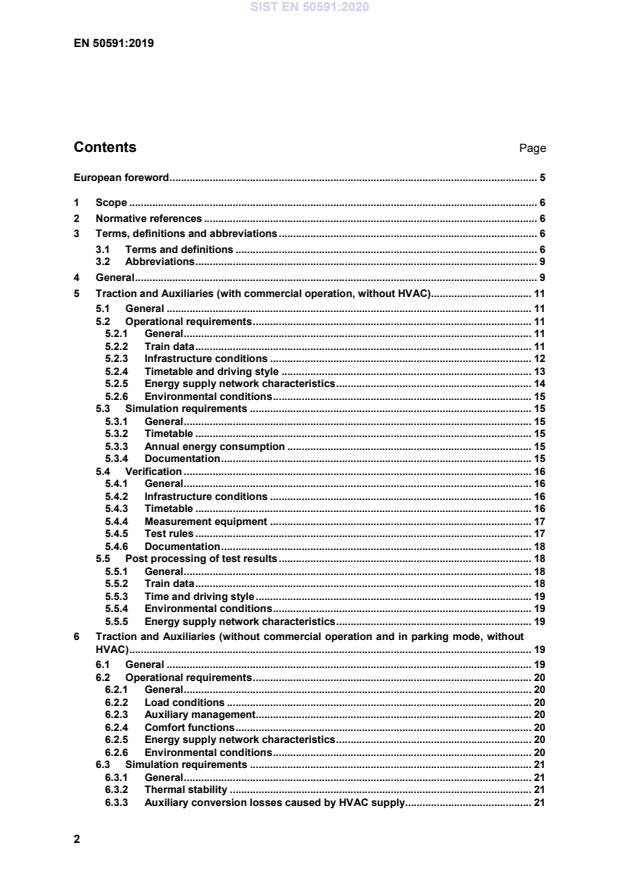
Contents Page
European foreword . 5
1 Scope . 6
2 Normative references . 6
3 Terms, definitions and abbreviations . 6
3.1 Terms and definitions . 6
3.2 Abbreviations . 9
4 General . 9
5 Traction and Auxiliaries (with commercial operation, without HVAC) . 11
5.1 General . 11
5.2 Operational requirements . 11
5.2.1 General . 11
5.2.2 Train data . 11
5.2.3 Infrastructure conditions . 12
5.2.4 Timetable and driving style . 13
5.2.5 Energy supply network characteristics . 14
5.2.6 Environmental conditions . 15
5.3 Simulation requirements . 15
5.3.1 General . 15
5.3.2 Timetable . 15
5.3.3 Annual energy consumption . 15
5.3.4 Documentation . 15
5.4 Verification . 16
5.4.1 General . 16
5.4.2 Infrastructure conditions . 16
5.4.3 Timetable . 16
5.4.4 Measurement equipment . 17
5.4.5 Test rules . 17
5.4.6 Documentation . 18
5.5 Post processing of test results . 18
5.5.1 General . 18
5.5.2 Train data . 18
5.5.3 Time and driving style . 19
5.5.4 Environmental conditions . 19
5.5.5 Energy supply network characteristics . 19
6 Traction and Auxiliaries (without commercial operation and in parking mode, without
HVAC) . 19
6.1 General . 19
6.2 Operational requirements . 20
6.2.1 General . 20
6.2.2 Load conditions . 20
6.2.3 Auxiliary management. 20
6.2.4 Comfort functions . 20
6.2.5 Energy supply network characteristics . 20
6.2.6 Environmental conditions . 20
6.3 Simulation requirements . 21
6.3.1 General . 21
6.3.2 Thermal stability . 21
6.3.3 Auxiliary conversion losses caused by HVAC supply. 21
6.3.4 Energy storage systems . 21
6.3.5 Annual energy consumption . 21
6.3.6 Documentation . 21
6.4 Verification . 21
6.4.1 General . 21
6.4.2 Comfort functions . 21
6.4.3 Test preparation . 22
6.4.4 Environmental conditions . 22
6.4.5 Measurement equipment . 22
6.4.6 Test duration . 22
6.4.7 Documentation . 22
6.5 Post-processing of test results . 22
7 HVAC . 22
7.1 General . 22
7.2 Methods . 23
7.2.1 General . 23
7.2.2 Method I [with climatic chamber / EN 13129:2016] . 23
7.2.3 Method II [without climatic chamber] . 23
7.3 Operational requirements . 23
7.3.1 In-service with commercial operation mode . 23
7.3.2 In-service without commercial operation mode . 25
7.3.3 Parking mode . 26
7.3.4 Total annual consumption . 26
7.4 Simulation requirements . 26
7.4.1 General . 26
7.4.2 Documentation . 27
7.5 Verification . 27
7.5.1 General . 27
7.5.2 Measurement equipment . 27
7.5.3 Test rules . 27
7.5.4 Documentation . 28
7.6 Post-processing . 28
Annex A (normative) Definition of standard parameters . 29
A.1 General . 29
A.2 Infrastructure characteristics . 29
A.3 Electric traction system characteristics . 30
A.4 In-service with commercial operation mode . 31
A.5 In-service without commercial operation mode and in parking mode . 32
A.6 Fuel characteristics . 33
Annex B (normative) Definition of standard values for service profiles . 34
B.1 General . 34
B.2 Suburban passenger traffic . 34
B.3 Regional passenger traffic . 35
B.4 Intercity passenger traffic. 37
B.5 High-speed passenger traffic . 38
B.6 Freight mainline . 40
B.7 Metro passenger traffic . 43
Annex C (normative) Operational Hours of HVAC . 45
Annex D (informative) Application Guide . 47
D.1 Objectives for use in procurement projects . 47
D.2 Application in Procurement Process .47
Annex ZZ (informative) Relationship between this European standard and the essential
requirements of EU Directive 2016/797/EU [2016 OJ L138] aimed to be covered .49
Bibliography . 52
European foreword
This document (EN 50591:2019) has been prepared by CLC/SC 9XB “Electrical, electronic and
electromechanical material on board rolling stock, including associated software” with contribution of
UNIFE-UIC TECREC 100_001.
The following dates are fixed:
(doa) 2019-11-02
— latest date by which the existence of this document
has to be announced at national level
(dop) 2020-02-02
— latest date by which this document has to be
implemented at national level by publication of an
identical national standard or by endorsement
(dow) 2022-08-02
— latest date by which the national standards
conflicting with this document have to be withdrawn
This document supersedes CLC/TS 50591:2013.
The main changes in this edition compared to CLC/TS 50591:2013 are the adoption of existing
CLC/TS 50591 enquiry comments, the harmonization with results from the European Lighthouse
Project Roll2Rail and the inclusion of an HVAC energy quantification method. Since separate methods
for traction and HVAC energy quantification are described, the document structure had to be revised.
Attention is drawn to the possibility that some of the elements of this document may be the subject of
patent rights. CENELEC shall not be held responsible for identifying any or all such patent rights.
This document has been prepared under a mandate given to CENELEC by the European Commission
and the European Free Trade Association, and supports essential requirements of EU Directive(s).
For the relationship with EU Directive(s) see informative Annex ZZ, which is an integral part of this
document.
1 Scope
The purpose of this document is to support rolling stock procurement, especially life cycle cost (LCC)
assessment.
This document is applicable to the specification and verification of energy consumption of railway
rolling stock. It establishes a criterion for the energy consumption of rolling stock to calculate the total
net energy consumed, either at current collector or from the fuel tank, over a predefined service
profile, to ensure that the results are directly comparable or representative of the real operation of the
train. For this purpose, this document considers the energy consumed and regenerated by the rolling
stock. The determination methods covered are the simulation and the measurement.
This document provides the framework that gives guidance on the generation of comparable energy
performance values for trains and locomotives on a common basis and thereby supports
benchmarking and improvement of the energy efficiency of rail vehicles.
This document does not cover the comparison of energy consumption with other modes of
transportation, or even for comparison between diesel and electric traction, covering only the energy
consumption of the railway rolling stock itself.
2 Normative references
The following documents are referred to in the text in such a way that some or all of their content
constitutes requirements of this document. For dated references, only the edition cited applies. For
undated references, the latest edition of the referenced document (including any amendments)
applies.
EN 13129:2016, Railway applications – Air conditioning for main line rolling stock – Comfort
parameters and type tests
EN 15663:2017+A1:2018, Railway applications – Vehicle reference masses
EN 50163:2004, Railway applications – Supply voltages of traction systems
EN 50388:2012, Railway Applications – Power supply and rolling stock – Technical criteria for the
coordination between power supply (substation) and rolling stock to achieve interoperability
EN 50463-1:2017, Railway applications – Energy measurement on board trains – Part 1: General
EN 50463-2:2017, Railway applications – Energy measurement on board trains – Part 2: Energy
measuring
UIC leaflet 552, Electrical power supply for trains – Standard technical characteristics of the train line
(10th edition, June 2005)
3 Terms, definitions and abbreviations
3.1 Terms and definitions
For the purposes of this document, the following terms and definitions apply.
ISO and IEC maintain terminological databases for use in standardization at the following addresses:
• IEC Electropedia: available at http://www.electropedia.org/
• ISO Online browsing platform: available at http://www.iso.org/obp
NOTE When possible, the following definitions have been taken from the relevant chapters of the
International Electrotechnical Vocabulary (IEV), IEC 60050. In such cases, the appropriate IEV reference is given.
Certain new definitions or modifications of IEV definitions have been added in this standard in order to facilitate
understanding. Expression of the performance of electrical and electronic measuring equipment has been taken
from EN 60359:2002.
3.1.1
comfort systems
all equipment consuming energy for passenger and crew comfort belonging neither to the traction
equipment nor to traction auxiliaries, mainly for the provision of a comfortable environment (for
example lighting, heating, air conditioning, toilets, information and entertainment systems, laptop
supplies)
Note 1 to entry: Comfort systems are split in two groups for use in this standard: Heating, Ventilation and Air
Conditioning (HVAC) and Other comfort functions.
3.1.2
consist
single vehicle or a group of vehicles which are not separated during normal operation
Note 1 to entry: A consist can contain no, one or several consist networks.
[SOURCE: IEC 60050-811:2017, 811-37-20]
3.1.3
contact line
conductor system for supplying electric energy to vehicles through current-collecting equipment
[SOURCE: IEC 60050-811:2017, 811-33-01, modified – the Note 1 to entry has been omitted.]
3.1.4
electric traction system
railway electric distribution network (infrastructure) used to provide energy for rolling stock
[SOURCE: IEC 60050-811:2017, 811-36-21, modified – “(infrastructure)” has been added and the
Note 1 to entry has been omitted.]
3.1.5
energy storage system
ESS
physical system which is comprised of energy storage technologies such as batteries, double-layer
capacitors, flywheel, etc. and other equipment to connect the storage technologies to traction
equipment, including control, cooling and monitoring systems
3.1.6
heating, ventilation and air conditioning
HVAC
system to provide heating, ventilation and air conditioning for comfort
3.1.7
infrastructure
fixed installations of the railway system (for example tracks, power supply, signalling, communication)
3.1.8
net energy
difference between the energy taken (consumed) from the contact line, fuel tank by the traction unit,
and the energy fed back (regenerated) into the contact line by the traction unit
3.1.9
primary power source
subsystem in a hybrid system the primary purpose of which is to supply energy to other subsystems in
the hybrid system by either consuming the fuel stored on-board or taking in energy from external
source
3.1.10
regenerative braking
braking in which the energy produced by the motors is fed into the line or used by on-board devices
[SOURCE: IEC 60050-811:2017, 811-06-25, modified – “electro-dynamic” and “contact” have been
removed, “into energy storage” has been replaced with “or used by”, and the Note 1 to entry has been
omitted.]
3.1.11
rolling stock
all vehicles with or without motors
Note 1 to entry: Examples of vehicles include a locomotive, a coach and a wagon.
[SOURCE: IEC 60050-811:2017, 811-02-01]
3.1.12
service profile
outline of the expected range and variation in the mission with respect to parameters such as time,
loading, speed, distance, stops, tunnels, etc., in the commercial exploitation of the train
3.1.13
single-train run
run of one train over a part of the infrastructure, without inclusion of effects of other trains
3.1.14
state of energy
SoE
remaining energy to be discharged, normally expressed as a percentage of full energy
[SOURCE: EN 62864-1:2016, 3.1.14, modified – the end of the definition “as expressed in relevant
standards” has been removed and the Note 1 to entry has been omitted.]
3.1.15
traction auxiliaries
equipment needed to operate the traction equipment and the train in normal operation mode, but not
producing tractive or dynamic braking efforts themselves (for example cooling fans, oil and water
pumps, compressor, air supply for brakes, HVAC for the leading driver’s cabin, train control and
management system and signalling equipment)
3.1.16
traction equipment
equipment on-board of the train directly needed to produce tractive or dynamic braking effort (for
example transformers, converters, motors, gearboxes, internal combustion engines, fuel cells, energy
storage systems)
3.1.17
traction unit
locomotive, motor coach or train-unit
[SOURCE: IEC 60050-811:2017, 811-02-04]
3.1.18
train
combination of rolling stock coupled together
[SOURCE: IEC 60050-811:2017, 811-01-08, modified – the Note 1 to entry has been omitted.]
3.1.19
user-defined service profile
service profile which is defined by the user for the comparison of the energy consumption of trains
Note 1 to entry: It is also intended for the comparison of simulations and real tests of the energy consumption of
trains on an existing infrastructure.
3.2 Abbreviations
For the purposes of this document, the following abbreviations apply.
AC Alternating Current
DC Direct Current
ESS Energy Storage System
HVAC Heating, Ventilation and Air Conditioning System
LCC Life Cycle Cost
SoE State of Energy
UIC Union Internationale des Chemins de Fer
4 General
Energy is an integral quantity. This means that the cumulated energy is the decisive factor. Realistic
train operation always takes place under the constraints of infrastructure and operational
requirements.
The following train modes are used in this standard:
— In-service with commercial operation mode:
This mode covers the normal operation of a train, including several passenger load cases or a
locomotive hauling a consist of freight wagons. The train is moving or is stationary and the HVAC
system is running in its normal operation mode.
— In-service without commercial operation mode:
In this mode a passenger train is stationary, the HVAC system is in operation as for commercial
operation but without passengers in the train. This situation occurs frequently, for example when
the train is waiting between two commercial runs.
— Parking mode:
A train is in parking mode when it is stationary in depots, with the power supply active, without
staff or passengers being on board. Usually, the HVAC system runs with reduced settings for
temperature and airflow.
Other train modes such as empty carriage stock movements are not considered in this standard as
they do not contribute significantly to the annual energy consumption.
In this standard the preconditioning (pre-heating or pre-cooling) and cleaning are not considered
separately. The corresponding hours shall be counted in the in-service without commercial operation
mode.
The train is switched OFF for remaining time of each day, therefore without any energy consumption.
To keep different characteristics, requirements and procedures manageable, the energy consumption
of the whole train is subdivided into the following three different energy categories, which are handled
separately:
1) Traction and Auxiliaries (in-service with commercial operation mode, without HVAC);
2) Traction and Auxiliaries (in-service without commercial operation mode and in parking mode,
without HVAC);
3) HVAC.
This document incorporates infrastructure and operational conditions into “service profiles” for the
train. The service profile for traction and auxiliaries is assessed via train runs along a line for in service
with commercial operation and stationary at the depot for in service without commercial operation.
HVAC is assessed via an operational point matrix for different operational modes.
The energy consumption over such service profiles shall be used as an input when assessing LCC.
This requires a well-defined and harmonized methodology for specification and verification of the
energy consumption. The selected approach has two steps:
a) simulation of the energy consumption of the train for the three energy categories mentioned
above;
b) verification of the simulation by undertaking measurements.
It is important to note that two different types of service profiles for traction and auxiliaries may be
chosen:
4) user-defined service profiles based on data from a real railway line, normally one or several lines
of the railway network where the train will be operated;
5) standard service profiles, for the following categories:
— suburban (passenger service);
— regional (passenger service);
— intercity (passenger service);
— high speed (passenger service);
— freight mainline service;
— metro (passenger service).
Definitions of relevant parameters for the user-defined (1) and standard (2) service profiles are set out
in Annex A. Annex B describes the standard profiles. The standard service profiles are characterized
by definitions of standard values for the identified service types being typical (that is representative) –
yet not real – of the type of railway service.
This means that it may not be possible to validate these on a real world track unless some
adjustments of the verification results are undertaken to take into account the differences between the
simulation and verification. However, these standard service profiles are intended to be a common
basis against which different trains can be simulated and simulation results compared.
For the assessment of HVAC energy consumption, standard weighting factors for the operational
points are set out in Annex C.
5 Traction and Auxiliaries (with commercial operation, without HVAC)
5.1 General
This clause is focused on traction energy in-service mode on a single train run for a train travelling
from origin to destination location including standstill times on the way using the representative driving
cycles. It includes energy related to traction auxiliaries (control, cooling and leading driver’s cab HVAC
which is necessary for safe train driving) and other in commercial operation usually activated on-board
systems in normal operating mode.
It excludes energy related to HVAC for the passenger saloon and for the inactive driver’s cab, auxiliary
equipment rarely used is also expressly omitted (for example windscreen wiper, sanding, defrosters).
For the traction and auxiliary energy in service, the defined timetable for the operation over a specified
line plays an important role. This document is therefore not a direct specification of detailed driving
styles, instead it provides a framework which allows freedom for the user to propose sound solutions
integrating a given mix of energy efficient technologies and driving styles.
5.2 Operational requirements
5.2.1 General
The information in this subclause is applicable for both simulation and verification of energy
consumption. The definitions of relevant parameters are given in Annex A. Each parameter is
identified by a letter followed by two digits.
5.2.2 Train data
5.2.2.1 Train and traction equipment
The analysis of energy consumption shall include the train and its mechanical losses, the traction
chain (electric, diesel-electric or diesel-mechanic) and all auxiliaries which are essential to operate the
traction chain including control circuits for traction and signalling.
5.2.2.2 Load conditions
EN 15663:2017+A1:2018 shall be read in conjunction with this subclause.
The gross mass, and therefore the load, of a train has a significant influence on its energy
consumption. The mass of the train shall be specified as set out in this clause based on the train
category:
a) Passenger trains:
The train mass (ID S05) is based upon design mass in working order plus the mass of 50 % of
seated passengers set out in EN 15663:2017+A1:2018.
b) Freight trains:
The train mass consists of the locomotive mass which is based upon the design mass in working
order plus a trailing consist, which shall be homogeneous, i.e. shall consist of only one wagon or
coach type. The following values shall be specified for the trailing consist as a load:
1) total mass of the trailing consist [t] (ID S06);
2) rotating masses in terms of equivalent mass [t] (ID S07);
3) length of the trailing consist [m] (ID S08);
4) running resistance [kN] of the trailing consist versus speed [km/h] over the whole speed
range (ID S09).
The parameters used to characterize load conditions are set out in Table A.4.
5.2.3 Infrastructure conditions
5.2.3.1 Longitudinal profile
The longitudinal profile shall be defined by the following parameters:
1) total distance of selected route or reference track from selected origin location to selected
destination location [km] (ID I01);
2) height [m], as an absolute value (above sea level) (ID I02);
3) gradient [‰], as difference in height divided by difference of distance in longitudinal direction (ID
I03).
ID I02 and ID I03 are correlated. It shall be checked and documented that the integral of gradients
along the track results in the correct difference of height between origin and destination location.
The parameters used to characterize the longitudinal profile are set out in Table A.2.
5.2.3.2 Maximum speed profile
The maximum speed profile [km/h] shall be defined by the following parameters: maximum speed
profile at every location along the selected route or reference track (ID I04).
The speed profile shall include the following criteria:
1) maximum speed for which the line, relevant to the profile, is planned;
2) permanent speed reductions due to curves, defined by the required capabilities of the specified
train:
For example, tilting trains may have a higher permitted speed in some sections along the route
than other trains;
3) non-permanent speed reductions due to signalling, defined by conditions during verification runs
or service operation of the train:
For example, speed restrictions imposed by the changeover between two tracks shall already be
included in the speed profile;
4) rules for safe operation:
For example, if the operation rules require the target speed to be reached 100 m before a
permanent speed restriction, this shall be included in the profile.
The parameters used to characterize speed profile are set out in Table A.2.
5.2.3.3 Curves
The curves shall be defined by the following parameters: location and radius of each curve along the
selected route or reference track [m] (ID I05). Transitions can be simplified as step-functions.
The parameters used to characterize curves are set out in Table A.2.
5.2.3.4 Tunnels
The tunnels shall be defined by the following parameters:
— location and length [m] of each tunnel along the selected route or reference track (ID I06);
— location and cross sectional area [m ] of each tunnel along the selected route or reference track
(ID I07).
Short tunnels with a length of less than 20 m and road bridges over the railway are negligible.
The parameters used to characterize tunnels are set out in Table A.2.
In addition, the tunnel surface and ventilation shafts or cross vents may have a significant impact on
tunnel drag and thus energy consumption in case of long tunnels, these data should be provided as
well.
5.2.4 Timetable and driving style
5.2.4.1 Timetable
A single-train run shall be specified. The sensitivity of energy consumption versus travelling time is
high. Therefore, the requirements on precision of the timetable are high as well.
The timetable shall be defined by the following parameters:
— Timing points:
the number and exact location of all planned stops (origin location, destination location and
intermediate stops) and passing points (if applicable) (ID S01).
— Standstill times on the route:
the time duration elapsed for stopping at scheduled stops (wheels not in motion), during the run
over the specified profile (ID S02).
— Standstill time shall be given for each planned intermediate stop. Otherwise the timing point
is considered to be a passing point (without stop).
— Standstill times at the origin location or destination location of the train run shall be given only
if they are considered as part of the train run.
— Departure, arrival and passing times:
Required timings for departures (time at which the wheels begin to roll), arrivals (time at which the
wheels stop) and passing (time at which the rear of the train has passed the point) along the train
run (ID S03).
— All these times shall be given as total time elapsed since departure from the origin location,
that is duration including all running and standstill times between origin and the respective
timing point.
— It is required to specify the arrival time at the last stop, that is the journey duration as total
time elapsed (from wheels rolling at origin location to wheels stopped at destination location).
— It is not mandatory to define the arrival and departure time for each intermediate stop. An
optimization of the train run over more than one stop-to-stop section is possible in such
cases.
— For passing points (optional) an earliest passing time, or a latest passing time, or both, in
order to avoid conflicts with other trains, may be defined. If an earliest passing time as well as
a latest passing time are specified, they shall have a minimum difference of 30 s.
— Minimum speed (optional). Minimum cruising speed over a particular section between two
locations (for operational constraints, in order to guarantee the capacity of the line) (ID S04).
All times shall be specified in (hh:mm:ss) format.
The parameters used to characterize the timetable are set out in Table A.4.
5.2.4.2 Driving style
The driving style is not specified by this standard, even though it may have significant effect on the
energy consumption. The driving style (that is acceleration or deceleration at each point of the trip)
should be chosen as a way to minimize the energy consumption of the operating train while respecting
the following conditions:
— safe operation of the train, under the rules applicable for the expected operation of the train. If any
such rules exist, they shall be specified together with the infrastructure and timetable information;
— specified timetable (5.2.4.1) shall be followed. Normal (or extra) reserves in the timetable, with
respect to the performance of the train operation should be used for energy efficient driving.
5.2.5 Energy supply network characteristics
5.2.5.1 Electric traction system
For electric trains, the following electric traction system parameters shall be specified:
— nominal voltage (ID E01) and nominal frequency for AC (ID E02), as set out in EN 50163:2004;
— maximum train current (ID E03), as defined by EN 50388:2012, Clause 7 and default values set
out in EN 50388:2012, Annex F;
— position and length of neutral sections (if applicable) along the selected route or reference track,
which require the traction power to be removed (ID E04).
The parameters used to characterize the electric traction system are set out in Table A.3.
5.2.5.2 Other traction systems
For trains using internal combustion engines, fuel cells or other primary power sources, the
characteristics of the fuel shall define at least the lower heating value (LHV) of the fuel (ID F01, A.6).
5.2.5.3 Regenerative braking
Regenerative braking is the capability to generate energy during braking through the traction chain.
The regenerated energy can be used by auxiliaries, comfort systems, stored in ESS or fed back to the
electric traction system. The use of regenerative braking shall respect the operational rules.
AC supply lines are usually able to accept the regenerative braking power, but DC supply lines can
have a limited power acceptance when no other train requires the power nearby.
The regenerative braking effort can also be used to supply in-service comfort functions, depending on
the power needed. This capability is always present, regardless of the supply system, and avoids
consuming energy from the main supply during periods of braking.
In cases where the electric traction equipment allows for regenerative braking, the consumed and fed
back energy at the current collector shall be identified separately for both AC and DC electric traction
systems.
a) for AC single phase electric traction systems: net energy at current collector, that is fed back
energy counted as negative without any other reduction factor than the one that may be imposed
by the traction chain itself (for example a part of the braking energy may be systematically
consumed in dissipating loads even in regenerative mode);
b) for DC electric traction systems, two calculations shall be made:
1) fully regenerative in the same conditions as for AC electric traction systems;
2) fully dissipative with the total braking energy consumed or dissipated in the vehicle without
any consideration of fed back energy.
The effect of any on-board energy recovery systems, (for example the amount of braking energy
stored in batteries or other devices for later use by traction or auxiliary systems) shall be identified.
Any on-board energy storage system should have the same energy content before and after the
simulation or the test. If this is not possible, the difference in stored energy shall be given. In this case
it shall be defined, how the energy storage system is charged and which efficiency is to be considered.
It may depend on the individual project or economic rules in different countries how consumed and fed
back energy is included in the life cycle cost (LCC) considerations.
5.2.6 Environmental conditions
The following parameters are defined for environmental conditions unless specified otherwise. The
nominal values shall be taken for simulation.
— external temperature [°C]: 15 °C ± 5 °C;
— humidity [relative humidity %]: 50 % ± 40 %;
2 2 2
— sunlight [W/m ]: 200 W/m ± 200 W/m ;
— average wind [m/s]: 1 m/s ± 1 m/s, head wind shall be assumed for simulation;
— environmental conditions: dry rails with good adhesion conditions;
— ambient air pressure [hPa]: international standard atmosphere 1 013 hPa.
It is recommended to start the train in a thermally stable condition for the simulation and verification
runs, as starting with a train at a different temperature would affect the results (traction chain losses,
auxiliary power).
5.3 Simulation requirements
5.3.1 General
Energy simulation of the train, its traction auxiliaries and comfort functions without HVAC over the
defined service profile shall be done based on conditions set out in 5.2.
5.3.2 Timetable
The precision for the journey time shall be ± 1 s.
The difference between the specified times for standstill, departure, arrival and passing (as set out in
5.2.4.1) and the respective simulation results shall be within the defined precision, without extra effort.
The timetable shall be given for both directions.
5.3.3 Annual energy consumption
If an annual energy consumption calculation over the service profile runs is requested, the annual
running distance in km for each profile shall be specified (ID S10) as set out in T
...